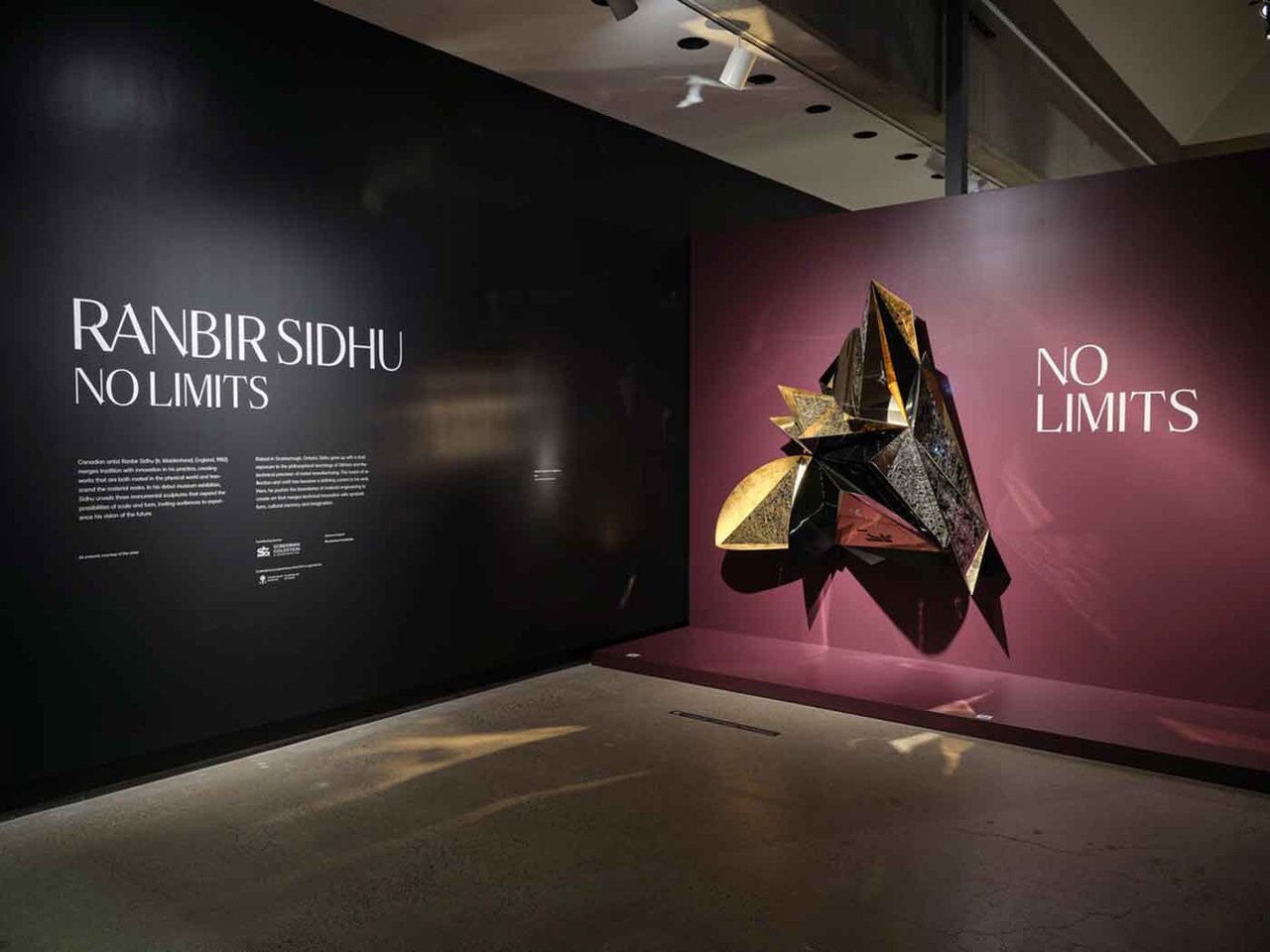
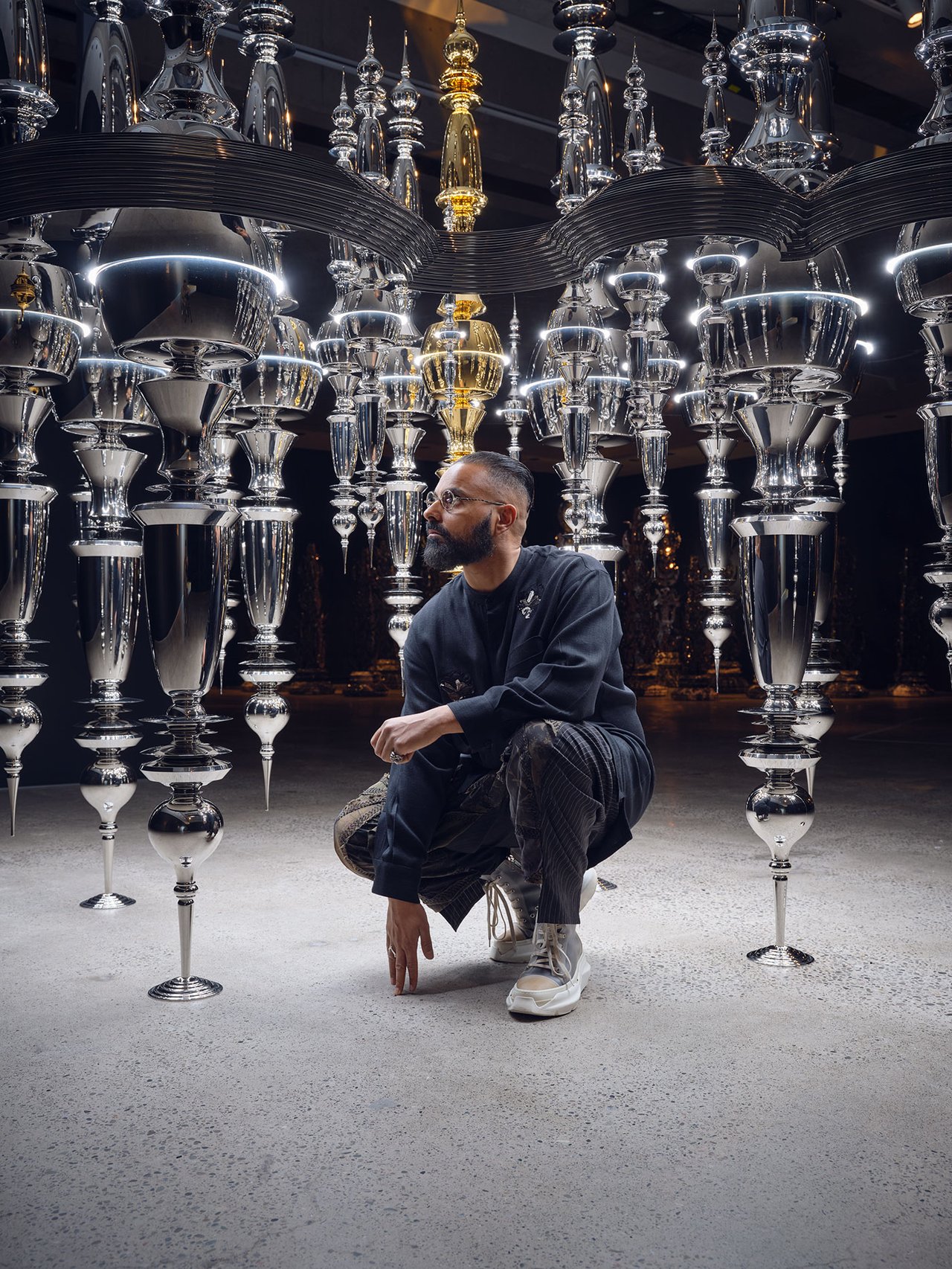
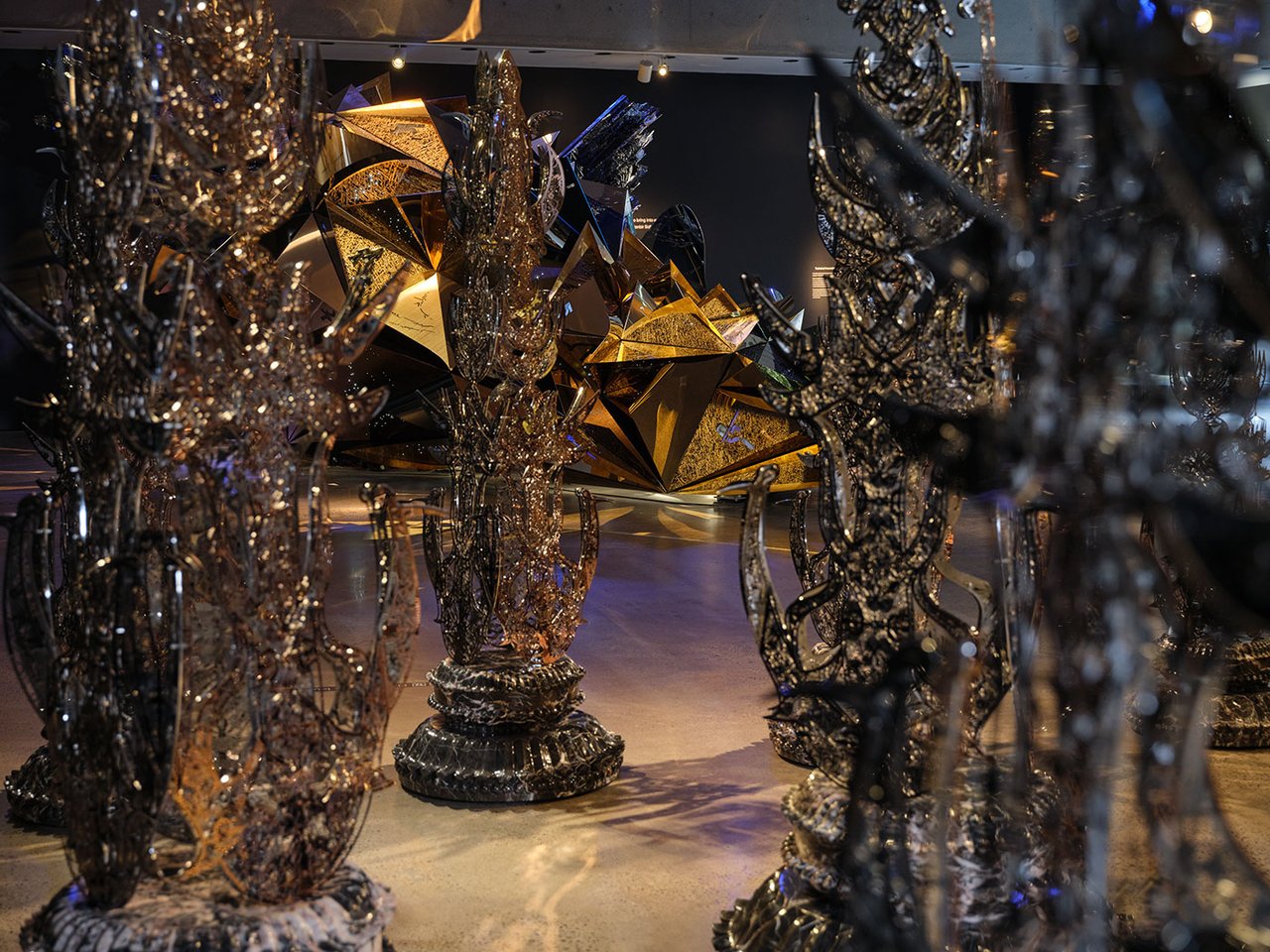
“Ranbir Sidhu: No Limits” is at Art Gallery of Ontario (AGO), Toronto, until January 3, 2027
Ranbir Sidhu’s work moves across sculpture, architecture, and conceptual inquiry. The term “South Asian futurism” serves as a provisional entry point into the worlds his practice constructs, though it remains a term that gestures toward the work without fully containing it. That multiplicity is shaped, in part, by his background. Sidhu was born in Maidenhead, England, and grew up in a manufacturing environment in a Sikh family in Canada.
Sidhu’s work and story is created from that liminal space that many first-generation children exist in, forged in the environments that their parents emigrated to, but still tethered to memories of a homeland; its customs, its culture, and history. In “No Limits”, Sidhu moves fluidly between sculpture, architecture, and conceptual inquiry, foregrounding his monumental and hybridized metal structures, both physical and ideological, that contextualize his beliefs around collective and personal memory.
Futurism, as it is regularly encountered, has largely been shaped through the lens of white men and, more recently, through Afrofuturist thought. Sidhu's work opens out the question of who has the right to decide what the future of humanity looks like, extending this inquiry into a South Asian register.
In his practice, the future is not a distant endpoint but a collapsing of time, where ancient knowledge, speculative technologies, myth, space travel, and memory exist all at once.
His work echoes the thinking of the theorist June Jordan, particularly in its attention to space as a lived and contested terrain. Drawing on his upbringing, Sidhu reclaims the materials and logics of industrial labor, transforming them into sculptural forms that inhabit the museum. This gesture is both intimate and systemic, a meditation on lineage, on the translation of labor into art, and on the often unseen continuity between craftsmanship and so called fine art.
The exhibition’s title draws from the ambition of Sidhu’s grandmother, a respected village leader, grounding the work in a deeply personal register. In “No Limits”, Sidhu engages with themes of cultural inheritance, resilience, and spirituality, fused with his forays into material experimentation. He sees time as fluid and memory as a foundational element in how we build.
Seen in the context of cultural ecologies across physical and spiritual borders, Sidhu’s practice treats the digital not as a separate category, but as an embedded condition; one that shapes the systems, logics, and temporalities through which contemporary work comes into being.
The artist spoke to Emann Odufu about time, transmission, and about how he makes use of the digital within his sculptural practice.
Emann Odufu: You have described your sculptures as “future relics”. What distinguishes a relic of the future from a monument of the present?
Ranbir Sidhu: Yes, I have this idea of future relics. That phrase feels closest to what I’m trying to make. I’m not interested in making something futuristic in a literal or stylized sense, but something that feels as though it has already survived time, as if it has been excavated from another moment.
A monument often fixes meaning. A future relic stays more open, more transient.
EO: What you say very much aligns with the idea of Sankofa, espoused in the study of Afrofuturism, of looking backwards to understand the present and future. There's an element of resilience and the survival of time embedded in that.
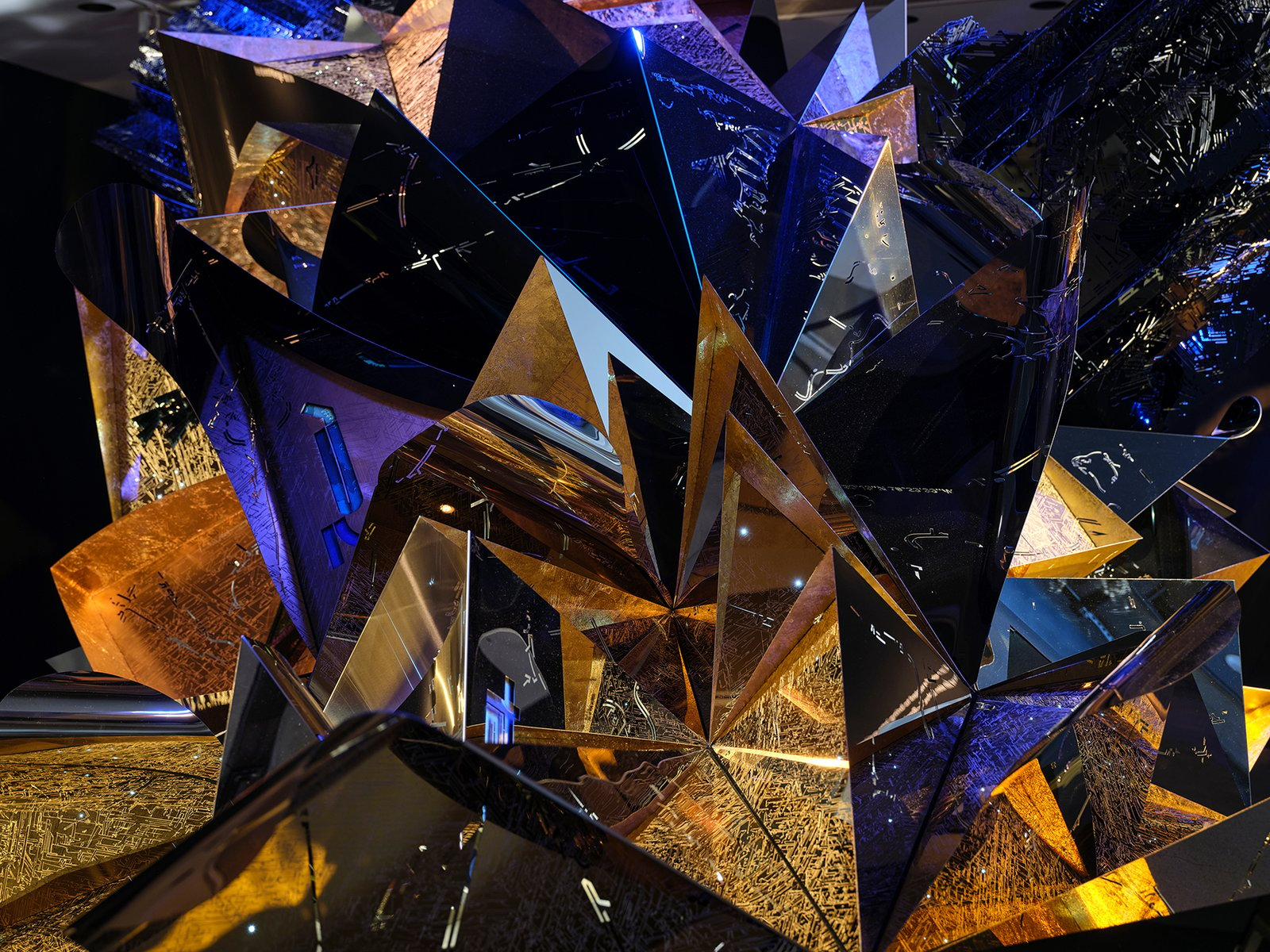
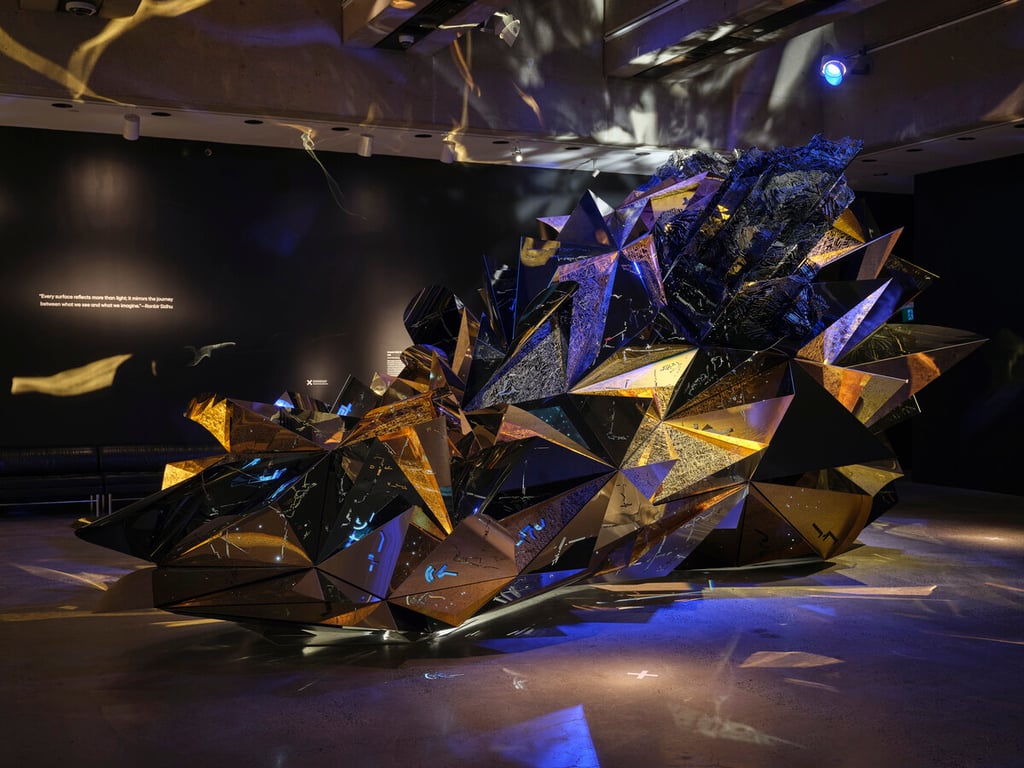
RS: People often connect my work to ideas of the future on their own, and I understand that. But for me it begins less with “the future” as a concept and more with time, continuity, and transformation. I’m interested in how memory, history, faith, architecture, and inherited forms move through time and become something else. Not nostalgia, and not a clean break from the past either. More like transmission. There is a condition of porosity. The best way to understand this is seen through my work Fortress of Memory (2025).
EO:This approach reminds me of another South Asian artist, Suchitra Mattai, who, like my family, is from Guyana. Specifically, how you both use memories personal or collective that become the building blocks for your sculptures; where architecture and space exist as the holder of these memories. You titled the exhibition “No Limits”, and the scale of these works feels unapologetically ambitious. Was building at this magnitude important to you beyond the technical challenge?
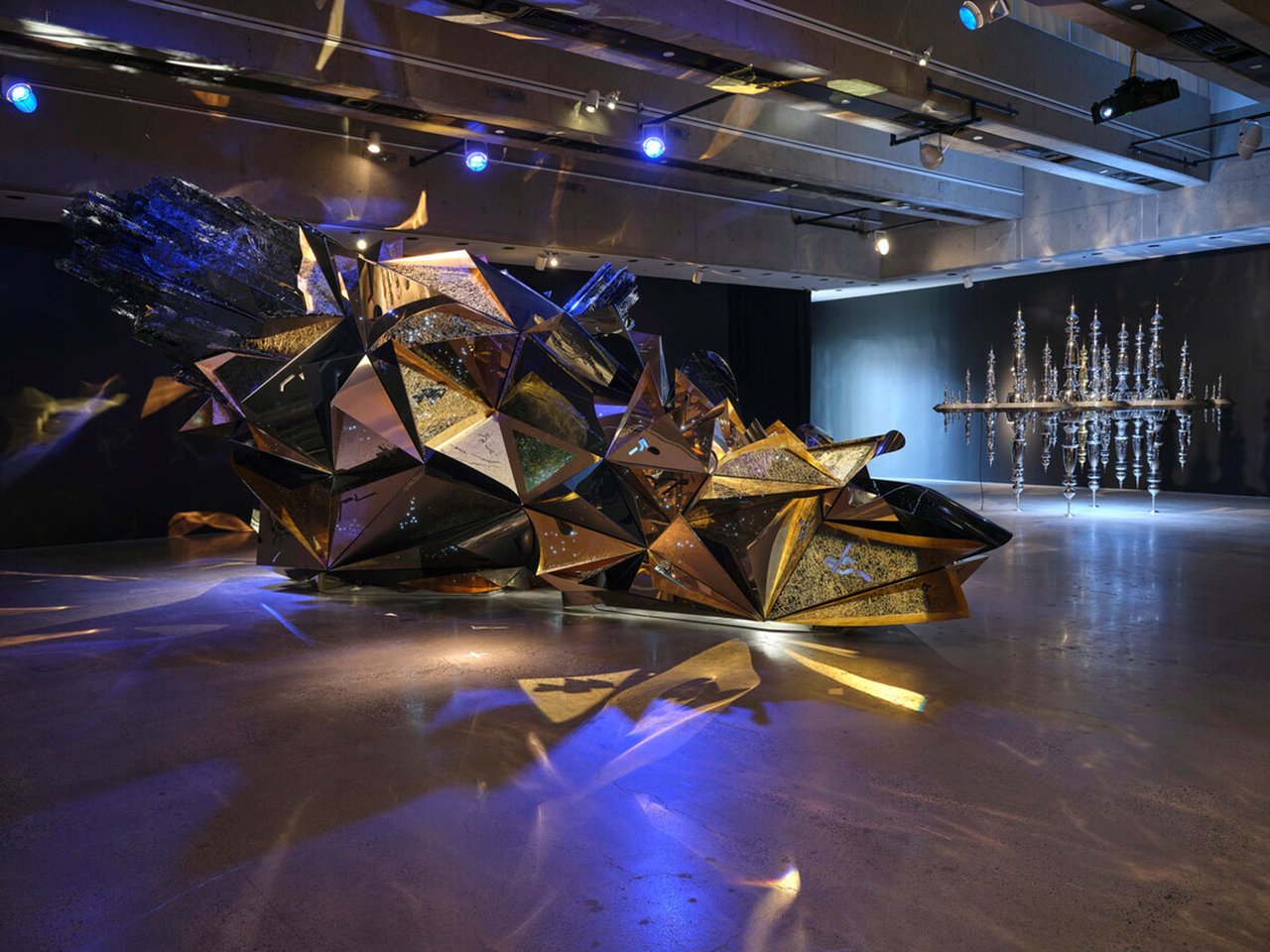
RS: When someone stands in front of a mountain, their view of life changes. Scale is very important to me. It’s not only a technical choice. It changes how the body relates to the work, because once something reaches a certain magnitude, it stops feeling like an object you simply look at and starts becoming an environment or an encounter. It can feel architectural, almost spiritual.
EO: From my understanding, Sikh philosophy resists hierarchy and centrality. Does that worldview inform your interest in decentralized forms such as asteroids, crystalline geometries, and multi-faceted structures?
RS: Sikh philosophy fundamentally rejects fixed hierarchy, not just socially, but metaphysically.
The idea of “Ik Onkar” points to a unified reality that isn’t organized around a single centre of power, but rather expressed through infinite forms simultaneously. There’s no privileged vantage point. The divine exists equally in all directions, in all things.
That view definitely informs how I think about form. Instead, I’m drawn to structures that distribute attention and where meaning isn’t centralized but emerges through multiplicity and relation.
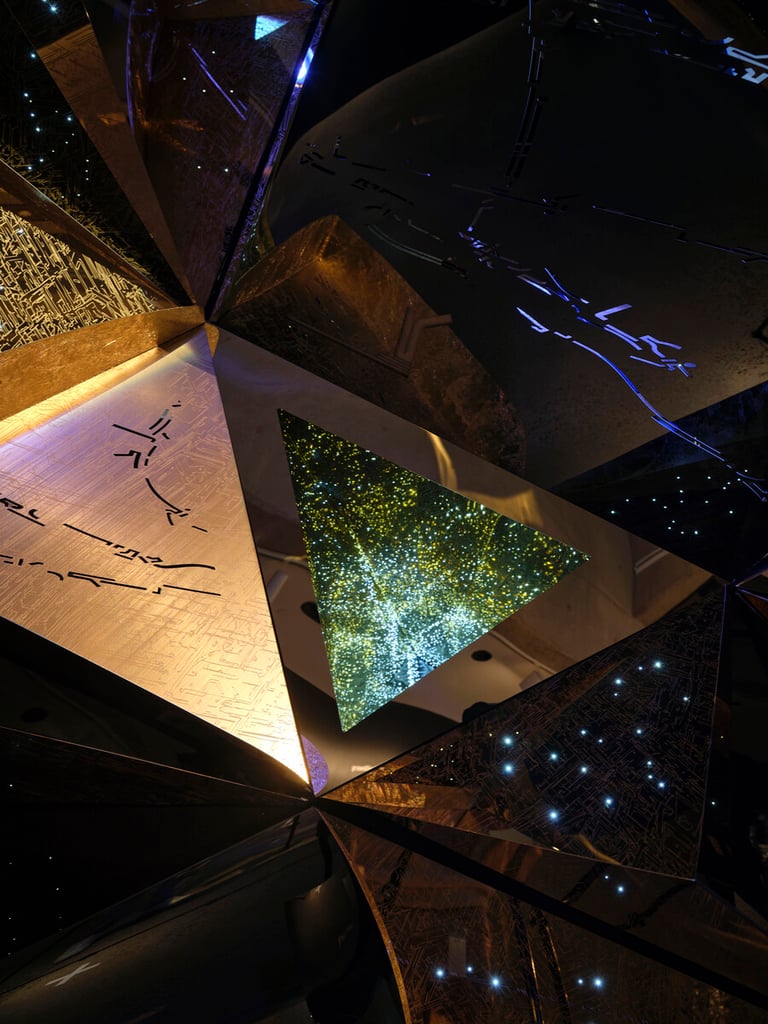
That’s where things like asteroids, crystalline geometries, and faceted structures come in. They don’t have a front or a hierarchy of surfaces. Every angle carries equal weight. They reflect and refract rather than dictate. In that sense, the object behaves more like a field than a monument.
Even materially, when I work with mirror finishes or light, the piece dissolves any fixed reading. It becomes dependent on the viewer’s position, on environment, on time.
So the work resists being “held” from a single perspective. It's not a literal translation of Sikh philosophy, but that underlying idea of decentralization, of unity without singular authority and infinite expression, is deeply embedded in how I construct form.
EO: Does that discovery begin in software, in sketching, or somewhere more intuitive?
RS: It moves between software, sketching, and intuition. But not necessarily in that order. Sometimes something starts with a rough sketch, sometimes in digital form, and sometimes as more of a feeling than an image. The intuitive part is always there first. A lot of the time it feels less like I’m inventing a form and more like I’m discovering one.
EO: Does working digitally shift how you imagine monumentality?
RS: Yes, because software lets me test scale, geometry, reflection, and structure in a very direct way. It helps me understand the work spatially and push the form further. But I don’t experience the digital process as separate from instinct. Sketching catches something raw, and then the digital process helps me clarify and build it.
However, for me, monumentality is not about making something dominant. It is about giving a form enough presence that it begins to feel inevitable, as though it has its own gravity. The body responds to that before language does. You don’t just observe it. You measure yourself against it, and in that moment the work becomes almost devotional.
EO: Can you tell me more about your training and how you came to be an artist? Also, who do you look to as influences?
RS: I’m a self-taught artist. I came to art through making, and my education has been shaped by fabrication, observation, and a long engagement with form. Before I even thought of myself as an artist, I was already absorbed in the behavior of materials, especially steel, its weight, its resistance, its capacity to reflect. I was drawn to how something so industrial could also feel intimate, how a hard surface could hold light, memory, even vulnerability. That was really the beginning of my training.
I’m influenced by artists like Henry Moore, Constantin Brancusi, Anish Kapoor, and James Turrell, but just as deeply by Sikh and Islamic architecture, sacred geometry, and material cultures of memory.
The AGO exhibition is important because it gives the work the scale and seriousness it needs. These are large, reflective forms that ask the viewer to move, to slow down, and to become implicated in the act of looking. Showing them in a major Toronto museum allows the work to enter a broader conversation around sculpture, memory, identity, and contemporary Canadian art.
EO: What led to your show at AGO?
RS: It began quite serendipitously. I met Julian Cox, the curator of the exhibition, at the opening of KAWS: FAMILY at the Art Gallery of Ontario in Fall 2023. That encounter gave me the opportunity to share my body of work with him. It sparked his interest, and a series of conversations and studio visits followed. I think the exhibition emerged from a shared sense that this was a moment to introduce the work more fully into the Canadian art milieu.
EO: I’m a huge fan of KAWS, and though your practices are vastly different I can see the connection between your work and his, specifically the sheer size of your sculptures and also hybridity being a core language that you navigate very effectively.
RS: Yes,I think hybridity is very central to the work, though not only in a formal sense. It reflects the fact that our existence is already multiple, made up of overlapping histories, inheritances, and ways of seeing that do not resolve into a single origin. I’m drawn to forms and materials that can carry that complexity. In that sense, hybridity is not an effect in the work. It is its ground.
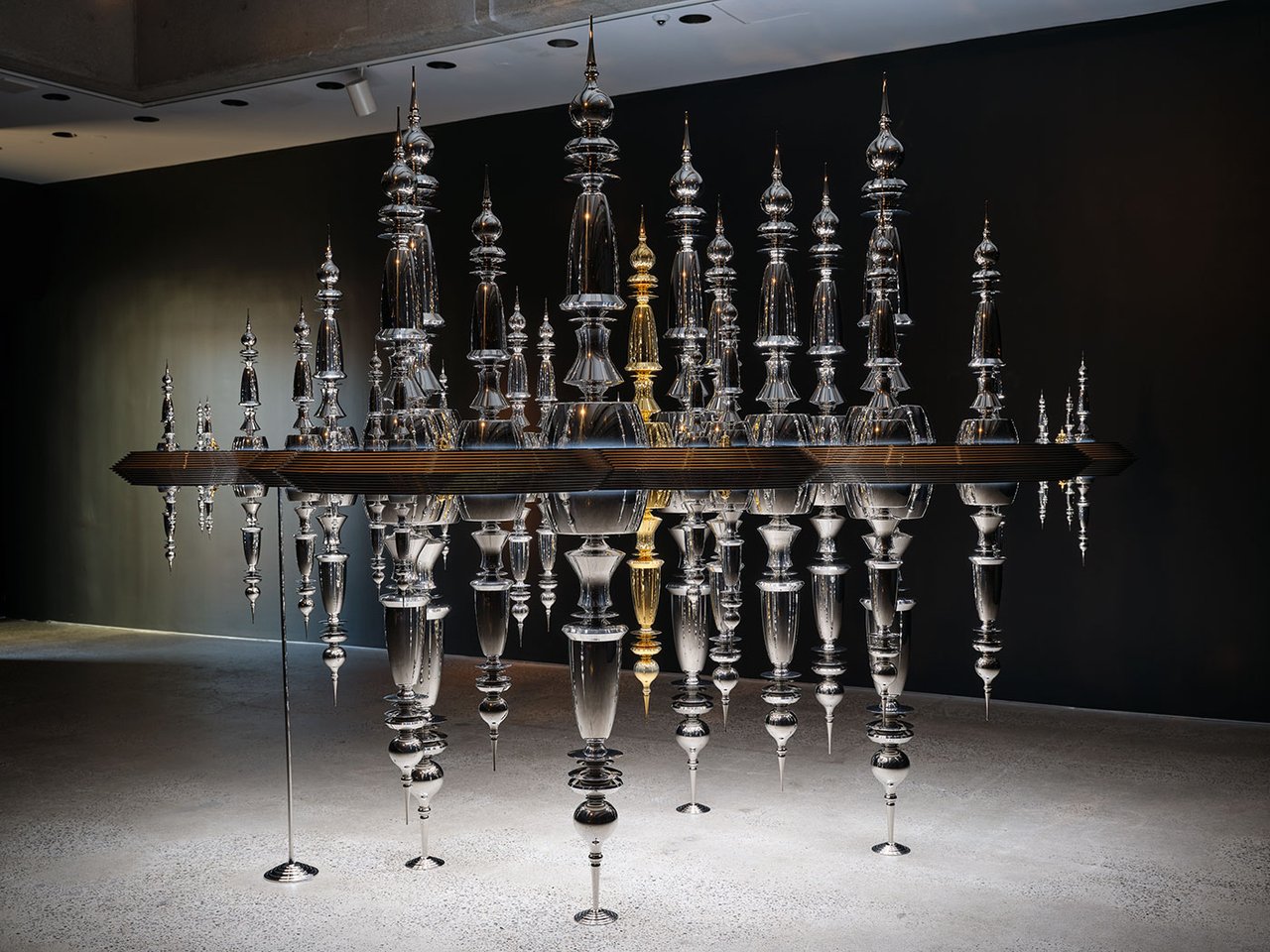
EO: Your workOdyssey, featured in “No Limits”, references Byzantine domes and Islamic minarets. Are you consciously engaging architectural history, and if so, is it about inheritance, revision, or something else?
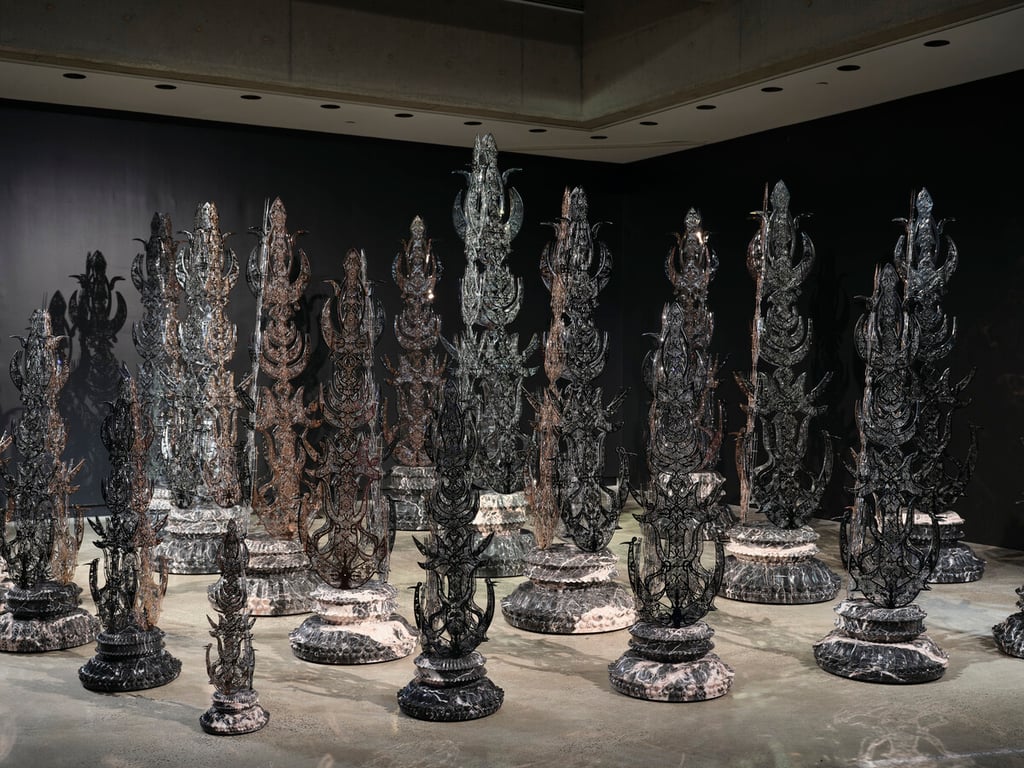
RS: Yes, definitely, but not as a quotation. I’m very interested in sacred architecture and in how certain forms carry memory and devotion across time. Domes, minarets, and vertical structures are never only formal to me. They already carry a way of seeing, a way of orienting the body, a way of feeling space as something charged and interior as much as monumental.
So when those references enter Odyssey, it is less about citing an architectural history than allowing those lineages to move through the work and become something else.
I’m interested in how inherited forms can be transmitted, transformed, and re-felt in the present. The work does not try to reproduce a sacred structure. It tries to hold onto something of its resonance.
EO: How does intergenerational family memory become material in steel?
RS: A big emotional foundation for this body of work is my grandmother. When I think about strength, I think about a kind of endurance that is quiet, steady, and absolute. That presence enters the work less as an image than as affect, as something felt before it is named.
For me, steel becomes the material that can carry that charge. It holds force and restraint at the same time, which is very close to how I understand memory. For me, steel is a deeply effective material.
EO: How do you see AI, simulation, or generative logic influencing the future of metalworking?
RS: I’m interested in those tools as part of an expanded process of visualization and testing. They can generate new possibilities and help me think through form, scale, and structure in ways that are incredibly useful. But technology is never the author of the work. Artistic vision and intent have to remain central. In the end, it still comes back to judgment, intuition, and what the material allows.
Ranbir Sidhu is an artist who transforms stainless steel and marble into sculpture and installation. Born in 1982 in Maidenhead, England, and raised in Scarborough, Ontario, Sidhu makes work that challenges how we perceive material, scale, and space. Sidhu draws inspiration from the spiritual transcendence of post-war abstraction and the historical depth of his Sikh heritage in his practice. Alongside his studio work, he pursued night classes at Durham College of Applied Arts and Technology, Ontario to strengthen his technical knowledge of fabrication and metalwork. He embraces the creative possibilities of advanced fabrication technologies to produce works that are as conceptually rich as they are visually and technically arresting.
Emann Odufu is an independent art and culture critic, film-maker, and curator from Newark, New Jersey, whose work explores contemporary art and Black visual culture through Afrofuturism, narrative, and cultural memory. His writing and creative work have appeared and been featured in the New York Times, HuffPost, Paper Magazine, Office Magazine, Right Click Save, and the Brooklyn Rail. His curatorial practice includes exhibitions at the Liu Shiming Foundation, National Arts Club, MoCA Westport, Friedrichs Pontone Gallery, and Leila Heller Gallery. He has spoken at Harvard University, Yale University, the British Film Institute, and the National Academy of Design, and is a member of AICA-USA.