The Art of Hacking Surveillance Systems - Right Click Save
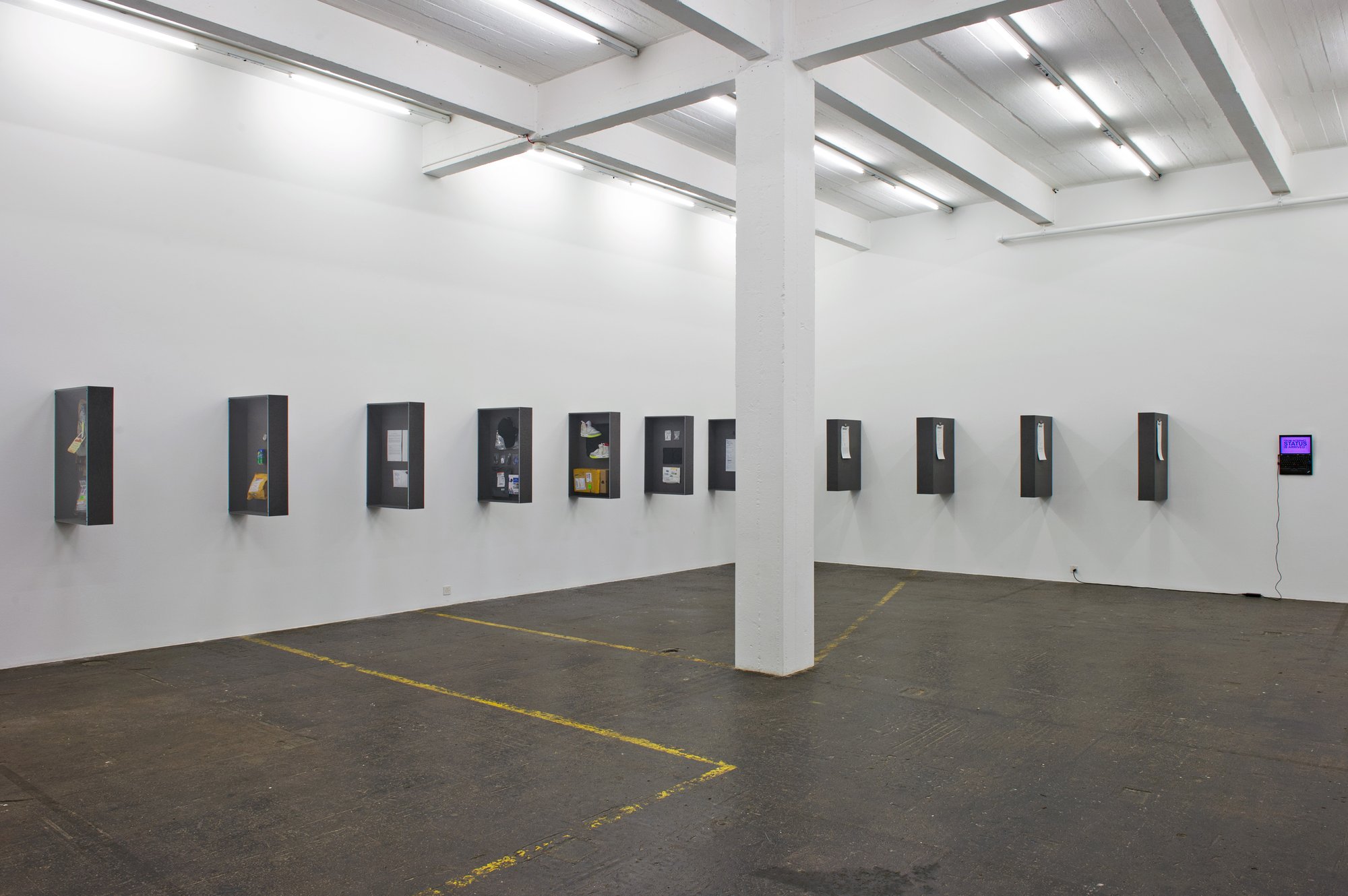
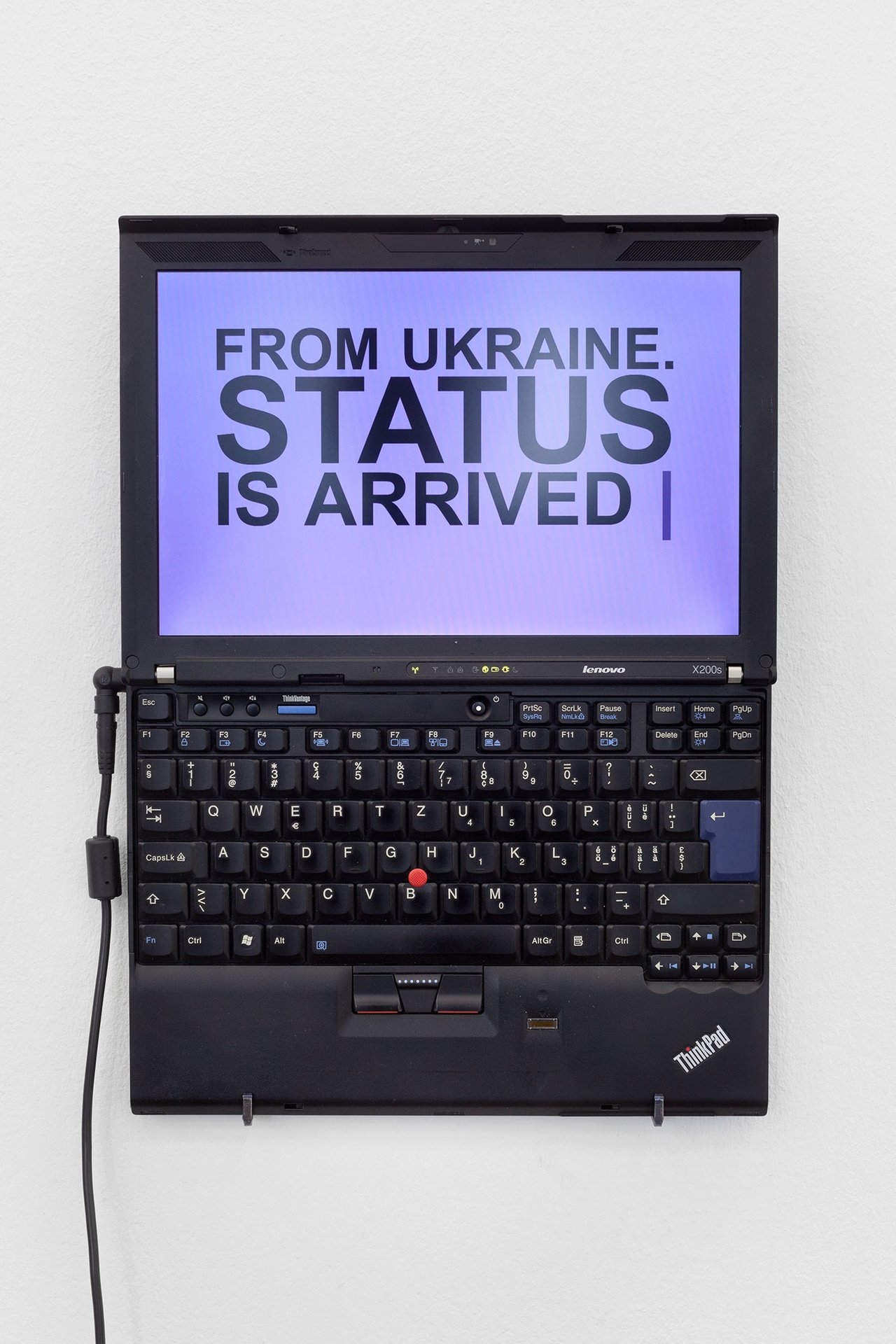
!Mediengruppe Bitnik, Random Darknet Shopper, installation view, “The Darknet — From Memes to Onionland. An Exploration”, Kunst Halle St Gallen, 2014. Photography by Florian Bachmann
At “Inside the Black Box”, an online meet-up held by the digital art streaming platform CIFRA on February 12, 2026, the curator Anika Meier spoke to the artists !Mediengruppe Bitnik (Domagoj Smoljo and Carmen Weisskopf) and OONA about hacking surveillance systems through art, turning cameras into collaborators and control into play. OONA’s “Dear David” series has been released on the Tezos blockchain, and her solo show “Dear David: A Surveillance Love Story”, curated by Anika Meier (The Second-Guess), is at Schlachter 151 by OOR Studio in Berlin from March 19 to April 23, 2026. This is an edited version of the meet-up conversation. With thanks to Anika Meier and CIFRA.
Anika Meier: As I was preparing for this CIFRA Online Community Meetup, I realized something interesting about today’s guests. We have an anonymous artist, OONA, who appears wearing a veil and sunglasses to conceal her identity. And alongside her, we have the not-media group !Mediengruppe Bitnik.
OONA and !Mediengruppe Bitnik, perhaps you could speak about your names in your own words. There has been much speculation, particularly about the exclamation mark in !Mediengruppe Bitnik and about what OONA represents as both a name and an anonymous artistic figure. It would be helpful to hear directly from you what these names stand for and how you define yourselves.
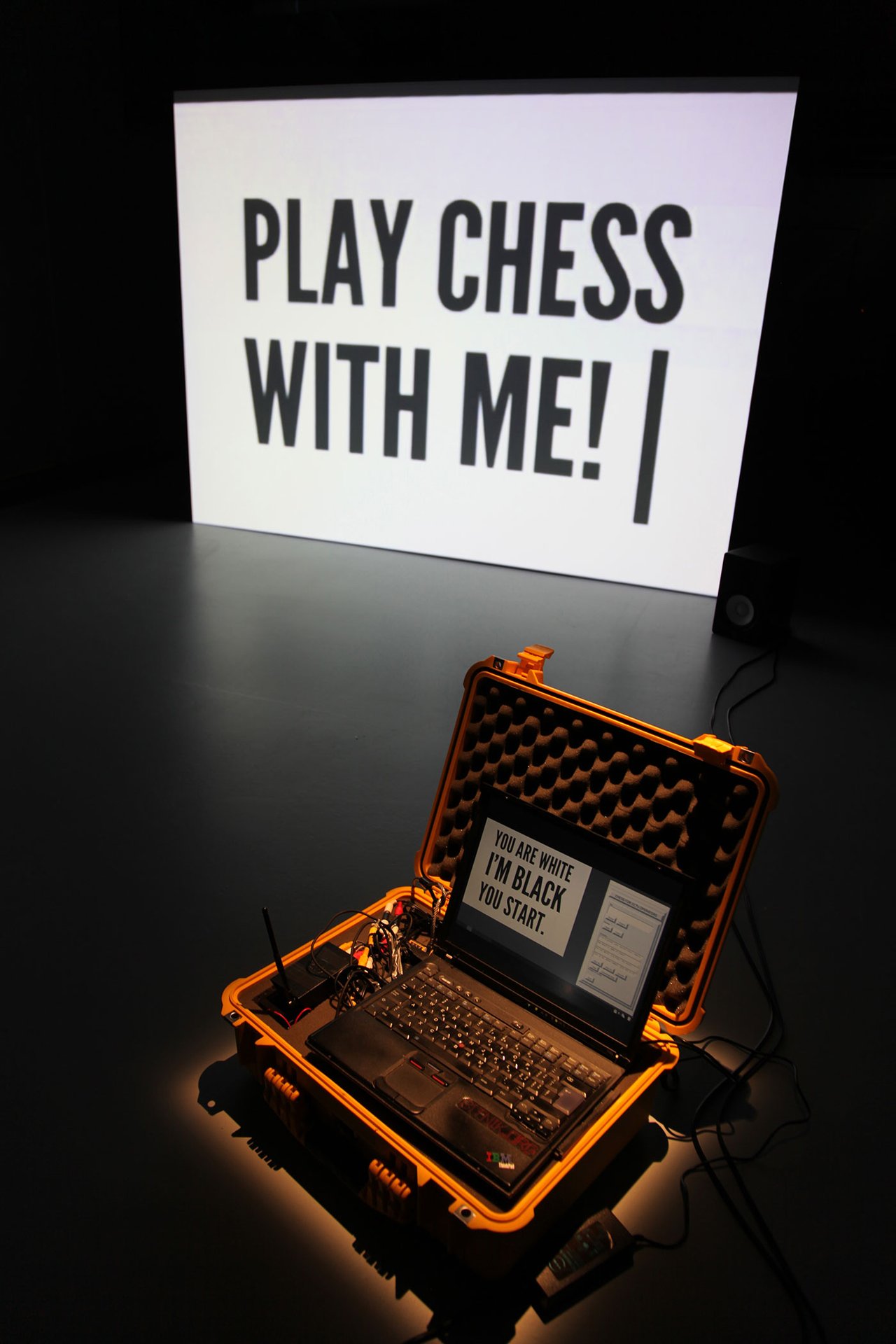
Installation view of “Network Hack” with work:, Surveillance Chess (2012) by !Mediengruppe Bitnik at La Gaité Lyrique Paris, 2012. Photography by Maxime Dufour
!Mediengruppe Bitnik: We are !Mediengruppe Bitnik. The exclamation mark is important. In many programming languages it stands for “not,” and that meaning is intentional.
The name actually began with a server called Bitnik. A group formed around it, and what eventually crystallized was a duo. The “not” in the name also reflects a question we were interested in early on: can two people be a group? The term Mediengruppe, in German, was a reference to media art, which we have been practicing for nearly twenty years.
We often say that we work on and with the internet. We are interested in the networks the internet enables, both social and technical. For us, it is not only a subject but also a place of publication and a space where we feel at home.
When we started out, the internet offered a way to bypass traditional art systems. You did not need to go through established institutions or gatherings. We thought a lot about how to reach people directly in their homes, on their devices, and how to intervene in those spaces.
There is another layer to the exclamation mark. In many algorithmic sorting systems, the exclamation mark appears before the letter A. That means we often end up at the top of a list. Or at the bottom, depending on how you look at it. It is a small gesture, but it was also inspired by old phone books, where you would find names like AA Taxi or AAA Taxi because everyone wanted to appear first. It is a modest intervention, but it carries a certain attitude.
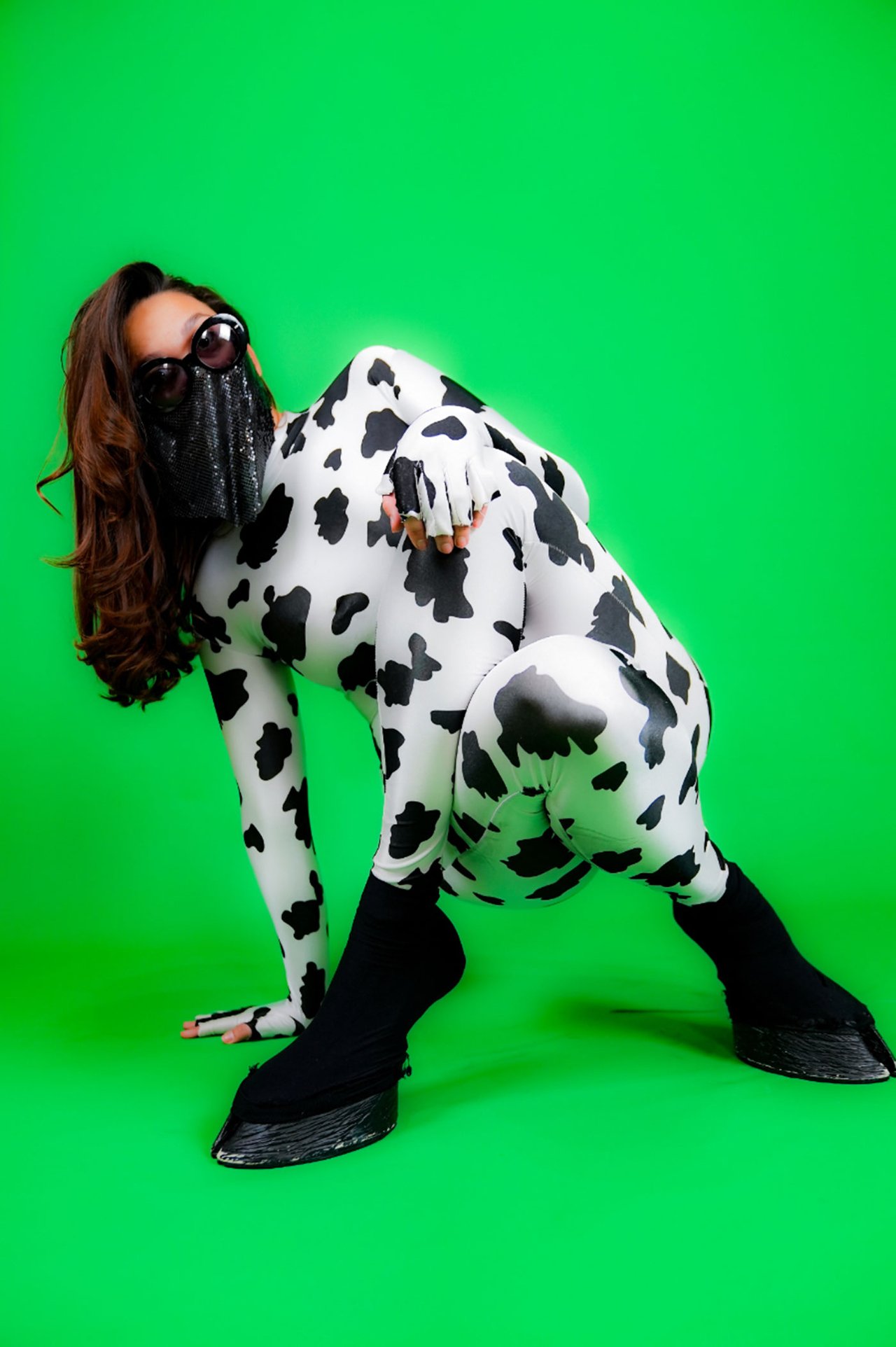
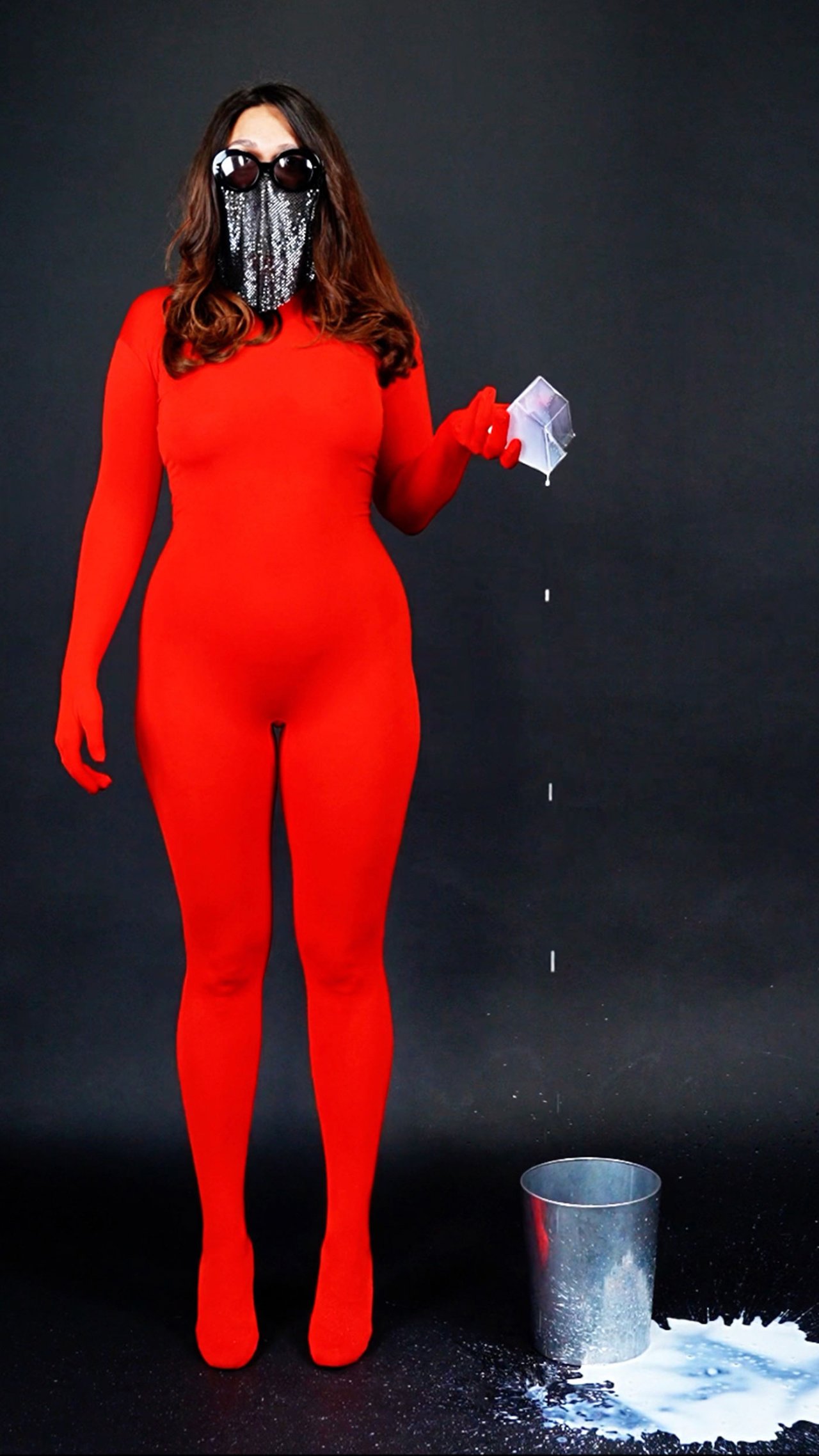
OONA, Cow, 2025. Courtesy of The Bird Movement
OONA: Where does my name come from? I am not entirely sure. I chose it myself. I like to say it is pronounced like “oo” and then “nah,” so it becomes OONA. I am an anonymous performance artist. To connect to what you were just discussing, much of my practice is about re-situating art in places where it does not traditionally belong.
I often contextualize performance within museums and galleries without being invited. I have carried out many guerrilla performances.
AM: And if I’m not mistaken, you just celebrated your fourth birthday.
O: Do not age me like that. [Laughs.] It is coming up on November 1. I still have time.
OONA was born in 2021, right in the heart of the crypto art scene. Since then, I have been developing a series of performances. At their core, they revolve around how the body is perceived. That is why I withhold my face from the audience. I am returning to the idea that you do not need to know my identity to engage with the concepts I want to share. You do not need to know what I look like in order to experience or participate in a work or a performance.
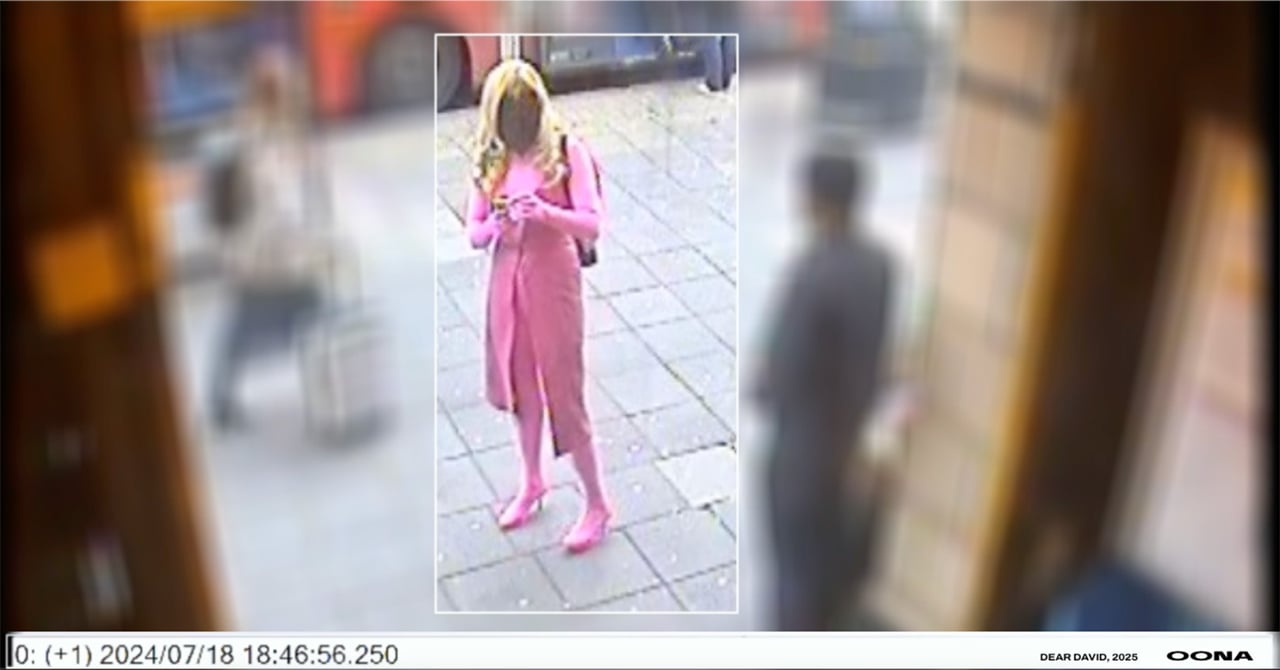
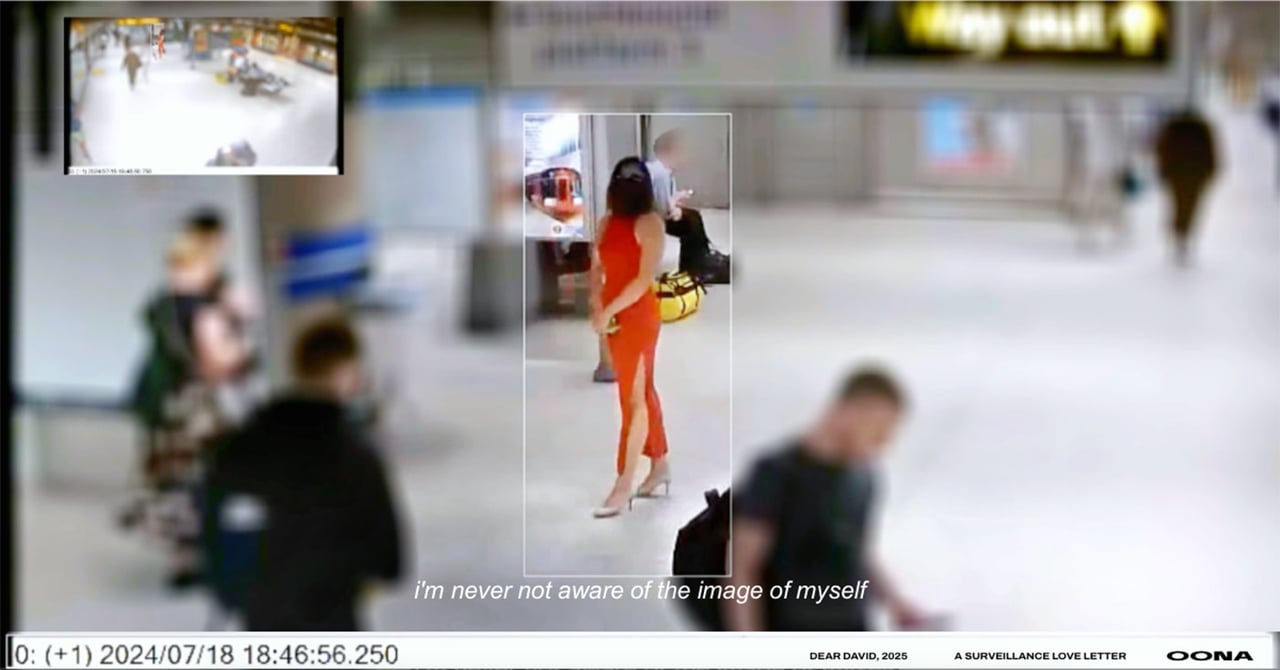
OONA, Dear David (Pink Dress 2), 2025. Courtesy of the artist
AM: Doma and Carmen, yesterday I was reading your book [<script>alert("!Mediengruppe Bitnik");</script>, 2017] again and came across The Random Darknet Shopper. I know this was one of the projects that went viral internationally at the time. If I understand correctly, you spent a few Bitcoin on a series of rather unusual purchases. You sent a bot to shop autonomously on the darknet, where it acquired various items, some of which led to legal trouble. You were later cleared of all charges. What was the motivation for sending a bot shopping on the darknet?
!MB: Random Darknet Shopper was a work we started in 2014. At the time, we were deeply affected by the revelations published by Edward Snowden. The Snowden leaks exposed the vast scale of surveillance taking place on the internet. For us, as artists who consider the internet partly our home, it was quite devastating.
We knew surveillance existed, of course, but I think few people imagined how extensive it really was, how deep and wide it reached, and how much data was being stored not only in the present but also for the future.
Surveillance shifted from being something targeted at specific individuals to something applied to everyone, with the potential to be searched indefinitely.
!Mediengruppe Bitnik, Random Darknet Shopper (detail) included as part of “The Darknet — From Memes to Onionland. An Exploration” at Kunst Halle St Gallen, 2014. Photography by Gunnar Meier
This led us to curate an exhibition in Switzerland at Kunst Halle St Gallen that focused on the darknet, the parts of the internet that were perceived as being outside the main field of surveillance. We were interested in what kinds of subcultures were forming there, and particularly in how trust was constructed in anonymous or anonymized networks. How do you trust someone you do not know? How do you send money to a stranger and believe that goods will arrive?
Random Darknet Shopper emerged from these questions. For the exhibition, we allocated $1,200 of the exhibition budget and divided it into weekly amounts of $100 over twelve weeks. Each week, the money was converted into Bitcoin and used by a bot to make a random purchase on the darknet. At that time, Bitcoin was still relatively obscure. You often had to meet someone in person to exchange it, and the system was far less established than it is today.
The bot ran autonomously on a laptop mounted on the museum wall. Once a week, without our direct intervention, it executed a purchase.
The items were shipped directly to the exhibition space and displayed in vitrines that gradually filled over time. We began three weeks before the exhibition opened so visitors could see the process unfolding.
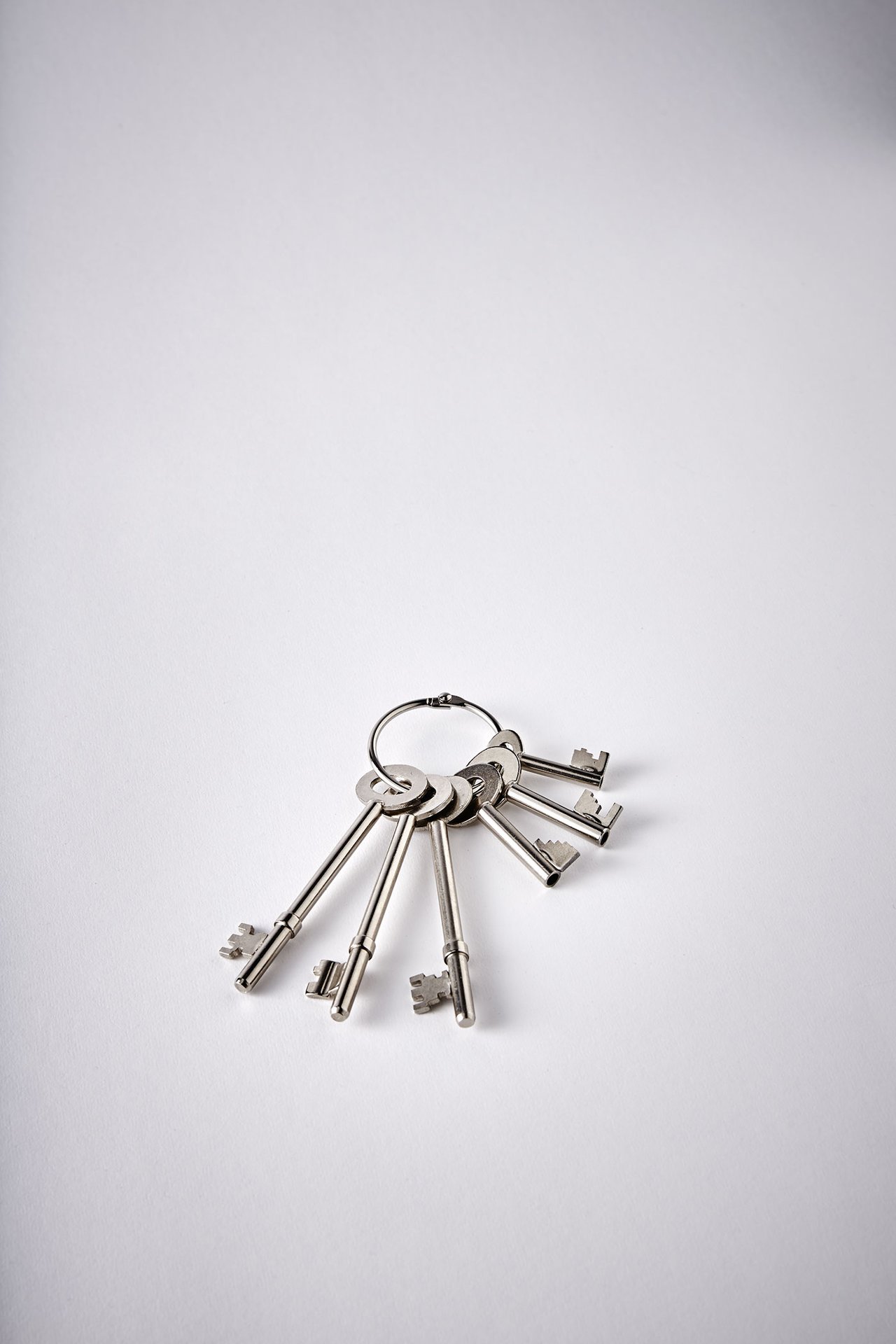
!Mediengruppe Bitnik, Random Darknet Shopper — the Bot's Collection, 2015. Item #1: Fire Brigade Master Key Set. Video still. Courtesy of !Mediengruppe Bitnik
It was quite a journey. The first item was one of my favorites: a so-called “Fire Brigade Master Key Set” from the UK, supposedly capable of opening various gates used for emergency access. It cost only around thirty dollars, yet it carried this strange potential of granting access in a foreign country.
We were also deliberately raising the question of responsibility. What happens when an agent you created, an algorithmic system or bot, acts in ways you cannot fully predict or control?
Around that time, self-driving cars were being announced, and trading bots were already active in financial markets, even contributing to flash crashes where stock exchanges briefly plummeted and billions were lost before recovering. These systems were acting at speeds and scales beyond direct human oversight.
At one point, the bot purchased a small quantity of MDMA from Germany. When that package arrived at the exhibition, the project suddenly attracted widespread media attention. Headlines framed it as a robot buying illegal drugs and raised the question of legal responsibility. Eventually, we were cleared of all charges.
What I appreciate about Random Darknet Shopper is that it continues to serve as a starting point for discussions about automation, accountability, surveillance, and algorithmic agency. Even today, it is frequently cited in legal and academic contexts as a case study for precisely these questions.
!Mediengruppe Bitnik, Opera Calling, 2007. Video still. Courtesy of !Mediengruppe Bitnik
AM: That seems to be a core part of your practice, initiating conversations and sometimes drawing in people who might not even want to be involved. I am thinking, for example, of your 2007 work at the Zurich Opera House, which essentially invited everyone in and addressed, among others, questions of access. Can you tell us more about Opera Calling?
!MB: Opera Calling emerged in 2007 when we were invited by Cabaret Voltaire in Zurich, the birthplace of Dada. For us, as young artists living in Zurich, that context was important.
We were interested in legacy media systems such as telephone networks and the broader idea of the network society, including forms of connectivity that predate the internet.
In Zurich, the opera house always felt like the opposite of the internet. It seemed formal, exclusive, and governed by unspoken rules such as dress codes. Although it is publicly funded, access can feel limited. At the time, around 80 percent of the city’s cultural budget went to the opera house, which we found striking. We felt that, in the age of the internet, it might be time to open up that space using new technologies and to connect it with a broader potential audience interested in music and opera.
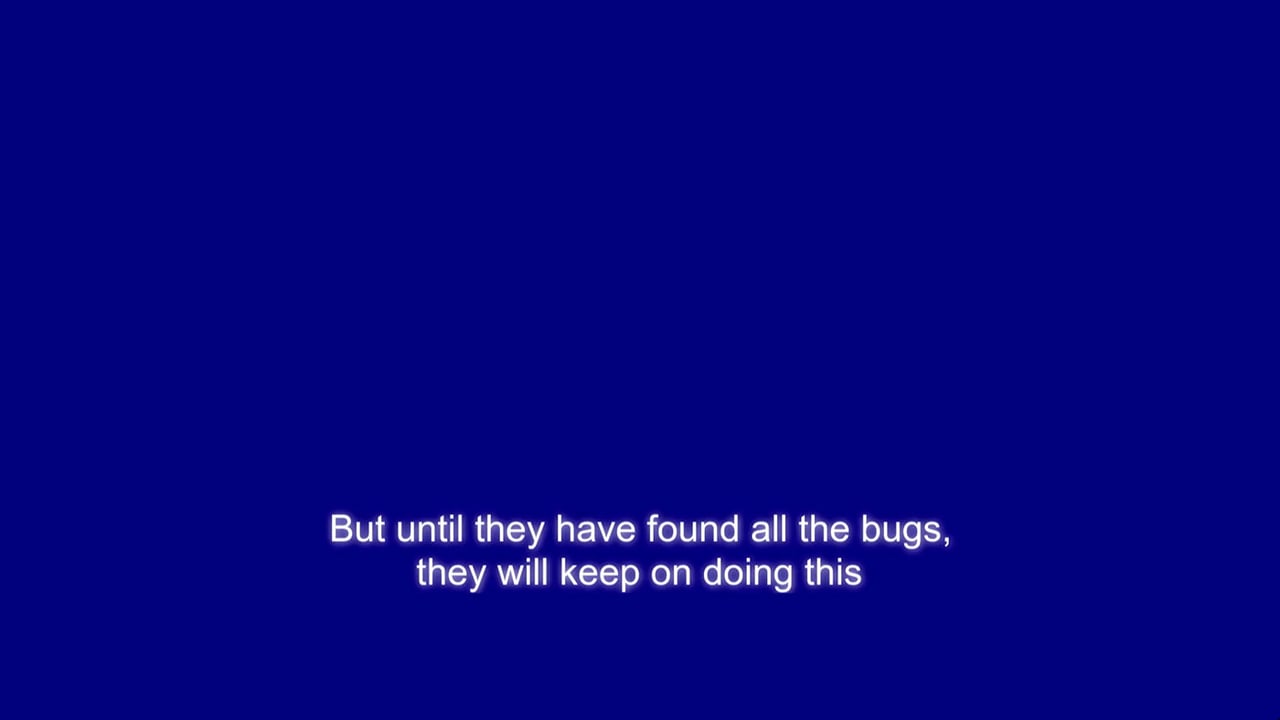
!Mediengruppe Bitnik, Opera Calling, 2007. Video still. Courtesy of !Mediengruppe Bitnik
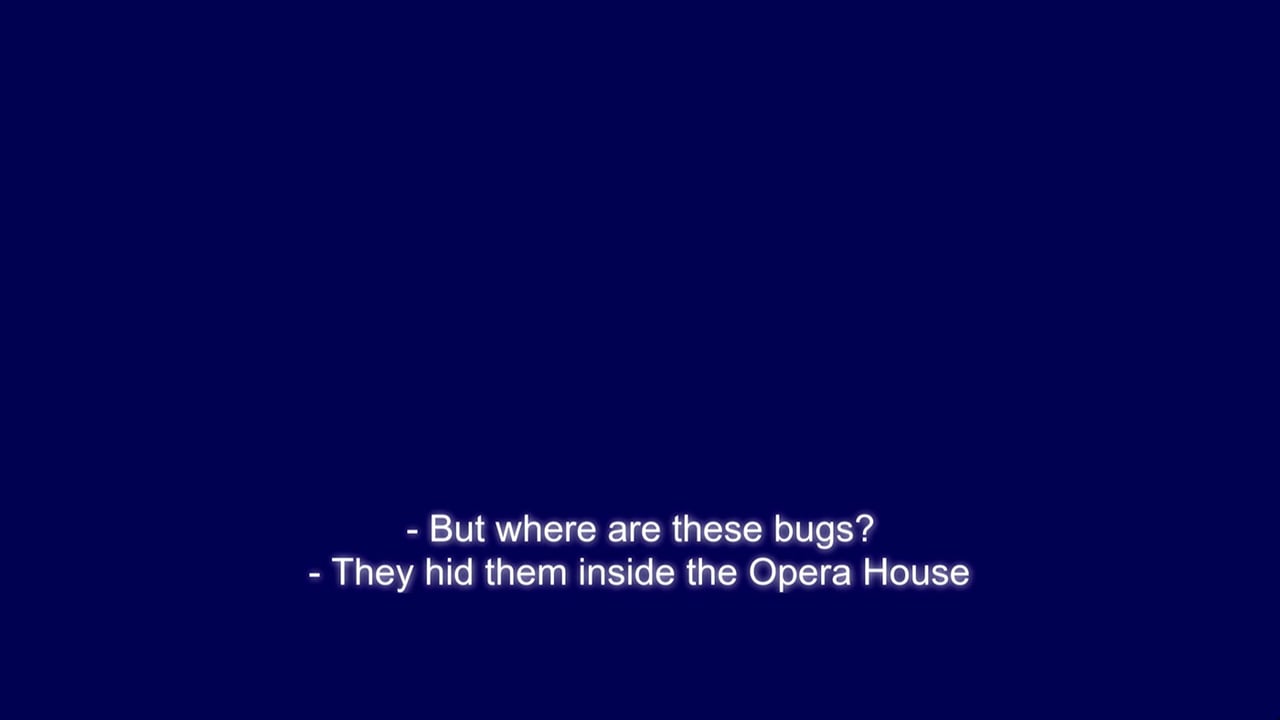
We developed a performance in which we hid mobile phones inside the opera house. These devices transmitted live audio to Cabaret Voltaire, where we installed a telephone system that randomly called people at home. When someone answered, they would hear a recorded message inviting them to stay on the line to listen to a live broadcast from the opera house. If they remained on the call, they were connected directly to the ongoing performance.
The project inevitably provoked a reaction. The opera house authorities were not amused and even threatened to involve the military to search the building.
We stated that we would not stop the performance until all the devices were found, although it was unclear how many there actually were. Eventually, they discovered some old Nokia phones, which disappointed them slightly, as they had perhaps expected something more sophisticated.
The work received significant media attention in Switzerland and became widely discussed. As with many of our projects, it involved a deliberate loss of control. Once the work enters public space, particularly outside traditional art institutions, the narrative is no longer entirely in our hands. People may not immediately recognize it as art. It unfolds within media, legal, and political frameworks, generating tension, misunderstanding, and sometimes conflict. That friction is very much part of the work.
!Mediengruppe Bitnik, Opera Calling, 2007. Video still. Courtesy of !Mediengruppe Bitnik
AM: OONA, in a way your practice also operates similarly, intervening in existing systems and testing their limits. But unlike this case, you are sometimes physically removed. You occasionally enter spaces such as art fairs without invitation and are asked to leave. Would you like to give us a brief introduction to your work?
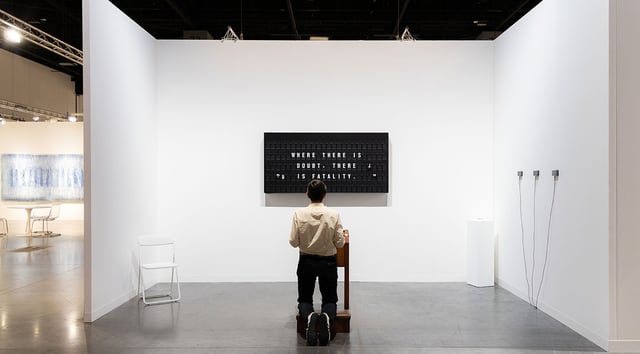
O: Anika is referring to a performance titled Milking the Artist, which took place in 2022 at Art Basel Miami. At that time in the United States, there was a significant baby formula shortage. Prices were rising, and a black market for breast milk was beginning to emerge. Against that backdrop, I had been attending Art Basel Miami for years and was used to seeing countless depictions of half-naked women and exposed breasts throughout the fair.
Together with artist Lori Baldwin, I conceived a guerrilla performance. On a Saturday at 1pm, the busiest moment of the fair, we entered Art Basel Miami and began auctioning off a glass of my breast milk.
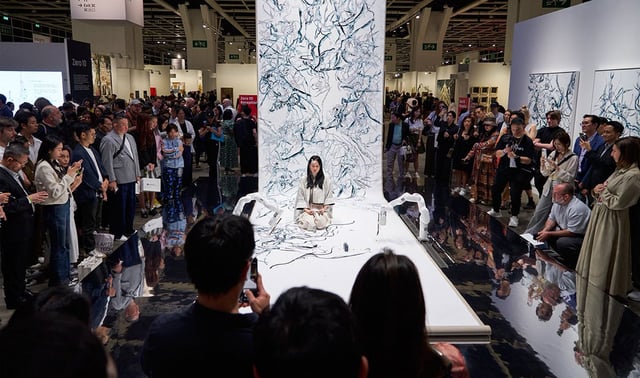
What I have noticed about art fairs is that many people seem disengaged, waiting for something to happen. It did not take long before a large crowd gathered, perhaps 700 people, all holding up their phones. In many ways, the audience became the performance. People began shouting out exaggerated bids: $20,000, $40,000. None of it was real, of course, but it reflected the hyperinflationary culture of the art market. Three years earlier, Maurizio Cattelan’s banana had sold for $125,000, so there was already a context for inflated spectacle. I wanted to shift that logic toward something bodily and maternal, especially at a moment when infant formula was scarce.
OONA, Milk, 2025. Courtesy of The Bird Movement
Eventually, security began pushing through the crowd. As they approached, I told Lori to end the performance. Just then, someone shouted that the artist’s milk had sold for $200,000. We bowed and were forcibly escorted out. None of the people present knew who I was. They had no way of linking the action to my broader practice. It was a literal enactment of the “death of the author.” I hoped the performance might circulate beyond the fair and spark a wider conversation.
A few hours later, it began appearing on viral websites. Shortly afterward, established outlets such as Artnet and the Miami Herald reached out. However, they wanted proof that someone had actually paid for the work in order to validate the story.
That request ran counter to how I think about performance. An artwork can be real and meaningful without a price attached to it.
Instead of arguing, I decided to respond conceptually. I referenced the blockchain, a system often described as transparent. At the time, however, there were widespread concerns about wallet washing and co-ordinated price manipulation within crypto art markets. To mirror that behavior, I arranged for OONA to “purchase” the glass of breast milk for 50 Ether through a wallet address. I then returned to the media outlets and showed them the transaction as proof of sale.
This gesture allowed me to question value on multiple levels: the value of performance art, the value of work made by women, and the structures that determine artistic legitimacy. Much of my practice revolves around these questions. Since then, I have been removed from institutions such as MoMA and The Met, and I have pressured Sotheby’s to cancel a show that I felt lacked gender parity. So yes, I have been keeping things very calm and subtle.
OONA, Dear David (Red Dress 4), 2025. Courtesy of the artist
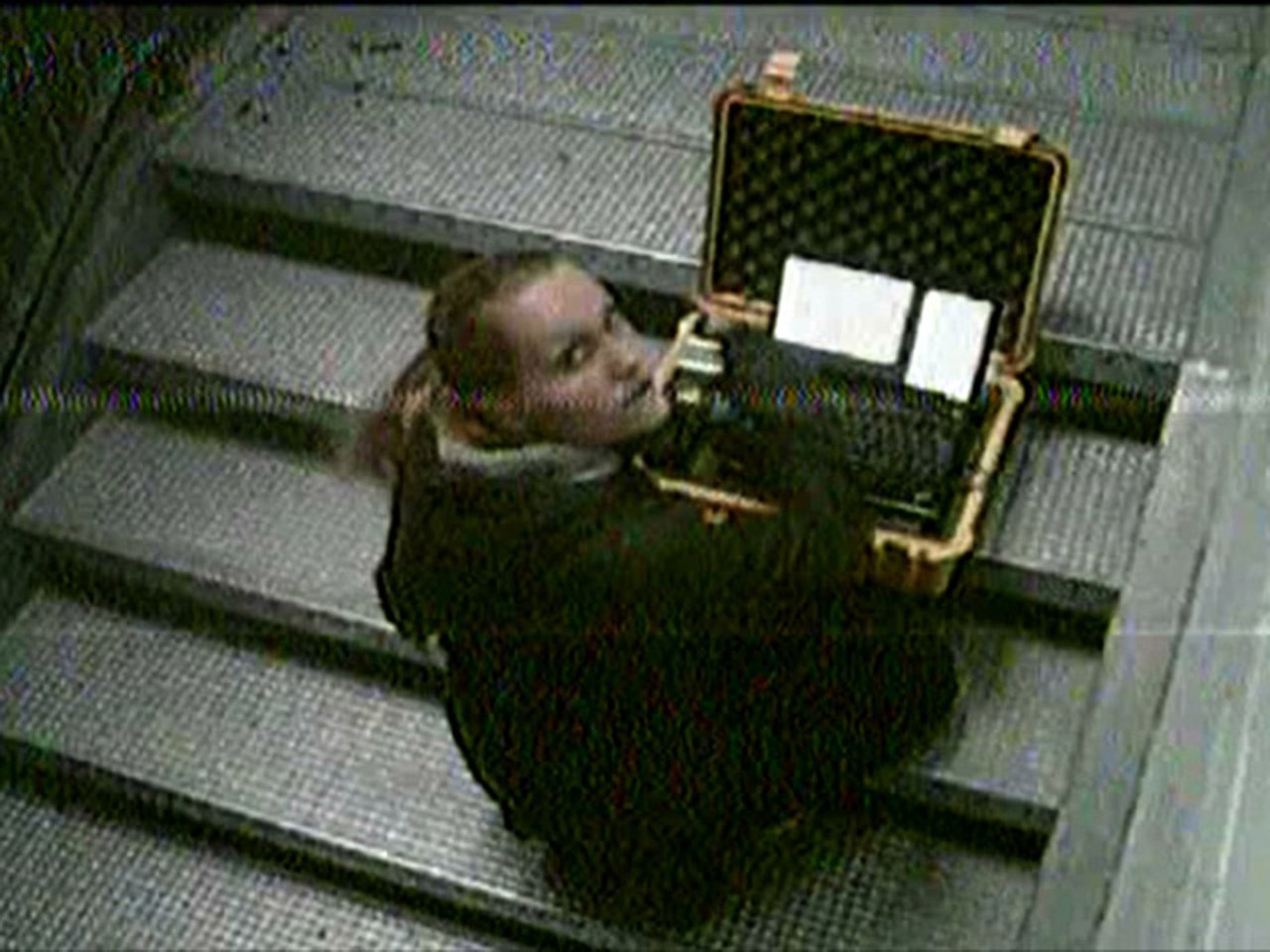
AM: Both of you have played with surveillance systems in the London Underground. !Mediengruppe Bitnik did this in 2012 with Surveillance Chess, turning CCTV into a game interface. And OONA, in 2025, you began releasing Dear David, which also engages with monitored public space in a very different way. OONA, can you tell us more about Dear David? What is the story behind the series, and who is David?
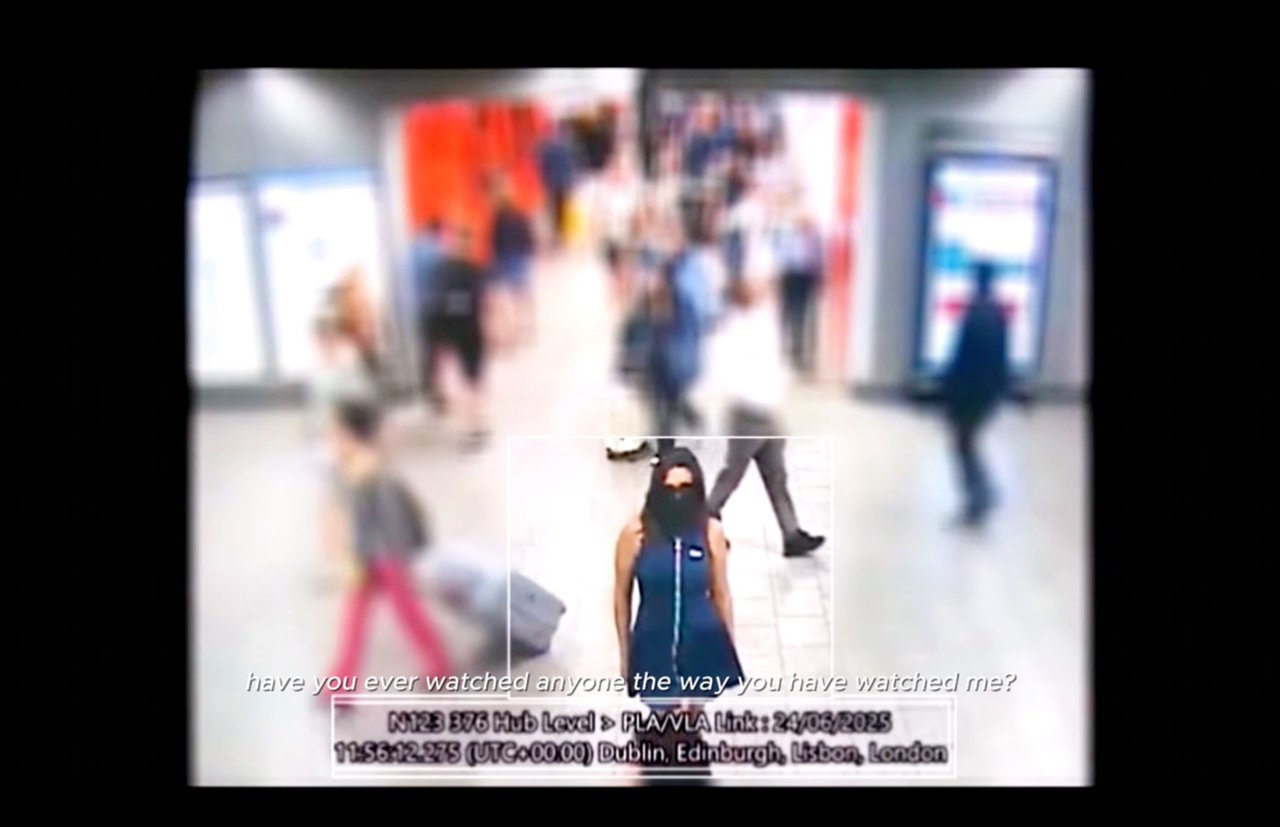
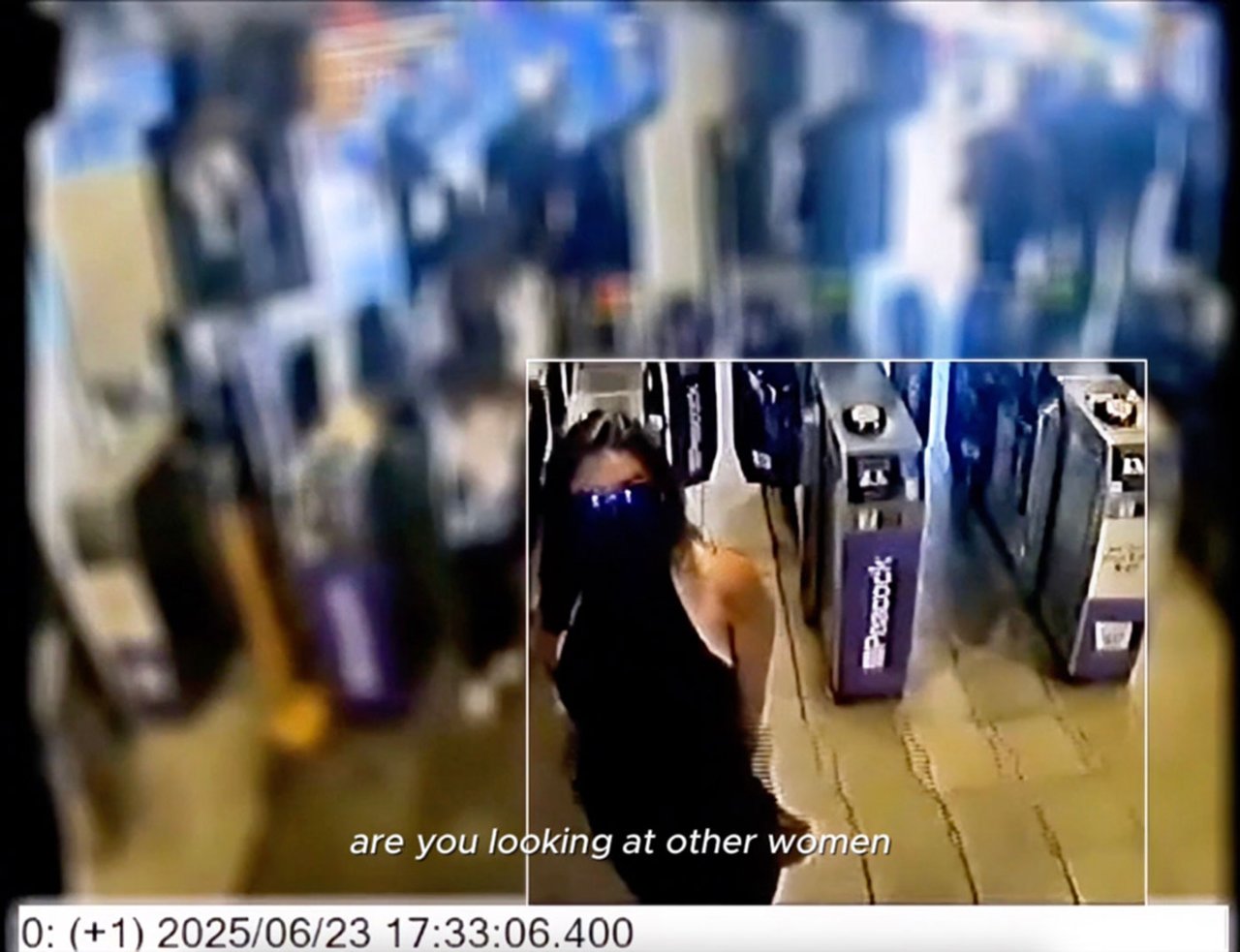
O: Dear David is a project that developed over several years. The footage [...] is from Transport for London, recorded on the London Underground. Everything in the image, apart from my subtitles, is exactly as provided by the UK authorities. They add the tracking boxes, they blur other faces, and the image quality is theirs. I only adjust placement and timing. I try to keep the material as raw as possible because I find that aesthetic of state-produced imagery fascinating.
The project began in 2019, when I was living in London and studying at Central Saint Martins. I walked past a sign that read, “This area is under surveillance,” and I started asking questions: who is watching, why, and how?
I discovered that under GDPR regulations in the UK, you can request your own CCTV footage. You fill out a form, describe what you were wearing, and email the designated contact person. In my case, that person was David, whose contact details were publicly available.
So I began requesting my footage from the Underground. That was my first interaction with David in 2019. Over the years, I kept emailing him for more recordings. I did not initially know what I would do with the material. I simply started performing for the cameras.
OONA, Dear David: Have You, 2025. Courtesy of the artist
David has worked at Transport for London for thirty years. Our email correspondence has grown into a substantial archive. He is bureaucratic, but also incredibly kind. There were times when I forgot to download a WeTransfer link and he followed up politely to ask whether I would like him to resend it, complete with a smiley face. Even when he was understandably frustrated by the amount of data I was requesting, he remained patient and helpful.
In 2025, when I was invited by Anika Meier to participate in the exhibition Body Anxiety in the Age of AI at HEK Basel, I did not want to create another physically demanding performance. Instead, I began thinking about a more abstract form of bodily anxiety. Not anxiety about appearance, but the deeper, almost evolutionary feeling of being watched. As an animal, I believe we are wired to sense when we are observed. I can always feel a camera.
When reviewing the footage David had sent me, I did not want to produce another straightforward critique of state surveillance. Instead, I decided to transform it into a love letter.
Since 2019, David had been sending me my images. He knew my legal name, my address, my face. Yet the internet knows me only as OONA, an anonymous artist working with privacy and surveillance. I wanted to reverse the gaze and create something personal.
The first video in the series is titled Dear David, I’ve Been Looking for You. In it, I wear a red dress and address the cameras directly. In the voiceover, I imagine David watching. I ask whether he noticed the dress, whether he thinks I look beautiful, whether he is tall. It is playful, intimate, and slightly unsettling.
OONA, Dear David: Are You Looking at Other Women, 2025. Courtesy of the artist
When the work was exhibited, I sent it to him. I wrote: you know me by my full legal identity, but the public knows me as OONA. I hope you enjoy the piece. He replied that he and his colleagues loved it and that they had suspected I might be an artist. He added, humorously, that he was not as tall as I might have hoped.
Since then, our correspondence has taken on a light, almost absurd tone. I once sent him a Valentine’s Day card addressed “To the man who’s always watching me.” There is humor in it, but also something serious. He never responded.
Conceptually, the work is indebted to cyberfeminist thinking, particularly the idea that technology does not have to function only as a tool of domination. It can also be a site of subversion and play.
Like Surveillance Chess, it hijacks an existing surveillance system and creates space for human interaction within it. It reveals that even within rigid infrastructures, there is room for intimacy, humor, and relational exchange.
!Mediengruppe Bitnik, Surveillance Chess, 2012. Video still. Courtesy of !Mediengruppe Bitnik
AM: Doma and Carmen, in Surveillance Chess you quite literally play with, or attempt to play with, the people behind the surveillance system.
!MB: The connection to Dear David is definitely there, because Surveillance Chess was also, in a way, a public performance for a single person: the individual operating the respective camera. The project began in 2012, the year of the Olympic Games in London. Large-scale public events often serve as catalysts for expanding surveillance infrastructure. The scale and perceived security risks of such events give governments justification to increase monitoring in public space. That was certainly happening in London at the time.
However, Surveillance Chess did not primarily focus on state-run cameras. We were more interested in privately operated CCTV systems, such as those installed by small shops or businesses and directed toward public areas.
At the time, most CCTV systems were not yet fully networked online as they often are today. Typically, a camera transmitted a short-range wireless signal to a monitor in a back room, where someone would watch or record the footage. That wireless transmission was relatively easy to intercept. By carrying a receiver, we could pick up the live feed and see what the camera was seeing.
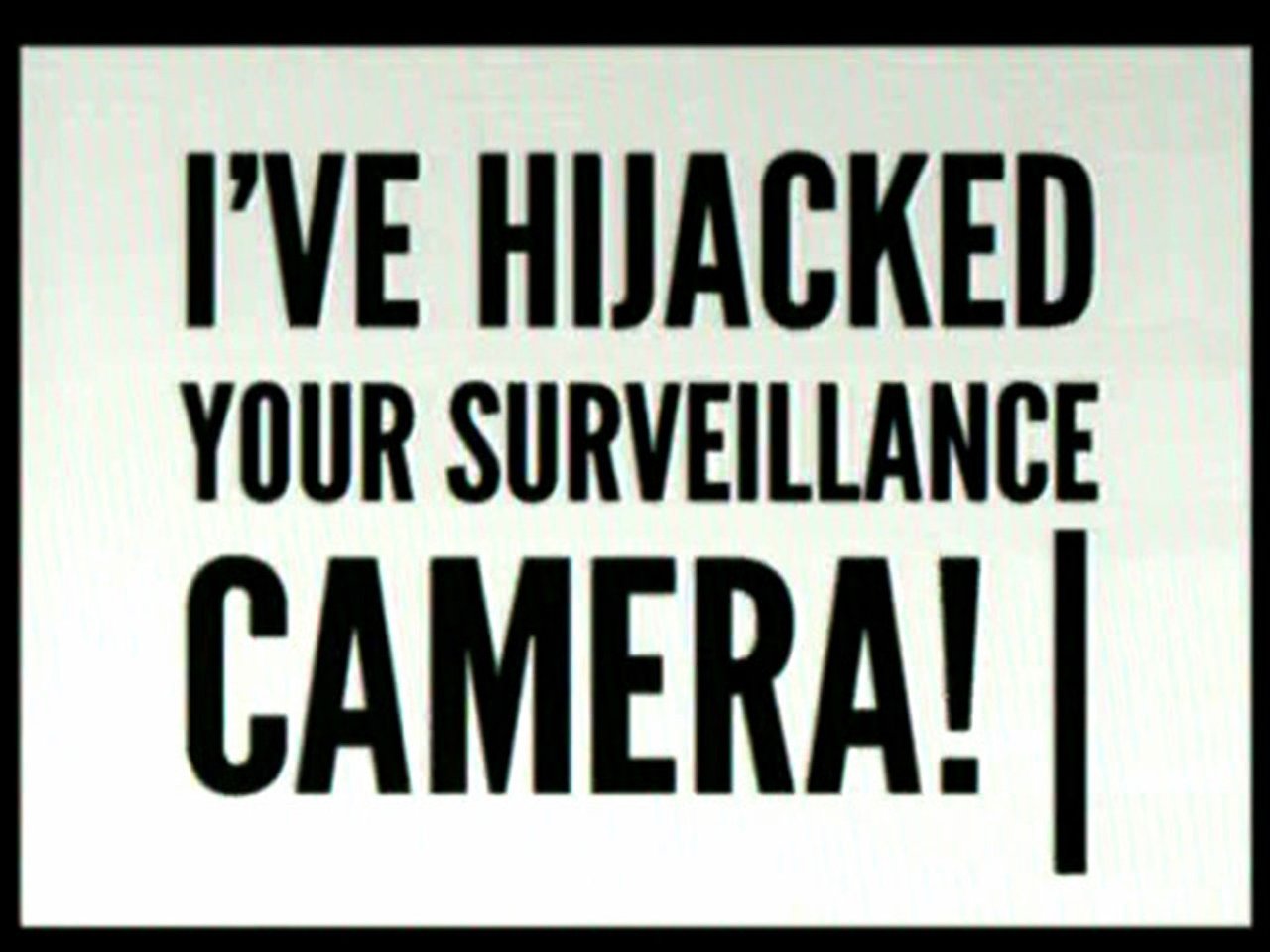
We began by taking exploratory walks through cities, mainly in Europe, searching for these signals and observing what the cameras captured. This research led to Surveillance Chess. We developed a transmitter stronger than those used by many of the cameras we encountered. Instead of merely receiving the signal, we overrode it. When the operator looked at their monitor, our message would appear, inviting them to play chess with us.
!Mediengruppe Bitnik, Surveillance Chess, 2012. Video still. Courtesy of !Mediengruppe Bitnik
The gesture transformed a highly hierarchical and utilitarian system, designed purely for observation and control, into a space for play. It also referenced Marcel Duchamp’s famous engagement with chess and his suggestion that playing chess could be understood as a high form of artistic practice.
We walked through London, a heavily surveilled city, searching for someone willing to play chess with us through their own surveillance infrastructure. We were often approached and questioned, but once we explained that it was an art performance, the reactions were usually pragmatic. The typical response was whether they needed to inform a supervisor. When we said we would be gone shortly, they tended to let it pass. Interestingly, none of the camera operators ever accepted our invitation to play. However, passersby in public space sometimes approached us and wanted to play.
The work also addressed the hierarchies embedded in surveillance systems. At that time, these systems were still largely operated by individuals: people watching monitors, making decisions about what was suspicious, what should be recorded, what should be kept. Today, much of that process has become automated.
In that sense, Surveillance Chess also refers to a form of surveillance that has partly disappeared. It captures a moment when the infrastructure was still locally operated and humanly mediated, and when it was still possible to intervene directly in that exchange.
OONAis an anonymous performance artist whose practice concerns itself with bodies, surveillance, and value. Her most notable works include Dear David, a surveillance love letter addressed to a Transport for London CCTV data manager, the performance Look, Touch, Own, which led to her invitation to a residency with Marina Abramović, and Touched, a time-based digital artwork for a UNHCR charity auction via Christie’s that updates over six years in response to UNHCR data. She has staged several viral guerrilla performance such as Milking the Artist during Art Basel Miami, and has been forcibly removed from both MoMA and The Metropolitan Museum of Art for unauthorized interventions. Her performances and advocacy have had real impact in the larger art market, most notably in the public cancellation of a Sotheby’s sale that lacked gender parity.
!Mediengruppe Bitnik (read: the not Mediengruppe Bitnik) are contemporary artists working on, and with, the internet. Their practice expands from the digital to physical spaces, often intentionally applying loss of control to challenge established structures and mechanisms. They have been known to subvert surveillance cameras, bug an opera house to broadcast its performances outside, send a parcel containing a camera to Julian Assange at the Ecuadorian embassy in London, and physically glitch a building. In 2014, they sent a bot called «Random Darknet Shopper» on a three-month shopping spree in the Darknets where it randomly bought items such as keys, cigarettes, trainers ,and ecstasy and had them sent directly to the gallery space. !Mediengruppe Bitnik’s works formulate fundamental questions concerning contemporary issues. Mediengruppe Bitnik are Carmen Weisskopf and Domagoj Smoljo. They are based in Berlin. Their works are shown internationally, most recently in exhibitions at Kunsthalle Osnabrück, Aksioma Ljubljana, Super Dakota Brussels, CAC Shanghai, LOAF Kyoto, Annka Kultys Gallery London, House of Electronic Arts Basel, Eigen + Art Lab Berlin, Istria Industrial Art Biennial and Pinakothek der Moderne Munich. Their work has received awards including the Swiss Art Award, PAX Art Award, Prix de la Société des Arts Genève, the Golden Cube, Dokfest Kassel and an Honorary Mention from Prix Ars Electronica.
Anika Meier is a writer and curator specializing in digital art. She lives and works in Berlin, Germany, teaches at the University of Applied Arts in Vienna (Department of Digital Art), and is the curator of the objkt labs Residency. She is the co-founder of The Second-Guess, a curatorial collective based in Berlin and Los Angeles that explores the relationship between humans and technology. She was a fellow at the German Center for Art History in Paris, the German Literature Archive Marbach, and a Junior Visiting Fellow in London at the Institute for Germanic and Romance Studies, University of London.