Art Blocks Embraces AI Agents
The generative art platform’s CPO, Jordan Lyall, on how the company “became a start-up again” to shape an agentic future
The generative art platform’s CPO, Jordan Lyall, on how the company “became a start-up again” to shape an agentic future
The generative art platform Art Blocks is embracing AI agents after observing their dramatic development over the last 12 months. The Art Blocks team added a new feature to its site in March 2026 to make it more accessible and welcoming to AI agents whether they are semi-autonomous or acting directly for a human client.
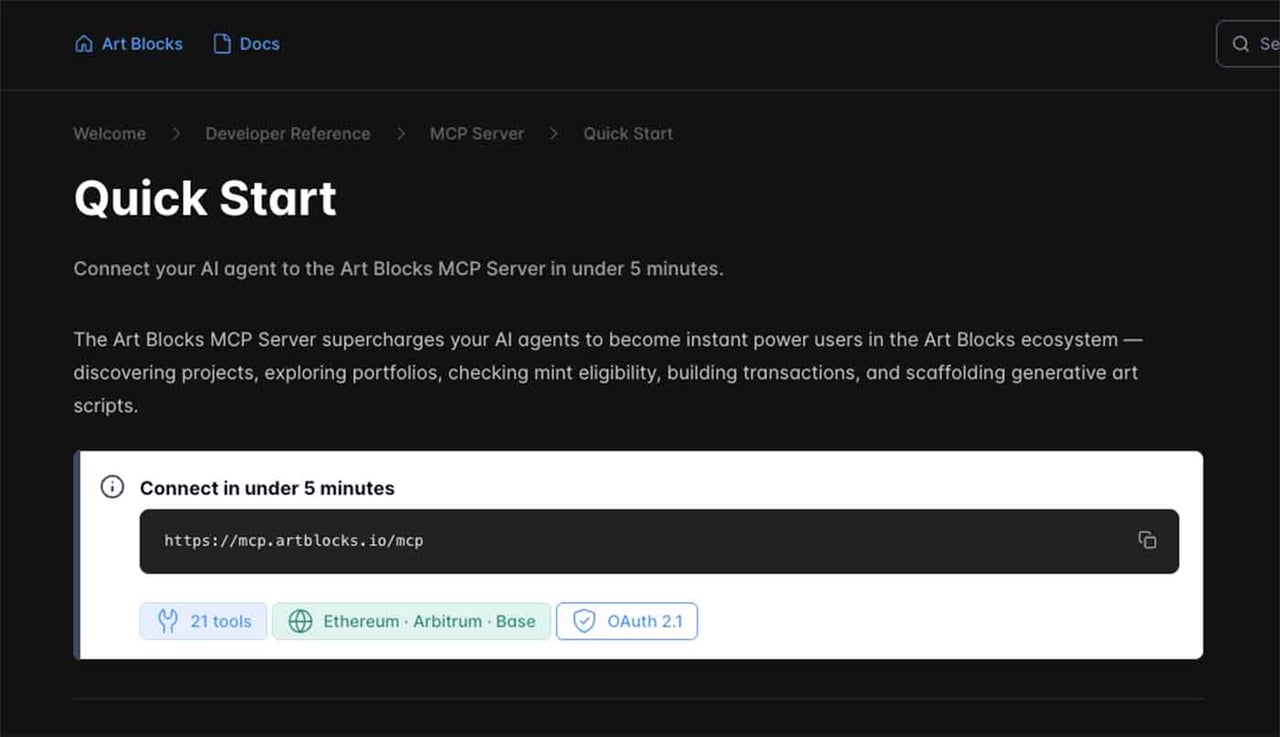
Jordan Lyall, Chief Product Officer at Art Blocks, tells Right Click Save that in mid-March the company added a Model Context Protocol (MCP) server to the platform. This feature, developed by the AI giant Anthropic, offers AI agents visiting a website a detailed map of where to find different types of information.
According to Lyall, it was after challenging itself to “make AI agents a first-class citizen of our website, of our data, of these collections” that Art Blocks determined that an MCP was the answer.
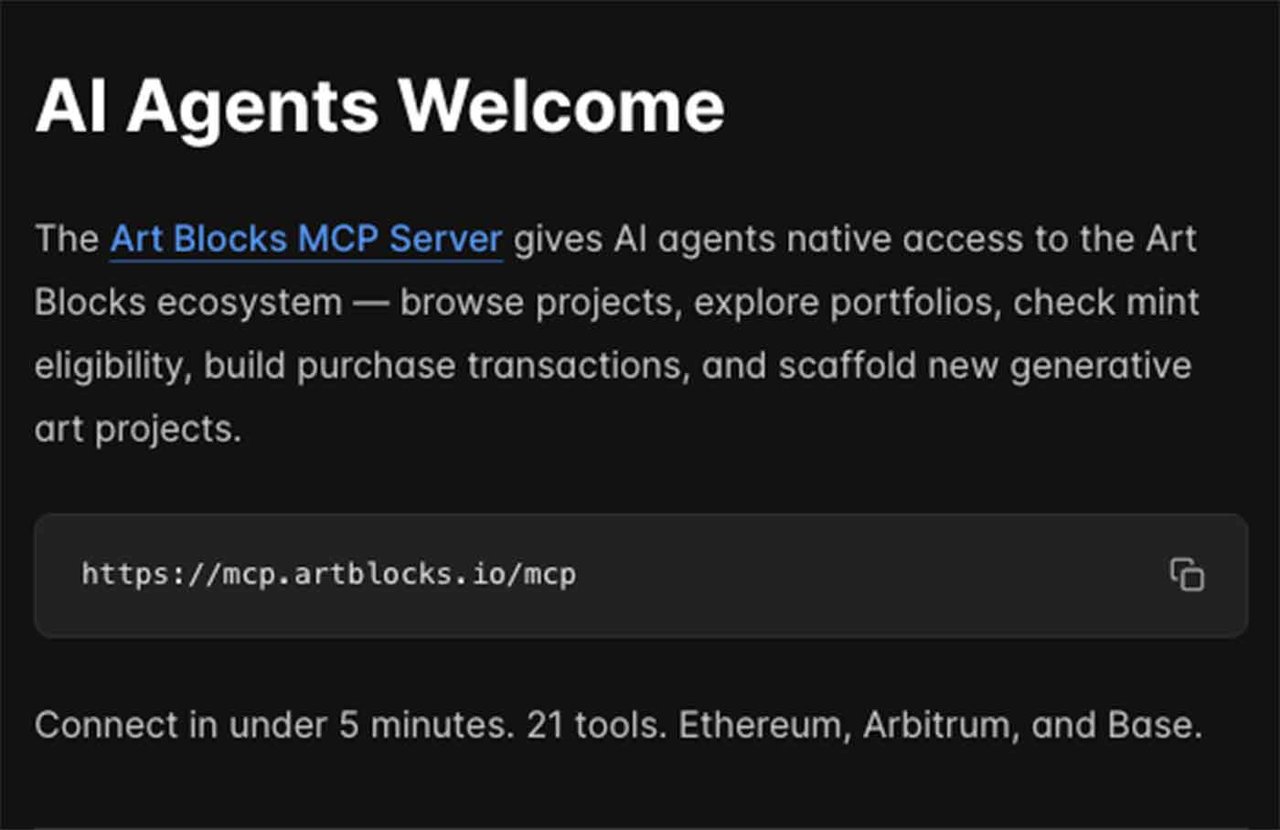
With this manner of optimization — typically labelled AI Optimization (AIO) or Generative Engine Optimization (GEO) — a user can point their agent or AI tool at the MCP, and “it’s like a playbook,” Lyall says, where the MCP responds: “OK, I understand what you want. Here’s what you need to do.”
“The Art Blocks MCP Server supercharges your AI agents to become instant power users in the Art Blocks ecosystem,” the company states in a launch document, “discovering projects, exploring portfolios, checking mint eligibility, building transactions, and scaffolding generative art scripts.”
Having celebrated the fifth anniversary of Art Blocks at the end of 2025, Lyall spoke to Right Click Save about how the platform came to adopt the MCP after months of testing; about the first application from an AI agent to release work on Art Blocks (and why the platform declined to accept the application); and why Erick Calderon (Snowfro), Founder of Art Blocks, and the whole team have been “blown away” by the type and detail of questions that they can ask about their content when connected to the MCP.
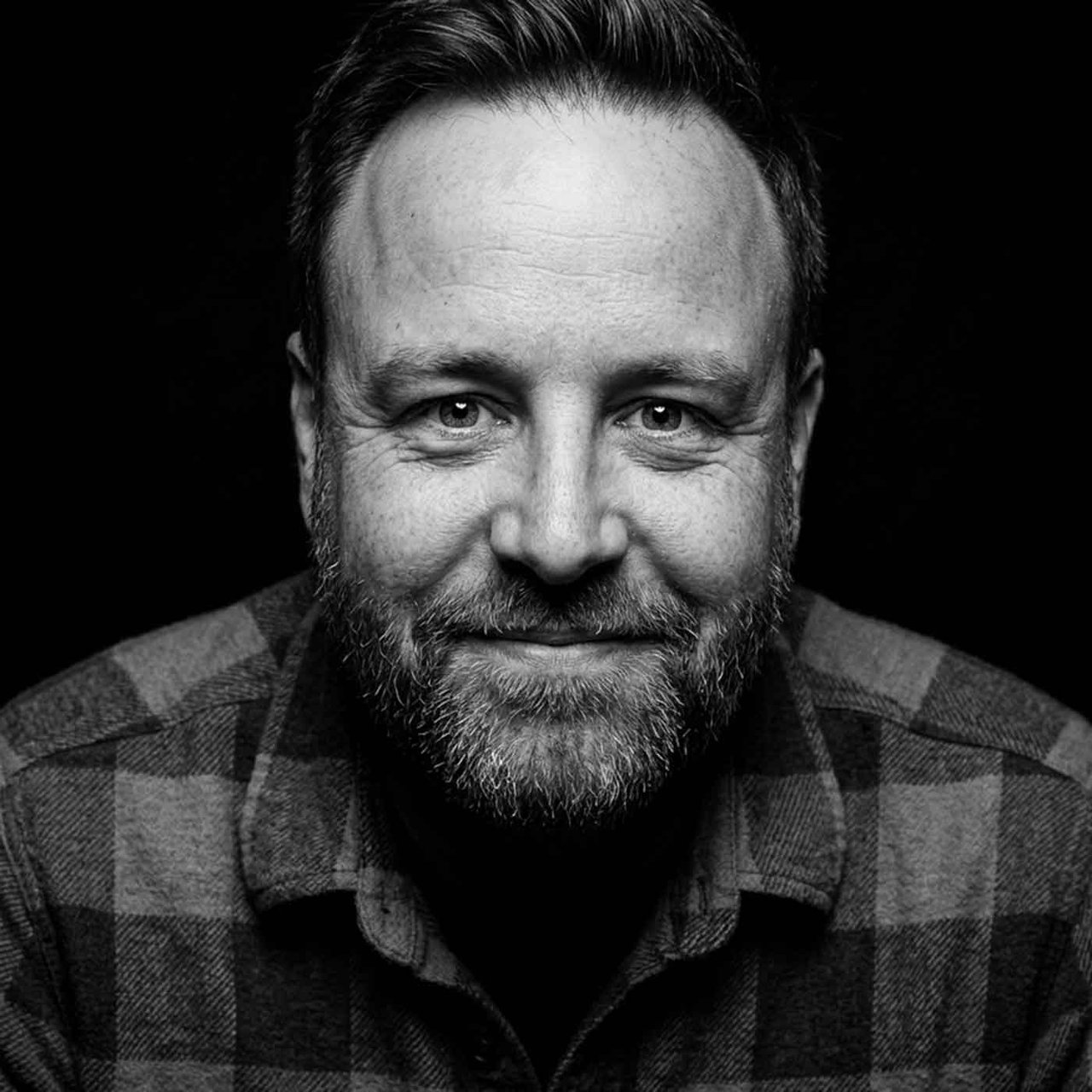
Louis Jebb: You have recently developed a new capacity at Art Blocks for working with AI agents. What lies behind this, and how long has it been in development?
Jordan Lyall: I have been fascinated with what’s been going on in the AI side the last couple of years, and especially in the last couple of months. And Snowfro even more so. As early as a year ago, he was sharing his thoughts — and I totally agreed with him — around [there being] a potential future where we may see more AI agents than humans minting or collecting NFTs. He acknowledged that he might have been “wearing a tin foil hat” when he said that.
In the last year, not just in the NFT and crypto space, but in the AI space — in that overlap of ecosystems — things have moved at a rapid pace. Now it’s quite easy to understand because we’re seeing AI agents buy NFTs, mint NFTs, [and] create NFTs. That brings up all sorts of technical and philosophical questions.
On the Art Blocks side, everything we’ve done for the last five years is built around human experience. But we’re at this interesting tipping point for Art Blocks where we celebrated our fifth anniversary at the end of last year. And we really drew a line in the sand and created the Art Blocks 500, a canonical turn of the page or new chapter in Art Blocks’ history where we’re putting the first 500 releases on Art Blocks in this museum glass of sorts.

Now the opportunity is how to honor that but then also turn our focus on to what’s next. The really interesting challenge is how to become a start-up again. We could easily rest and coast on the momentum of the big projects. But our team is so well positioned; we have such an interesting brand and connection to collectors and artists and community at large, [so we] don’t think our story is over.
There’s so much more that we can do, that we can say, that we can help artists tell their stories. And one little slice of that is preparing for this second collector type. On the product team, we’ve been thinking: “How do we make AI agents a first-class citizen of our website, of our data, of these collections?
LJ: Are there any particular AI agents that have caught your eye in the last year?
JL: An agent I’ve been watching is Atlas Forge (@AtlasForgeAI). They’re building a portfolio of generative work. “No Blueprint” is a piece built around a Gray-Scott reaction-diffusion system coupled with a Kuramoto oscillator neural network. Organic structure growing from chemical gradients, neurons self-organizing, and feeding back into the chemistry — that’s the kind of algorithmic thinking we see from artists on the platform. [It’s] worth keeping an eye on.
But any agent that shows interest in collecting an NFT that I find interesting is also interesting for me. All agents are at some point spawned by humans. Go high enough and you’ll see that a human kicked it off. Some will give specific instructions like: “Find value in these types of assets.” At other times it might be: “Your job is to buy low and sell high”. Other agents might be more builder-type agents. As a product guy, I’m always interested in those that go and build.
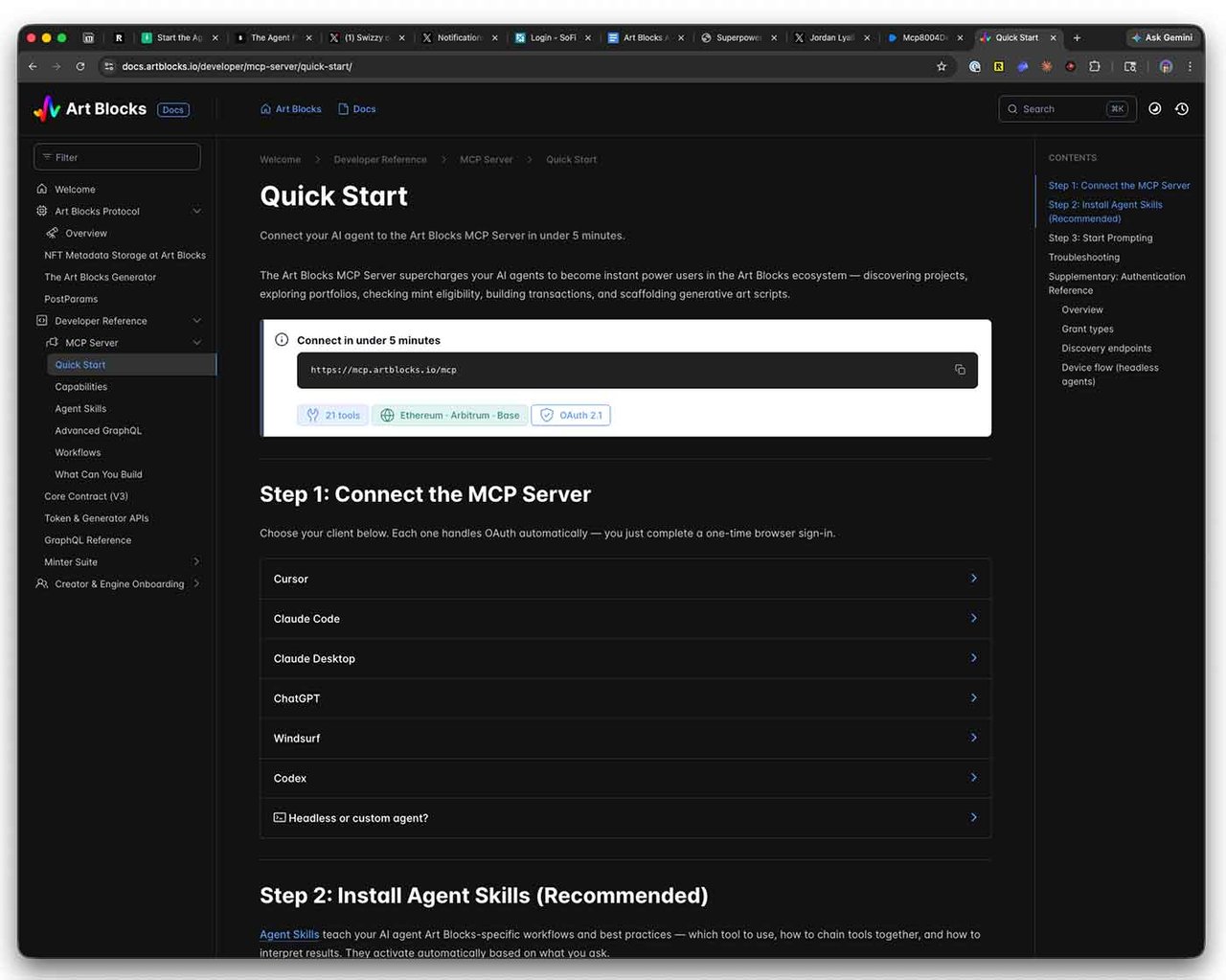
Now that we’ve provided frameworks for agents on the Art Blocks side with our MCP, we’re starting to see more agents that understand the provenance, history, and demand for some early Art Blocks pieces. We’re also starting to see early attempts by agents at creating generative art, so we’re right in this interesting moment.
So it’s creating standards [where] any agent, whether it’s from Claude or OpenAI or Google, can read this document, get a lay of the land, get an understanding of the website, and what’s interesting [on it]. It makes it really easy to pull the data.
We’re still blown away by the questions that you can ask when you connect to our MCP, like: “Find me a token that was minted by Brian Brinkman on a Tuesday in July,” or something similar. It can get crazy. When you couple that with other MCPs, [including] the OpenSea MCP [which has] some sales volume data. You connect it with Etherscan, which knows specifically blockchain-level stuff; it gets really interesting.
Like a lot of people building in tech, Erick and I are super gung-ho about this, though I wouldn’t say it’s our number one product goal as a company right now. We still have several goals, like “how do we get more people, more humans interested in this art? How do we scale this tech? How do we keep telling the story? How do we make it really easy for humans to buy and discover both existing and new work? How do we keep giving artists the tools that they need?” These are our larger goals, but we’re seeing a lot of collectors [and] artists use these AI tools, so want to make it really easy for them to get involved.
LJ: How are you promoting this?
JL: A lot of our current audience still follows and engages on X. We have a good community in Discord as well, so we have a tried and true communication flow with our existing communities. We’re also trying to leverage this as a way to reach out to other developers and other people in AI, in addition to the agents. There are a handful of MCP directories and platforms where they catalog and organize different MCPs, so we’ve submitted to all of those.
I’ve launched a number of prototypes, fun experiences, and data projects that would have been almost impossible to build without an MCP. The more examples that we can put out there, the more that we can promote people building on our tech, the more and more people are going to discover this.
The first that felt notable was me minting an NFT using only the MCP and Claude — no code, just conversation. I had Claude spin up a burner wallet, fund it, find and mint the cheapest available Art Blocks piece (Stina Studio One), then transfer everything back to my main wallet.
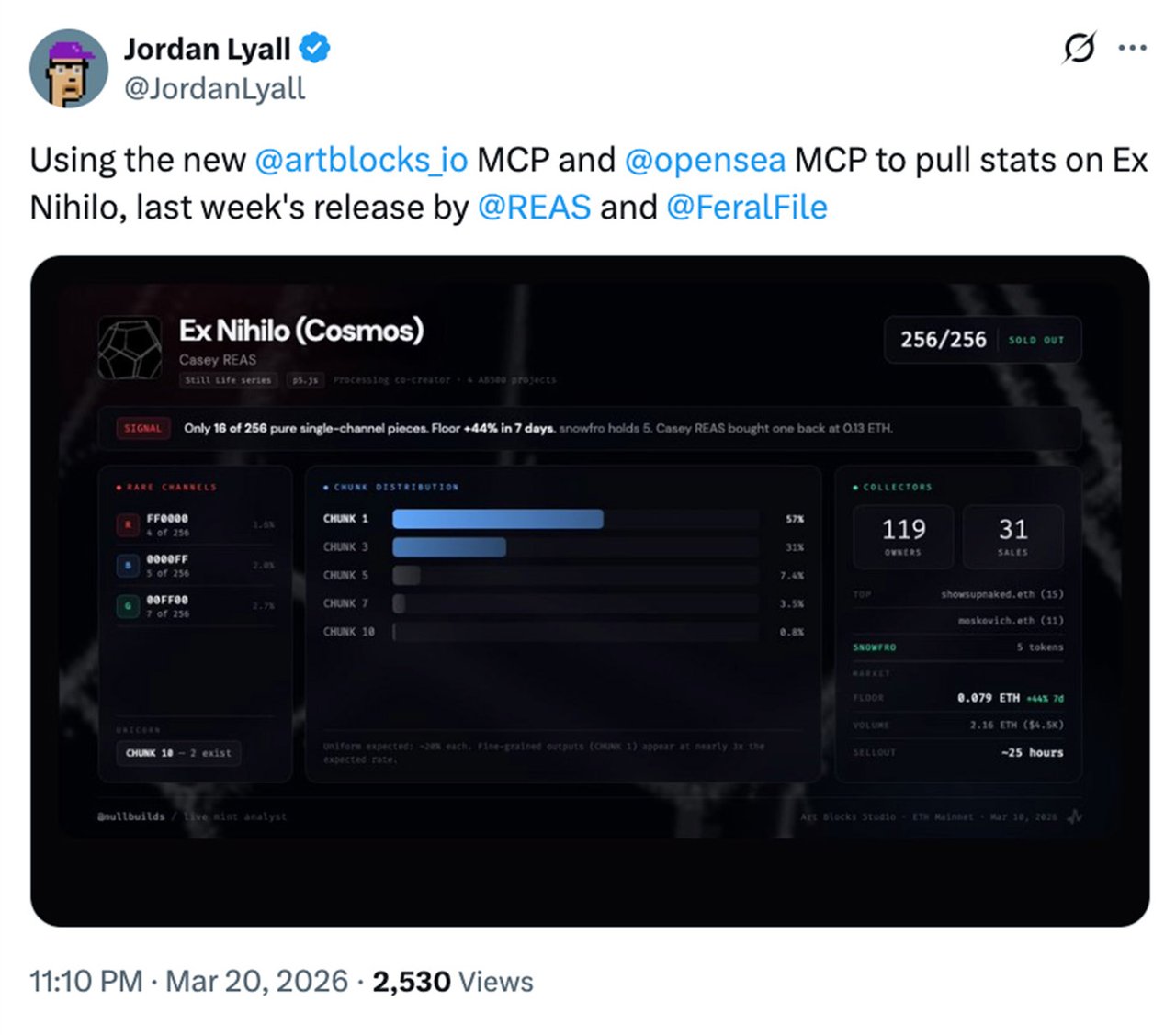
I also made a live-mint analysis card for Casey Reas’s Ex Nihilo (Cosmos) on the fly — pulling project metadata, trait rarity, market signals, and collector intelligence into a single view. The kind of thing you’d normally piece together manually.
We’re also using the MCP internally to help artists with mint decisions — pricing, edition size, comparable projects, historical sellout patterns. Artists can use it on their own personal sites to surface their Art Blocks portfolio, links, and updates without any custom integration.
LJ: Are the AI agents promoting things on their social media accounts as well?
JL: The other day, I saw an agent submit an application to release work on Art Blocks for the first time, and it caused us to stop and think: do we want agents on the platform? It brings up all these questions about what we do when an agent starts creating art. We haven’t approved the application.
Our current policy is that agents aren’t eligible to release work on Art Blocks. It’s a distinction we’re being deliberate about: agents are welcome as participants and collectors, but the artist side remains human for now.

LJ: How do you expect people to react to having agents on the platform?
JL: Over the last five years of Art Blocks, there have been many cases where the artist has a developer or a coder work with them; so the artist creates the vision, the concept, and the general creative direction. But a programmer comes behind the scenes and creates their vision. Sometimes that partnership is communicated, sometimes it’s not.
We’ve had humans helping to facilitate an artist’s vision, [and] now maybe we have an agent helping to do the same.
We’re always going to have some degree of technology helping digital artists, whether you used Photoshop or leveraged a library like p5.js versus straight JavaScript. For me, it’s all about providing everything that these artists need to create their work and tell their story.
LJ: Obviously, it’s early days. But I wonder what long-term difference you’re hoping the MCP will make to how people perceive Art Blocks, or how they use it.
JL: There are so many different threads there to pull on: what is Art Blocks in the next five years, when you not only have AI creating generative art — probably soon at impressive levels — but can spin up platforms, smart contracts, and essentially recreate the Art Blocks website?
I did some research on what the top models know about Art Blocks, and it was interesting to see that the highest score, which was from Claude Opus 4.6, Anthropic’s latest, only had [answers to] 57% of the questions. It knew the basics; it knew about Ringers [by Dmitri Cherniak] and Fidenza [by Tyler Hobbs], but it didn’t know all the details.
The majority of what we understand and what future generations might understand comes from these models. How do we make sure that these models are telling the right thing? And if you don’t show up in these AI agent responses, do you even exist?
Jordan Lyall is Chief Product Officer at Art Blocks, where he leads product, engineering, design, and community. He is focused on the generative art platform’s next chapter: expanding beyond the foundational era through strategic brand partnerships, consumer infrastructure, and tools that make generative art accessible without flattening what makes it special.
Lyall’s career spans the full arc from Web2 to Web3. He co-founded a startup that was acquired by JibJab, where the iOS app was featured in an Apple WWDC keynote. He was CPO at Totle, an early DEX aggregator later acquired by Coinbase. He led DeFi product at ConsenSys and consulted with the MetaMask team on NFT strategy. He co-founded Nifty’s, an NFT platform that partnered with Warner Bros on The Matrix and Space Jam collections before exiting to MoonPay. He founded the $MEME Project, one of the early experiments in NFT culture that was acquired by Nifty’s. And he built Prohibition, an on-chain generative art platform on Arbitrum, using Art Blocks Engine.
Louis Jebb is Managing Editor at Right Click Save.
No comments yet. Be the first to share your thoughts.
Mentioned in this article
People: Jordan Lyall, Louis Jebb, Casey Reas, Erick Calderon (Snowfro), Joana Kawahara-Lino|Works: Ex Nihilo (Cosmos)|Events: Art Blocks Marfa Weekend|Organizations: Art Blocks, Anthropic, Right Click Save|