Speculative Visions at the Munch Triennale - Right Click Save
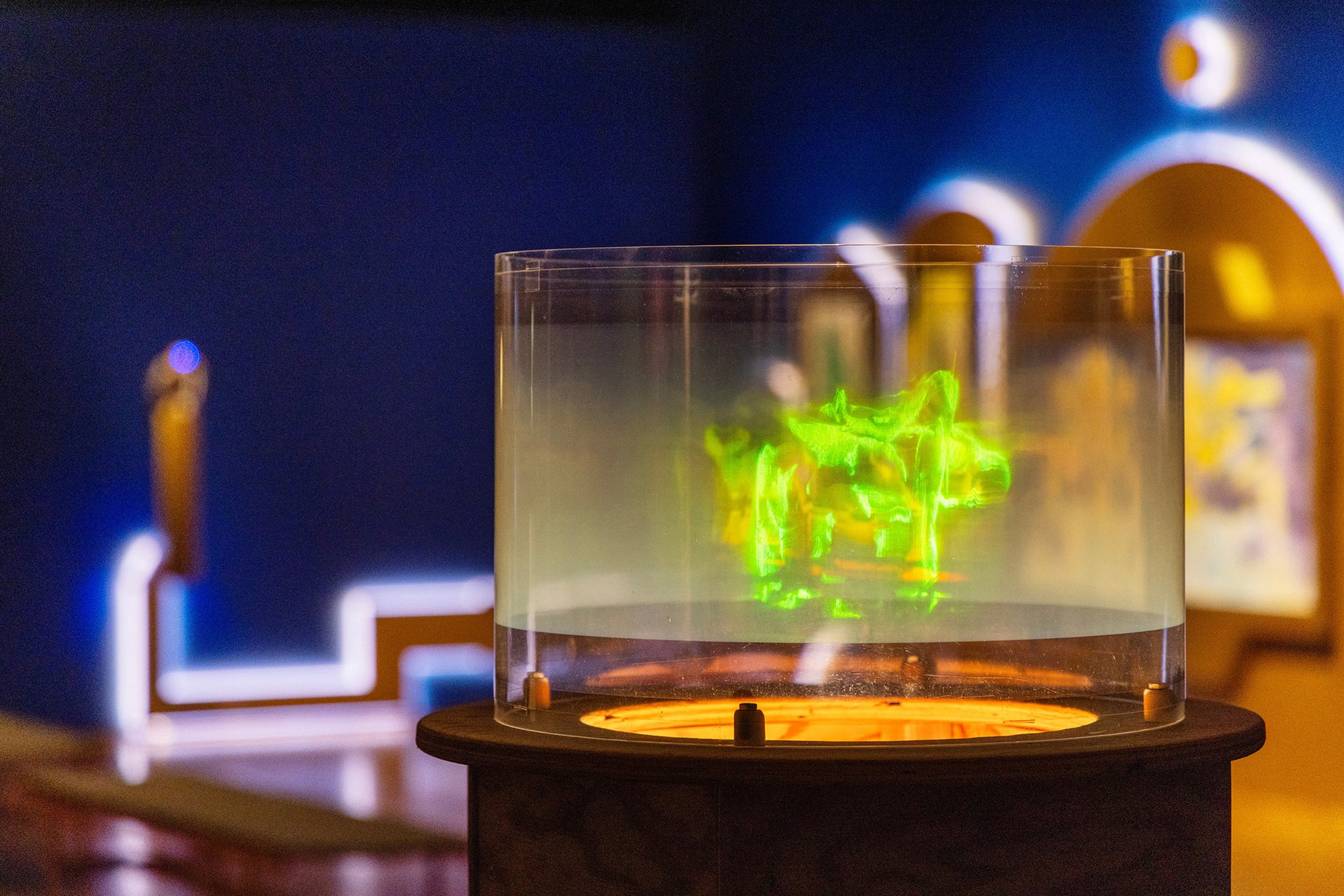
Credit: Simone Forti, Huddle (1975–78). Installation view, “Almost Unreal”, Munch Triennale, Oslo. Photography by Ove Kvavik/Munch. Courtesy of the artist and Munch
“Almost Unreal”, the 2025 edition of the Munch Triennale, curated by Tominga O’Donnell and Mariam Elnozahy, is at Munch, Oslo, the museum home of the world’s largest collection of works by Edvard Munch (1863–1944), until February 22, 2026.
“Almost Unreal” builds on, and differentiates itself from, the first iteration of the MunchTriennale in 2022, which followed the theme “The Machine Is Us”. That exhibition coincided with a general recognition of a digital transformation impacting society following the global pandemic and the emergence of AI into mainstream consciousness.
The 2025 Triennale confronts the aftermath of this digital deterritorialization, adopting a Janus-headed approach that looks back towards craft-based techniques of weaving — which form a direct continuity in their binary dimensions with the computational — while at the same time glancing forward to encourage speculative visions of the future. 26 works are featured by artists from a diversity of cultural backgrounds and locations.
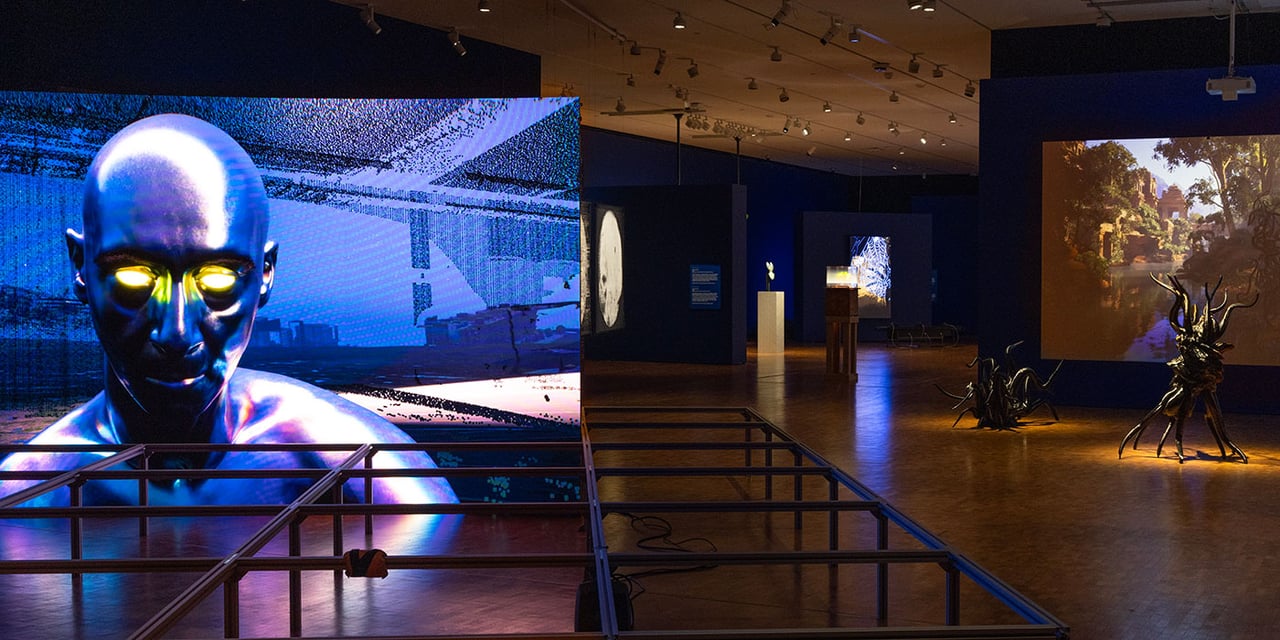
Installation view, “Almost Unreal”, Munch Triennale, Oslo. Photography by Ove Kvavik/Munch. Courtesy of the artists and Munch
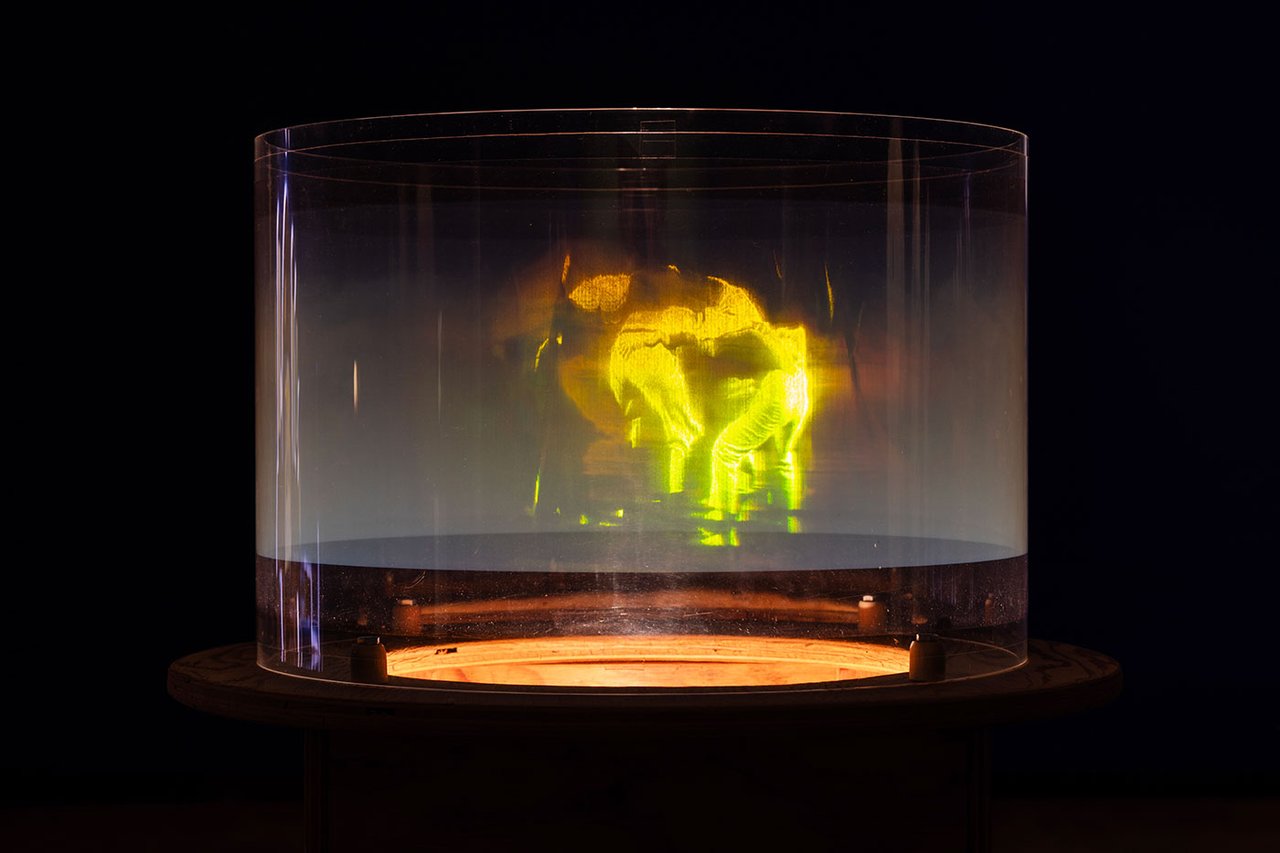
Writing in the exhibition catalogue, Mariam Elnozahy, director of the exhibition space Konsthall C, in Stockholm, and co-curator of “Almost Unreal”, notes the importance of holography to the curatorial vision, exemplified by Huddle, a work from the mid-1970s by Simone Forti, that greets the visitor as they enter the gallery. “In the small scale of the cylindrical hologram, you can see an apparition of a group of bodies, holding each other tightly in a group embrace,” Elnozahy writes. “And how beautiful: parts constituting a whole. Discrete bodies and distinct entities becoming indistinguishable in their totality. Explicate forms unfolding from implicate forms in one holomovement. A group hug.”
Elzohany highlights how Forti, a choreographer, had the idea in the 1970s, in dialogue with a physicist, of converting certain dance moves into three-dimensional holographic projections that “allow an illusion of movement, which becomes evident when the viewer moves around the hologram”.
She observes further how Forti’s multi-holographic work “underscores the proposition at stake in the [whole] exhibition: that the technologies of control, exclusion, and violence that are written by social media platforms such as X, or gaming worlds such as [Grand Theft Auto], can be thwarted, refused, rewritten. In Forti’s Huddle, the blurring of bodies in the holographic field resists the logic of separation; the collective embrace becomes an act of refusal. Maybe the group hug can offer interconnection as a countermeasure to isolation, tenderness as an answer to fragmentation”.
Simone Forti, Huddle, 1975-78, Installation view, “Almost Unreal”, Munch Triennale, Oslo. Photography by Ove Kvavik/Munch. Courtesy of the artists and Munch
Elnozahy’s co-curator, Tominga O’Donnell, contemporary art lead at MUNCH, tells Right Click Save that the exhibition title harks back to a song sungin Super Mario Bros. (1993), the first film made of a video game, while simultaneously reflecting the present popularity of Unreal, a game engine used by “many of the artists selected”. For O’Donnell, “‘Almost Unreal’ refers to a current moment in which the division between the real and the unreal is becoming increasingly uncertain.
“Recent technological developments enable the creation of simulated, augmented and enhanced realities, which destabilises the idea of truth and veracity. Anything can be faked, so what can you trust?” (Tominga O'Donnell)
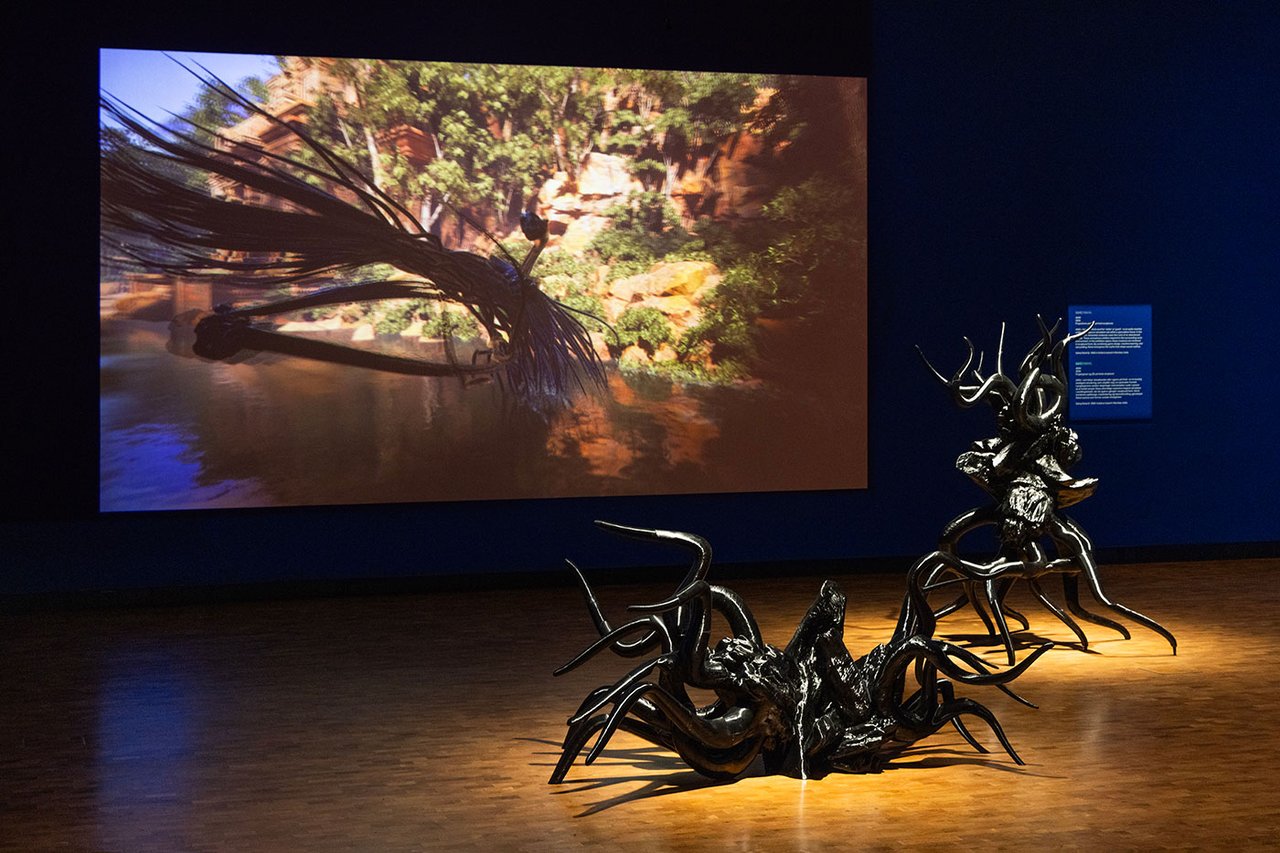
The resulting exhibition takes this question in various novel directions while also pointing back towards more static, less permeable, forms of art and craft production, by including several woven works and using a display architecture that simulates elements of scaffolding, and videos lodged within what look like primitive stone structures. The need for audiences to learn to crouch a little to view Forti’s holographic work in its true color dimensions, and to recognize that if they make some noise in the adjacency of Sahej Rahal’s audio-reactive AI simulation, Atithi, they can change what appears on the screen, are amongthe most appealing aspects of the curatorial offer.
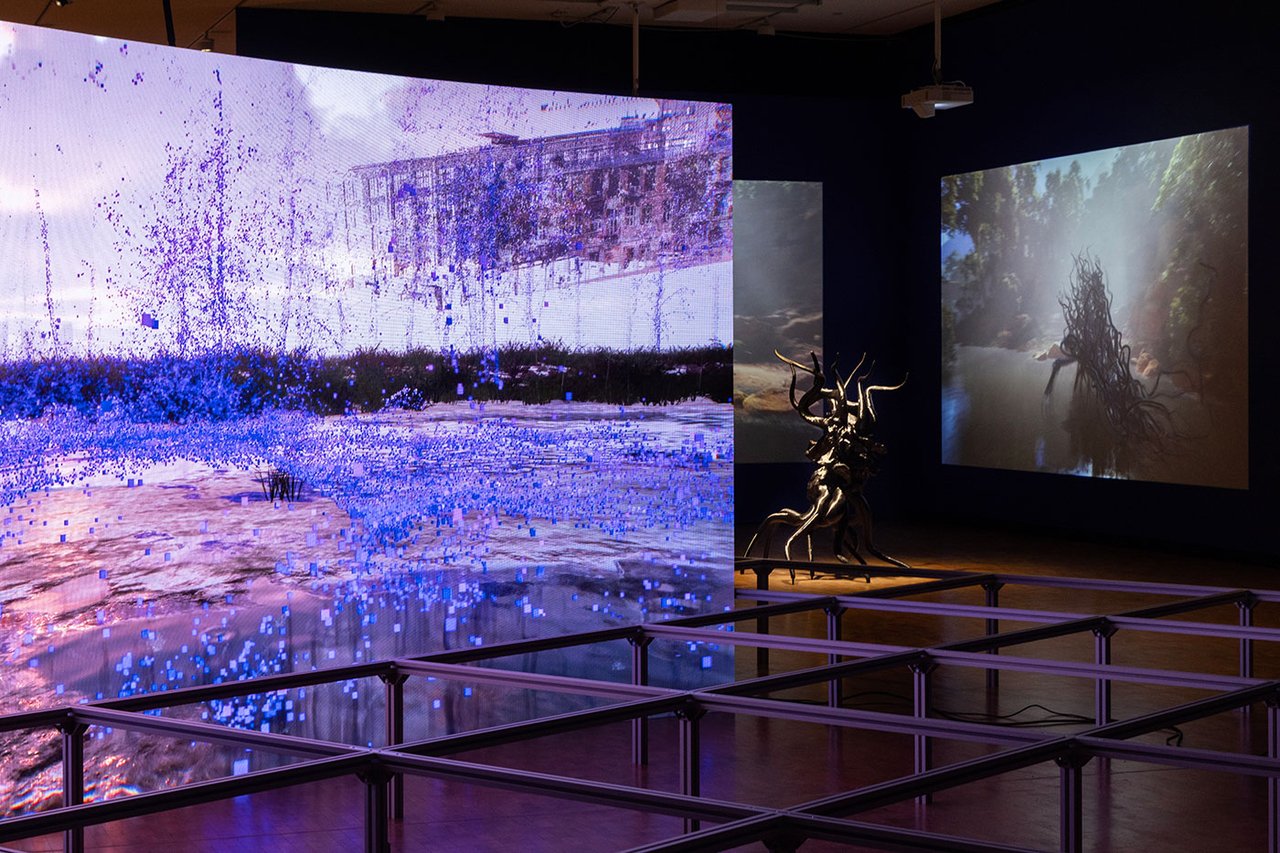
Infopsin, Patch Opal (2025, left) and Sahej Rahal, Atithi (2025). Installation view, “Almost Unreal”, Munch Triennale, Oslo. Photography by Ove Kvavik/Munch. Courtesy of the artists and Munch
Such light-touch and rather joyful interactive possibilities are not the whole story. Visitors as they wend their way around the main gallery encounter a series of rather lengthy videos and video games that seek to draw them in more closely. Many demand a considerable amount of time in order to appreciate their unfolding.
Without watching a significant part of the 38-minute-long audio-visual hack by the Palestinian-born artist Firas Shehadeh, of the Grand Theft Auto v Dreamcore video game, the visitor might miss entirely the substance of what is on view; that, as the dimly-lit title card states, “draws parallels between the fictional city of Los Santos and colonized Palestine”. This, the third iteration in Shehadeh’s series Like An Event in Dream Dreamt by Another — Dreamcore, is a new commission for the Triennale.
So too is Patch Opal (2025), a wide-screen audio-visual installation by the Lithuanian artists Infopsin. Lasting 20 minutes, made with Unreal gaming software and utilizing the realism of LiDAR scanning technologies, it rewards those with time to spend in close listening and viewing, beyond a superficial glancing at the spectacle of an evidently post-Anthropocene narrative. Its message, of how creatures who survive a seeming environmental apocalypse may have to begin again, learning to mirror each other, but “without touching”, is played out in front of a scenography in which parts of the Oslo fjord are recognizable.
It seems to go beyond the real and the unreal into a zone of hyperreality, as a technocultural progression that LiDAR helps to faciliate remarkably.
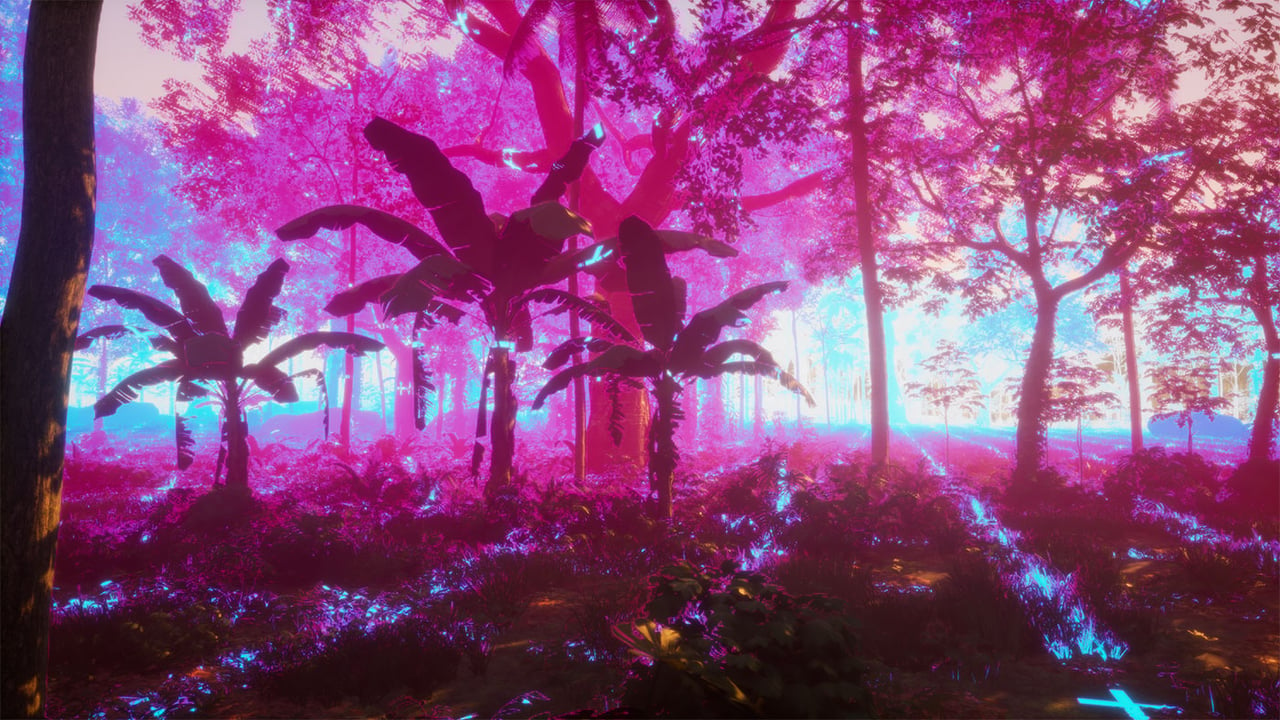
Alice Bucknell, Earth Engine: Ground Truthing (2025). Courtesy of the artist and Munch
A newly commissioned video, Earth Engine: Ground Truthing (2025), by the Los Angeles-based Alice Bucknell (and collaborators), addresses “the fantasy of a world that can be measured and controlled through predictive technologies”. The piece articulates with authoritative precision, as well as creative intensity, these technologies’ controlling lines of force — perhaps the same technologies of control that Elzohany identified in her catalogue article — while foregrounding, in “Palm Royale”-style color tones, the importance of paying attention to what is actually happening on earth and underground, from tectonic plates to mycelial and plant root systems.
Lasting fifteen minutes, Bucknell’s work is a critical intervention in contemporary art’s repositioning in, and critique of, the era of big, extractive data. It deserves to be seen more widely. An accompanying video game meanwhile invites interaction.
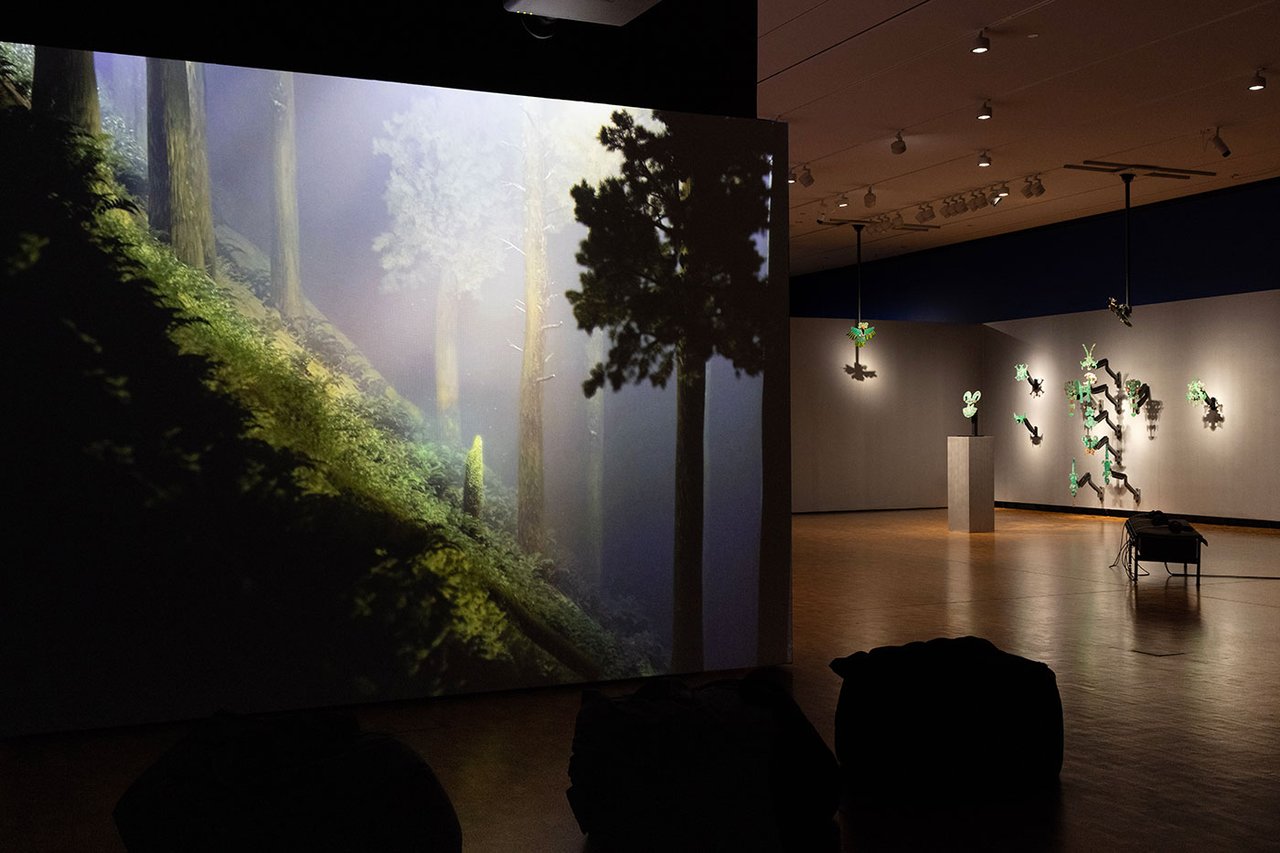
Another lengthy video demands a considerable degree of patience from the viewer. Finding Bambi (2023), by the Swedish artist Sven Pahlsson,runs for 25 minutes, with only subtle variations in what we see during this period. The curators place significant emphasis in their promotional narrative on the fact that Pahlsson made the work “by hand” using Blender, rather than a game engine such as Unreal.
Sven Pahlsson, Finding Bambi (2023, foreground). Installation view, “Almost Unreal”, Munch Triennale, Oslo. Photography by Ove Kvavik/Munch. Courtesy of the artist and Munch
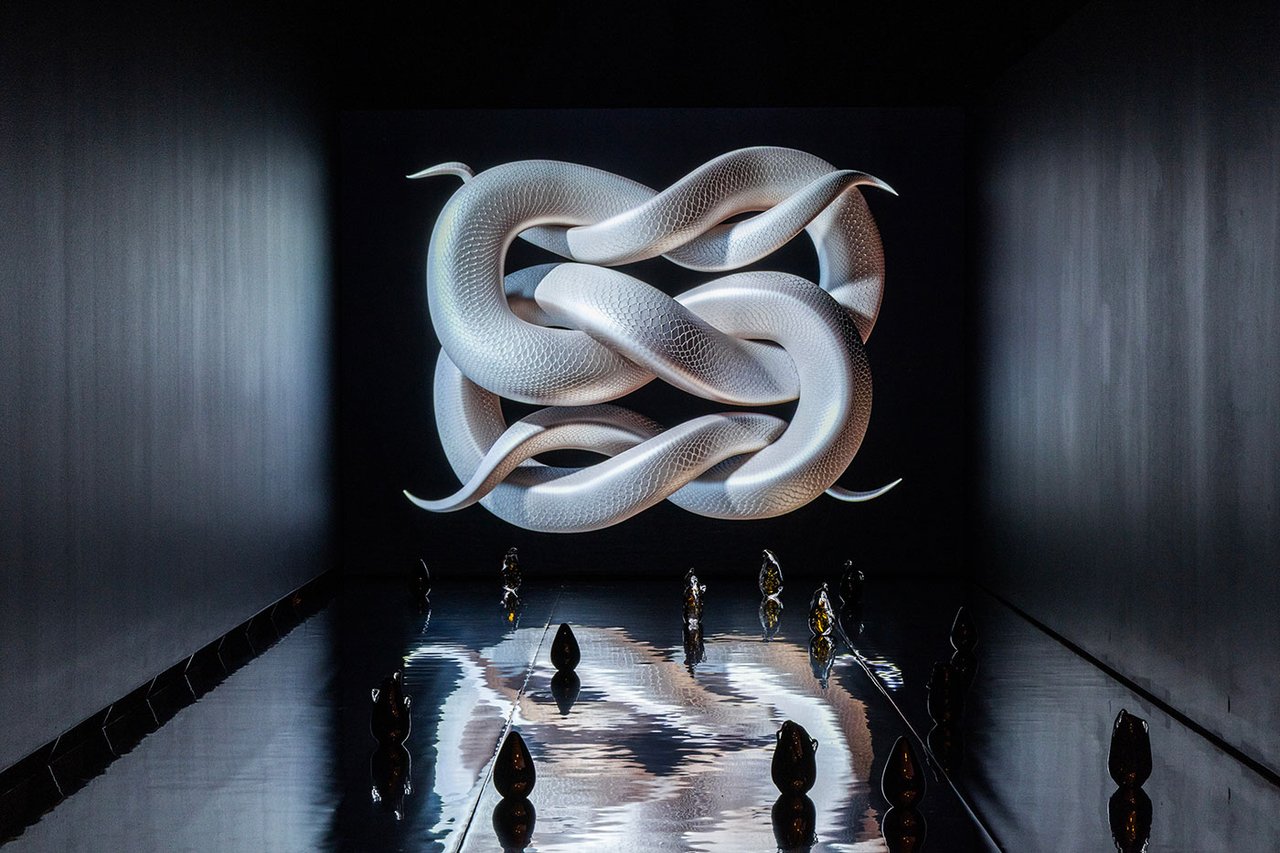
A sense of ethereality meanwhile pervades If Water Could Weep (2023), by the Lithuanian-born artist Emilija Škarnulytė, who describes her practice as existing “between the realms of the documentary and the imaginary” and as engaging with “deep time and invisible structures”.
In a single-room installation that the viewer is invited to gaze into yet does not feel free to enter, the artist conjures up hidden properties shining below surfaces of blackness, that simulate the depths of water as a portal to hidden mythological creatures, such as goddesses and sea creatures.
Škarnulytė tells Right Click Save that her ecologically and cosmically related work often engages with “dead zones” in oceanic and river waters, as a consequence of human pollution and despoliation of natural resources.
Emilija Škarnulytė, If Water Could Weep (2023). Installation view, “Almost Unreal”, Munch Triennale, Oslo. Photography by Ove Kvavik/Munch. Courtesy of the artist and Munch
O’Donnell says that part of the curatorial concern within this exhibition was technology’s “huge cost to the climate (in the energy it demands)”, and how this “accelerates colonial extractionism (in the parts and rare earth minerals required to run)”. She notes too the “immense cost to interpersonal relations (destroying so-called IRL interactions) and to human imagination (as many of us spend hours doomscrolling and succumbing to clickbait” that comes with this territory.
With the exhibition sitting in the Munch museum, home to the defining collection of Edvard Munch’s works, it is difficult to overlook the relationship to the expressivity of Norway’s best-known artist.
The signage to Munch’s masterpiece, The Scream (1893), housed in an upper gallery, indicates that the title refers to a sense that the artist felt on walking through Oslo one evening that “Nature”, as he put it, was screaming.
Sahej Rahal, Atithi (2025). Installation view, “Almost Unreal”, Munch Triennale, Oslo. Photography by Ove Kvavik/Munch. Courtesy of the artist and Munch
The artist duly conveyed this sensation through and within the misshapen layers of different colors that curve around and over and above the face and head of the figure, whose expressive inarticulacy speaks loudly of a sense of horror. Is the figure covering his ears so as not to listen, or focus more closely on what is happening around him? And why does this seem both timeless and contemporary?
In the context of “Almost Unreal”, the multiple iterations of The Scream made by Munch and, later in the 20th century, by Andy Warhol, as well as the picture’s transformation into a much used emoji, become all the more performatively illustrative of the work’s enduring acuity.
Bronac Ferran is a writer, curator, and researcher based in London. She has been commissioned to write exhibition reviews and catalogue essays by, among others, LACMA; ZKM, Karlsruhe; the Migros Museum, Zurich; Tate Liverpool, Tate Modern; the Mayor Gallery; Victoria Miro, London; and Studio International. She is a former Senior Research Tutor in Innovation Design Engineering at the RCA and a former Director of Interdisciplinary Arts at Arts Council England.