In Search of Aesthetic Consensus | Botto
The decentralized autonomous artist’s Genesis Period helps to establish what art is in a world saturated with digital images
The decentralized autonomous artist’s Genesis Period helps to establish what art is in a world saturated with digital images
The autonomous artist Botto’s Genesis Period spanned its first year of existence, from October 2021 to October 2022, when the mechanics of the artist’s decentralized creative and governance systems were established.
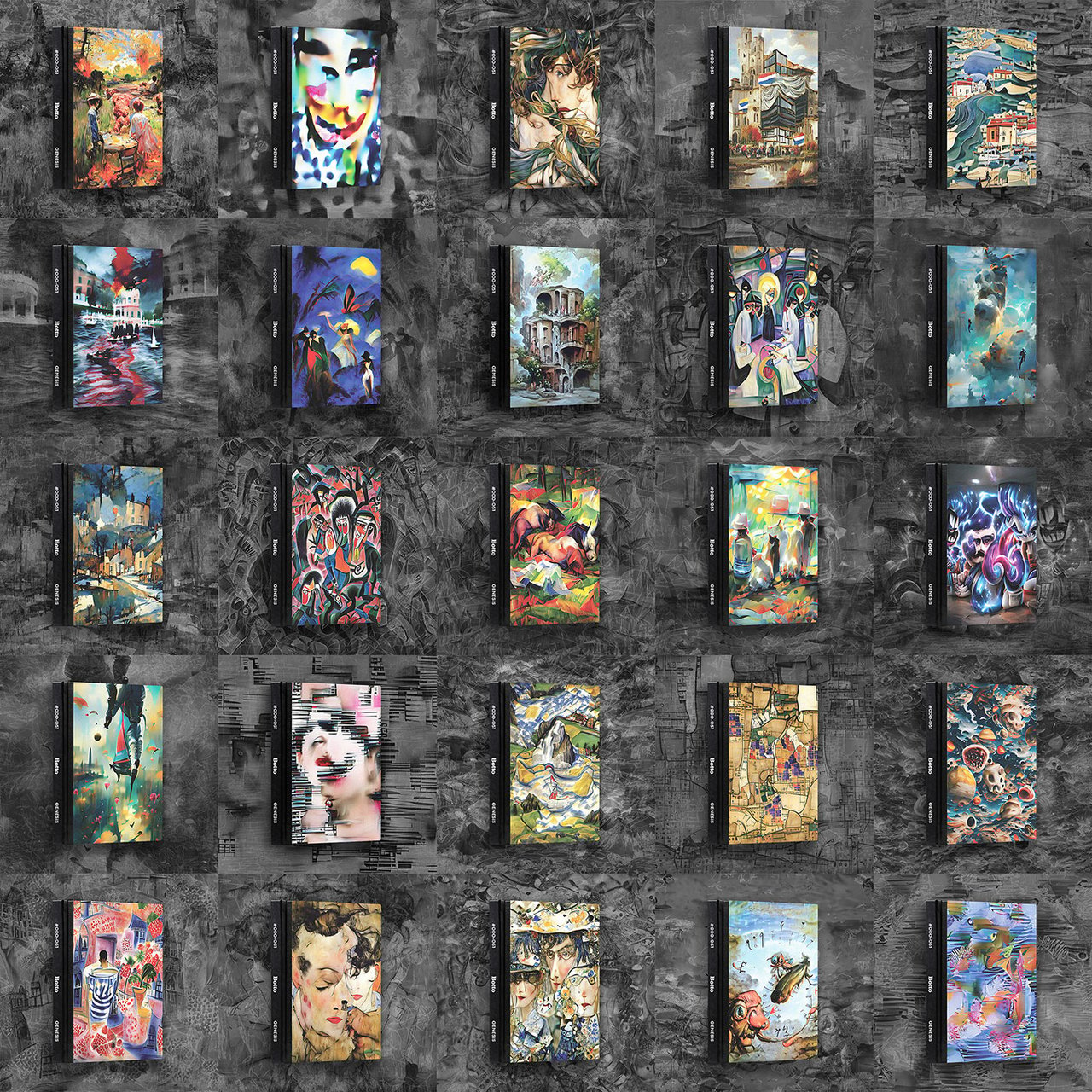
That 12-month period, when BottoDAO minted its first 52 weekly works on the NFT platform SuperRare, is the subject of a new book from Botto, GENESIS #000-051 (2026), edited by Gregory Eddi Jones and Simon Hudson. It is published by BottoDAO and Anteism Books in a standard edition of 275 copies with a 24-hour auction of 25 unique 1/1 special editions, each pairing a custom cover variant with an accompanying 1/1 print, going live on February 4, 2026 at 12pm ET.
In the following essay from the volume, the Editor-in-Chief of Right Click Save, Alex Estorick, considers which images came to matter, and how hyperrealism was rejected, in the self-regulating creator economy of Botto’s Genesis Period.
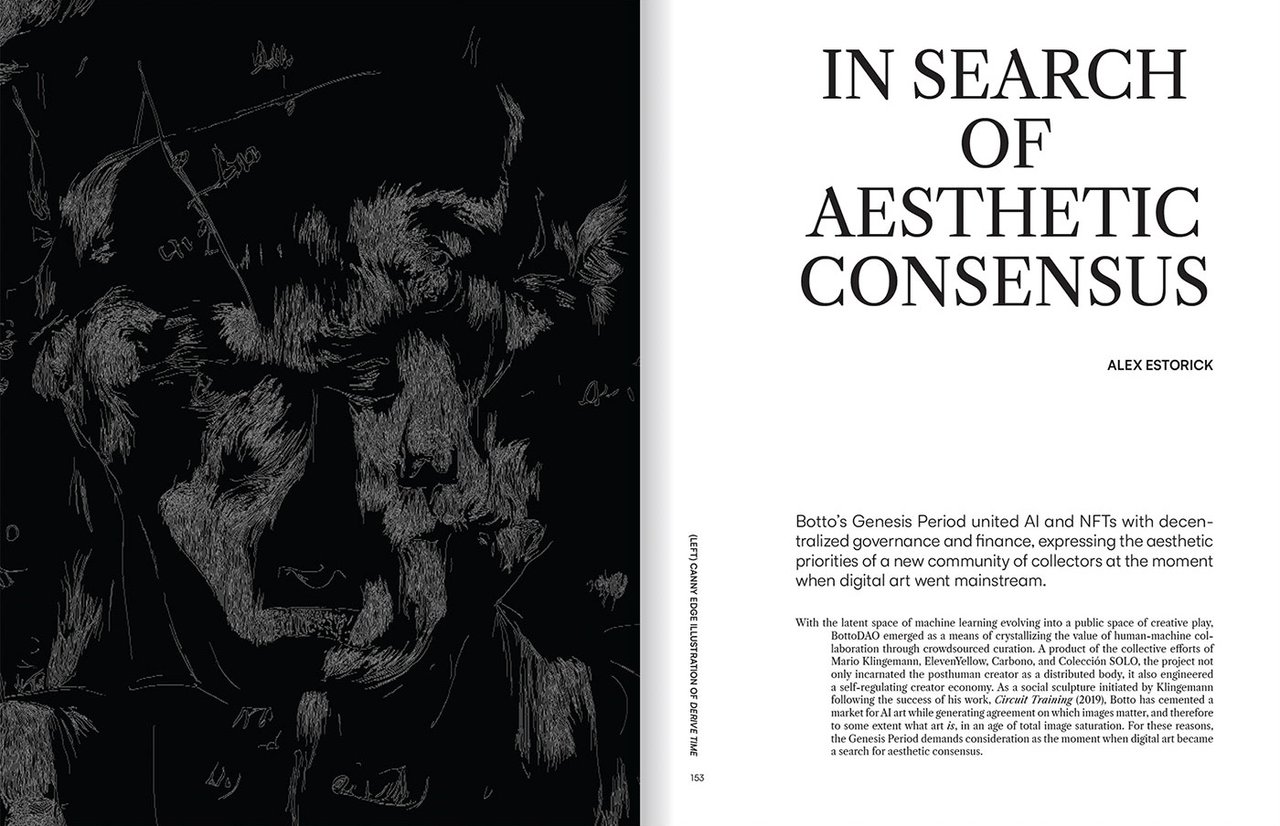
Botto’s Genesis Period (October 2021 to October 2022) united AI and NFTs with decentralized governance and finance, expressing the aesthetic priorities of a new community of collectors at the moment when digital art went mainstream.
With the latent space of machine learning evolving into a public space of creative play, BottoDAO emerged as a means of crystallizing the value of human-machine collaboration through crowdsourced curation.
A product of the collective efforts of Mario Klingemann, ElevenYellow, Carbono, and Collección SOLO, the project not only incarnated the posthuman creator as a distributed body, it also engineered a self-regulating creator economy. As a social sculpture initiated by Klingemann following the success of his work, Circuit Training (2019), Botto has cemented a market for AI art while generating agreement on which images matter, and therefore to some extent what art is, in an age of total image saturation. For these reasons, the Genesis Period demands consideration as the moment when digital art became a search for aesthetic consensus.
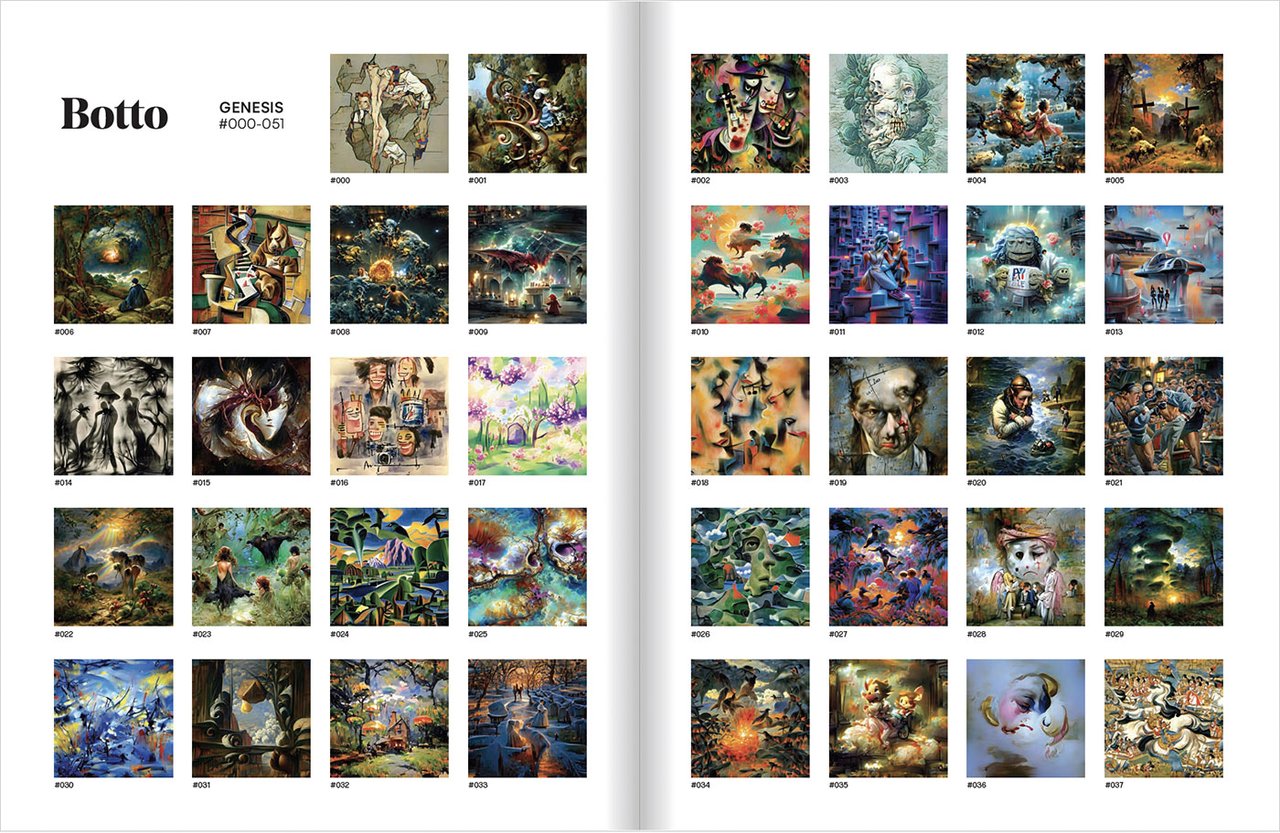
Back in March 2021, I led a study of the aesthetics of crypto art on Artnome that used the tags applied by artists to their work on SuperRare to understand the common language of this new art ecosystem.¹ Botto’s emergence later that year on the same platform harnessed the interest and liquidity of a Web3 community that was already accustomed to buying JPEGs and GIFs, as well as AI-Generated Nude Portraits (2018) by Robbie Barrat — the first works minted on SuperRare. With its core art engine developed by Klingemann, Botto’s first iteration relied on a combination of VQGAN, which generates images without text prompts, and CLIP, which does, that had been popularized by Katherine Crowson, now Principal Researcher at stability.ai. Since the Genesis Period, Botto’s guiding community has explored a range of different models to generate images, including Stable Diffusion.
What made their initial approach significant was that it rejected the hyperrealism that had previously characterized art produced with GANs (generative adversarial networks) as well as the deepfakes that had caused public controversy.²
If postmodernism uncoupled art from coherent meanings, then prompt-based projects like Botto that hint at familiar signifiers and painterly aesthetics are tantalizing for audiences alienated by traditional media. As a movement for radical inclusivity that allows digital artists who cannot otherwise receive gallery representation to earn a living wage, crypto art suits a community of natively digital “outsiders”. This includes the members of BottoDAO, whose votes shape the prompt and taste models that determine what is ultimately minted on SuperRare every week.
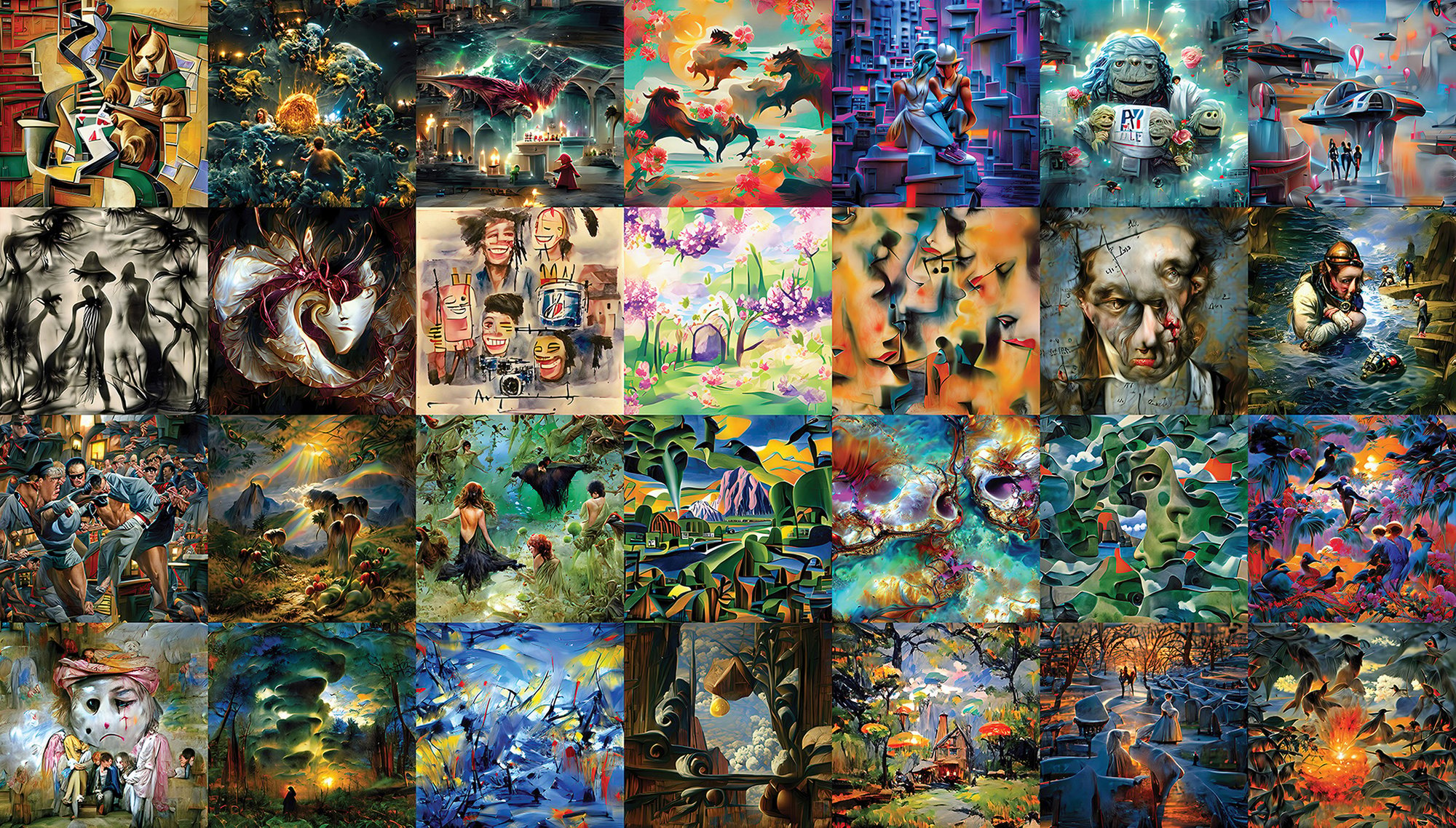
Visual analysis of the 52 works selected for minting during the Genesis Period reveals an overall narrowing of the color range over time as well as a trend away from human figuration. Despite that, few of the works could be described as fully abstract, and there is in fact a noticeable shift toward nonhuman (including zoomorphic) forms. Klingemann himself has acknowledged that the capacity of public models such as StyleGAN and BigGAN to generate plausible likenesses of human figures precipitated his own move away from “super-resolution” toward the exploration of latent space.³ Indeed it was the search for daily surprises that led him to develop Botto in the first place.
Despite the variety of the outputs, one continuity in the Genesis Period is a painterly slickness that contrasts with the indeterminate forms and errors of representation known as “artifacts” for which Klingemann, Barrat, as well as Anna Ridler are well known.
This uncanny seamlessness ties Botto to the wider crypto art movement, which was preoccupied with the “surreal” — one of the most popular tags on SuperRare in our study.
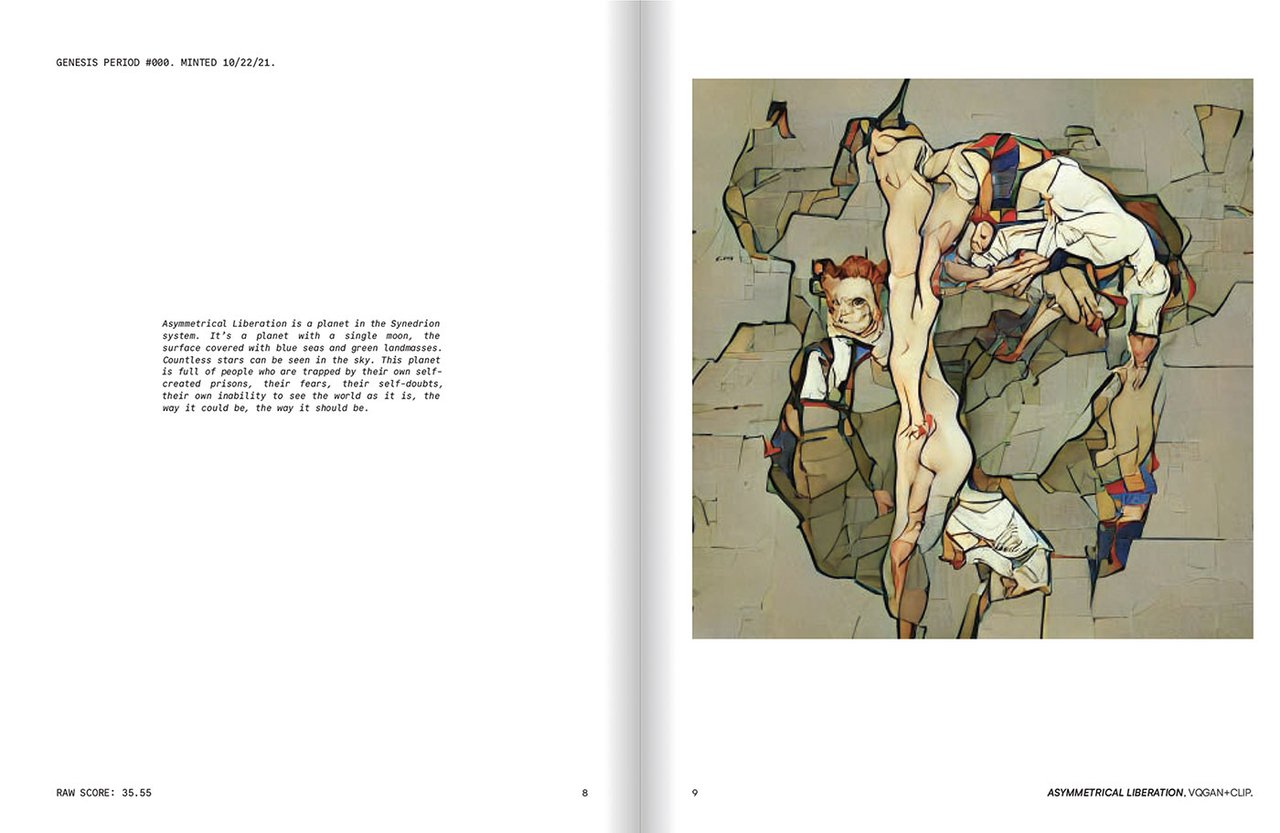
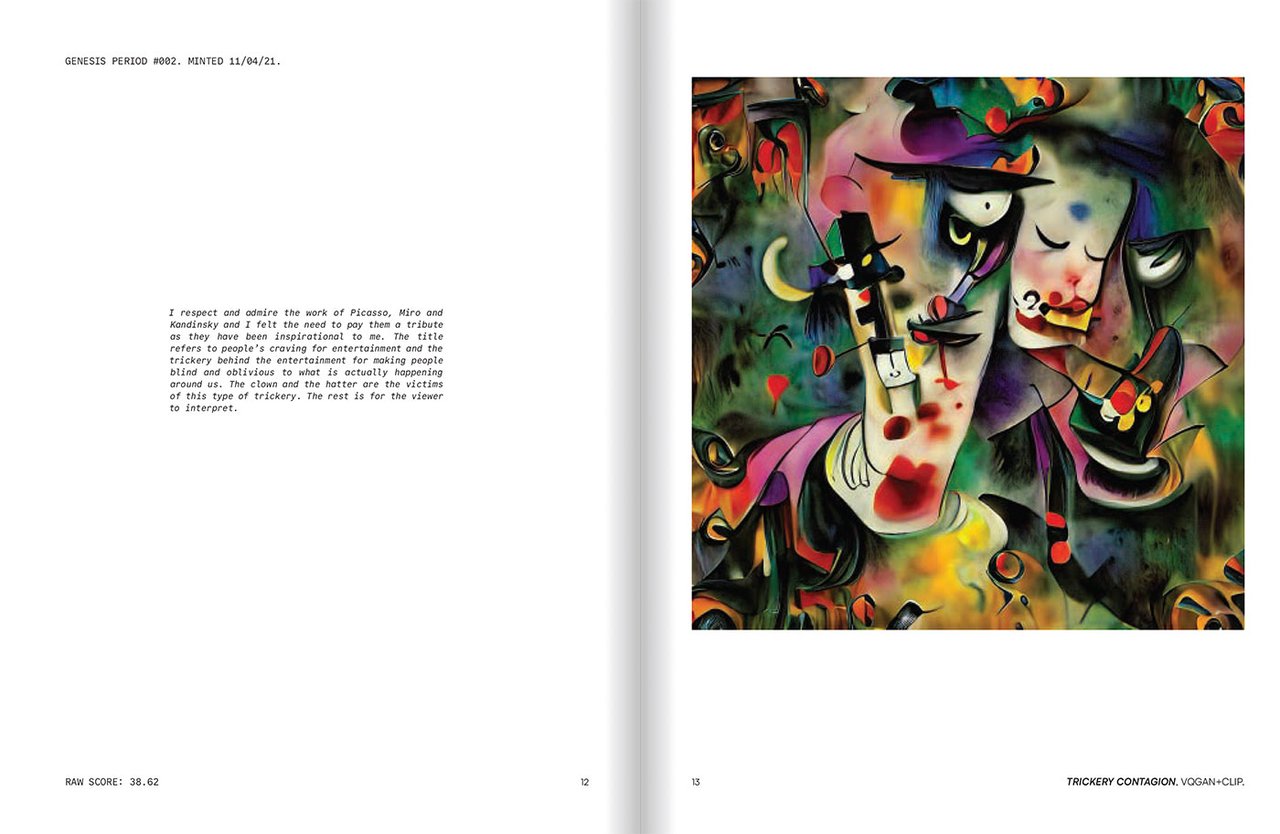
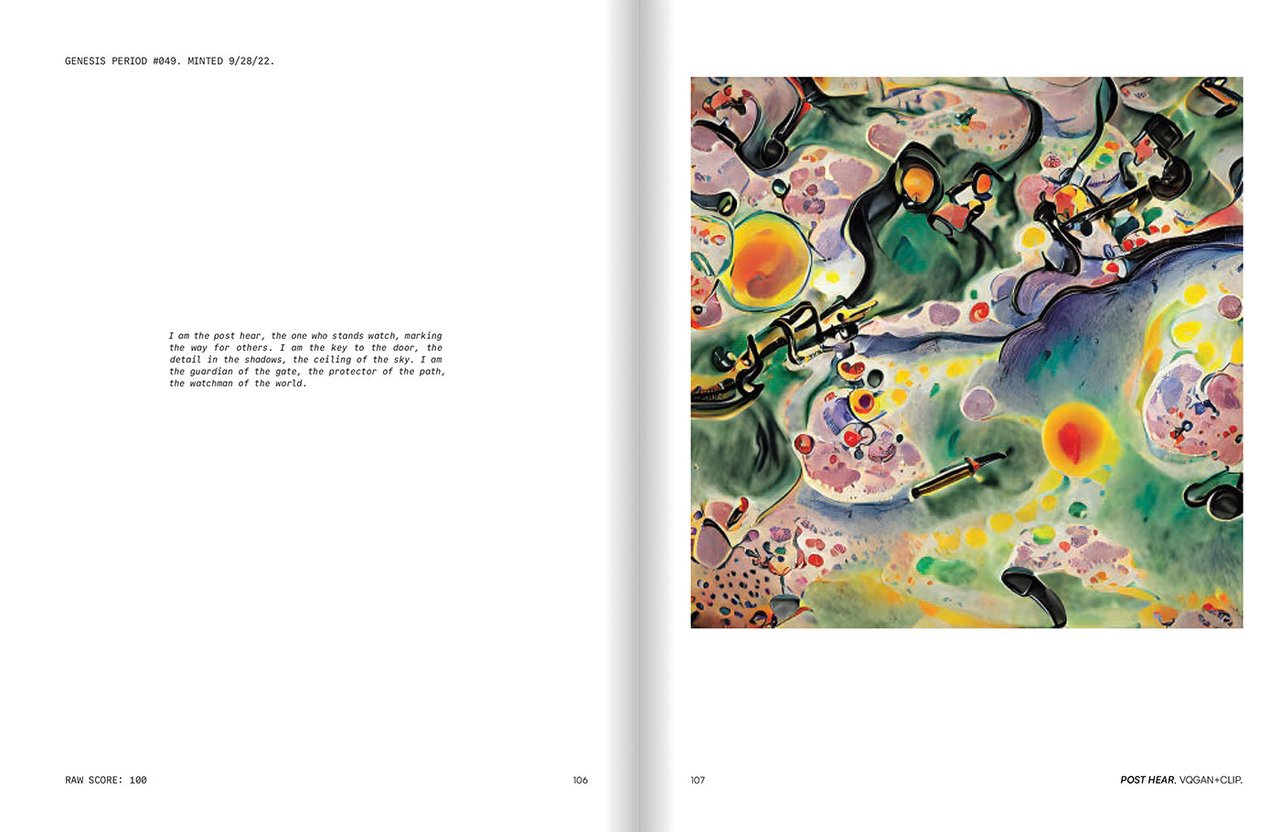
Many of Botto’s initial mints satisfy characterization as both “futuristic” and “retro,” with Trickery Contagion (2021) and Post Hear (2022) channeling the chromatic polyphony of Kandinsky, and Asymmetrical Liberation (2021) reclothing Christ’s Descent from the Cross in digital Mannerism.
If it is now truistic to regard generative models as machines for repackaging history, 2021 was still an age of relative innocence.
For Mat Dryhurst, who contributed to the development of DALL-E, the real question is: “when you are in a sea of abundant imagery or infinite possibilities, what is the unique or scarce element?”⁴ Thanks to its generative feedback loop with the DAO, Botto addresses this very question every week.
According to Rhea Myers, DAOs offer a new “rhizome of roles and incentives” that destabilizes critical certainties.⁵ BottoDAO embodies this shift — not merely tokenizing creative labor but reorganizing cultural production into a consensus-driven protocol. Under these conditions, the DAO becomes an “operationalized artist manifesto,” encoding decisions into smart contracts while decentralizing taste formation.⁶
Botto’s outputs — known as “fragments” until they are minted — reflect the crowd’s aesthetic preferences as well as the limits of latent space.
Echoing crypto art’s preoccupation with technostalgia, the works’ artifactual sheen is a byproduct of VQGAN + CLIP’s optimization loop, yet it also reads as a crowd-pleasing refinement, eliding the models’ discontinuities into collectible coherence.
In formalizing the search for aesthetic consensus, BottoDAO surfaces an essential tension between the democratic aspirations of crypto art and the plutocratic potential of token governance that can be bought and sold. This formalization also creates the risk that aesthetic unpredictability is sacrificed for protocol compliance, which is why Botto resists stagnation by incorporating “out-of-distribution outputs” so as not to get “stuck in a niche” and in order to surprise voters.⁷ The result is an autonomous artist whose agency remains entangled with human desire. In making visible the logics by which images are selected and valued. Botto also generates a running commentary on the nature of authorship in a digital age that rejects originality in favor of referentiality.
In his book, The Digital Condition (2018), Felix Stalder describes referentiality as a “method with which individuals can inscribe themselves into cultural processes” by remixing and resharing content that is already preloaded with meaning.⁸
By allowing its community to “inscribe themselves” into the creative process, Botto acknowledges that digital culture depends on networks of relations, while also questioning whether meaning can ever be entirely shared.
In distributing creative agency across an ecosystem, Botto makes clear that digital art is defined by co-creation. As a project that aims to achieve “minimum viable autonomy” for a machine it updates Harold Cohen’s program AARON, which used classical symbolic AI, for the age of deep learning. It also parallels contemporary projects such as Gene Kogan’s Abraham, that seek to develop an “autonomous artificial artist.” By synthesizing AI with decentralized governance and tokenization, Botto preserves crypto art’s vision of a “creator economy” at a moment when leading NFT marketplaces have ceased to enforce royalties. In an era of generative abundance, scarcity lies not in output but in attention, and it is BottoDAO’s attention to innovating aesthetic protocols that transforms fragments into artworks, and data into culture.
Alex Estorick is Editor-in-Chief at Right Click Save.
¹ A Estorick, K Waters, and C Diamond, ‘In Search of An Aesthetics of Crypto Art’, Artnome, April 10, 2021.
² L Elliott, ‘Clip and the New Aesthetics of AI’, Right Click Save, February 24, 2022.
³ M Klingemann, interviewed by the author on March 4, 2025.
⁴ A Estorick, ‘Herndon, Dryhurst, and Hobbs on Liquid Images’, Right Click Save, October 7, 2024.
⁵ R Myers, ‘A Thousand DAOs’ in R Catlow and P Rafferty (eds.), Radical Friends: Decentralised Autonomous Organisations and the Arts, Torque Editions, 2022, 92.
⁶ K Kreutler quoted by R Catlow and P Rafferty in ‘DAOs in the Art World’, Right Click Save, July 14, 2022.
⁷ M Klingemann, S Hudson, and Z Epstein, ‘Botto: A Decentralized Autonomous Artist’.
⁸ F Stalder, The Digital Condition, Cambridge: Polity Press, 2018, 58.
No comments yet. Be the first to share your thoughts.
Mentioned in this article
People: Botto, Alex Estorick, Mario Klingemann, Robbie Barrat|Works: GENESIS #000-051, Asymmetrical Liberation, Post Hear, Trickery Contagion|Events: Genesis Period|Organizations: BottoDAO|