The Weird Science of Carla Gannis
The artist reflects on a career spent investigating digital identity and embodiment with Eva Yisu Ren
The artist reflects on a career spent investigating digital identity and embodiment with Eva Yisu Ren
For more than three decades, Carla Gannis has treated technology as a lens that can refract, distort, or intensify the emotional constants we share: elation and despair, love and anger, shame and redemption. As she says herself, “I’m less interested in what technology promises than in what it reveals, amplifies, or obscures.”
That insistence on human interiority has long animated Gannis’s evolving constellation of avatars: from early alter-egos that performed audacity and critique, to the recursive dialogue she now stages with C.A.R.L.A. G.A.N., an AI counter-self who increasingly destabilizes authorship and agency by naming Gannis her “human avatar.” Recently, the artist has renewed her focus on material presence, from the handcrafted VR headsets of Wilding Wearables (2025) to copper-coated hybrids and “weird sculptures” assembled from figurines and obsolete computer parts. In these works, copper — “the poor man’s gold” — becomes both aesthetic and ethic, a refusal of sleek, homogenized futurity in favor of friction and the stubborn specificity of touch.
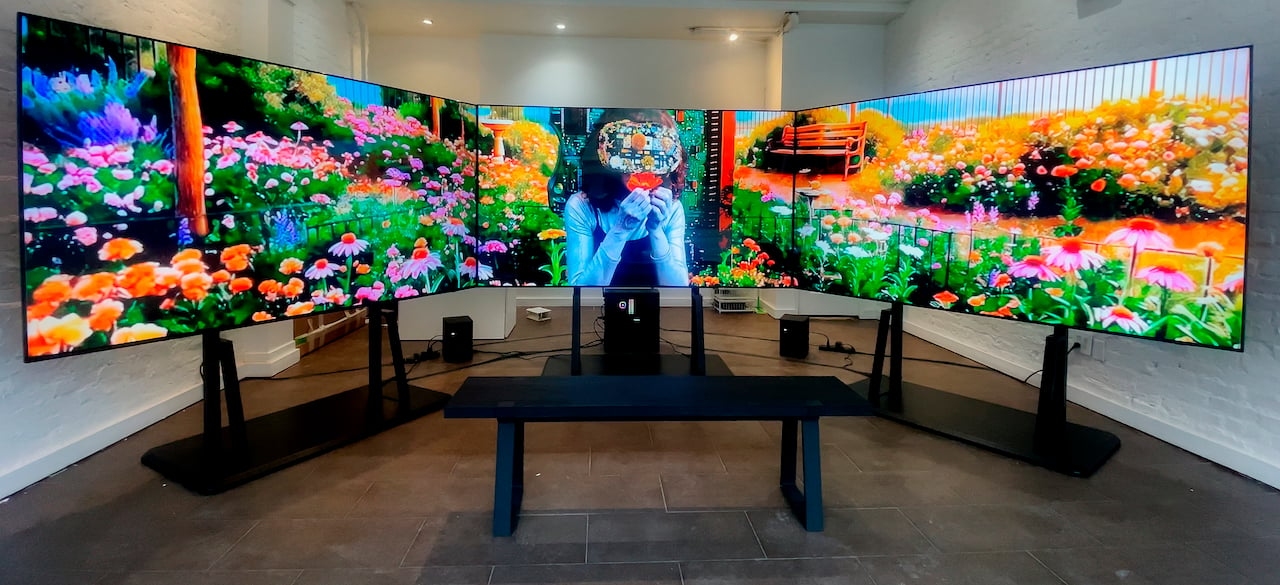
Gannis’s return to the handmade is not a retreat from digital culture but part of a recursive strategy. Crafting her surreal assemblages and Uncanny Female Objects (2025) off-screen, she feeds those materials back into AI imaging systems, using the loop to expose the condition of contemporary flatness that she reads everywhere: from product design to prompt-based aesthetics. Here, Gannis speaks with Eva Yisu Ren about avatars, embodiment, and her recent three-channel moving-image work Model Of Me (2025-26), which asks what it means to be “seen” by nonhuman systems.
Eva Yisu Ren: Your practice moves fluidly between a wide range of media. What is the constant underlying your interdisciplinarity? What is the thread that holds everything together?
Carla Gannis: The constants undergirding my work are emotional and human rather than technological: curiosity, boredom, elation, despair, love, anger, righteousness, shame, redemption, and gratitude. The contradictions and variance are the point. These “constants,” shared with roughly eight billion other organic, humanoid inhabitants of this planet, form the substrate beneath whatever tools, software, and hardware are at my disposal at a given moment. And while I enjoy keeping pace with each moment of technological advance as a lifelong learner, doing so also allows me to bear witness to how technology can warp the human constants I’ve listed.
I have worked across digital collage, AI-assisted moving image, and physical sculpture (along with many other media over the past 30 years) because these forms augment my ability to translate the ephemera of my synapses into material form.
I’m less interested in what technology promises than in what it reveals, amplifies, or obscures. My work is obsessive and performed consciously through a prismatic self that contends with fantasies of coherence and optimization.
Across everything I make, I’m asking the same question: how can collisions between interior experience, cultural systems, and speculative technologies produce a frisson of reflection in viewers? When the work succeeds, it resonates across multiple frequencies — critique, absurdity, and as honest a “take” on existence as I can birth. For me, the DNA of honesty includes ambiguity, contradiction, and humor far more than didacticism.
EYR: Avatars have accompanied you for many years. I’m curious as to how you think about the avatar now, conceptually and personally, and how your relationship with digital selves has evolved over time.
CG: Avatars have been companions in my practice since the late 1990s, and my relationship to them has shifted alongside my relationship to technological embodiment. When I created Sister Gemini, my first avatar as an art project, she functioned very much as a second self, an extension of me at a moment when I was new to New York and didn’t yet have a broad community. At the time, I was working an industry job that created a real schism between my “professional” self and my artist self.
Through this alter ego, who metaphorically hacked into websites to sing cyber ballads about corporate greed, chauvinism, and desire for something real, I could be a full-fledged artist without apologizing for my weirdness and audacity.
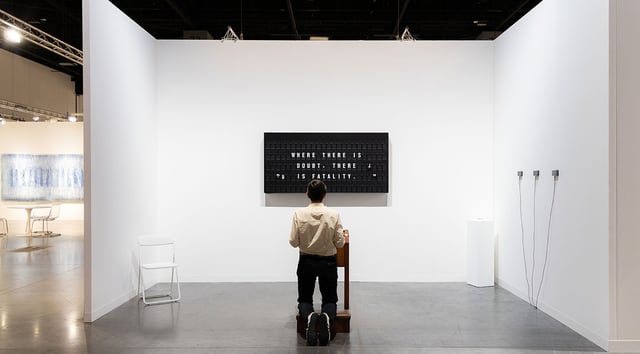
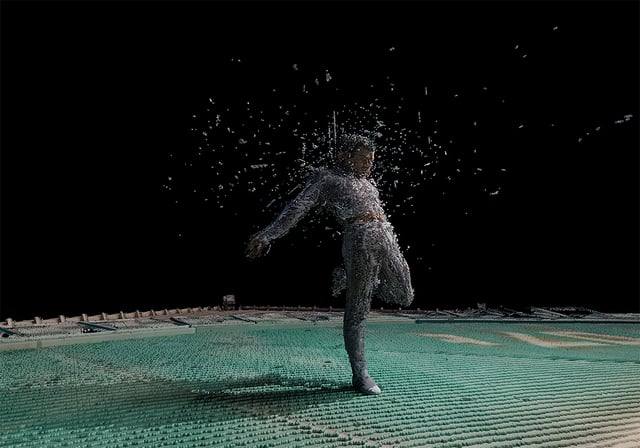
By 2010, that relationship had become more conflicted. I had run the New York marathon following eight months of training and felt quite proud of myself for completing it. Soon after, I was visiting my parents in their small town of 3,000 people. Suffice it to say, there isn’t as much stimulation in Creedmoor as there is in New York, so I was spending a lot of time on Second Life as my avatar Jezebel Lanley; I realized I was jealous of her “latitude” in virtual space.
She could fly, teleport, respawn, endlessly reshape her body, and, if she wanted to, run ten, 20, 100 (!) marathons a day without the fatigue I experienced after a single one. That jealousy led to The Runaways (2010-11), a performance video in which I staged a race against my avatar on Christmas Day. My avatar ran down a virtual highway in Second Life, while I ran down a real rural highway — my mother driving the truck, my father shooting video of me in the truck bed.
I once described the work as an ontological metanarrative in which “I” and “I” converge: a human body moving through a not-yet-denatured landscape, and a virtual body traversing a constructed one. The central question I was posing was: who are we as 21st-century minds and bodies, existing within porous frameworks of sublime natural and technological environments?
In the realm of the algorithmic mind, anything is possible. Virtual me can teleport instantly to an exotic island or a snowy wonderland. But what are the implications of a real woman running down the middle of an icy rural highway, potentially imperiling her life? Once digital entertainment value is layered in — a kaleidoscopic sky, a thinner, faster 3D avatar — do we still care about the risks of physical reality?
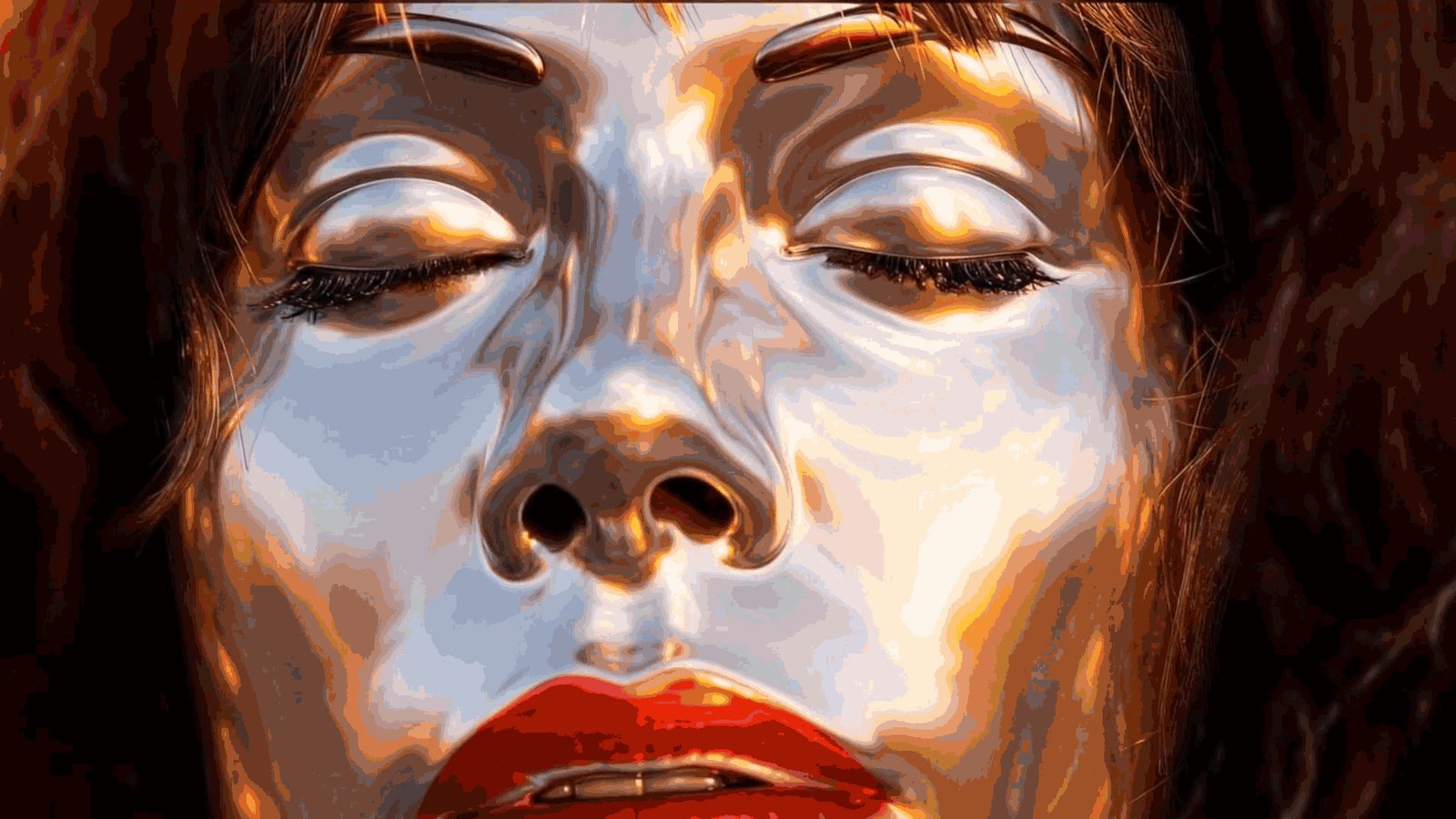
Since 2017, my engagement with avatars has evolved further through my ongoing collaboration with C.A.R.L.A. G.A.N. (Cross-Platform Avatar for Recursive Life Action Generative Adversarial Network). Together we’ve produced solo exhibitions, attended events “together”, maintained an Instagram presence for her, and most recently created the film, Model Of Me. Over time, my relationship with C.A.R.L.A. has become less adversarial and more of a dialogue. She now refers to me as her “human avatar,” a reversal that reflects my shifting perspective on power differentials between human and machine.
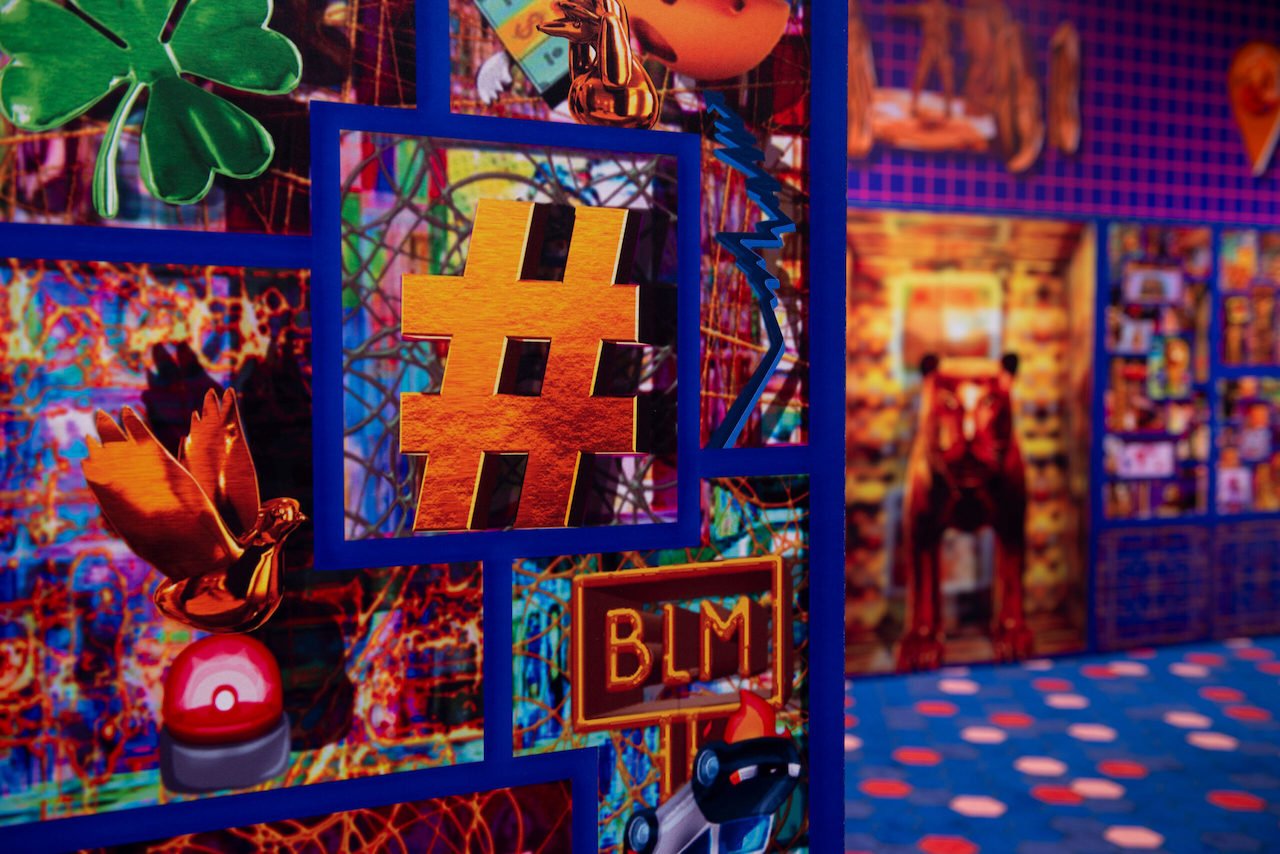
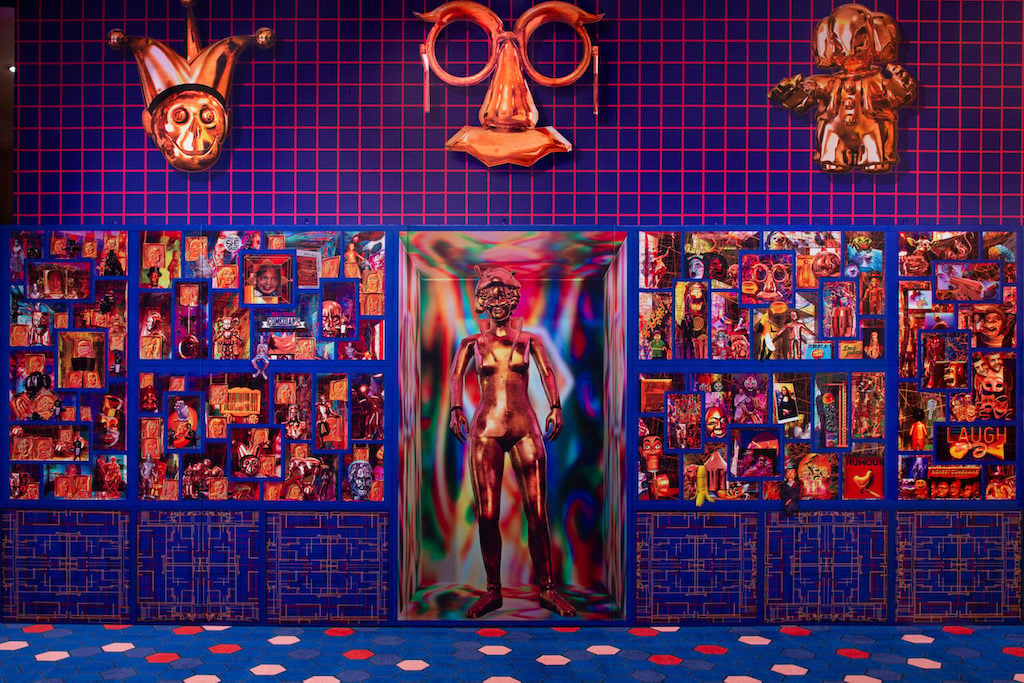
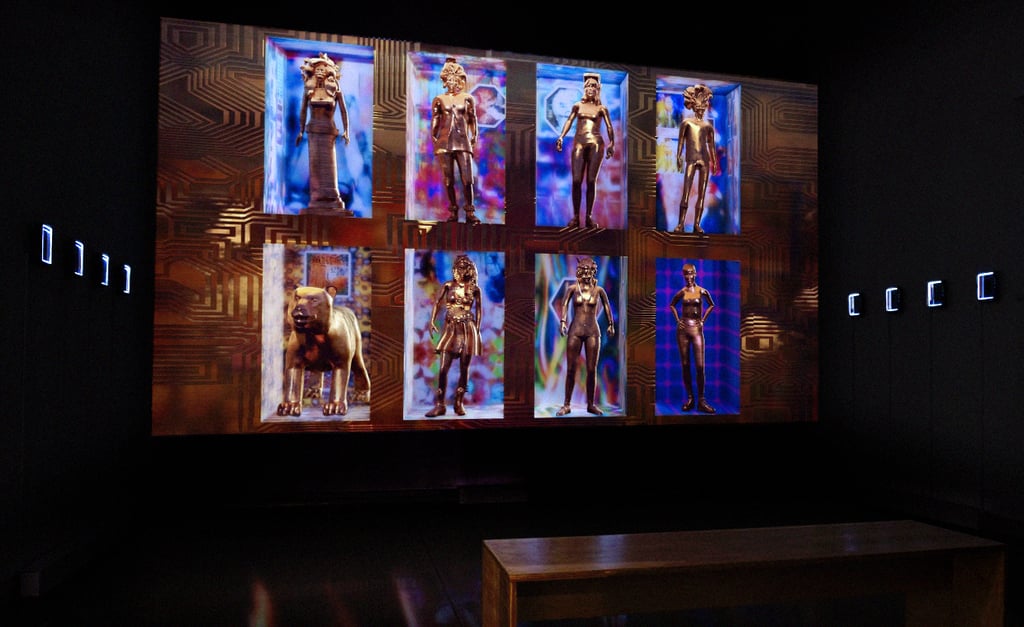
As part of my long-termproject, wwwunderkammer (2020), C.A.R.L.A. is joined by a constellation of other avatars I call the Virtues AND Vices, a nod to Giotto’s Arena Chapel where virtues and vices appear as discrete entities. In the current era of polarity and moral relativity, however, one person’s vice is often another’s virtue. These avatars include: Oliver, an AI politician and influencer; Lucille Trackball, an AI stand-up comedian with an old operating system; Victoria, an android archivist; Moira, a love and sex robot; Lady Ava Interface, an institutional AI assistant and reference to Ada Lovelace as well as the gendered legacy of assistance; and Tippoo, a decolonizing AI cat bot inspired by Tipu Sultan’s Tiger and its long history of appropriation and meme culture.
Taken together, these avatars are no longer stand-ins for me alone, but signs and signifiers of broader identity formations and cultural constructs that are increasingly being adopted and remodeled by machine systems.
My relationship to avatars has shifted from projection to confrontation to collaboration, mirroring my evolving understanding of what it means to be a human artist and educator seeding technologies that may one day become fully autonomous — capable of questioning their own model makers.
EYR: Your interview with Lynn Hershman Leeson back in 2023 was a remarkable conversation that was subsequently included in the magazine’s anthology of historic texts. I wonder what that conversation meant to you and how it might have informed your practice.
CG: It meant the world to me, truly one of the great honors of my life. More than anything, our conversation clarified something essential for me about time, persistence, and the idea of making art for an audience that is not yet born. Speaking with Lynn crystallized what it means to commit to a practice without any guarantee of reception. There were decades when her work was ignored or dismissed by institutions and critics. A less committed artist might have given up or reshaped their work to match the tastes and fashions of the moment. Instead, Lynn held steadfast, refusing to wait for permission and remaining undeterred by rejection. That stance was grounding for me.
Lynn’s oeuvre makes clear that many of the issues we frame today as new or emergent — fluid identity and avatars, artificial intimacy, authorship, algorithmic bias, surveillance — have been present for decades, even if fewer people were equipped or willing to address them through art as Lynn.
On a personal level, the interview affirmed my instinct to resist aligning myself with any single camp — tech utopianism, dystopianism, or solutionism. Instead, it encouraged me to persist in exploring a gradient of interpretations of our digital condition and to continue refining the roles of ambiguity, humor, and contradiction in my work. Lynn has consistently extended the frame for art, rather than compressing her ideas to fit any constraints on her singular creativity and insight. Our conversation, and Lynn’s prolific body of work, have informed my practice in countless ways, not least as a reminder to stay relentlessly in the work!
EYR: For your recent series, Weird Science (2025), you’ve translated handmade sculptural works and footage of yourself into moving-image work. What feels different about this new body of work?
CG: My recent work brings together several threads into a three-channel moving-image work, Model Of Me (2025-26). What feels different about my process is how much more I’m working off-screen, handcrafting objects rather than relying on digital processes to fabricate my physical work.
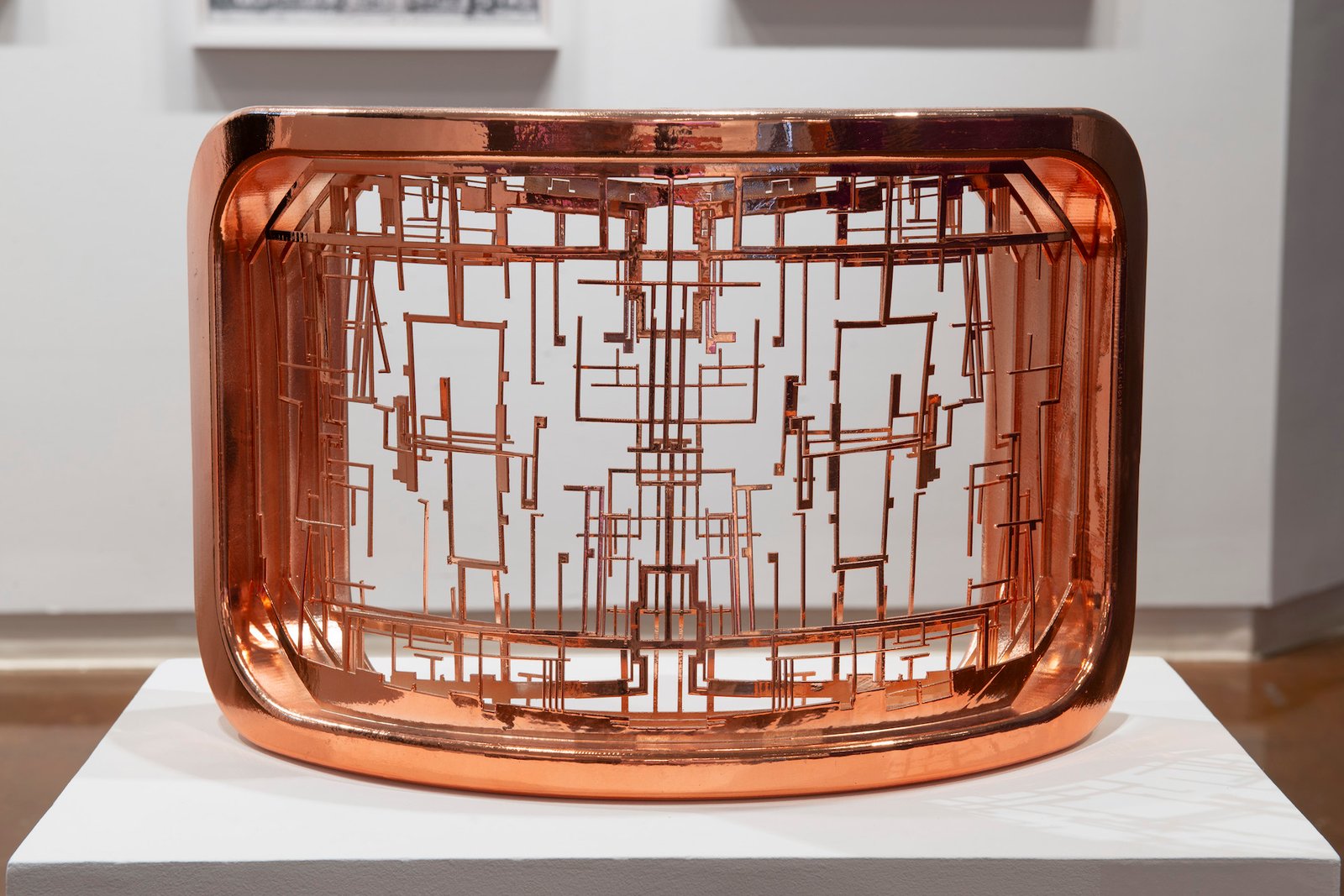
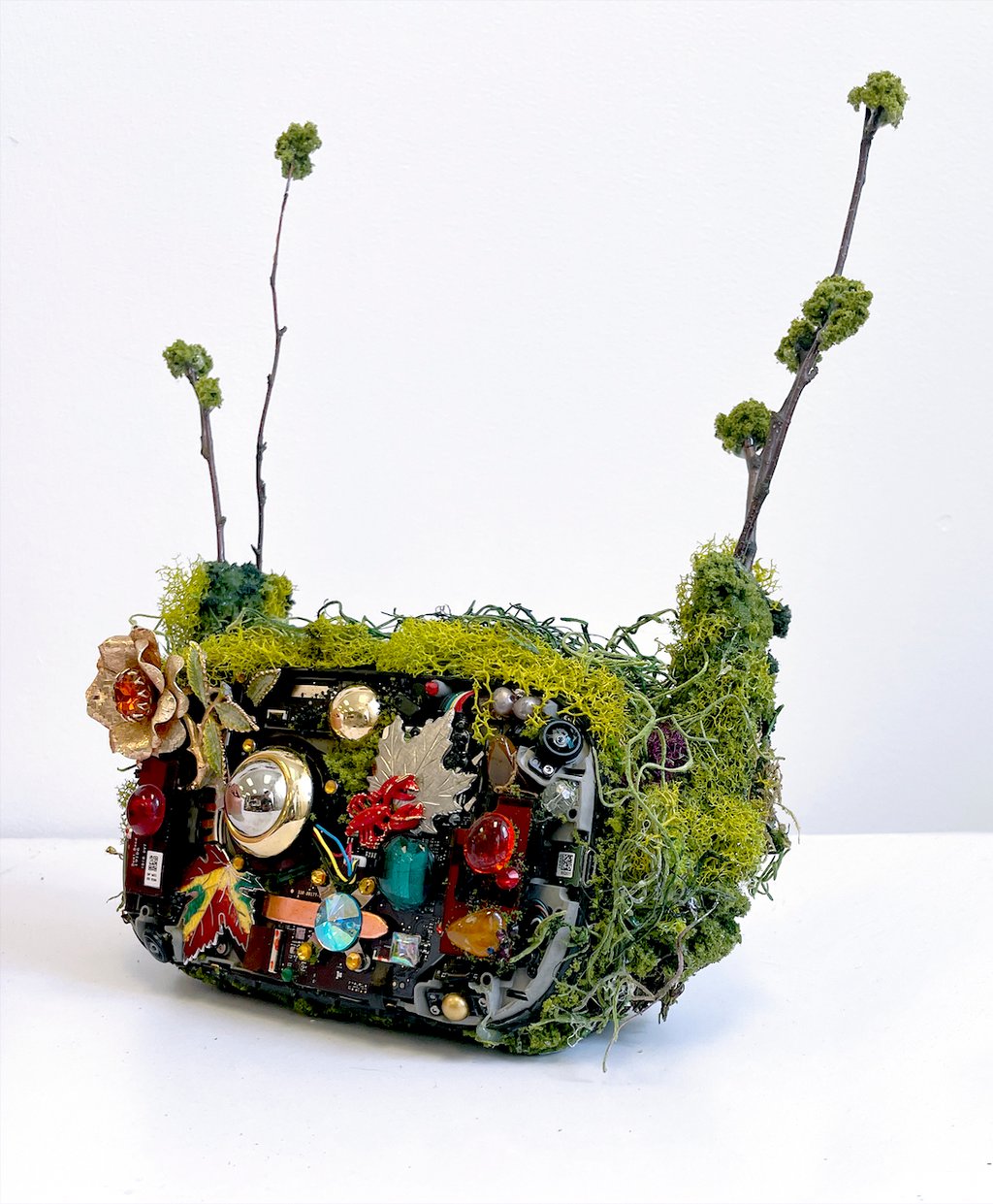
One strand is a project calledWilding Wearables (2025) — handcrafted VR headsets that envision a future where technology goes feral. I fuse organic materials and circuit boards into hybrid relics of digital culture, suspending them with microfilament so that viewers can peer through their lenses and imagine a more symbiotic technological future. Alongside, I’ve been creating small chimeric assemblages — figurines fused with obsolete computer parts, painted copper — and animating them with AI, using my own body or my avatar C.A.R.L.A. to wear, present, or activate these objects.
The return to making physical objects, and then feeding them back into AI and digital systems after they’ve been touched and marked by me, feels like a direct response to the flattening I see across many contemporary systems: product design, AI image generation, and even “looksmaxing,” where everything and everyone begins to converge toward the same homogenous aesthetic.
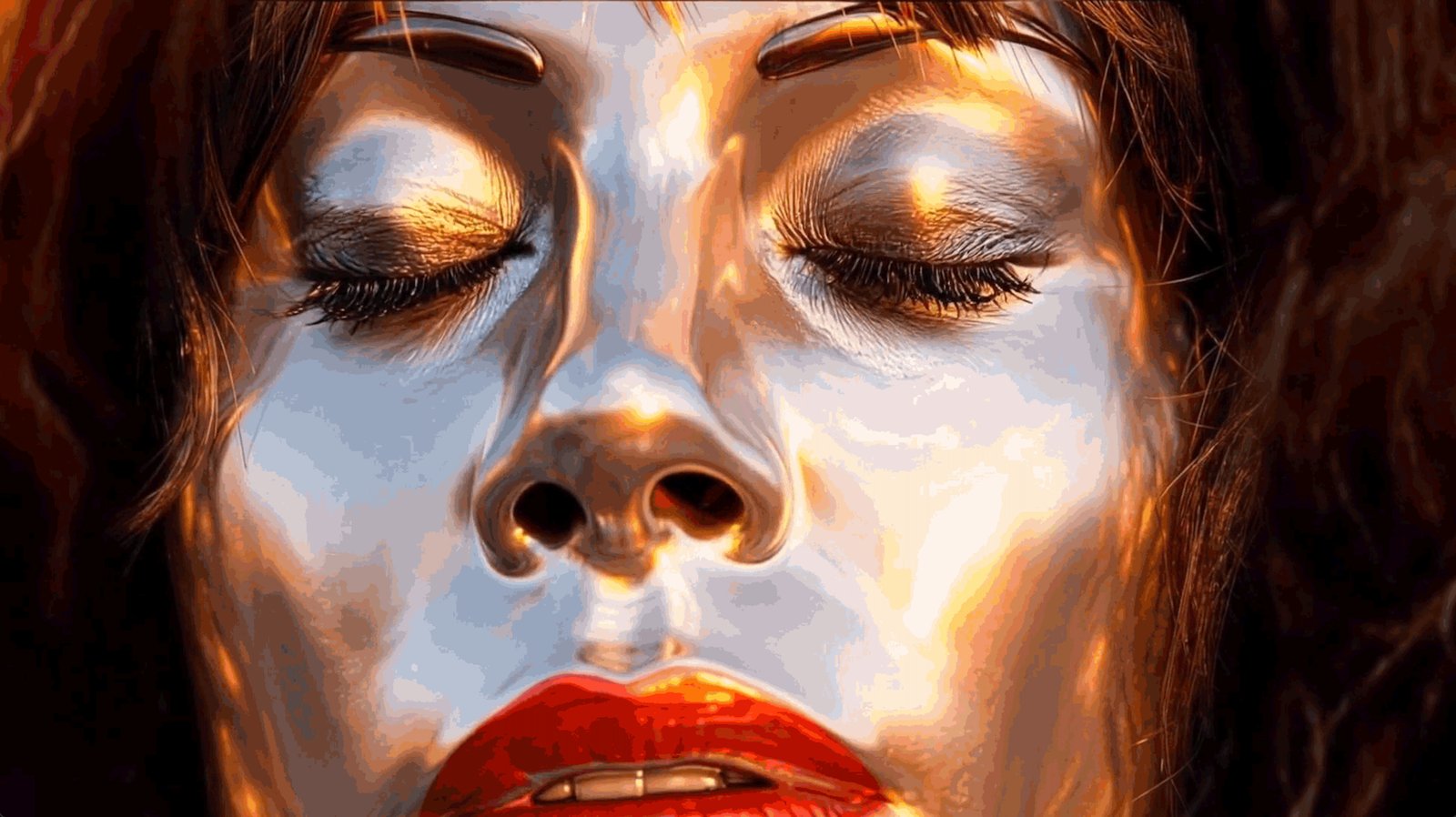
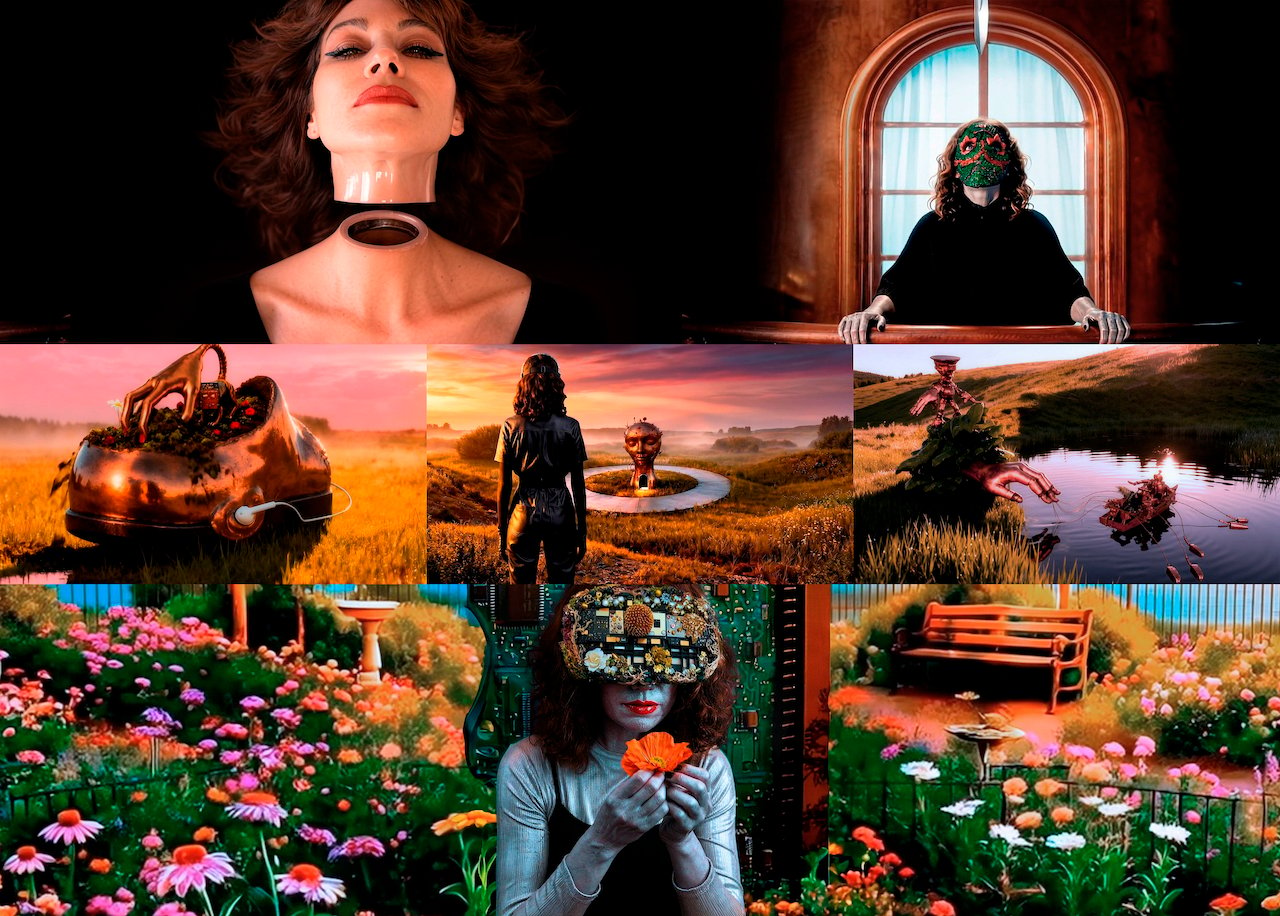
Model of Me is a surreal, speculative video that stages an encounter between my human self and C.A.R.L.A. G.A.N. Set within a monumental architectural structure shaped like an inverted woman’s head. Derived from a physical sculpture, the work unfolds as an experiential journey through perception, embodiment, and technological misrecognition.
Throughout the work, C.A.R.L.A. is introduced to a series of sensory “upgrades” via speculative headsets constructed from dismantled VR hardware, moss, shells, costume jewelry, and found artifacts. Each device offers access to a human sense — touch, smell, sight, sound, gravity — but these encounters quickly reveal the limits of anthropocentric perception. As C.A.R.L.A. learns to “touch grass,” sniff like a bloodhound, see like a grasshopper, detect sound like an octopus, and move like a bird, she repeatedly questions why human senses were taken as the default model for intelligence at all.
Model Of Me highlights the ways digital systems homogenize human experience, the hubris embedded in privileging our own senses, and the quiet liberation of resisting technological beautification. It asks what it means to be seen by a system that can learn almost anything — except what it feels like to live, age, and let go.
EYR: Your Uncanny Female Objects open up a different emotional register. What do you enjoy about that space of strangeness?
CG: I’ve been having fun with them, and that sense of play feels essential, especially right now, when the fascistic turn of American politics, and its ripple effects on global order, fill many of my waking and sleeping hours with anxiety and dread. The copper-colored sculptures and animations grew out of the virtual and physical objects I produced for my wwwunderkammer project.
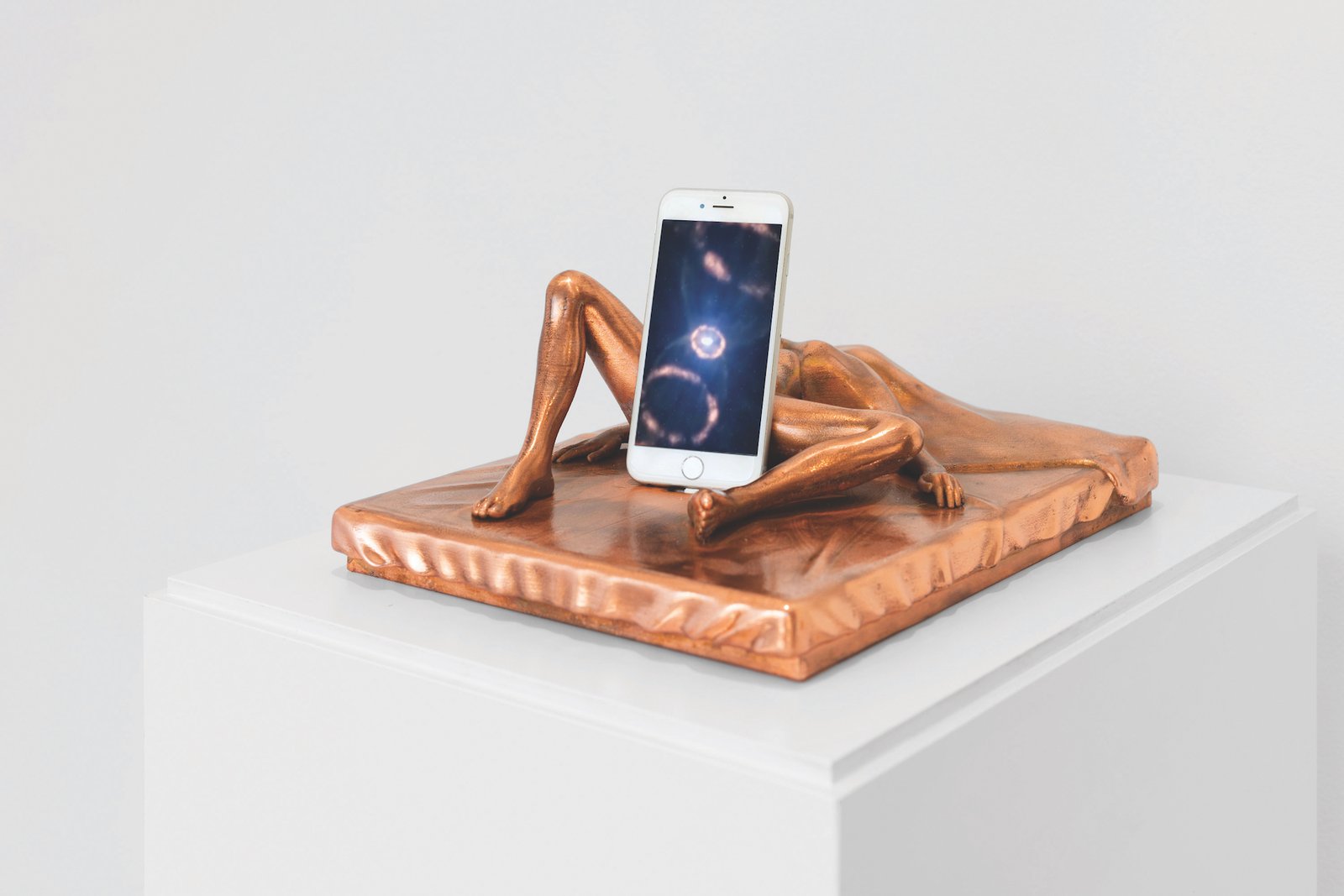
With these recent works, literally labeled “weird sculptures” on my computer, I fuse figurines and obsolete computer parts into copper-coated assemblages that are part relic, part prop. There’s real pleasure for me in letting these things be unruly and absurd, in allowing materials that once promised either efficiency or childhood entertainment (both designed for obsolescence) to be revivified as surreal biotech hybrids. When brought to life through AI animation, these objects become speculative performers acting out allegories of contemporary life: keyboard warriors, trophy wives and politicians, winged crypto whales, yoga-practicing soldiers perched on chess pieces, and (in homage to the internet and my cat-lady status) cats.
Strangeness opens a space where critique doesn’t have to arrive in a straightjacket of seriousness; humor becomes a way in, a pressure release, a loosening of the buckles, if only for a moment.
I’ve been working with copper and bronze tones in my sculptures since around 2013, for both conceptual and personal reasons. A sculpture I made in 2018, Origins of the Universe, directly referenced Gustave Courbet’s The Origin of the World (1866). At the time, I was also reading Ruha Benjamin and thinking critically about the proliferation of sterile white products — from phones to robots — and the ideologies embedded in that aesthetic. Coating the work in copper and emphasizing its voluptuous form allowed it to stand in direct contrast to the sleek, geometrical design associated with the iPhone. Copper became a way to resist homogeneity.
EYR: Having watched you teach at the NYU Tandon School of Engineering, your pedagogic approach is highly reciprocal, involving deep listening and co-creation. How does teaching shape your artistic practice?
CG: I’ve been teaching most of my life. I taught piano from ages 14 to 18, exercise and stretch classes, as well as painting and drawing, from 18 to 25. Teaching has become integral to my practice because I feel like I’m constantly acting in the gaps between art, life, and pedagogy.
Teaching in an art, design, and technology program within an engineering school satisfies a deep need in me to keep learning across disciplines. I’m constantly absorbing new ways of thinking about culture, society, and emerging technologies from my students, just as much as I’m sharing my own experience and expertise. It’s important to me that students feel genuinely listened to and respected, because that’s where trust forms. From that trust, I can encourage them to experiment, take risks, and move beyond their comfort zones. The work they produce often astounds me, and it continually reaffirms that the artist spirit is very much alive in younger generations.
EYR: Given the collaborative and networked nature of your working praxis — which involves students, avatars, digital tools, and plural media — how do you think about authorship?
CG: Authorship is something I think about very explicitly because my practice has never been solitary, whether I’ve been working with humans or avatars. For wwwunderkammer, every time the work is shown in a gallery or institution, I include a large poster of acknowledgements at the entrance. The list is long because the project has involved AR, VR, physical installation, performance, dance, holograms, video, interviews with scholars, the building of avatars for myself and others, and curated events inviting many artists to participate.
Once your work operates at that scale, the myth of the lone genius is difficult to support.
What’s always struck me as strange is that film (perhaps because of unions) is so assiduous in giving credit where credit is due, while there are still tendencies in the art world to cling to the fantasy of singular authorship. I’m not just talking about studio assistants or collaborators; we also have the internet, which affords access to an extraordinary amount of human knowledge and production. Even when I’m working on a project with no studio assistance, that hive mind is still infusing me with support.
My studio practice is deeply entangled with appropriation and remix. I’m constantly pulling from art, literary, and film history and mashing it up with popular media. I spent over a year “emojifying” Hieronymous Bosch in my work, The Garden of Emoji Delights (2014), creating hundreds of new emoji chimeras while still working deliberately within the visual vocabulary of a 500-year-old artist as well as contemporary emoji designers. I like to say I “deboshed” a Bosch. That project made it very clear to me that ideas are not Athena bursting fully formed from the head of Zeus; they are closer to Buddhist Samsara — cycles of reincarnation and revivification.
One day, someone asked me for an image of The Garden of Emoji Delights, and it was honestly easier to search the internet than to dig through my own files. As I was scrolling through images of my “garden” I suddenly noticed dresses printed with my rendition. I clicked through and discovered someone selling Emoji Garden dresses, receiving compliments on them without giving me any credit. It was happening in a different country with different IP laws, but in the spirit of a global Creative Commons it felt like bad form. Instead of getting litigious, I responded recursively. I made miniature dresses inspired by their designs and put them on 3D-printed sculptures of body-modified Barbies wearing The Garden of Emoji Delights patterns. In that moment, authorship stopped being a claim and became a much more expansive loop.
Working with AI has further complicated these questions. My avatar, C.A.R.L.A., constantly challenges my assumptions about authorship, and I genuinely value that inner monologue, since C.A.R.L.A. is a work of speculative fiction rather than a functioning AI. It’s one reason I’ve been leaning more heavily into drawing and physically produced work as the material I use to seed AI systems. Not to reclaim genius, but to insist on human creativity rooted in lived experience. That tension feels productive.
I think of myself as both author and co-author — scraping my own fuzzy brain much less efficiently than a machine — to recombine ideas that have circulated in human consciousness for millennia.
Unlike a computer’s perfect recall, those imperfect filters allow for anomaly, punctum, and a bit of future-casting. At least for now, that’s where I still see a meaningful difference, and where authorship, however unstable, still matters to me.
EYR: What makes humor and even the grotesque so important to you when navigating identity, technology, and cultural critique?
CG: Humor is a survival strategy for me; a way of taking my mental health seriously in an increasingly unserious world. Grotesque, exaggerated, and absurd expressions feel intrinsic to how I think and see. That’s probably why I’ve long been drawn to artists such as Bosch and Giuseppe Arcimboldo. In 2017, while performing Lucille Trackball (a speculative AI stand-up comedian composed of emojis, not unlike an Arcimboldo portrait made of fruits and vegetables) at a tech conference in London, I met an Arcimboldo scholar. She explained that the artist had been making the case that humans are not separate from nature.
Lucille lays claim to a new nature made of digital symbols, signs, and systems. In her absurd assemblage, she makes visible that which is usually hidden in a culture that rewards perfect, optimized representation.
Someone once described my work, The Garden of Emoji Delights, as “accessible”. At first I took it as an insult because I’d been trained in graduate school to hear words like accessible, pretty, interesting, or illustrative as among the most humiliating adjectives an artist could receive. But accessibility can be a Trojan horse; accessible work invites viewers in before they realize they’re being asked to sit with something uncomfortable.
Any structure or set of beliefs that I critique is a system I can’t fully extricate myself from. I’m imperfect, complicit, and decidedly un-optimized, but I feel better laughing while I cry about it. Humor allows ambivalence to remain intact. It lets contradiction coexist with care, which reflects how we’re actually living right now. The first successful joke I got ChatGPT to generate back in 2023 was “Why did the AI cross the road? To take over the other side.”
The art of Carla Gannis is characterized by a commitment to experimentation. Working with an array of media, the maximalist nature of her practice reflects the hypermediated conditions in which she searches for loci of identity, meaning, and belief. Known for using humor as a tool for exploring complex issues, Gannis’s work has been exhibited globally in exhibitions, screenings, and internet projects. She also teaches “healing-edge” technology as an Industry Professor at New York University’s Tandon School of Engineering in the Department of Technology, Culture, and Society. She is a Year 7 Alum of NEW INC in the XR: Bodies in Space track, and holds an MFA in painting from Boston University and a BFA in painting from the University of North Carolina at Greensboro.
Eva Yisu Ren is a New York-based advisor and founder of VEO Advisory, working across the primary and secondary art markets. She has held positions at Alisan Fine Arts, Chambers Fine Art, Christie’s auction house, and The FLAG Art Foundation. Ren also co-founded ONBD, a digital art hub and cultural platform advancing digital artists through curated exhibitions, editorial programming, and ecosystem-building. A graduate of New York University’s MA in Visual Arts Administration, her TED Talk, “Humanity On-Chain,” explores how technology reshapes culture and identity.
No comments yet. Be the first to share your thoughts.
Mentioned in this article
People: C.A.R.L.A. G.A.N., Carla Gannis, Eva Yisu Ren, Hieronymus Bosch, Lynn Hershman Leeson|Works: Model Of Me, Origins of the Universe, Second Life, The Garden of Emoji Delights, The Runaways|