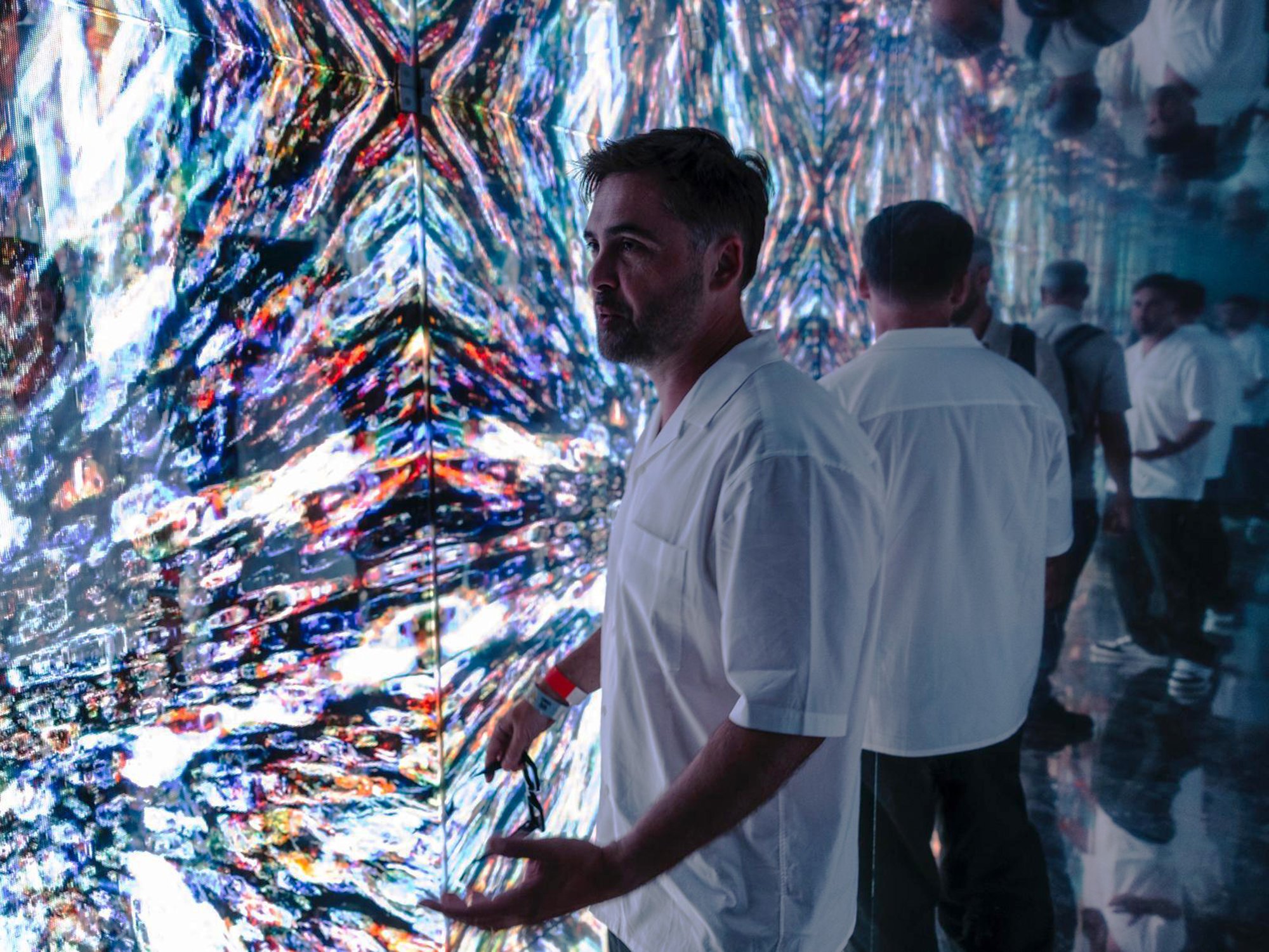
Marlene Corbun, curator of Eko33’s Calculated Skies at NFC Summit, Lisbon, talks to the artist about how the histories of optical inquiry and generative art are interwoven in his recent work
At NFC Lisbon (June 4-6, 2026), the digital gallery DANAE presented Calculated Skies, 2026, a solo project by the artist Eko33 (Jean-Jacques Duclaux), curated by Marlene Corbun.
The project has a generative system where one codebase produces an immersive mirrored environment, the Generative Infinity Room, and a series of 20 unique artworks. “They are,” the artist says, “different states of the same system.”
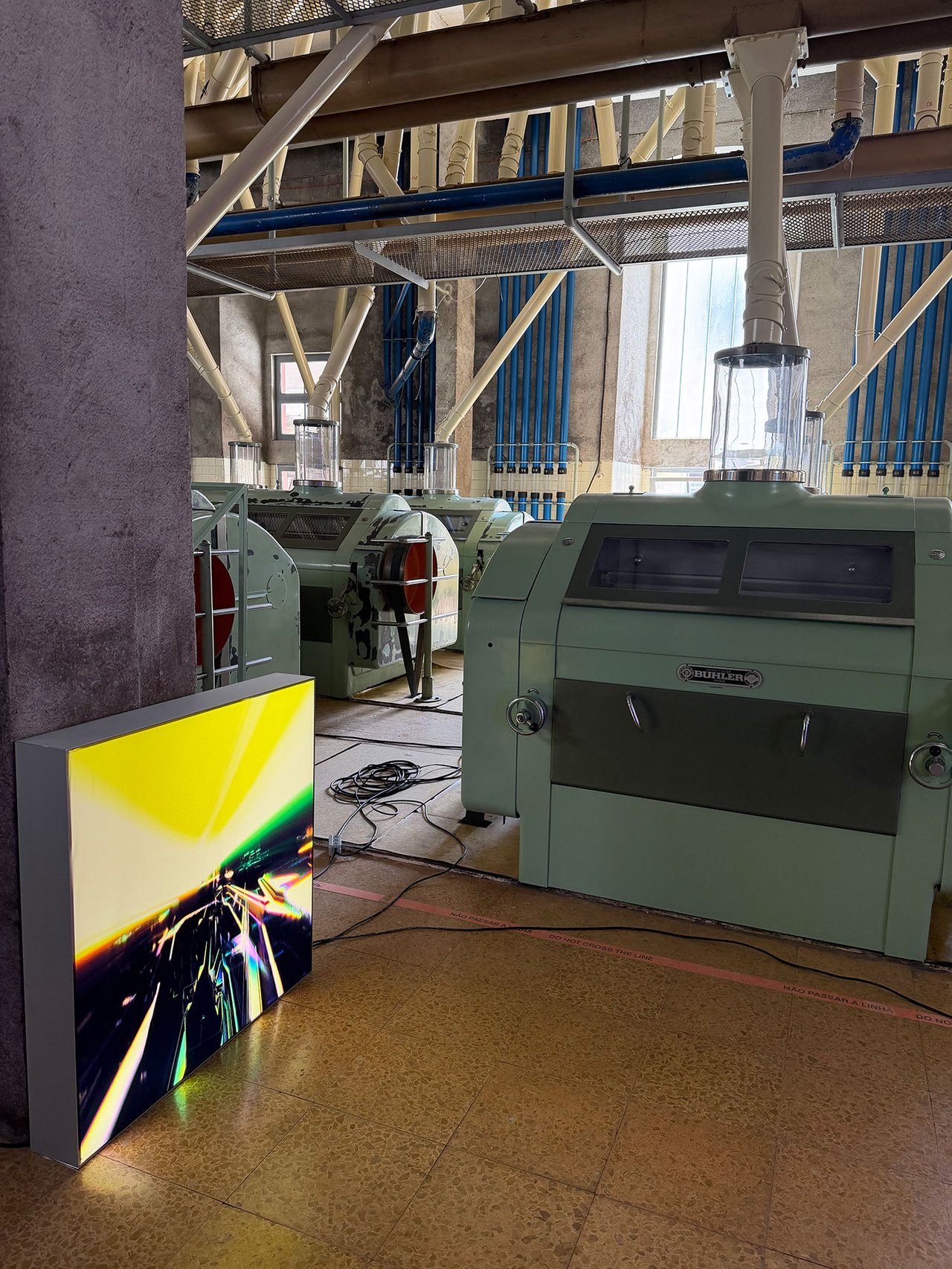
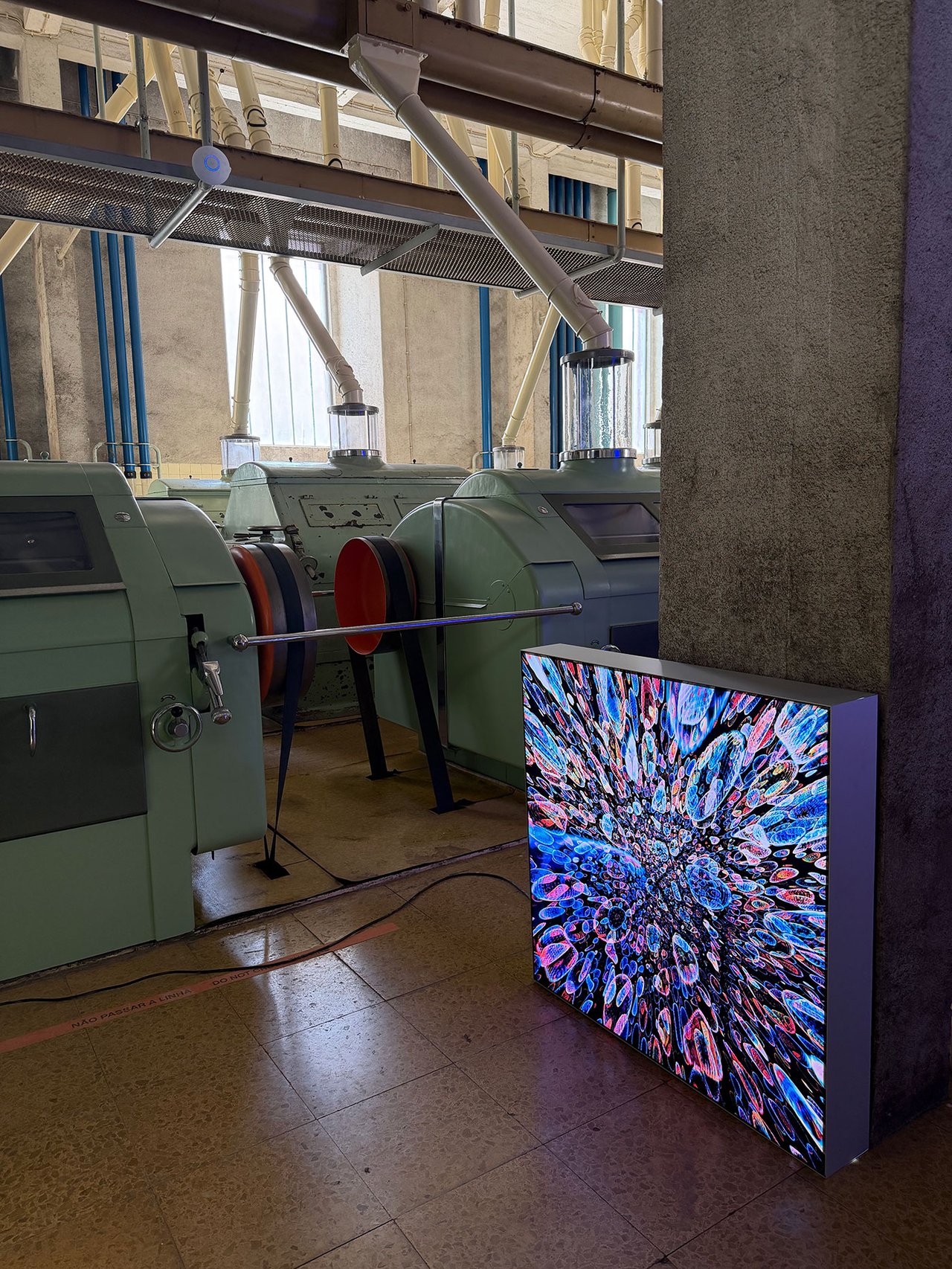
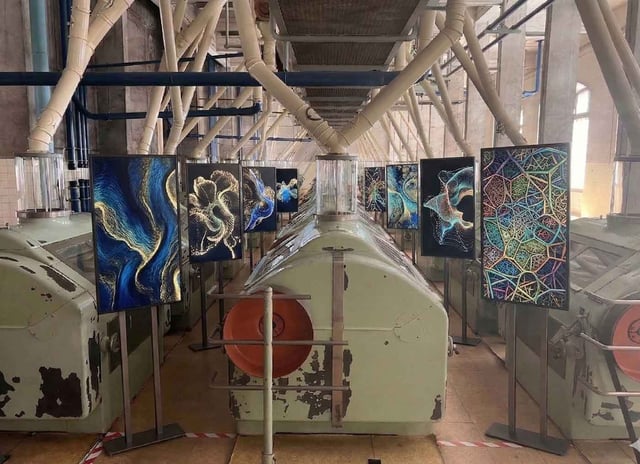
Two of the outputs were presented at the Lisbon event as large-scale lightboxes, set in the industrial spaces of a former flour mill, offering an encounter with the aesthetic universe unfolding within the mirrored room.
Corbun and Eko33 discuss how Calculated Skies engages with a long history of optical inquiry, one extending from the 2,300-year-old geometries of Euclid and the theories of vision developed by the mathematician Ibn al-Haytham, a millennium ago, to contemporary generative practices. And how the work extends beyond optical experimentation, opening a contemplative space in which technology becomes a catalyst for self-awareness and personal reflection: one that works within the same logic that organizes contemporary life.
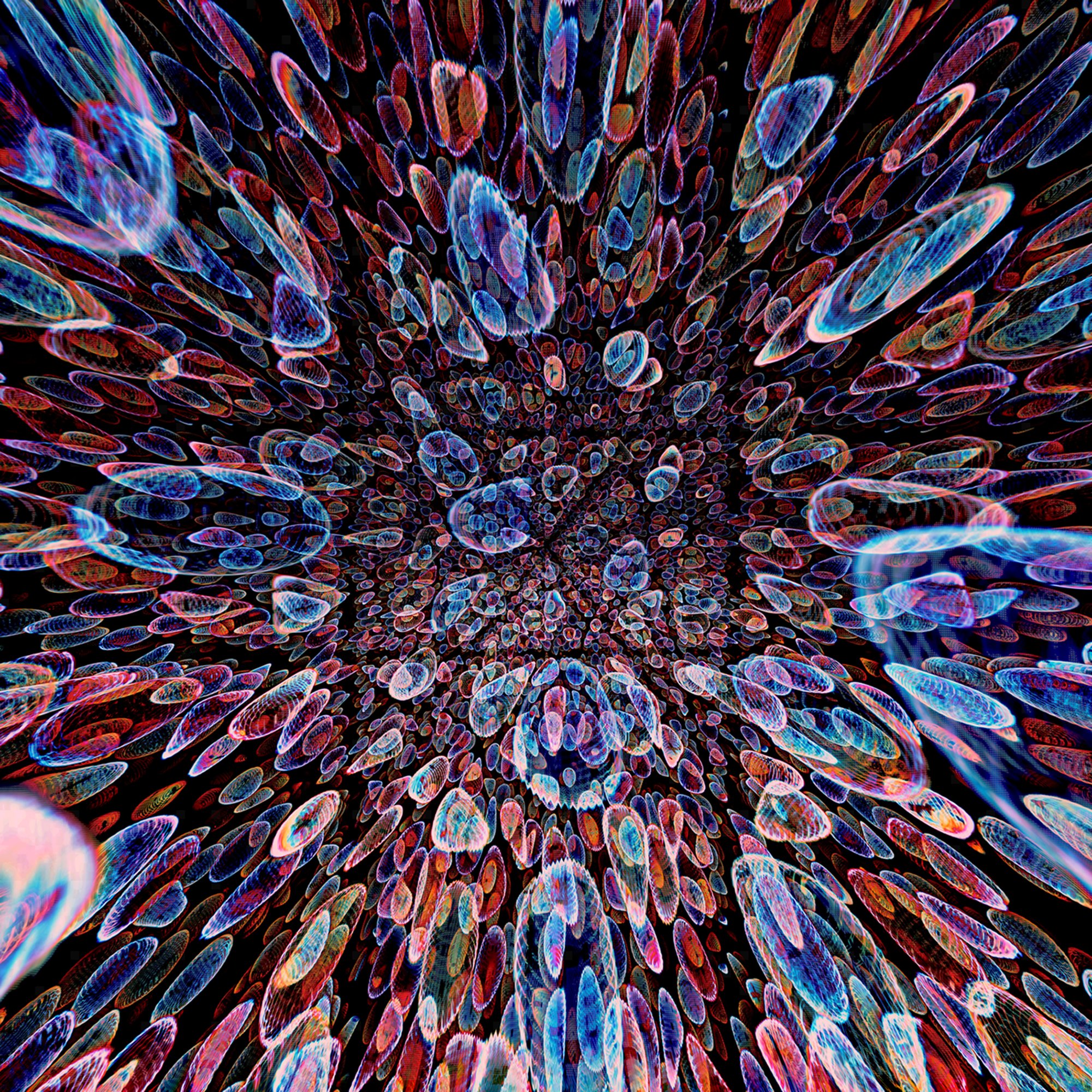
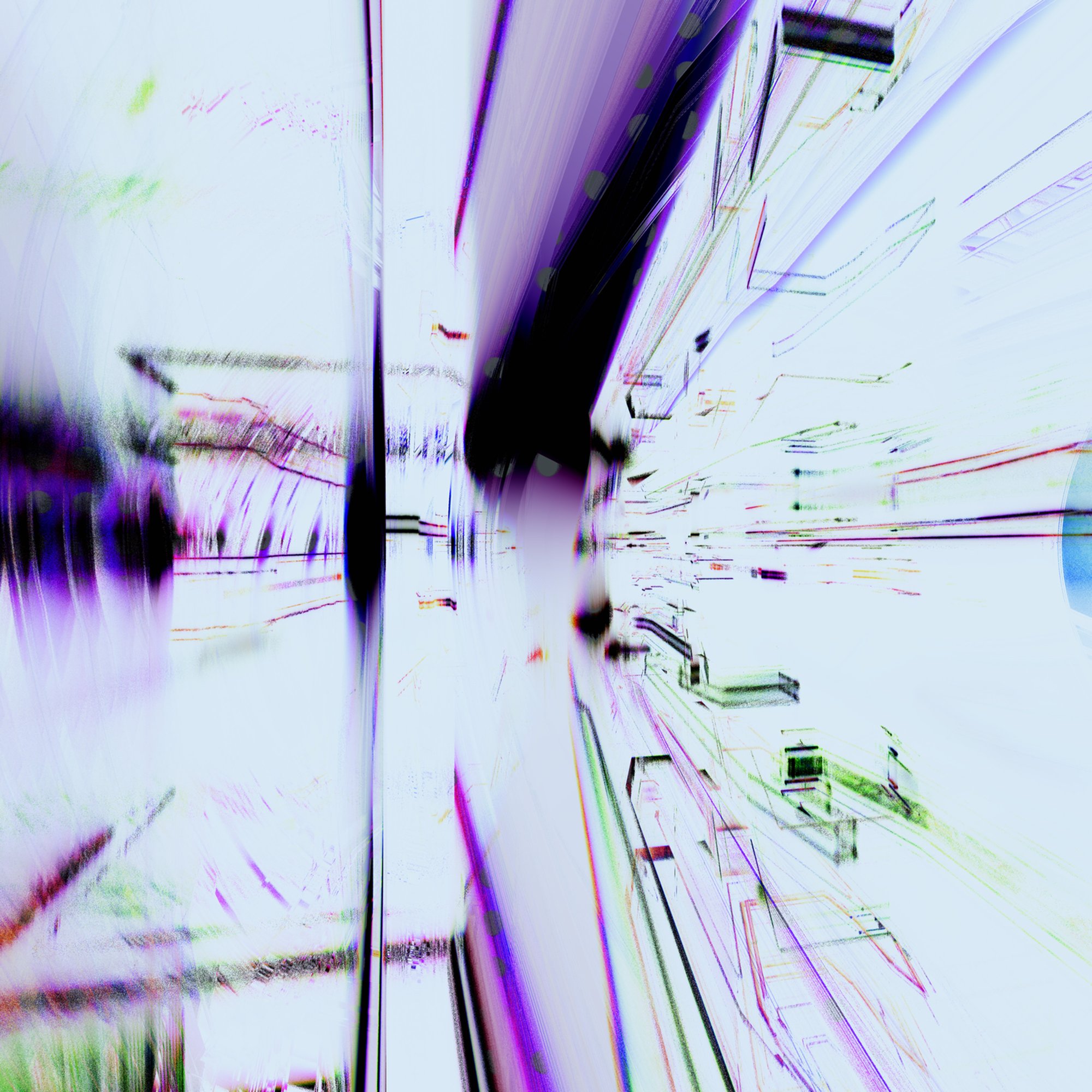
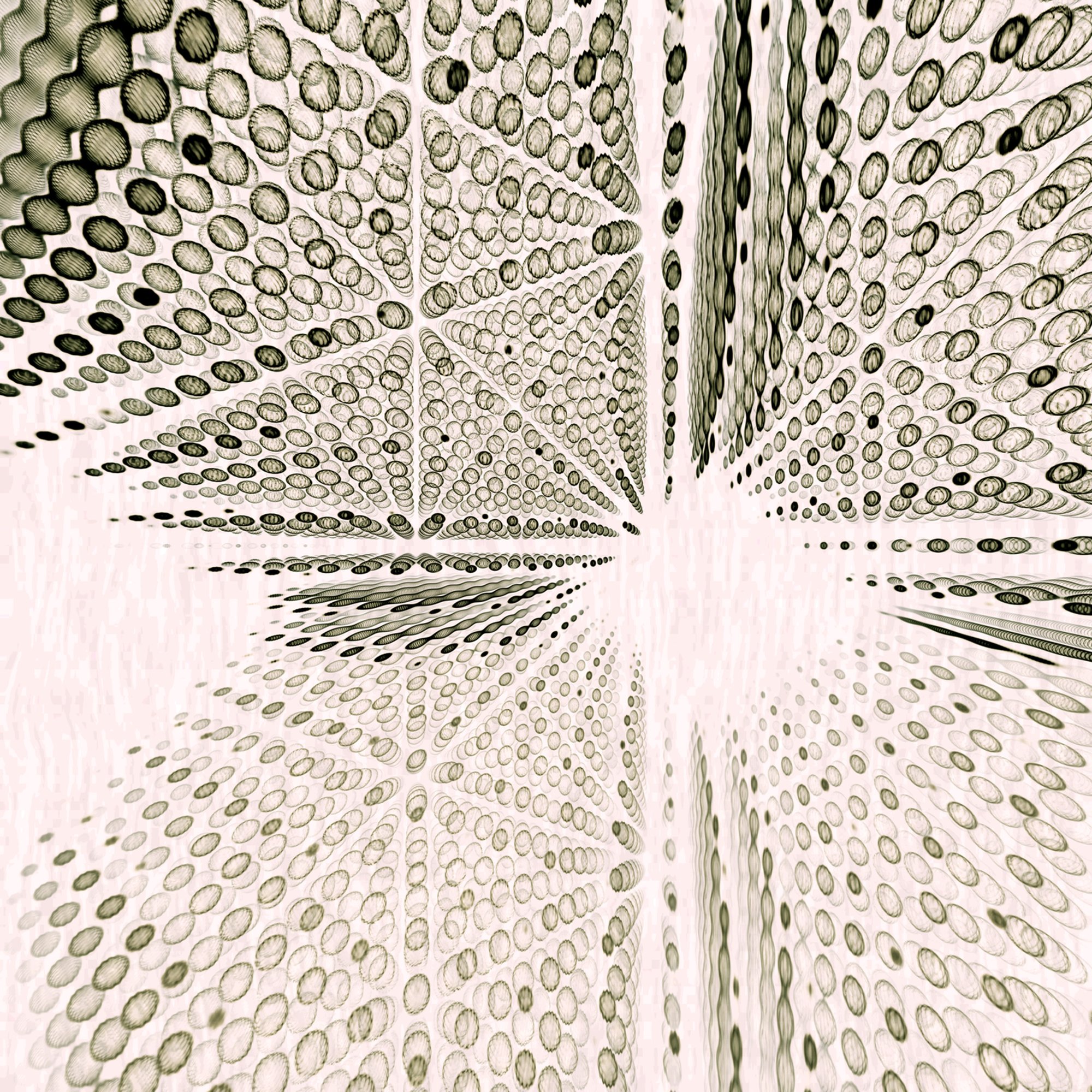
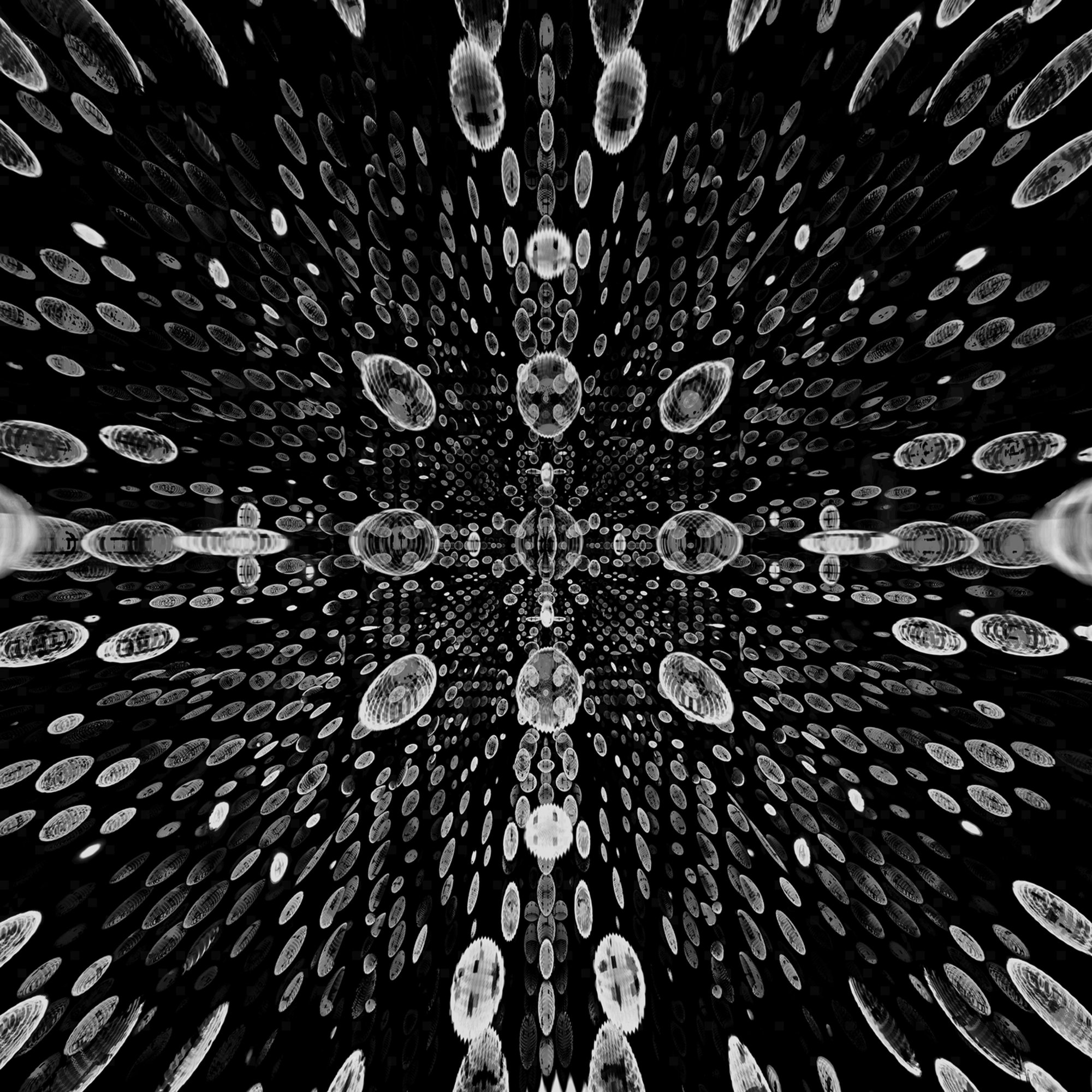
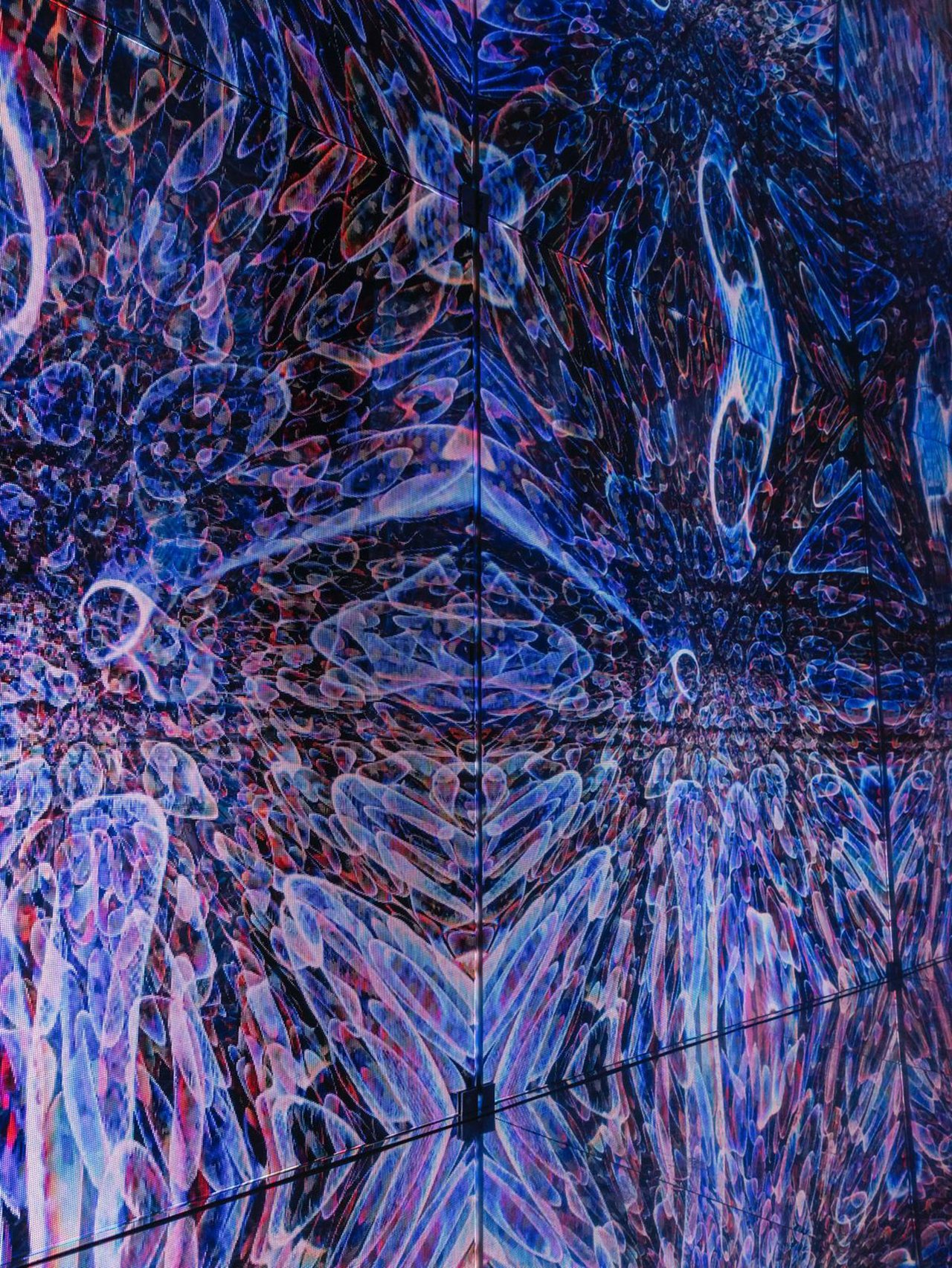
Eko33, Calculated Skies 00, 2026. Courtesy of the artist
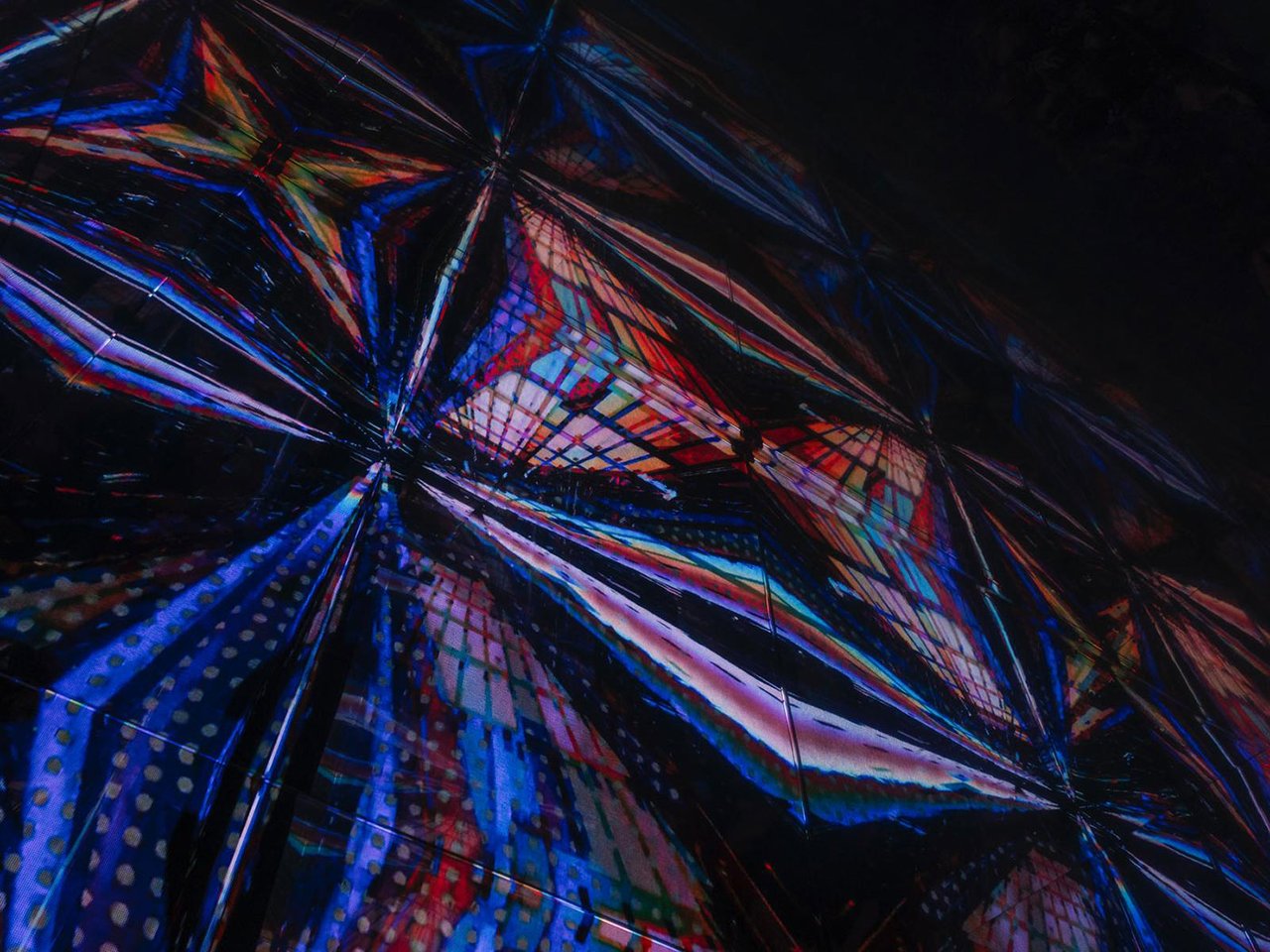
Eko33, Calculated Skies 08, 2026. Courtesy of the artist
Eko33, Calculated Skies 010, 2026. Courtesy of the artist
Eko33, Calculated Skies 011, 2026. Courtesy of the artist
Marlene Corbun: Generative art has undergone profound transformations over the past decade, particularly with the growing visibility of digital and algorithmic practices. What makes the current moment so significant within the history of generative art?
Eko33: In my opinion, the significance is not simply that generative art has become more visible. It is that several histories that used to remain separate are now colliding in public: conceptual art, computer graphics, crypto, artificial intelligence, moving image, installation, and the social life of networks.
For a long time, generative art was treated as some kind of technical subculture or as a historical footnote to the plotter pioneers. Today, that is no longer possible.
Code is one of the most dominant infrastructures of perception, finance, identity, attention, entertainment and memory. So when artists work generatively, we are not only using a tool. We are working inside the same logic that organizes contemporary life.
What changed over the last decade is that audiences learned to read computation as culture rather than as novelty or an obscure engineering practice. Blockchain made provenance and collectibility visible; AI made the collective memory as an archive of images visible; and immersive systems made code spatial and bodily. For me, the important thing is to reconnect this moment to a longer history. Generative art is not young. The current moment matters because it is finally being understood as both historical and contemporary, as a way to think through the systems that now think through us.
Installation view, Eko33, LightboxCalculated Skies 04, 2026, in the former flour mill which was home to NFC Summit, Lisbon. Courtesy of DANAE
MC: How do you use code to shape sensory experience? Do you wish to recode audiences’ subjectivity in some way?
Eko33: I think of code less as instruction than as a field of tensions. A line of code can decide rhythm, density, hesitation, latency, brightness, scale. It can make an image appear too quickly, or refuse to resolve. That is already sensory. You feel it in the body before you understand it conceptually.
I do not want to recode audiences in the sense of programming them. The audience is already being coded every day by social platforms, metrics, interfaces, recommendation systems. I am more interested in creating a situation where that becomes perceptible. Ideally I would really love for it to help people become more cognizant of the technological biases in our everyday life.
In my work, code shapes conditions for attention. It can make perception unstable, slow, recursive, slightly uncertain. It asks the viewer to notice their own looking.
In that sense, yes, there is a transformation of subjectivity, but it is not coercive. I am not trying to replace one program with another. I am trying to open a gap inside the program. Perhaps the audience leaves with a slightly altered awareness of how images, systems, and their own expectations are acting on them.
Installation view, Eko33, LightboxCalculated Skies 00, 2026, in the former flour mill which was home to NFC Summit, Lisbon. Courtesy of DANAE
MC: Many of your works exist as live systems in continuous transformation rather than as fixed images, yet digital is always discrete and continuous in some way. Do you prioritise one over the other?
Eko33: I do not really prioritise one over the other. The tension between the discrete and the continuous is precisely where the work happens.
The digital is made of cuts. It samples, quantizes, compresses, stores, executes. But perception rebuilds continuity from those cuts. A live system is a sequence of discrete events that produces continuous attention. Each frame is finite, but duration lets it become atmosphere. Mirrors intensify this problem. They are immediate and analog, but in Calculated Skies, 2026, they receive generated images that come from discrete computation. The viewer’s body enters as another unstable input. Reflection makes computation feel less like a screen and more like weather. It becomes a field you inhabit.
So I work with discontinuity as a material, but I try to make it felt as presence. Glitches, loops, delays, repetitions, generative variation: these are not only technical properties. They are psychological events. They remind us that continuity is often a construction, something the mind negotiates.
I do not want the image to become a perfect flow. I want it to retain traces of calculation, because those traces are where the work remains alive.
Eko33, detail from Generative Infinity Room. 2026. NFC Summit, Lisbon. Courtesy of NFC Summit
MC: How did the idea for your immersive mirrored space Calculated Skies first emerge?
Eko33: Calculated Skies emerged from a simple obsession: How will I feel having a generative artwork completely around me while having my physical self at the center of the work.
I had been thinking about the Infinity Room, not as spectacle, but as an algorithmic mirror. Most digital works still assume a frontal relationship between viewer and image. I wanted to break that, to make the image spatial, multiplied, and unstable.
The project began with the idea of using the same codebase to generate both the immersive environment and a series of unique works. That was important to me. The installation is not an illustration of the code, and the lightboxes are not documentation of the room. They are different states of the same system. One becomes architecture, the other becomes object.
The title, Calculated Skies, came from that tension. A sky suggests something open, atmospheric, almost sacred. A calculation suggests control, structure, precision. I wanted to hold both together. The work is a constructed sky, but it is also a place where calculation loses some of its authority and becomes reflection, duration, and experience.
Eko33, detail from Generative Infinity Room. 2026. NFC Summit, Lisbon. Courtesy of NFC Summit
MC: The project draws on long histories of optics. In what ways does your project resonate through deep time?
Eko33: Mirrors are among humanity’s oldest technologies for making the self strange. Before they were aesthetic devices, they were ritual objects, optical instruments, social tools. Catoptrics, the study of reflection, runs from ancient optics through Ibn al-Haytham, Renaissance perspective, anamorphosis, the Claude glass, the kaleidoscope, and then into modern and contemporary art.
I am interested in that deep continuity. A mirror is never just a mirror. It is a technology of positioning: who sees, who is seen, from where, and under what conditions. In Calculated Skies, I wanted to place computation inside that history.
The algorithm is not presented as a rupture with older optical culture. It is another reflective apparatus. Like the convex mirror in painting, or the kaleidoscope as a machine for variation, the generative system reorganizes the viewer’s position inside the visible.
That is the deep-time element for me. We often imagine digital art as immaterial, fast, without ancestry. But every screen, every sensor, every generative image is part of a much older history of optics, illusion, geometry, and self-recognition. Calculated Skies tries to make that ancestry physically felt.
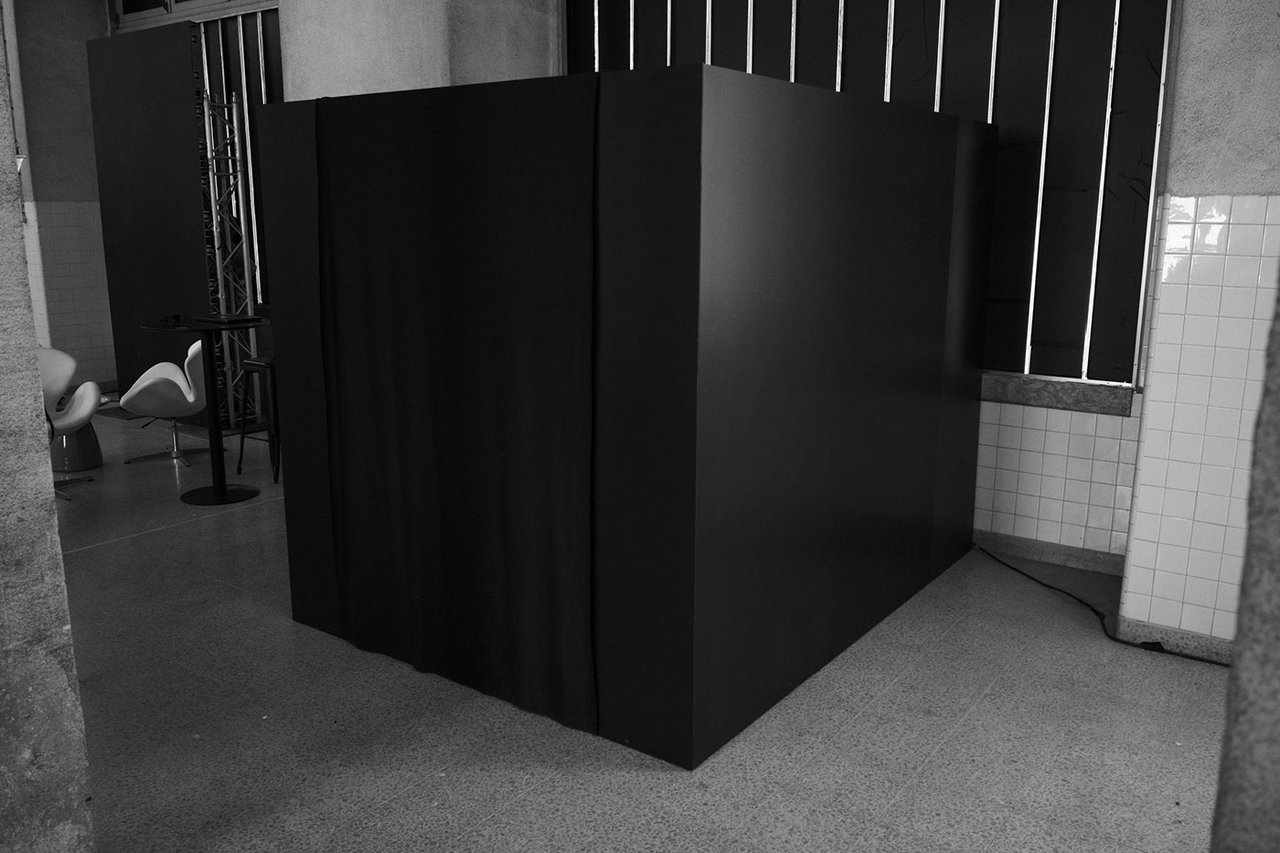
Installation view, Eko33, Generative Infinity Room, 2026. NFC Summit, Lisbon. Courtesy of the artist
MC: Within the installation, visitors eventually encounter their own reflection suspended within an evolving and apparently infinite environment. What kind of emotional or introspective experience did you hope the work would generate?
Eko33: I was not looking for a spectacular selfie moment, although the mirror always risks that. I wanted the visitor to encounter themselves almost as an interruption.
You enter the space expecting an infinite environment, but at some point your own body appears inside the system. You become one of the elements being composed. That moment can be beautiful, but also slightly uncomfortable.
The work asks: where am I in this image? Am I observing the system, or has the system already absorbed me? That ambiguity is central to how we live with technology now. We are constantly inside environments that reflect us back to ourselves, but often in ways we do not control.
So the emotional register I hoped for is quiet, not spectacular. A pause. A moment of recognition, but also of doubt. Reflection here is both optical and psychological. It creates a short delay in the flow of perception, where looking outward turns inward. I would like the visitor to leave with the feeling that technology is not only something we use. It is also a space in which we meet, distort, and perhaps recover parts of ourselves.
I also very much like the idea that it can be an introspective moment.
Jean-Jacques Duclaux (Eko33) was born in 1980 in Grenoble, France, and lives and works in Switzerland. Under the pseudonym Eko33, he has been developing for over twenty years a protean visual and sonic body of work, exploring digital cultures and the regimes of perception specific to their environments. At the intersection of visual arts, sound and computational technologies, his artistic practice questions the contemporary conditions of image production, human-machine relationships and the possible emergence of a non-human, or transhumanist, imagery. Trained from adolescence in electronic music and code, with a self-taught and resolutely exploratory approach, he developed his first digital works in 1999, using a portable Commodore SX-64, Max/MSP software and Nato.0+55+3d. Since then, he has progressively expanded his creative palette towards more complex generative systems, incorporating artificial intelligence models, neural networks and programmed environments, to produce multi-referenced abstract works that combine geometric rigor and chromatic intensity. His work has been the subject of solo and group exhibitions internationally, in fairs, biennials, galleries and museums such as Art Basel, the Seoul Museum of Art and the Venice Biennale. He regularly participates in conferences and panel discussions at major contemporary art events and has taught creative coding in international art schools.
Marlene Corbun is a Paris-based advisor and curator specializing in contemporary and digital art. With more than a decade of experience consulting collectors across White Cube gallery, Christie's auction house, and the European financial group, ODDO BHF, she has led major projects for leading digital art platforms as well as institutions including the British Museum, Centre Pompidou and Monnaie de Paris, where she curated exhibitions and contributed to acquisition strategies.