·
STEMMING A FUTURE ROOTED IN NOSTALGIA | POLYGON1993
A
Arthemortabout 2 months ago
(first draft posted here for feedback, kinda of a mess right now, my brain is weird)
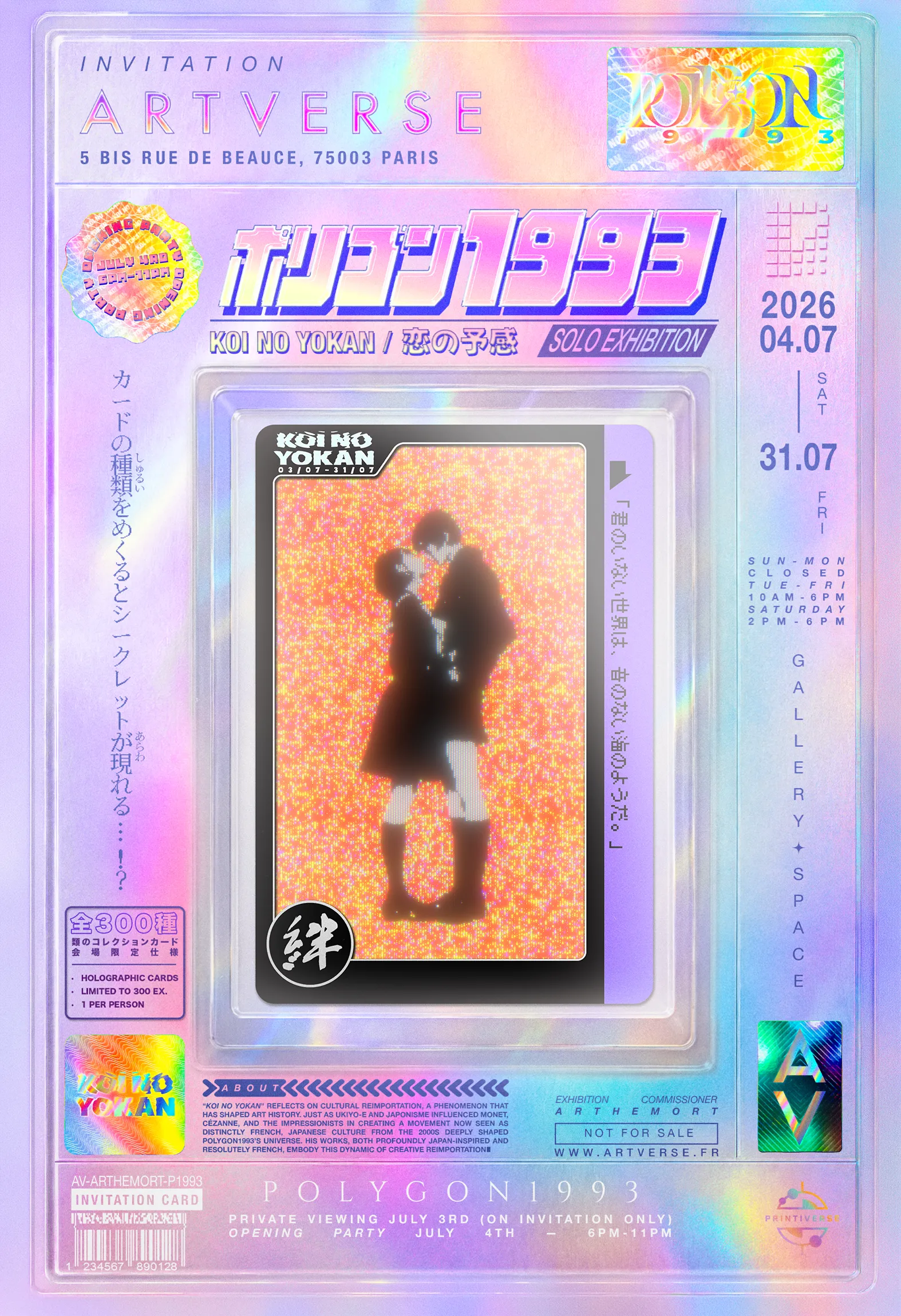
Deck: With "Koi No Yokan," POLYGON1993 brings the aesthetics of digital glitch and analog circuit bending into dialogue with trading-card culture, cypherpunk principles, and the codified white cube of contemporary art; a century of cross-cultural image-making and Occidental-Oriental influence.
Brian Beccafico (aka Arthemort)
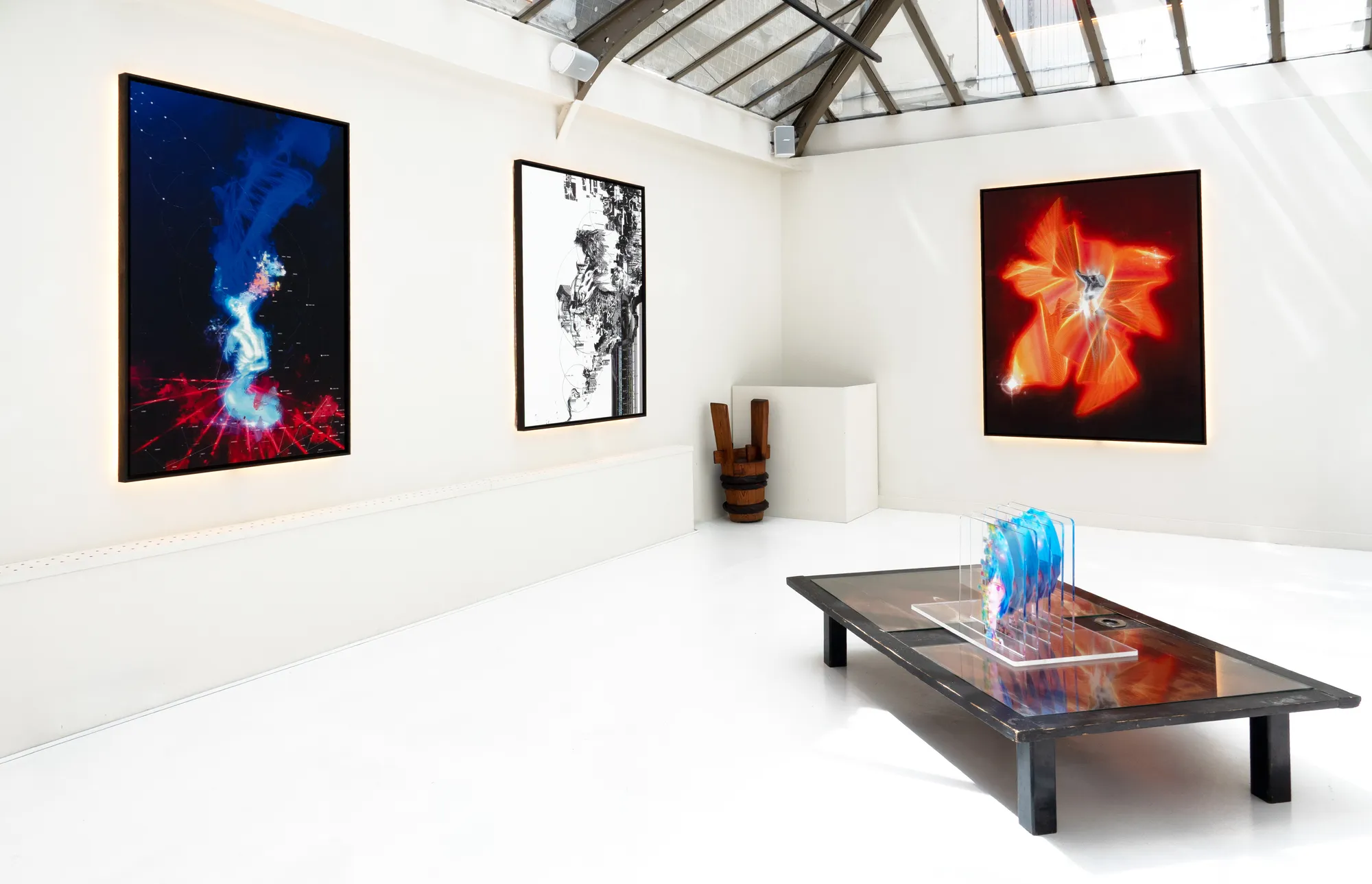
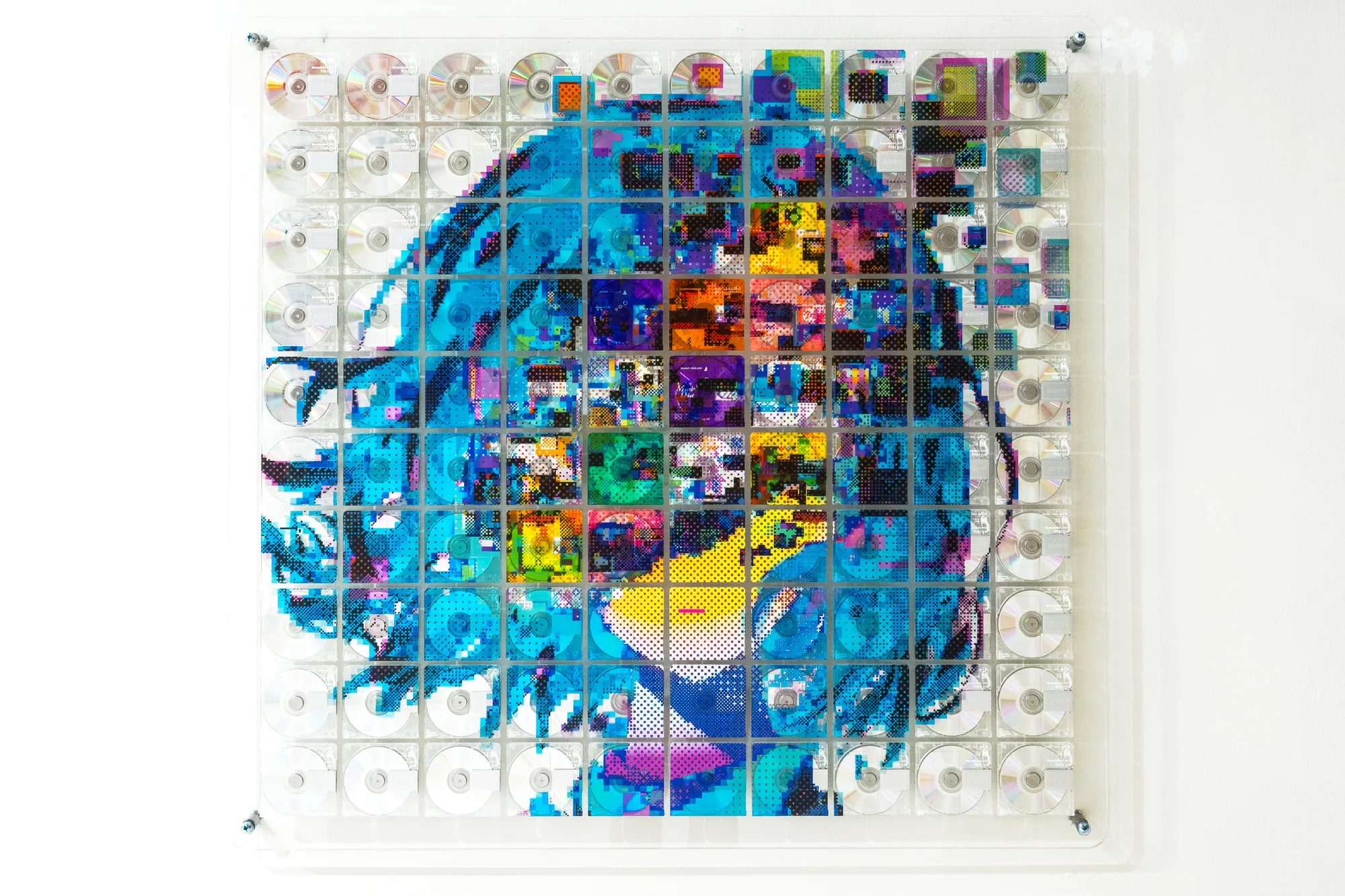
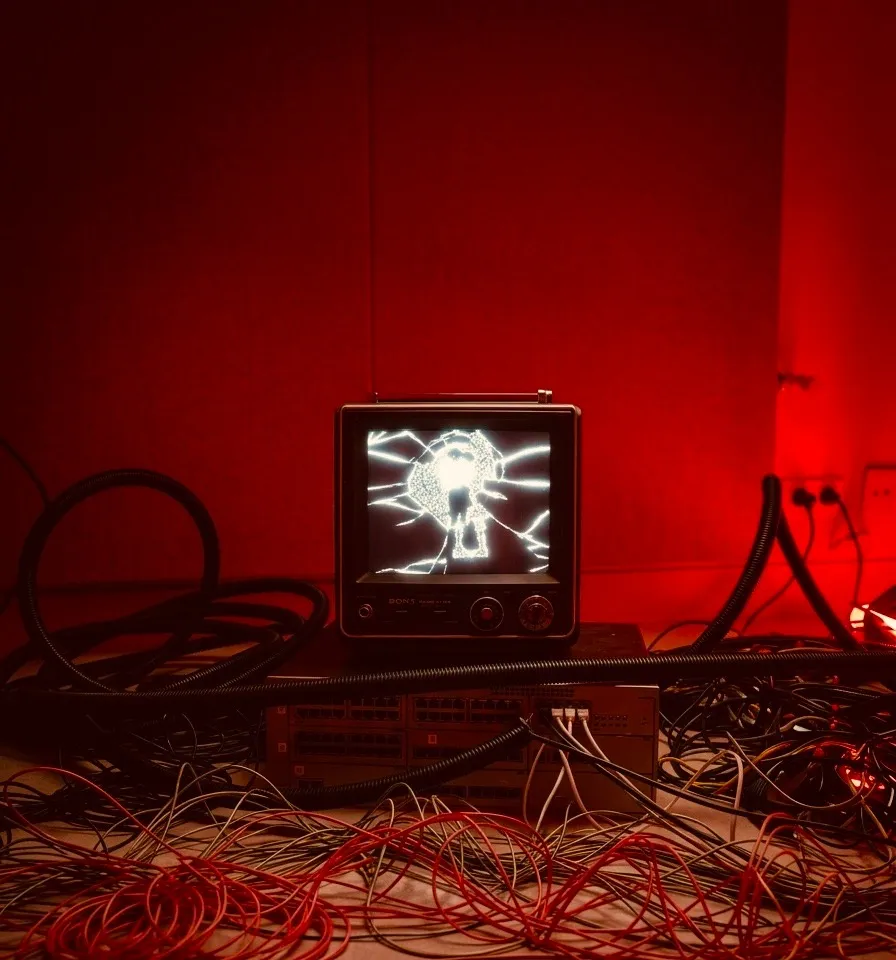
POLYGON1993 uses circuit bending, photography, AI, digital media, and innovative printing techniques as a gateway into a retro-futuristic and retro-mania world grounded in nostalgia for an obsolete analog world. "Koi No Yokan – The Premonition of Love," his first solo exhibition in France, was on display from July to September 2026 at Artverse, Paris, timed to open just ahead of Japan Expo, Europe's largest festival of Japanese culture. The exhibition brings together fifteen physical works (ten UV prints, four UV texturised paintings, one UV print on plexiglas sculpture) alongside a dedicated section devoted to Phantasm, POLYGON1993's original trading card game (phantasm.world), and an immersive cables mess and CRT installation in the gallery's basement. The show also features an exclusive collaboration with Mitsuhiro Arita (a living legend in trading-card and licensed illustration, the artist behind some of the Pokémon Trading Card Game's most iconic original artwork, including the 1999 Base Set Charizard, with further credits spanning Magic: The Gathering, Final Fantasy XI, and concept design for the Berserk: The Golden Age Arc film trilogy) titled Kirin, a sumi-ink work by the Japanese artist, glitched by POLYGON1993. The exhibition is produced and curated by Brian Beccafico, founder of Arthemort.
The expression koi no yokan doesn't have a real translation in Occidental concepts. It's amazing to think that something like love (which we might assume is universally understandable across humanity) has semantic nuances our brains can't really grasp unless we have a word for it. Words shape our perception of the world: for most of history, the word "blue" didn't exist, and we had to wait for the word before we could finally perceive the color.
As a curator, using words that are open to interpretation is a goldmine for art jargon that lets you evade any conceptual debate; but I'll attempt to give you something of a definition of what it could mean, and how the show I've curated, the scenography I've come up with, and the work the artist has produced are truly the essence of what koi no yokan means.
So let me try the personal route instead of the definitional one.
Have you ever had the conviction, upon meeting someone, that you are destined to fall in love? That undeniable yet ineffable certainty is what I (Brian Beccafico) felt upon seeing the work of the artist (POLYGON1993). I was sure his work was something I'd adore the more I got to discover it.
Now, I'm not a strong believer in Stendhal syndrome; if anything, I believe the entire concept is just creatively elegant, made-up bullshit by the poet to cover up the fact that he'd walked all over Florence and climbed a substantial number of stairs to reach the frescoes at Santa Croce, ending up with the dizziness any overweight person would feel in that situation.
But let's not let my pragmatism ruin the magic of poetry and the twists words can bring to reality. For most people, art speaks to either the mind or the heart (it's intellectual or emotional) yet I connect most with artwork when it speaks to my senses, shifting the perception of reality (a topic I explored in my text for the auction "Natively Digital: Oddly Satisfying"). Over the past century, and in recent history, those concepts were explored by artists like M.C. Escher, Vasarely, Pol Bury, Carlos Cruz-Diez, Olafur Eliasson, and James Turrell.
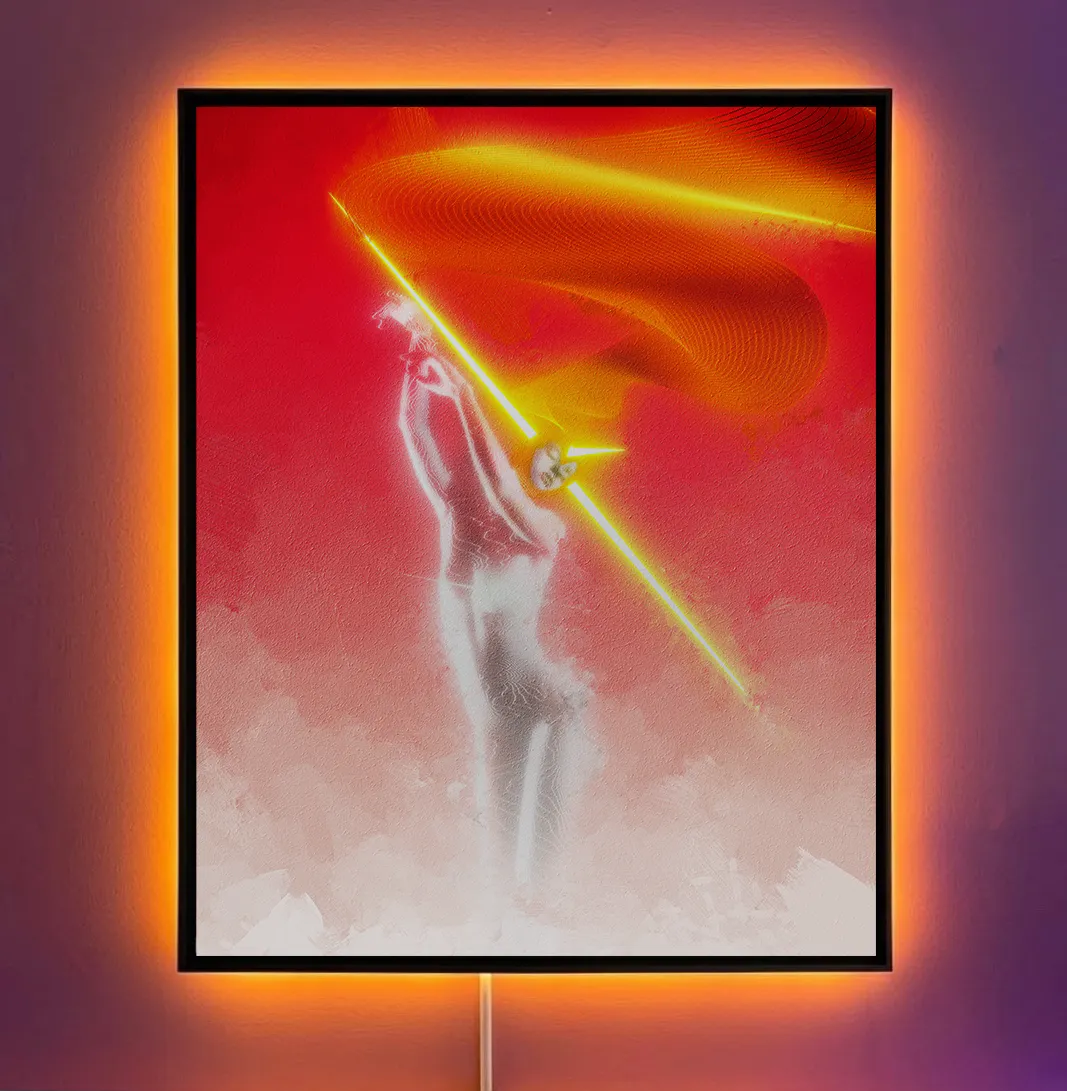
I find the exploration of mathematical planes, knot theory, non-Euclidean geometry, anamorphosis, illusion in general, and perception fascinating. I believe glitch artists are (often unknowingly) the digital-art continuation of those explorations and of the Kinetic/Op Art movement.
Light, in that regard, is one of the most fantastic tools an artist can play with, and one the artists mentioned above often privileged. The sensorial perception of light is very human and subjective, in the broader realm of living things.
As you know, the visible spectrum for humans (and most mammals) sits between infrared and ultraviolet wavelengths. Although our three cones let us perceive a certain range of nuance, there are examples of animals that can perceive far more nuance than we can. Something even more fascinating is animals that can perceive further up or down this range of wavelengths; I was stunned to learn that common flowers display fantastic patterns and shapes under ultraviolet light, visible only to insects.
This idea that there's a hidden layer to reality, imperceptible to the naked eye, excites me because our digital reality is tangible in the same way. We fill our world with wavelengths we can't perceive, and yet they translate into technology that very much impacts our perceivable world.
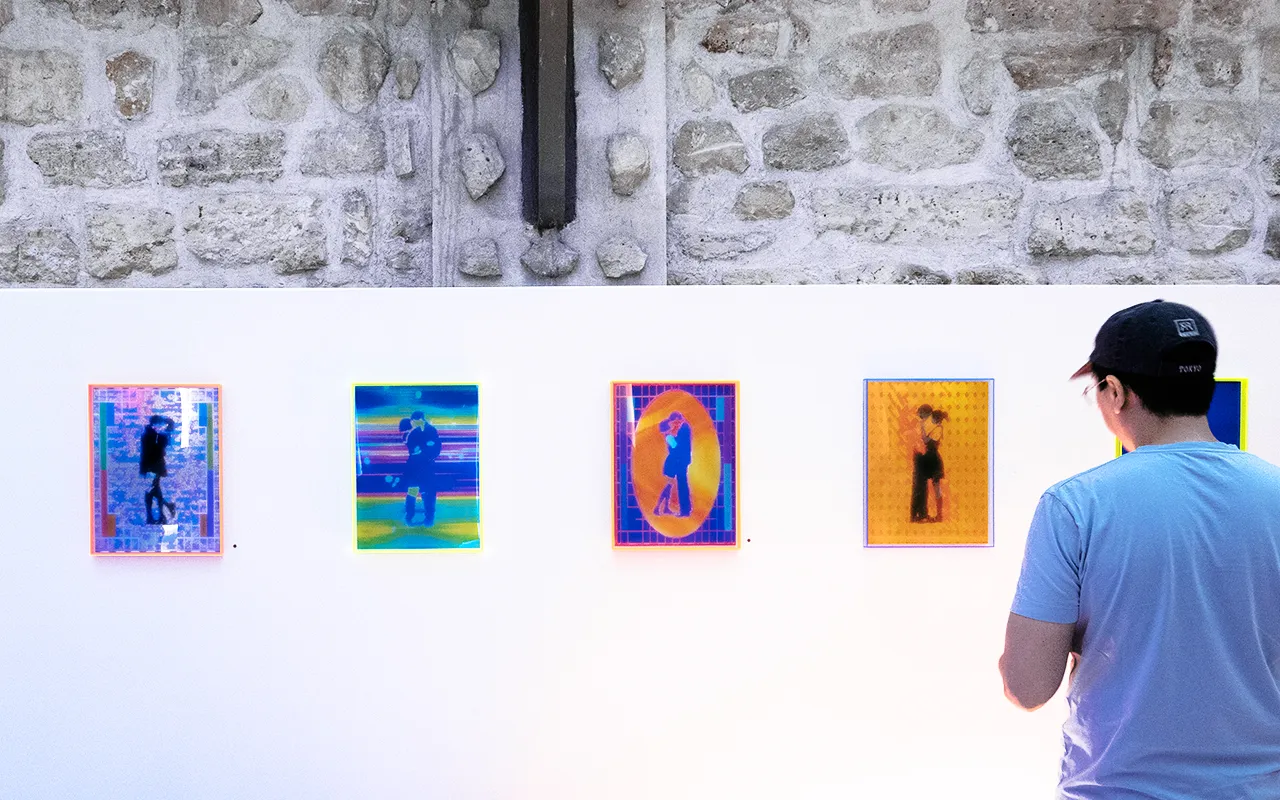
At the heart of the exhibition is the use of UV printing and holographic effects rendered on the prints and cards on show. I often wonder how animals must perceive an effect we can only clumsily render as shiny rainbows.
A side anecdote, since we're on the subject of who gets to see what: many people in my family are colorblind, so I've come to easily notice others with the same condition. I once met an esteemed curator in the art world, realized he was also colorblind, asked him about it, and he made me promise never to tell anyone, or his reputation would be ruined. I guess a limitation in perspective isn't a limitation but another lens through which to experience art though not many people are willing to see it that way.
That same idea (that a filter can be a lens) is literalized in the show's own materials. Diffraction, and layers of filters (whether biological or cultural) impact the perception we have of the world and of others around us. A polygon, like a prism, is used to diffract light and reveal its subtlety. What POLYGON1993 does in his work is also shine a light on concepts we're often too ethnocentric to notice.
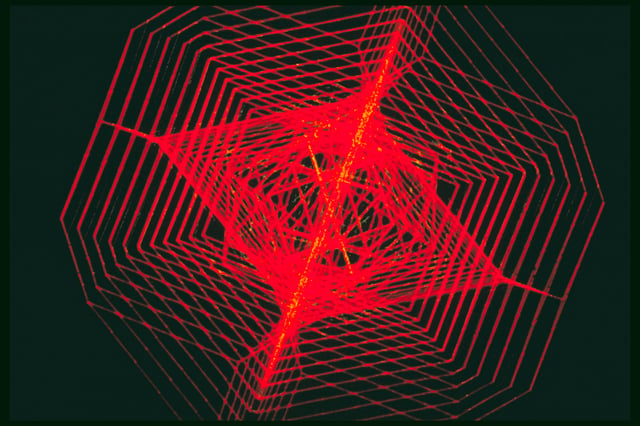
That's literally how the work gets made, not just how I've chosen to describe it. POLYGON1993 starts with a photograph (often of his own body) and routes it through circuit-bent analog modules before recapturing it: photographed, corrupted, reclaimed. What comes back carries the visible trace of that passage; unstable colors, vibrating contours, textures suspended between precision and degradation. It's a search for beauty without objectification, and it means the glitch in his work isn't a filter applied after the fact. It's the process the image actually survived.
One filter in particular kept coming up at the opening: nationality. Since this was his first exhibition in France, a lot of visitors assumed the artist was Japanese for us Europeans, this aesthetic feels very Japanese-influenced (which it is). But funnily enough, POLYGON told me that whenever he exhibited in Japan (which he's done a lot), nobody ever told him this; if anything, they found his work very French! It's funny how that works sometimes. In my exhibition text, I draw a parallel to that anchor point in art history: the Impressionist movement.
If you ever visit Monet's house in Giverny, beside a lush garden filled with plants from all over the world, you'll find inside the house itself one of the biggest ukiyo-e (Edo-period Japanese print) collections in Europe, with famous works by Hokusai, Hiroshige, and others. The Impressionist movement, perhaps perceived as the most French of all, is in fact heavily Japanese-influenced! Many of the groundbreaking concepts Impressionism brought to Occidental art, its painters found on the other side of the world. It took the end of Japan's isolationist policy for the seeds it sowed to sprout across global visual culture.
Nowadays we hear a lot of debate about cultural appropriation. The Japanese, from what I've heard, don't really perceive it as negative, rebranding it instead as cultural valorization; though that reframing might itself read as a bit of a white-savior syndrome here. So for the show, I talk about "cultural porosity," because I believe culture is fluid and borderless.
There's actually a word for the specific shape this takes, and it's more precise than the one I coined: gyakuyunyuu, literally "reimport" in Japanese; the term for a product that leaves its country of origin, gets transformed elsewhere, and comes back enriched by the trip. That's POLYGON1993's trajectory in one word: a French artist raised on Japanese pop culture, recognized first in Japan, now reimported into the country he actually comes from.
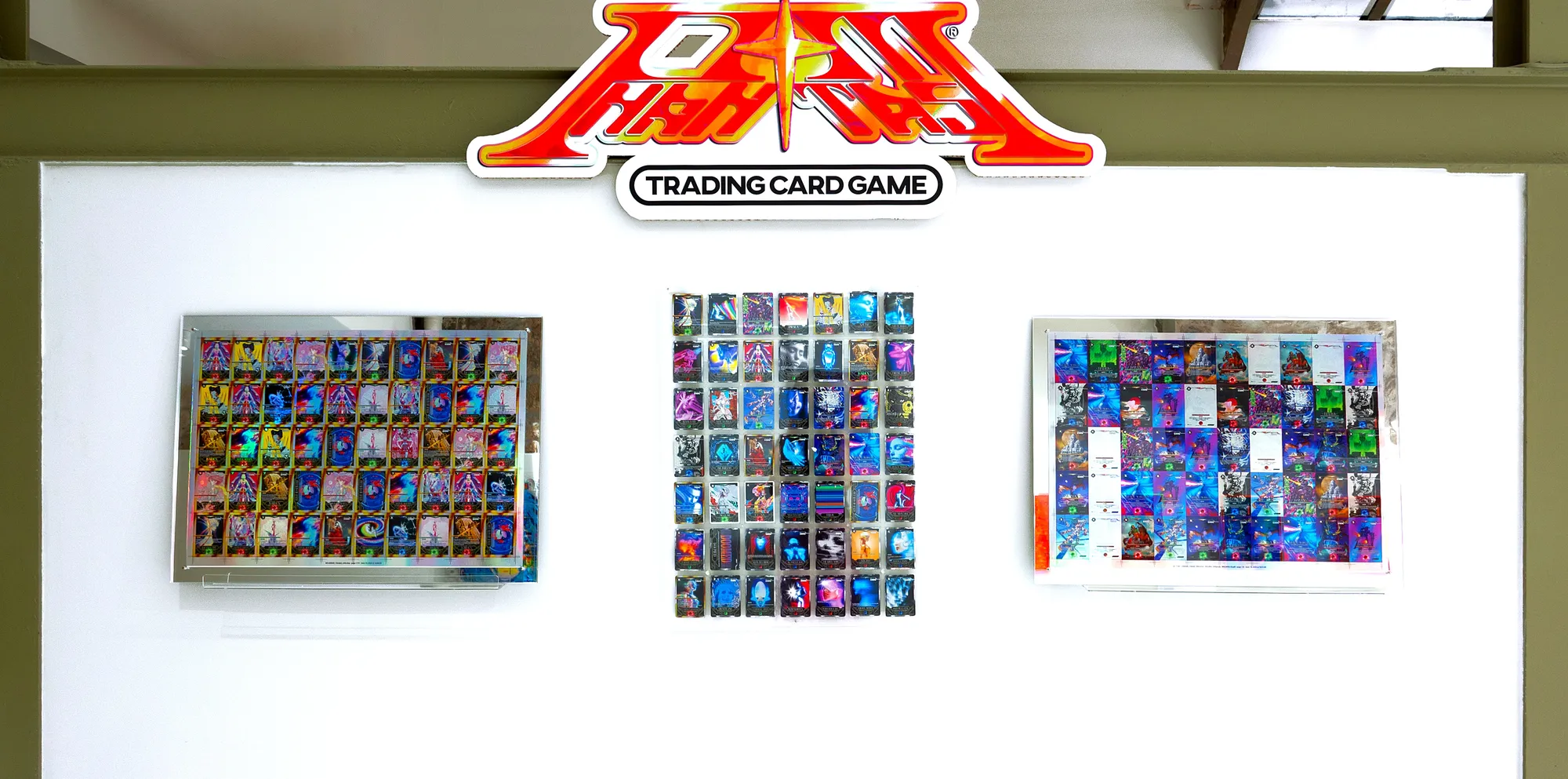
And porosity runs in more than one direction. Culture is a feedback loop: among the artists licensed in Phantasm are Philippe Druillet, alongside Moebius and other Franco-Belgian illustrators (the ones who forged science fiction's visual aesthetic) and authors such as Arthur C. Clarke, working in the lineage of the genre's original architects: Mary Shelley, Jules Verne, and H.G. Wells, who authored the concept itself. All of them European pioneers of a genre that is now largely considered an American movement thanks to Hollywood cinema. This cinema then influenced Japanese anime like Akira, which in turn influenced Europe back in the '90s. The fantasy genre went through a similar process, and many of its influences (Arabic, African, Oceanic roots) aren't often accounted for. Phantasm stages a version of the same shift closer to home: from blue chip to red chip, from artwork to collectible; two worlds that have always shared a love of collecting without ever quite mixing.
Moreover, with the internet and digital media, we now live in what the sociologist Marshall McLuhan described as a "global village," in his book The Global Village: Transformations in World Life and Media in the 21st Century, co-written with Bruce R. Powers and published posthumously in 1989. Culture has never been so easily accessible, and thanks to the soft power of Asian nations, Occidental countries have never been so exposed to Oriental media (whereas in the early 20th century those examples remained rare like the Beatniks in the US and the influence Zen Buddhism had on their literature, later giving birth to the New Age movement). One of the biggest examples of this happened between France and Japan in the '90s and early 2000s, a period that coincides with the "rarest childhood generation" that bore witness to our world shifting from analog media to digital.
As you might have guessed, POLYGON1993 was born in 1993, right in the midst of that period. As an artist, he's fulfilled many childhood dreams collaborating with Mitsuhiro Arita for this show, having worked with licenses like Tekken, and so on. This phenomenon is nowadays outshone by questions around the influence AI will have on Gen Alpha and Gen Z, which largely remain unknown.
What we do know is this: people of this generation are craving a rollback to analog media, to what feels real, and are very much confused by the rise of AI — yet we know not to fall victim to a reactionary response. We're the ones who made friends and connections online, who experienced art through consoles, one and zero at a time, back when video games were deemed toxic and violent, when screens, forums, and social media were deemed alienating.
Digital culture was also deemed decadent, brain-rotting, idiotic; Pokémon were "cringe," etc. I think this '90s generation has a huge role to play in shaping the social future of how we interact with technology for decades to come, because we know how the machines we operate actually work, how to repair and operate them, and (once they're gone forever) how to resurrect something close to what they were, through emulation.
Walter Benjamin once wrote an essay called "The Work of Art in the Age of Mechanical Reproduction" (1935); I believe a follow-up called "Art in the Age of Digital Emulation" is in order. The fact that POLYGON1993 still uses CRT monitors and circuit bending in his work isn't about being a purist, but rather about recreating, as closely as possible, a digital reality we can no longer log into. Emulation, as good as it gets, will always be a copy of a copy..a Ship of Theseus that will soon not have any of its original planks.
If the image itself can no longer be trusted to stay whole, the room that holds it matters more than ever. As our world is shifting, and the art world is shifting alongside it, further and further away from a nearly obsolete brick-and-mortar model, what this exhibition has shown me is that a gallery space can be what sociologist Ray Oldenburg termed "a third place" or, in Nicolas Bourriaud's own language from Relational Aesthetics, a "social interstice" especially when it comes to digital art. I've seen people come from hundreds of kilometers away for this show, some staying in Paris for days just to visit it, from every generation, and mostly ones who told me, plainly, that they had never set foot in a gallery before; people who had followed the artist's work for years, so happy to finally be able to experience it in France, the native country of the artist.
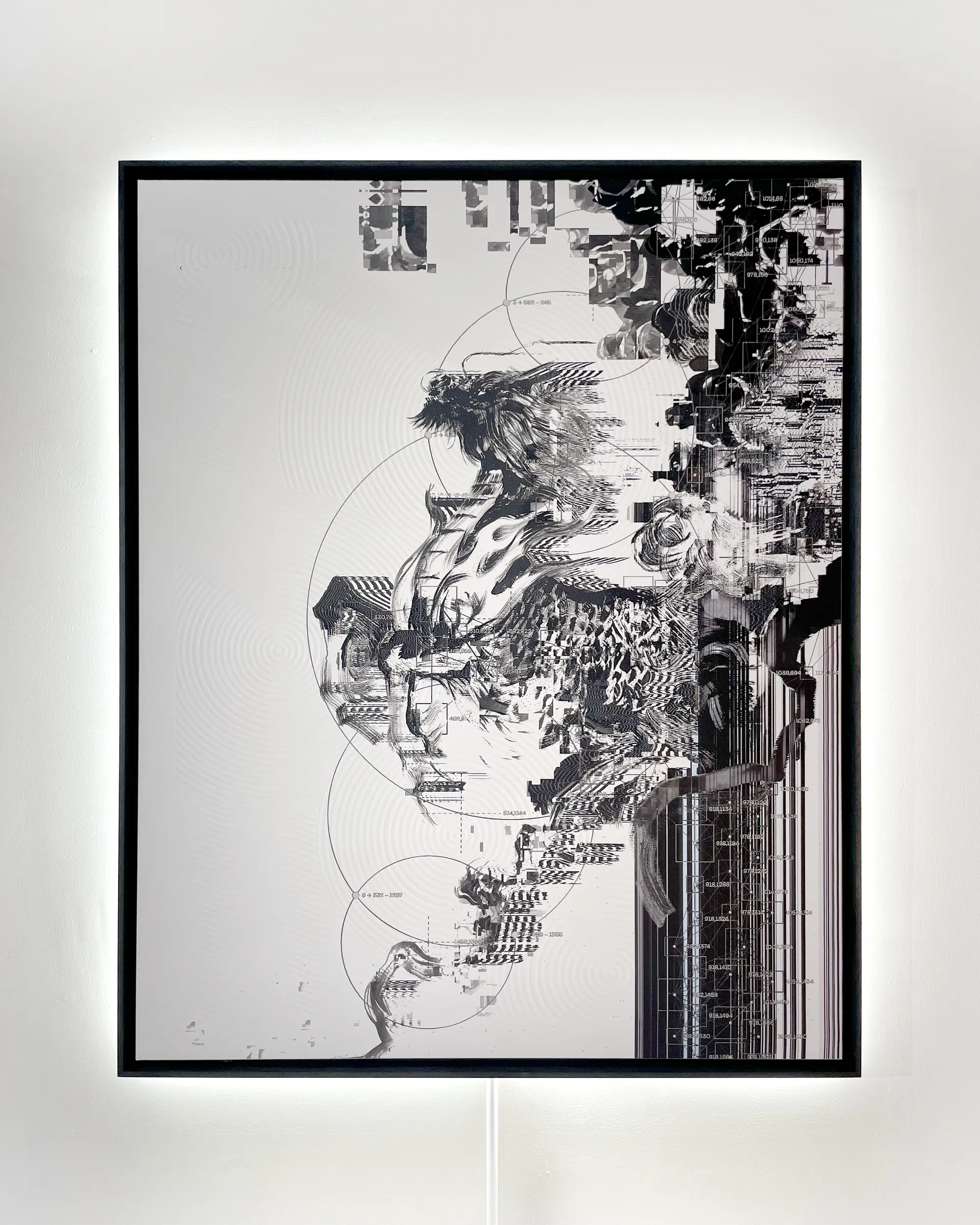
Kirin
Mitsuhiro Arita x POLYGON1993
The clearest expression of that idea in the show is Kirin, the collaborative piece with Mitsuhiro Arita. At its center is a kirin (the mythical unicorn of East Asian folklore, tied since antiquity to Confucius, said to appear only before the birth or death of a sage) rendered by Arita in sumi ink within the raked-sand patterns of a karesansui, the Japanese dry-landscape garden where gravel stands in for water. POLYGON1993 folds glitch into that stillness: fractured pixels, coordinate grids, a lattice of data points spreading across the canvas like static. The kirin has always been closer to mirage than sighting; visible only to those who actually look. That's what drew both artists to it. Arita has illustrated some of the most recognized images in the world and had never shown in a gallery until this one; POLYGON1993 works in a medium contemporary institutions still treat as marginal. The kirin becomes a kind of shared self-portrait: recognized long before being legitimized, present in plain sight, waiting on the right kind of attention.
This isn't an abstract stake for me, either. My family collected a movement that could be considered similar to Pop Art, but by European artists; artists who exhibited alongside the likes of Warhol and Basquiat, and were often regarded by their American counterparts as even more talented than they were, yet somehow those artists' names wouldn't ring a bell for you. In France, for some reason, even when you succeed abroad, you're not celebrated in your own country. Our chauvinistic nature doesn't seem to apply to cultural production museums would rather collect work by big American names than champion the artists who built that history within their own borders.
By the time we started talking about a French show, POLYGON1993 had already collaborated with OpenAI, Bandai Namco, A$AP Rocky, Grimes, Tame Impala, Charli XCX, Pantone, Sony Music, and Warner Music, exhibited across the US, Japan, the UK, Portugal, Italy, and South Korea, and had just closed a solo show, Paradigm Shifters, at The Harmonyst Gallery in Tokyo, backed by the Institut Français du Japon and the French Embassy in Japan. None of that is niche. So it seemed absurd to me that nobody had ever proposed him a solo show in France. So I decided to take the gamble. There's a version of this that's almost a cliché at this point: no one is a prophet in their own land least of all in France. It's a harsh reality, but if he were American (same goes for me in the curatorial world) I think we'd get so many more opportunities. But I don't think we're doomed to be a big fish in a small pond..we just ought to do better, and more.
And the gamble paid off. Despite landing in the middle of summer (the worst possible slot on a Paris gallery calendar), Koi No Yokan drew 300 people to the Luma preview, 500 to the public opening, and 300 more to the closing, and came close to selling out the Koi No Yokan series entirely, at €1,200 an entry. Streamers, YouTubers, critics, cultural influencers, and journalists showed up throughout the run; the Franco-Japanese Chamber of Commerce attended the Arita event specifically. One critic came back several times and said he'd never seen a show this innovative. Grida, Artverse's former curator, called it the best show the gallery has ever held. A cultural influencer put it more bluntly: it was, in their words, a slap in the face.
POLYGON1993 is a French visual artist, director, and media scenographer whose practice spans digital illustration, sculpture, collectible objects, and NFTs. A devoted collector of Japanese trading card games, retro consoles, and video games from the '90s and 2000s (Dragon Ball, Pokémon, Game Boy) that visual world became his own education, filtered back through a distinctly French sensibility. His signature process starts with photography, often of his own body, routed through circuit-bent analog video devices from the 1980s and '90s before being recaptured; a technique he's used to build a body of work exhibited across the US, Japan, France, the UK, Portugal, Italy, and South Korea, and to collaborate with OpenAI, Bandai Namco, A$AP Rocky, Grimes, Tame Impala, Charli XCX, Pantone, Sony Music, and Warner Music. His solo show Paradigm Shifters opened at The Harmonyst Gallery in Tokyo in March 2025, backed by the Institut Français du Japon and the French Embassy in Japan. POLYGON1993 has always been based in France; "Koi No Yokan – The Premonition of Love" is nonetheless his first solo exhibition there, after building his audience and reputation largely in Japan first, a gyakuyunyuu: an artist reimported into the country he never actually left.
Brian Beccafico is the founder of Arthemort (arthemort.art), an independent Paris-based curatorial and art advisory practice working at the intersection of contemporary art and Web3. He works as a curator, art advisor, and collection manager, and previously directed the digital art department at Sotheby's Paris and co-founded Artcrush. He is a juror for the Lumen Prize, has been curating digital art exhibitions since 2020, and has studied the application of blockchain systems to the art world since 2016.
I loved it when you mentioned how different nationalities received it differently! Being somewhere in the middle of both cultures, I could see a lot of very Western in POLYGON’s work, but also a visible fondness and admiration for Japanese culture.
Plus, the exhibition looked phenomenal in person!
Thank you, Joana, for our original discussion on the topic when I was looking at closing the press release, which undoubtedly helped me put all this into words! will add some pictures by editing the post tomorrow for easier contextualisation :)