An Artist’s Handcraft Rooted in Digital Design | Makiko Harris
In a new exhibition, the former digital product designer presents four-metre-long sewing needles whose scale demands that viewers reckon with the oldest, and most intimate, interface of handwork
Auronda Scalera
Makiko Harris spent years designing digital products before her Japanese grandmother’s sewing kit came to her. In “I Hold You in Devotion”, at Kristin Hjellegjerde Gallery, West Palm Beach, the two inheritances meet. Soon after the exhibition’s opening, Harris discussed how the exhibition can be read through the needle’s role as perhaps the oldest interface we still hold in our hands.
The show’s honoring of sewing as a practice of care performed by hand feels timely, addressing as it does our moment: when a concern for the handmade, in opposition to the outputs of AI, has become for many a political statement or a moral choice.
The sewing kit
Every tool carries an idea of the body that will use it. A sewing needle assumes a hand steady enough to guide it, and a patience willing to repeat the same small gesture thousands of times. While Makiko Harris was studying at the Royal College of Art, London, she travelled to her grandmother’s house in Hokkaido, where the family was going through her belongings. “Her sewing kit was the one thing I knew I wanted to keep,” Harris tells me. It was a box of tools with no fabric inside: sewing needles, crochet hooks and knitting needles, some plastic, many metal, “each with different bends and different eyes, made for different kinds of work.”
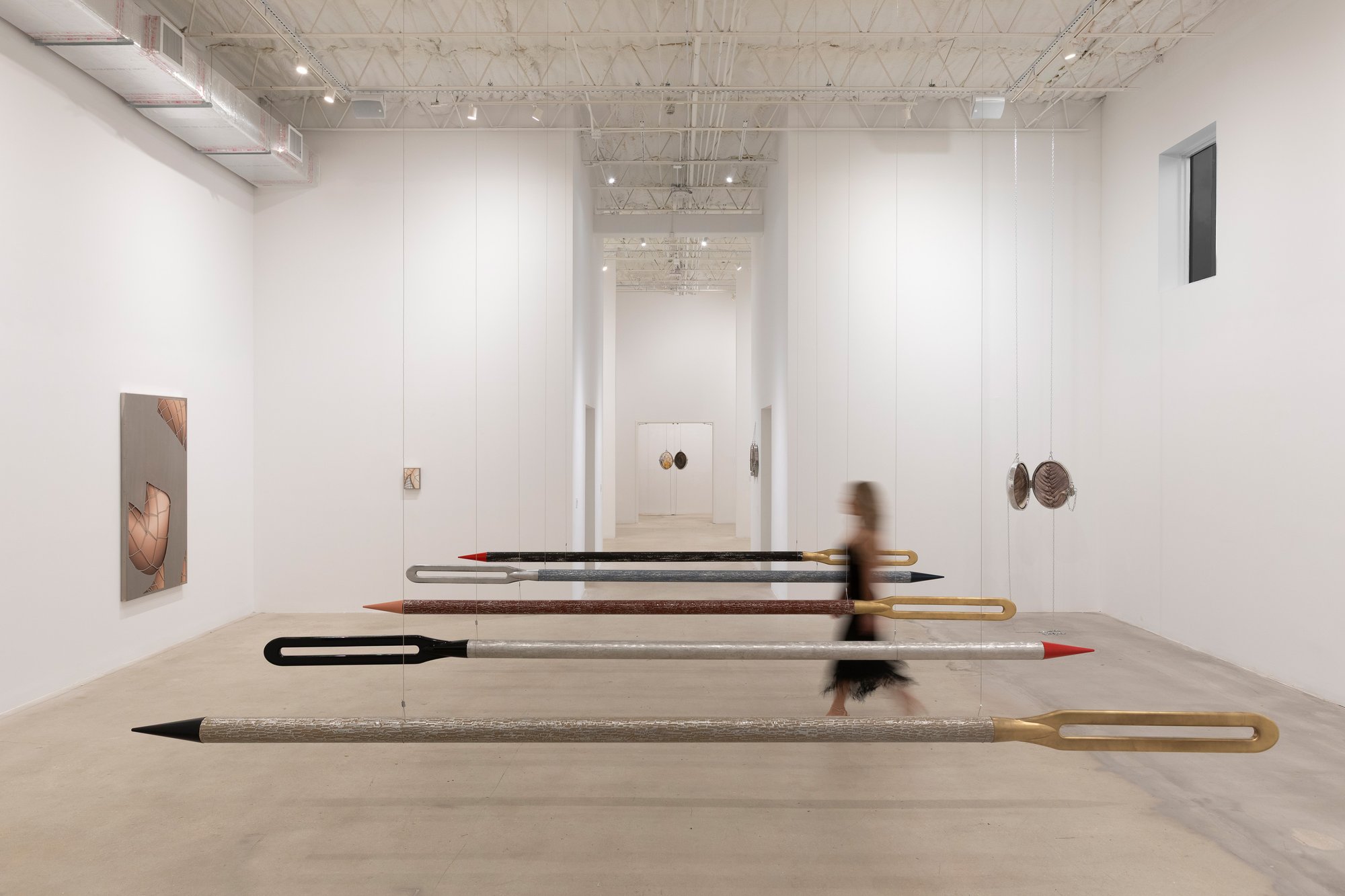
Installation view, Makiko Harris, “I Hold You in Devotion”, Kristin Hjellegjerde Gallery, West Palm Beach, Florida. Photography by Premier Photo
For her grandmother, sewing was a daily task and also a form of expression. The needles made clothes, and they gave her a space to make something entirely her own. They also made room for a private creative practice that nobody thought to record.
A few days after the opening of “I Hold You in Devotion”, Harris talked of how a body of work like this begins. It starts with receiving something, she said, and the thinking about beginnings comes afterwards. The sewing kit and its contents are an exact image of that attitude. “They felt sculptural to me straight away,” she says.
“I thought a good way to memorialise what these needles meant to [my grandmother] would be to make sculpture at a scale people would have to reckon with.” Soon after, she booked into the metal workshop and began making enlarged replicas.
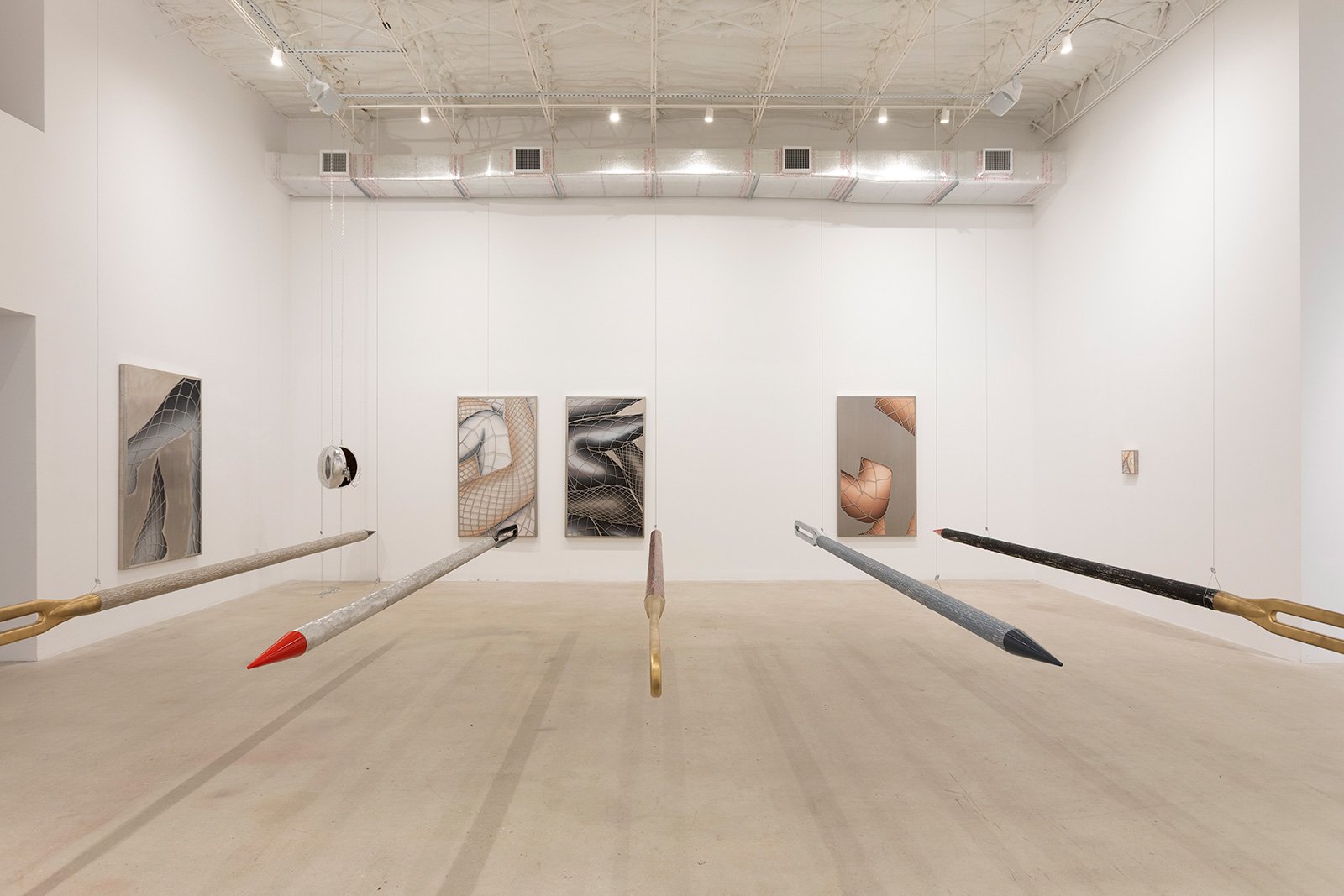
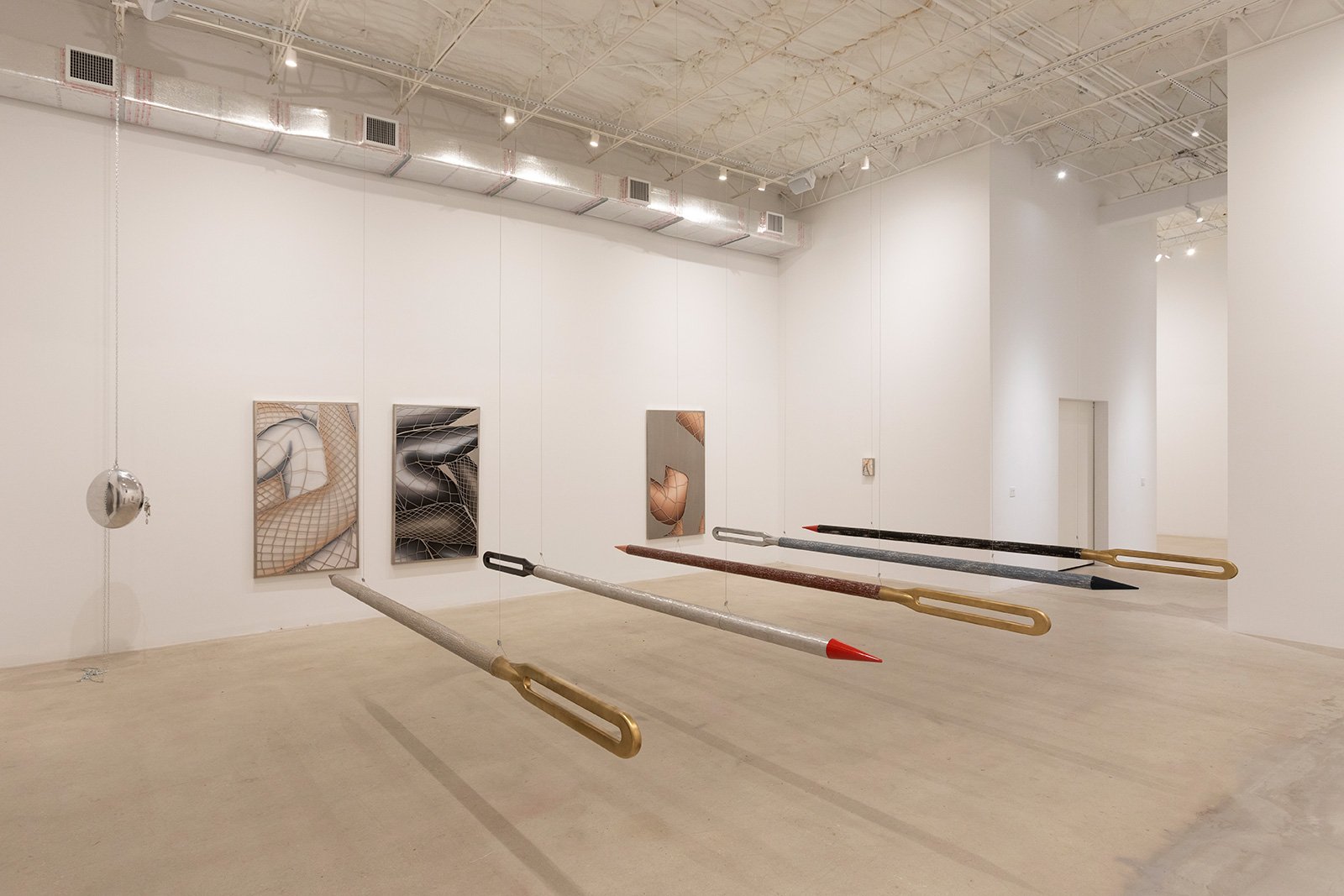
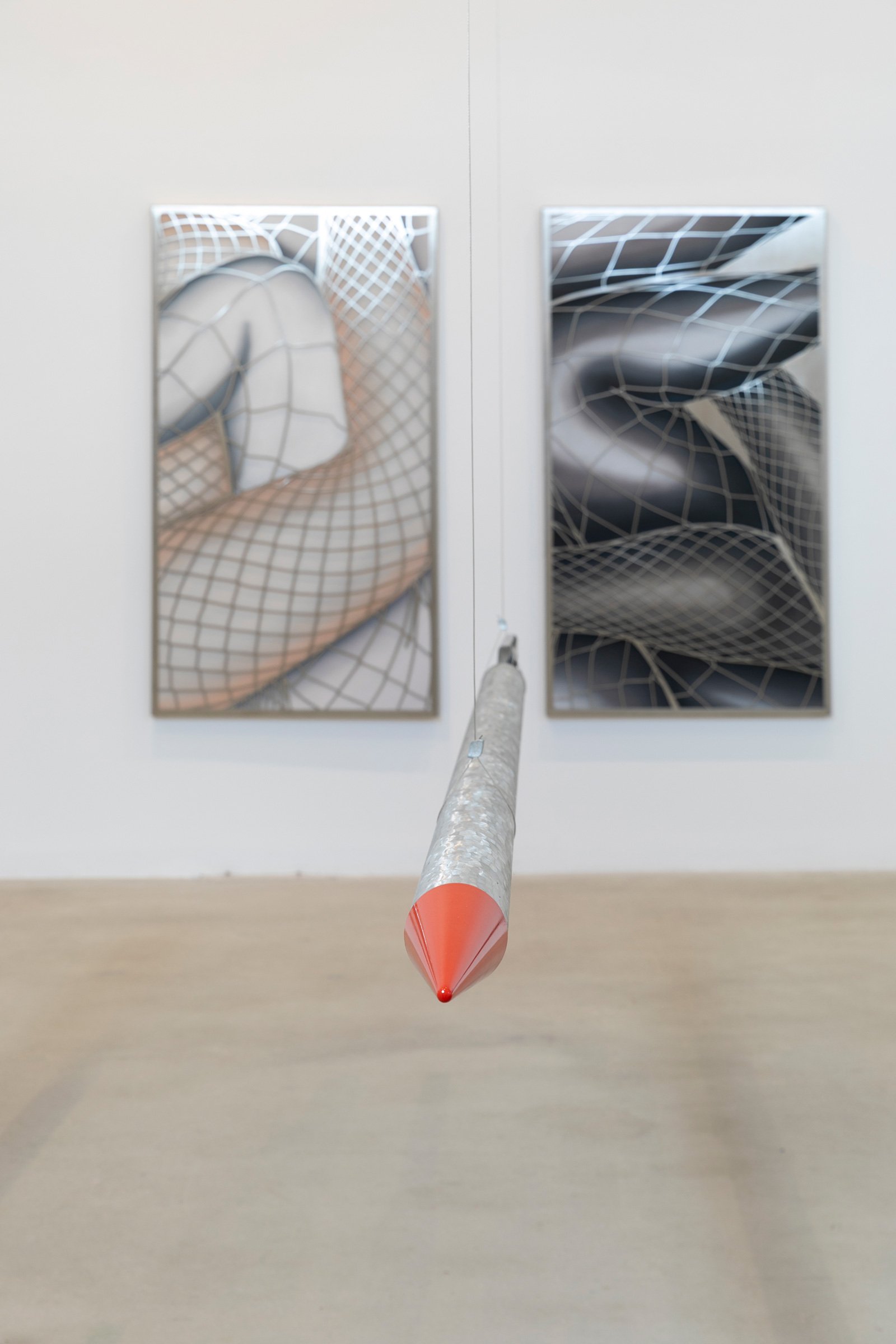
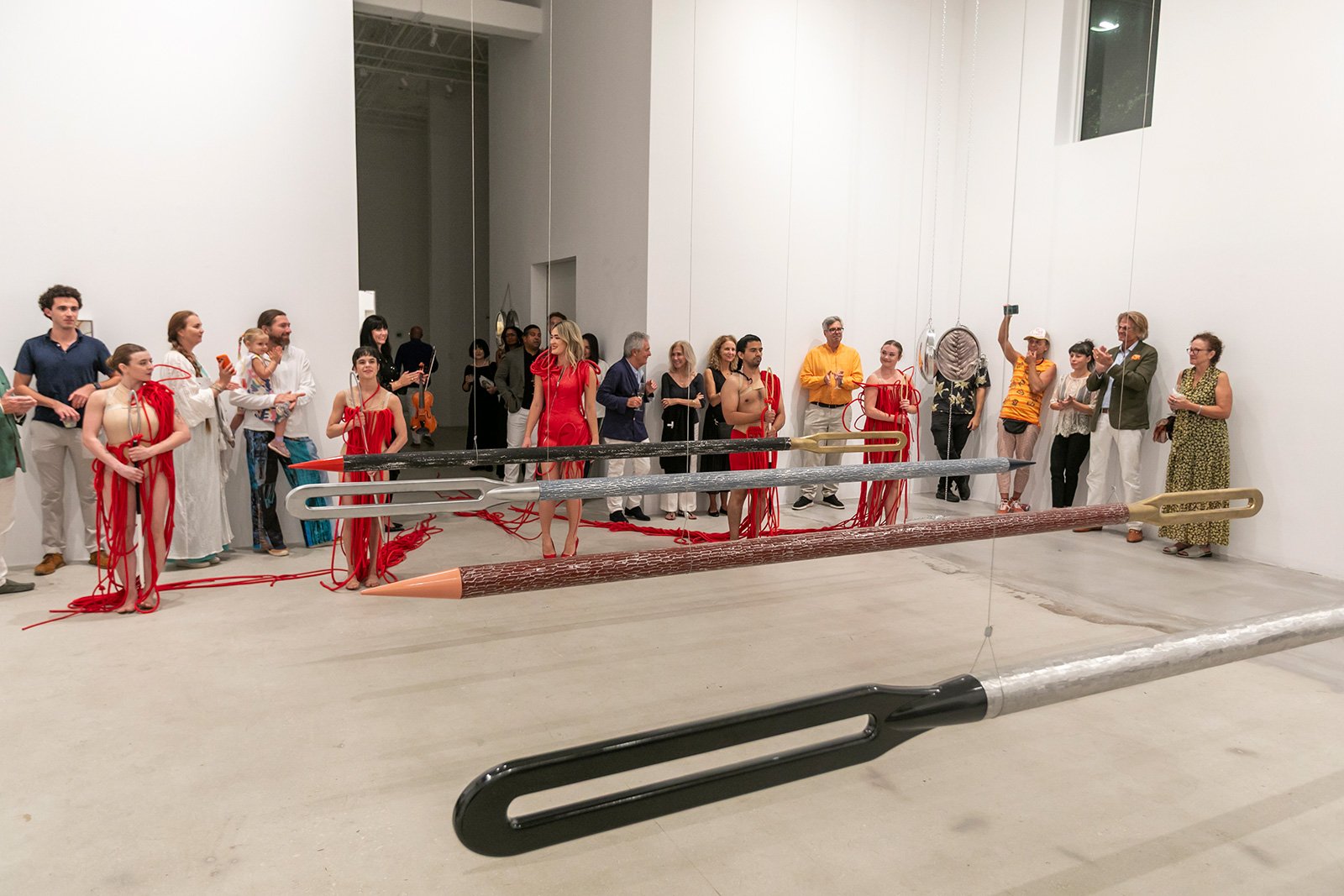
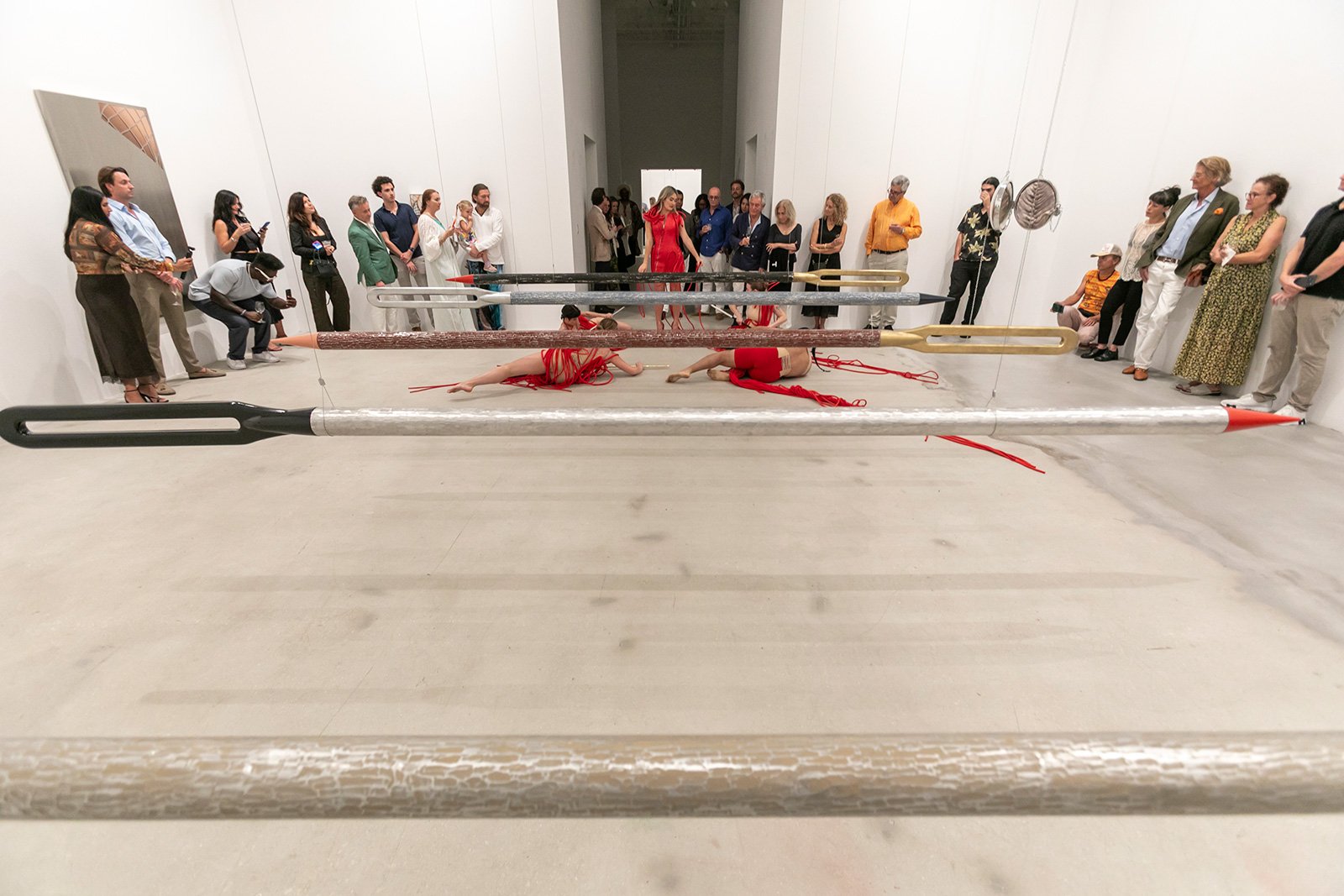
In “I Hold You in Devotion”, five of those needles return at four metres long. Hand-finished in aluminium, they are suspended on steel cable at stomach or groin height, depending on the visitor. “I wanted the sculptures to change the architecture of the space and force people to move their bodies in a new way,” Harris says, “so that the soft parts of the body feel vulnerable against them.” Hair and metal are the fundamental materials of her practice; here metal leads. A needle in the hand is directed by the body; at this scale the direction is reversed, and the body has to negotiate its route around the tool.
The philosopher Giorgio Agamben, in his essay What Is an Apparatus? (2006), widens Michel Foucault’s conceptof the “apparatus” to cover anything able to capture or orient the gestures of living beings, and he deliberately counts the computer and the mobile phone among his examples. The needle belongs on that list. It is one of the earliest technologies to organise a body’s attention into a repeatable pattern, and Harris knows its younger relatives well. Before committing fully to the studio she worked as a digital product designer, and from 2015 to 2025 she ran her own design agency. This double training, in the domestic tool and in the screen interface, is a key to the exhibition.
Installation view, Makiko Harris, “I Hold You in Devotion”, Kristin Hjellegjerde Gallery, West Palm Beach, Florida. Photography by Premier Photo
The seam made visible
The working vocabulary of product design is a vocabulary of bodies. A user journey and a friction point are both predictions about what a hand and an eye will do next. Harris reached that vocabulary by a winding route. Born in the Netherlands in 1989 and raised between Japanese and American cultures, she studied philosophy and studio art at Tufts University, Boston, worked in costume and fashion, then moved to the West Coast of the US and into digital product design.
Harris returns often to what she calls the machinization of life, the gradual absorption of everyday gestures into automated systems. The technology industry has a word for its ideal product, and it is borrowed from the sewing room. A seamless experience is one where the user never sees the joins or the labour holding it together. Harris pulls the seam back into view. Enlarged to four metres and cast in metal, the needle stops reading as an extension of the hand and begins to look like a component of a machine.
Auronda Scalera: Which habits from product design came into the studio with you?
Makiko Harris: The habit I’ve brought in most is a way of managing projects called agile development. You break a large launch into small, self-contained chunks of work called sprints. At the end of each sprint you have something real to look at; you review it, learn from it and adjust the plan. It assumes you won’t know everything at the start. In the studio I have many strands running at once, with fabricators and collaborators. Knowing how to hold a vision, break it into chunks and work through it iteratively has helped me enormously. I haven’t thought of these artworks as products. The habit that really carried over is the way I manage the work.
Installation view, Makiko Harris, “I Hold You in Devotion”, Kristin Hjellegjerde Gallery, West Palm Beach, with works (from left): Trust (2026), Mega Needle in Ladybird Silver (2026), and Triumph (2026). Photography by Premier Photo
The traffic between screen and material
The spirit is visible in the hang. The exhibition existed first as a digital model: Harris made 3D renderings of the entire installation and, in her words, “lived with them for nearly a year” before testing the height of the needles against the bodies of people in the gallery.
The same traffic between screen and material runs through the Stockings paintings, in which fleshy limbs press against fishnet forms made of stainless steel. “For me, the crop is the curation of the image,” Harris says. The source photographs, inspired by Daido Moriyama’s 1987 fishnet series, are cropped on screen: “I crop it, set the aspect ratio, then vectorise it into a DXF data file for my fabricators. It’s laser cut, the edges are welded, and the screens come back to the studio to be paired with the oil paintings.” For digital artist readers of Right Click Save, the DXF may be the most telling detail in the exhibition, the moment where a picture turns into an instruction.
The loom and the engine
The link between needlework and computation is older than it looks from a screen. In 1843, describing Charles Babbage’s Analytical Engine, Ada Lovelace wrote that it “weaves algebraical patterns just as the Jacquard-loom weaves flowers and leaves.” The cultural theorist Sadie Plant built a whole argument on this lineage in her book Zeros + Ones (1997), showing how textile labor and the history of computing were entangled from the start, and how often women stood at both ends of the thread without being credited at either. A designer of digital products who now makes needles is retracing that family line.
Textile at present enjoys a moment of intense visibility in the art world, and visibility brings the risk of a material turning into a style.
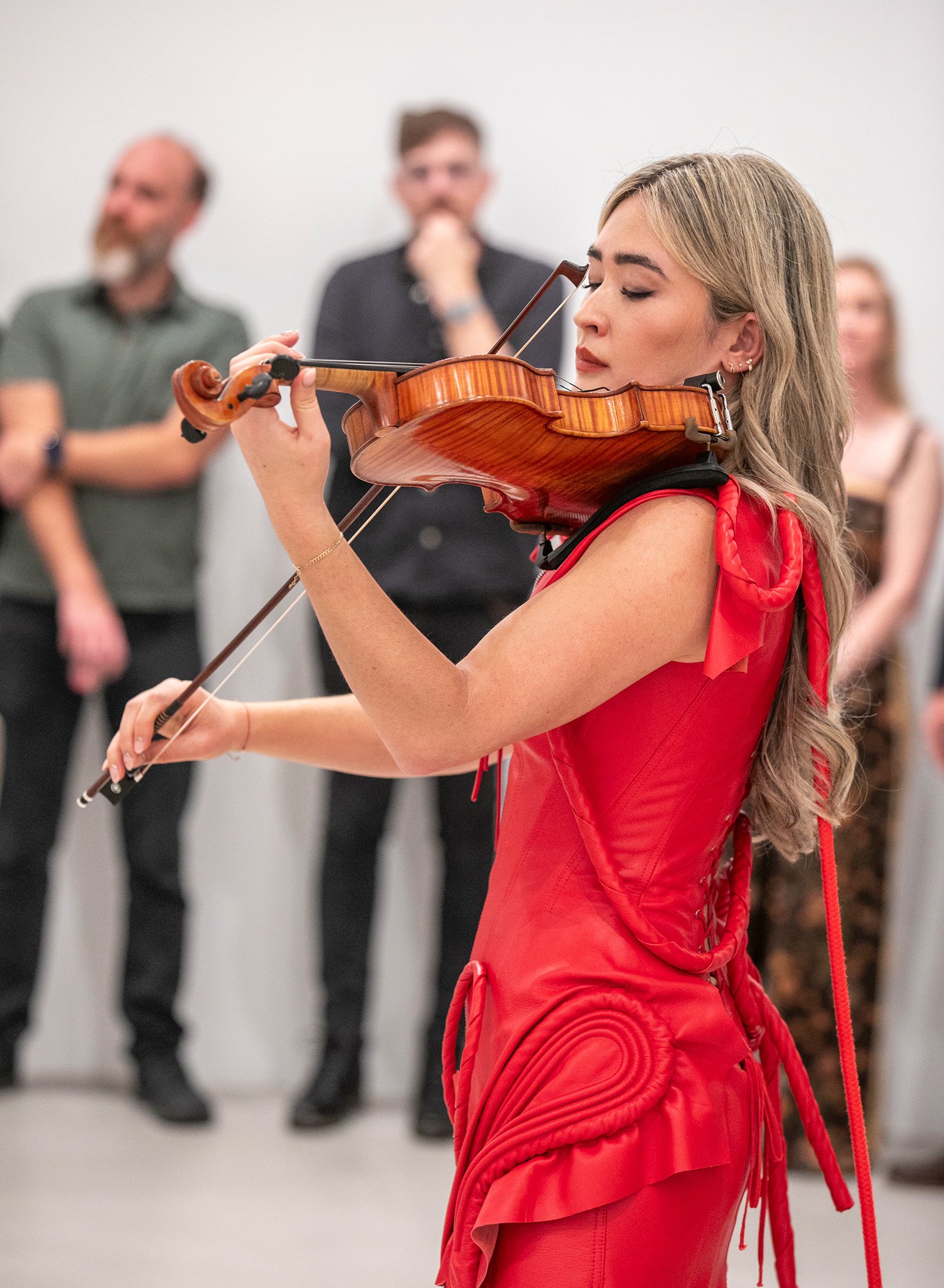
Installation view, Makiko Harris, “I Hold You in Devotion”, Kristin Hjellegjerde Gallery, West Palm Beach. Harris is wearing a costume by Deborah Milner and playing music by Carlos Basilisco on violin during opening night. Photography by Premier Photo
Harris approaches textile from an earlier point in its life. In her practice it is first a performative act, a gesture of threading and binding carried out by bodies, before it becomes anything that could hang on a wall. She is clear about her lineage. “I’m working in the lineage of Louise Bourgeois, who made needle sculptures herself,” she says, and she cites Cecilia Vicuña, who works with textiles at scale. Bourgeois insisted that the needle “is never aggressive, it’s not a pin.” Harris parts ways with her there: “My needles are a little aggressive. At this scale, and hung where they are, they make you feel your own softness.” Textile art that stays in its original format, she adds, interests her less than work that transforms it.
Harris describes the theme at the centre of the exhibition as stitching, understood as connection and as a form of social cohesion. She uses the word relational, and the echo of relational art is apt. In the 1990s the curator and critic Nicolas Bourriaud described a generation of artists whose material was human relations themselves. Harris gives that idea a body and a tool. “All of this work is ultimately about connection, and connection through adversity,” she said. “It’s not that there isn’t conflict, but we stay connected through it anyway.”
A stitch joins two pieces of cloth by piercing both, so every seam is a line of small wounds arranged so that they hold. Platforms promise connection as a frictionless default. A stitch reminds us that joining is labor, and that it leaves holes.
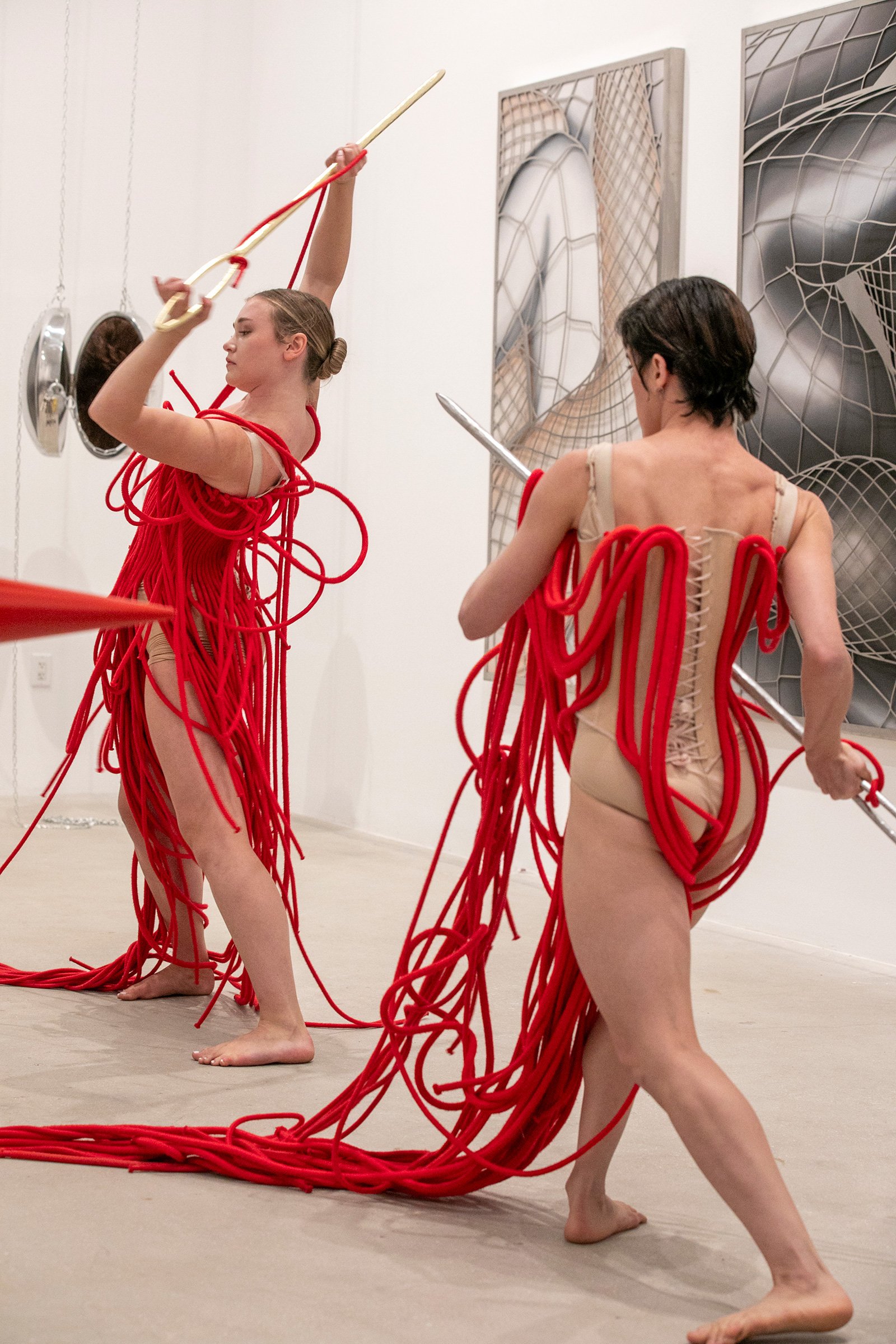
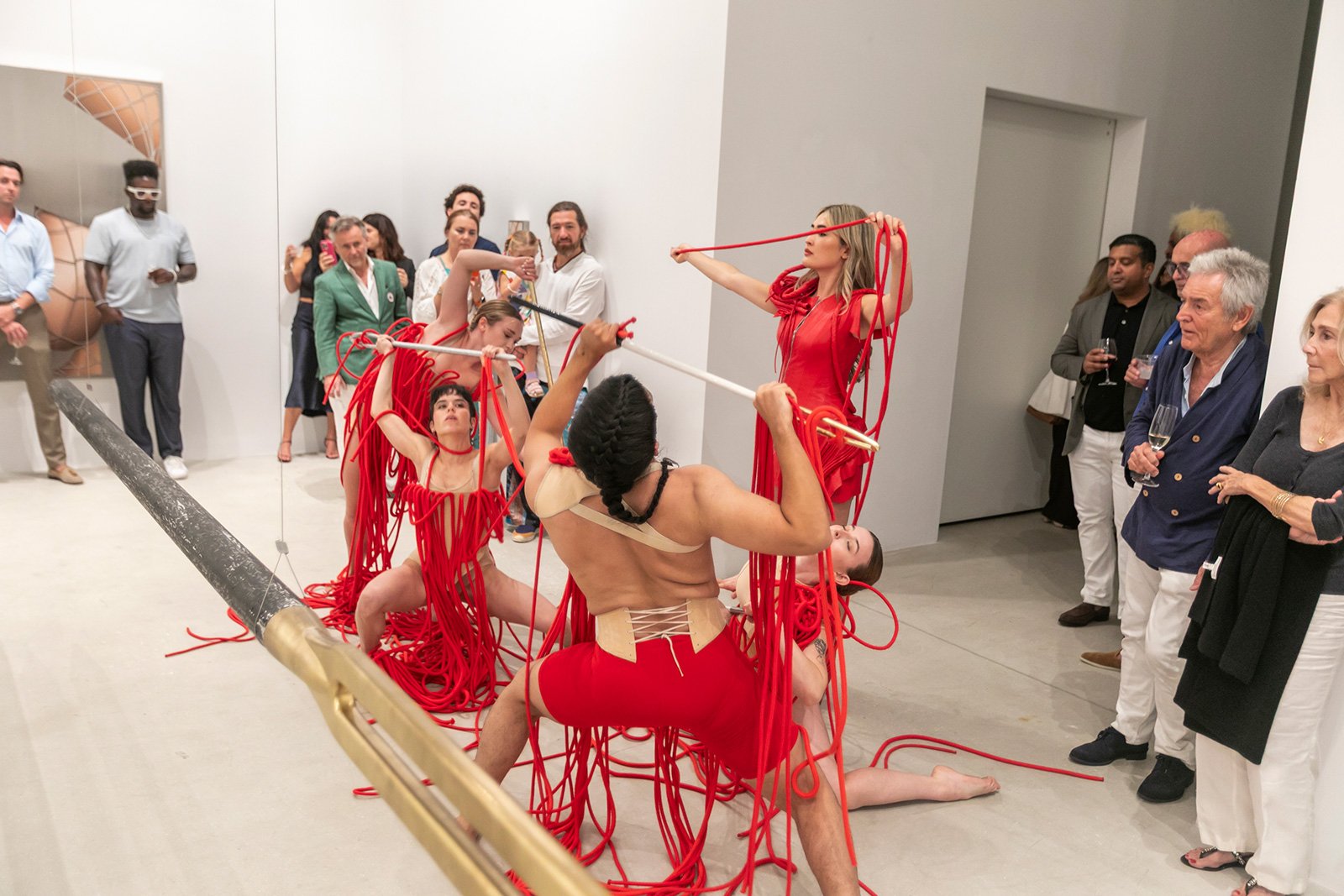
Installation view, Makiko Harris, “I Hold You in Devotion”, Kristin Hjellegjerde Gallery, West Palm Beach. Opening night dance presentation with performers from Ballet Florida. Photography by Premier Photo
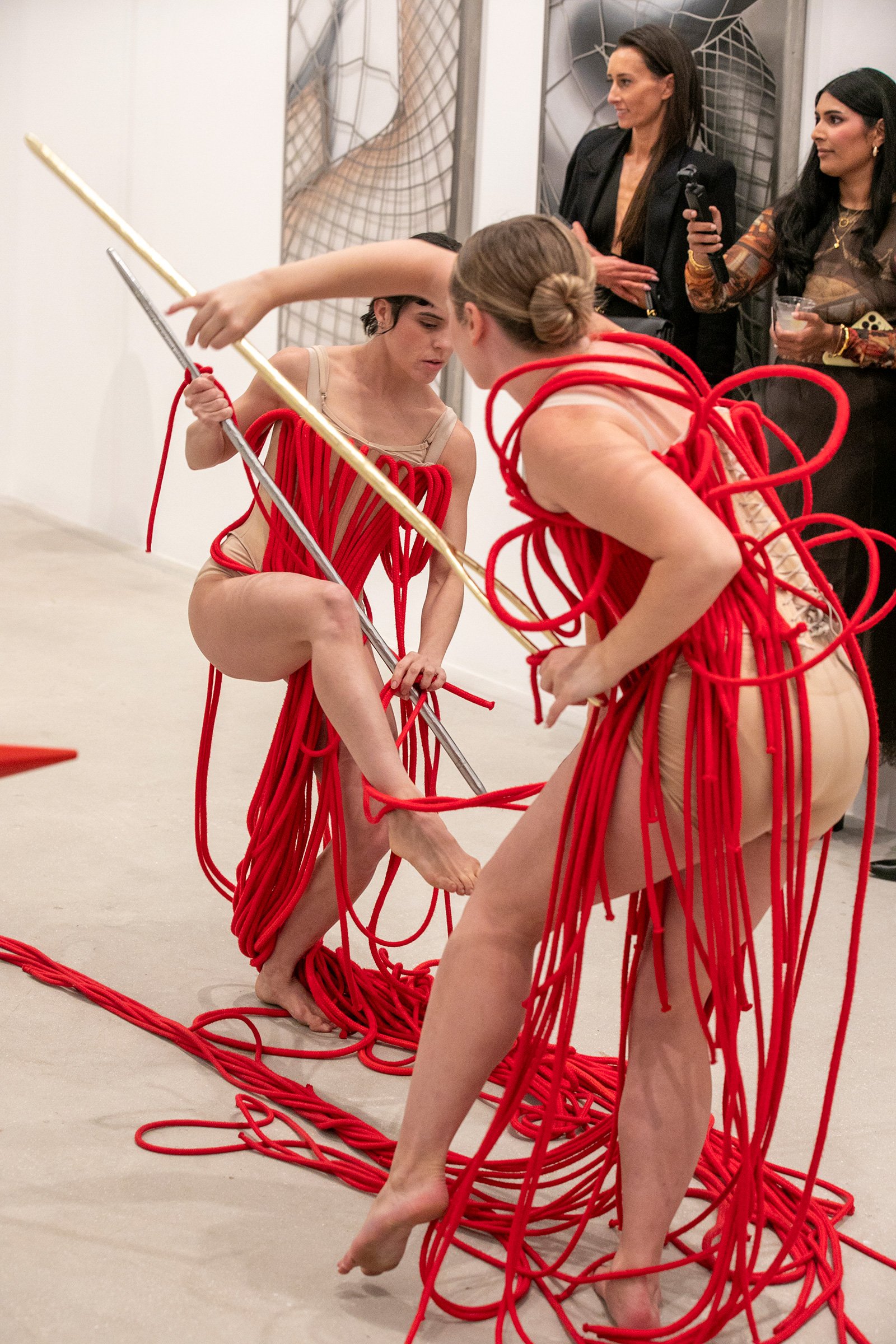
Installation view, Makiko Harris, “I Hold You in Devotion”, Kristin Hjellegjerde Gallery, West Palm Beach. Opening night dance presentation with performers from Ballet Florida. Photography by Premier Photo
A red thread through the room
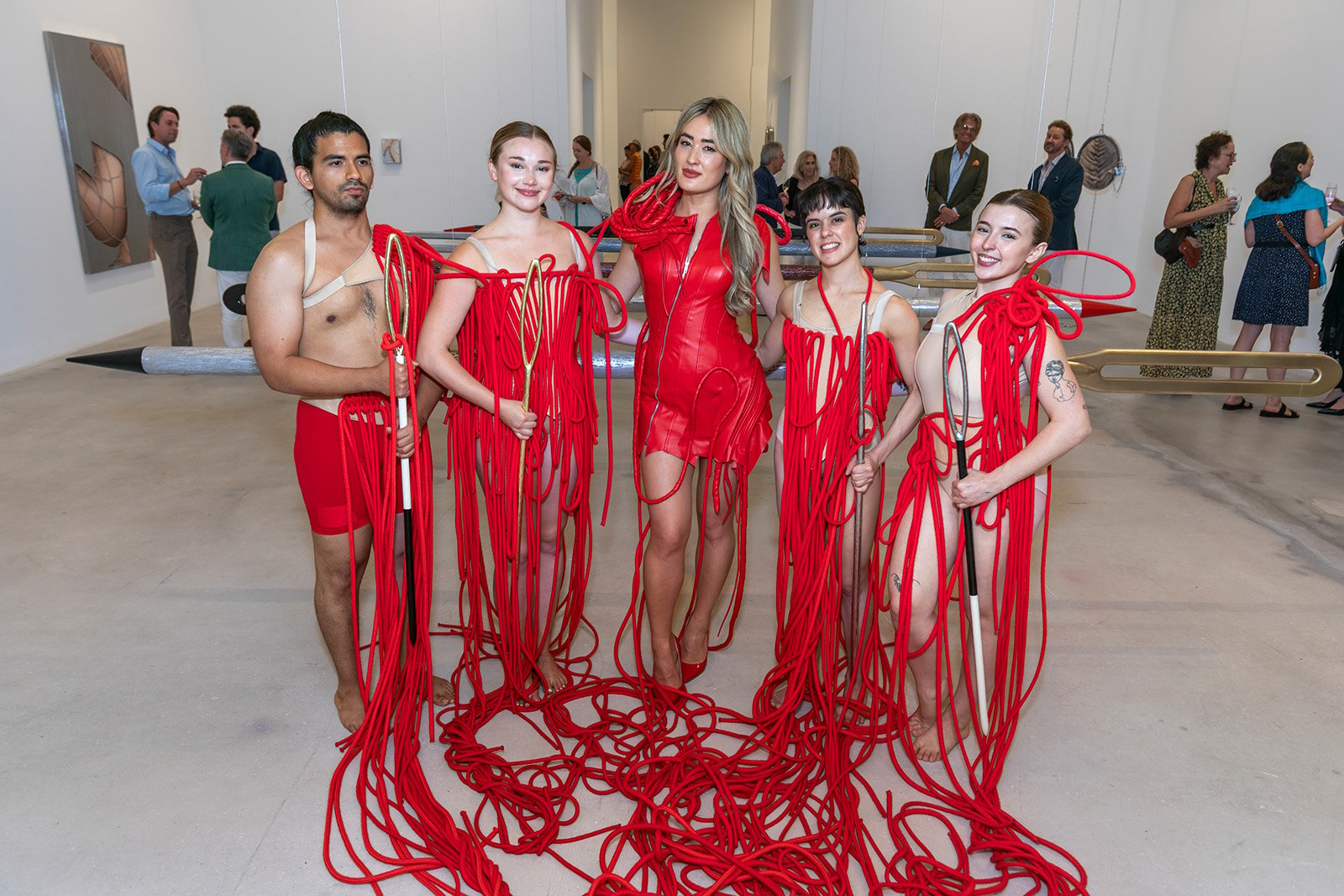
At the opening, red threads ran around the gallery, enclosing the needles and the people moving between them. Four dancers from Ballet Florida performed original choreography inside this web, with costume and rope sculptures by the couture designer Deborah Milner, a collaborator since Needle Dance (2025). Carlos Basilisco wrote the music, and Harris played it live on the violin she has studied since the age of four. The performance used the earlier, metre-long needles, which, as Harris puts it, “can be wielded; they’re almost spear-like in relation to the body.” Her earlier work drew on the Japanese myth of the red thread of fate, the invisible cord said to tie together people destined to meet. For one evening the myth became physical, and the audience found itself inside it.
Performance is where the textile gesture becomes visible before it settles into an object. Faith enters here. Harris speaks of connection in terms close to devotion, as something one commits to without knowing in advance where it will lead. Music taught her the same commitment: “delayed gratification, and the lesson that boring repetition is what builds results”. Needle Dance Live was performed once, on the opening night; a film of the evening is being edited for release.
Memory, enlarged and prised open
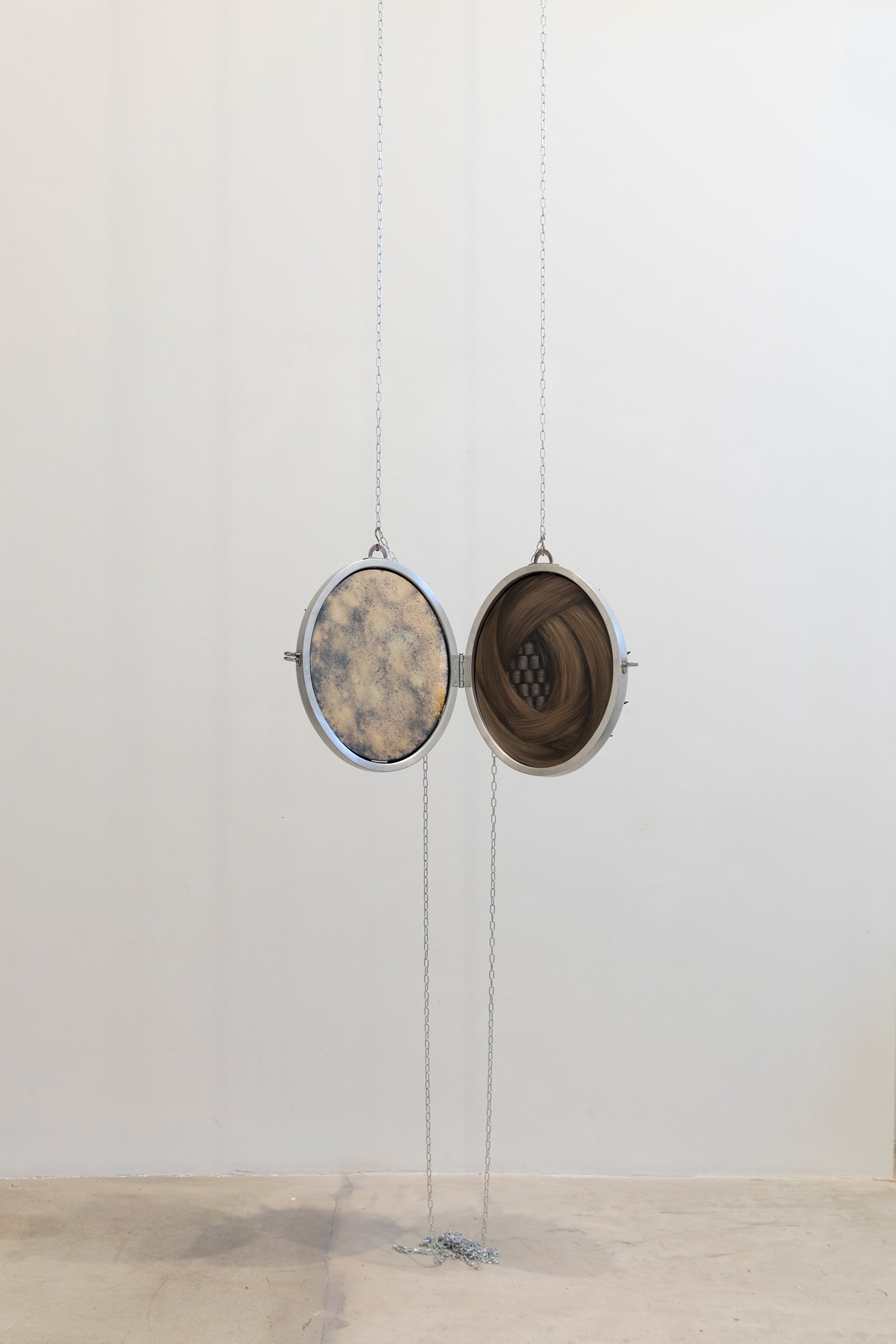
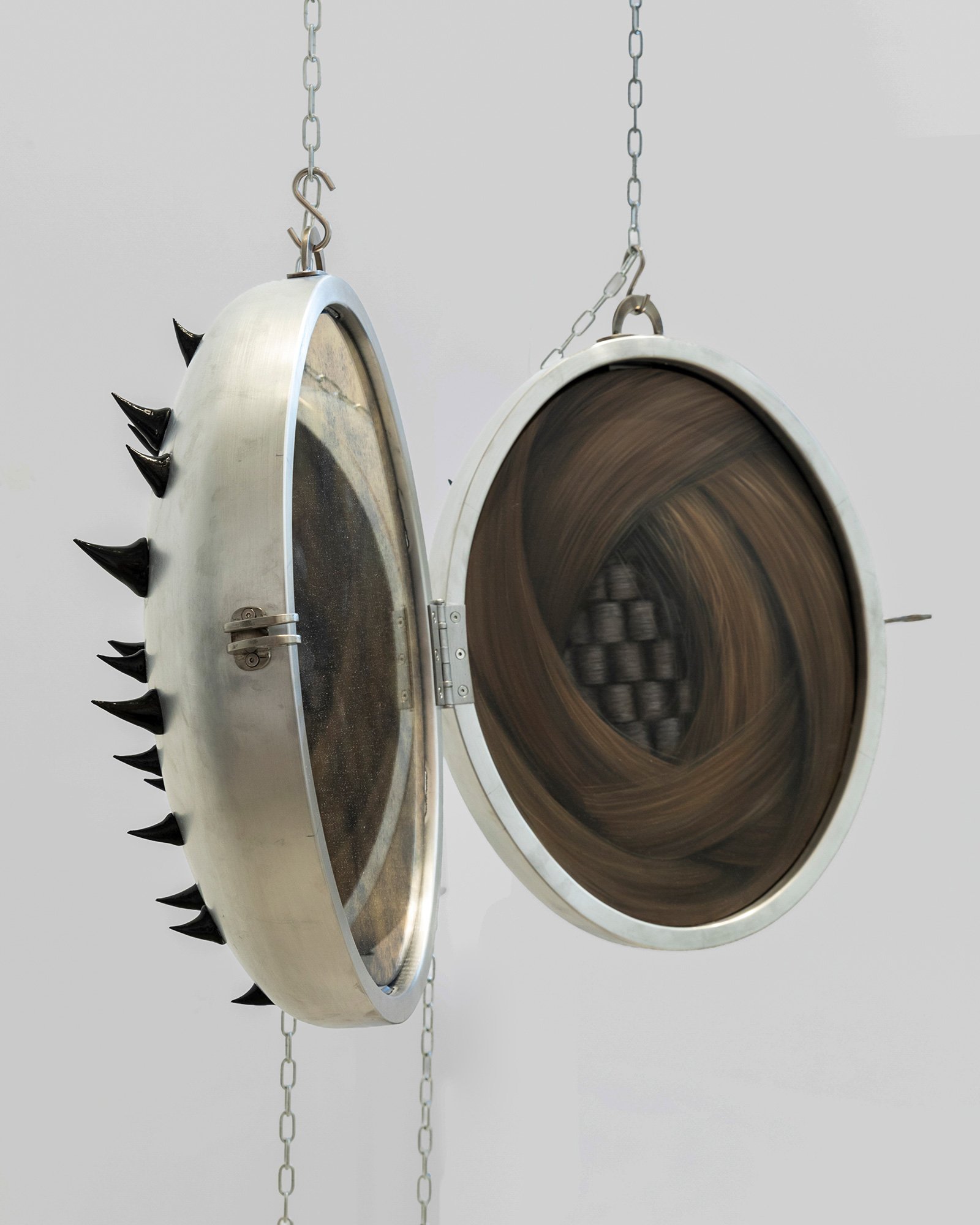
If the needles concern joining, the lockets concern keeping, and here the two materials Harris calls fundamental meet directly: metal outside, hair within. Shown for the first time, the lockets draw on Victorian mourning jewellery, in which a lock of hair or a small portrait of the dead was worn against the skin. Harris enlarges the form to an imposing scale and displays each locket open, held by chain and padlock as though someone had forced it. Some hold real human hair, supplied by the wig maker who made Harris’s performance wig; others hold painted hair modelled on Victorian mourning pieces she found in London markets. The colours come from people in her family and others she loves. Facing the hair, every locket holds a vintage patinated mirror. “Where a traditional mourning locket holds a portrait of the beloved,” Harris says, “mine returns the viewer their own reflection.”
Installation view, Makiko Harris, “I Hold You in Devotion”, Kristin Hjellegjerde Gallery, West Palm Beach, with work: I hope to see you again someday (2026). Photography by Premier Photo
Installation view, Makiko Harris, “I Hold You in Devotion”, Kristin Hjellegjerde Gallery, West Palm Beach, with work: I hope to see you again someday (2026). Photography by Premier Photo
AS: So is the viewer being asked to remember someone, or to imagine being remembered?
MH: I think both. Hair is the one part of the body that doesn’t decay after death. It holds the DNA of the person it came from. So it’s a connection between past and present, and into the future.
AS: A thread joins things, while a chain holds and restrains them. Do you see the chain as the thread’s counterpart?
MH: Definitely. A thread is soft and flexible, and it joins things by passing through them. Once a stitch is made, the thread almost disappears into the fabric, and it can be cut or broken. A chain is connection made hard and permanent, and it stays visible. That’s also why it can restrain: the same strength that keeps things together can keep them from leaving. The chain feels like the red thread of fate made visible and made of steel.
A locket was a storage device long before we had a word for one. Today most of us carry our dead in a phone, in photographs and voice notes that no one has the heart to delete. Harris’s lockets make that intimacy visible at a scale that cannot be pocketed, and the padlock adds a note anyone who thinks about digital privacy will recognise: the case is open and locked at once. Her answer on the chain also holds a small theory of the network. A thread is the connection we stop noticing once it works; a chain shows every link, and can hold us in place.
Brushing
The lockets point to where Harris is heading next. An exhibition planned for London in 2027 will give more room to hair, and to the act of brushing it. Hair is the body’s own thread. It grows from us and outlasts us, which is why the Victorians trusted it to carry the dead. In Harris’s thinking it becomes a line running back to people from the past, a way of connecting them with those in the room now.
Brushing someone’s hair is among the most intimate gestures one person can offer another, the kind of care a parent gives a child or a carer gives someone who can no longer raise their arms. Each pass of the brush is a repetition, like a stitch, and like a stitch it puts things in order without cutting. Harris imagines brushing as performance. If “I Hold You in Devotion” makes the seam visible, the next exhibition promises to make touch visible and audible too.
Installation view, Makiko Harris, “I Hold You in Devotion”, Kristin Hjellegjerde Gallery, West Palm Beach. Harris (centre) with performers from Ballet Florida who gave the opening night dance presentation. Photography by Premier Photo
Installation view, Makiko Harris, “I Hold You in Devotion”, Kristin Hjellegjerde Gallery, West Palm Beach. Opening night dance presentation with performers from Ballet Florida. Photography by Premier Photo
Installation view, Makiko Harris, “I Hold You in Devotion”, Kristin Hjellegjerde Gallery, West Palm Beach. Opening night dance presentation with performers from Ballet Florida. Photography by Premier Photo
Installation view, Makiko Harris, “I Hold You in Devotion”, Kristin Hjellegjerde Gallery, West Palm Beach. Opening night dance presentation with performers from Ballet Florida. Photography by Premier Photo
Devotion as maintenance
In Japan, shrines and temples hold Hari-kuyō, a memorial service for broken needles, usually in February. Seamstresses and tailors lay their bent and snapped needles into a block of tofu or konnyaku and thank them. Harris does not know whether her grandmother kept the ritual, though she “wouldn’t be surprised if she did.” She traces it to a Shinto sense that spirit can dwell in things, and to the folk belief in tsukumogami, objects that come alive after long use.
“Underneath it is the idea that things which serve us deserve gratitude,” she says. “Inheriting her needles, I felt that. They carried years of her work and her care for the people she sewed for.”
The title “I Hold You in Devotion” leaves its “you” open. It could be the grandmother, the friends in the paintings, the visitor who walks between the points, or the needle itself. Our devices have learned to hold us too, and the word we use for that is engagement. Harris proposes an older and more demanding model, in which holding is a practice of care performed by hand, and the tool is honored for the work it has done. Devotion, in this exhibition, looks a great deal like maintenance: the patient, repeated attention that keeps a seam, or a relationship, from coming apart.
That is where the product designer and the granddaughter meet. Both know that whatever we make will shape the bodies that use it. Harris has chosen to make tools that look back at us, point first, and ask how we intend to hold one another.
Makiko Harris is a London-based Japanese-American artist whose practice sits at the intersection of feminism, materiality and desire. Combining metal sculpture and oil painting while across digital and physical processes, she translates photographs of her own skin into laser-cut steel, layers translucent oils against stainless steel mesh, and scales up fingernails, sewing needles and fishnet into monumental sculpture. Extending into film, performance and sound, her work explores intimacy and the theatre of the self. Her solo exhibitions with Kristin Hjellegjerde Gallery include I Hold You in Devotion (West Palm Beach, 2026) and Lacquered Rebellion (London, 2024). Notable group exhibitions include Body Archive at Kristin Hjellegjerde Gallery (Berlin, 2025); Magical Body at Kunstverein Wolfsburg (Wolfsburg, 2025); Textiles and the Female Nude at Villa Schöningen (Potsdam, 2025); and Confront and Constrain at Ames Yavuz (Singapore, 2024). In 2025 she launched Needle Dance in London, an immersive multimedia exhibition and film screening attended by around 700 people. Live performance has since become a recurring thread in her practice. Her live adaptation of Needle Dance premiered at South London Gallery (London, April 2026), was presented at Kristin Hjellegjerde Gallery (West Palm Beach, October 2026), and will be staged at Dulwich Picture Gallery (London, 2027). Selected for New Contemporaries 2026, she exhibited at South London Gallery and MIMA, Middlesbrough Institute of Modern Art. Her outdoor commission Mega Nail in Lady Alleyn Red is held in the Dulwich Picture Gallery Sculpture Gardens. Her work is also in the Beth Rudin DeWoody Collection and private collections internationally. She has been a finalist for the Ingram Prize and the Cass Art Prize. Alongside her studio practice, she brings over a decade of experience as a technologist and digital product designer. Harris holds an MA in Contemporary Art Practice from the Royal College of Art, London (2023). She studied painting at California College of the Arts, San Francisco, and holds a BA in Philosophy and Art from Tufts University, Boston (2011), where she focused on feminist philosophy and aesthetics. She is represented by Kristin Hjellegjerde Gallery (London, Berlin, West Palm Beach).
Auronda Scalera is an artistic director, curator, and cultural strategist whose practice sits at the intersection of contemporary art, digital culture, and artificial intelligence. Based in the Middle East, she brings two decades of institution-building and curatorial leadership across Europe, the Middle East and Asia, working at the scale of ideas across exhibitions, public programmes, and government policy. She has been appointed International Curator of Tuwaiq Public Art Festival and Symposium for Riyadh Art 2027 and curator of Beijing Biennale Art and New Media 2027. Her curatorial and consultancy record spans many editions of the Venice Biennale, Art Dubai Digital, Noor Riyadh Festival, AlUla Design Week, the Lumen Prize for Sotheby's, among others. Recent projects include Cosmotechnics: Ding Yi as a Planetary Code for Venice Biennale 2026, Body Machine featuring Sougwen Chung at Palazzo Citterio-National Museum of Digital Art in Italy, and 404_LAND: territory not found, an experimental exhibition at HEK Museum in Basel. A trusted government cultural strategist across the UAE, Saudi Arabia, Qatar, and Jordan since 2018, she has also served as founding director of IAM, the UK's first online research museum dedicated to art and new technology, and of Visiva, a 7,000 sqm cultural district in central Rome. Scalera lectures internationally at institutions including Kingston University London, IESA Paris, and VCUarts Qatar, holds collaborations with The Alan Turing Institute Art and AI group and Oxford University Art and Education group, and was named one of the Top 20 Most Inspiring Women in Culture by the NYC Journal in 2023. She works in close curatorial partnership with Dr Alfredo Cramerotti, Director of Media Majlis Museum at Northwestern University Qatar and President of IKT.