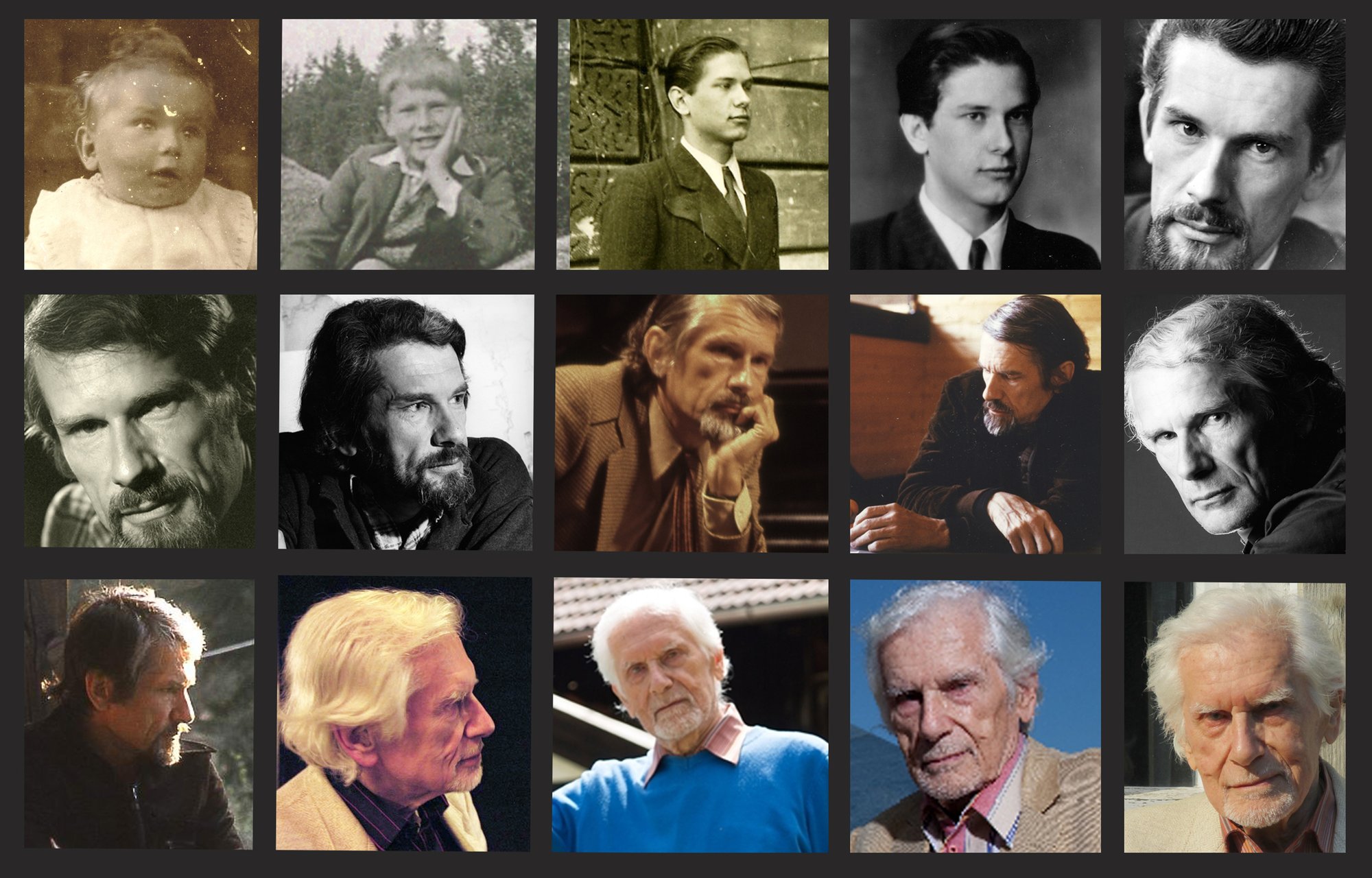
Anika Meier talks to the digital art pioneer’s widow, Susanne Päch, about a new exhibition of Franke’s work, a new edition of his writings, and why so many of the questions he spent decades exploring feel so relevant again today
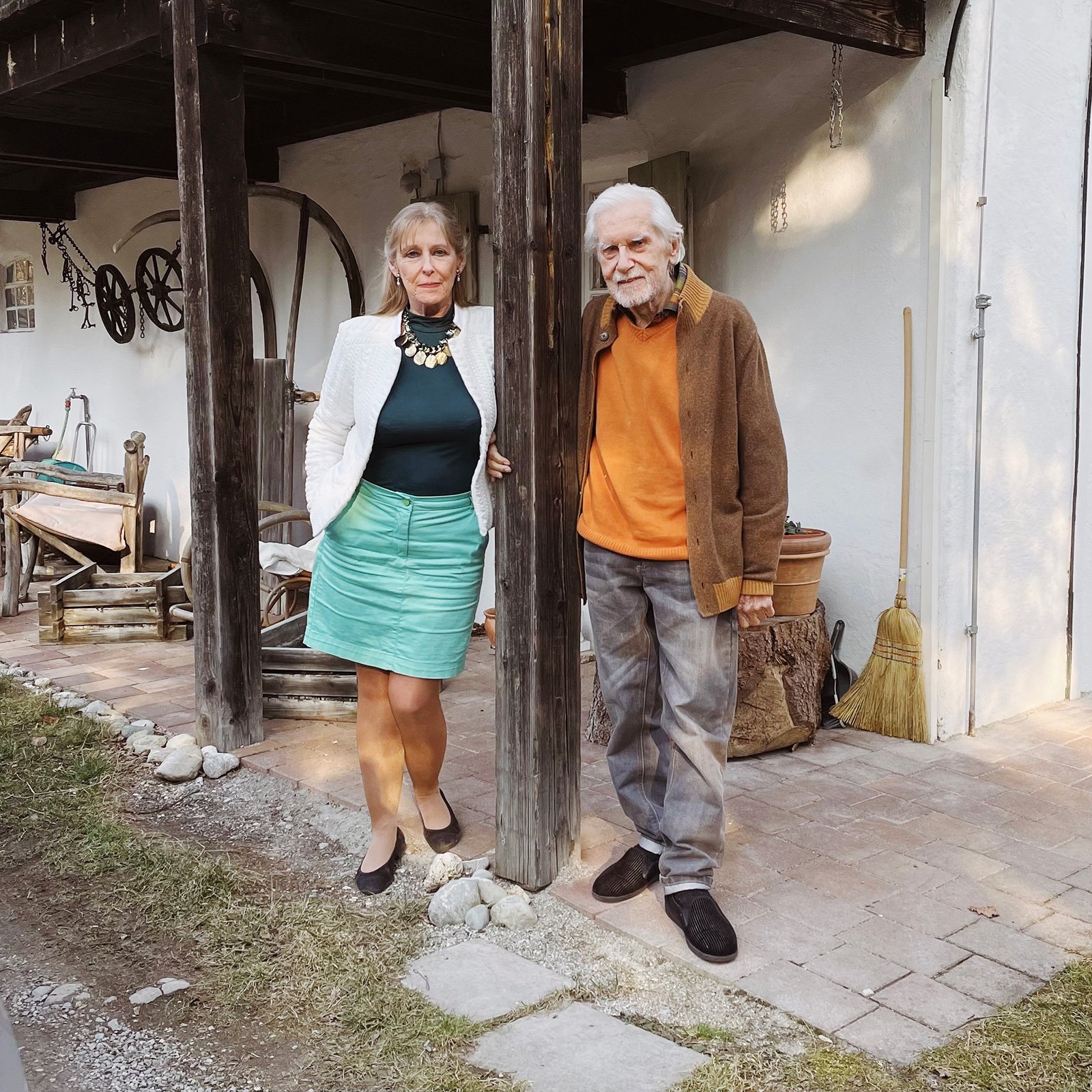
In early 2022, Alfred Weidinger, the director of the Francisco Carolinum in Linz, told me I had to meet Herbert W. Franke. So we drove to see Franke and his wife, Susanne Päch. Herbert was 94 at the time. What struck me most when I met him was his curiosity. He wanted to know what was happening in art now, what artists working with new technologies were interested in, and where these conversations were taking place. I told him: Twitter. With Susanne’s help, he joined. For some artists, Franke was a discovery. Others had known his work for years. Mario Klingemann, for example, has described him as a kind of teacher from afar. When Herbert W. Franke: VISIONARY was shown at the Francisco Carolinum a few weeks later, Klingemann, Kevin Abosch, and other artists traveled to Linz for Franke’s 95th birthday.
Franke had been thinking about many of the questions that concern artists working with technology today since the 1950s. His work moved from photography and experiments with analog systems to computers, algorithms, and virtual worlds, while his thinking extended across art, science, perception, mathematics, and the future. At the same time, he wrote science fiction and explored caves.
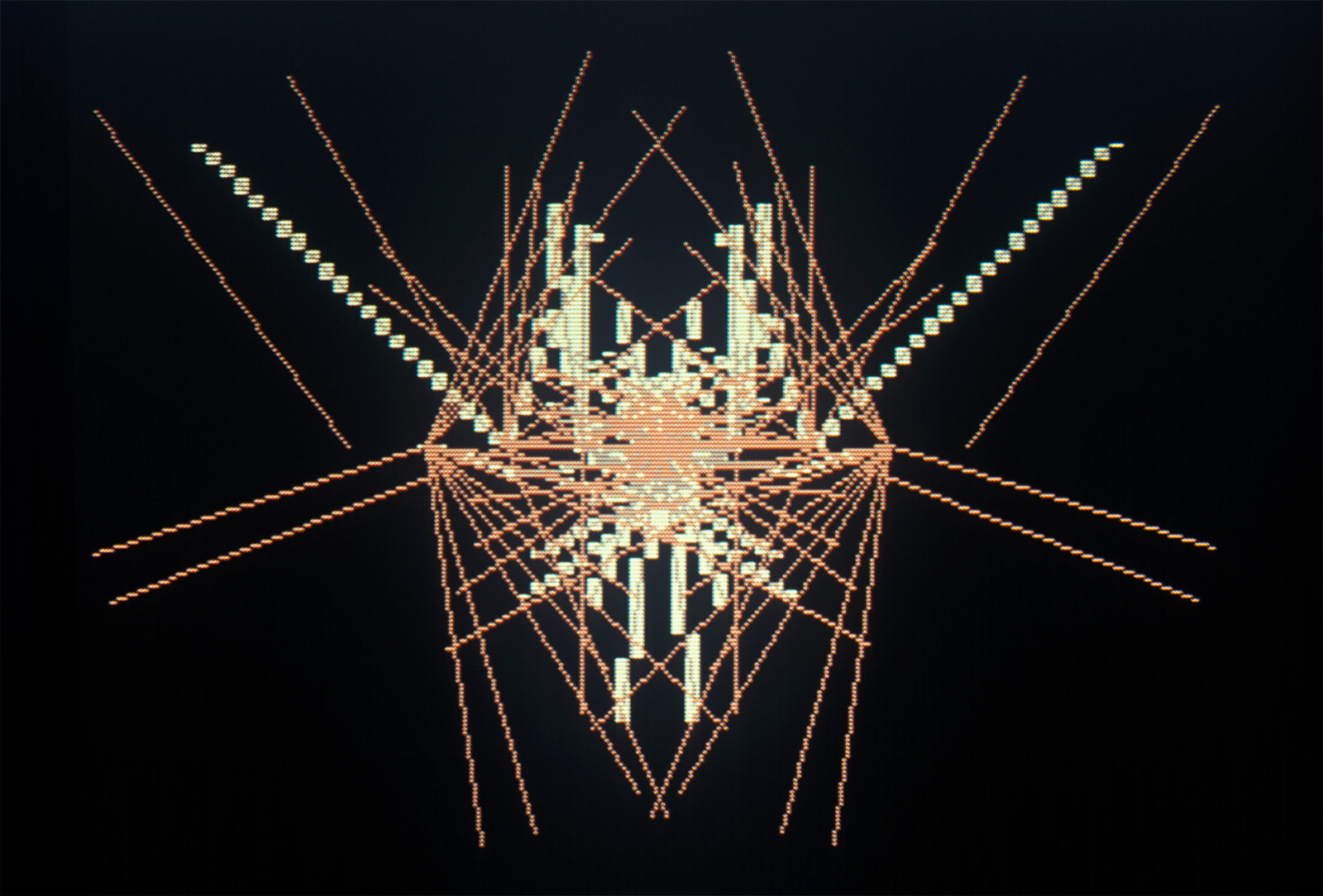
What mattered was his curiosity. New technologies gave him new tools to think with. This was also why, at 94, he was interested in what was happening with NFTs. In the months that followed, we worked together on bringing Math Art(1980-95) to the blockchain. After Herbert’s death in July 2022, Susanne and I worked on the Tribute to Herbert W. Franke, followed by the auction of ZENTRUM, based on a program he had written for the Apple II in 1982. These projects were all connected by the same idea: to support the Foundation Herbert W. Frankeand its work in keeping the artist’s legacy visible and accessible, while continuing something that had always been central to Franke himself: to understand his own work as part of a larger development rather than in isolation, and to engage with the artists shaping that development.
Susanne Päch and Herbert W. Franke, 2022. Photography by Anika Meier
The Tribute brought together what we came to call “Franke and Friends”, spanning different generations, while its proceeds helped fund the digitization of more than 1,800 manuscripts from Franke’s archive at ZKM, including a €20,000 donation, as well as computer science education for young people in Namibia.ZENTRUM later helped fund the publication and English translation of Franke’s writings and the Generative Art Summit in Berlin in 2024, where “Franke and Friends” came together again, this time to discuss the history and future of generative art.
Four years after Alfred Weidinger told me I had to meet Herbert, I spoke with Susanne Päch again. There is a lot happening around his work. Herbert W. Franke would have turned 100 in 2027. The Herbert W. Franke edition with Deutscher Kunstverlag is forthcoming, and Museum Folkwang is showing Franke together with Gottfried Jäger in “Art and Construction”.
It was a good opportunity to talk to Susanne about her work with the foundation, the estate, and Franke’s archive, but also to return to Franke himself. How do you make the connections between an artist, scientist, science-fiction writer, speleologist, and theorist visible? What connected these different parts of his life and thinking? And why do so many of the questions he spent decades exploring, from machines and creativity to perception and what it means to be human, feel so relevant again today?
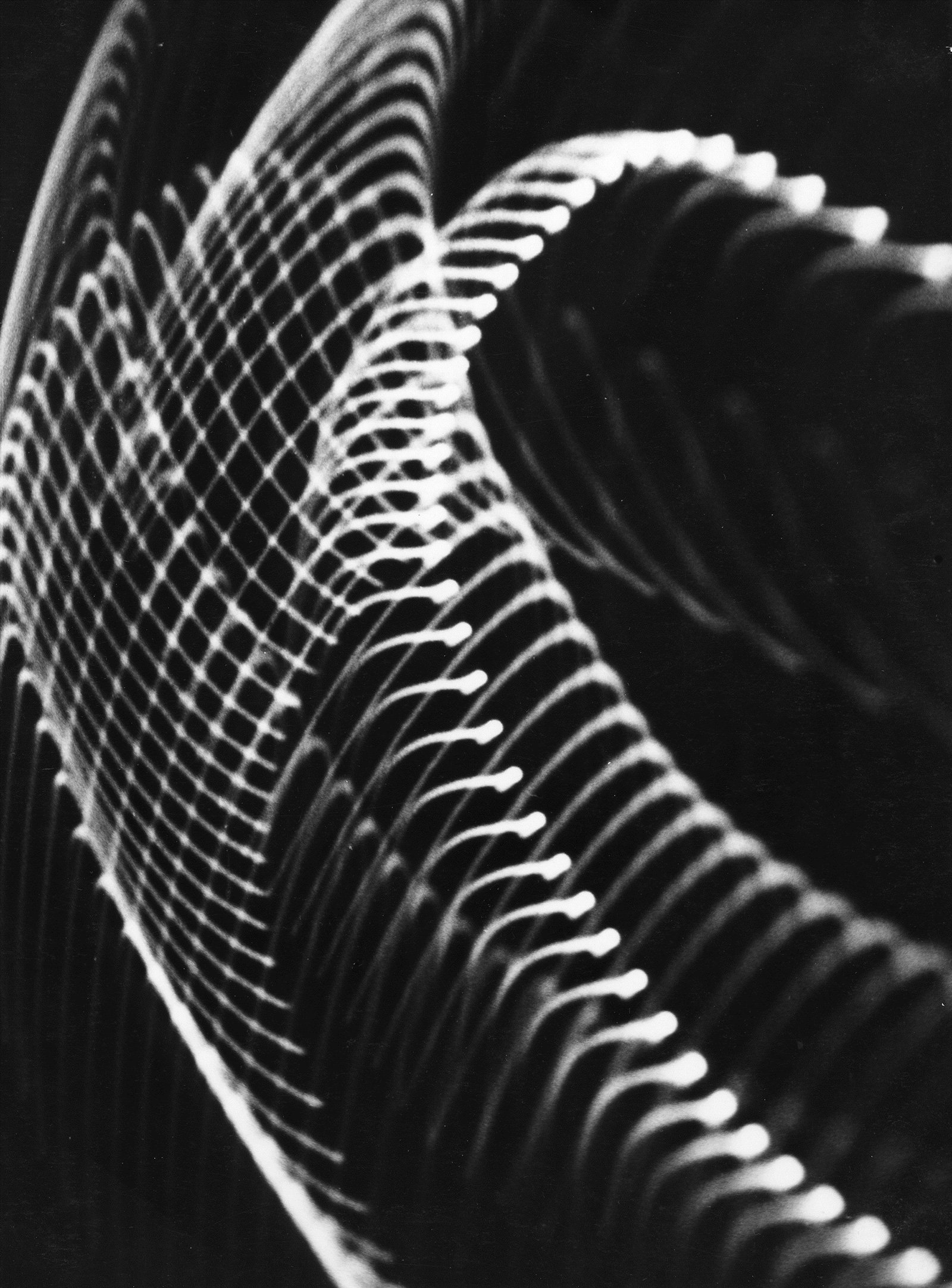
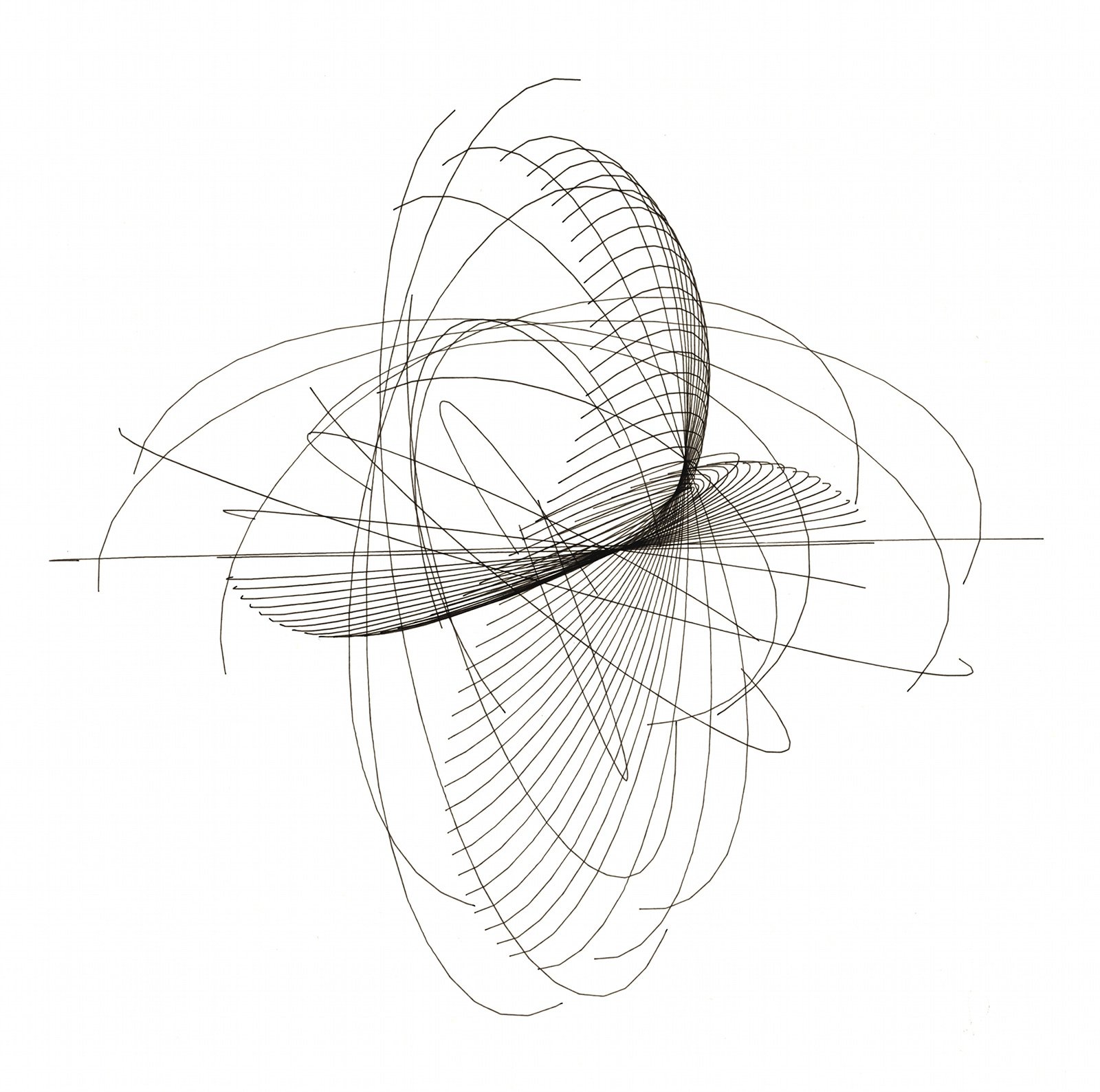
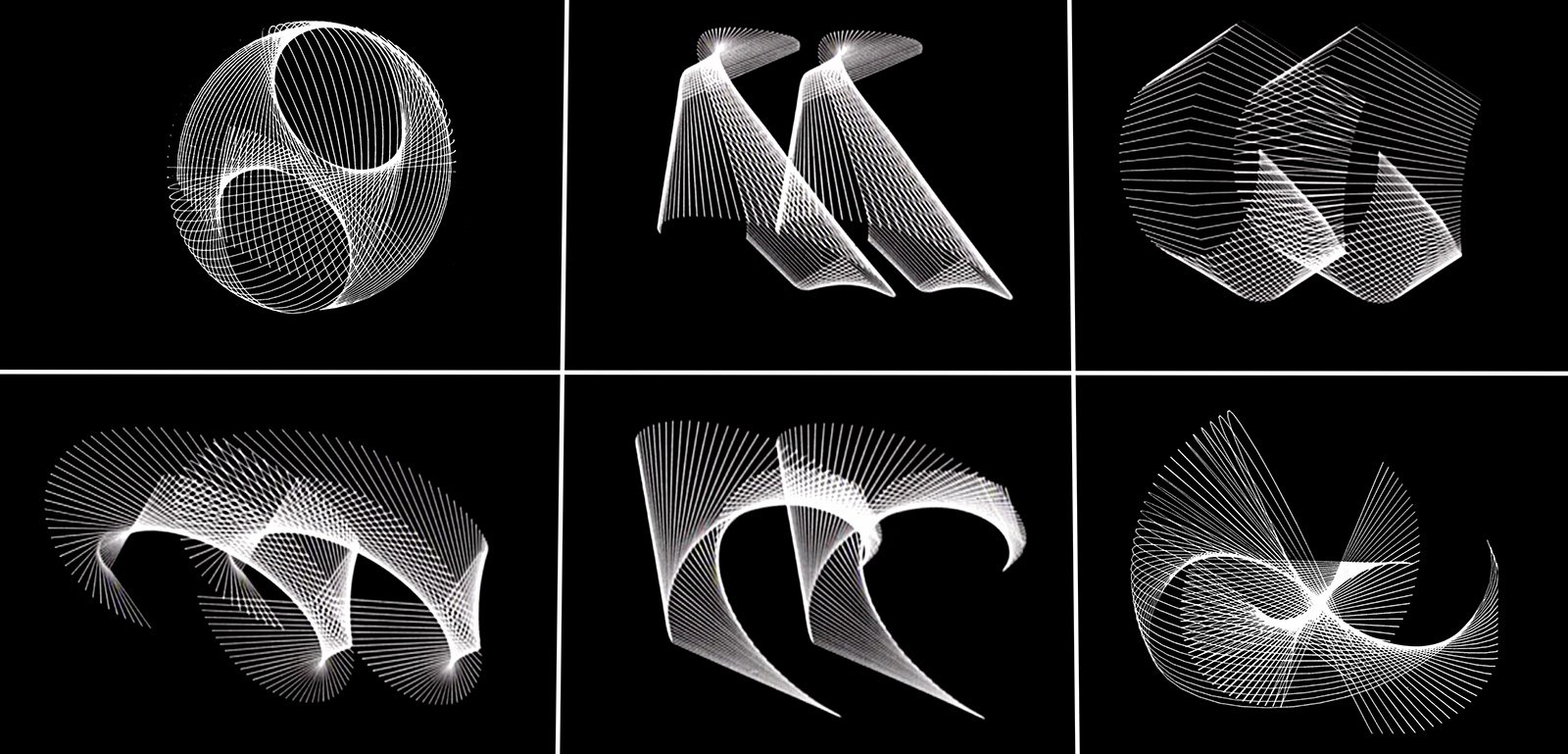
Herbert W. Franke, Oszillogramme, 1954-58. Copyright: Foundation Herbert W. Franke
Anika Meier: Susanne, for the past several years, you’ve been overseeing the foundation and the estate of Herbert W. Franke. Was it clear to you from the beginning that this work would come to occupy such a large part of your life?
Susanne Päch: That wasn’t the original plan. After working as a consultant for several years, I returned to journalism. When we established the foundation, I imagined eventually arriving at a 50:50 model: spending half my time working for the foundation and the other half continuing my own journalistic work. Almost five years later, that still hasn’t happened, because the foundation’s work has been so successful, but perhaps also because I constantly have new ideas. And, of course, 2027 is approaching: Herbert’s 100th birthday. My hope is to introduce Herbert and his art to a new audience.
AM: Speaking of his 100th birthday, Herbert had a very long life and, as is often said, several different lives as a writer, scientist, artist, and art theorist. He was still involved in establishing the foundation himself. Did you talk about what was important to him for the foundation?
SP: We never discussed the precise goals of the foundation in great detail. We didn’t really need to because it was clear to both of us. For me, Herbert as a thinker and scientist, as someone who was always looking ahead, is at the center. That is the heart of it. Everything else follows from that.
He made art in order to think ahead. He wrote literature in order to look ahead. And, of course, he pursued science in order to advance it. Behind all of this was always a desire to understand the world better.
Herbert W. Franke, Lichtformen, 1954. Generative art series. Copyright: Foundation Herbert W. Franke
AM: Herbert W. Franke was one of the first to think about the relationship between art and technology. As we look ahead to 2027 and his 100th birthday, what do you think is the most important aspect of his thinking that we can take with us today?
SP: The most important thing would be: stay curious. Try to understand the world, to penetrate it intellectually. Try not to live only through emotion. That doesn’t mean that emotions are unimportant. But for Herbert, being human was defined by reason.
There is a book by Herbert that I knew about but had never actually read: Der Mensch stammt doch vom Affen ab (Man Does Descend from the Apes After All in English), published in 1966. I read it while preparing the Herbert W. Franke edition for Deutscher Kunstverlag, and suddenly so much became clear to me. The title is actually terrible and was imposed on Herbert at the time by his publisher, Helmut Kindler. For the new edition, I will call the book System Leben (System Life in English).
In it, Herbert traces the development of life from its smallest beginnings, from single-celled organisms to thinking beings, with a particular focus on perception: How have living beings perceived their environment over the course of evolution? How have they communicated with it? And how did we come to perceive the world in the way we do today? Perception, after all, is our only means of apprehending the world. We can do so only through the senses available to us: sight, hearing, taste, smell, and touch. And our perception is highly limited. It gives us access to only a particular fragment of reality.
Herbert ends the book with a thought that essentially asks: Have we even become human yet? We are still strongly driven by emotions and therefore often act against our better judgment. For him, the question was whether we have enough time to truly become human.
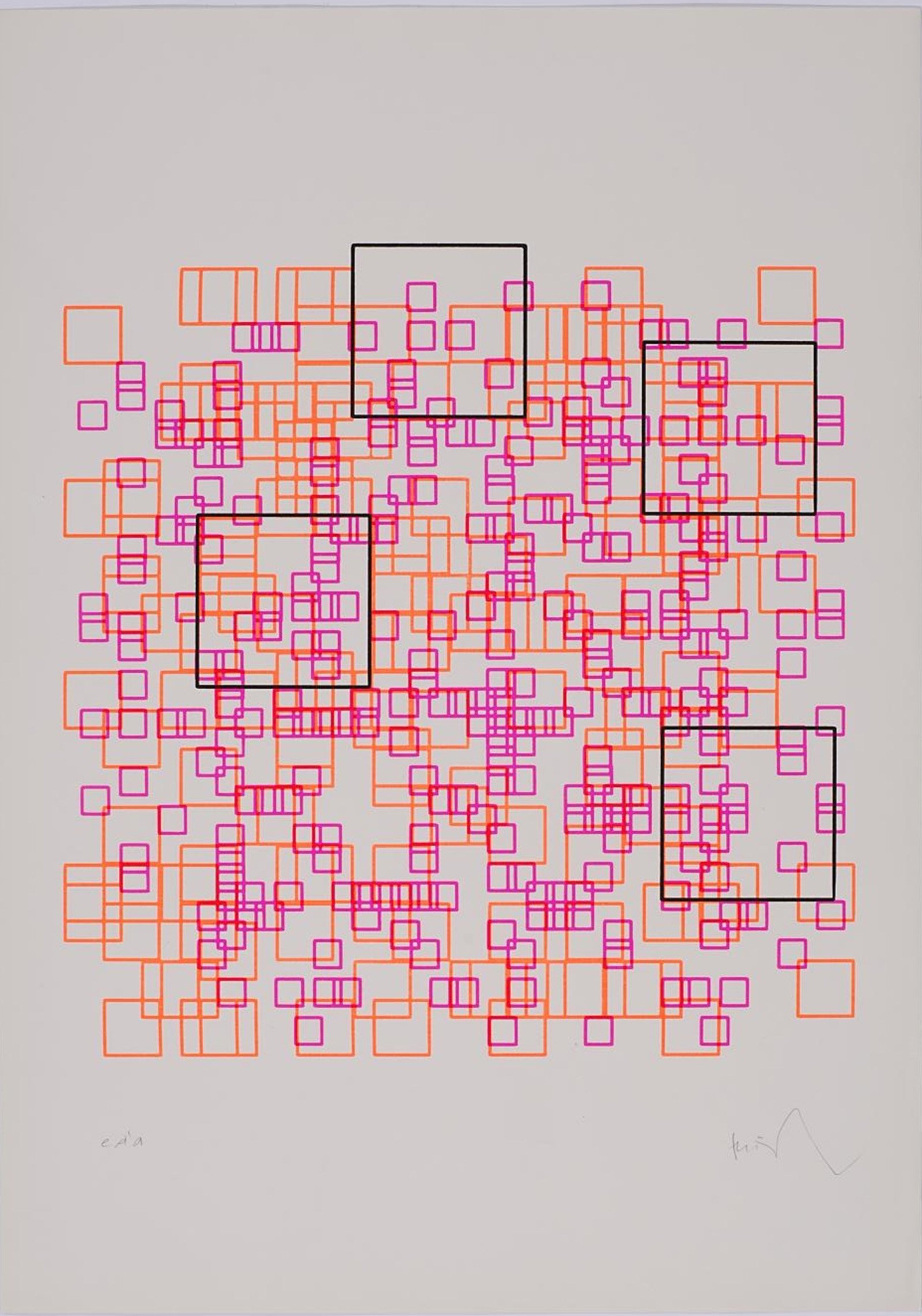
Herbert W. Franke, Quadrate, 1967-70. Computer art. Copyright: Foundation Herbert W. Franke
AM: And what did “becoming human” mean for Herbert?
SP: It illustrates very clearly how Herbert approached the world and life. For him, it was about reason, not cold rationality, but the attempt to understand and to act consciously on the basis of that understanding. That can also mean doing things others might say you cannot do when it comes to protecting the future or looking ahead.
AM: In the age of AI, this is one of the crucial questions: What does it actually mean to be human? Turning to the first volume of the Herbert W. Franke edition, why did you decide to begin with Kunst und Konstruktion (Art and Construction) from 1957?
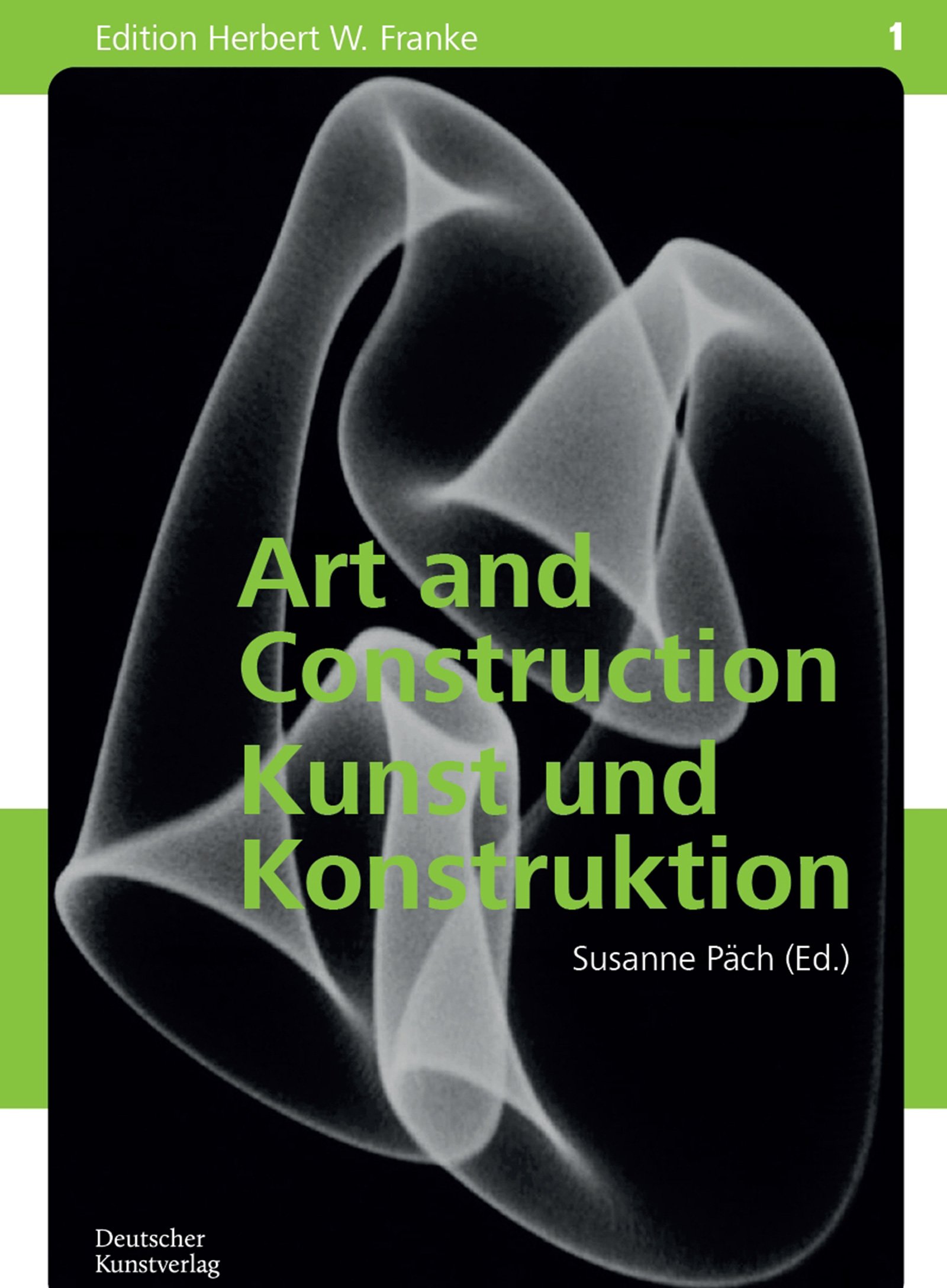
SP: For me, this book is a kind of Big Bang for everything that defined his life. Kunst und Konstruktion already contains almost everything he would later do and think about.
It is like a small cosmos in itself. It is remarkable how much foresight he already demonstrates there, thinking about questions such as how we communicate with machines. It is a very early book in which he was already thinking theoretically about the art of the future.
At the same time, hardly anyone knows Kunst und Konstruktion today, even in Germany. The book has been almost completely forgotten. That’s why I wanted to bring it back into view and, for the first time, make it available to an international audience in an English translation.
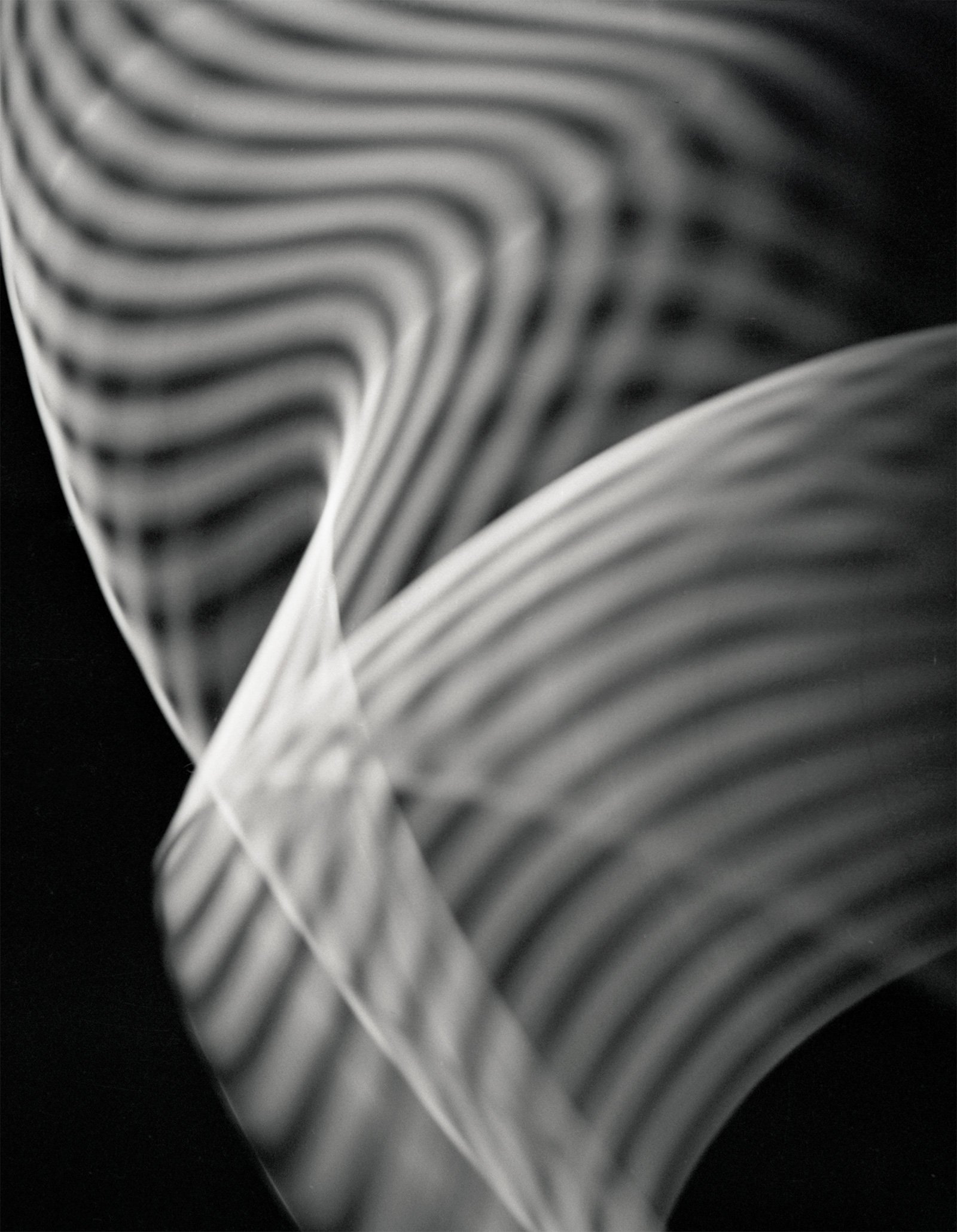
Book cover, Herbert W. Franke, Art and Construction / Kunst und Konstruktion, 2026. Copyright: DKV. Cover photo: Herbert W. Franke, Oscillogram from the series Tanz der Elektronen, 1958-59
AM: What also interests me about Kunst und Konstruktion is how relevant the book’s starting point remains today. In the opening pages, Herbert first has to make the case for why art created with technology is art at all. Every new generation of artists working with new technologies still has to engage in this debate. Franke, however, had to start at the very beginning. The term “pioneer” is used very frequently today, but in his case it seems genuinely appropriate. How do you see it?
SP: That’s why I really like our activities on X, which were largely initiated by you. There, he not only presented himself as a dinosaur, but the community also described him as a “Proto-OG”.
AM: Since we’re already talking about today’s community of digital artists, one book that is much better known than Kunst und Konstruktion is Computergraphik — Computerkunst (Computer Graphics — Computer Art). For the edition, you chose the first edition from 1971 rather than the expanded version from 1985. Why?
SP: I deliberately went back to the first edition because it is the original and is no longer available today. Of course, one consequence is that someone like Vera Molnar does not yet appear in it. For the new edition, I have modified this to some extent.
I tried to obtain the rights again for almost all the images from the historical edition, while also expanding the selection to include several additional artists. These are figures we now consider among the major pioneers of that early period who were included in the 1985 edition but not yet in the first. Herbert had to submit the manuscript as early as 1970. He did not yet know some of these artists at the time, while others only emerged a little later.
Herbert W. Franke, Einstein Digital, early 1970s. Computer art. Copyright: Foundation Herbert W. Franke
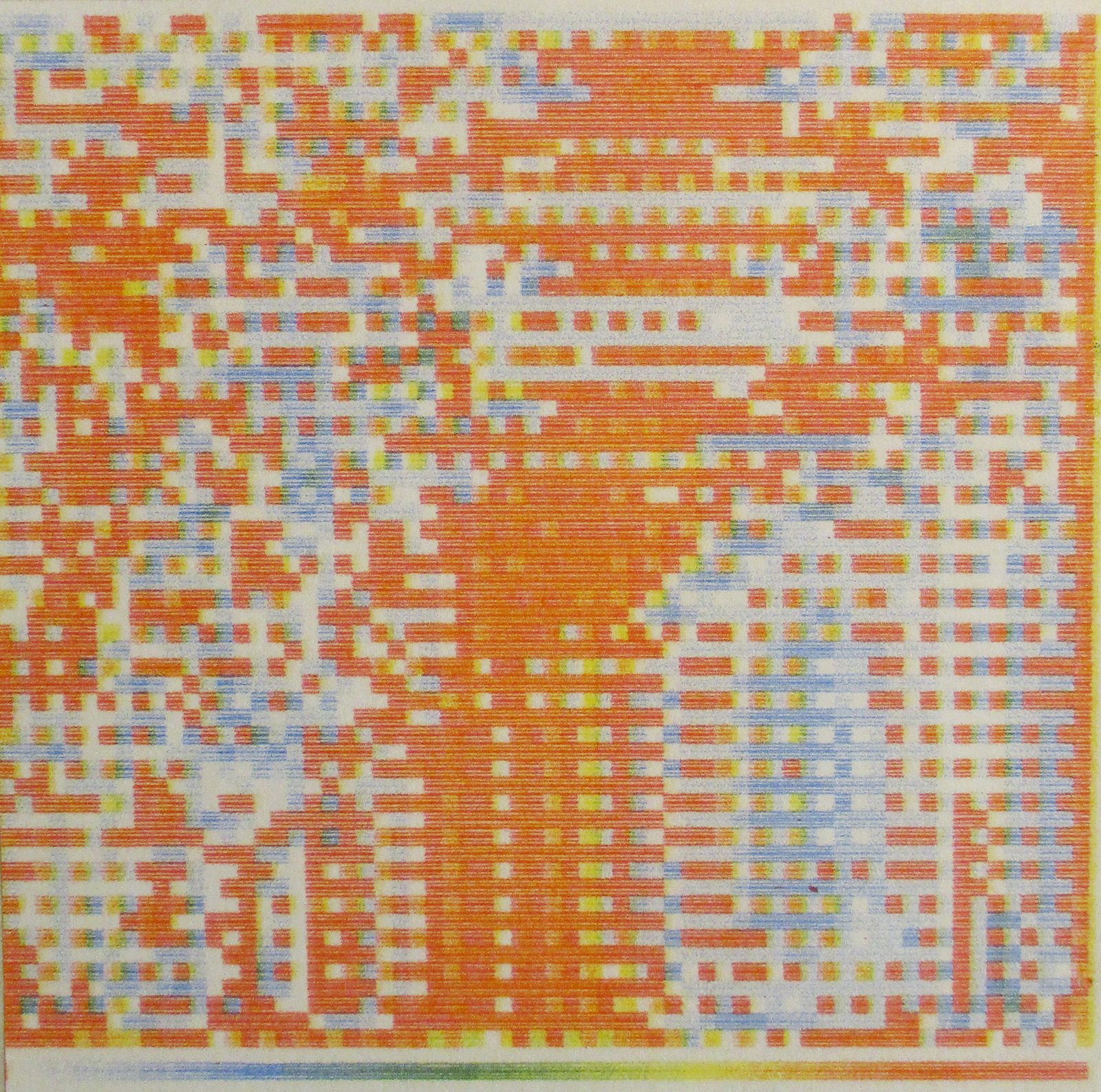
Herbert W. Franke, Farbraster series, 1974. Computer art. Copyright: Foundation Herbert W. Franke
Herbert W. Franke, Cluster, 1974. Computer art. Copyright: Foundation Herbert W. Franke
AM: Today, it is comparatively easy to find out who is working with a particular technology, immediately look at their work, and contact them directly. Herbert submitted the manuscript in 1970. How did he find and research this international scene in the first place?
SP: Herbert was, it has to be said, a great communicator. He was always looking for what was new and unknown, including in art. He attended conferences and was frequently invited to events where this small community would meet. You have to remember that, in the beginning, there were perhaps only 40 or 50 people worldwide. That was how it was possible to gain an overview of the field. Herbert searched for these people everywhere, followed every new piece of information, and tried to track down addresses and establish contact. At every event, he met new people. And he was never the kind of artist who was primarily interested in his own work. What interested him were the insights he could gain through his own work. It was also important to him that what he was doing was embedded in a larger development. For him, that was evidence of its relevance. He didn’t want to be a solitary artist operating in some elevated sphere. He wanted to be part of a development and actively help shape it at the forefront. That is also why he enjoyed writing about other artists. In that respect, he was again more of a scientist.
It wasn’t: I am the center of the artistic universe. It was: I am part of a universe that is evolving. That was also why he was so fascinated by the New Tendencies in Zagreb. They emerged from what I would call classical art and later incorporated generative and computer-based art. What mattered to Herbert was that digital art had not suddenly appeared out of nowhere as something entirely new. He understood it as the logical development of a much longer history.
That is why he consistently spoke of generative art. For him, its precursors included artists such as László Moholy-Nagy and, of course, the Bauhaus, people who approached questions of form and design through abstraction. Ultimately, it didn’t matter to him whether someone worked with a computer or with pencil and compass, like Hans Hinterreiter or Manfred Gräf. Artists working with traditional means could embody the same development for him. And, of course, there was Gottfried Jäger and photography.
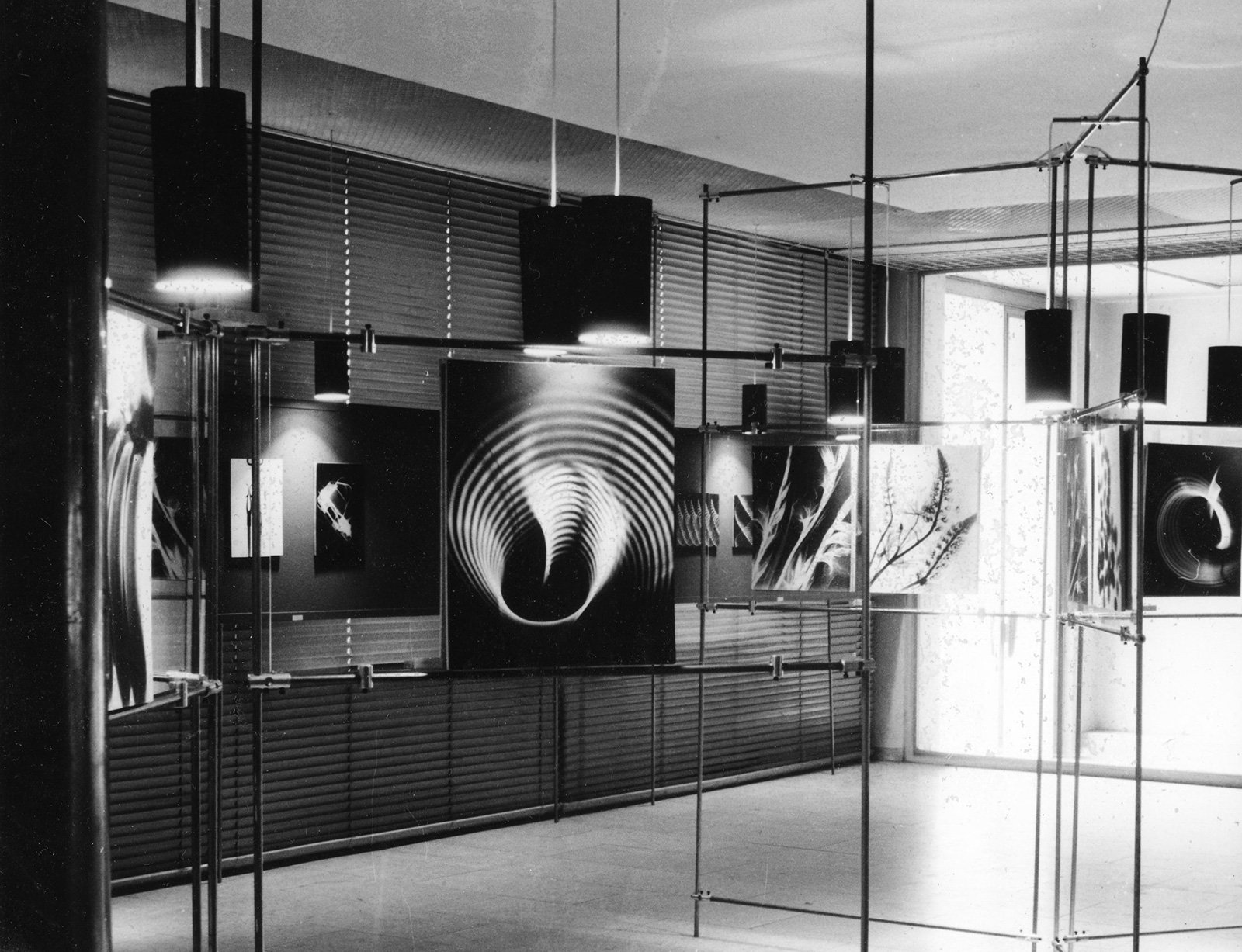
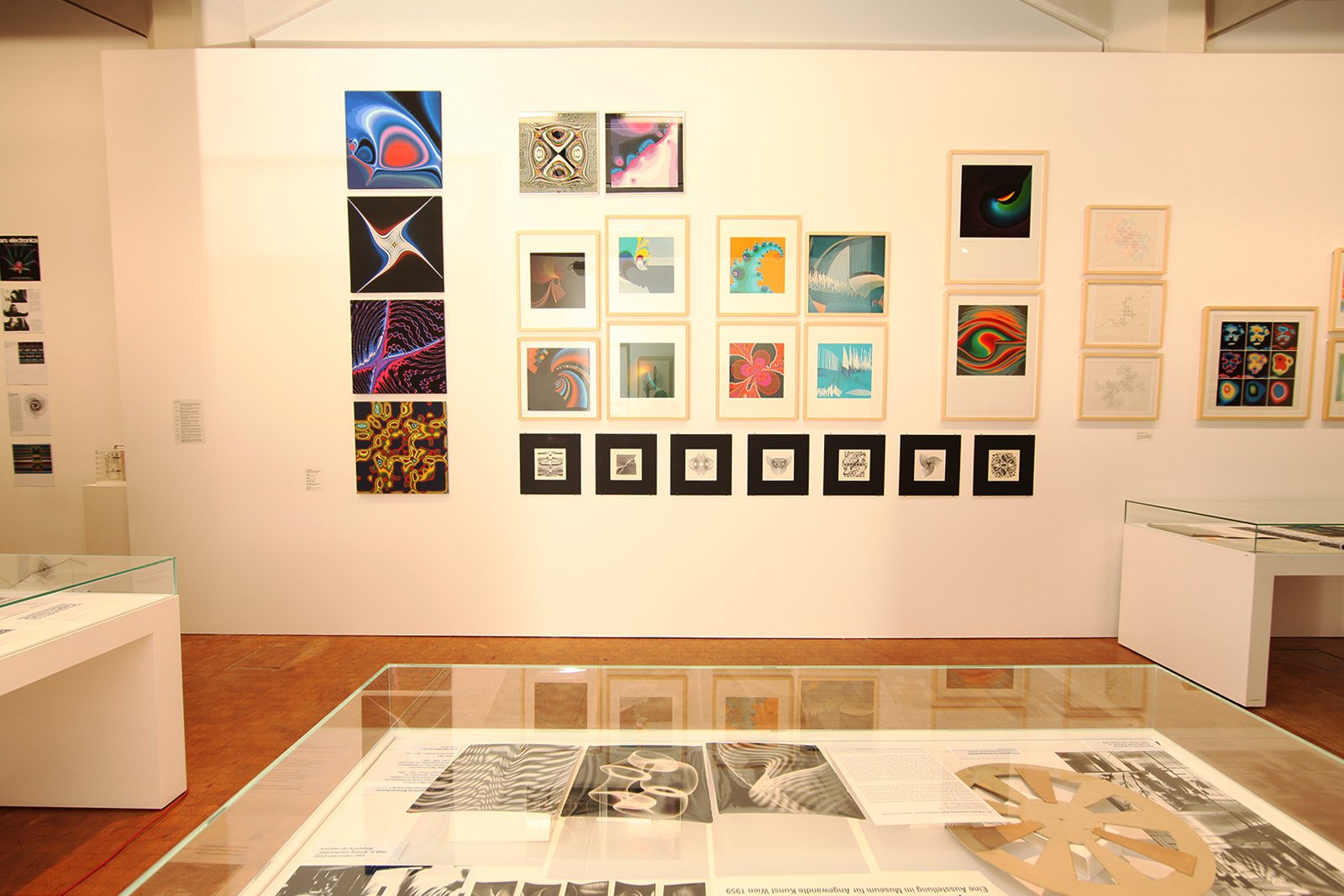
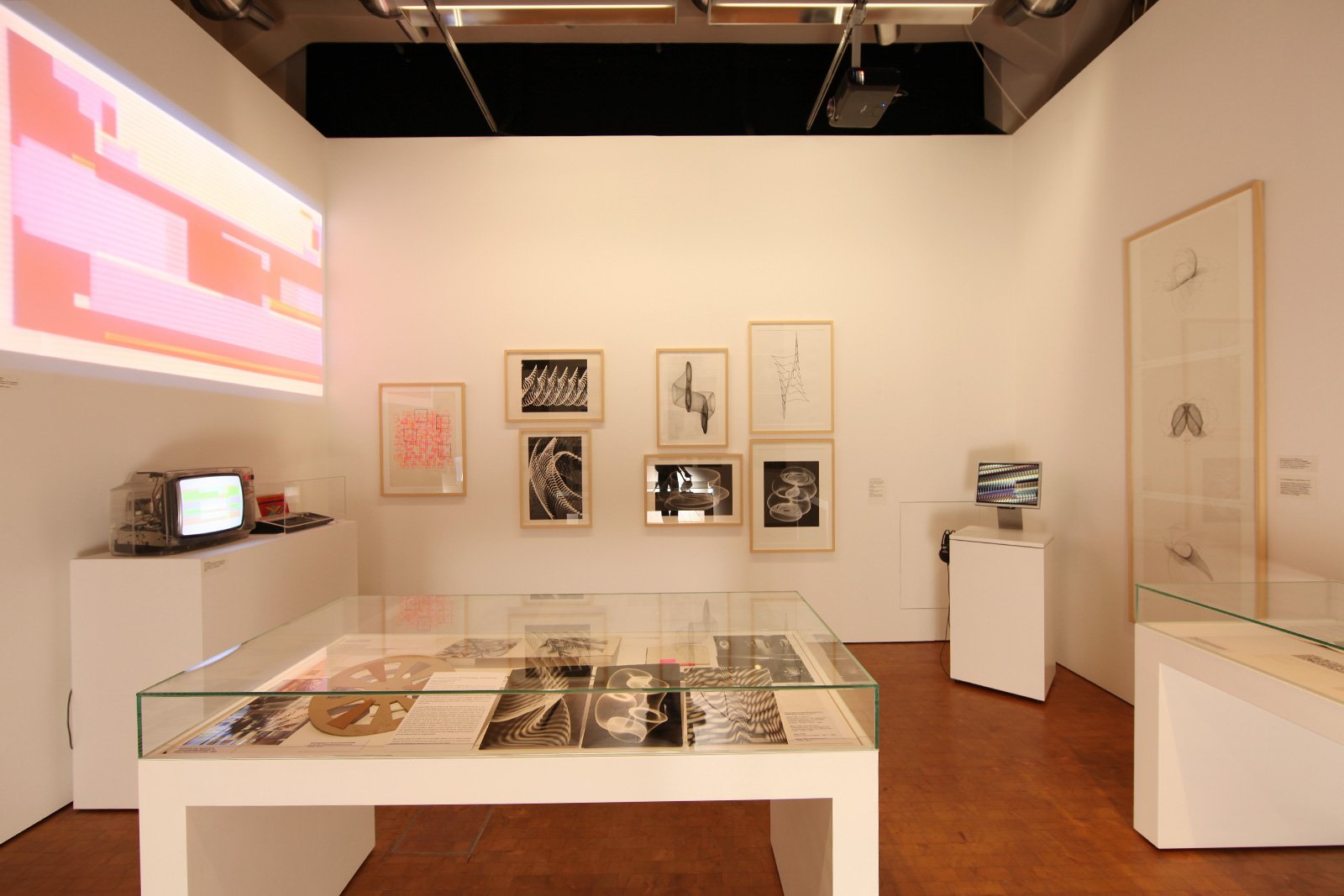
Installation view, “Experimentelle Ästhetik” (“Experimental Aesthetic”), Gewerbemuseum, Zurich (now the Museum für Gestaltung), 1959, with works by Herbert W. Franke. The exhibition, Europe’s first museum show of electronic art, had opened in Vienna earlier in the same year. Copyright: Foundation Herbert W. Franke
AM: In the exhibition at Museum Folkwang, Herbert is now being shown alongside Gottfried Jäger. Since the 1960s, Jäger has explored a form of photography that does not reproduce visible reality but generates images according to predetermined rules and mathematical principles. In 1968, he coined the term “Generative Photography” to describe this approach. Franke became both a friend and a mentor to him. How did the two meet?
SP: Through Kunst und Konstruktion. Gottfried read the book before he knew Herbert, and it was a revelation for him. Gottfried was several years younger than Herbert and was still studying photographic technology at the time, but he had already begun exploring artistic processes. As he later put it, Kunst und Konstruktion made him realize what he actually wanted to do. The two came into contact soon afterward. Gottfried still remembers how, in the late 1950s, he rather tentatively approached Herbert for the first time. Herbert was an incredibly warm and approachable person, and they immediately got along very well. From that point on, Gottfried also came to regard him, to some extent, as a mentor. That is why the exhibition at Museum Folkwang is titled Herbert W. Franke / Gottfried Jäger: Kunst und Konstruktion. In a sense, their shared history begins with this book.
AM: Generative photography seems particularly relevant again today because it understood photography not simply as a medium for depicting reality, but as one capable of generating images through rule-based processes. In the age of generative AI, the question of how images are produced is being posed all over again. That is why I find it interesting that Museum Folkwang is approaching Franke and Jäger from the perspective of photography. Herbert himself, after all, came to art partly through photography. Would you agree?
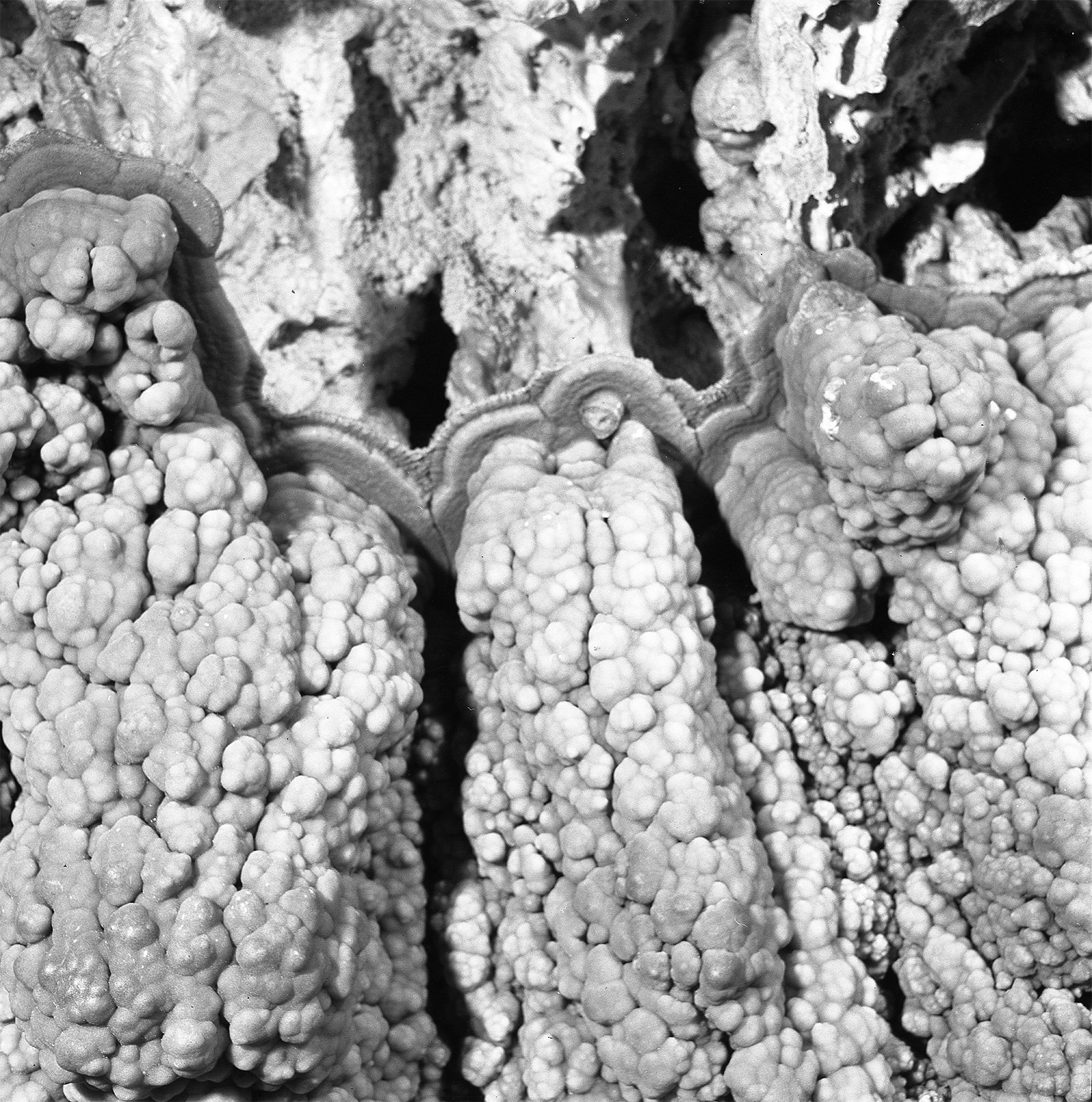
SP: I think there were two important impulses that led him toward art. One was undoubtedly his exploration of caves and his attempt to make visible the incredible aesthetics of stalactite formations, which are generated by nature and usually remain hidden from view. This also led him to think about continuous processes, because these formations grow according to principles that can be described mathematically.
The other impulse came from his work as a scientist. He worked with microscopes and other scientific instruments and noticed that they sometimes produced images that became aesthetically interesting precisely because of an error. He was fascinated by the fact that an error could produce something aesthetic.
Herbert W. Franke, Cave Speleotems, 1960s. Photo series. Copyright: Foundation Herbert W. Franke
Photography was therefore an obvious medium for him. He had drawn extensively as a child and teenager but found the process cumbersome. The first image-making apparatus available to him was the camera. He had received his first camera at the age of ten from his father, an electrical engineer who strongly encouraged his interest in technology.
But as early as the 1950s, Herbert realized that the camera was ultimately a rather imperfect instrument for the kind of art that interested him. He was convinced that there would be better machines for it. So, as soon as it became possible, he moved from the camera to the computer.
For Gottfried and other artists in this circle, the transition to digital art took considerably longer. Herbert repeatedly tried to convince them of the computer’s potential as a universal art machine. He was well aware that what computers could do at the time was only the beginning and that their possibilities would be entirely different in the future. But I can also understand why others did not initially take that step. They had a very different approach to their work. Herbert, on the other hand, said: This is the future, and I want to be part of it. Not in the sense that he wanted to establish himself as an important artist within it. He was simply so interested that he wanted to follow this development from the very beginning.
That is why he went to considerable lengths to gain access to a computer at all. In the late 1960s, that was anything but easy. Frieder Nake once told me about Herbert visiting him and looking wide-eyed at the computers and plotters Nake was already able to work with.
Herbert W. Franke, Stills from Rotationen / Projektionen, 1974. 16mm film of computer animations in real time. Copyright: Foundation Herbert W. Franke
Herbert W. Franke, Kaskade, 1983. Dynamic program controlled by music input. Copyright: Foundation Herbert W. Franke
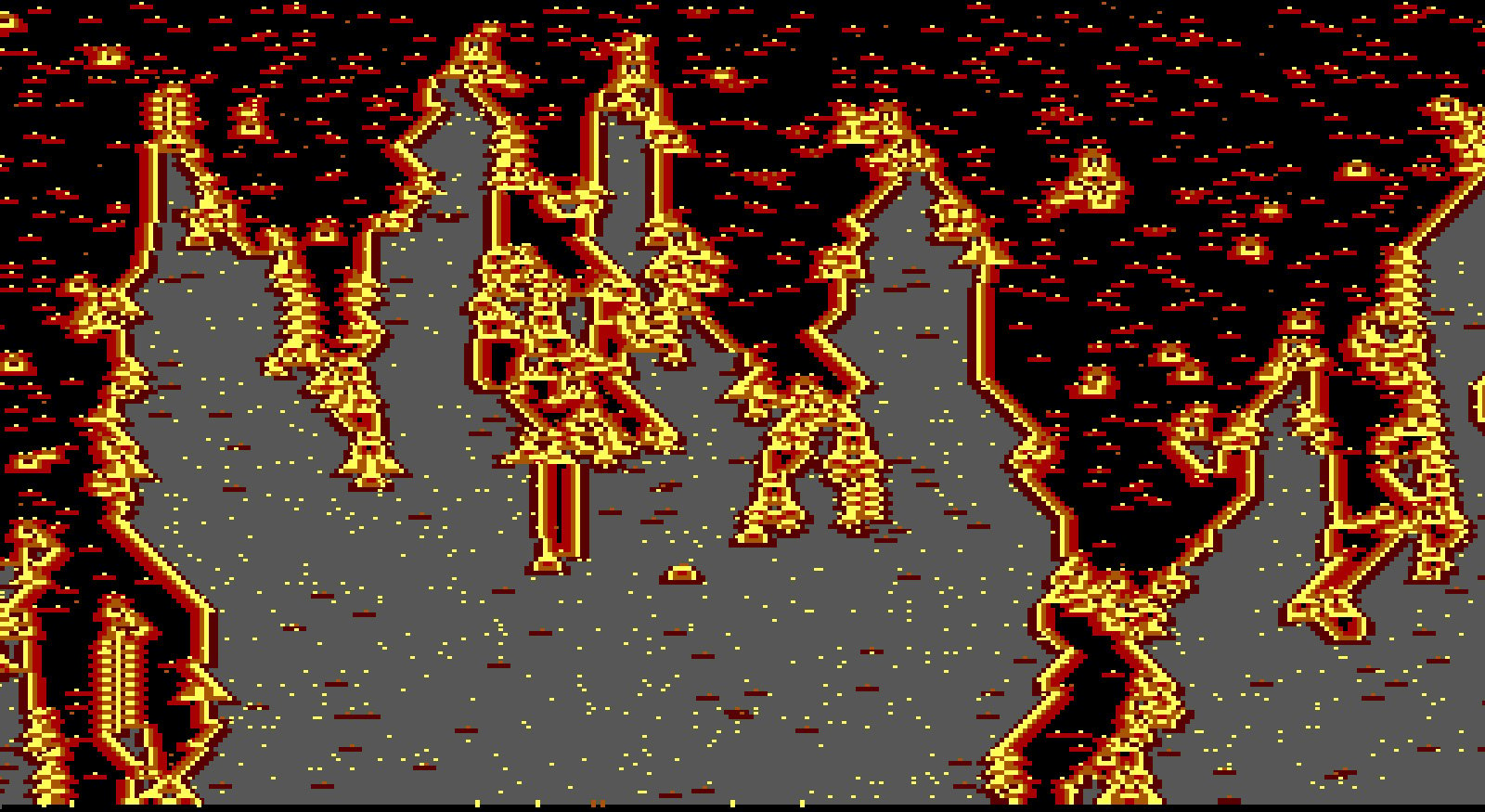
Herbert W. Franke, Zellulare Automaten – indeterministisch series, 1990s. Copyright: Foundation Herbert W. Franke
AM: If we focus on the art for a moment, what is his most important work for you personally, also as someone who lived with him for so long? And is your personal choice different from the work you consider most significant from an art-historical perspective?
SP: The most important work is probably Math Art (1980-95), simply because of how long he engaged with the subject. Herbert worked on it for 15 years, and in a sense he had already explored it earlier in a more abstract form and continued to do so later in different ways.
Although I think it is the wrong approach to Herbert to try to define him through individual works and ask: Which is the most important?
AM: But that is often how art history operates. It asks why a particular work was especially significant for its time. And if you choose Math Art, it is interesting that Herbert worked on it for 15 years. What was the question that kept him engaged for such a long period?
SP: Herbert once said something in an interview that I consider very central: “All art is mathematics.” He was convinced that the algorithmic lies at the heart of all art, not only music but also visual art and even at the level of meaning. For Herbert, mathematics was not a language invented by humans. He believed that mathematics defines the universe, that it existed long before humanity and constitutes a system of rules that also defines us.
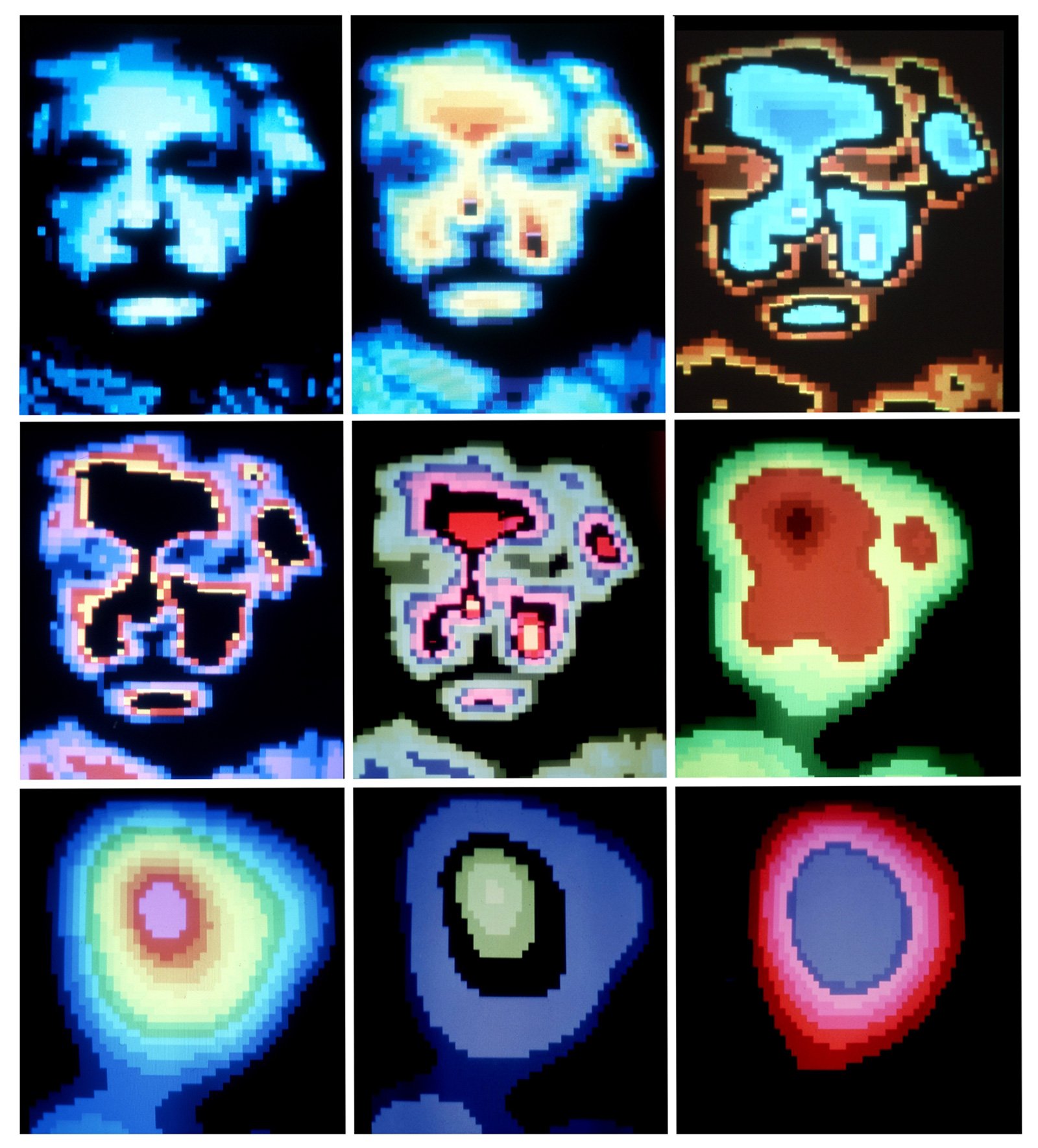
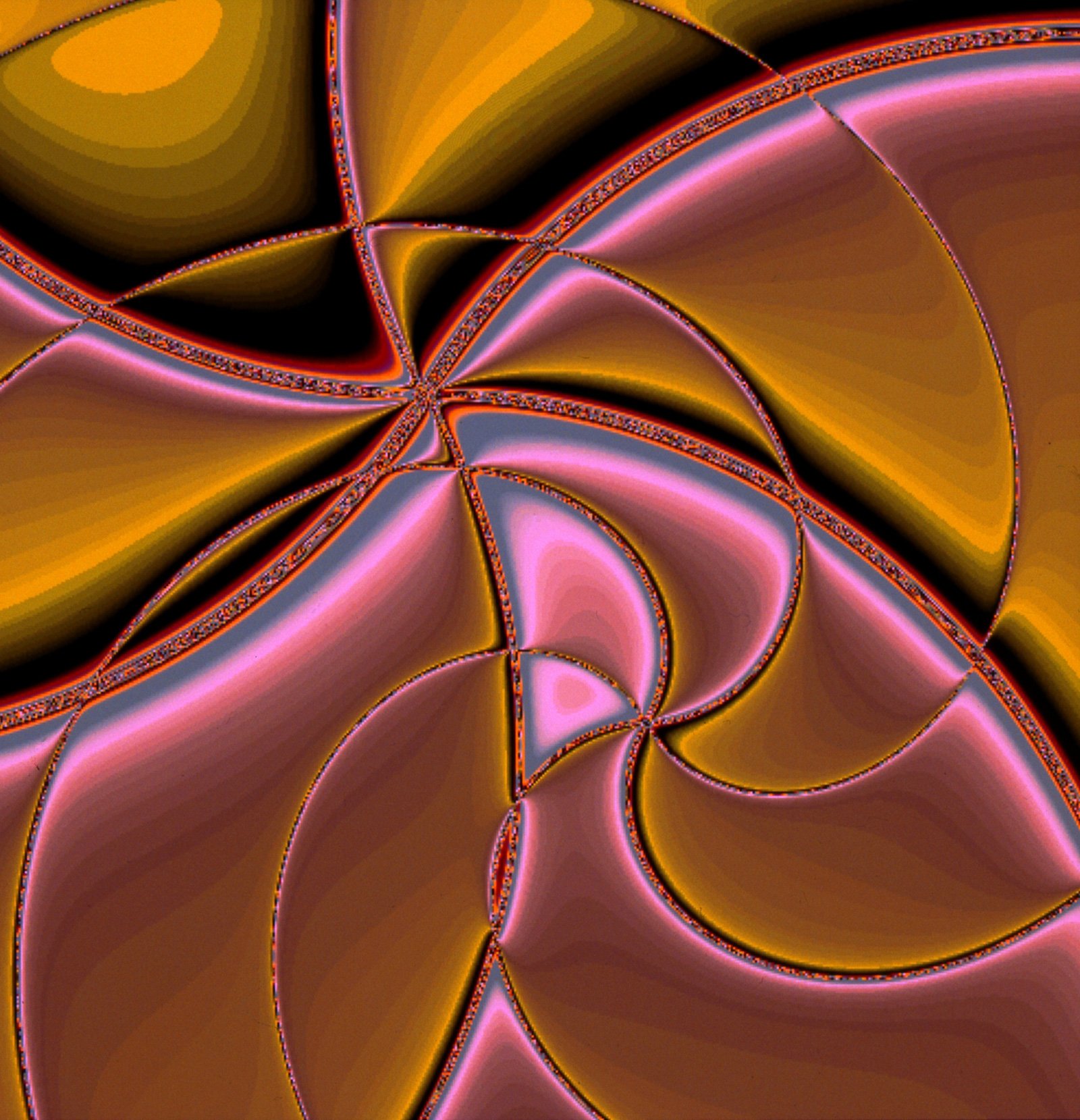
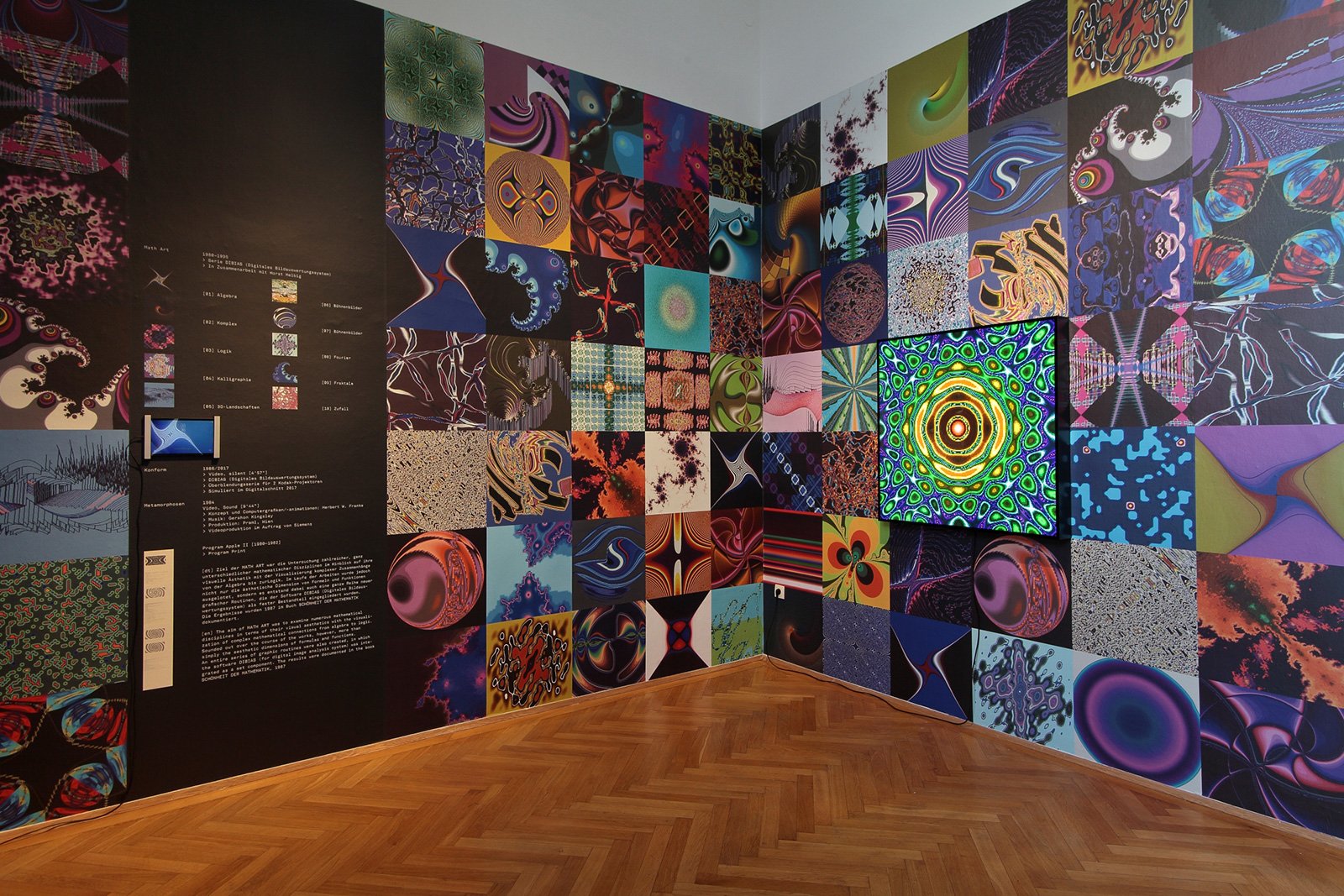
Herbert W. Franke, Math Art, 1980-95. Computer art series. Copyright: Foundation Herbert W. Franke
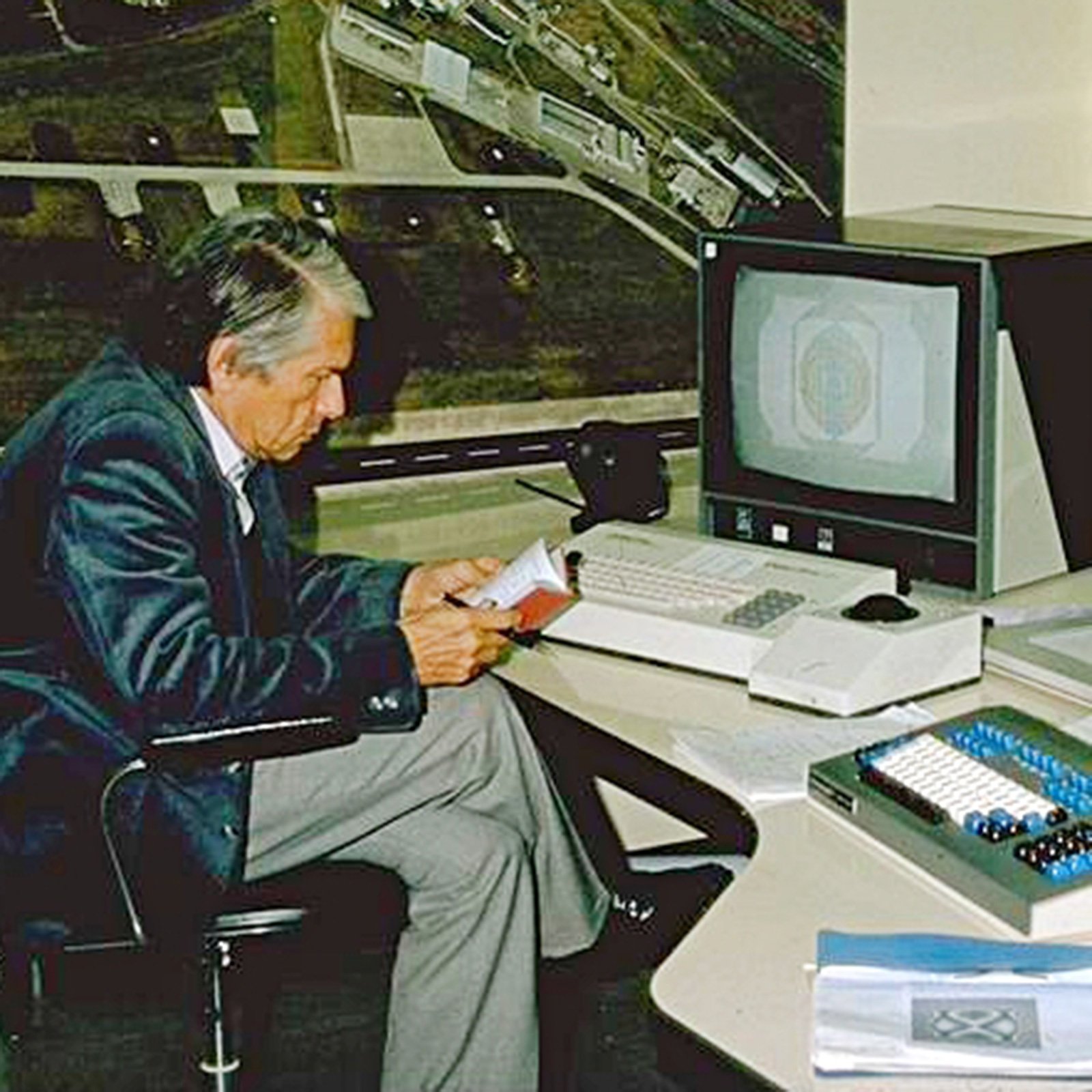
Herbert W. Franke working on his Math Art series with the DIBIAS image processing system at the DLR (German Aerospace Center) Copyright: Foundation Herbert W. Franke
AM: How did he translate this idea of mathematics as a fundamental system of rules into his artistic practice in Math Art?
SP: He wanted to demonstrate that mathematics possesses an inherent aesthetic and that different mathematical structures can produce different aesthetics. In other words, mathematics can be used to generate very different kinds of art. That was his initial impetus: to demonstrate that mathematical forms possess their own aesthetic properties and that these properties differ from one form to another.
Then the work began to take on a life of its own. They kept experimenting with new things, combining mathematical forms and working with them in increasingly free artistic ways. This led, for example, to the Bühnenbild (Stage Design) series in the mid-1980s.
By then, it was no longer primarily about demonstrating the aesthetic qualities of a particular mathematical form and how they differed from those of another. It became a free play of combinations.
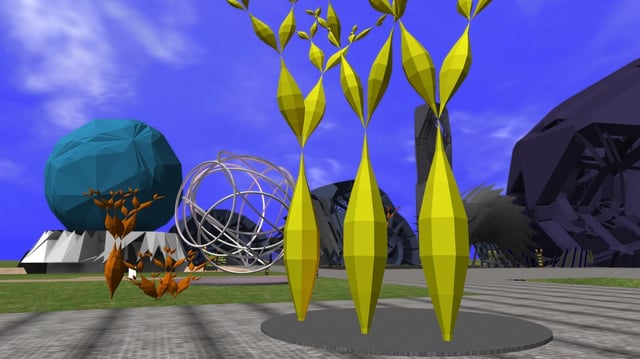
Installation view, “Herbert W. Franke | Wanderer zwischen den Welten” (“Herbert W. Franke | A Wanderer Between Worlds”, ZKM Karlsruhe, 2010. Copyright: ZKM Karlsruhe
Installation view, “Herbert W. Franke | Wanderer zwischen den Welten” (“Herbert W. Franke | A Wanderer Between Worlds”, ZKM Karlsruhe, 2010. Copyright: ZKM Karlsruhe
AM: You met around 1980. By then, decades of this very complex thinking already lay behind him, from speleology and his early writings of the 1950s to art, mathematics, and physics. You didn’t experience some of these earlier periods yourself, yet over time you became deeply immersed in this entire world. What was it like for you to gradually become familiar with his thinking and these earlier chapters of his life?
SP: It really happened automatically, simply by being there. It wasn’t as though I spent my life as Herbert’s archivist. Quite the opposite. I always had my own life and wanted to be successful professionally in my own right. Herbert was, of course, always my backup. I could always turn to him. But there were only a few projects that we actually worked on together.
It was only in the last few years that I realized something had to be done, otherwise a great deal might be lost. And today, I am sometimes surprised myself by how much I know about Herbert and how much of him is in me, if I can put it that way. I often know very precisely how he would have reacted to something, how he would have spoken, or what he would have thought. That was never my intention. It simply developed over time.
Herbert always said that it was very rare to find someone who truly understood you. And he repeatedly told me that I understood him. Perhaps that also had something to do with the fact that my own studies and way of thinking placed me between the natural sciences and the humanities. Herbert was clearly more rooted in the natural sciences. But I had a feeling for both sides, and that was certainly helpful.
Installation View, “Herbert W. Franke: Visionary”, Francisco Carolinum Linz, 2022. The Math Art room. Photography copyright Francisco Carolinum Linz
AM: Did that understanding also change the way you saw his art?
SP: Absolutely. When Herbert first showed me his graphics, the Quadrate (Squares) or works from the Drakula (Dracula) series, his early works from between 1968 and 1971, they were not my world at all. At the time, I was more interested in the Impressionists, to some extent the Expressionists and Futurists. Initially, I had no connection at all to abstract computer art and its very austere aesthetic.
In that sense, I am actually a good example of Herbert’s conviction that the perception of art is individual and depends on the knowledge each person carries in their mind. For him, there was no such thing as an absolute work of art.
Today, I move within the world of generative art myself, and I like it. Learning to understand it has also changed my perception. Herbert always said that understanding creates a sense of well-being. When you understand something and recognize patterns and connections, you develop an interest in it and can take pleasure in it. That is what happened to me with Herbert’s art. By now, of course, it has long since become “my” subject too.
Susanne Päch (*1955) is a journalist and media expert who holds doctorates in media studies and the history of science and technology. She is the owner and managing director of mce mediacomeurope GmbH, a consulting company specializing in content and multimedia. The company also operates HYPERRAUM.TV, an independent IPTV channel dedicated to science and technology. Today, Päch primarily serves as founder and CEO of art meets science – Foundation Herbert W. Franke, where she manages the legacy of her late husband, Herbert W. Franke.
Herbert W. Franke (1927–2022) was an Austrian artist, physicist, science fiction author, and theorist whose work explored the relationships between art, science, mathematics, and technology for more than six decades. He began experimenting with abstract photography and electronic image-making in the 1950s and presented his first museum exhibition, Experimentelle Ästhetik, at the Museum of Applied Arts in Vienna in 1959. In 1970, his computer-generated work was shown at the 35th Venice Biennale. Franke was also an influential theorist of technologically and mathematically informed art. His publications include Kunst und Konstruktion (1957), Phänomen Kunst (1967), Computergraphik – Computerkunst (1971), and Apparative Kunst. Vom Kaleidoskop zum Computer (1973), co-authored with Gottfried Jäger. In 1979, he co-founded Ars Electronica in Linz. Alongside his artistic and theoretical work, Franke was one of the most influential German-language science fiction authors of his generation. His literary work includes Der grüne Komet (1960), Zone Null (1970), and Ypsilon Minus (1976). In 2016, the European Science Fiction Society honored him with its Grand Master Award for his literary work. In 2010, ZKM | Center for Art and Media Karlsruhe presented the comprehensive solo exhibition Wanderer zwischen den Welten. In 2022, the Francisco Carolinum in Linz dedicated the retrospective VISIONÄR to Franke on the occasion of his 95th birthday. In 2026, the Museum Folkwang in Essen presents Herbert W. Franke / Gottfried Jäger: Art and Construction, bringing together around 250 works by the two artists and tracing their decades-long dialogue between non-representational photography and early computer art.
Anika Meier is a Berlin-based writer, moderator, curator, and lecturer specializing in art, technology, and digital culture. She teaches at the Department of Digital Art at the University of Applied Arts Vienna, is the co-founder of the curatorial collective The Second-Guess, and is the curator and program lead of the objkt labs Residency. She regularly contributes to Monopol, Kunstforum, Spike, SLEEK, Numéro Berlin, and The AI Art Magazine, and has moderated conversations and spoken at events including Art Basel, re:publica, and Ars Electronica.