As they move into advisory roles, the magazine’s Founding Editor, Alex Estorick, and Head of Community, Danielle King, discuss the ascent of sensemaking over tastemaking in the new art ecosystem
Once the initial hype surrounding the NFT boom started to die down, we encountered a common refrain in the digital art space:
“Can’t we all stop talking about NFTs and just get back to talking about Art?!”
As the representatives of a magazine dedicated to radical inclusivity, our answer was always the same: “Of course you can, but if you do you’ll be ignoring the communities of digital artists, especially those in the global majority, who can make a living only thanks to NFTs”.
Suffice it to say, NFT is no longer the most popular word in the English language (as it was in 2021), and, sure enough, old habits have returned. The prospect of a different art ecosystem defined by decentralization, disintermediation, and resale royalties now feels like a mirage, while much of the vital infrastructure on which the new cultural economy depended — including this magazine’s original parent company, ClubNFT — has been forced to close.
As big a debt as the world of digital art owes Jason Bailey, who cofounded ClubNFT in 2021 and whose blog Artnome first documented crypto art, without the vision and investment of Tony Lyu, who purchased Right Click Save in 2025, whole swathes of recent art history — as well as the personal stories of multiple generations of artists — would have been put at risk.
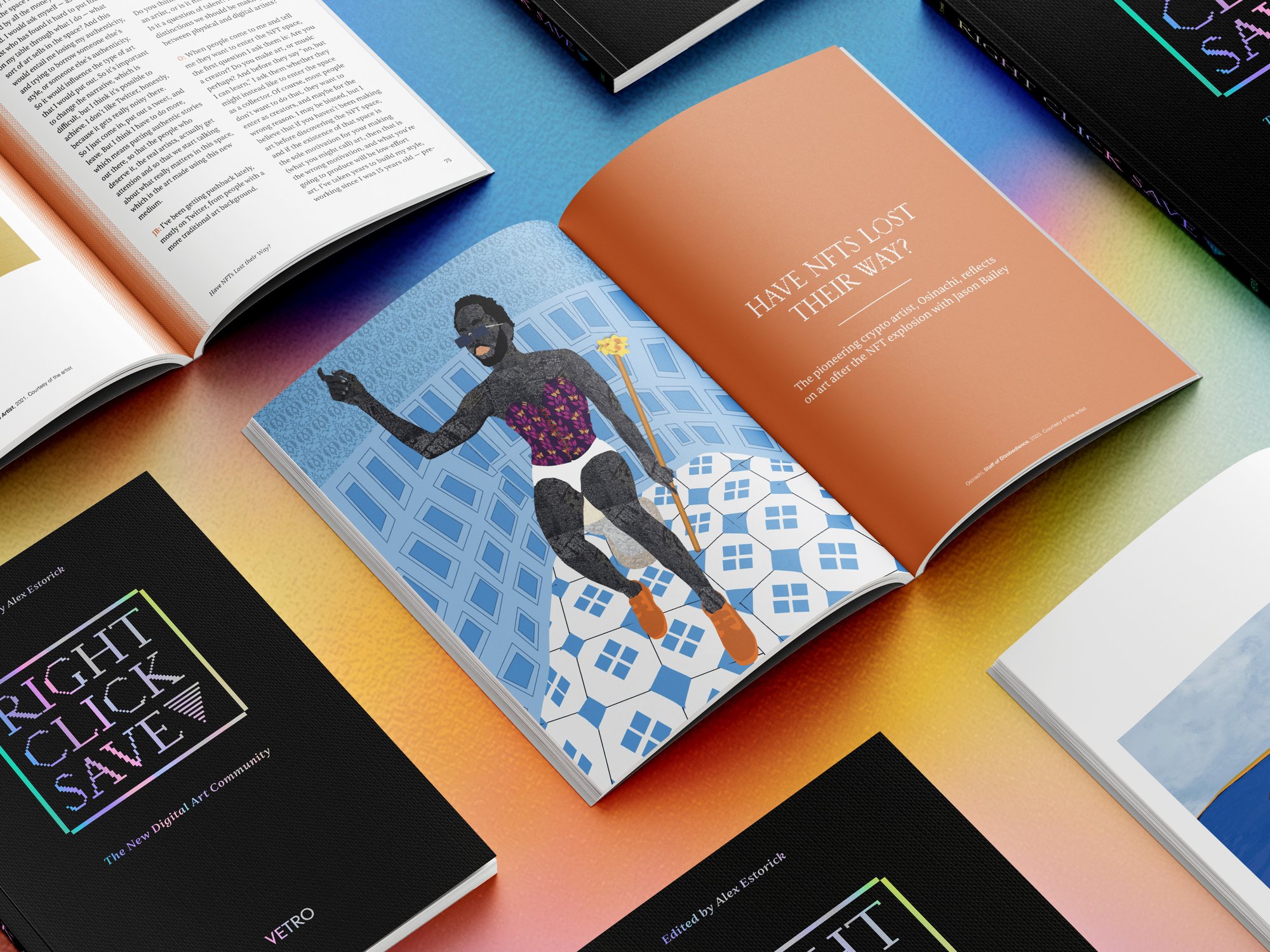
Alex Estorick (ed.), Right Click Save: The New Digital Art Community, Berlin: Vetro Editions, 2024
When we launched Right Click Save, the job was to keep up. A new community was assembling itself in public, across Discord servers, Twitter Spaces, and mint pages, and someone needed to document it before it disappeared. Our 2022 conversation with a panel of generative art collectors clarified how the new wave of open platforms was transforming a traditionally private, solo endeavor into a social one. Without a single authority determining what counted as “good” art, its value was open to negotiation between those taking part. The recent closure of fxhash underscores why such conversations are worth recording: the communities that form around such infrastructure can outlast it, but their histories need somewhere to live.
While we have left no stone unturned in seeking to unveil overlooked histories of digital art, the job of documenting people and practices that tend to be ignored is never done. Though it is truly saddening to witness the decline of a genuine alternative to centralization, hierarchy, and gatekeeping, the process of bringing two worlds together — one of Right Click Save’s priorities — is helping to foster new behaviors. If artspeak remains the lingua franca of the art world, today a visit to one or another “blue-chip” gallery feels less exclusionary.
While it would be wrong to claim that Right Click Save has somehow rewired the art world, its growing archive of interviews with artists who fall between the cracks represents a vital repository and warning to curators inclined toward narrow narratives.
Moreover, by (incessantly) stressing the hybrid reality of contemporary art practice, which increasingly fuses analog and digital media, and human and non-human agents, we are convinced that the people and values of what was once a digital underclass will come to define the terms of the new art ecosystem.
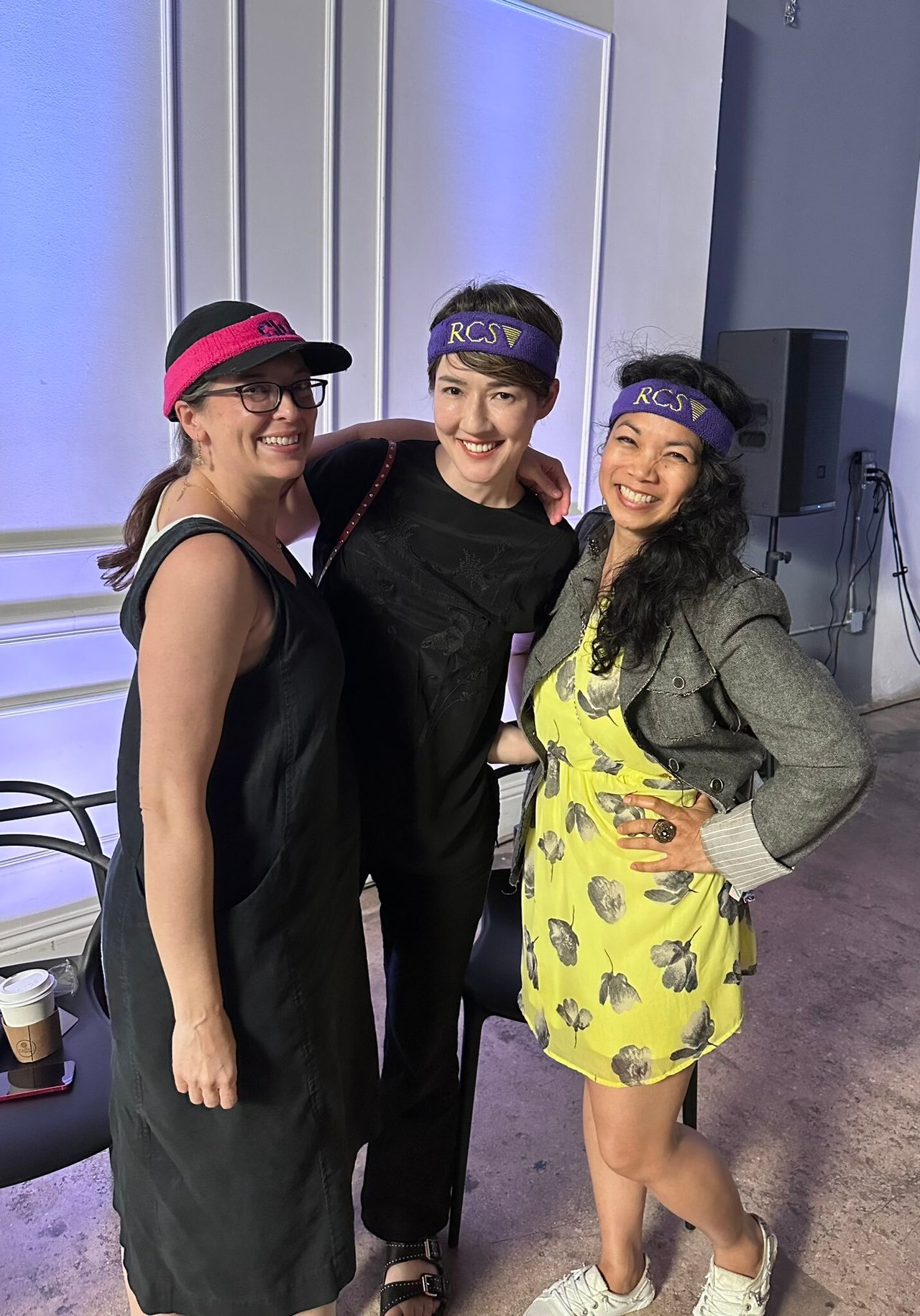
Danielle King with Sputniko! (Hiromi Ozaki) and Ann Marie Alanes, at FEMGEN, Miami, 2022. Courtesy of Right Click Save
If FEMGEN was a moment when crypto conversation matured, by the time we posed the question in 2024: Where Next for Digital Art?, the early optimism had given way to scrutiny. Our role soon began to shift as the institutions of the established art world paid greater attention to practices whose meaning had developed through unfamiliar channels.
Each world was intrigued by the other, but much was getting lost in translation.
At Right Click Save, we believe that by representing the values of a community whose common language is code, we are well placed to make sense of the growing entanglement of art with technology. Indeed, our core principle of letting the language of artists shape the terms by which their work is evaluated can help to ensure that the value of art doesn’t depend on the arbitrary decision-making of a new class of tastemakers.1
This also means giving readers the context to understand why something matters to the people who made it, especially when their practices challenge familiar definitions of art. Our weekly newsletter works in the same spirit, connecting developments across the ecosystem so that readers encountering digital art in a museum and those participating in an artist-led platform feel they are part of the same conversation.
That conversation now has a home of its own in the Forum. Whereas a magazine is capable of offering considered perspectives, a community needs somewhere to think out loud. When readers challenge an argument or sharpen an idea first raised in an article, they shape the discussion themselves. In this way, the openness that made platforms like fxhash or Hic Et Nunc meaningful can also inform the life of a publication, whose capacity to make sense of rapid change depends on its ability to listen.
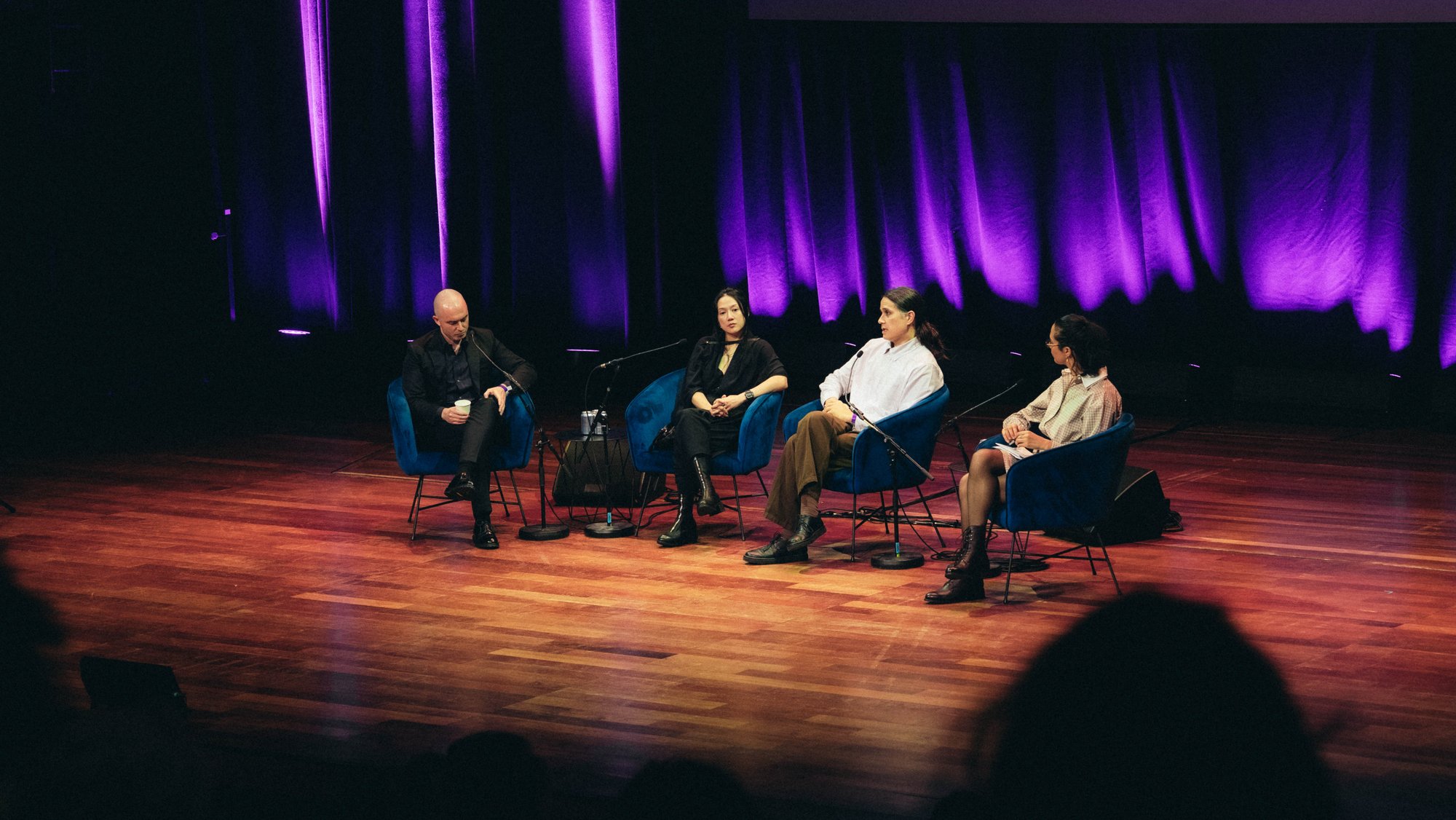
Panel discussion on “The Image After AI” at Creative Intelligence, Southbank Centre, London, 2026, with speakers (from left): Alex Estorick, Sougwen Chung, K Allado-McDowell, and Jazia Hammoudi. Photography by Oscar Clark
In the five years since digital art went mainstream, the relationships between humans, machines and nature have been fundamentally transformed. As we reflect on this period, one imperative will continue to guide the editors at Right Click Save: art writing today must be an act of sensemaking, not tastemaking.
As we move into advisory roles, we do so with the conviction that the magazine’s future belongs to the colleagues and communities who will shape its next chapter. Originality, criticality, and plurality remain the DNA of Right Click Save, which has always been a listening exercise for artists working at one intersection or another. Under Tony’s stewardship, the new team has the opportunity to give these principles fresh expression while continuing to spotlight artists making sense of new technologies. We can’t wait to support their work as they open up emergent possibilities in a more inclusive art ecosystem. And we would like to thank all of the Right Click Save community for supporting the magazine both online and in person over many years. It has been the honor of a lifetime.
Alex Estorick is a writer, editor, and curator based in London. As the Founding Editor of Right Click Save, he seeks to develop critical and inclusive approaches to emerging technologies. He is also an Associate Lecturer in the Department of Computing at Goldsmiths, University of London. He writes for various publications, from Artforum to the Financial Times, and was lead author of the first aesthetics of crypto art. His edited volume, Right Click Save: The New Digital Art Community, is published by Vetro Editions. In 2025, he was included in the Monopol Top 100, a list of the most important people in the art world. He is also Vice Chair of the Estorick Collection of Modern Italian Art.
Danielle King is an artist, writer, and curator based in Western Massachusetts. She studied studio art and art history at Harvard University, working primarily in photography and film. Her recent work utilizes AI technologies to create alternative art histories, explore memory and the duality of self, and investigate capitalist and art historical ideals of beauty, femininity, and motherhood. After receiving her MBA from the Yale School of Management, Danielle spent eight years managing the Department of Painting and Sculpture at the Museum of Modern Art in New York. Danielle is an alumna of the VerticalCrypto Art Residency and an Adjunct Lecturer at the Center of Creative Computation at SMU.
1 Which isn’t to say that artists shouldn’t be scrutinized for the language they choose to use.