In Emergent Fields | Iskra Velitchkova
The artist distills her generative vision through a sublime world of shadows, writes Alex Estorick
The artist distills her generative vision through a sublime world of shadows, writes Alex Estorick
Here shining rays of light shoot through the darkness of night, and we become aware of giant shadows swaying back and forth, moving ever closer around us and destroying within us all feeling but the pain of infinite yearning, in which every desire, leaping up in sounds of exultation, sinks back and disappears. (E.T.A. Hoffmann reviews Beethoven’s Fifth Symphony for Allgemeine musikalische Zeitung in 1810.)
In its division into a series of chapters and in the coincidence of its launch with the birth of the artist’s first child, Vera, I See Generative (ISG) represents a summa of the principles that have guided Iskra Velitchkova’s practice since she first used code to generate art. As an invisible force that shapes the world, WIND makes for a natural focus for the inaugural release as well as an apt analogy for the emergent potential of randomness, which once defined the work of another Vera (Molnar).
At a time when code increasingly mediates human experience of material realities, it is Velitchkova’s ability to generate numinous zones of digital experience that marks her out as a unicorn even among the current golden generation of generative artists.
Despite her experience of long-form generative art, where an artist’s algorithm outputs hundreds of variations, each transferred to a collector without intervention or curation by the artist, Velitchkova has always been concerned with, what she terms, “narrative logic”.
For this first incarnation of ISG’s long-term durational project, she has curated nine large-format expressions of WIND, the “masterworks”, with each accompanied by a further nine “traces”, selected in collaboration with Alejandro Cartagena, that offer insight into the systems from which they emerged.
The resulting clusters function synecdochically, with part and whole in an eternal relay, elegantly distilling Velitchkova’s output space into a sublime world of shadows. Despite the formal diversity of WIND’s different chapters, which range in appearance between ethereal material and mental cartographies, their monochrome uniformity hints at the artist’s use of overlapping systems. The result is a comprehensive statement of Velitchkova’s aesthetic principles as well as a mythic elision of cosmic geometries and organic morphologies by which the artist reworlds reality.
If WIND invites comparison with drawing, it is not because the artist conceives of the works themselves as drawings, but because they explore the conditions under which worlds come into being.
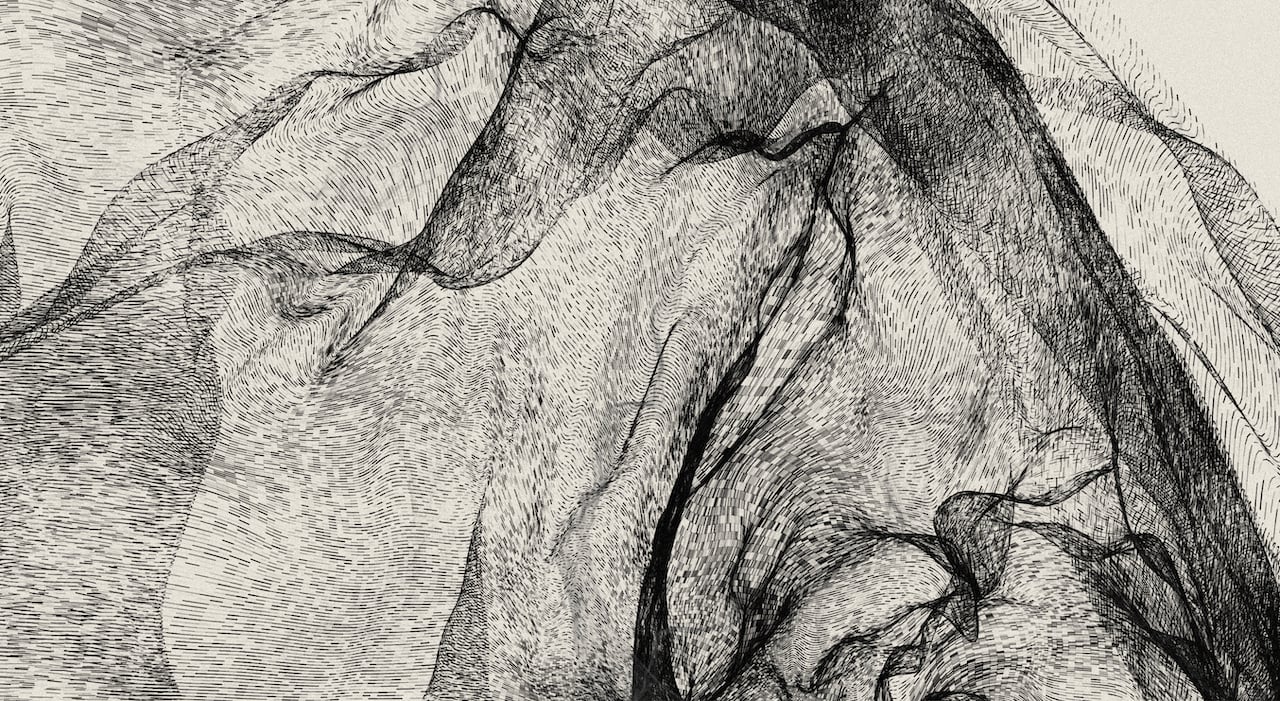
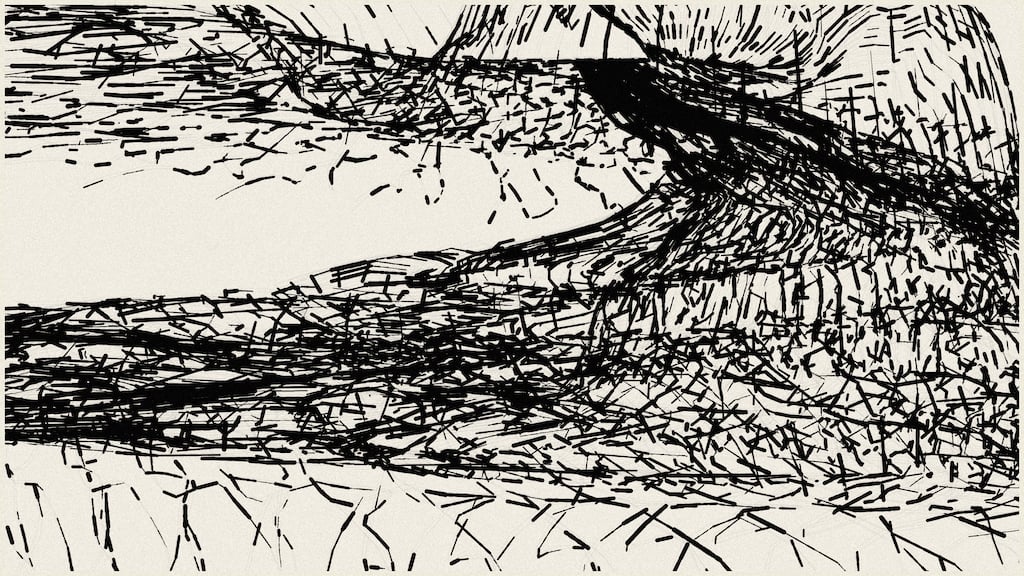
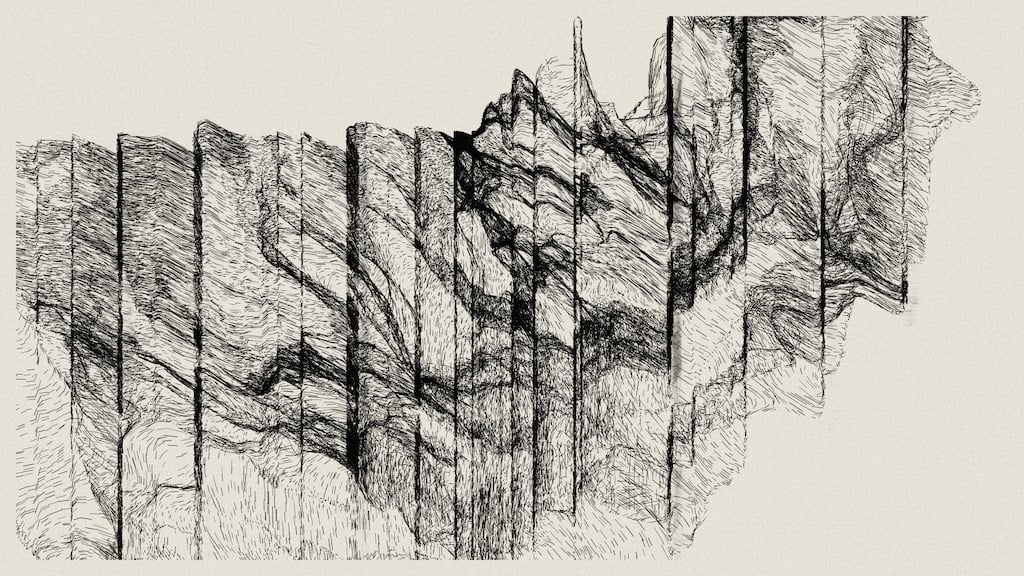
Across its nine chapters, WIND articulates the cognitive primitives of Velitchkova’s generative vision: line, pressure, accumulation, and attenuation, all put to the expression of digital material as both plastic and fibrous. These are not drawings in any conventional sense, but presentation images whose visual logic functions as a means by which forms can unfold. Like the preparatory studies in chalk, ink, and metalpoint that shaped the divine design of Renaissance paintings, their purpose is not a final resolution but the suspension of an image at its moment of revelation.
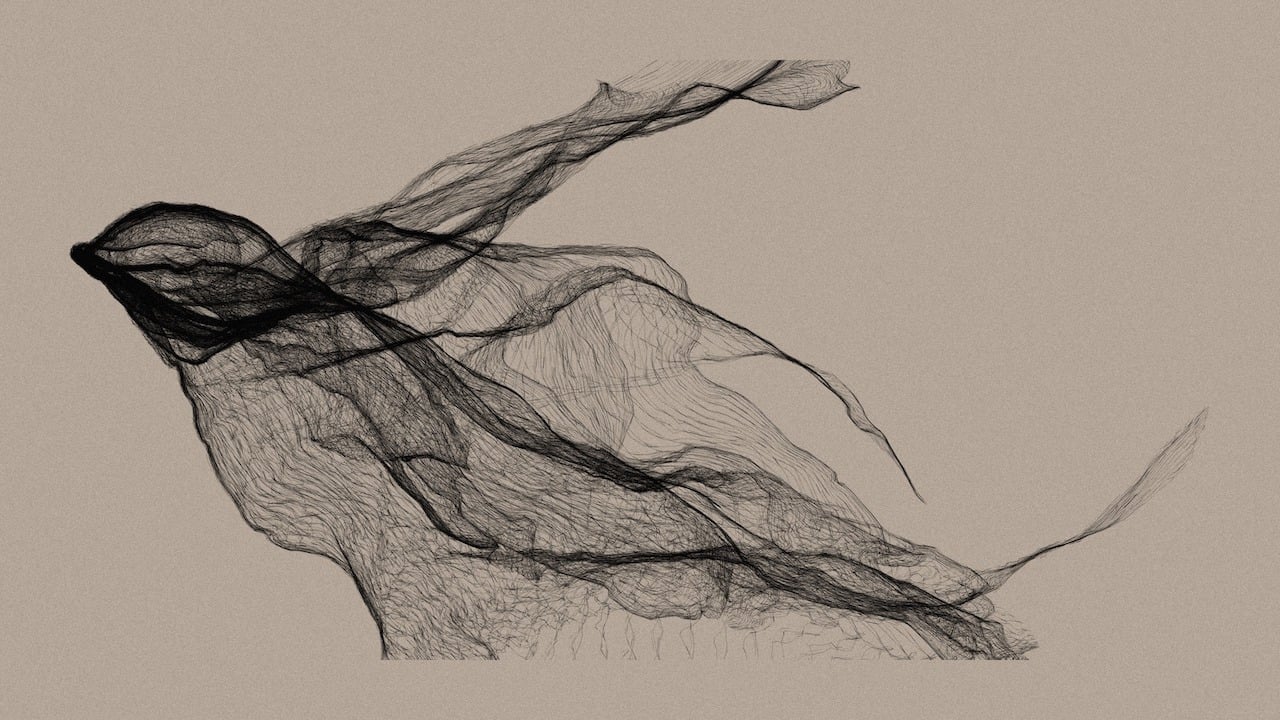
This is immediately evident in chapters such as Bird / Scarf and Nothing / Moving, where forms hover between gravity and weightlessness. In the former, feather-light structures evoke drapery caught mid-motion, their mesmeric modelling recalling the delicate chiaroscuro of Boltraffio’s studies after Leonardo from the 1490s. Yet they also resonate with the fluidity of ykxotkx’s code-based Flow Paintings of 2024.
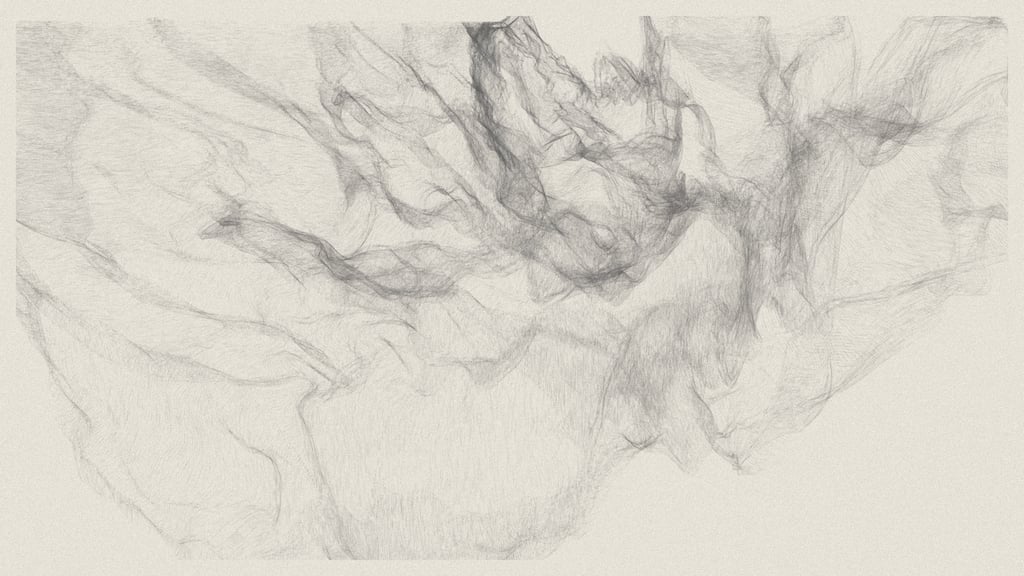
Birds have been a consistent leitmotif in Velitchkova’s work, sometimes appearing as a memory and sometimes as a means of expressing, what she has called, the “field of reflection that guides [her] practice.” In Nothing / Moving, form becomes a practically vestigial presence, and WIND a condition of near absence. The oscillation between these extremes establishes a fundamental premise of the project: that form is always in flux.
According to the artist, birds are also a metaphor for “the distance that separates us from things and how it can be measured.”
In this sense, distance describes the interval between the absence of code and the appearance of form, and between a system’s latent potential and the singular image that ultimately asserts itself.
This distance is measurable in lines of code, yet irreducible to them; it is equally temporal, perceptual, and conceptual. Chapters such as Presence / Scent make this clear through tonal inversion, switching between pale forms on dark grounds and their opposite. The resulting images evoke both cosmic illumination and terrestrial turbulence — dust devils, astral phenomena, the eye of a storm — without resolving into literal representation.
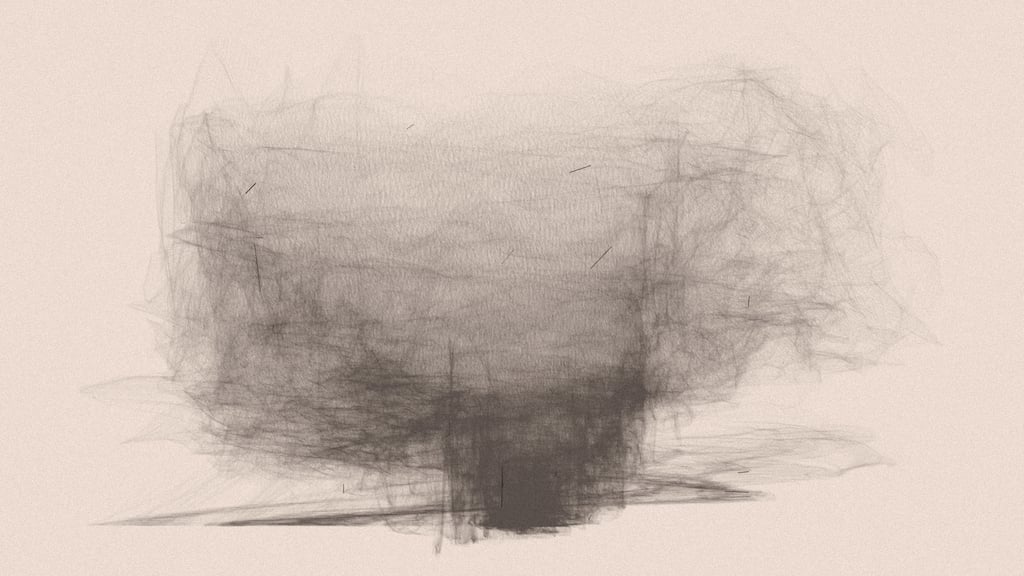
WIND here operates as a sublime force in the Burkean sense, something akin to Rembrandt’s Three Trees (1643), an etching, engraving, and drypoint that imagined nature as an awe-inducing system beyond the limits of reason.
In Velitchkova’s work, the sublime emerges not through a surfeit of visual information but through the artist’s restraint in refusing to collapse distance for the sake of immediacy.
This refusal is perhaps best expressed in Asphalt / Weight and Burnt / Stone through images of folding and enfoldment. In these chapters, arcing contours gather, fold back on themselves, and unfurl again, producing billowing structures that sustain material integrity despite their porousness.
The algorithmic logic that defines these forms, with points drawn toward the center of a digital canvas only to unfold again according to varying degrees of randomness, is purposely designed to translate WIND’s ineffable activity into visible tension. Folding here is both a compositional strategy and an epistemic model: a way of imagining space as a sequence of pulsing fields. The results recall earlier works such as Uninhabitable (2021), where space appeared to buckle and strain under invisible pressure.
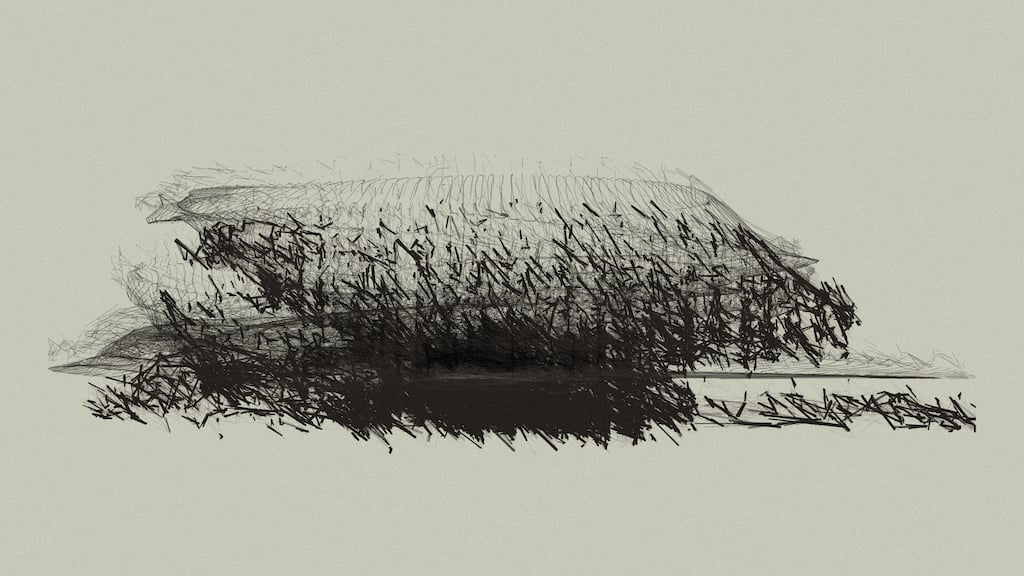
Elsewhere, WIND induces a calligraphic atmosphere. In Japan / Heat, Lake / Placid, and Symphony / 5 line becomes an expressive current that swells and tapers into an enveloping tempest without abandoning its graphic discipline. The latter recalls the brush plottings of Roman Verostko that were inspired by his collaboration with shufa [Chinese calligraphy] master Wang Dong Ling, while Lake / Placid introduces a grey-green ground that instills an atmosphere of rare foreboding.
Here, WIND seems to collapse inwards, forming vortices that verge on black holes, their edges fraying like J.M.W. Turner’s late dissolutions of land, sea, and sky. In Symphony / 5, this turbulence resolves into a more measured formal repertoire: tightly controlled parabolic curves that place WIND in the service of harmony.
Here, the convergence of geological strata with musical notation conjures a world winding in on itself — still in balance but reverberating with digital cacophony.
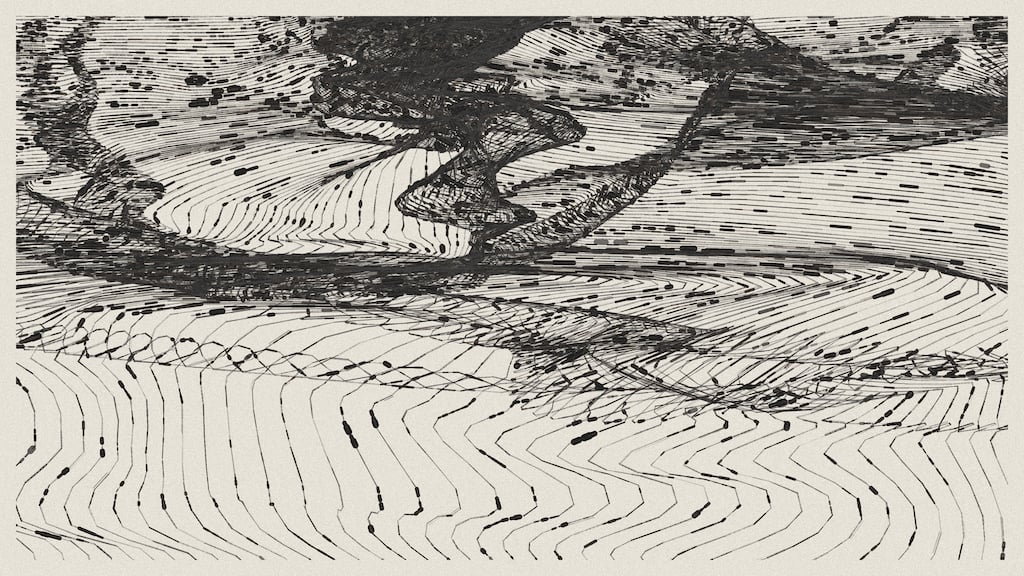
In spite of their formal variety, these chapters are united through narrative, understood not as representation, but as a journey through output space.
Velitchkova has long argued that meaning in generative art is constituted through narrative rather than sheer aesthetic sensation. WIND exemplifies this conviction by rejecting both the spectacle of endless variation and the search for a grail.
Instead, the nine chapters function as an epic cycle: autonomous yet interrelated systems that articulate different inflections of the same narrative. The accompanying “traces” are not alternatives or improvements but remnants of a wider world. WIND replaces the superabundance of Uninhabitable and horizon(te)s (2022, in collaboration with Zach Lieberman) with a durational structure that guides the viewer’s attention through a form of distributed curation.
When describing her work with autonomous systems, Velitchkova speaks of “waiting for the wind to appear,” revealing a practice of calculated delay where authorship is displaced without being relinquished. This form of system-building generates a second self that is still governed by rules set by the artist, but which retains the capacity to surprise her.
In this context, randomness becomes a kind of agency: an invisible force that influences outcomes without dictating them. By sequencing this invisible force, WIND presents a new form of generative sublime while illuminating the art of code-based narration.
Despite being the inaugural chapter of I See Generative, this project is both retrospective and forward-looking — a reflection on the artist’s creative roots as well as an ongoing field of inquiry. WIND, as both subject and method, gives shape to the random forces that encode contemporary digital realities. That the project coincides with a moment of personal transformation lends it a quiet poignancy, yet WIND resists biographical closure. Instead, it stages an ending that is also an opening: a cycle rich in emergent potential, whose meaning lies not in resolution but in the sustained negotiation between that which is sensible and that which remains beyond the limits of human vision.
Mentioned in this article
People: Iskra Velitchkova, Alex Estorick|Works: WIND, I See Generative, ISG 01 | Bird / Scarf, ISG 02 | Nothing / Moving, ISG 03 | Presence / Scent, ISG 04 | Asphalt / Weight, ISG 05 | Japan / Heat, ISG 06 | Lake / Placid|