On Indigenous Wisdom and Technoshamanism
An artist, a tribal chairwoman, and a media theorist on how art can support land reclamation and language revitalization
An artist, a tribal chairwoman, and a media theorist on how art can support land reclamation and language revitalization
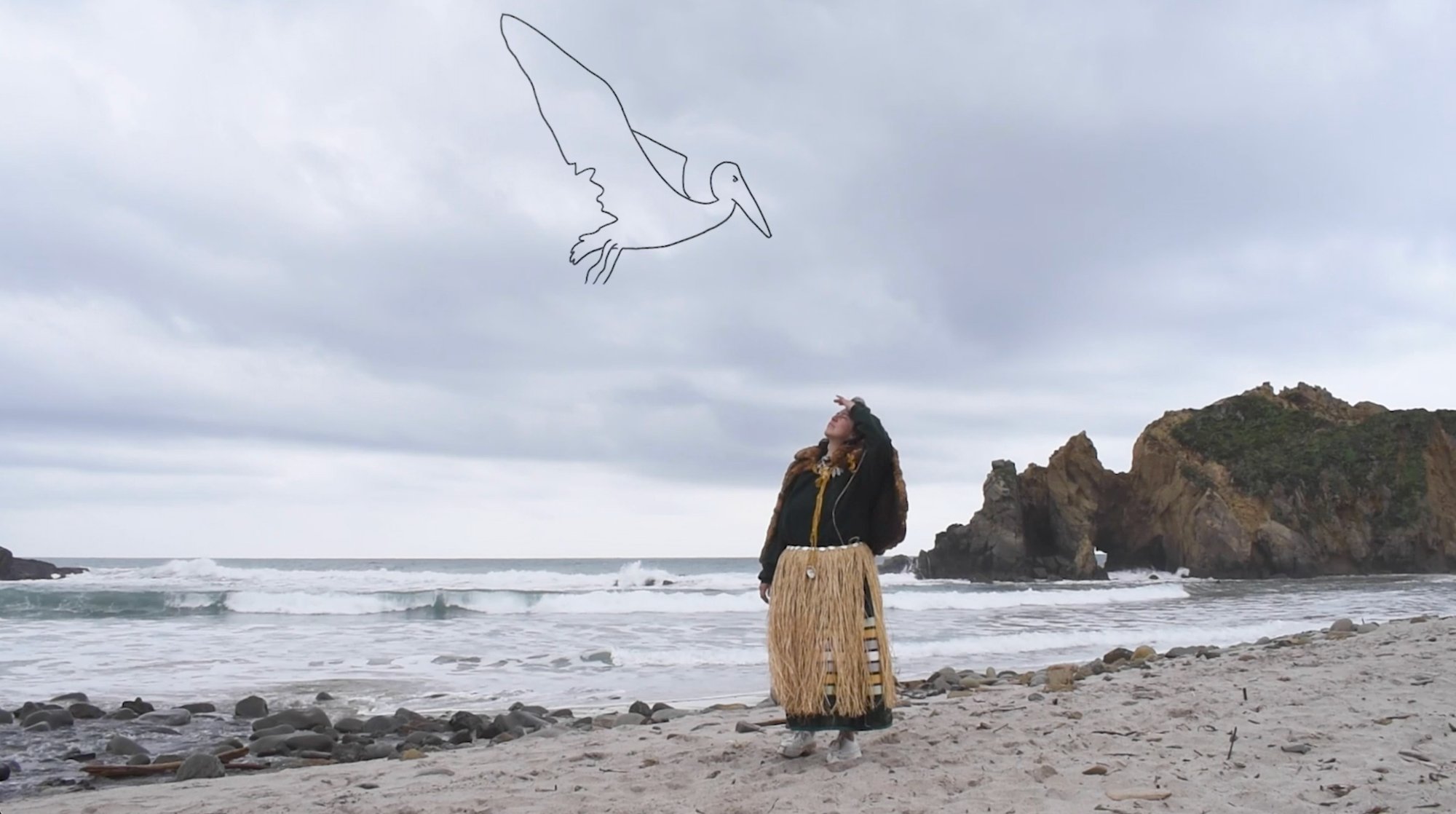
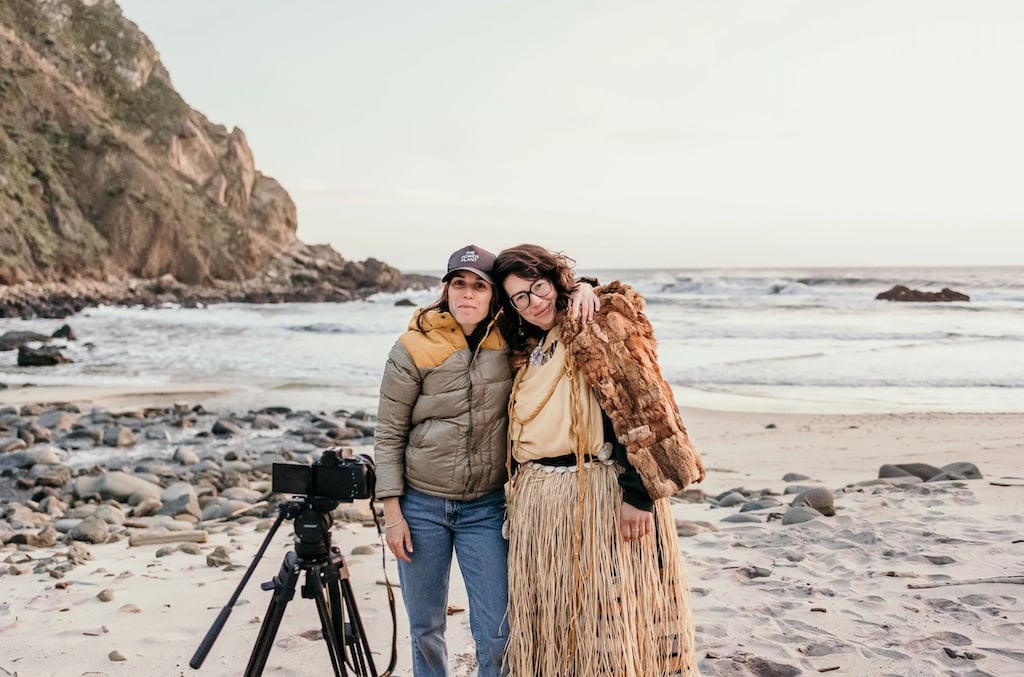
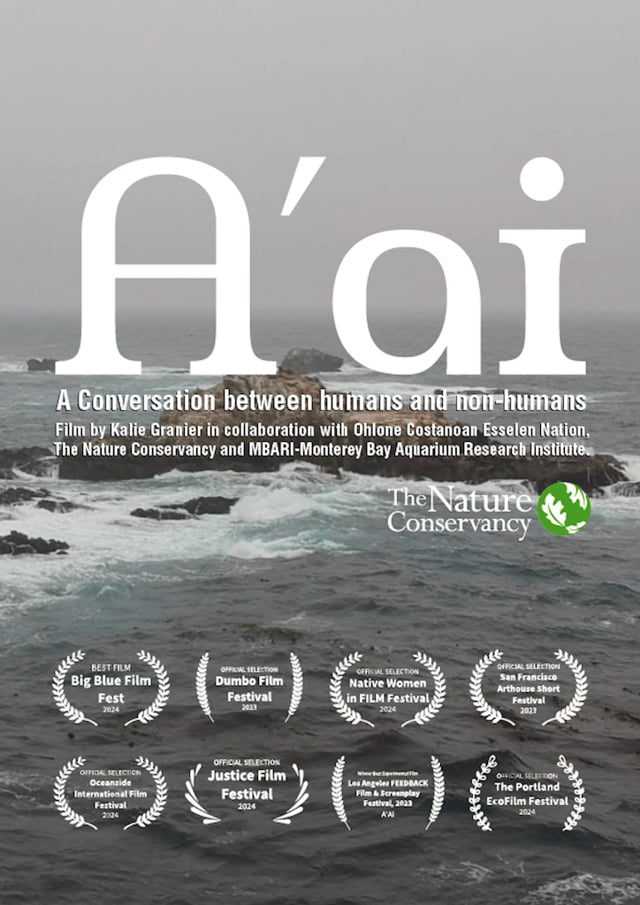
Based out of Santa Cruz, California, Kalie Granier’s practice considers the relation of art to ecology and cultural memory. As part of her work, she has developed a long-standing collaboration with Louise J. Miranda Ramirez, tribal Chairwoman for Ohlone Costanoan Esselen Nation, and her granddaughter Alexandria Casares. In 2023, they produced an experimental film A’ai, presented entirely in the Esselen language. Today, Granier and Ramirez continue to collaborate, while years of dialogue between the artist and groundbreaking professor of art and electronic media, Edward A. Shanken, led to a special screening of the film in his Environmental Art Studio course at UC, Santa Cruz.
Granier’s focus on weaving connections between human and non-human worlds, as well as ancestral and contemporary narratives, aligns closely with the magazine’s own focus on the entanglement of natural and digital ecologies. In order to extend the discussion to the language of Indigenous technologies, the artist agreed to host Ramirez and Shanken in a discussion about the radical potential of entangling contemporary art, activism, and scholarship.
The guiding thread of their conversation was collaborative interdisciplinarity, which Granier regards as both a way of working and an essential space for exchange in order to think and act within a world shaped by systemic crisis.
For the artist, this joining of different skills, knowledges, and world views allows individuals to engage deeply with complex questions while approaching them from multiple perspectives. It also opens a dialogue between fields that are often siloed, making visible forms of interdependence that are more crucial than ever in the face of collapsing ecosystems.
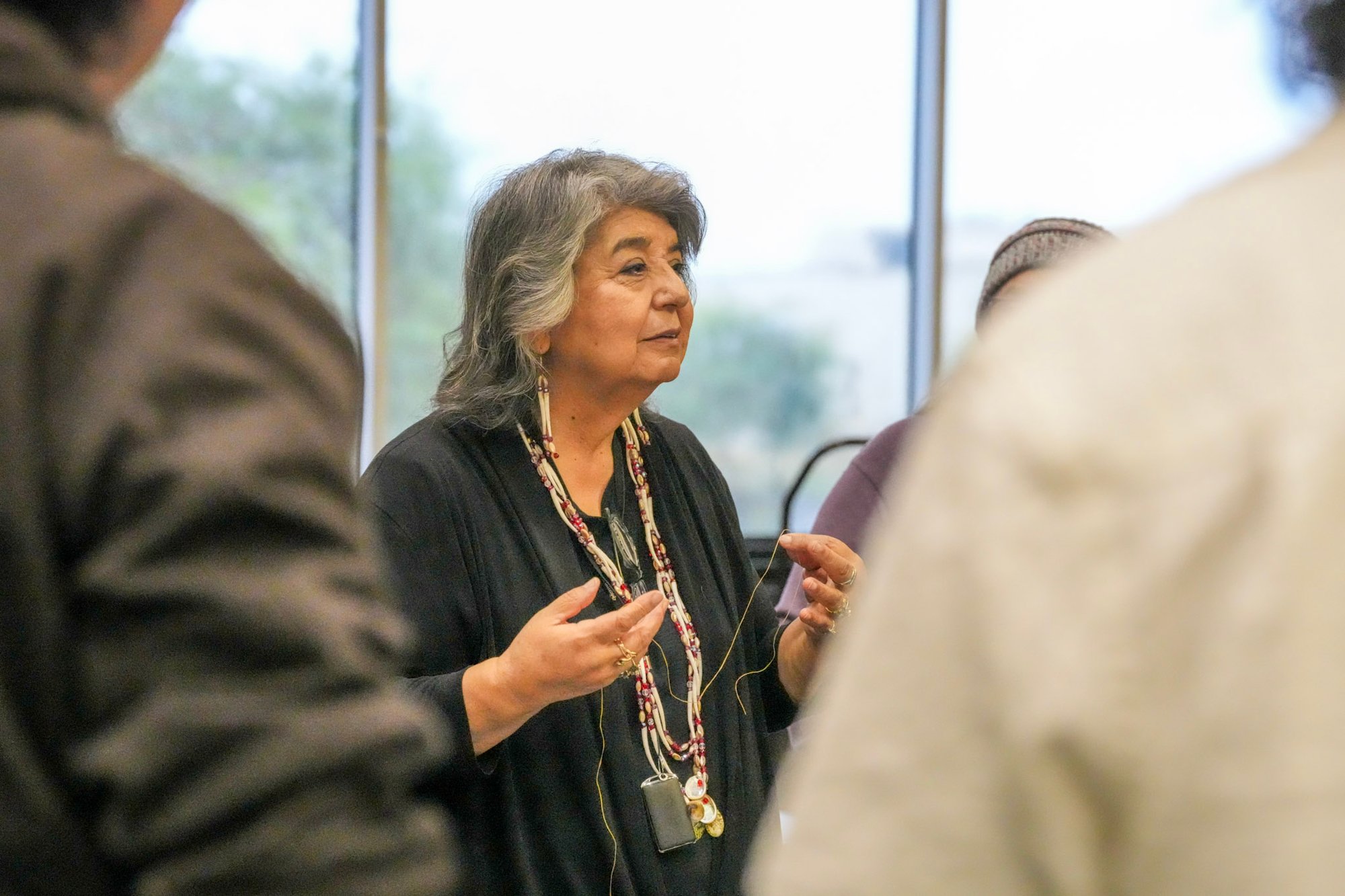
Louise J. Miranda Ramirez: I’ve been the tribal Chairwoman for Ohlone Costanoan Esselen Nation since 2006. [Together] we are about 600 tribal members, constantly growing and changing, [but] it’s difficult because there are federally recognized tribes in the area who currently make so much money through gaming — we don’t have funding. Sometimes you meet people who are not there for the money [but] to help us be acknowledged in the community, to bring our existence back. Kalie has always been there, working with us.
Edward A. Shanken: For many years, my research focused on the intersections of art and technology, and I construed technology through a lens of post-industrial culture — the technology of science that emerged during the period of modernism in Europe. After writing about that for many years, I had the opportunity to experience very powerful ancient technologies developed by Indigenous people in ceremonies involving plant medicine and the rituals that have grown up with and through the medicine.
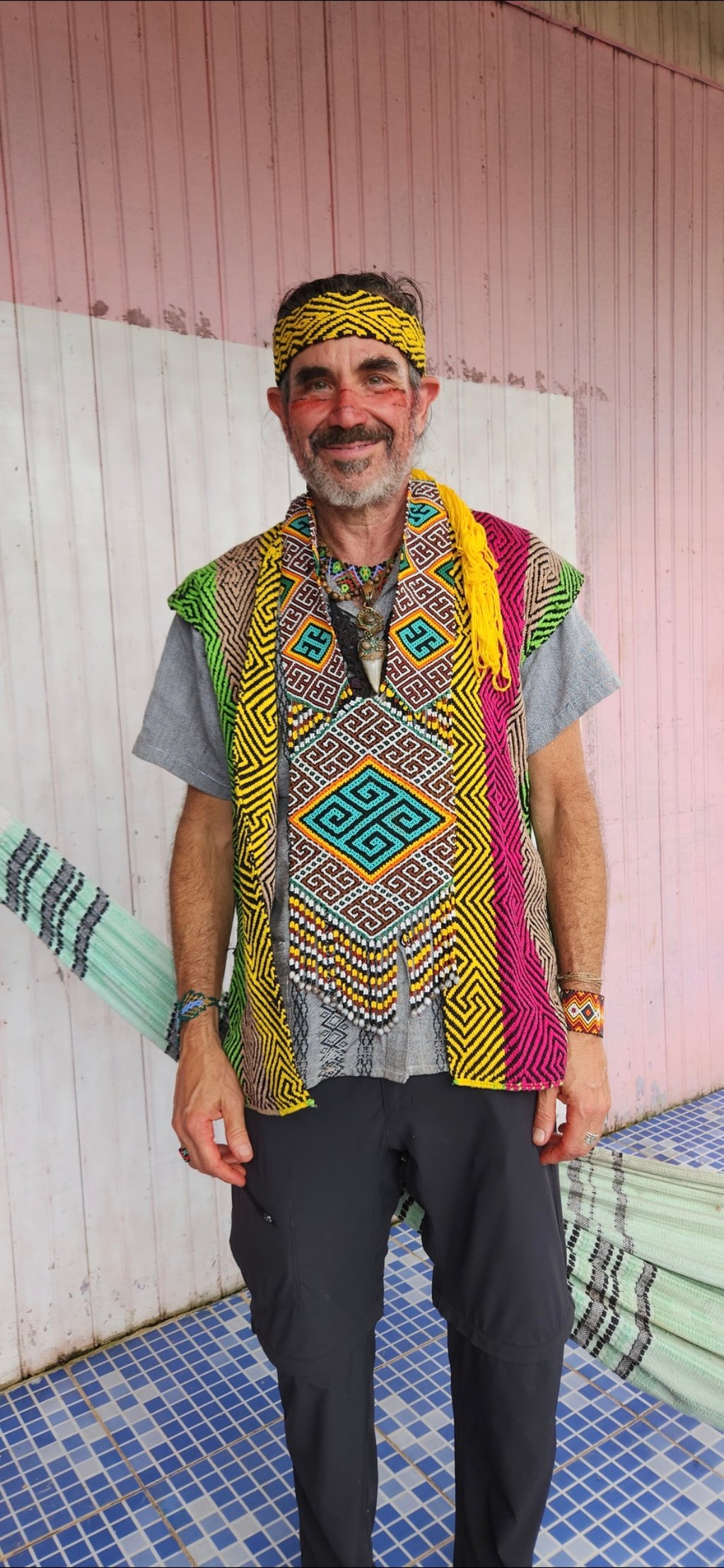
My first ayahuasca ceremony in 2019 led to the realization that my conception of technology was too limited. I recognized that the pharmacology of the tea and the rituals in the ceremony — the ikaros (“prayers”) chanted by the shaman (or taita here in Colombia), are very powerful and sophisticated forms of technology. This led me to reconsider and expand my understanding of technology, and what I needed to do in my practice as a scholar and educator.
In one of my ayahuasca ceremonies, I received a vision that became the foundation of my course in which Kalie has been a guest speaker, and in which A’ai, her collaboration with Louise, Alexandria, and the Esselen Nation, was screened. Paralleling my vision, our course text, Thich Nhat Hanh’s beautiful book, Love Letter to the Earth (2012), espouses the principle that we must open our hearts to ourselves; open our hearts to others; and open our hearts to the Earth. From that place of open-heartedness we can potentially make art that opens others’ hearts to the Earth. This research brought me to Peru and Brazil, and now Colombia. I think of technoshamanism as a proposition:
What possible synergies can emerge when we join the powerful technologies of Indigenous cultures and the powerful technologies of post-industrial culture? And how can we use art as a medium for exploring that question?
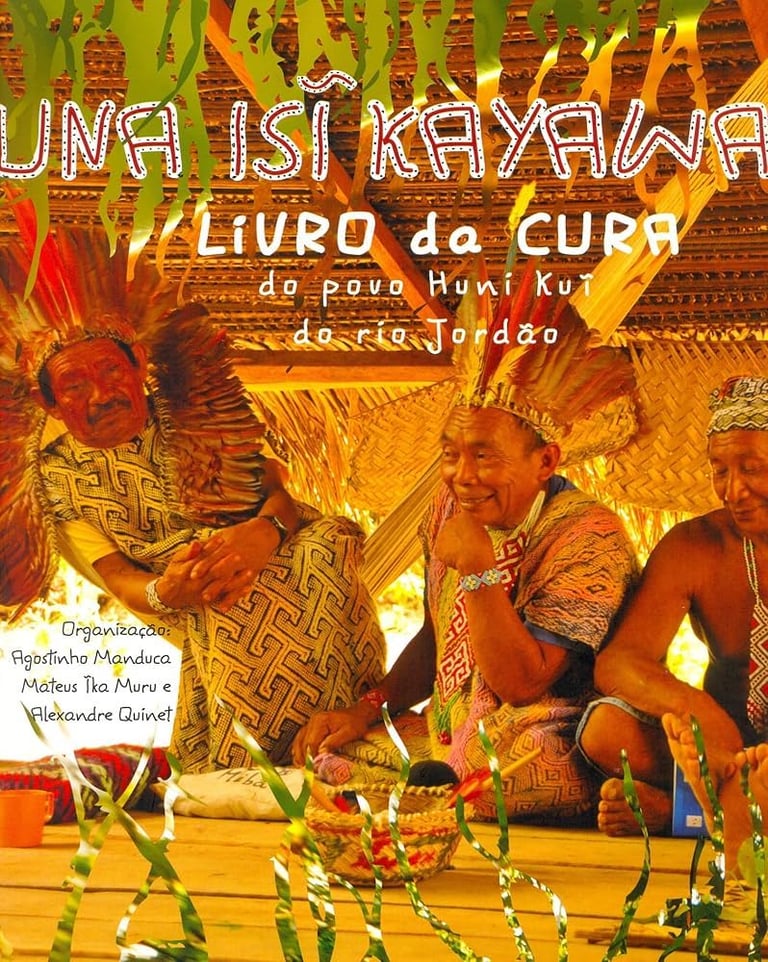
My research on technoshamanism led me to discover a video game created in collaboration with the Huni Kuin tribe in Acre, Brazil. It is their stories in their voice, their spoken words in their language, and their drawings and their photographs that are the story revealed through this video game. I had the opportunity to spend a week with a Huni Kuin community in their village in 2024, which was a life-changing experience. I’m now stewarding the publication of an English language translation of Una Isi Kawaya: The Book of Healing of the Huni Kuin of the Rio Jordão (2014), which can best be described as an artist’s book, again in their words, with their drawings and images, that shares the singular knowledge of plants and healing developed by the Huni Kuin over centuries or millennia.
Last year, I was awarded a grant from The Andy Warhol Foundation to research an exhibition on this theme. The exhibition will open in 2028 at Real Art Ways, a wonderful alternative space in Hartford, Connecticut that is celebrating its 50th anniversary. I’m currently traveling the world to try to discover the best examples of what technoshamanism might be for this exhibition, and to expand my conception by having conversations with artists, scholars, and shamans.
Kalie Granier: Louise, could you explain how interdisciplinarity takes shape through the articulation of political leadership, cultural preservation, education, ecology, and art in order to support your community and transmit traditional knowledge in a living and contemporary way?
LMR: Sometimes I’m two people: the person who is out there politically: arguing, educating, [and] trying to get an understanding of what we need without being the fighter. With my people, I’m a different person because I get to share the language and the stories with them. I get to sit there and be a tribal member — someone who can share all our stories.
When we look at artwork, it shows that we’re still here. I look at artwork from José Cardero in 1791 and people see the Spanish attacking our people, and they say, “Oh.” What I see is that, in 1791, 21 years after [Junipero] Serra was here, my people were still fighting, still existing. They still had their traditional dress. They still had their traditional homes. We still lived among our people.
When I read the stories of Isabel Meadows, talking about how we buried our ancestors within the village and protected them, I realize how strongly I feel about reclaiming our ancestors. If nothing more, making sure that they’re resting and not still in museums or the universities. We need to bring them home.
EAS: Thank you, Louise, for sharing that story, which really resonates with me as someone who lives in that area on the other side of the bay. I know that there are remains on the UCSC campus, and the Indigenous people of the Santa Cruz area, the Amah Mutsun, are also not recognized. I’ve experienced similar things in Colombia, where I am right now, and in Brazil with the Huni Kuin.
I’ve been involved at UCSC with a group called The Center for the Study of the Force Majeure, which was created by the pioneering art-science collaborative team of Helen and Newton Harrison and now led, after their passing, by their son Josh Harrison. One of the projects I was involved with that involved interdisciplinarity was an approach to land and forest fire management.
As you were saying, Louise, Indigenous people know how to take care of the land, and have stewarded these lands for thousands of years. When colonizers came to California, they saw what they thought was wilderness, but in fact, those lands had been carefully tended with knowledge and wisdom cultivated over millennia by Indigenous people who knew they had to set fire to the land carefully in order to avoid the kinds of devastating, catastrophic fires that would threaten their survival. The lower-temperature fires that Indigenous cultures have practiced also create more fertile land. In the Living Forests project, we wanted to join that Indigenous knowledge and wisdom with the latest scientific developments in trying to anticipate fires using statistical data, complex sensor networks, and geo-spatial analytics.
Research by James Utterback and by Lee Fleming demonstrates that the level of innovation and invention that arises from interdisciplinary collaborations is much greater between very disparate groups. But there’s also a much greater chance of zero innovation or failure — it’s a high-risk game. You’ll have many failures, but when you have successes, they tend to be more highly significant.
In my research on technoshamanism, I’m joining art and technology with the technologies of Indigenous cultures and the technologies of post-industrial cultures. I dream of synthesis. What can we learn from each other? Can we create something that’s greater than the sum of its parts?
KG: I’d like to turn to restoration. This notion encompasses multiple realities: the restoration of artwork from the past; the restoration of history through decolonial approaches; the restoration of ecosystems to prevent their collapse. All these forms of restoration involve accepting a certain degree of loss. Restoring does not mean returning to a previous state, but rather accepting that what is repaired will never be exactly the same, and learning to live differently with what has been transformed.
Louise, I would love for you to share how over the course of your life you have restored, or rather revitalized, the Esselen language, how this lifelong work has been guided by your ancestors, notably through dreams, and how the question of transmission and survival beyond yourself is posed today.
LMR: I heard about a program at the University of Berkeley called Breath of Life for speakers of a California Indigenous language that didn’t have any more speakers — the reclaiming of the language. It took a week to go up to Berkeley, stay there, and go through the archives [and] read Harrington’s notes. In 1602 when Lapérouse came in, he wrote a bunch of language. Then, in 1791, the Malaspina expedition wrote a bunch of language. I was gathering everything I could on the language that existed.
At the conference, we studied with David Leedom Shaul, who was supposed to be the expert in Esselen language. I had already formed a dictionary for myself before going up to the conference, so I was aware of some of the words and thinking [around] pronunciation. I was lucky because I was the only one who wanted to know Esselen, which was the oldest language that existed — part of the Hokan family. Anthropologists and archaeologists believe that it has been here for more than 13,000 years, and that our language didn’t start changing until other people started coming into California around 2,500 years ago.
I was asked, “How come it was so easy for you to learn the language?” Because on the first day, we were supposed to explain only two words. I was able to write two sentences with David. We were [then] able to work on translating prayers and actually forming our language again.
One of the other linguists asked David, “Did you ever think that you would be teaching Esselen to an Esselen person?” And he said no, that he still believed [Alfred] Kroeber’s note that the Esselen were extinct and that [the language] was gone. They asked me: “How did you pick this up, Louise?” And I said, “I believe that my great-grandmother, who was identified by CE Kelsey in 1906 as the Monterey Band of Monterey County at the Sur Rancheria, lived with us in Salinas, and we all know she spoke what was said [to be] ‘Indian’.”
I looked at them and I said, “It lives in me. I didn’t know what it was, but it was there.”
I had realized in advance of meeting David that our language was written by people from other countries: Germans, Spanish and, probably, French. After the first class session, he went through every word I had written in my dictionary. He had never seen it, and he said, “Prove to me these words.” He would say, “We don’t have a word for ‘food’.” And I said, “Oh, yeah, we do. It’s hamakshu.” And he would say, “Prove it.” And I would go to the explorers’ notes and prove it to him. He would say, “We don’t have a word for ‘beautiful’.” I would say, “Yeah, we do — loliki.”
In going through these classes with other natives, I’d ask, “What do you know about ‘thank you’?” [Because] we didn’t have a “thank you” in our language. When I asked all these other tribes, they would always say that “thank you” relates to the heart [and] feeling good. We knew that our word nish is “my” and could also be ni. Masianex is “heart”; elpa is “feels”; and “good” is saleki. So put it together: nimasianexelpasaleki. I’m telling a native person, “My heart feels good.” I’m telling other people, “thank you.” The language has evolved. We’re not just creating words out of nowhere — we’re extending what we have.
KG: How do you view new technologies as chairwoman?
LMR: I think that we’ve come to an era [when] we have no choice but to [make a] record. We’re in a fight for our existence [and] we have to let people know that we are here. If we choose not to put it online [and] to not to write it down, it goes away again, and we can’t let it go away.
Our young people use technology [but] I get scared, using the computer, that I’m going to ruin it and destroy everything, so I still have a lot of paper copies around. But we must be able to use the technology that exists because we don’t want to lose it again.
Everything we do seems to be a fight, whether it’s talking to the government or politicians [and] it’s not over. [Everything] needs to be remembered [because] if it’s only in our minds, it’s going to be forgotten; so it’s important to work with artists [and] with researchers. I know a lot of elders may not agree, but we have to be prepared for the future.
When we were working on our land grant and the Big Sur Land Trust wanted people to come in and learn about the land, my response was [that] they must be young. It’s important for us that young people know how to maintain this land, to know our stories. We already know what we know. It’s not going to change us. Let our young people carry on because they have to be here. They still have a future.
Let Ka Lai / We Are Here is a celebration of the presence and continuity of the Esselen people, affirming song, dance, and communal existence across generations. To Louise J. Miranda Ramirez it is “almost a protest song”.
Kalie Granier is an artist and filmmaker working at the intersection of ecology, Indigenous knowledge, and contemporary art. Her multidisciplinary practice spans video, installation, upcycled natural materials, and earth-based pigments. Collaborating closely with scientists, environmentalists, and Indigenous communities, her work blends different temporalities while weaving connections between spiritual and earthly realms, human and non-human worlds, and ancestral and contemporary narratives. Granier holds an MA from ESAG Penninghen School of Visual Art in Paris. Her work has been exhibited internationally and she frequently delivers lectures at institutions, including The University of California, Santa Cruz, The University of San Diego, and Santa Clara University.
Louise J. Miranda Ramirez is Tribal Chairwoman of the Ohlone Costanoan Esselen Nation (OCEN) and a language revitalization specialist. OCEN is a historically documented, previously recognized tribe. OCEN is the legal tribal government representative for over six hundred enrolled members of Esselen, Carmeleno, Monterey Band, Rumsen, Chalon, Soledad Mission, San Carlos Mission, and/or Costanoan Mission Indian descent of Monterey County. All OÇEN Tribal Members are the Indigenous people of Greater Monterey County, California, with proof of ancestry documented in original recordings found in Carmel Mission and Soledad Mission. Louise is Esselen, Chumash and Yaqui. She is the Great-Granddaughter of Thomas Santos Miranda and Inez Agnez Garcia Miranda, each Esselen and recorded as the Monterey Band of Monterey at the Sur Rancheria in 1906, by Special Indian Agent, C.E. Kelsey, identifying California’s Landless Indians. As Chairperson her greatest responsibility is the cultural protection of OCEN Ancestors.
Edward A. Shanken writes and teaches about the entwinement of art, science, and technology with a focus on interdisciplinary practices involving new media. He is Professor at UC Santa Cruz, where he has served as Director of the Digital Arts and New Media (DANM) MFA program. Recent publications include essays on art and shamanism, sound art and ecology, art historiography, and bridging the gap between new media and contemporary art. Further publications include his critically praised survey, Art and Electronic Media (Phaidon Press, 2009), while his book, Inventing the Future: Art, Electricity, New Media was published in Spanish in 2013 as Inventar el Futuro, with Portuguese and Chinese translations forthcoming in paper and E-text. He also edited and wrote the introduction to a collection of essays by Roy Ascott, Telematic Embrace: Visionary Theories of Art, Technology and Consciousness (University of California Press, 2003). His most recent book is Systems (Whitechapel/MIT Press, 2015). Dr Shanken earned a PhD and MA in Art History at Duke, an MBA at Yale University, and a BA at Haverford College.
No comments yet. Be the first to share your thoughts.
Mentioned in this article
People: Kalie Granier, Alexandria Casares, David Leedom Shaul, Edward A. Shanken, Louise J. Miranda Ramirez|Works: A’ai, Una Isi Kawaya: The Book of Healing of the Huni Kuin of the Rio Jordão|Organizations: Monterey Bay Aquarium Research Institute, Ohlone Costanoan Esselen Nation, The Nature Conservancy|