The coder and chemist reveals the power of cellular automata to unite sound and image, writes Joana Kawahara Lino
Joana Kawahara Lino
Kazuhiro Tanimoto, “Rain Blooms”, is on view at NEORT++, Tokyo, until May 31, 2026, and available as an edition of 128 unique artworks via Art Blocks Studio.
A cellular automaton is a study in patience. You define a grid; assign each cell a state; write a rule that tells each cell how to update based on its neighbors; then run it and watch the consequences of your decisions unfold across time, often in directions you did not anticipate and could not have predicted even though every step follows inevitably from the last.
The whole enterprise rests on a paradoxical feature of emergent systems: that determinism at a local level can generate unpredictable behavior at a global level. With Rain Blooms (2026) Kazuhiro Tanimoto takes this tension not as metaphor or aesthetic but as the principal subject of his work.
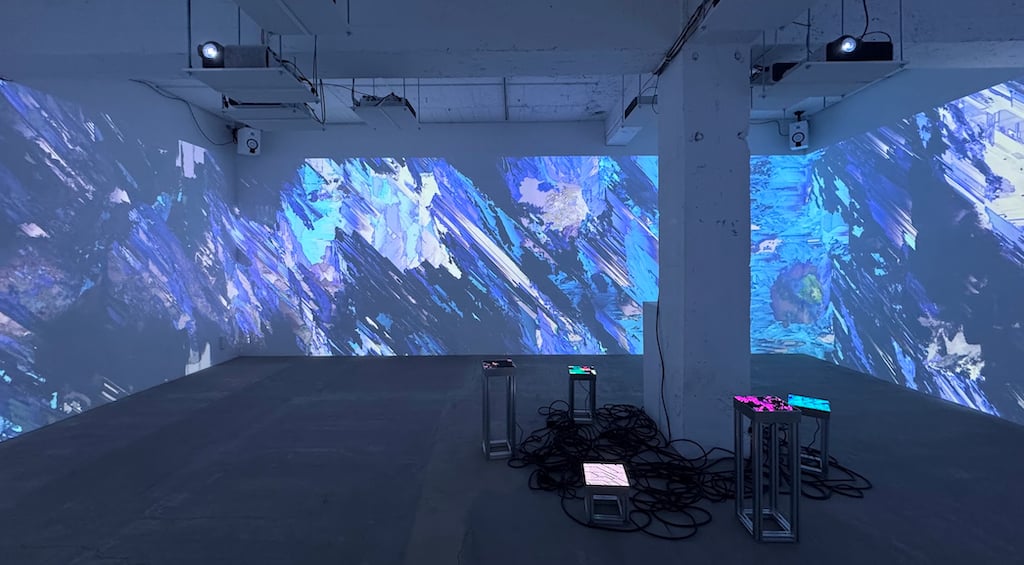
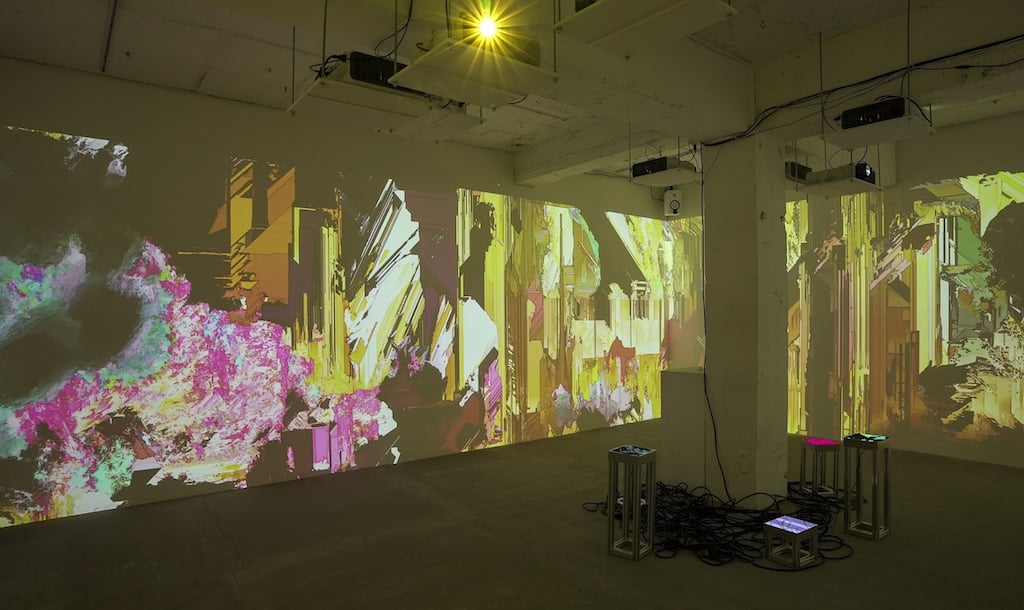
Installation view of Kazuhiro Tanimoto: “Rain Blooms” at NEORT++, Tokyo, 2026. Photography by NEORT
The exhibition centers on a cellular automaton that the artist has built from the ground up over two years. This is important to emphasize because the field of generative art has a tendency to treat computational models as interchangeable skins — something you apply to get a certain look. Tanimoto is not interested in cellular automata as a style. His approach is closer to materials research, which is fitting given that he is a chemist.
Following his inaugural experiment in cellular automata, Mutual Field (2025), he has since expanded the classical automaton in several directions: the neighborhood structure is non-standard, allowing cells to reference positions beyond the immediate adjacent grid; multiple species coexist within the system, each governed by distinct relationships of attack, assimilation, and indifference; and each cell carries a vitality parameter, whose value rises and falls through interaction, lending the system a metabolic character. None of these extensions is purely decorative, and each changes the system’s behavior in structural ways, opening up realms of possibility that a simpler model would not be capable of.
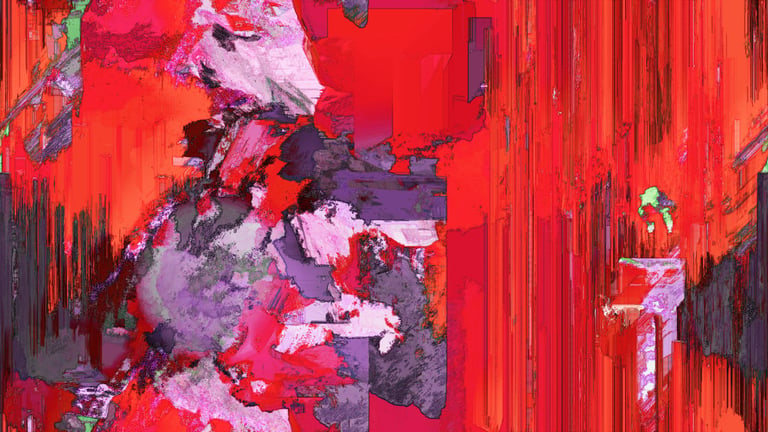
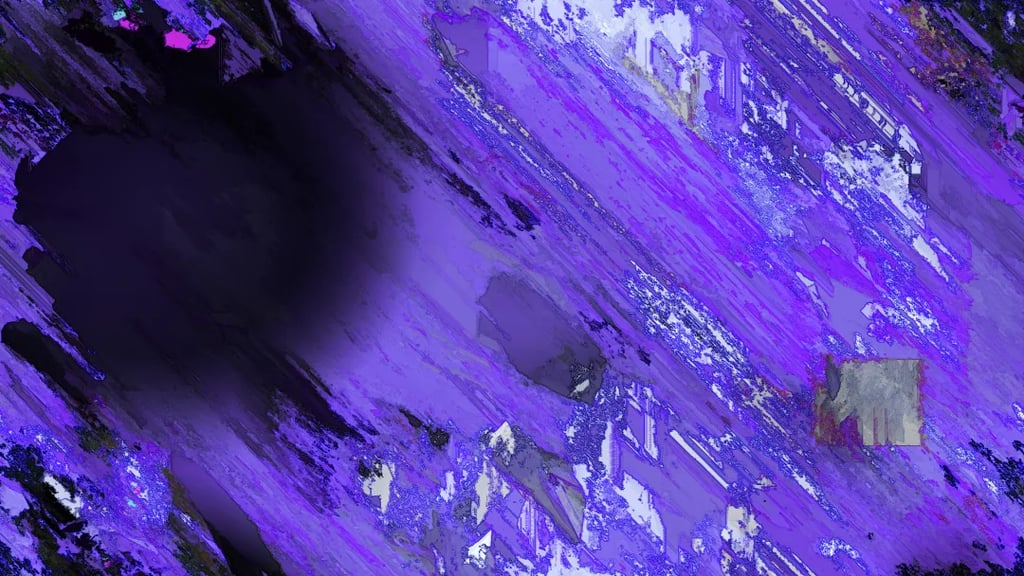
The visual results are striking for their lack of obvious human authorship. Organic, swelling movements appear alongside linear, almost mechanical motions. Complex interference patterns form at the boundaries where these behaviors meet. A mark drawn into the system is immediately absorbed into the logic of the grid — collapsing, proliferating, and then reforming as the local rules take hold. Tanimoto often uses the analogy of paint dripped onto canvas, but he is also giving the canvas its own agency.
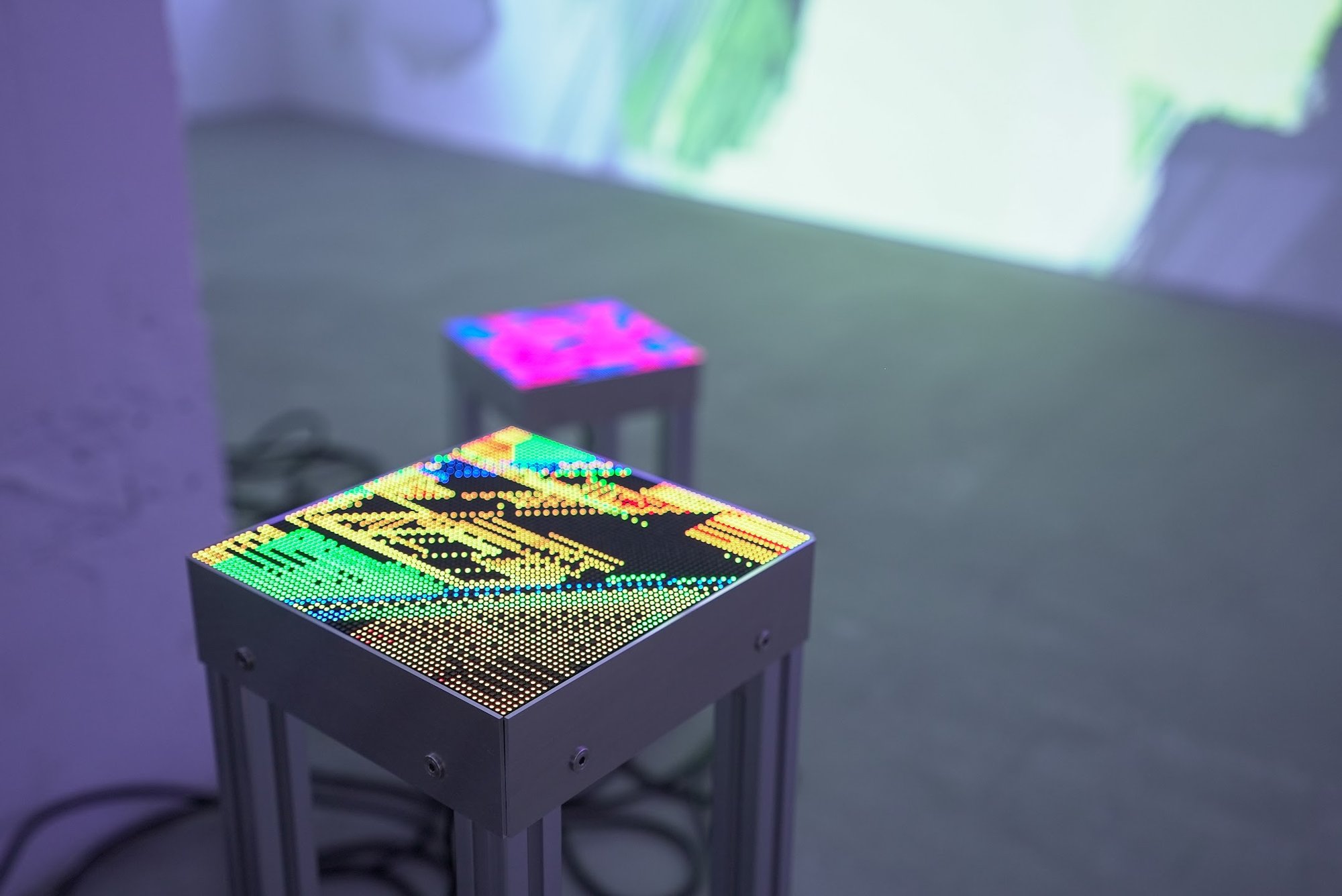
Kazuhiro Tanimoto, Mutual Field, 2025. Photography by NEORT. Courtesy of the artist
It would be easy, and wrong, to position this work as a novelty within the history of generative systems. The lineage is long and distinguished. John Conway’s Game of Life (1970) established the cultural grammar, while Stephen Wolfram’s systematic classification of elementary automata in the 1980s demonstrated that even the simplest rulesets could produce behavior of extraordinary complexity.
Artists working with cellular automata include figures as varied as Casey Reas, whose tissue-like “Process” series explored emergent biological patterning, and Karl Sims, who used computational models to produce forms that appeared alive precisely because they were not authored.
In Japan, the deployment of generative systems in physical installations has its own substantial history. The group, Jikken Kōbō (“Experimental Workshop”), active in the 1950s, brought together visual artists, composers, and engineers to produce works where sound and image were treated as interdependent outputs of shared technical systems rather than separate disciplines. At the other end of the spectrum, the data-driven environments of Ryoji Ikeda translate computational processes into spatial, sensory experiences.
Tanimoto’s work sits between these poles: his derivation of sound from the automaton’s visual state echoes Jikken Kōbō’s integration of media, while his use of LED hardware as a computational substrate shares Ikeda’s commitment to making technology legible.
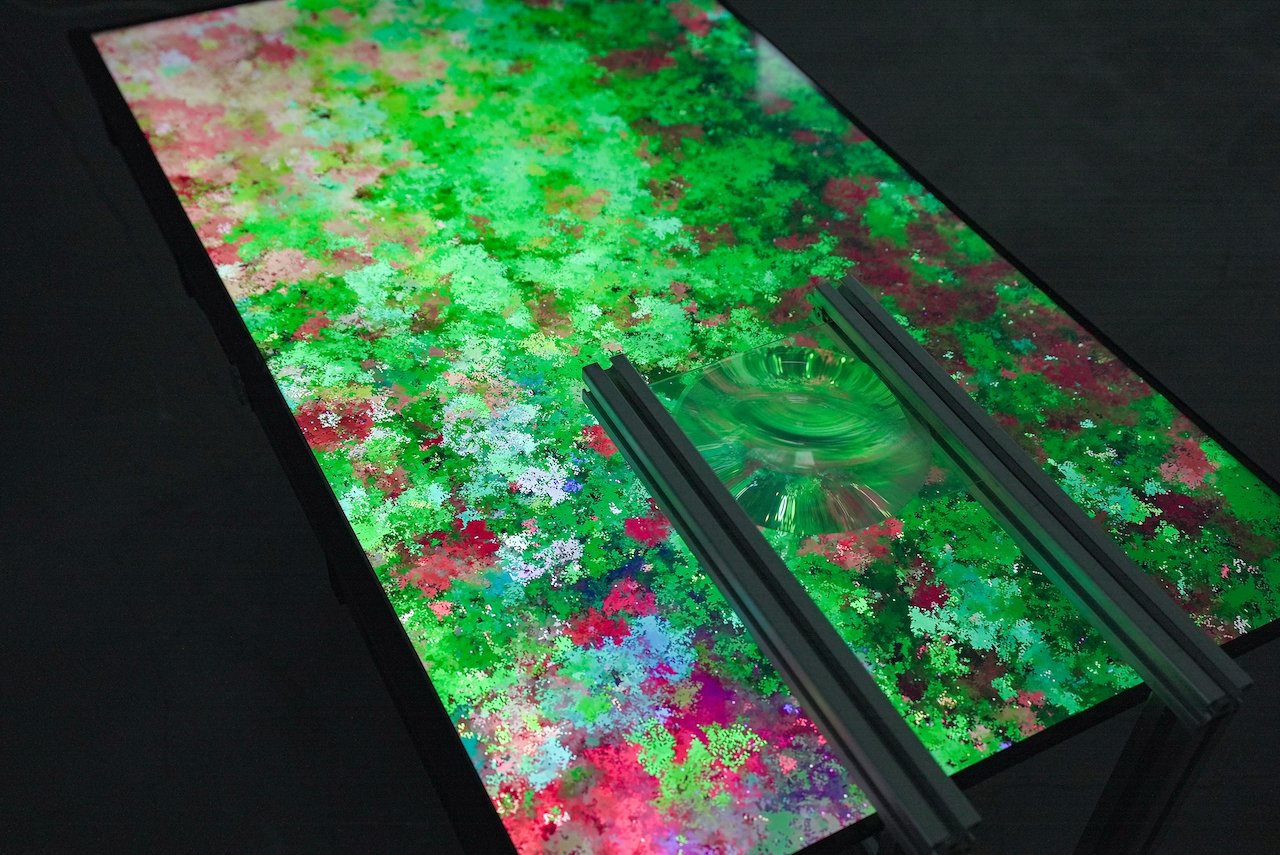
Kazuhiro Tanimoto, Rain Blooms Lattice, 2026. Photography by NEORT. Courtesy of the artist
The artist’s multi-species framework is his principal innovation. By introducing relationships of antagonism and assimilation between cell populations, the artist creates a system that never settles.
Classical automata tend toward equilibrium or repetition. Tanimoto’s system tends toward sustained instability — a state in which the visual field remains in continuous transformation without collapsing into either chaos or stasis.
This is harder to achieve than it might appear, and it is what separates Rain Blooms from the many generative works that produce attractive initial states but are not engaged with duration.
Kazuhiro Tanimoto, (Still from) Rain Blooms #105, 2026. Courtesy of the artist
The artist’s deployment of sound reinforces this framework. Rather than composing a soundtrack or assigning tones to events, Tanimoto derives the audio directly from shifts in hue, brightness, and saturation across the grid, so that both sound and vision share a common source. This approach extends a principle already present in his work Sea of Code (2024), where melodies were generated from data extracted from classical music and Markov chains. This approach is indebted to Hiroshi Kawano’s conviction that the essence of computer art lies in the computer’s autonomous capacity to generate beauty.
In Rain Blooms, the integration is tighter, with sound derived not from an external dataset but from the automaton’s evolving internal state.
The result is not synesthesia in a romantic sense but a precise demonstration that if both image and sound are products of the same computational process, their correspondence is not arbitrary but structural.
In the Tokyo installation, this dual output fills the space, and the effect is less about spectacle than spatial coherence. Everything seen and heard is evidence of the same system, experienced through different channels. Tanimoto’s training as a chemist is also evident in his attention to how substrates behave: how light diffuses across an LED matrix versus how it might be rendered on an LCD panel, and how refresh rates and pixel pitch can serve as compositional parameters rather than technical constraints.
Installation view of Kazuhiro Tanimoto: “Rain Blooms” at NEORT++, Tokyo, 2026. Photography by NEORT
As an edition of 128 outputs, as well as a collaboration between NEORT and Art Blocks, Rain Blooms represents a distinctive audio-visual “long-form” that reinforces generative art as a truly global movement.
Thanks to the artist’s hybrid literacy as both a chemist and a creative coder, Tanimoto highlights the productive tension at the heart of generative art: that a system built entirely from deliberate decisions can produce outcomes that are not predetermined. The emergent blooms are beautiful, but their beauty is a consequence, not a goal. The goal is the system. The system is the work.
Joana Kawahara Lino is a Portuguese-Japanese writer, creative strategist, and founder of LORE Studio. Her work spans curatorial practice, cultural strategy, and critical writing on digital art and Web3 ecosystems. She was Founding Curator of the Seattle NFT Museum and has held roles at Art Blocks and Foundation. She is currently based between Lisbon and Athens.
Kazuhiro Tanimoto, “Rain Blooms”, is on view at NEORT++, Tokyo, until May 31, 2026, and available as an edition of 128 unique artworks via Art Blocks Studio.