Once described as the “Bach of abstract animation”, the artist looks back on a 50-year career that includes working with George Lucas on the original Star Wars, as his 1985 animation Calculated Movements is issued as a new digital edition
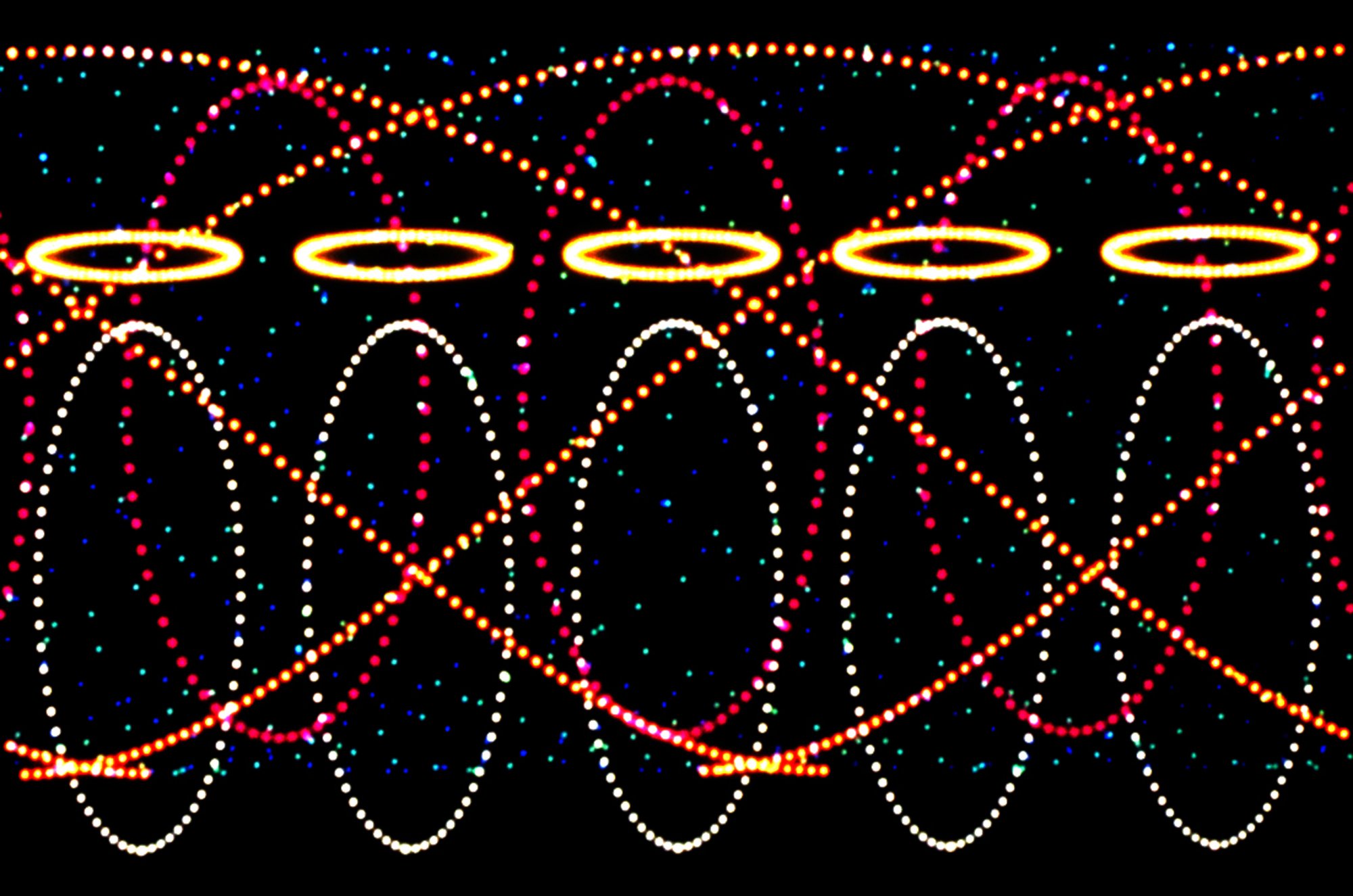
Larry Cuba’s film Calculated Movements, 1985, is being offered for the first time as an NFT, released through ArtMeta on Verse.
Larry Cuba has always understood computer code as an artistic medium in its own right, and the principal material of his art, rather than a tool operated by a technical team on his behalf. Having taught himself to program while a student at California Institute of the Arts (CalArts), Cuba realized his inaugural film, First Fig (1974), during his time at NASA’s Jet Propulsion Laboratory (JPL). One of the founding fathers of computer-based animation, John Whitney Sr, promptly brought him on as programmer for Arabesque (1975), a collaboration that shaped Cuba deeply even though he never fully subscribed to Whitney’s theory of “digital harmony”.
In 1977, Cuba developed the computer graphics for the celebrated briefing room sequence in George Lucas’s original Star Wars Episode IV: A New Hope. That assignment took him to the computing center at the University of Illinois at Chicago, where he worked with Tom DeFanti’s real-time system GRASS to create his film 3/78 (Objects and Transformations) (1978).
Cuba’s economy is noticeable: over more than fifty years, he completed only four animated films, including the aforementioned plus Two Space (1979) and Calculated Movements (1985). All his works were crafted with a different system, and each represents a distinct, often years-long dialog between mathematical structure and choreographed movement.
Once described by the American media theorist Gene Youngblood as the “Bach of abstract animation”, Cuba showed his films at the Museum of Modern Art, New York, the Hirshhorn Museum, Washington, D.C., and the San Francisco Museum of Modern Art, long before “computer art” was an established exhibition category.
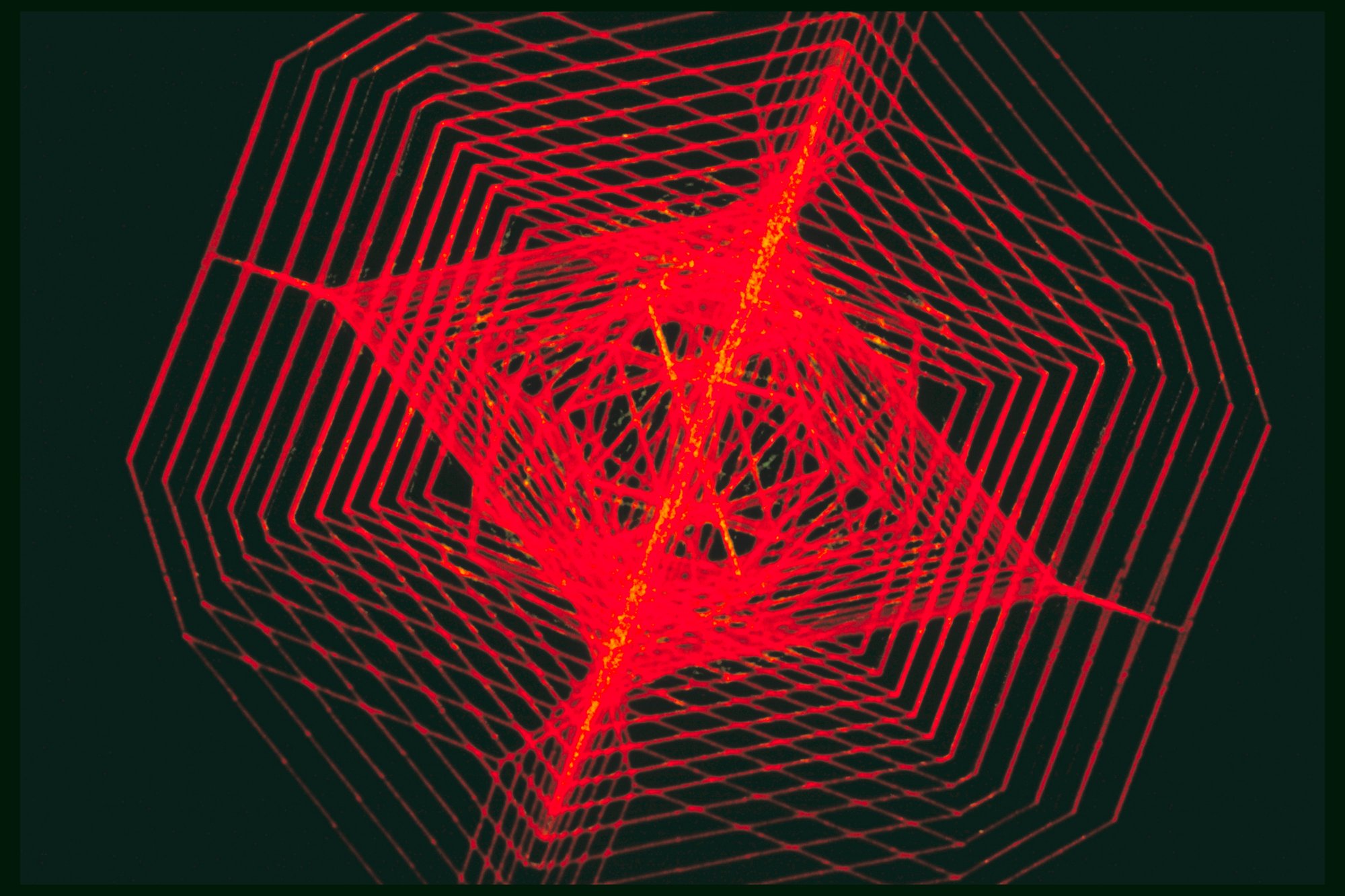
Developed over the course of two years in Cuba’s home studio in Santa Cruz on the ZGRASS raster graphics system, Calculated Movements marked a decisive break in his career for his use of solid forms rather than pure points of light. Four decades on from its original premiere at SFMOMA in 1985, the work is now being offered for the first time as an NFT. On the occasion of this release, Georg Bak spoke with Cuba about his background, musicality, exhibition history, and what it means for such a rare body of work to acquire a new, digital form of ownership.
Larry Cuba, (Still from) Calculated Movements, 1985. Courtesy of Larry Cuba
Georg Bak: How did you first become involved with computers, and what kind of hardware and software did you have access to at the time? What possibilities or limitations did you see in these machines as an artist? Were there other artists, film-makers, musicians, or specific artworks that inspired you as you were developing your own artistic language?
Larry Cuba: While I was a student in architecture at Washington University, I started seeing short, experimental, films and discovered that they were a special art form unto themselves. I was especially taken by Pas de deux (1968) by Norman McLaren and Allures (1961) by Jordan Belson. A little research on these artists led me to Gene Youngblood’s book Expanded Cinema (1970). There, I discovered that an artist named John Whitney was using a computer to make animated films.
At that moment, I had an epiphany. The concept was so compelling — I decided to quit architecture and study film instead. I moved to Los Angeles and enrolled in CalArts.
I tracked down Whitney in Los Angeles and asked if he would take me on as an apprentice. He said he would, but at the time he wasn’t working on a film because he was “between computers”. This was in the pre-personal-computer era, when computers were huge and expensive and only found in large institutions. An artist who wanted to use a computer had to find a benefactor at one of these institutions who would let them in at night to give them access to the computer when no one else was there. Whitney said he would call me when his latest bid to get access came through and he started working on a new film.
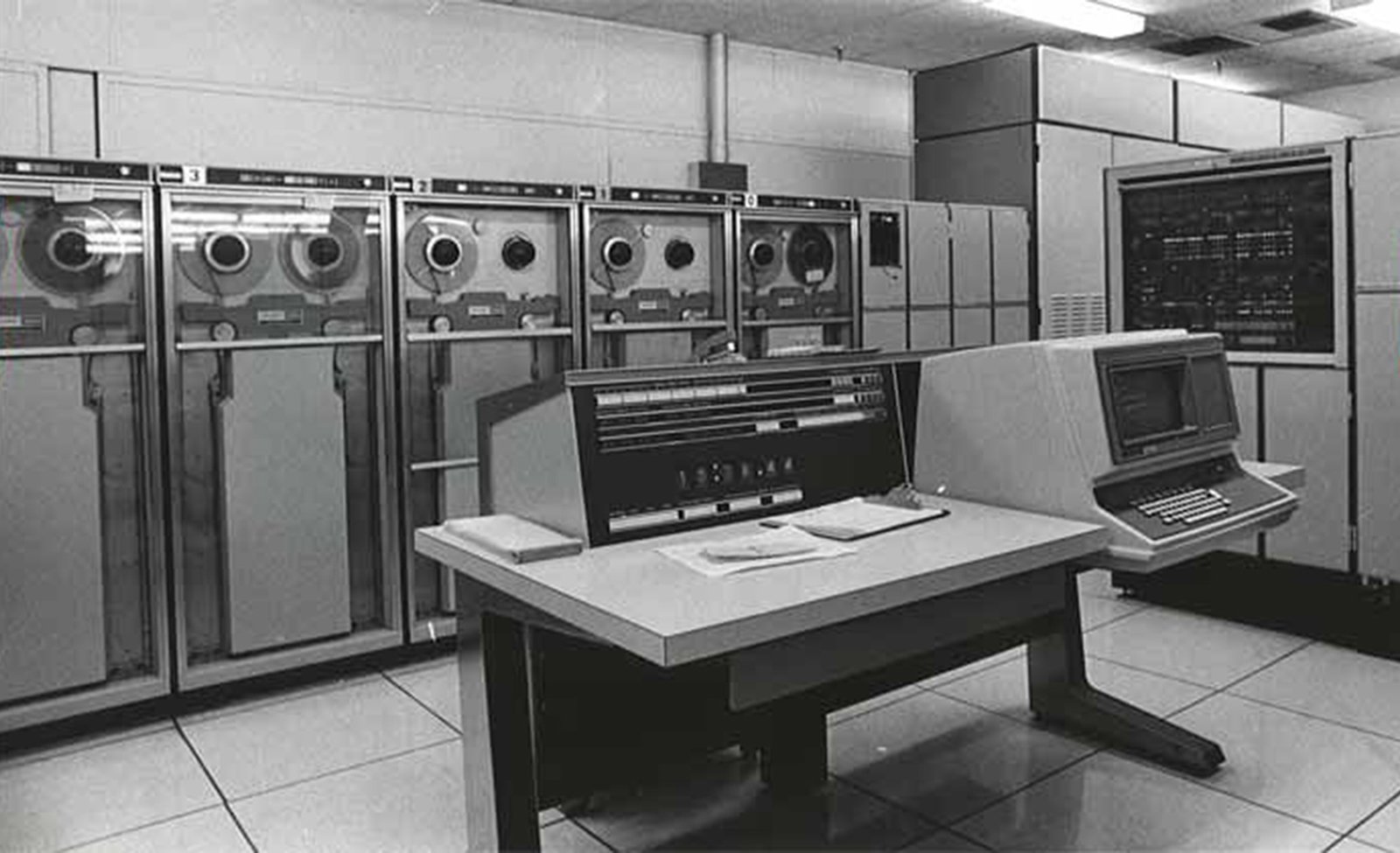
Univac 1080 mainframe computer at Jet Propulsion Lab (JPL), Pasadena, California. Courtesy of Larry Cuba
When I got to CalArts, I found that a professor there, Alison Knowles, had made a connection with NASA’s Jet Propulsion Laboratory to provide computer time to CalArts students. My first computer system was a Univac 1108, a time-sharing system that was accessed via alphanumeric terminals throughout their campus.
Graphics were drawn on a Stromberg-Carlson film plotter. When I initiated a run, my program, [which was] written in Fortran, would fill a file with drawing commands. Eventually, the computer operators at JPL would run my file through the film plotter and produce a strip of 35mm film which I would pick up at the main entrance. Unfortunately, all of the film equipment at CalArts was in the 16mm format. Whitney was kind enough to allow me to look at my material at his house in the Pacific Palisades on his 35mm Moviola, a film-editing machine.
Soon I got tired of driving to and from Pasadena so I rented a Teletype machine and a modem so I could work from my home near CalArts by phoning into the computers at JPL. I had been given an account with computer time credits, and everything was charged to my account.
The computer time was cheapest on the weekend, so that’s when I scheduled my long computer runs. I would program and debug Wednesday through Friday, run the program solid over the weekend, and go out to Pasadena on Monday to pick up my film. On Tuesday, I’d drive out to Pacific Palisades to look at the film and on Wednesday, I’d start the process all over again.
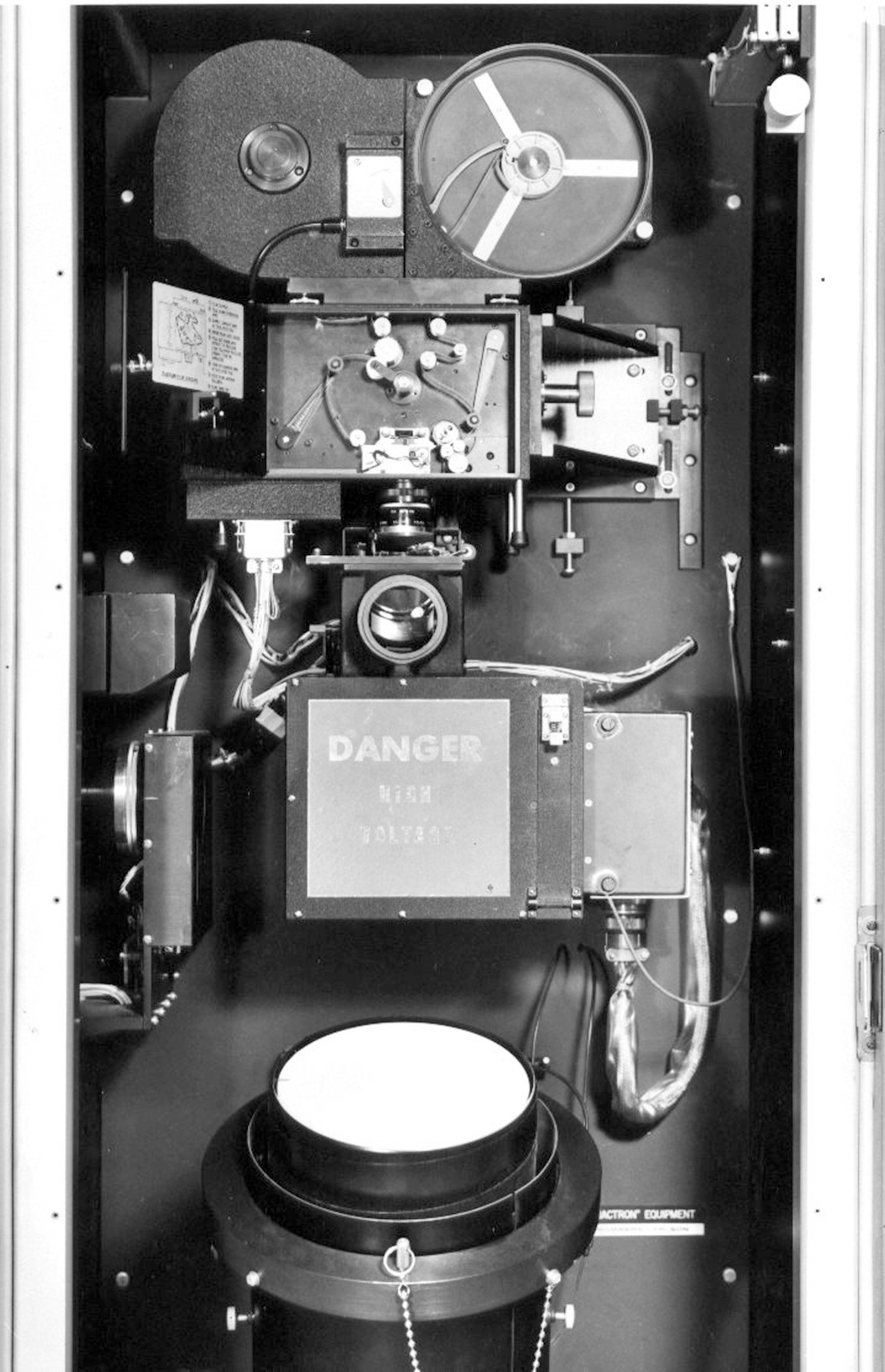
Stromberg-Carlson 4020 “film plotter” at Jet Propulsion Lab (JPL), Pasadena, California. The camera is above, looking down at the circular screen. Courtesy of Larry Cuba
At that pace, I was getting to see the results of my program once a week. That feedback cycle was pretty painful, but I figured if I could just finish one film, I’d have a calling card that might get me access to a more interactive system. After six months of that process, I had a finished film, First Fig (1974).
About inspirations: In addition to McLaren and Belson who started me on this path, I was also influenced by a lot of work I saw at CalArts. Of all of them, the films of Oskar Fischinger stood out as very special. He was the master of abstract animation.
GB: Your work as a programmer on John Whitney’s Arabesque is often treated as a technical footnote in the history of the film. How would you describe the artistic dynamic of that collaboration, and what did working with Whitney teach you about the relationship between programming and artistic authorship?
LC: Just as I was finishing up First Fig, Whitney called to say he was starting on a new film at a company that makes film plotters, Information International, Inc, also known as III (“Triple I”). He wanted me to program it because he had never learned that skill. He always worked by collaborating with a programmer to make his films.
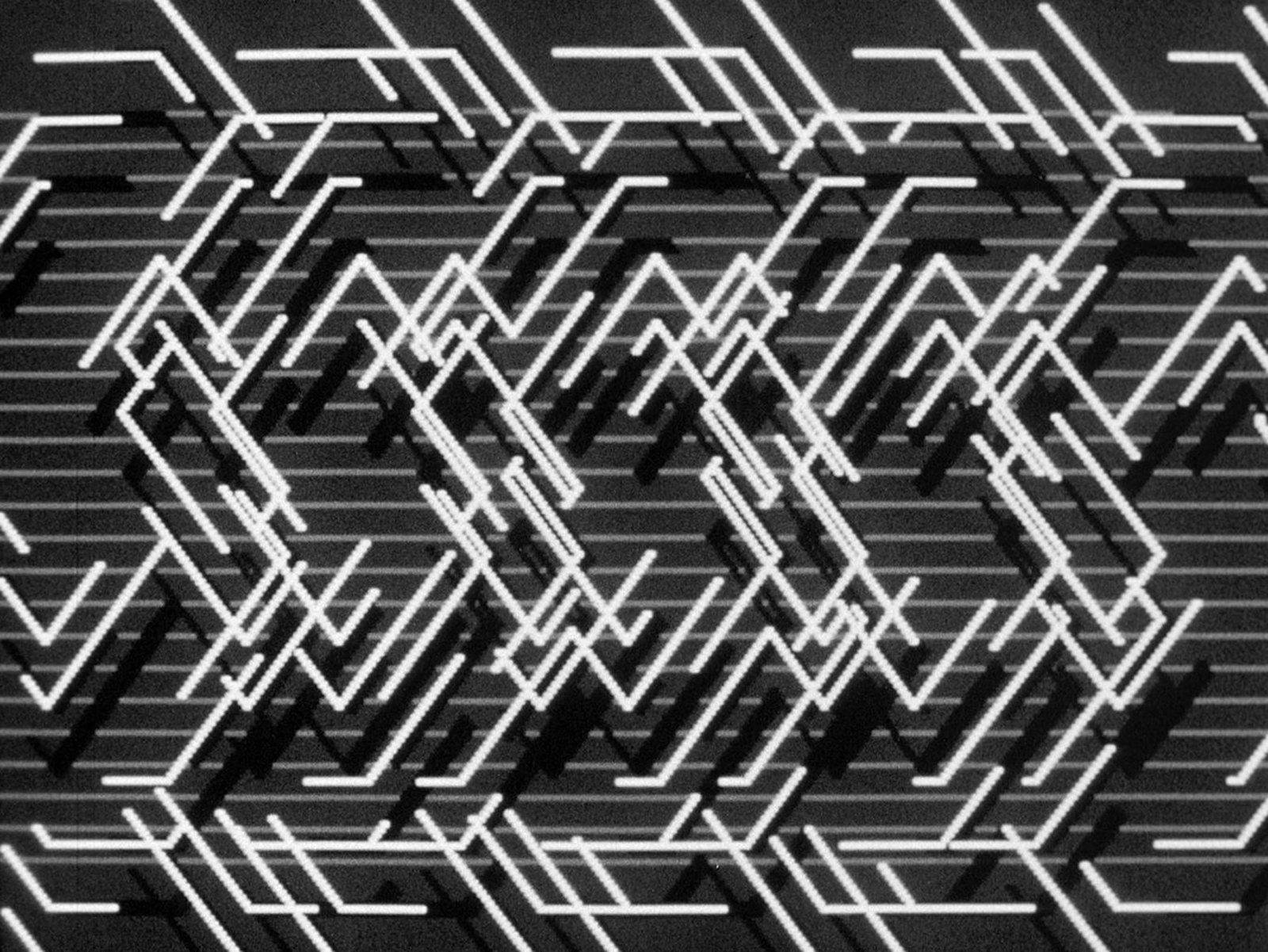
John Whitney, (Still from) Arabesque, 1975. Cuba programmed the film, working with Whitney. Courtesy of Larry Cuba
At III, we had access to the computers directly — no operators. Their film plotter, the FR 80, like the one at JPL, read data from magnetic tapes and drew the images on a small screen under an animation camera and then advanced the film after each frame. In this case, though, we weren’t generating data tapes. We used a simple language that was developed in-house just for reading the tapes and drawing on the screen.
The film plotter also had a graphics screen that was used for previewing the image as you developed your program. Then when you were ready, you could load the camera with film and shoot your sequence. They also had a film processor and a Moviola, so the film could be seen shortly after the shoot.
The film that comes out of the film plotter is in black and white. Whitney took it home to his optical printer and rephotographed it many times through different colored filters onto color film to get the multicolored images that are Arabesque (1975). After we had finished the programming, he spent months printing and editing to get to a finished film. The result is as much an “optical printer film” as it is a “computer film”. John [Whitney Sr] was comfortable creating with the printer. He could express his creativity directly without having to go through a programmer first, to interpret his ideas.
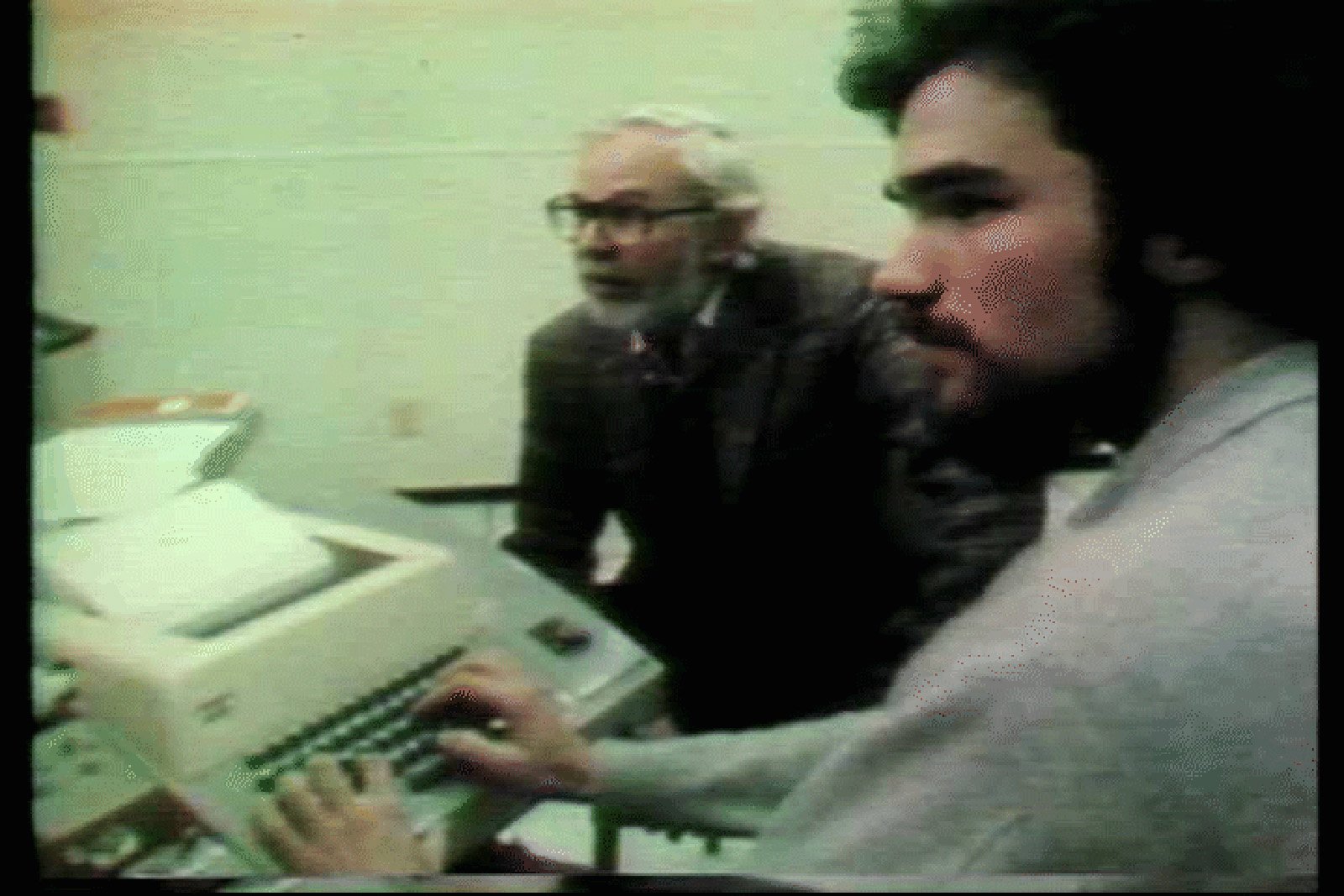
John Whitney Sr (left) and Larry Cuba at work on Arabesque, 1975, at Information International, Inc (III). Courtesy of Larry Cuba
When I made First Fig (1974), I followed John’s lead. I took the raw black-and-white footage to his house where he allowed me to use his printer to add color and reduce the 35mm down to 16mm. I wasn’t that comfortable using the optical printer. I did a minimal amount of colorizing, but the whole process was manual.
Because I wasn’t experimenting with algorithms, I was bored by the process. That’s when I decided to make the rest of my films in black and white, where the images are wholly being produced under program control. In exchange for programming John’s film, I gained access to the computer systems at III for my own work.
GB: Before making Calculated Movements, you programmed an animation sequence for Star Wars in 1977. How did that assignment come about, and how did working within such a large-scale commercial production relate to or differ from the development of your independent artistic practice?
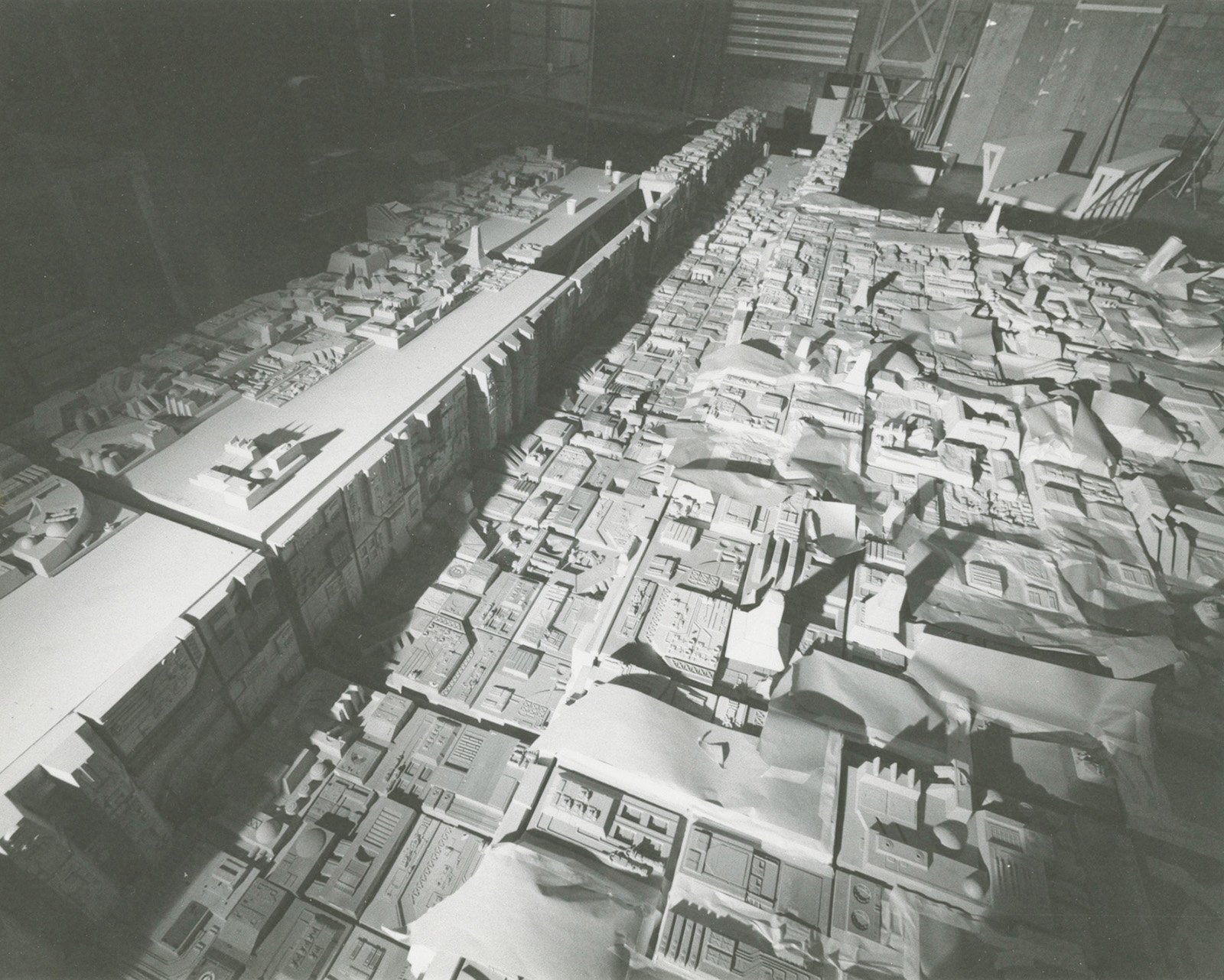
Miniature model of the Death Star trench for George Lucas’s Star Wars: Episode IV — A New Hope, 1977, the first of the Star Wars films. Larry Cuba was commissioned to digitize the trench, to make feasible a scene where rebel fighters and their pursuers could be shown flying down it in a quest to destroy the Death Star. Courtesy of Larry Cuba
LC: For his special effects unit, [George] Lucas was hiring people right out of the film schools around LA. When they were looking for a computer animation person to create this one scene, Rob Blalack of their optical department, recommended they call us (me and a fellow student who had collaborated on First Fig). Blalack was from CalArts and knew about our film. It was the only computer film made at CalArts to date.
They had called several computer animation firms to bid on the job, but I won the bid. It was a large-scale commercial production, but it didn’t feel like that to me. As a subcontractor working in Chicago, I had little contact with Industrial Light & Magic, Lucas’s special effects shop in Van Nuys, California.
The main difference between working on Star Wars and my own work was that for the Star Wars work there was a plan. There were the models of the Death Star that I had to digitize and the animation was to simulate the point of view of the pilots as they flew down the trench to the end. It was storyboarded and there were no surprises.
In my personal work, I never work to a storyboard — the design of the film emerges from the experiments I perform with my algorithms. When I begin, I never know where I’m going to end up.
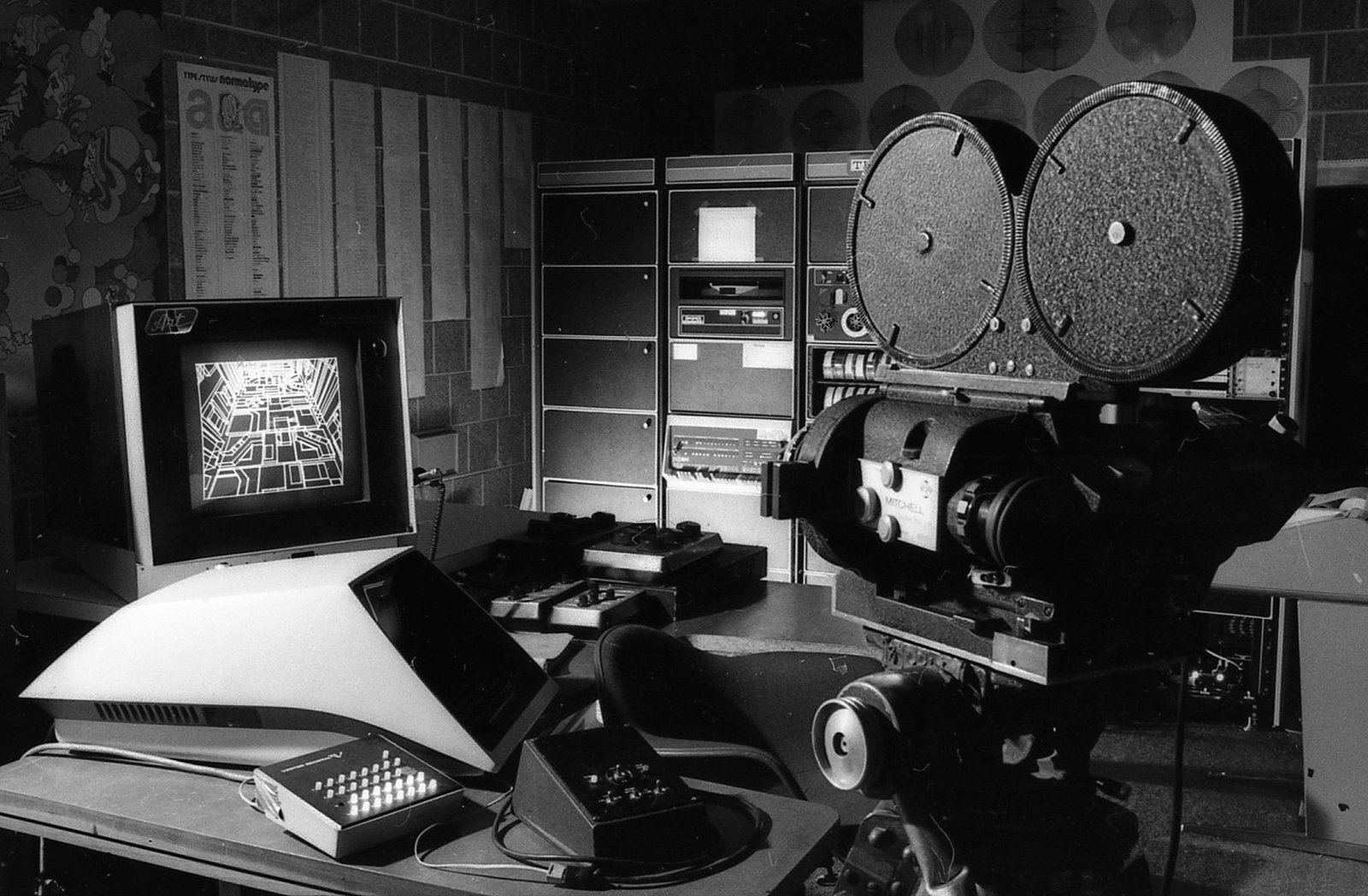
The camera set-up at University of Illinois Chicago Mitchell (UIC Mitchell), where a 35mm camera was used to film Cuba’s graphics for Star Wars, off the screen of the GRASS system in the university lab. Courtesy of Larry Cuba
GB: Star Wars went on to become one of the most watched films in popular culture. Were you aware at the time of the potential visibility of the work you were contributing to? And did that experience have any lasting effect on the way you approached your own work?
LC: I never thought about how big the audience might be for Star Wars. I was just trying to do the best job I could. I was hoping that special effects for movies would possibly support my personal work and this might be a start to that career.
Unfortunately, Star Wars became such a phenomenon that it was all anyone wanted to hear about. My personal work was overshadowed by that intense interest in Star Wars.
GB: Your animations have an unmistakable sense of musicality. What does Gene Youngblood’s analogy between you and Bach mean to you, and how do rhythm and repetition function in Calculated Movements and in your work more broadly?
LC: I was gratified by Gene’s enthusiastic review of my work in our interview. Music has long been used as an analogy to aid the understanding of abstraction in art. When you add the dimension of time to the art, as in film or video, the analogy to music becomes even stronger and more problematic.
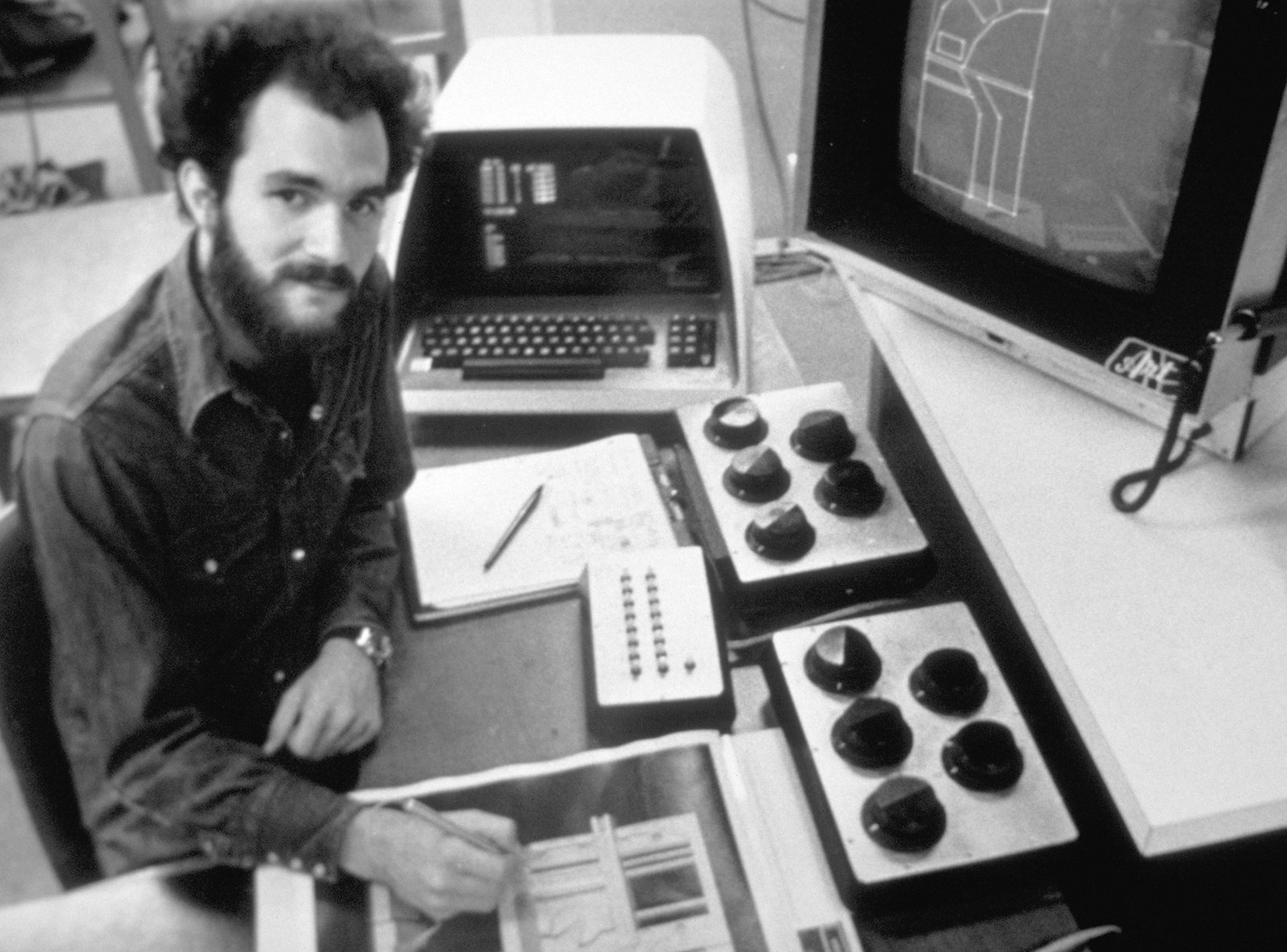
Larry Cuba at the lab at University of Illinois Chicago Mitchell (UIC Mitchell). Courtesy of Larry Cuba
Film is so dominant in its role as a storytelling medium that it’s hard to shift gears and consider it a platform for a different art form entirely: a visual form of music.
Everyone seems to have their own definition of “visual music”. For me, it refers to an art form that, like music, is temporal and abstract (i.e. non-narrative). But this doesn’t include starting with an existing piece of music and visualizing it with the movement of images in perfect sync, note for note.
Music works because it follows certain rules. Visual music is not music. Visuals have rules of their own and the trick is to find out what they are. One way in which my work is similar to Whitney’s is that we both produce a silent film completely before we start to decide what music would complement it best.
GB:Calculated Movements emerged from roughly two years of experimentation, with a vast amount of material eventually distilled into a six-minute film. What did you learn from the experiments that did not make it into the final work? Do you think of that rejected material as failure, research, or as an invisible part of the finished film?
LC: It’s all research. With every shot I would see what worked and what didn’t. I’d have to figure out, based on the results of the current experiment, what to do to make it better for the next experiment. After experimenting for a couple of years and working with the material to make a film out of it, I had the film Calculated Movements, but it was still on video.
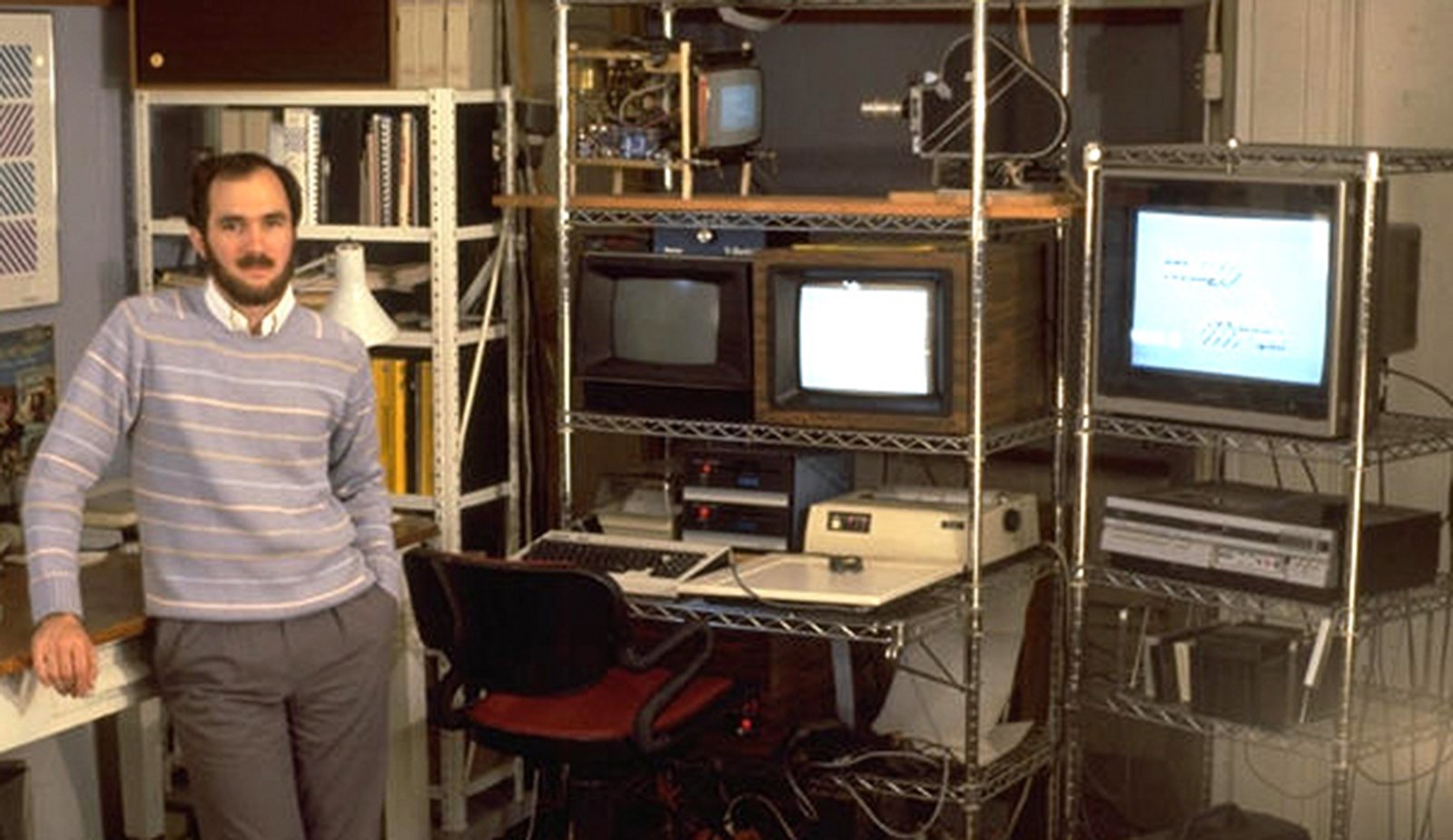
To record the computer images onto film, I constructed a crude, home-made film plotter that consisted of two parts: firstly, a Ciné-Kodak Special with an animation motor on it that could be triggered by the Datamax UV-1; and secondly, a small black-and-white video monitor that displayed the images in front of the camera. For the UV-1 to run through the whole program, to draw the six-minute film, working around the clock, took two weeks.
Cuba in his home studio in Santa Cruz with the ZGRASS system, with “film plotter” above and Lyon-Lamb animation system to the right. Courtesy of Larry Cuba
GB: Do you see a particular leitmotif — a recurring question, idea, or formal concern — that connects the works you’ve produced over the course of your career?
LC: I’ve always started with the smallest unit, a dot or a small cube, then repeat it and transform it according to some mathematical function of space and time. This creates a composite figure which serves as a primitive for additional repetition and transformation. This second level of transformations produces a hierarchical structure where every level is generated and controlled by a mathematical function.
My career has been a constant search for a system, both hardware and software, that would support my work. The hardware had to produce the imagery fast enough to get immediate feedback and the software had to be designed to support my mode of experimentation, which involves changing the program quickly and repeatedly.
Every film has been programmed in a different language. I’ve used Fortran, RAP (REL Animated Picture), GRASS, ZGRASS, and Python. Now I’m designing a language tailor-made for my art, one that facilitates this kind of hierarchical exploration of mathematical structure.
Along the way, I spent several years as a partner in a publishing firm and several years more founding and running The iotaCenter, a nonprofit dedicated to promoting and preserving abstract film, video, and performance. I also lost several years when, after a disk crash, my Python-PyOpenGL software failed to run. I had animated quite a few experiments at the time of the crash which I eventually compiled into my “Animation Notebooks”. They were screened as an installation at ZKM in Karlsruhe and the Punto y Raya abstract film festival.
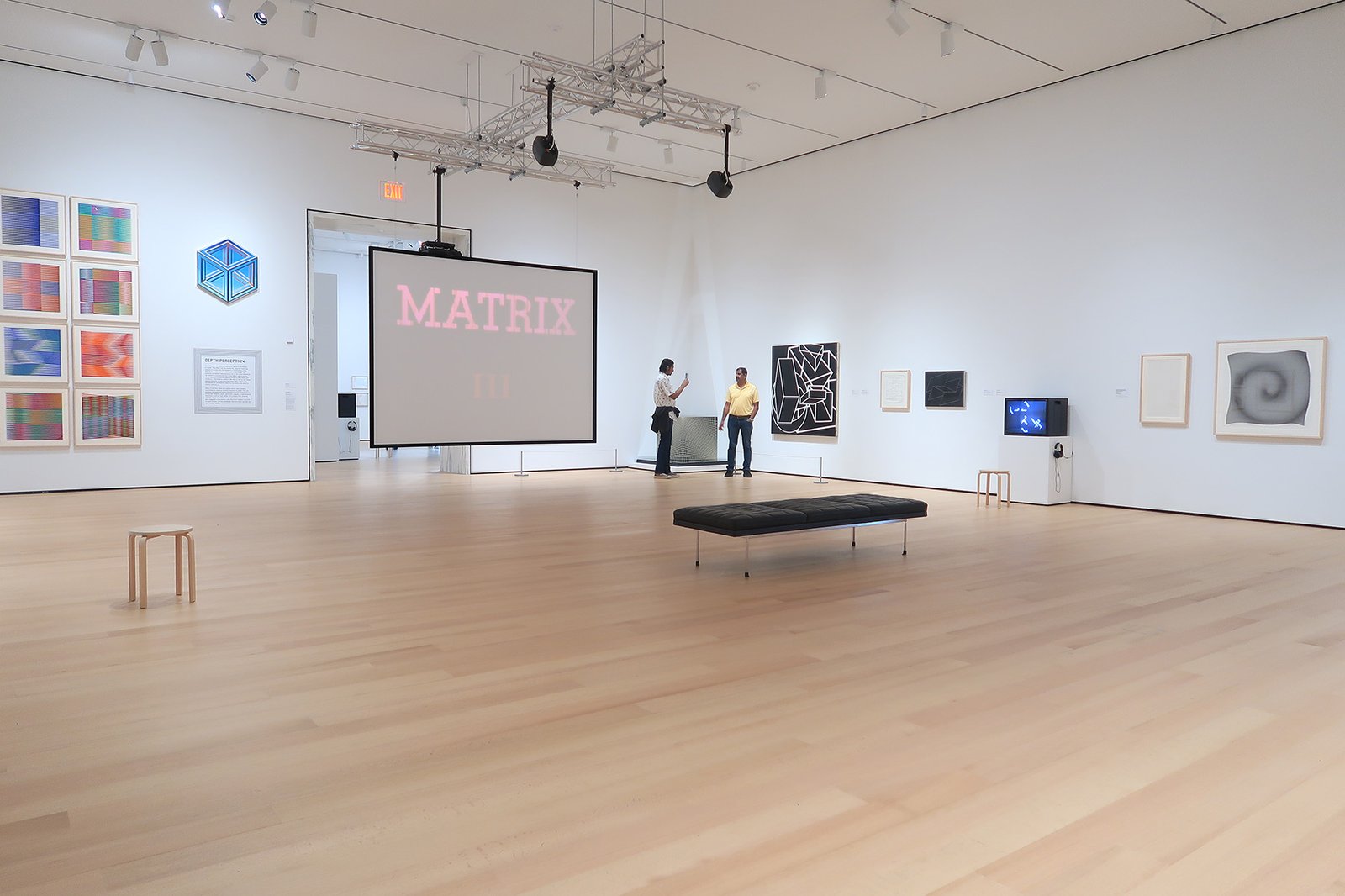
Installation view, “Electric Op” exhibit, AK Buffalo Art Museum, Buffalo, New York, 2024, showing work: Larry Cuba, Calculated Movements, 1985. Courtesy of Larry Cuba
GB: Your films have been exhibited in numerous different contexts. How would you ideally like your work to be experienced today? Does it belong primarily to the cinematic experience of watching a film from beginning to end, or can its meaning change when it is encountered as an artwork in a gallery or museum?
LC: Showing a film in a gallery context has always presented some challenges. A film is usually designed to be experienced linearly from beginning to end, but that is rarely possible in a gallery setting. It isn’t practical to expect someone to appear in front of the monitor at the exact time that the film begins and stand there for six minutes or so. They usually approach in the middle of the film, watch for 20 or 30 seconds and move on to the next artwork in the gallery. In cinema, on the other hand, the viewer knows what time to arrive at the theater to catch the film from the beginning; there is a comfortable chair to sit in for the duration, and there is not a room full of other artworks competing for their attention.
A monitor on a wall in a gallery doesn’t allow for the immersive experience of a theater screen or a dome projection. These films were definitely designed for the theater experience. Computer-animated works designed for the gallery experience would have no beginning and no end and could be experienced at the viewer’s choice of time and duration.
GB: You are currently developing OSKAR, your own programming language named after Oskar Fischinger, with the possibility of creating a fifth work. After such a long period of working with these ideas, what is it that still feels unresolved or worth exploring? And does seeing your earlier work circulate today as NFTs change the way you think about your new work?
LC: Circulation as an NFT does not affect the work as much as needing to fit it into a gallery context. For my next animation, I’m considering instead of, or in addition to, a linear film, making an endlessly looping piece for a gallery setting.
GB: The emergence of generative AI has radically changed the relationship between artists, code, and image-making. Does AI affect the way you think about your own practice, or does it reinforce what you have always considered distinctive about the human role in computational art?
LC: To me, AI is useful for solving well-defined problems. I wouldn’t use it to create new ideas. That’s for humans. After all, it’s the fun part.
Larry Cuba produced his first computer-animated film, First Fig in 1974, and then programmed John Whitney’s film, Arabesque. Subsequently, Cuba produced three more computer-animated films: 3/78 (Objects and Transformations) (1978), Two Space (1979), and Calculated Movements (1985). These works were shown at film festivals around the world and have won numerous awards. Cuba has presented his work at various conferences such as SIGGRAPH, ISEA, Ars Electronica, and Art and Math Moscow, and his films have been included in screenings at New York’s MoMA, The Hirshhorn Museum, SFMOMA, The Art Institute of Chicago, The Amsterdam Filmmuseum, and the Isetan Museum of Art, Tokyo. Cuba received grants for his work from the American Film Institute and The National Endowment for the Arts and was awarded a residency at ZKM Karlsruhe. More recently, his Calculated Movements has been presented at the Lucas Museum of Narrative Art, Los Angeles.
Georg Bak is a Swiss-based digital art advisor and curator who worked in senior positions at Hauser & Wirth and as an art advisor for LGT Bank in Switzerland before running his own digital art gallery Scheublein + Bak. He curated the landmark “Sealed Cryptopunks” sale at Sotheby’s and the exhibition “Ex Machina. A History of Generative Art” at Phillips in London having been the first to exhibit CryptoPunks in an art exhibition in 2018. Bak has served on advisory and curatorial boards for institutions including HeK Basel, MoCDA (Museum of Contemporary Digital Art), CADAF, Rare Art Festival New York, and Le Random. He co-founded NFT ART DAY Zurich and The Digital Art Mile, and is a partner at ArtMeta.