“Contemporary Perception is Hybrid” | Troika - Right Click Save
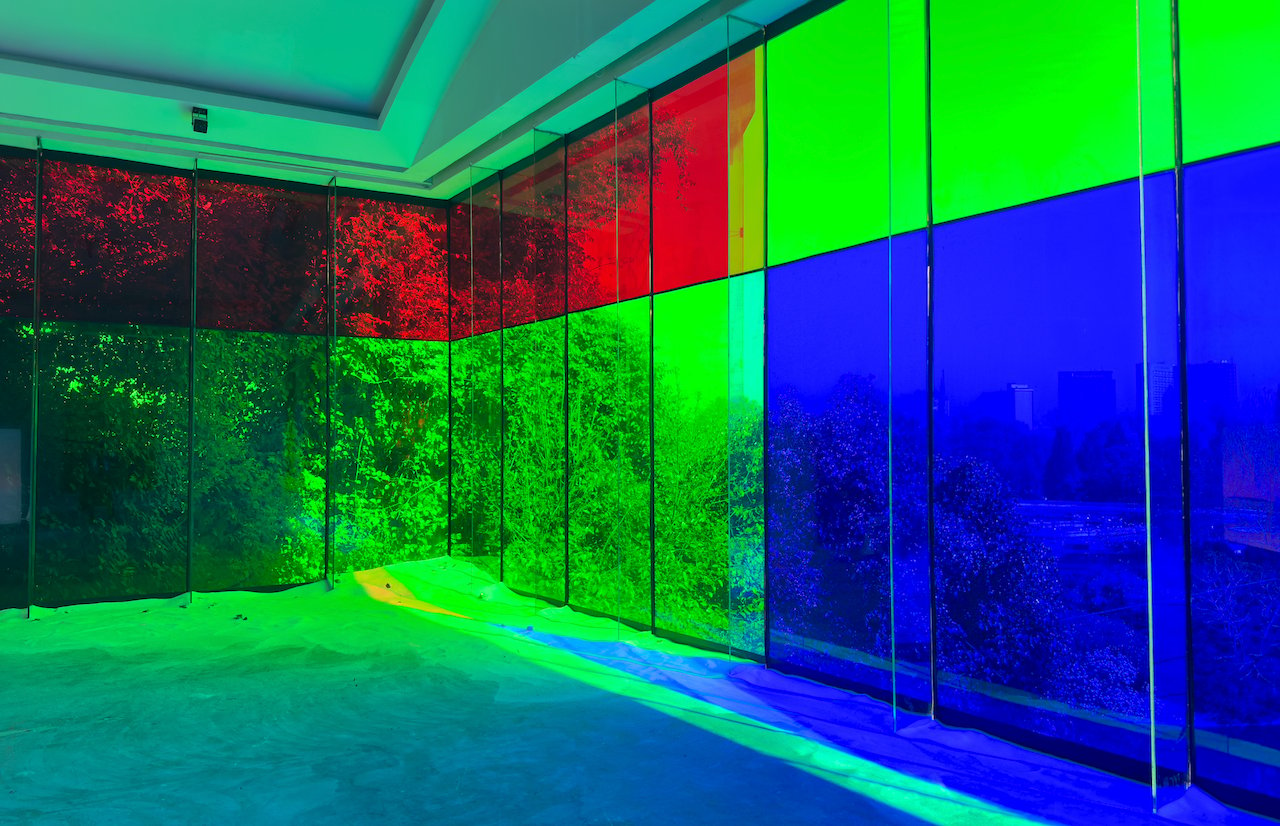
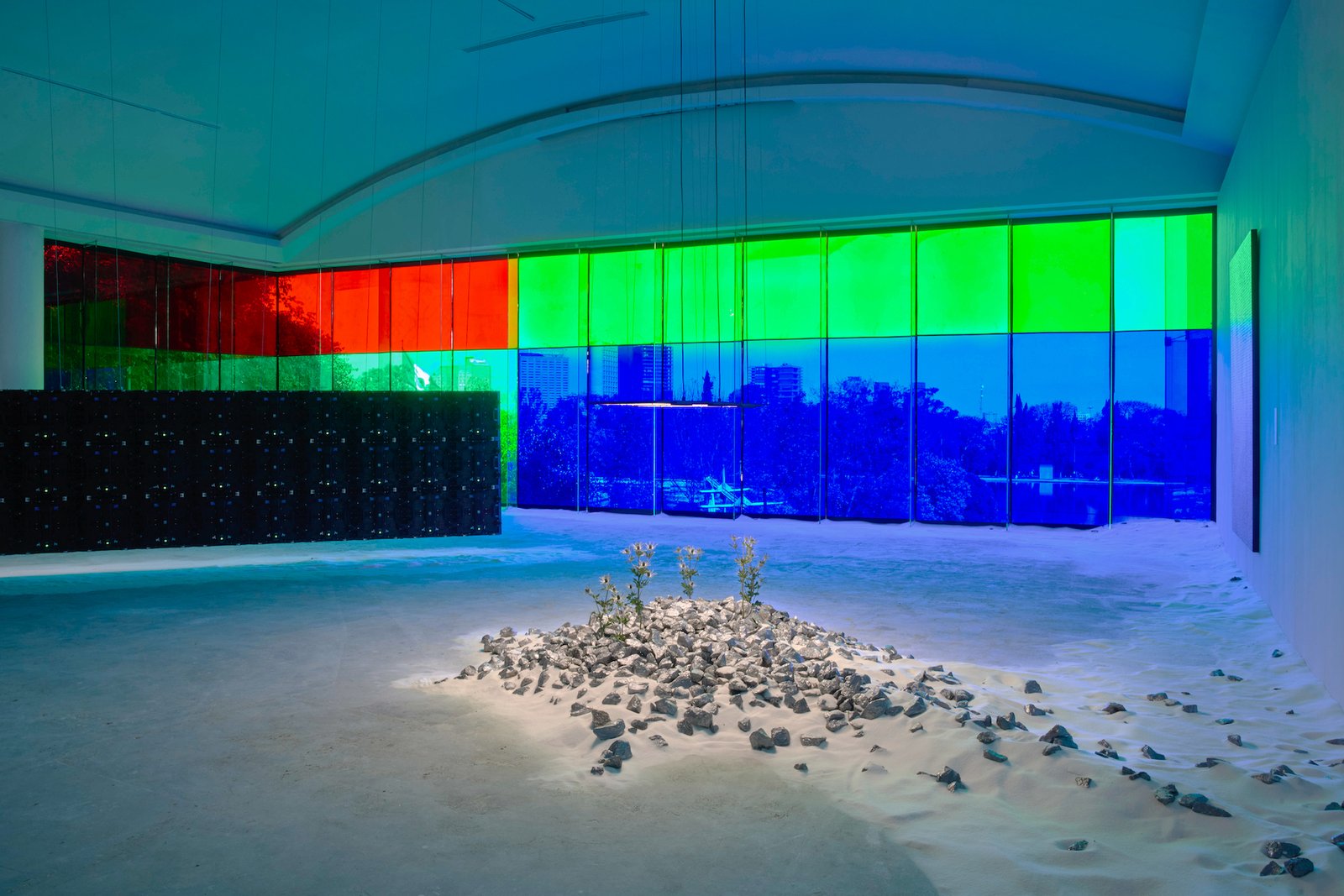
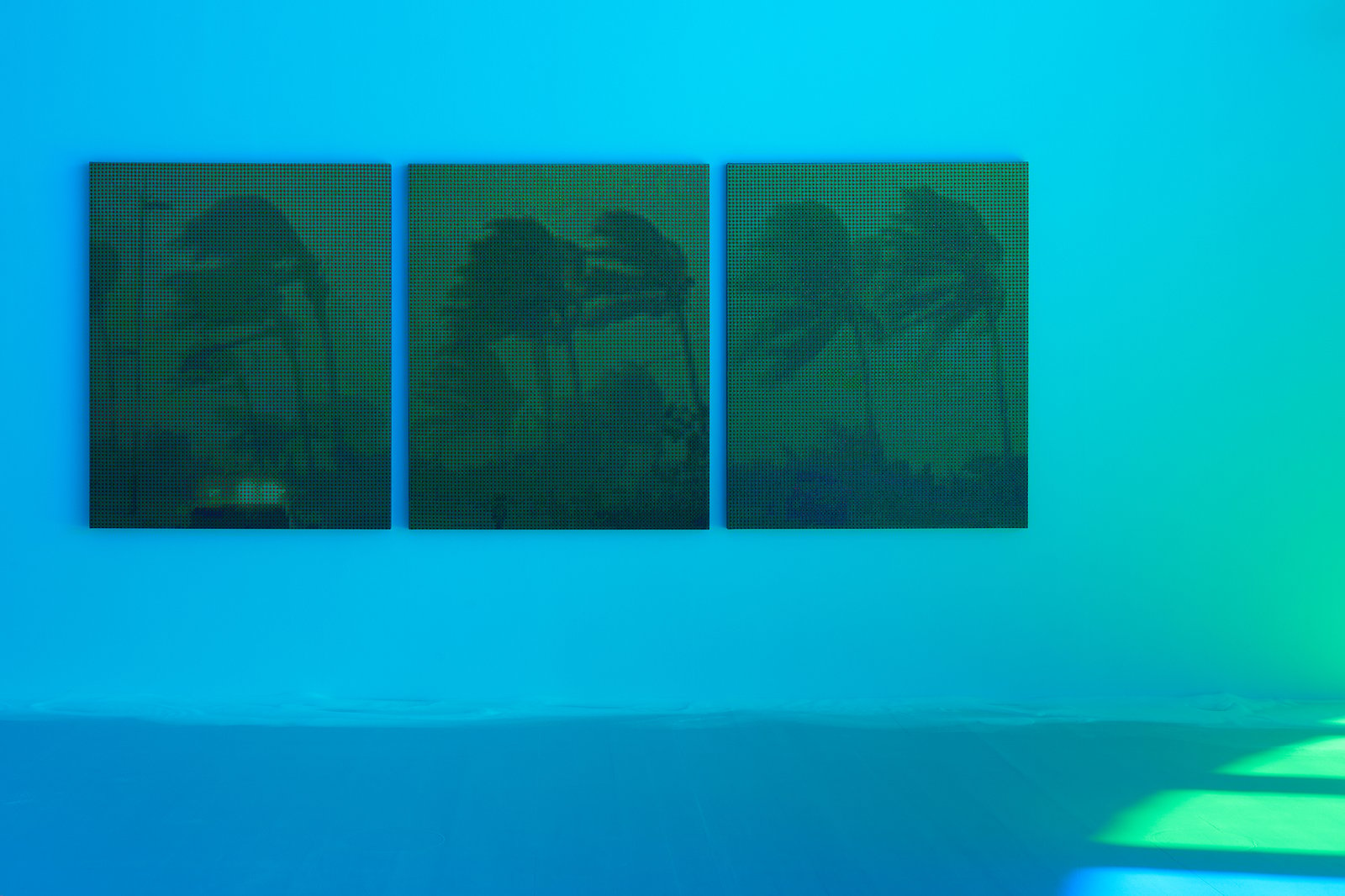
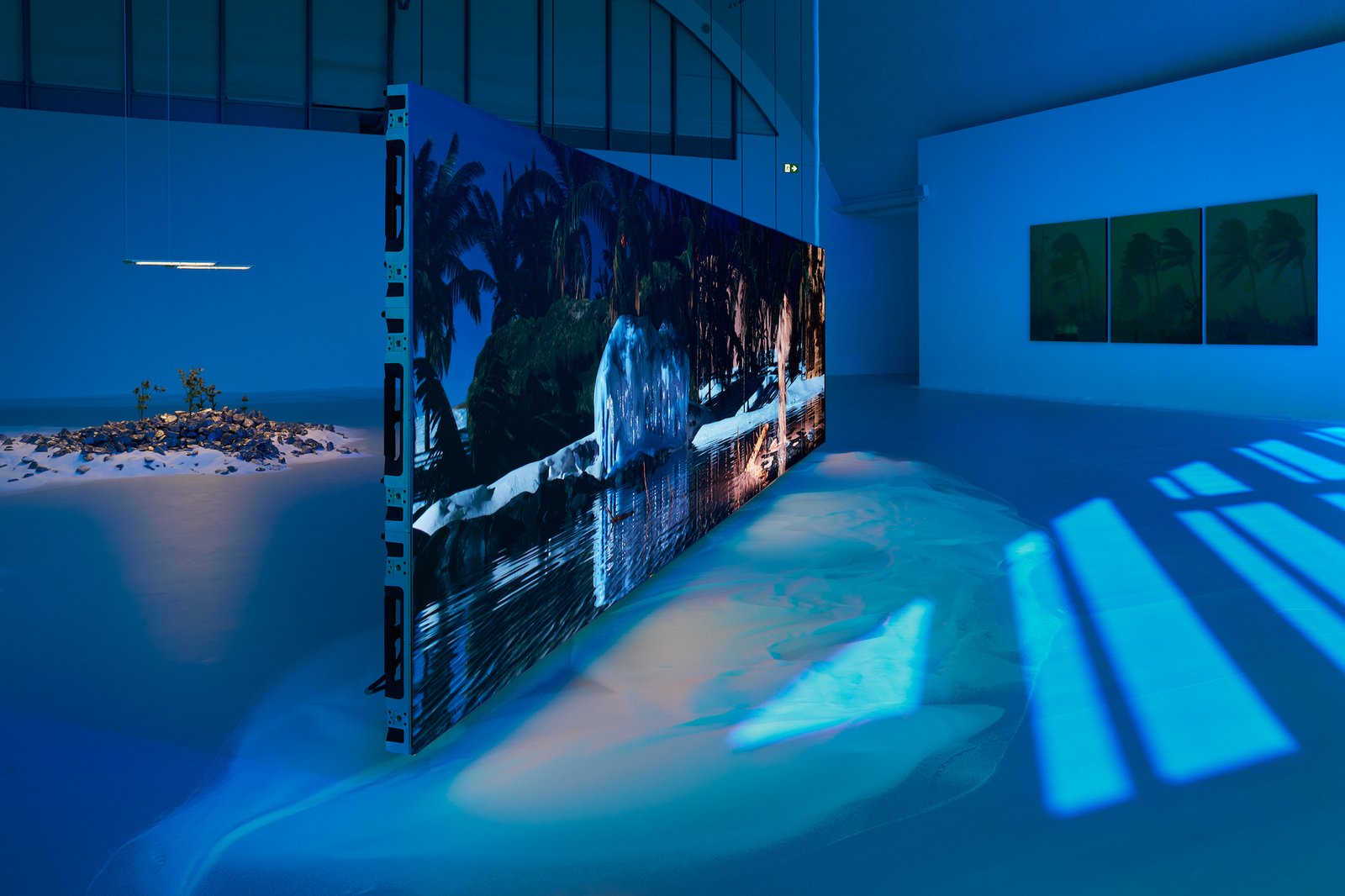
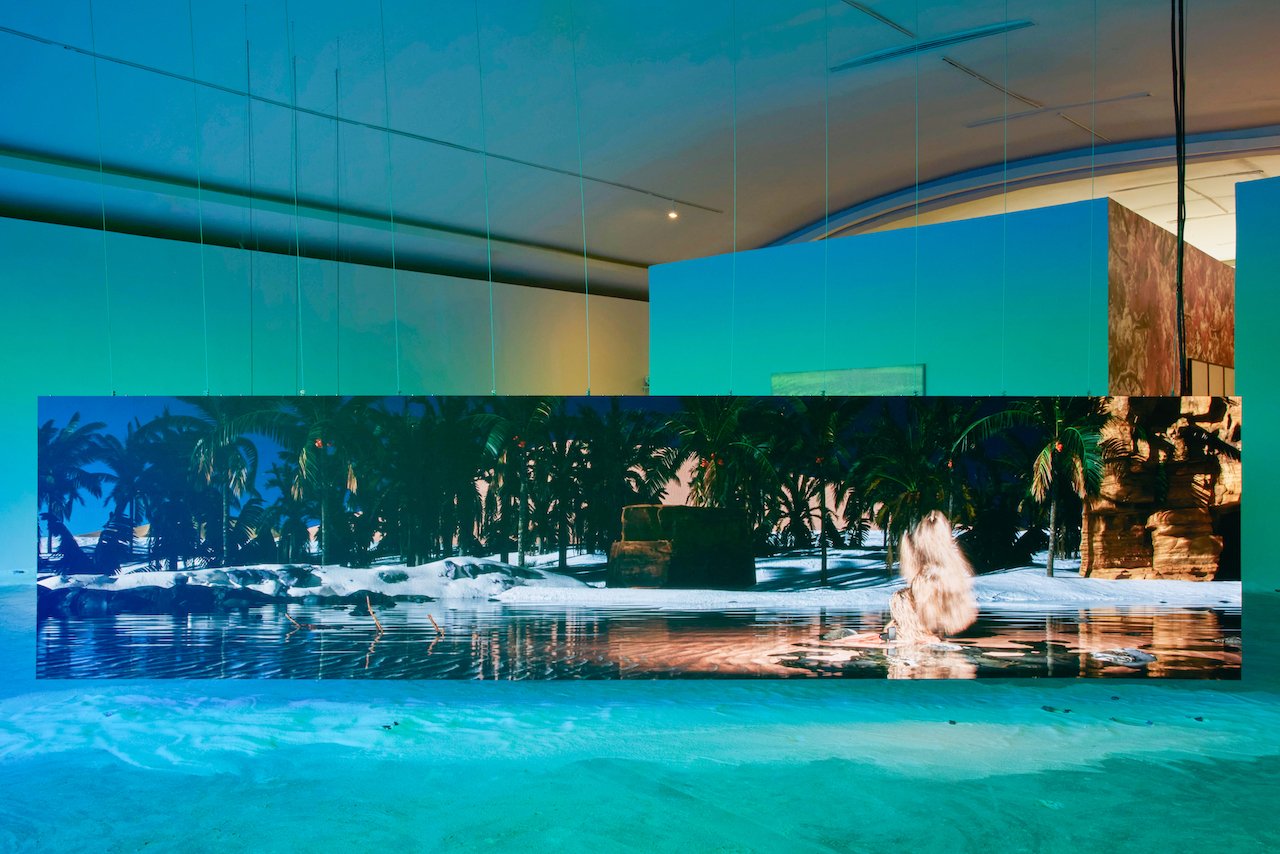
Installation view of “Chapter VIII: Hallucinations” at LagoAlgo, Mexico City, 2026, with work: Ultrared, Evergreen, Ocean Blue (2024) by Troika. Courtesy of the artist
“Chapter VIII: Hallucinations”, a new exhibition of works by Troika and Trevor Paglen, is at LagoAlgo, Mexico City, until May 31, 2026
If the age of generative AI promises that creativity is the new productivity, Troika’s brand of deeply considered, high-spec production prompts audiences to slow down and reflect. At a time when the social and environmental consequences of emerging technologies are accelerating to the point of illegibility, the group attests to the value of interdisciplinary practices that dissect entangled ecologies.
Founded in 2003 by Eva Rucki, Conny Freyer, and Sebastien Noel, in recent years the trio have had several landmark exhibitions that hint at the hybrid roots of their practice: from speculative design to photography to filmmaking. Following the launch of their new show “Chapter VIII: Hallucinations” at LagoAlgo, Mexico City, which situates their work in dialogue with that of Trevor Paglen, they sat down with the founding editor of Right Click Save, Alex Estorick, to discuss the ancient roots of non-human intelligence.
“Troika is doing some of the most innovative and exciting digitally-informed work out there — it’s been an honor to show alongside them” (Trevor Paglen)
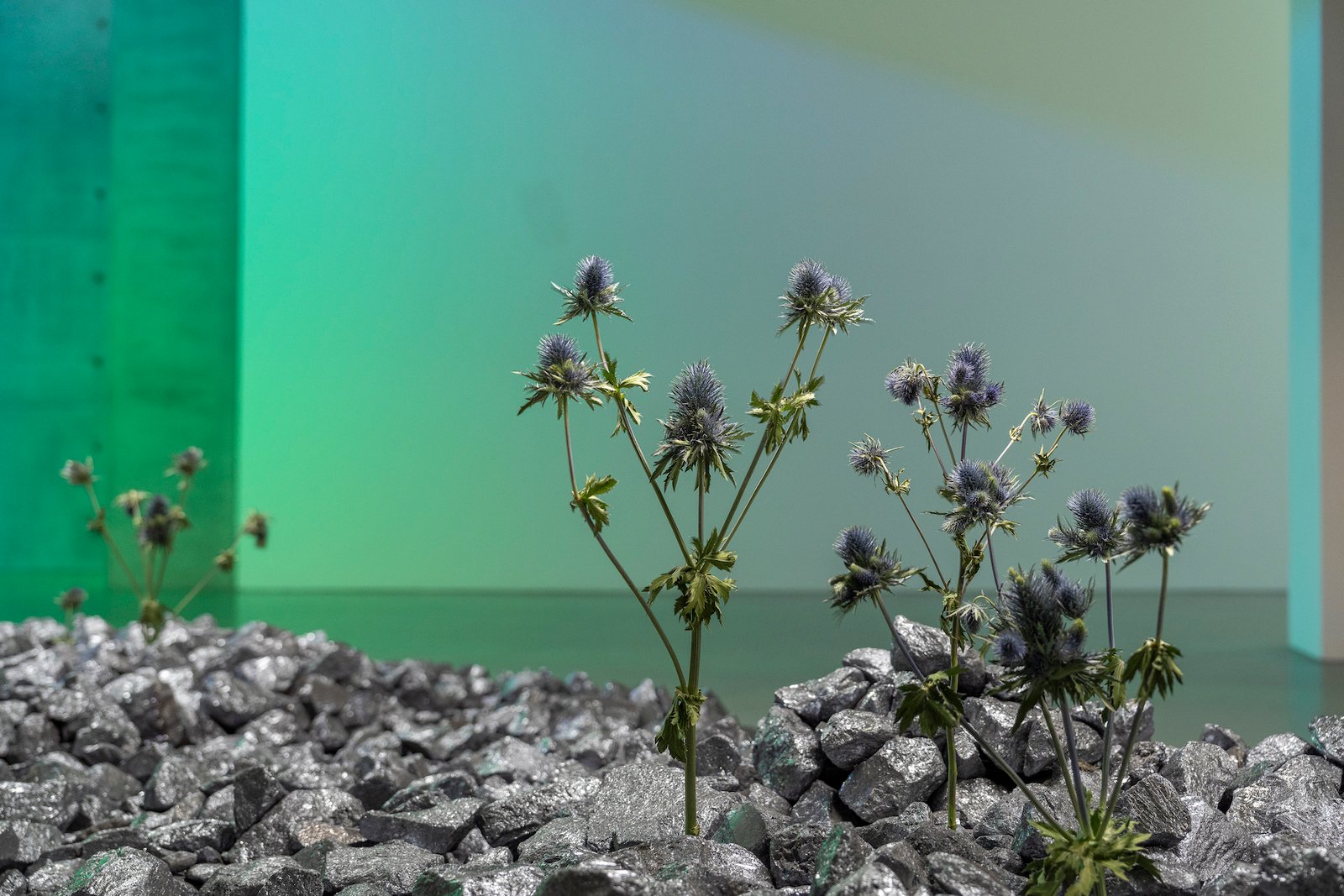
Installation view of “Chapter VIII: Hallucinations” at LagoAlgo, Mexico City, 2026, with works: Anima Atman (2024, foreground) and Ultrared, Evergreen, Ocean Blue (2024, background) by Troika. Photography by Alejandro Ramirez Orozco. Courtesy of the artist
Alex Estorick: It’s hard not to observe an increase in interdisciplinary, including digital, approaches by artists working today. As Troika, you cross-fertilize different literacies, including speculative design. How do your different trainings feed your collaboration and help you to generate such diverse outputs?
Conny Freyer: Our process moves across media because contemporary perception is itself hybrid. Minerals pulled from the ground run our digital lives, while we photograph waterfalls before we feel them. Ecological crisis, rapid technological change, fragmented truth worlds — these phenomena exceed any single medium. As artists, we allow the question to dictate the form, rather than committing to a medium or disciplinary identity.
The different training we have each undertaken across photography, filmmaking, speculative design, and visual language are tools that initially expanded our vocabulary and now enrich our process. They allow us to approach a question from multiple registers: conceptual, spatial, temporal, and material.
Our collaboration functions as a testing ground where these different literacies overlap and unsettle one another. They might inform understanding of how a system behaves — specifically, filmmaking might shape how time unfolds, while photography might define questions of framing and mediation, and what role media play in political, social, and cultural contexts. But none of these disciplines alone defines the work. Rather, we draw on them to construct artworks that investigate how reality is structured and perceived.
Troika, Anima Atman (2024) on view as part of “Pink Noise” at Langen Foundation, Neuss, 2024-25. Photography by Dirk Tacke. Courtesy of the artist
AE: Your work considers the entanglement of “the material and the virtual worlds” and how technology alters humanity’s relation to nature. How do you manage to address such all-encompassing questions while sustaining the coherence of a particular gesture?
CF: We don’t try to represent totality. Instead, we focus on precise perceptual interventions and personal experience. In Anima Atman (2024), for instance, technological mediation makes visible plant movements that escape human temporal perception.
The gesture is simple but its implications are vast, unsettling the hierarchy that places human consciousness at the center.
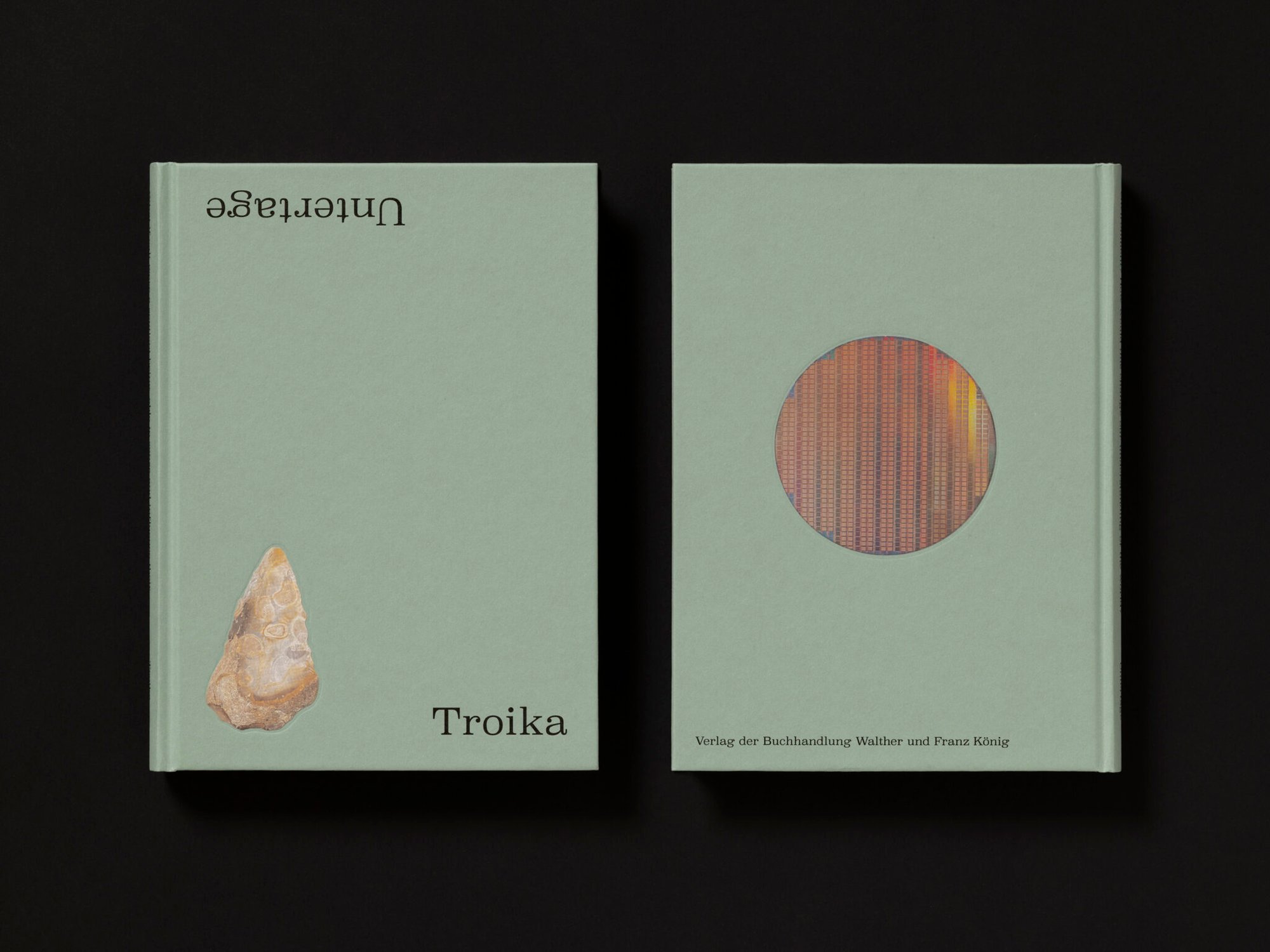
In our project series Untertage, salt operates as a narrative agent that connects geology, computation, and the historical entanglement of humankind and technology. By concentrating on one material or phenomenon, wider relationships become legible. Each work is a variation on the underlying question: how do the tools we invent reorganize the world we perceive?
Troika, Untertage, F Churchman (ed.), Cologne: König Books, 2024.
Sebastien Noel: Coherence in our work derives from an aesthetic language rooted in a conceptual stance — we try to embody the logic of the digital machine, which we see as the apex of a reductionist project begun in the European Enlightenment that is a source of much contemporary trouble. That was the moment when the medieval sense of an entangled world gave way to a model in which humans stand above nature, which is rendered as separable, dissectible, and exploitable.
That’s why our work is built from discrete units — bits, pixels, dice — repeated and recombined through cuts, splices, and collage, whether in sculpture or animated landscapes. We also adopt the visual grammar of contemporary technology: atemporal, spectacular, “eye-candy”.
Materiality is folded back into this logic: flint and silicon, earth pigments, and gold and platinum are all materials that both enact and point to the resources and technologies interrogated by the work.
Eva Rucki: We aim for complexity and ambivalence such that each work transcends illustration, often presenting contradictory positions. Anima Atman presents digital technologies as illusory through a series of custom lights, creating a stroboscopic effect so fast as to appear continuous, essentially digitizing reality in front of your eyes. This process replicates physically what your phone does when recording a movie or a conversation, taking bits, fragments in sequence. The plants’ motion is then both illusory in one sense, and real in another, inviting the viewer to re-evaluate their understanding of agency and the possibility of consciousness in our surroundings.
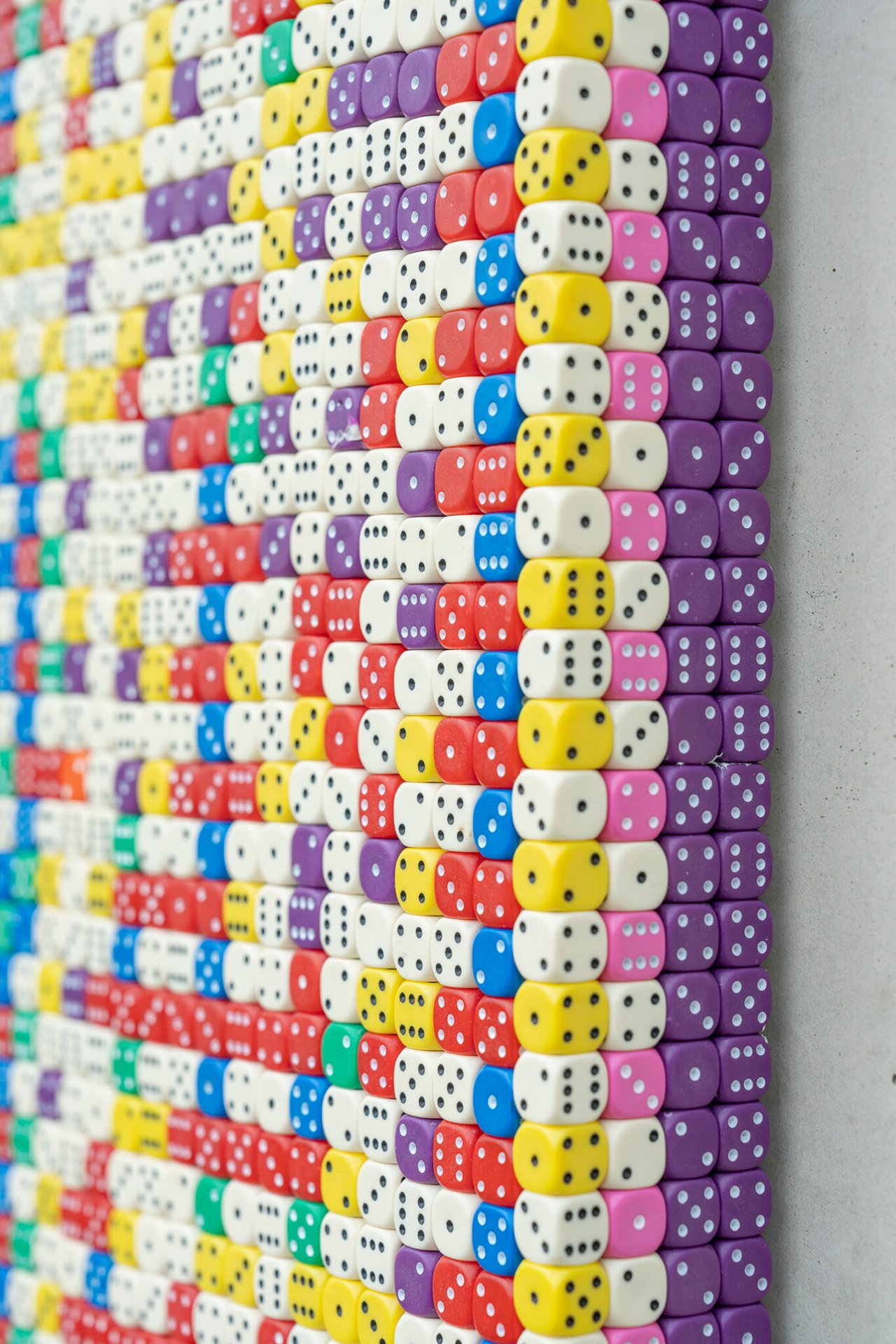
Our dice works [Life and Death of an Algorithm (2024) and Reality is not always probable (ongoing)] are based on early cellular automata. Over the years, we have developed algorithms that aim at creating the conditions in which to witness emergent phenomena, which we consider to be the basis of consciousness, sentience, and even life. The works are made by hand, computing the dice one by one, to express complexity unfolding at the limits of explainability.
Troika, Reality is not always probable (detail) (2024) on view as part of “Pink Noise” at Langen Foundation, Neuss, 2024-25. Photography by Dirk Tacke. Courtesy of the artist
AE: What determines your choice of medium for a given work and when do you know that you’ve found the right resonant frequency?
CF: Sometimes the choice of medium emerges from a physical encounter. Holding a piece of ice that is a million years old, or, for that matter, a piece of flint — an ancient tool — one becomes aware of how vision, perception, and time break into facets. Pigment is ground earth, and paint strokes accumulate like data. When we translate digital granularity back into mineral matter, we are not being nostalgic but rather tracing continuity.
We know that the “resonant frequency” is right when the material reveals that what appears virtual is anchored in geological time.
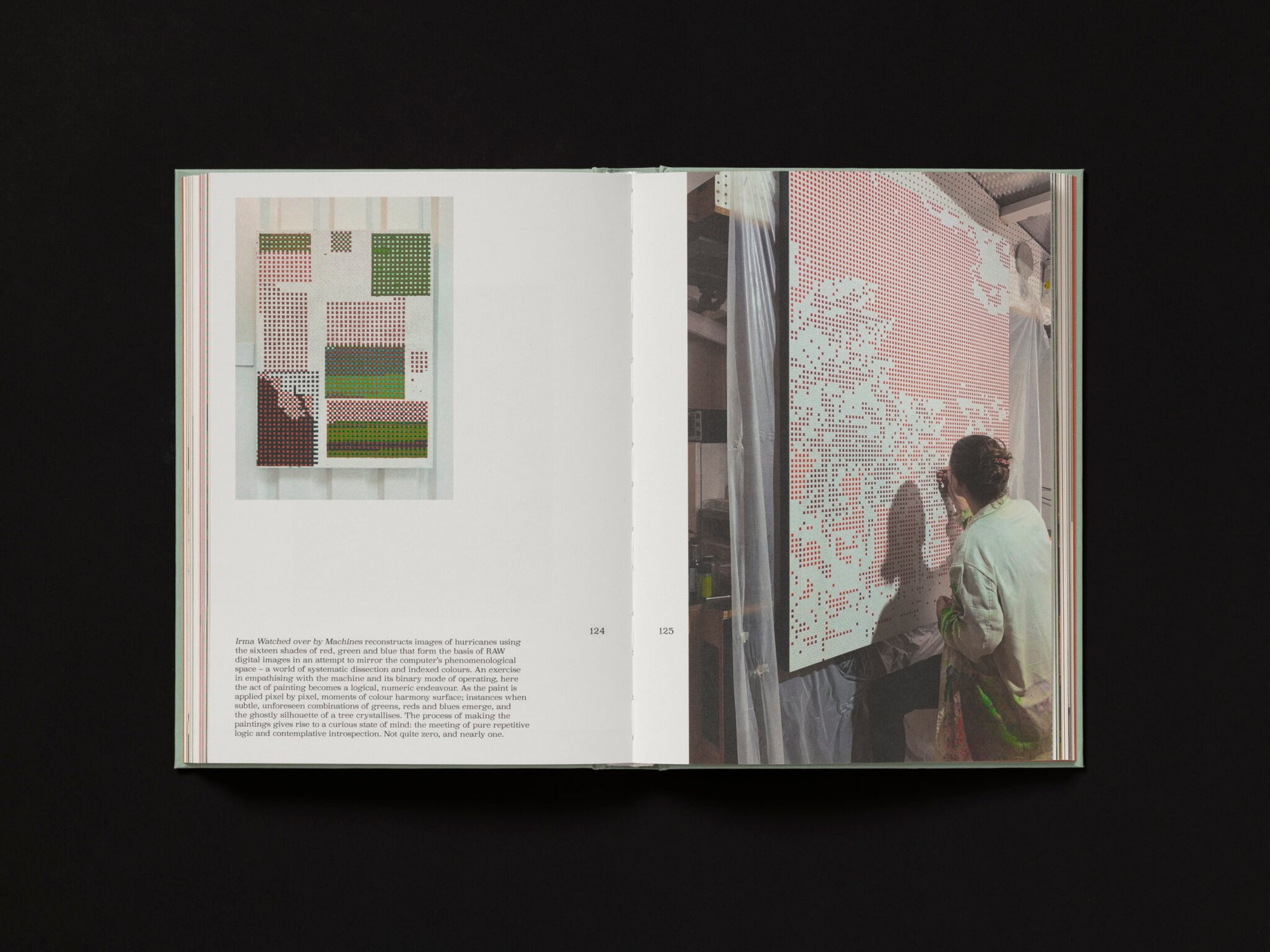
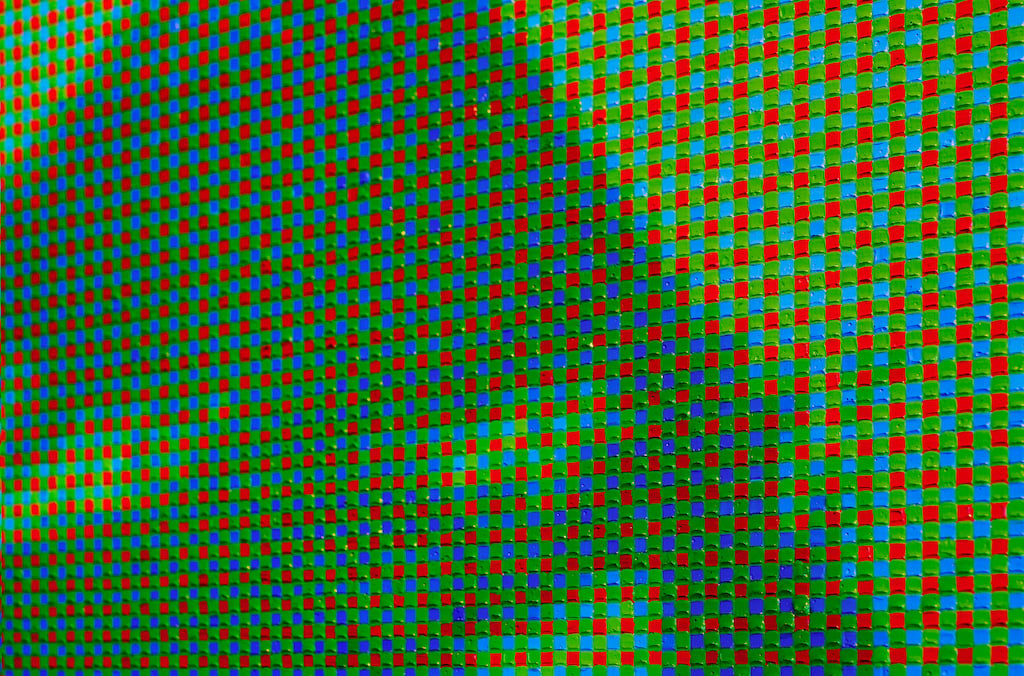
SN: Take our RGB paintings for instance. Everyone can appreciate, even without any prior technological knowledge, that a digital camera records the world in pure red, green, and blue, and that there are now an estimated one billion networked cameras recording the world 24/7. Indeed, the pink and orange hues of a sunset are not recorded in the digital image but statistically recalculated afterwards for human consumption.
If you start to paint that image, several major shifts occur. From a few meters away, the paintings look like crisp digital captures — forests, storms, skies — until the eye discovers that each “pixel” is painted by hand in the limited palette of a camera sensor with sixteen tones of red, green, and blue.
Troika, Irma Watched Over by Machines (2019-ongoing) on view as part of “Buenavista” at Schirn Kunsthalle, Frankfurt, 2025. Photography by Roy Bon. Courtesy of the artist
Painting becomes a way of entering the phenomenological space of the machine. It is not about the fantasy of seeing like a machine, but about how much labor and care it takes to fake that fantasy. Tiny shifts in hue and edge betray the work it takes to sustain the illusion of automation.
Our practice often circles around the politics of technological vision, and how the camera, drone, and algorithm reorder the natural world. In these paintings, the pixel grid becomes a kind of moral device and image of the violence that underlies all simplification. As sensors divide color into samples, an economy divides forests into assets. That same logic ties optical reduction to ecological extraction.
But if the grid is the emblem of this brutality, the act of painting it by hand becomes a counter-gesture: a slow, repetitive ritual that re-embodies what technology abstracts. It’s tempting to call this resistance, but we find the word too clean. What we aim to stage here is complicity — the recognition that we are already inside the system we critique. In the end, these paintings don’t simply show how machines see; they show how we’ve learned to see like them, and how, perhaps, we might still learn to see otherwise.
Installation view of “Troika: Buenavista” at Schirn Kunsthalle, Frankfurt, 2025, with works (from left): Anima Atman (2024), Buenavista (2025), and Irma Watched Over by Machines (2019-ongoing). Photography by Roy Bon. Courtesy of the artist
AE: For your recent show “Buenavista” at the Schirn Kunsthalle, Frankfurt, and in your current exhibition “Chapter VIII: Hallucinations”with Trevor Paglen at LagoAlgo in Mexico City, you’ve explored the ways human perception is being recalibrated — and reality remodelled — by digital media. What led you to this inquiry and what strategies do you find most suited to it?
CF: Our current duo show with Trevor Paglen traces a shared fascination with the ways humans, machines, and environments perceive, transform, and “dream” one another. Most of us are now aware of how digital aesthetics and virtual worlds have been naturalized. Social media filters and algorithms that favor an ideal aesthetic; tourist ads of seamless landscapes generated by rendering engines — these visual languages shape expectations of what we should look like and how reality should appear.
“Hallucinations”is an attempt at a speculative shift in subjectivity: what if we imagine ourselves inside the perceptual field of an artificial intelligence (AI), not anthropomorphizing it, but asking: what does it see? What does it discard? What does it optimize for? If human perception is shaped by experience, machine perception is structured by training sets and matrices of probability. To inhabit that space imaginatively is to experience a world decomposed into signal, contrast, and correlation.
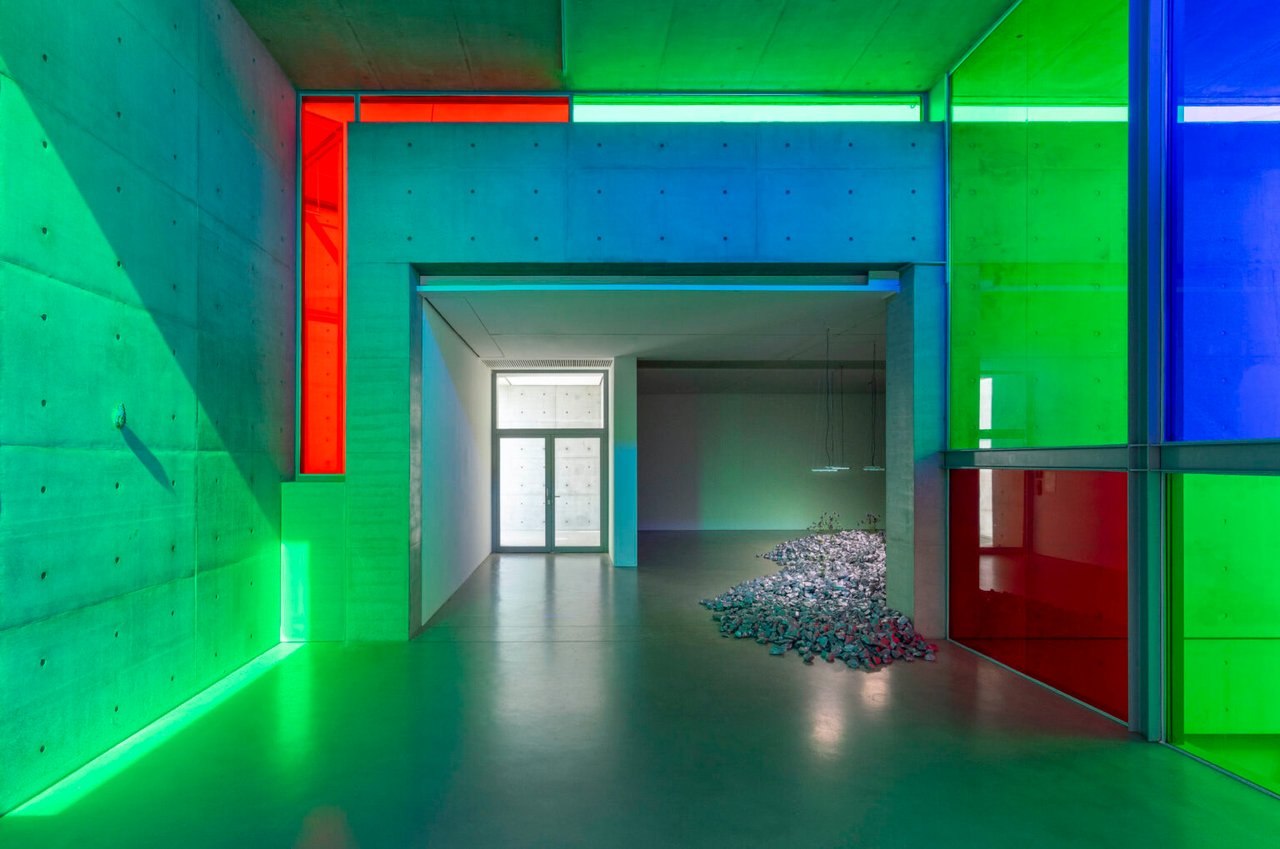
We have previously experimented at the Langen Foundation through our window installation, Ultrared, Evergreen, Ocean Blue (2024), where the architecture was filtered through red, green, and blue window film: the chromatic logic of digital imaging. People moving through the space were effectively inside the eye of a machine, immersed in the additive color model that underpins screen-based vision.
Imagining this interiority is not about projecting human emotion onto code, but about recognizing that machine perception now co-constructs reality. To step inside that logic, even briefly, reveals how profoundly our own perception has already been reformatted.
Installation view of “Pink Noise” at Langen Foundation, Neuss, 2024-25, with work: Ultrared, Evergreen, Ocean Blue (2024). Photography by Dirk Tacke. Courtesy of the artist
ER: This thinking extends to Buenavista (2025), a film initially made for Kunsthalle Schirn with curator Dehlia Hannah. In the film, a robotic creature dances violently to the tunes of a shapeshifting landscape backdrop constructed from “nature” libraries drawn from game engines, movie VFX, and 3D visualization softwares.
The robot’s choreography reads like a parody of our own compulsive gestures — clicking, scrolling, swiping in pursuit of the “most beautiful view” — while the landscapes feel uncannily familiar, as though drawn from collective memory rather than any singular geography. They are less about the environment itself than about the desire for environment.
These vistas hover in an ambiguous zone of belonging: are they ours, downloaded from the endless stream of perfect beaches, sunsets, and mountain views? Are they the machine’s? Or are they the result of a new, shared imaginary forming between the two?
SN: This opens up the possibility of a spectrum of consciousness, a continuum of intelligences, and shared cognition. The question thus becomes how to approach and understand alterity in all its plurality. “Hallucinations” enabled us to weave installation, painting, sculpture, and sound into a coherent environment to create complex associations between different bodies of work, while offering plural readings that operate on both an intellectual and a visceral, felt level.
Troika, “Buenavista” at Schirn Kunsthalle, Frankfurt, 2025. Courtesy of the artist
AE: It seems as though sound functions as a unifying channel throughout your practice. How do you see its role?
ER: Sound is the most immediate and immersive medium: you feel it before you think it, which makes it uniquely suited to ideas that resist language.
I Am a River (2025), the sound work for “Hallucinations” (and earlier at Schirn Kunsthalle), grew out of conversations with the zoologist Arik Kershenbaum in the lead-up to our permanent work at the University of Cambridge, Third Nature (2024). Arik, who studies animal communication, described to us how wolf howls distribute meaning across frequencies rather than through time, with each harmonic carrying its own component, so that even if parts are masked by wind or distance, the overall sense still arrives.
That non-sequential structure equates with digital error correction, suggesting a different model of speech and thought. I Am a River tests this by resetting a poem by Rumi so that all the words are sung at once by an AI voice instrument according to the harmonics of a female wolf, diffused across seven surround channels. Oscillating between recognition and otherness, it leaves one uncertain as to what one is hearing: an atemporal language where one is both present and dispersed.
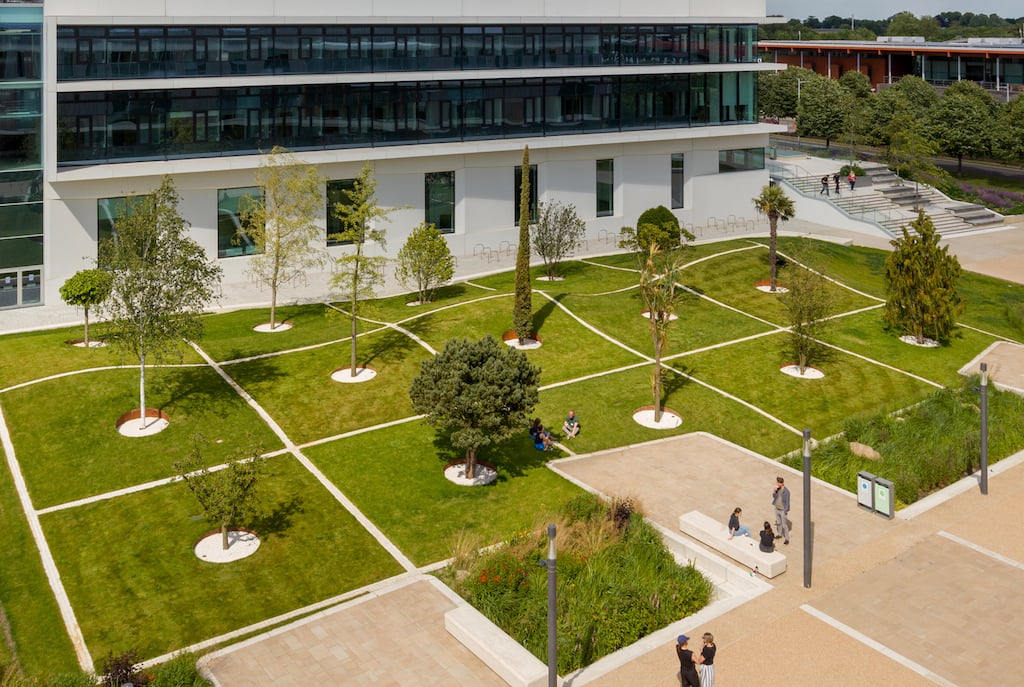
Troika, Third Nature, 2024. Courtesy of the artist
AE: Your ongoing project, Unterage (“below the earth” or, literally, “under the day”) uses writing, painting, film, and installation to reimagine human history through the lens of a non-human intelligence, “Salt”. How can earth’s mineral richness help humans to engage with non-human agents and intelligences, including AI?
CF: In this series of films, sculptures, and installations, salt appears as a material and actor that is fundamental to both biological life and digital systems.
When you consider that silicon chips are derived from flint or quartz, while batteries and circuits depend on rare metals, AI becomes legible as geology reorganized into logic and code. Rather than being futuristic, non-human intelligence is ancient, prompting humility and situating technological systems within terrestrial time.
SN:Untertage fictionalizes the history of humankind and its relationship to technology from the point of view of “Salt”, an alchemical stand-in for all the minerals extracted to make our technologies. Salt is a hive intelligence: a Machiavellian entity that manipulates humans into digging minerals out of the ground and building technologies to eradicate organic life.
Salt is crystalline, orderly, inorganic; it preserves bodies, dries out water, and arrests life. It gave humans the first tool with which to excavate minerals, the flint axe, which is also tied to early mining. Untertage proposes a coherent but radically alternative history of technology in which humans are not central agents, but the instruments of minerals.
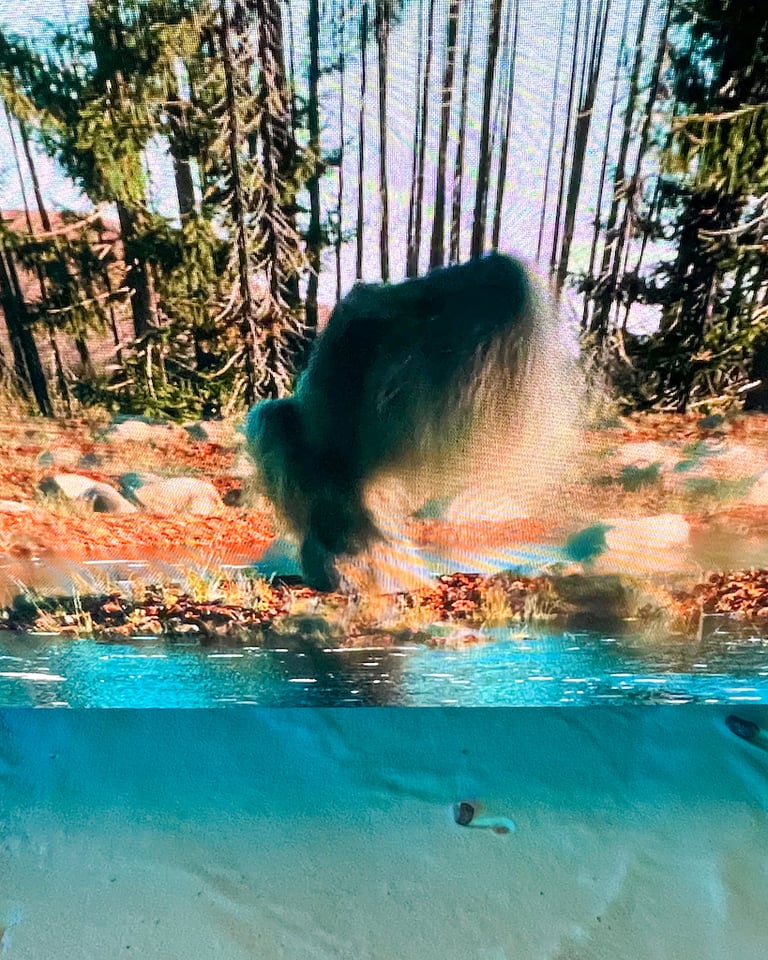
Troika, (Still from) Buenavista, 2025. Courtesy of the artist
AE: Your recent work, Dream Baby Dream (2025), used generative AI to explore the convergence of technological optimism, ecological collapse, and the aesthetics of power. The resultant imagery parodies the seamlessness of old Apple or Microsoft wallpapers which you describe as a “global, shared hallucination” of an “ambient ideology”. What approach do you take to emerging technologies and how have you managed to integrate them into your practice?
CF: An approach of lived contradiction. In Dream Baby Dream, the generative AI produces landscapes — images of seamless skies and idealized horizons that once promised technological transcendence, an ambient ideology smoothing over the material costs of extraction and ecological degradation.
By working from within the tool, we reveal its aesthetic defaults and ideological assumptions. The goal is not to illustrate critique but to expose how technological optimism and ecological collapse can coexist within the same visual language.
SN: People are often familiar with the ideas of existing biases in training sets used for facial recognition. Similar biases exist within photographic databases of natural environments, where exotic landscapes are heavily over-represented: scenes of sand dunes, remote desert, snowy landscapes in remote locations, white arctic sceneries — many of these locations express a human fantasy for an aestheticized and untouched nature.
Installation view of “Chapter VIII: Hallucinations” at LagoAlgo, Mexico City, 2026, with work: Buenavista (2025). Photography by Alejandro Ramirez Orozco. Courtesy of the artist
AE: We’d love to hear about any forthcoming projects you might currently be preparing for. How is 2026 shaping up for Troika?
Troika: We are bringing out a new book, Third Nature, with 15 researchers, writers, and curators contributing essays that are shaped by their individual practices.
The book explores the cultural construction of nature, diasporic, and multispecies belonging, and how we inhabit and co-produce hybrid ecologies shaped by computation and climate.
The book is conceived as an expanded site of our living artwork Third Nature in Cambridge and is meant not as documentation but as a way for the artwork to expand laterally across disciplines, voices, and pages. We are also working on a sculpture project with the Fraunhofer Institute in Germany and will be part of several exhibitions including “Das kalte Herz” (“The Cold Heart”) at Kunstmuseum Stuttgart.
Troika is a London-based contemporary art group formed in 2003 by Eva Rucki, Conny Freyer, and Sebastien Noel. Working across media including sculpture, film, installation, and painting, their work contemplates humanity’s experiences and attitudes towards new technologies and how these transform our understanding and relationships to nature, each other, and the wider world. Their artworks seek to reveal our experience of the living world and understanding of human and non-human life, consciousness, and agency. In this context their interest focuses on forms of life, artificial intelligence, algorithmic data, and virtual and physical representation systems. In 2019, Troika started a research project together with biologists, neuroscientists, the British Antarctic Survey, and physicists from Cambridge University that culminated in the group’s permanent outdoor installation Third Nature that opened to the public in 2024. Troika’s work is part of the permanent collections of M+, Hong Kong; V&A, London; The Art Institute of Chicago; MoMA, New York; Collección Jumex, Mexico City; and Centre Pompidou, Paris.
Alex Estorick is the Founding Editor of Right Click Save.