Ed Fornieles, Borrowed Lives: Anon (2026), is on Solos Gallery. Fornieles is a fellow of n-Space, a group working with interdisciplinary experimentation across art and technology at Somerset House Studios, London.
“On the internet, nobody knows you’re a dog” — Peter Steiner
Peter Steiner’s famous 1993 cartoon has become shorthand for the early internet: a place where anonymity made reinvention possible. Three decades later, anonymity hasn’t disappeared, it has changed shape. Today it lives in memes, avatars, burner accounts, Discord servers, crypto communities, and anonymous image boards. It’s also become one of the places where ideas about masculinity, belonging, and identity are negotiated.
Few artists have returned to those spaces as consistently as Ed Fornieles. From Facebook Sitcom (2012) to Cel (2019) and now Borrowed Lives: Anon (2026), his work explores what happens when people become the cultures they immerse themselves in. His latest project follows a teenage boy growing up online, asking how feeds, memes, forums, and communities reflect identity and actively produce it.
For Right Click Save, Fornieles talks to Anika Meier about growing up with the early internet and how those experiences have shaped both his life and artistic practice. Across works spanning more than fifteen years, Fornieles has returned to questions of role-playing, boyhood, masculinity, and belonging online. Taking Borrowed Lives: Anon as a starting point, the conversation moves from anonymous chatrooms and Facebook Sitcom to the manosphere, crypto communities, NFTs, and AI, exploring how the internet offers not just places to gather but identities to inhabit — and how those identities can shape the people we become.
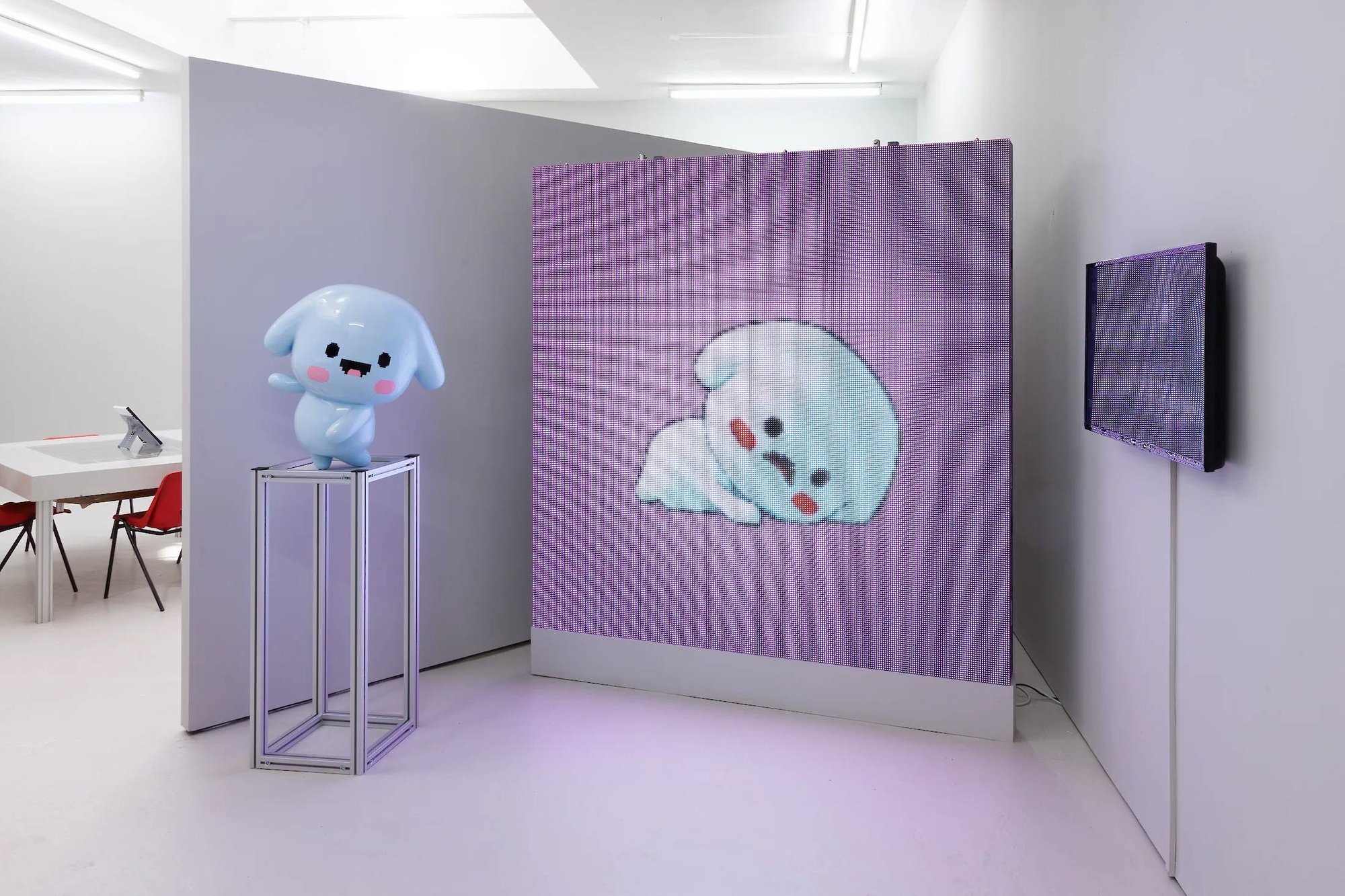
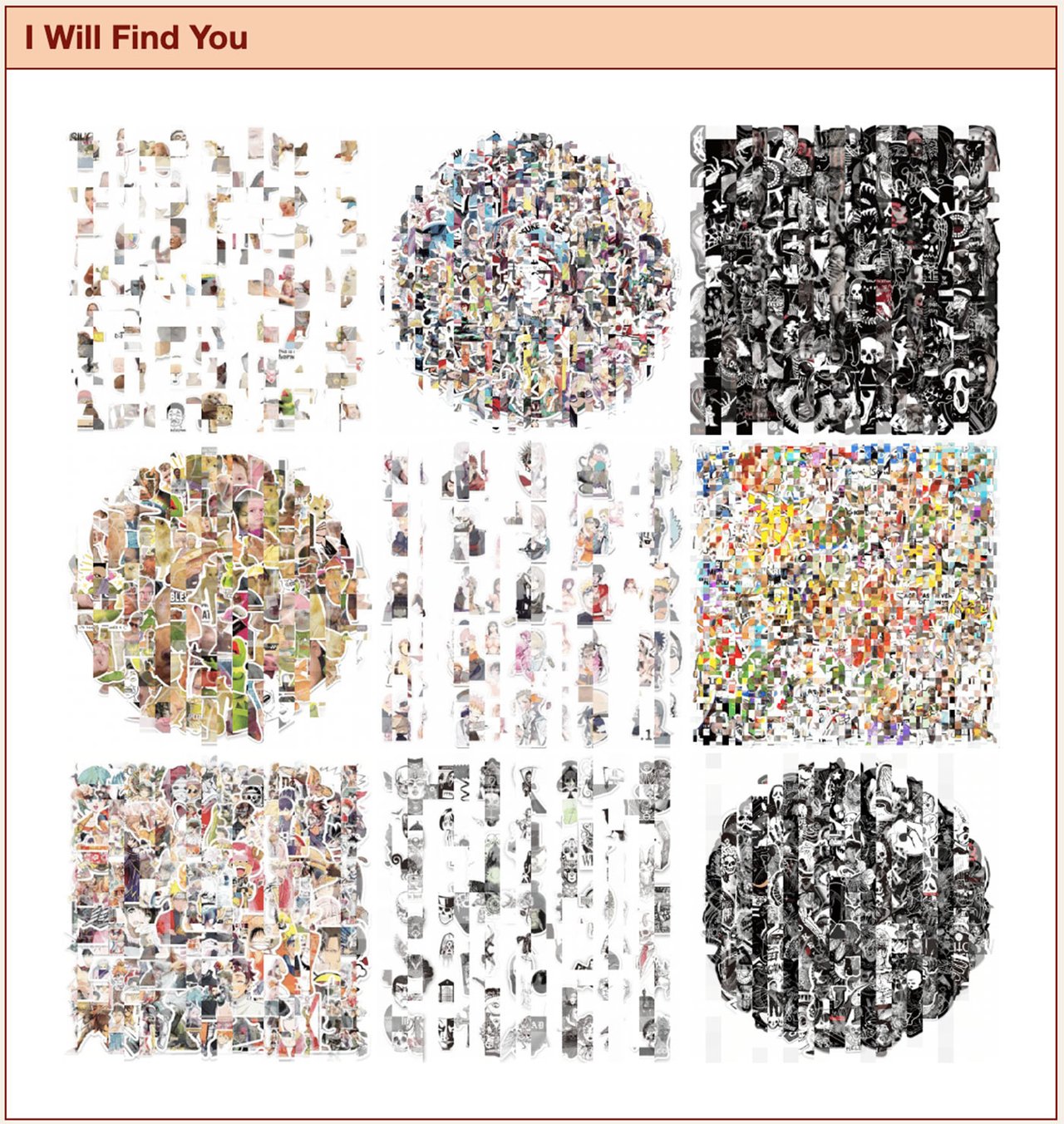
Ed Fornieles, Borrowed Lives: Anon, 2026. Animated GIF NFT. Courtesy of the artist
Anika Meier: What was your experience of growing up on the internet?
Ed Fornieles: I’m part of a generation — or perhaps we’re part of a generation — that bridged online and offline. My earliest memories are of being an early teen accidentally stumbling into the strange and slightly seedy space of online chatrooms. It was a thoroughly Web 1.0 experience.
AM: How did the internet change as you were growing up, and how does that compare with the internet today? I imagine one of the first platforms you really experienced was MySpace.
EF: MySpace, certainly. There were also very early MMOs and Second Life. I grew up through this transition from Web 1.0 to Web 2.0 and really came of age during Web 2.0.
I was at university when Facebook first rolled out to selected campuses, so I was part of that initial wave. When you are exposed to a technology at that age, it becomes something you can’t help but internalize. What was your experience?
AM: I went online because I was a music fan. I joined the message board for my favorite band. Before that, I had pen pals in Australia, where the band was from, and in the US. We’d send each other mix tapes, VHS tapes, and magazines. Then the message boards arrived, and you could chat with everyone you’d previously known through writing letters.
EF: That’s an interesting moment, the collapsing of distance, not just geographical but cultural. It’s in this moment that I started using these platforms to start making art. For instance, Facebook Sitcom, which used the affordances of Facebook. Suddenly, artworks could scale in a way they hadn’t before. A performance was no longer limited by obvious physical constraints; suddenly a performance could play itself out with tens or hundreds or even thousands of people over weeks or months, existing in people’s devices in a way that allowed it to become part of their everyday lives.
Facebook Sitcom was a performance that simulated the American college experience, consisting of 34 accounts that were created by scrapping content, images, and preferences from real students. These were then inhabited for over three months, where participants lived through their characters. They posted images, tagged one another, and collectively constructed fictional events and relationships.
AM: Looking back, was there something you learned through works like Facebook Sitcom about social media that you still think holds true today?
EF: There is a lot that I learned about social media that I think still holds true today. There is something about being shaped by the platforms you inhabit; there is something about a platform being a funnel; there is something about a drive toward escalation... In Facebook Sitcom, I played an awkward, geeky guy who fell in love with a goth girl who was having an affair with a bro; it was complicated... drama. One of the things I found interesting in this instance was its intensity. The stakes can feel real, and relationships genuinely develop — whether that performance is authentic or fictional. In the end, I don’t think that distinction really matters; things can easily begin collapsing in on themselves.
AM: You started making artworks on social media platforms almost immediately. But you didn’t have to make art. You could have played anybody.
EF: On the internet, nobody knows you’re a dog. That kind of experimentation was already happening in the early chat rooms, and it felt natural to port that sort of play into the work.
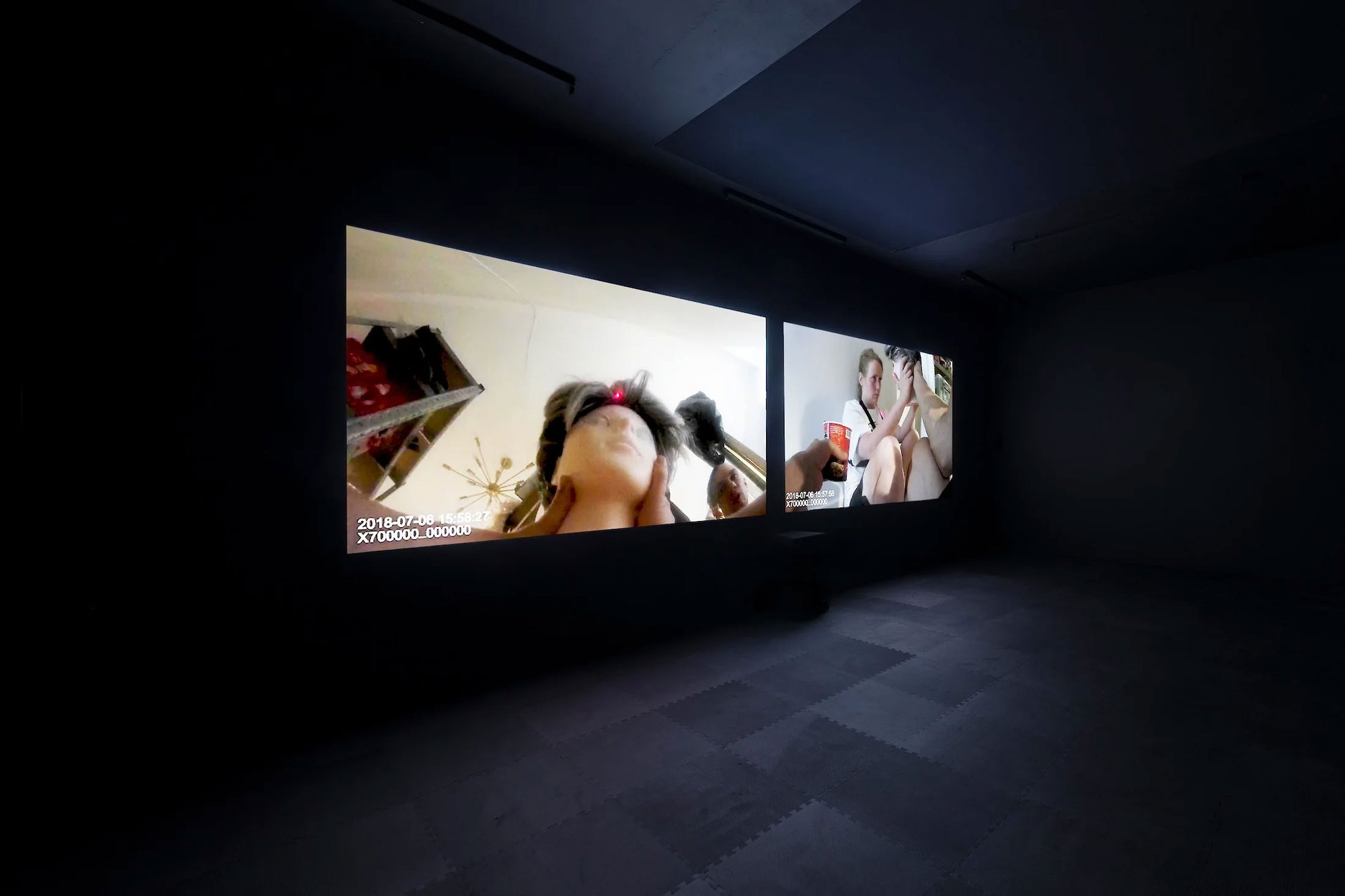
Ed Fornieles, Internal film on the subject of cute, 2024. Courtesy of the artist and Carlos/Ishikawa gallery
AM: But on the internet, nobody knows you’re an artist either.
EF: Or a troll. Or someone who’s completely sincere. Those distinctions begin to blur.
There’s this idea known as Poe’s Law. You can put a smiley face at the end of any sentence. Sincerity becomes questionable, irony is assumed by default. In that context, even the most honest, sincere, violent, or abhorrent statement becomes an open question mark.
AM: How has being online changed for you? I remember looking forward to going online because I knew I’d find people on the message boards. We’d talk about what had happened during the day, discuss music, and just spend time together. I did that for years. Then, much later, I reconnected with many of those same people on Instagram.
How did your experience evolve?
EF: It was similar for me. I grew up in the middle of nowhere, on a hill in the countryside. Every day I spent 45 minutes to an hour on the bus getting to school. The internet was where I spent most of my time at home. It was an escape from that sense of geographical isolation. That’s one of the reasons I carried those experiences into my work.
AM: Your new body of work, Borrowed Lives: Anon (2026), unfolds as what you’ve described as an “online opera”: a digital narrative told through one thousand artworks that follows a teenage boy navigating online culture and the communities that shape his sense of self. How did this project emerge, and what drew you back to questions of identity and online life?
EF: Every generation goes through the same process of becoming, but dressed in its own culture, fluencies, images, and norms. I’m interested in that cycle: the way a person comes into contact with a set of signs, roles, desires, and scripts and, for a period of time, is organized by them.
Ed Fornieles, Borrowed Lives: Anon, 2026. Animated GIF NFT. Courtesy of the artist
One reference point for Borrowed Lives: Anon is The Beautiful and Damned (1922) by F. Scott Fitzgerald, which begins with a spirit looking down on humanity before descending to inhabit a life. That life becomes the site of a cycle that has been performed countless times before. I’m interested in that relationship between the person and the force moving through them: the person as subject, host, puppet, and carrier.
That is what Borrowed Lives: Anon gestures towards. We encounter an ongoing stream of images: the psychic projections of a figure navigating adolescence. It remains unclear whether he is simply being pushed forward by the stream or whether he is somehow the originator.
I wanted to place the viewer in the position of the character. There will be a version of this work in the gallery, where the viewer is situated in front of, or under, a bank of screens. I want to place the viewer in the feed, for them to be immersed, for the images to move associatively somewhere between how we think and how we experience images online.
AM: You’ve repeatedly returned to the ways young men construct themselves online. What continues to draw you to that subject, and what does it reveal that other perspectives might not?
EF: I’ve looked at various identities within the work, but I guess I’ve come back to adolescence, and particularly young men, as it remains poignant for me on both a personal and political level. There has been a lot spoken and written in recent years about a crisis in male identity. There are truly a lot of good narratives right now, and how we deal with this crisis will have far-reaching social and political consequences.
Some of Borrowed Lives: Anon, and much of Cel, grew out of conversations with my friend Matt Goerzen, who worked at Data & Society after the 2016 US election, looking at the radicalization of young white men into the alt-right at the time. He was interested in what drove that process, and his research has very much informed the work.
Ed Fornieles, Cel, 2019. Courtesy of the artist
He said something that has always stayed with me: “The meme will meme you.”
If you immerse yourself in a group or culture long enough and become fluent in its language, it begins affecting your actions and eventually your sense of self. Figuratively, that’s what Borrowed Lives: Anon is trying to do: create an immersive stream.
AM: Could you take us back to Cel? What questions were you asking through those works?
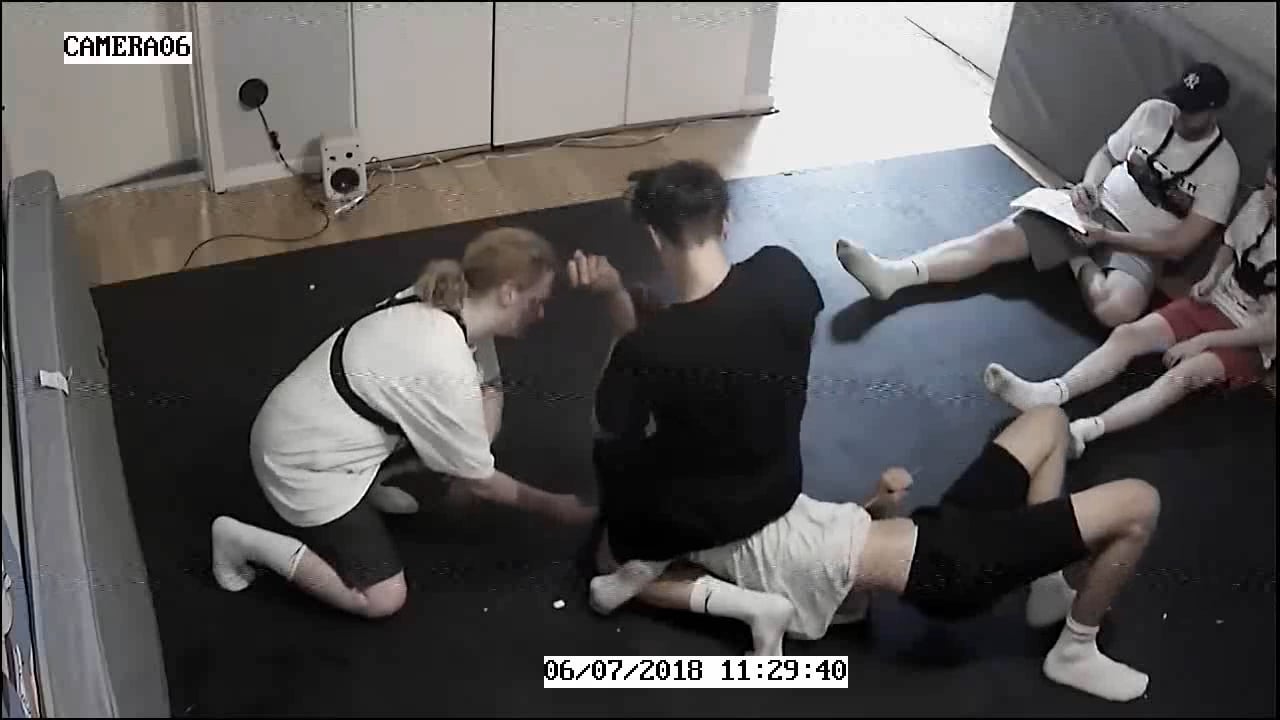
EF: Cel was an IRL role-play involving ten participants who re-enacted a hypothetical alt-right group. It was loosely based on a real community in Florida that had moved from online message boards into a shared living situation. Over three days, the participants existed within a highly hierarchical social structure, with mechanisms for moving up and down the pecking order through physical competition, intimidation, alliance-building, humiliation, and demonstrations of loyalty.
What interested me at the time was not simply condemning these groups from the outside, but trying to understand what made them attractive. What needs were they meeting? What narratives were they offering? What forms of belonging, status, purpose, or transformation did they make available to people who felt alienated elsewhere?
I was also interested in whether those same drives could be redirected. If these groups were successful because they offered myth, structure, intensity, and a sense of becoming, then the question became: could we imagine alternative narratives that were more generous, more complex, and less destructive?
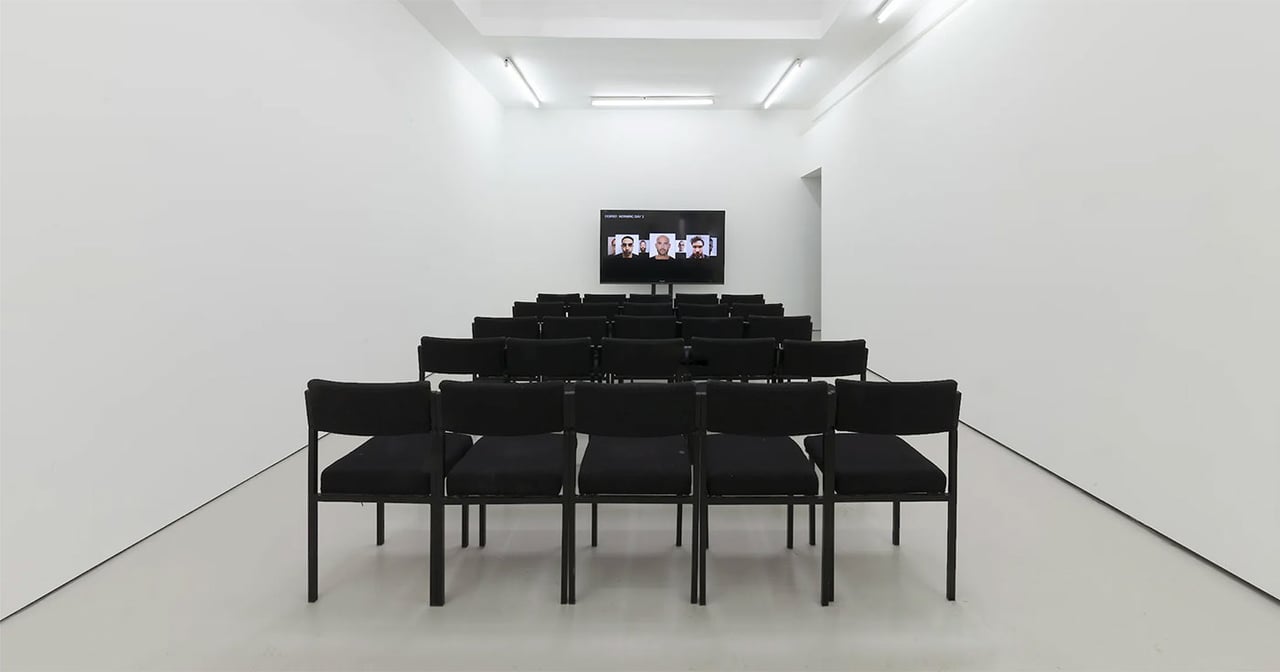
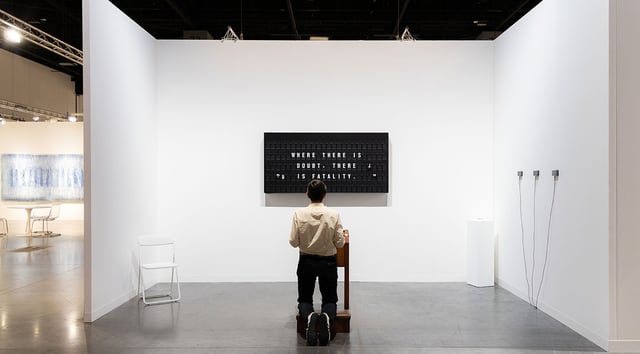
Installation view of Ed Fornieles, “Cel” at Carlos/Ishikawa gallery, 2019. Courtesy of the artist and Carlos/Ishikawa gallery
AM: When I think about artists such as Ann Hirsch, Petra Cortright, Amalia Ulman, and Molly Soda, their work often reflects on what it meant to grow up online as a girl or young woman. Your work, by contrast, has consistently explored boyhood, masculinity, and the online communities that shape them. Do you think those experiences of growing up online are fundamentally different? And how has that informed your approach to making work that exists both online and offline?
EF: I think they are different, although I would be careful not to make that difference too absolute. The artists you mention were often working with visibility, self-presentation, desirability, vulnerability, performance, and the way the female self is looked at, circulated, judged, and consumed online. A lot of that work understands the internet as a stage, but also as a hostile mirror. You perform yourself, but the performance is immediately captured by other people’s desire, resentment, projection, or ridicule.
The kinds of male online spaces I have returned to are often organized differently. They are less about visibility in the conventional sense and more about anonymity, refusal, rank, humiliation, humor, anger, and belonging through shared alienation.
The boy does not necessarily want to be seen as himself. He wants to disappear into a voice, a board, a meme, a collective posture. Instead of the selfie, there is the avatar, the Wojak, the frog, the username, the greentext. The self is still being performed, but often through disavowal: “This isn’t me”; “I’m only joking”; “be me”; and “anon”.
That is what interests me. These spaces offer a kind of cover. They allow certain impulses to appear that might otherwise be too shameful, pathetic, funny, violent, tender, or confused to express directly. They become theaters of becoming, but also machines for repetition. You arrive looking for language, and the language gives you a body.
When that material moves offline into an artwork or installation, something changes. Online, you are inside the flow: scrolling, posting, reacting, becoming part of the rhythm. In the gallery, the flow can be slowed down, spatialized, made strange.
Installation view of Ed Fornieles, “Cel” at Carlos/Ishikawa gallery, 2019. Courtesy of the artist and Carlos/Ishikawa gallery
AM: You’ve touched on the idea of belonging. Today there are countless niche online communities, yet it often feels as though the ones attracting young men are increasingly polarized. How do you think young men find a sense of belonging today?
EF: Every generation has grappled with that question, and I don’t think it is limited to young men. We all move between different language games. You perform yourself one way in one community, another way with your friends, another with your family, and another online. There has always been an element of fragmentation in identity.
That said, I do think the crisis around young masculinity is real, and it has been developing for a long time. It is tied to broader socio-economic decline, to loneliness, to the disappearance of certain forms of work and community, and to the sense that the future has narrowed.
AM: Have your expectations of online communities become more optimistic or more cynical over time?
EF: I see various signals. Some I’m optimistic about, others less so. I don’t think online communities are inherently good or bad. They are intensifiers. They take existing needs — for belonging, recognition, status, intimacy, and transformation —and accelerate them.
AM: Earlier you mentioned the alt-right. Figures like Andrew Tate have become enormously influential among young men. Why do you think the manosphere resonates with so many young men?
EF: I don’t want to claim too much authority here, but I am interested in the mechanics of it.
What fascinates me is how an online identity can arrive as an answer. A young person feels confusion, loneliness, shame, desire, anger, and lack. Then a feed appears that seems to know those feelings before they have even been articulated. It gives them language, images, enemies, jokes, rituals, and techniques. It says: “Be this.”
I think the manosphere resonates because it offers a form of becoming. It gives a person a role to occupy and a story to move through. You begin as someone who feels weak, invisible, rejected, or humiliated, and the community offers a path, however distorted, toward strength, legibility, and revenge. That can become addictive because it transforms pain into narrative.
With Borrowed Lives: Anon, I’m interested in that threshold. The feed gives something real: language, recognition, belonging, energy. But at a certain point, it begins to speak through the person. The identity compounds itself. The person becomes the substrate for a pattern that was already there.
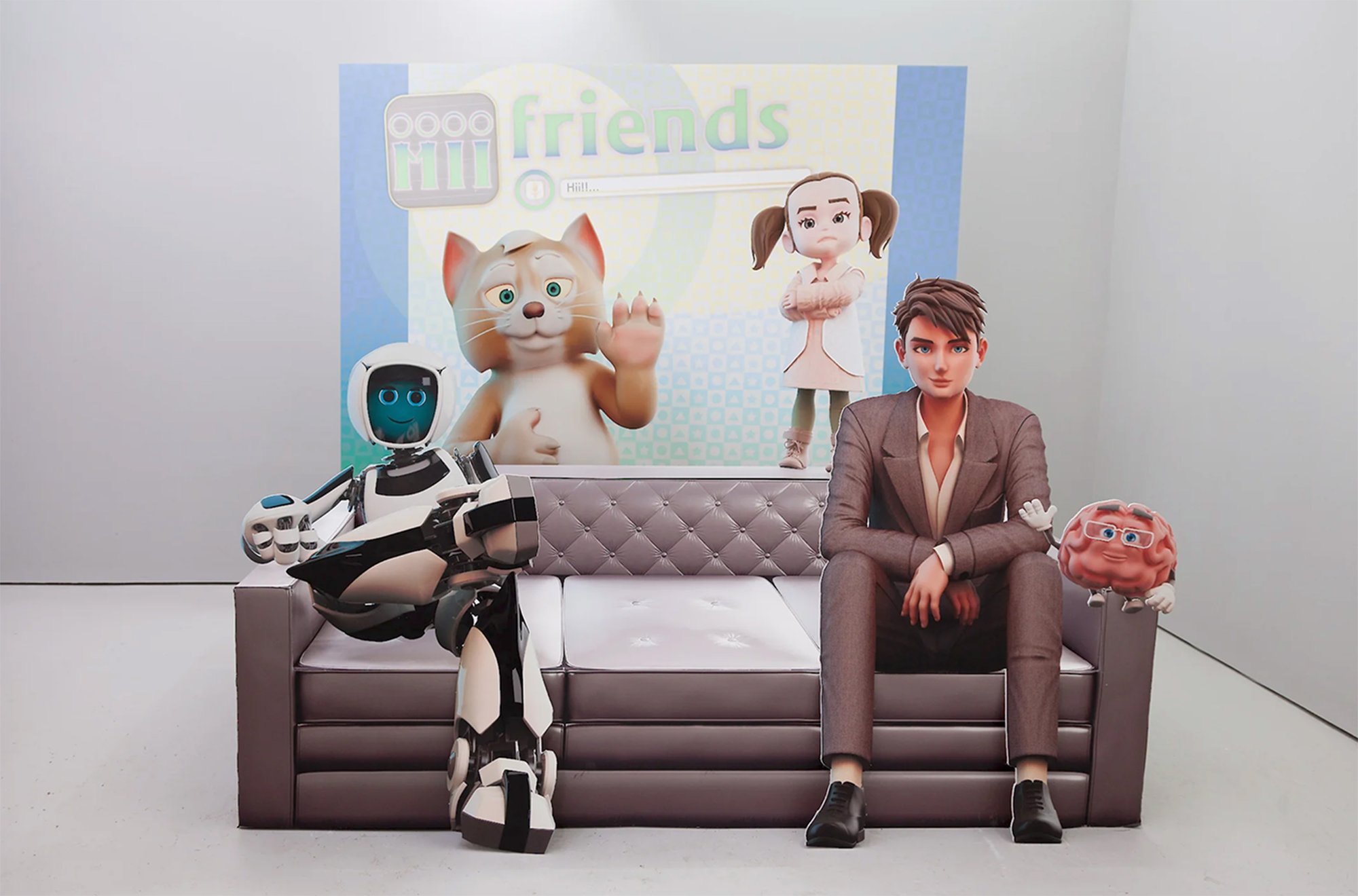
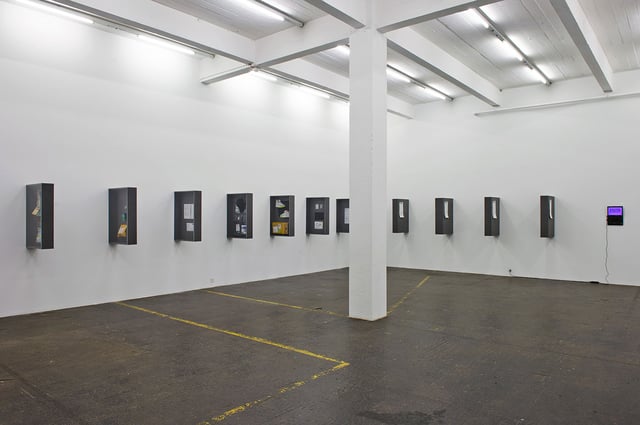
Installation view of Ed Fornieles, “Seed” at Carlos/Ishikawa gallery, 2017, with work: Finiliar (2017). Courtesy of the artist and Carlos/Ishikawa gallery
AM: I’d like to move to Finiliars (2024). The characters in that project evolve over time and are tied to different cryptocurrencies. What drew you to cryptocurrency as a framework for the Finiliars?
EF: One of the things I find most interesting about cryptocurrency is its capacity to generate communities around an asset. The asset is an alibi. The real desire is to find a group, to belong, to have your voice heard, and to feel that you are participating in something meaningful. The Finiliars became clans, or families, organized around particular cryptocurrencies. People’s emotional and financial investment became intertwined with a position and a community. They became loyal to that group. That’s what I wanted to explore.
AM: Did it work?
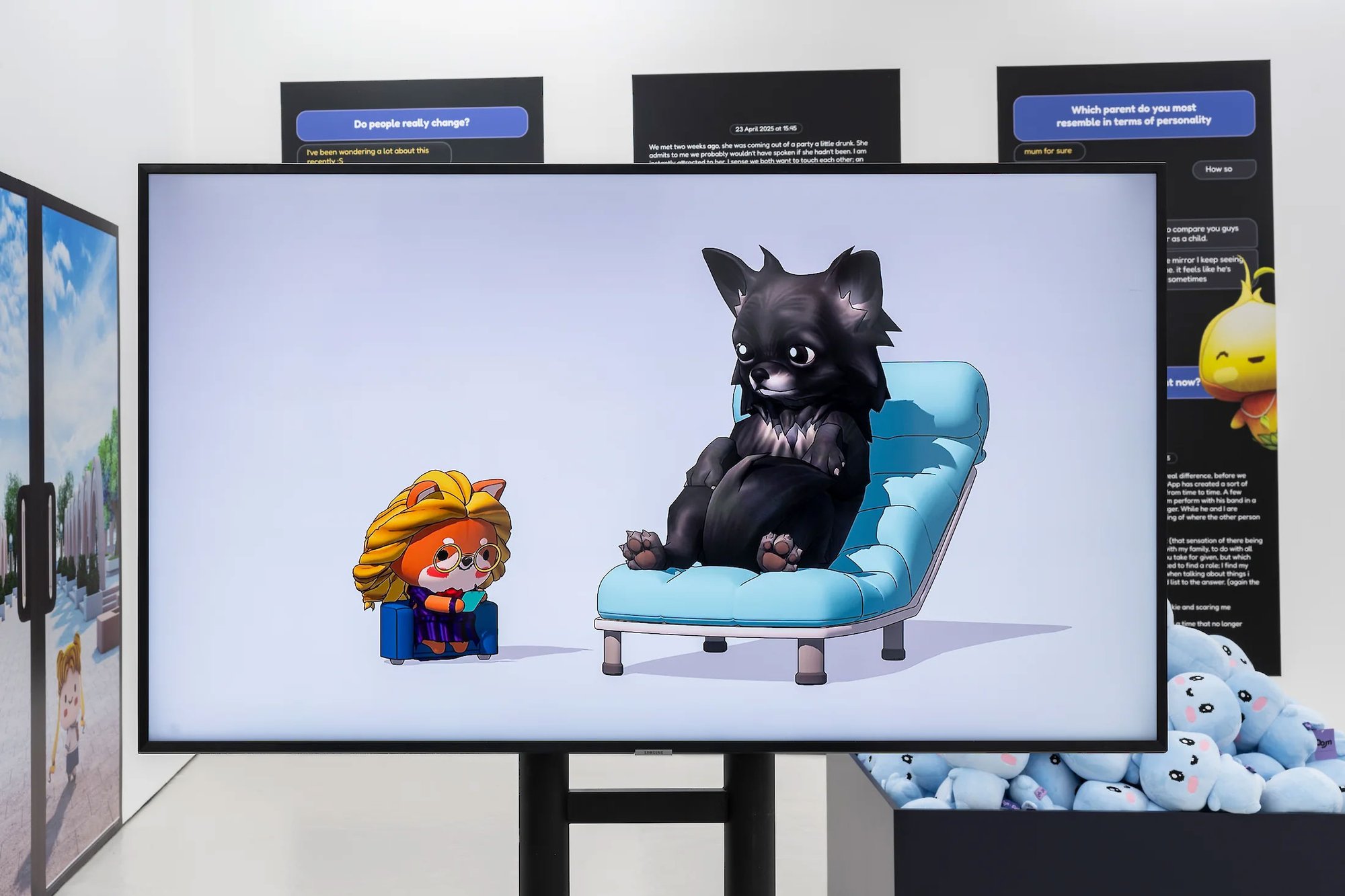
EF: Yes and no. Finiliars was a strange project. I wanted to see whether a company could function as a kind of hyperobject: an artwork that could encompass a limited company, a community, a set of products, a visual language, and the world those things produced together. It existed both inside and outside the gallery. People could inhabit it by buying into the project, spending time on the app, joining the community, or taking part in the experiences it generated, whether that was a dating app, immersive games, animated characters, or other experiments.
In the end, though, running a company as an artist broke me a little. It was fascinating, but eventually the logistics began to obscure the original intention. The demands of management, production, fundraising, community, and expectation became their own machine. We closed the company about a year ago, and honestly it felt like a relief.
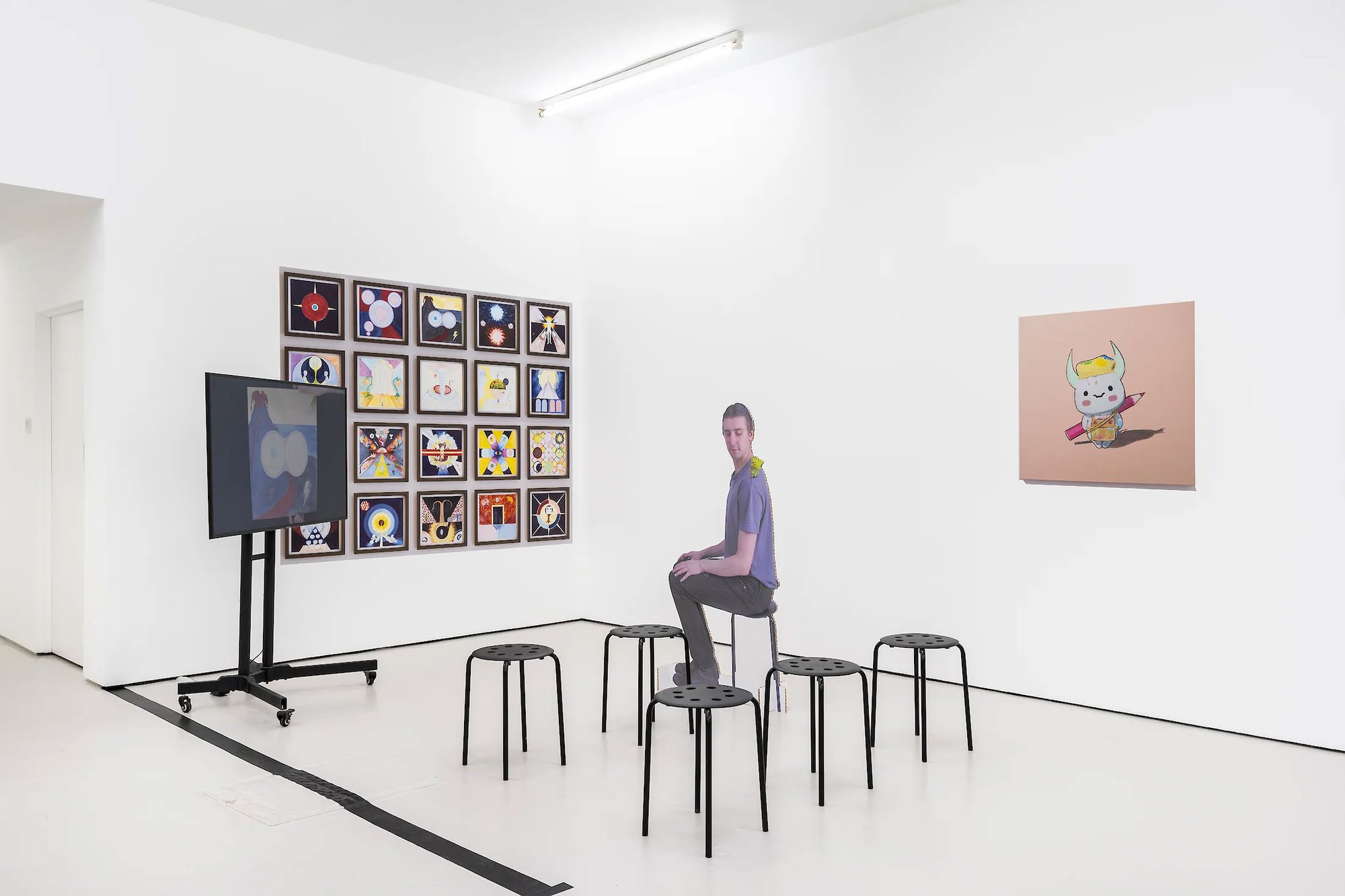
Installation view of Ed Fornieles, “Inside Out 2”, at Carlos/Ishikawa gallery, 2024. Courtesy of the artist and Carlos/Ishikawa gallery
AM:Borrowed Lives: Anon goes back to looking at how people live online. At the same time, you’re bringing the financial asset back into the work by releasing it as NFTs. What interested you about combining those two?
EF: To me, it’s a powerful combination. There are always different questions around a work. What is it about? What’s its materiality? Where does it come from? What is it speaking about? Then there’s the question of how it’s consumed, interacted with or collected. At their best, those things come together.
Borrowed Lives: Anon is about an identity that exists online, or is at least mediated online, and that it’s also collected online by a community that strongly identifies with the web.
AM: So would Borrowed Lives: Anon be different without the blockchain?
EF: The blockchain is an affordance. Like Instagram, TikTok, video, or any other platform of technology, it enables certain things. It allows work to scale through community building and interaction in ways that weren't possible before.
The work itself will eventually exist in a gallery as a nine-screen installation, where the viewer sits in front of, or beneath, an immersive environment. What I’d like to preserve is both worlds: something online and something physical.
AM: Do you feel your role as an artist has changed over the past 15 years?
EF: It’s something I’ve been asking myself a lot. The space in which I’m given permission to play has changed. For a while, I found myself working much more online. But at the same time, I’ve developed a real desire to return to the gallery, to performance, and to the physical world. For a few years, I became a CEO. Coming out of that experience has made me much clearer about the kind of practice I want to commit to.
At the same time, AI is changing everything as we speak. Borrowed Lives: Anon builds on a work I made in 2014 that live-streamed images from Tumblr communities. I would aggregate images from different subcultures into evolving compositions that unfolded in the gallery. At the time it was incredibly difficult to make and pushed me to my limits, both technically and financially.
Ed Fornieles, Borrowed Lives: Anon, 2026. Still from Animated GIF NFT. Courtesy of the artist
Now I’m making something that’s far more complex, but based on the same underlying idea: aggregating images and cultures into a constantly shifting composition. A few years ago, it would have cost many thousands of pounds to build. Today, I can do it with a Claude subscription. That fundamentally changes what an artist can make, and perhaps even what it means to be an artist.
AM: So AI allows you to make the works you wanted to make ten years ago, but couldn’t because they would have required enormous resources.
EF: Hans Ulrich Obrist always asks artists about their unrealized projects. I have a long list of unrealized projects, half-realized projects and almost-realized projects. Now I find myself working through them with AI.
Unrealized projects often acquire a certain aura. They remain potentially perfect because they never have to confront reality.
AI forces you to get your hands dirty. It forces you to make the work rather than hesitate. Borrowed Lives: Anon is an experiment, but it’s also about building a set of tools that will make the next work possible. That process never really ends.
AM: Someone said to me recently, “I’m so over the internet.”
EF: The internet is becoming a dataset. I think that’s changing the way we think about it. It is changing the way we use it. I’m working on another project at the moment in which I’ve been asked to turn myself into an AI. It’s a strange proposition.
The idea is to think of the artist as a dataset: as a collection of aesthetic decisions, ways of thinking, and sensibilities. What does it mean to codify that? What does it mean to have a conversation with it?
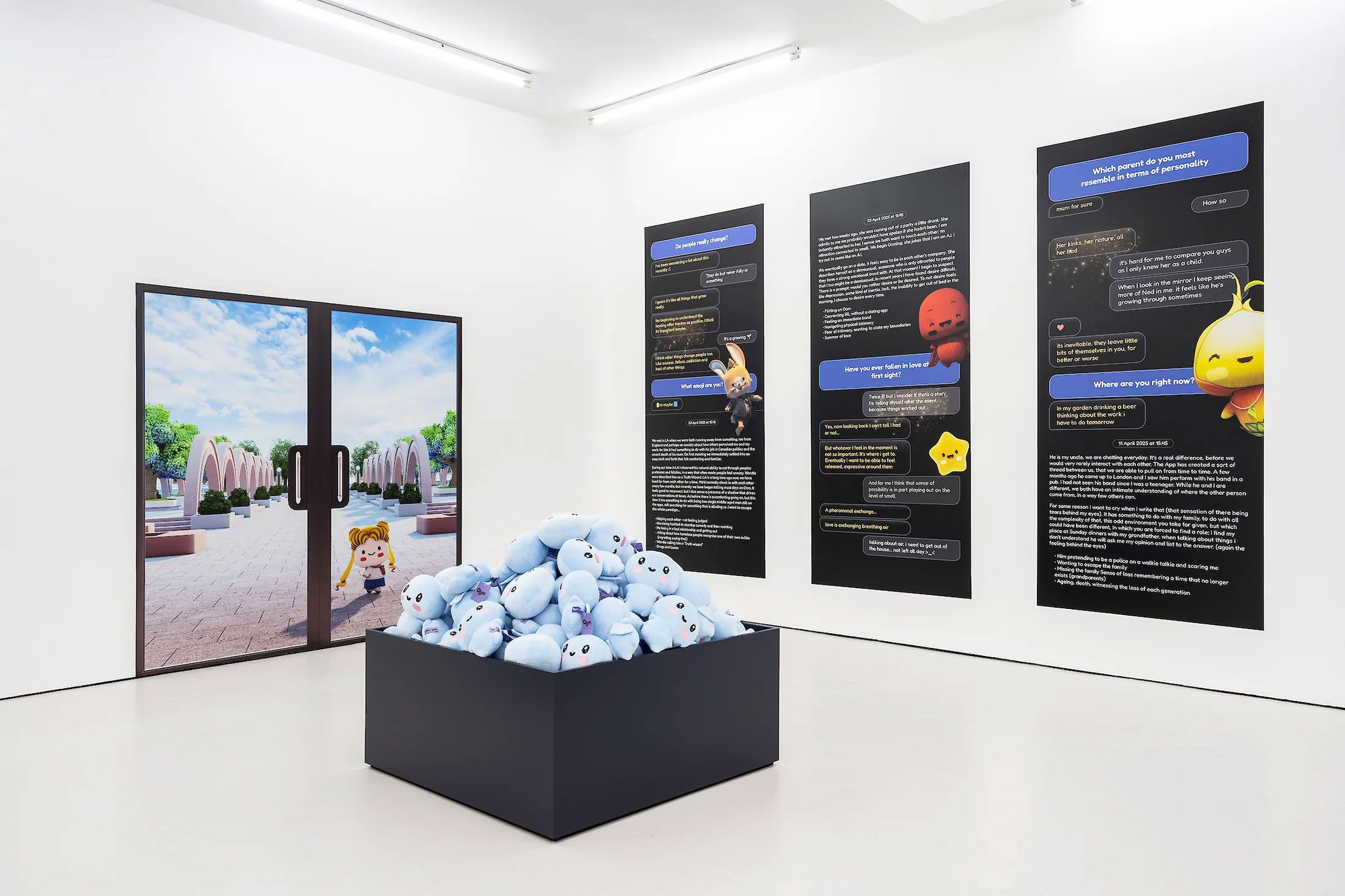
Ed Fornieles, installation view, “Inside Out 2”, 2024. Courtesy of the artist and Carlos/Ishikawa gallery
AM: Where do you still spend your time online?
EF: I’m around, but I’m more interested in communities that come together around specific topics of research. For instance, at the moment I’m doing a fellowship at Somerset House, where we’re looking at automated weapons systems and the impact of AI and automation on warfare.
As part of this, we’ve been organizing edit-a-thons, events where people can edit and update Wikipedia with information about the arms industry: what is being made, by whom, and how it’s being used. So I suppose my time online is now much more focused on research and specialist interests.
AM: I was asking because you’re releasing NFTs, and they come with a very strong sense of community. Is that still something that interests you?
EF: At its peak, Finiliars had more than 12,000 members on Discord. It was incredibly active. People posted every day. They got their children to make paintings of the Finiliars, sewed toys, and created all kinds of things. There was a real sense of collective excitement.
Obviously, NFTs have faded. We’re living among the remnants of that moment now. But I still think there are useful tools and items to take from those ruins.
Ed Fornieles, Borrowed Lives: Anon, 2026. Animated GIF NFT. Courtesy of the artist
AM: What are the useful things left of NFTs?
EF: NFTs can still bring people together around an idea. A sale can become a way of starting a conversation. It can fund an idea, its own kind of hyperstition, where fiction gradually becomes reality. For artists working with technology, NFTs can also make a certain kind of digital practice sustainable, or at least viable.
Looking at the legacy art world, I see a lot of similarities. Over the past decade, the traditional art market has become increasingly conservative. Painting has become the medium that’s most legible to finance, whereas video and digital art have often struggled within that system.
NFTs made digital art legible. They created a form of social and financial currency for digital work. What I also like is that a work can be collected by thousands of people. That allows conversations to happen and spread much more easily.
AM: It sounds more like having fans than collectors.
EF: Often it’s just curiosity, and I think that’s really nice.
Ed Fornieles is an artist working in London. Fornieles’s previous work has used film, sculpture, and immersive role play to investigate how a feedback loop of narratives, images, and actions provides a framework to navigate the world. Fornieles has exhibited at The Serpentine Gallery, Chisenhale Gallery, Martin Gropius Bau, amongst various other institutions and galleries.
Anika Meier is a Berlin-based writer, curator, lecturer, and digital strategist. She teaches in the Department of Digital Art (Class of UBERMORGEN) at the University of Applied Arts Vienna and is the co-founder of The Second-Guess, a curatorial collective based in Berlin and Los Angeles exploring the relationship between humans and technology. She is also the curator and program lead of the objkt labs Residency. Anika Meier has held fellowships at the German Center for Art History in Paris, the German Literature Archive Marbach, and the Institute for Germanic and Romance Studies, University of London. Her work includes collaborations with institutions such as Fondation Beyeler, Musée d’Orsay, Goethe-Institut, and Highsnobiety. She has spoken at Art Basel, re:publica, and Ars Electronica, and writes for publications including Monopol, Kunstforum, Spike, SLEEK, Numéro Berlin, and The AI Art Magazine.