Images After AI | Trevor Paglen
The artist and polymath discusses how machines see with investigative journalist Manisha Ganguly
The artist and polymath discusses how machines see with investigative journalist Manisha Ganguly
We once looked at pictures, then with the advent of computer vision and machine learning, pictures started looking back at us. Now something even stranger is happening: generative AI, ad tech, recommendation algorithms, engagement economies, personalized search, and machine learning are inaugurating a new relationship between humans and media. Pictures are now looking at us, looking at them, eliciting feedback and evolving.
— Trevor Paglen
In his new book, How to See Like a Machine: Images After AI (Verso Books, 2026), Trevor Paglen argues that the last fifteen years have produced two revolutions in our relationship to images, each as consequential as the invention of photography and perspective. The first is the advent of computer vision; the second is generative AI.
The book emerges at a moment when both transformations have become sufficiently legible for broader critical conversation, and when their combined effects are reshaping not only image-making but the foundations of empirical knowledge. Where photography once anchored a shared sense of reality — the Abu Ghraib images, the “napalm girl”, the footage of Rodney King — generative AI has severed that bond. Paglen calls this rupture the “indexical flip”: the moment when audiences ceased to assume that a photographic image bore any relationship to the world and began, instead, to search for proof that it did.
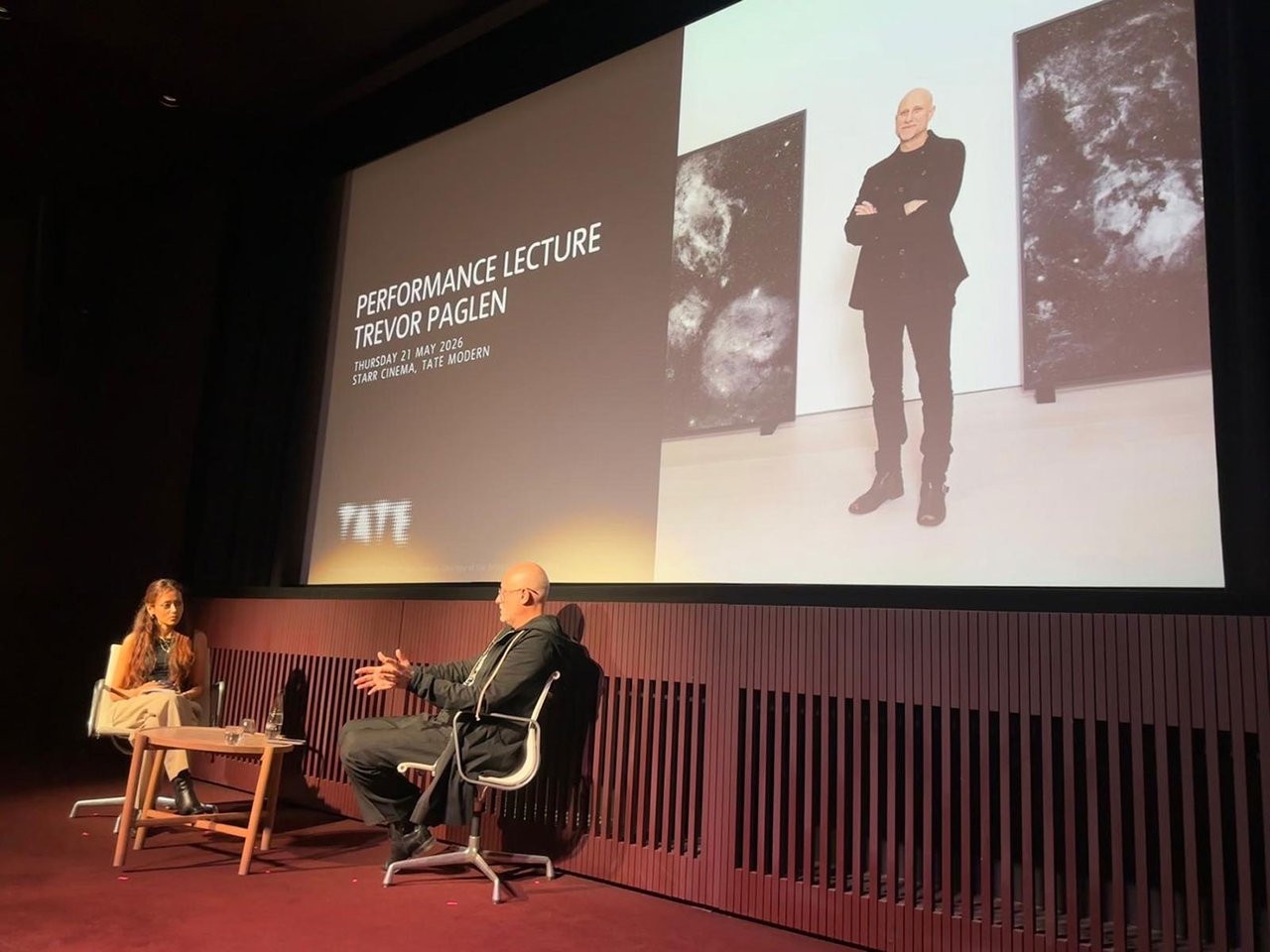
The following conversation was hosted at Tate Modern by the investigative journalist Manisha Ganguly, herself a practitioner working in the forensic tradition that the indexical flip now urgently threatens. Ganguly’s experience documenting the Syrian civil war and, more recently, conducting open-source investigations into Gaza and Ukraine, gives the exchange a distinctive double register: where Paglen theorizes the epistemological crisis from the perspective of an artist and researcher, Ganguly traces its consequences at the level of evidence and accountability. Together, they map a landscape in which AI does not merely generate images but provides an alibi for distrust, political violence, and the collapse of acknowledged fact.
Manisha Ganguly: A lot of this book charts years of your research into image-making and AI, but I want to take you back to the beginning, because at the start of the book you say that you didn’t actually realize its potential before you created an early model of what we now know as generative AI. What was the first experiment that made you think, “Okay, maybe there’s something there”, and why is this the best moment for the book?
Trevor Paglen: The high-level argument of the book is that in the last 15 years or so we’ve undergone two huge revolutions in our relationship to images, each one of which is, in my opinion, as big a deal as the invention of photography or the invention of perspective. The first of those is the advent of computer vision, and the second is the advent of generative AI.
On the question of “why now?” I’ve been writing about this stuff as I’ve been working with it and developing it. I started coming out with projects using computer vision and AI around 2015-16, and people were like, “I have no idea what you’re talking about.” I’m happy that it’s come out now because I think there is enough of a common sense to have a conversation about it that would have been harder five or six years ago.
We started building generative AI systems in the studio around 2015-16, maybe 2014 already.
At that time, I was like: “oh, if this gets really good, maybe it’ll be a plugin for Photoshop” — a really dumb plugin. It took me a while to realize that it is a much bigger deal with much bigger implications.
MG: Was the significance due to the fact it was believable, because some of the early work that you were doing — you definitely knew it was created artificially?
TP: Yeah, I think it was believable, and the other piece of it that I did not anticipate was the ability to generate media at the scale that it’s generated now — to the point where, if you look on any social media feed, good luck finding something that a human wrote.
MG: You were talking about how, earlier, we went to social media to consume media, and now you’re almost trying to find the true images through a tsunami of AI slop.
TP: Yeah, I was noticing that there was a moment coming where there would be a flip where you would start to assume that every text you read and every image that you looked at was AI-generated, and that common sense would change.
For me, the exact moment when that happened was when the the war between the US and Iran started, and I was looking at Twitter, or X, trying to figure out what was going on, and I realized that instead of trying to throw away the pieces of crap that were in the feed I was actually looking for the nuggets of gold.
I had a moment where I almost stepped back and thought, “Oh shit, that happened, on this Saturday.” That was pretty stunning to me. I started calling it the “indexical flip”: where, instead of assuming that an image that looks like a photograph has some relationship to something that happened in the world, you’re assuming it didn’t.
MG: Talking about the flip, one of the early experiments you discuss in the book is where you take Magritte’s famous painting, The Treachery of Images (1929), which includes the text Ceci n’est pas une pipe (This is not a pipe), and put it through an AI image-detection system. Can you talk about that experiment and what you found?
TP: It was a variation: “This is not an apple”. We ran it through a computer vision classifier with an AI back end that’s trying to figure out what things are, and it draws a green box around the apple and says, “this is an apple.” That gave me two chapters of content: one about classification — how we assign different labels to different objects in the world [and] the politics of that, and how those politics get imported into automated systems. Then, the second part looks at the political economy of that: when you name something in a certain way within an automated system, you’re essentially commoditizing a part of the world that was previously difficult to commoditize.
In the 1960s, you absolutely could have hired someone to sit next to everyone driving on the road and monitor how they were driving and adjust their insurance policy in real time, but it would have been ridiculously inefficient.
Now you can track driving, track sleep, give someone a refrigerator that tracks the food they eat — effectively colonize, for lack of a better word, intimate parts of life that in earlier eras were far too inefficient for capital to bother with.
You see this commodification of moments in everyday life, of gestures, brought into a circuit of capital.
MG: Now we’re [witnessing] this feedback loop [...] where images are noting that we are viewing them, extracting feedback, and then feeding more images back to us. How does that change the paradigm of image-making and consumption?
TP: In the book, there are three chapters that form a kind of mega-chapter called “Society of the PSYOP” — a reference to Guy Debord’s Society of the Spectacle (1967) and Foucault’s discussion of the society of surveillance.
I was trying to understand qualitatively how our relationship to media changed when you have those feedback loops and attention mechanisms, and when you have media that is monitoring you in ways that might even be more intimate, while collecting more data from you than you’re collecting from the media you’re looking at. It was interesting to go back and read the army field manual on PSYOPS — you’re like: “Oh, it’s all here, how you do this stuff.”

MG: You started your lecture by saying that things like viruses and fires, and in many cases wars, do not care if you believe in them or not, but we’re seeing this fragmentation of society into echo chambers, where we’re effectively in an information marketplace and you can choose your facts. Where do you see things heading?
TP: I do think that the old Enlightenment deal is probably cooked, and what I mean by that is: you collectively decide to believe in empiricism, you try to organize society around the theory that people are going to have a collection of shared facts and that you have rational deliberation over them — that’s how you have a democracy.
Now, it’s never worked exactly that way, but let’s call that the ideal type of modern or liberal democracy. That’s probably cooked because the empirical grounding on which it’s based has a lot to do with photography in the sense that if I show you the images from Abu Ghraib, we’re going to agree that that happened. We can argue about what happened, but we agree that it happened. Rodney King [and] the “napalm girl” are canonical examples. But in the post-indexical-flip moment, I don’t know if that works in the same way.
Where is this going? There are a couple of options. You can do fascism — fascism loves making images and image worlds and fantasies; that’s a big part of it. You can do some kind of lizard-brain chaos, which is the cultural form of the same thing. Or you can try to alter your relationship to images collectively.
If I’m looking at an image online, I’m much more conscious of the psychological trick being used to try to harvest my attention at this moment. A lot of these moments where my lizard brain would just be attached to something, I try to kick up to my rational brain — what’s happening here? They’re using this trick.
I have a fantasy about making a catalog of tricks that platforms use to harvest your attention. My friend Gideon Jacobs thinks that’s the path forward. I’m less sure. I don’t think that’s going to be the thing that saves us because our lizard brains just override our rational brains whenever you put them in competition with each other.
A third path forward is to start thinking very seriously about cognitive and perceptual health [and] about social media feeds as akin to the tobacco industry. That conversation can be much more robust, and we can take very seriously the cognitive effects that this kind of wild-west attention economy has on us, and not dismiss it as being just some online practice.
MG: If we take the brain experiment you were doing on yourself to its logical conclusion, do you see a future where you could create an image that is the most terrifying thing ever seen, which is then used as a tool of suppression or submission?
TP: Yeah, 100%. I’m doing all this work with neuroscientists right now, and what they’re really worried about — I’ll use the metaphor of the helmet — is you’re going to go to work, and you’re going to put on a helmet, which you’re going to use to control your computer. You’ll have this direct neurological relationship to your workplace or your environment.
They’re worried about: if you think about the word “unionized”, do you just automatically get fired? Is your performance being evaluated in real time? Is your pay being modulated in real time based on performance?
You get into this whole world of extreme surveillance, and you can scale that out to society in general.
When I started that project several years ago, most neuroscientists were saying that it would never happen, and the reason was that, if you’re not in an fMRI machine or you don’t have a chip in your brain, your skull is a pretty big shield between you and any sensor. Language models have changed that now for the reason that you can use them to reconstruct a thought or mental image from much coarser data. If the helmet is getting coarse data, but it knows you thought about the phrase “quick fox lazy”, it will synthesize the pattern: “the quick brown fox jumps over the lazy dog”. [Because] most of the thoughts you have are patterns that exist in the universe, they’ve gotten much more worried about language models.
TP: But I have a question for you because you’re involved in OSINT (open-source intelligence) and in the evidentiary exploration of photography, images, and media, which, paradoxically, has been invigorated by the proliferation of cameras at the same time. Could you talk a little about how you’re trying to understand indexicality — and the relation of photographs to the world — through some of that work?
MG: Most of the work I started doing during the Syrian civil war was collecting images — that was the most documented war at the time, because of three ingredients: the rise of smartphone cameras, internet connectivity, and social media.
Previously, when you had images of war crimes or arms smuggling, it had to literally be taken by a photographer who got really lucky and managed to smuggle the photos out. But now you had war criminals themselves, and people who were engaging in these criminal activities, taking photos and uploading them on social media. You had the proliferation of trophy videos everywhere, and we had this brief golden age of accountability, where we thought that these images could be used as evidence. But the opposite happened. The images basically created a culture of more war crimes and incited people to continue without any accountability.
Now I’ve come to the point where [...] I’ve been using live-stream cameras, working with journalists on the ground to try and investigate war crimes in Gaza due to the block on foreign reporters on the ground. But the problem right now for me is the liar’s dividend: you can have the most forensic image of the most well-documented war crime and somebody can still point at it and say: “I don’t believe you.” It’s creating this ecosystem where even if you have the most forensically evidenced fact, it’s something you can choose or not choose to believe. There’s a choice now which previously we didn’t have — the death of empirical reality, as you call it.
TP: At the end of the day, [...] it becomes another device for reinforcing the predisposition, and the AI gives you an alibi for trusting what you want to believe.
Trevor Paglen is an artist whose work spans image-making, sculpture, investigative journalism, writing, engineering, and numerous other disciplines. Paglen has had one-person exhibitions at the Smithsonian Museum of American Art, Washington D.C.; Carnegie Museum of Art, Pittsburgh; Fondazione Prada, Milan; Barbican Centre, London; Vienna Secession, Vienna; and Protocinema Istanbul, and has participated in group exhibitions at the Metropolitan Museum of Art, New York; the San Francisco Museum of Modern Art, and Tate Modern, London.
Paglen has launched an artwork into distant orbit around Earth in collaboration with Creative Time and MIT, contributed research and cinematography to the Academy Award-winning film Citizenfour (2014), and created a radioactive public sculpture for the exclusion zone in Fukushima, Japan. He is the author of several books and articles on subjects including experimental geography, artificial intelligence, state secrecy, military symbology, photography, and visuality. In 2014, he received the Electronic Frontier Foundation’s Pioneer Award and, in 2016, he won the Deutsche Börse Photography Prize. Paglen was named a MacArthur Fellow in 2017. In 2026, Paglen was named the winner of the LG Guggenheim Award. Paglen’s sixth book, How to See Like a Machine: Images After AI (2026) is published by Verso Books. Paglen holds a BA from the University of California, Berkeley, an MFA from The Art Institute of Chicago, and a PhD in Geography from UC Berkeley.
Dr Manisha Ganguly is an award-winning investigative journalist, filmmaker, and academic focused on conflict, visual evidence, and emerging technology. She is an investigative correspondent and leads visual forensics at The Guardian, previously working as investigative producer for the BBC. A pioneer of open-source investigations, her reporting has been cited by the United Nations and led to EU sanctions. She is a European Press Prize laureate, a Forbes Under 30 honoree, and has been shortlisted for this year’s Orwell Prize.
With thanks to Annie Bicknell.
No comments yet. Be the first to share your thoughts.
Mentioned in this article
People: Manisha Ganguly, Trevor Paglen|Works: How to See Like a Machine: Images After AI|Organizations: Pace Gallery, Tate Modern, Verso Books|