“The Hand of AARON | Harold Cohen’s Freehand Line Algorithm” is part of a special series of three essays commissioned by Right Click Save from the distinguished computer scientist and son of Harold Cohen, Paul Cohen, dedicated to the language of digital art. Read his other essays on “The Trouble with Terminology” and “On Creativity in Digital Art”.
From the program’s inception around 1973, I had been convinced that AARON would need to be built upon a convincing simulation of freehand drawing, and gave much attention to modeling the feedback-dependent nature of human drawing behavior.¹ (Harold Cohen)
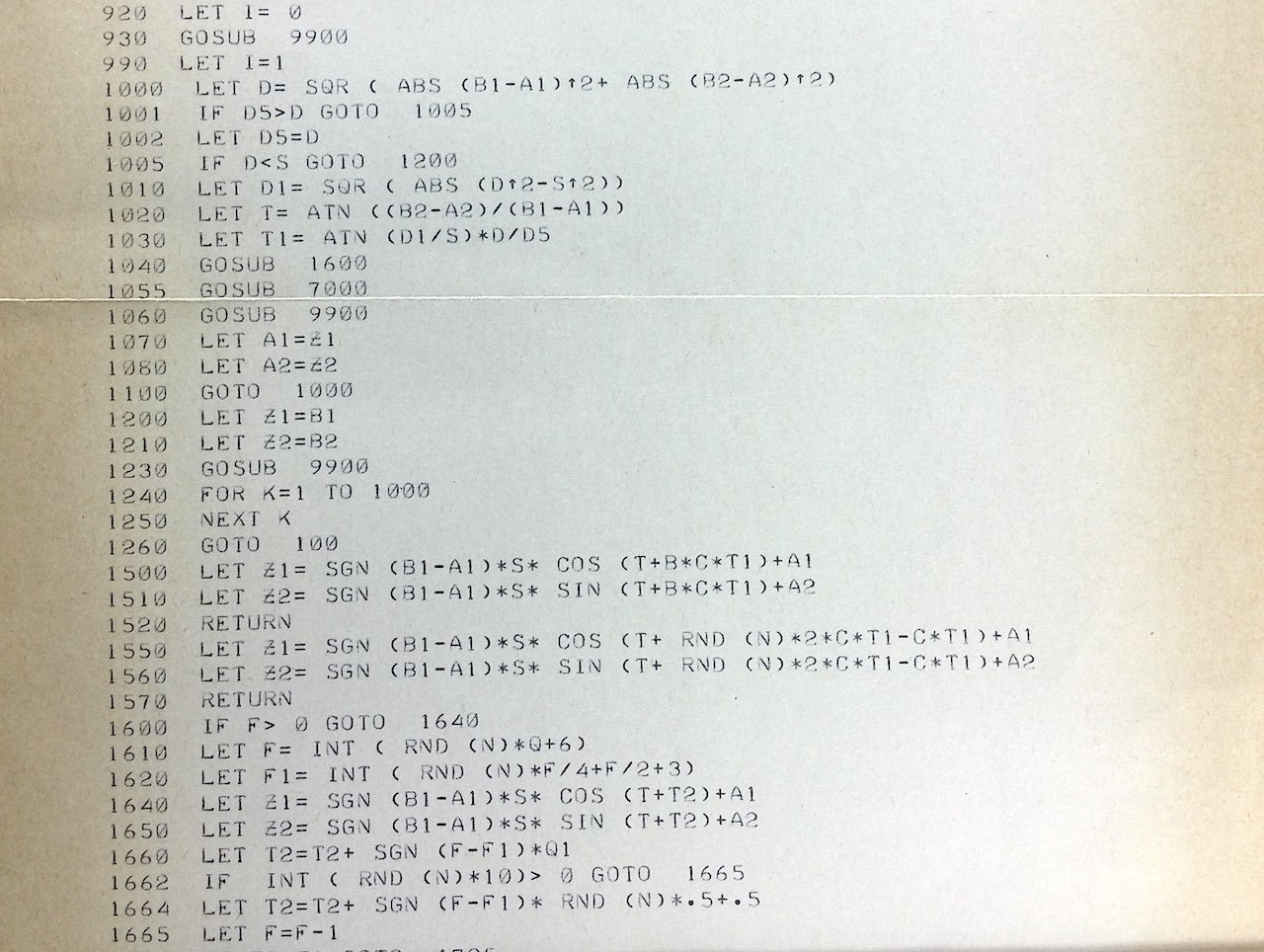
In 2023, seven years after Harold Cohen died, Tom Machnik found a faded strip of teletype output jammed into one of Harold’s old notebooks (Fig. 1). As the artist’s studio manager, Tom knew that he was holding a very early program written in a primitive language called BASIC; the oldest surviving snippet of Harold’s code and, it turned out, one of the most important. Tom had discovered an early implementation of the artist’s Freehand Line Algorithm (FLA).
Figure 1 Part of the 139 lines of BASIC code that implement Harold Cohen’s Freehand Line Algorithm. Courtesy of the Harold Cohen Trust
As Harold’s son and a computer scientist myself, I set about deciphering the code, reimplementing it in Python and experimenting with it. The calls to SIN, COS, and ATN (arctangent) told me that the code was constructing circles and vectors, while looping extensively, but how these constructions produced freehand lines was unclear.
As I slowly figured it out, I recognized some foundations of my father’s approach to digital art: his commitment to process over appearance, the roles of feedback and randomness, the source of AARON’s approachable style, and his lifelong commitment to lines that appeared to be drawn by hand. But none of these foundations is explicit in Harold’s code.
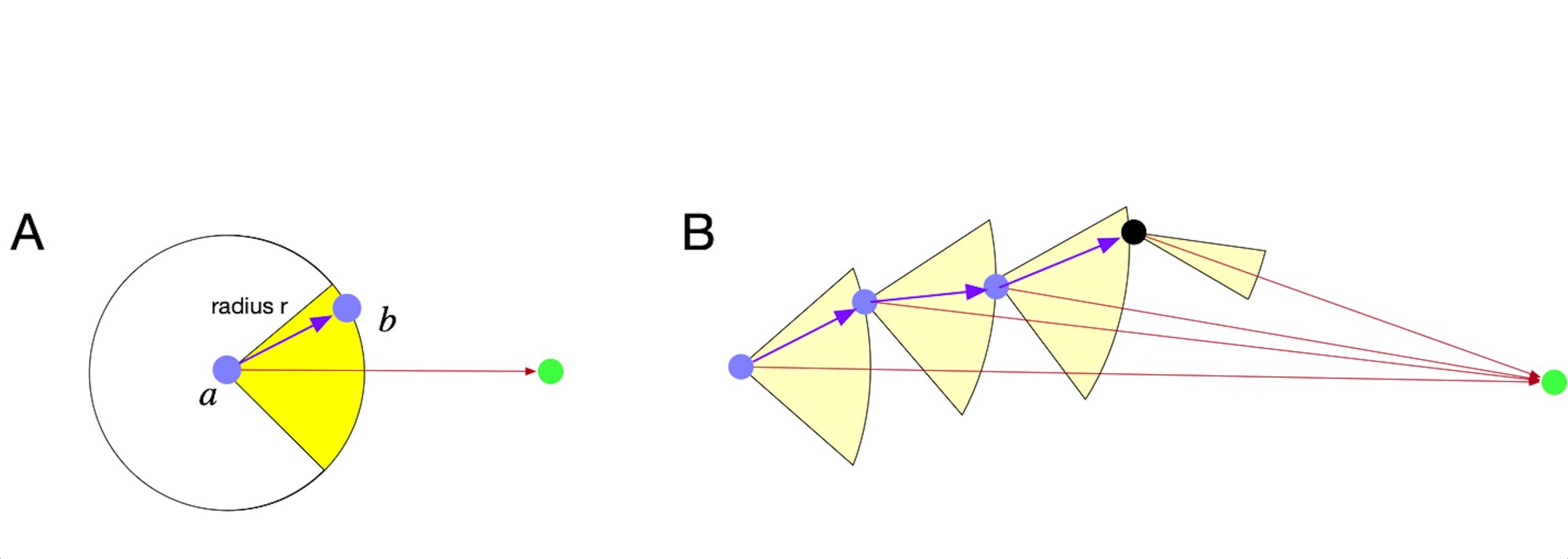
Code tells computers what to do, but we must look to the design and behavior of programs to understand Harold’s goals. The design of the FLA is illustrated below in Figure 2. To draw a freehand line from point a to the green destination point, the FLA draws a sequence of line segments of length r. These will generally not lie along the red straight-line vector, but will instead deviate by an angle selected at random within a “wedge” (shown in yellow in Fig. 2A). After constructing line segment ab, the process repeats from b.
Figure 2A To draw a freehand line between the violet and green points, draw a short segment of length r with a random angular deviation from the red direct line, bounded by the yellow “wedge”. Figure 2B As the length of the red vector decreases, the allowed angular deviation decreases.
This process will usually not reach its destination. Rather, it will overshoot and then correct, producing a rough spiral. Human-drawn lines don’t have this pathology because we draw based on visual feedback. We can connect two points with a line, but because our hands are not perfectly steady and our hand-eye coordination is not instantaneous, the line will not be perfectly straight. Harold realized that these deviations could serve as evidence of intentionality:
“Most of the time the feedback is required — and the artist can claim no exemptions in this regard — by the unpredictability of the equipment we use, whether that unpredictability is caused by arthritis or worn bearings, lack of muscular coordination or sloppy steering [....] [t]he constant complex decision-making which actually takes place, and which is clearly evident in the articulation of the line, confirms the viewer’s belief in the artist’s intentionality.”²
The FLA implements feedback through its evaluation of the red vector from the current point to the destination (Fig. 2B). This vector expresses both the distance to the destination and how sharply the line must change direction. When the deviation is large and the distance is large, the FLA says: “I’m not worried, I still have plenty of time to adjust my path.” But when the deviation is large and the distance is small, the FLA reduces the size of its wedge to pull the next segment closer to the red vector. These adjustments happen with increasing frequency as the distance to the destination decreases.
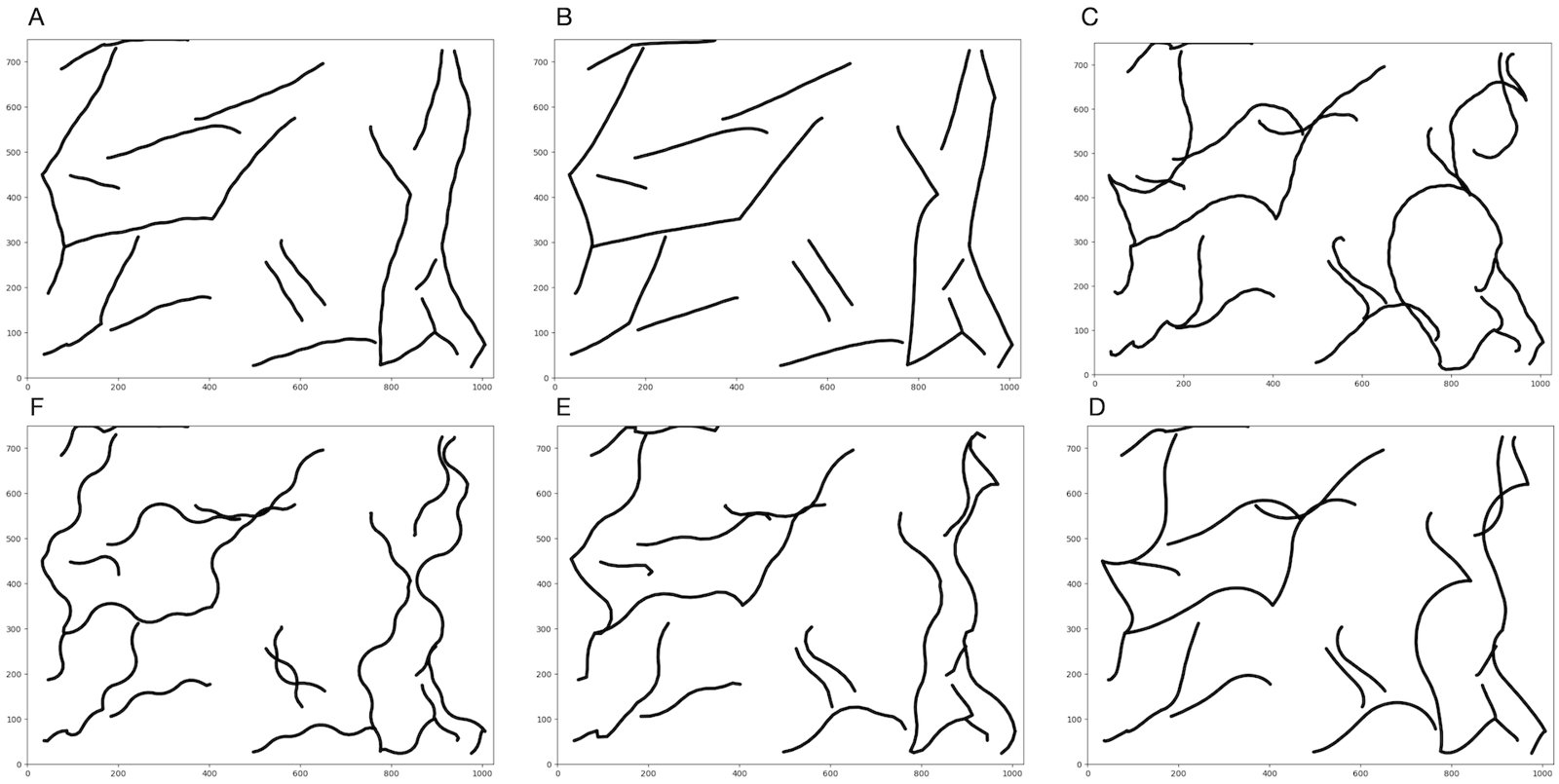
Figure 3 One drawing made with freehand lines generated by six settings of the FLA parameters. Courtesy of Paul Cohen
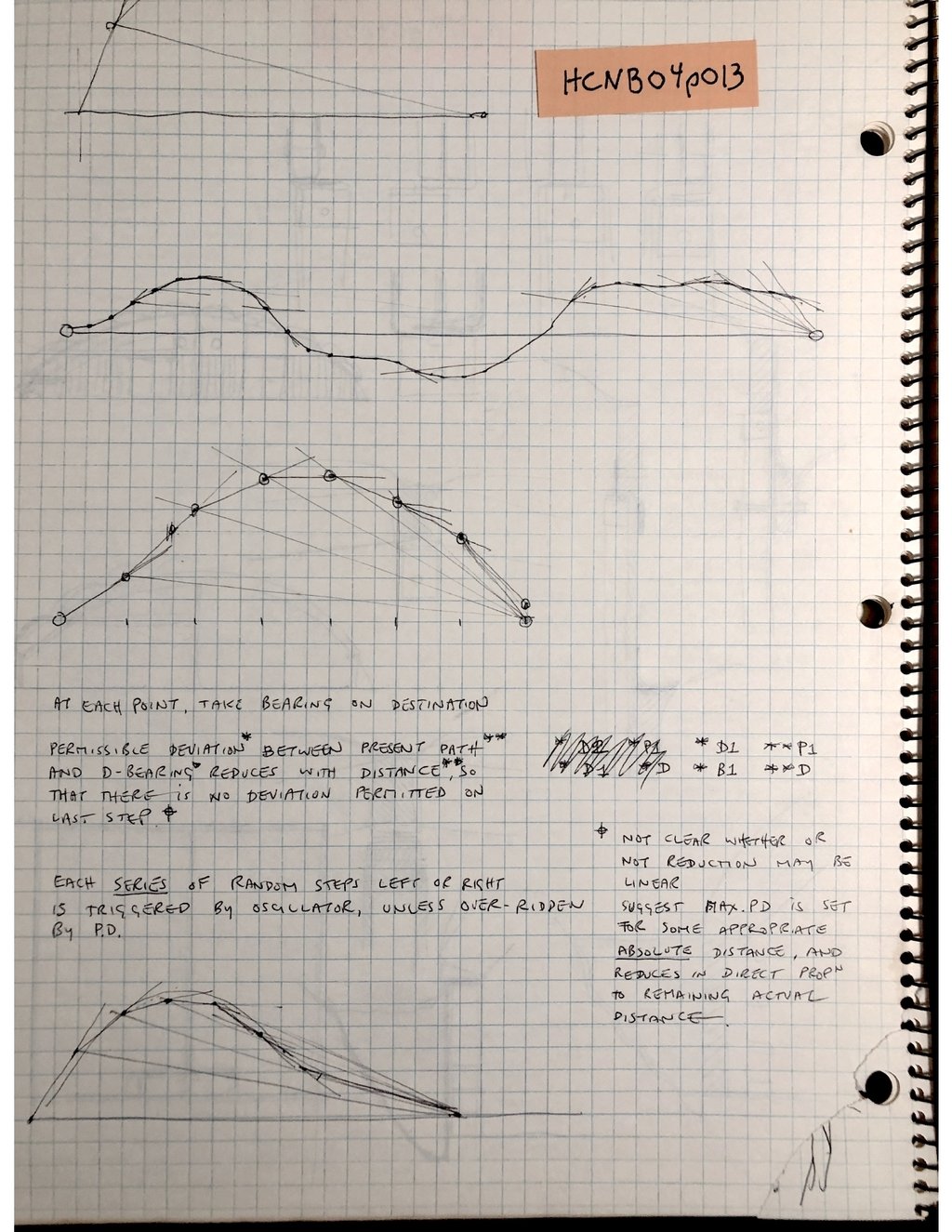
You can play with the FLA and even use it to render your own drawings here. The five parameters of the FLA produce a wide range of “styles”, some of which are shown in Figure 3. As far as I know, Harold viewed this variety as a fortunate side effect rather than the main purpose of the FLA. His notebooks and essays reveal quite clearly what he wanted from the FLA: iteratively constructed, feedback-driven lines (Fig. 4).
It might seem paradoxical that the FLA, which was designed to evoke intentionality, should depend on randomness, which generally erodes the impression of intentionality (note the many calls to RND in Fig. 1). But the FLA does not draw random lines, it draws lines that respond to random perturbations. If the FLA did not inject random deviations into its lines, they would be perfectly straight and there would be nothing for feedback to respond to nor any illusion of intentionality.
For Harold, the illusion was not threatened by randomness, but rather enhanced by humanlike adjustments to random deviations, which is how humans actually draw.
Figure 4 A page from one of Harold Cohen’s notebooks in which he developed his Freehand Line Algorithm. Courtesy of the Harold Cohen Trust
All the pioneers of digital art — Charles Csuri, Manfred Mohr, Vera Molnar, Frieder Nake, and Georg Nees — relied on mathematical curves and straight lines. Harold thought that such obviously artificial lines would not convey intentionality. He regarded mathematical curves as poor attempts to approximate the appearances of human-made drawings, and that no appearance-driven strategy would succeed:
“What seemed certain to me, and still does, is that freehand drawing involves an elaborate feedback mechanism, a continuous matching of current state against desired end state and a continuous correction of deviation [...] [I]t never seemed to me that the dynamic qualities of drawing would be captured by spline interpolations. Indeed, it never seemed to me that those qualities would be reproducible by trying to mimic appearance at all.”³
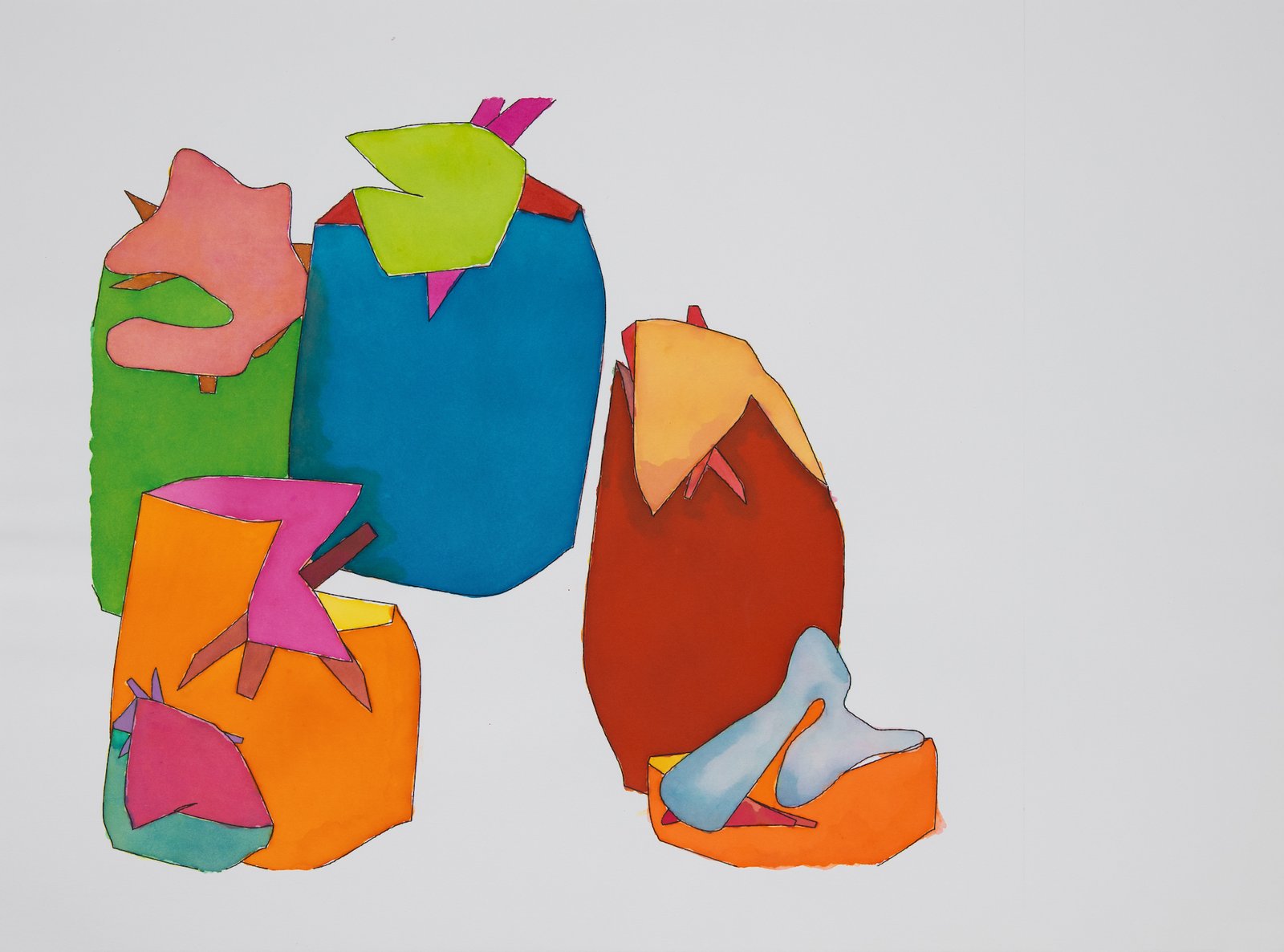
Harold Cohen, Untitled (i23-3912), 1982. Colored dye over plotter drawing in ink on paper. Courtesy of Gazelli Art House & Harold Cohen Trust
Here we see Cohen’s most fundamental stance: Art is generated by art-making processes, not by adjusting appearances based on splines or lines or, today, the colors of pixels. The viewer wants to be convinced that a work of art is constructed at every level, from line to color to composition. According to Harold,
“AARON’s strength lies in the fact that it is designed to operate within, and feed into, the transactional context, not to reproduce the aesthetic qualities of existing art objects. It takes full advantage of the viewers’ predispositions and does nothing to disabuse them: indeed, it might fairly be judged that some parts of the program — the simulation of freehand dynamics, for example — are aimed primarily at sustaining an illusion.”⁴
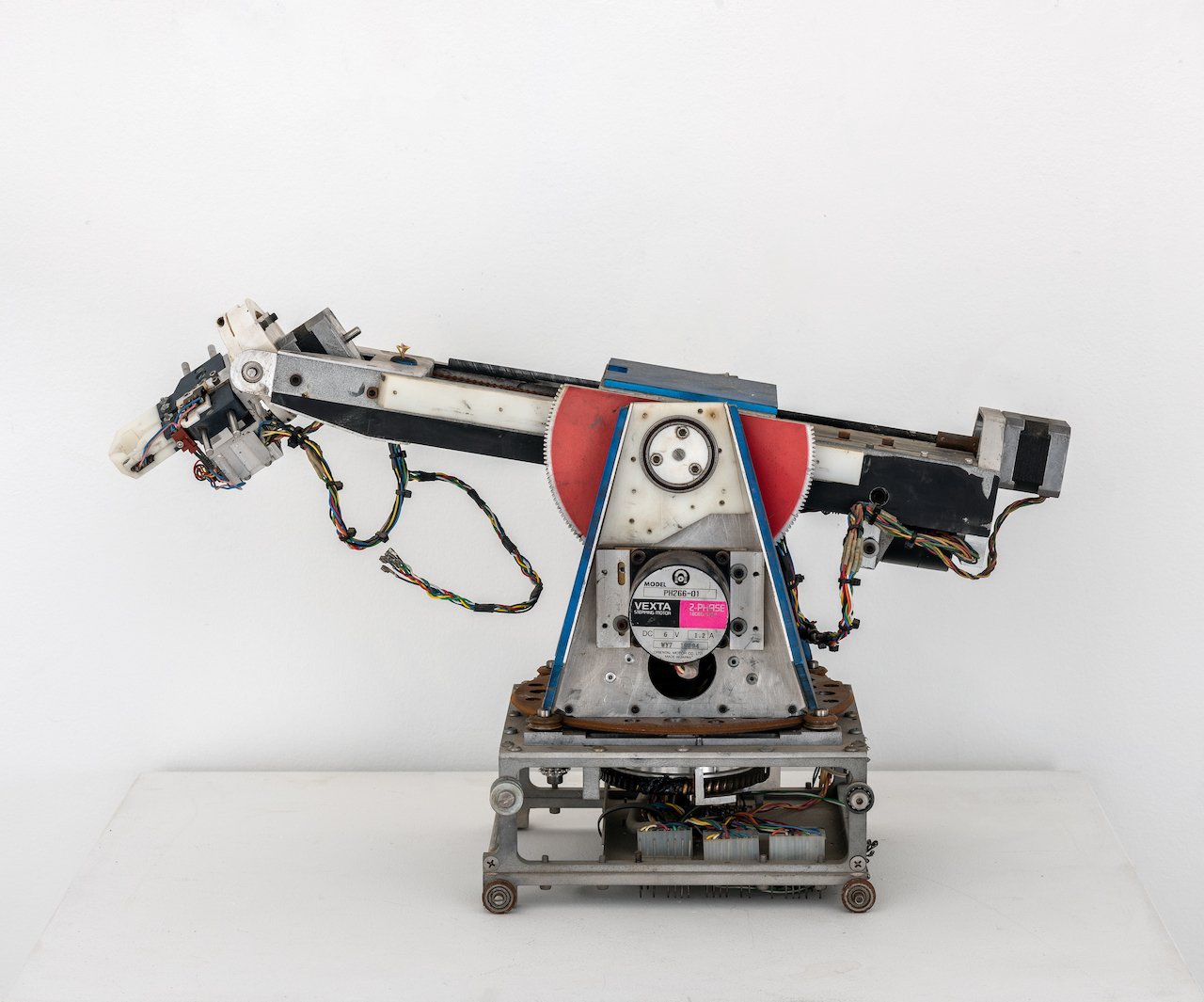
Harold was so intent on creating this illusion and so confident in Gombrich’s idea that a work of art is completed by its audience that he built plotters and painting machines to show museumgoers that AARON, itself, was making images. Recounting his exhibitions at documenta 6 and the Stedelijk Museum in 1977, he wrote:
“A virtually universal first assumption of the audiences was that the drawings they were watching being made by the machine had actually been made in advance by the “real” artist, and somehow “fed” to the machine. After it had been explained that this was not the case viewers would talk about the machine as if it were a human artist. There appeared to be a general consensus that the machine exhibited a good-natured and even witty artistic personality, and that its drawings were quite droll.”⁵
Harold Cohen, Drawing Machine (Arm), 1980. Steel, copper, plastic. Courtesy of Gazelli Art House & Harold Cohen Trust
Harold was surprised by these attributions of personality:
“[...] I know of nothing in the program to account for it. [....] But I am forced now to the conclusion that these more elusive elements of evocation — personality is only one of them, presumably — are generated out of the complexity of the program as a whole, and not from the action of program parts; that given an adequate level of complexity any program will develop a ‘personality’.”⁶ (Harold Cohen)
While Harold didn’t expand on what he meant by “complexity”, it is well known that dynamical systems can create sequences of points in space that have distinctive personalities — think of fractal images such as the Mandelbrot set. Harold detested fractal images, but his FLA is in fact a dynamical system, as illustrated in Figure 2B. It isn’t surprising that the FLA generates lines that have personalities.
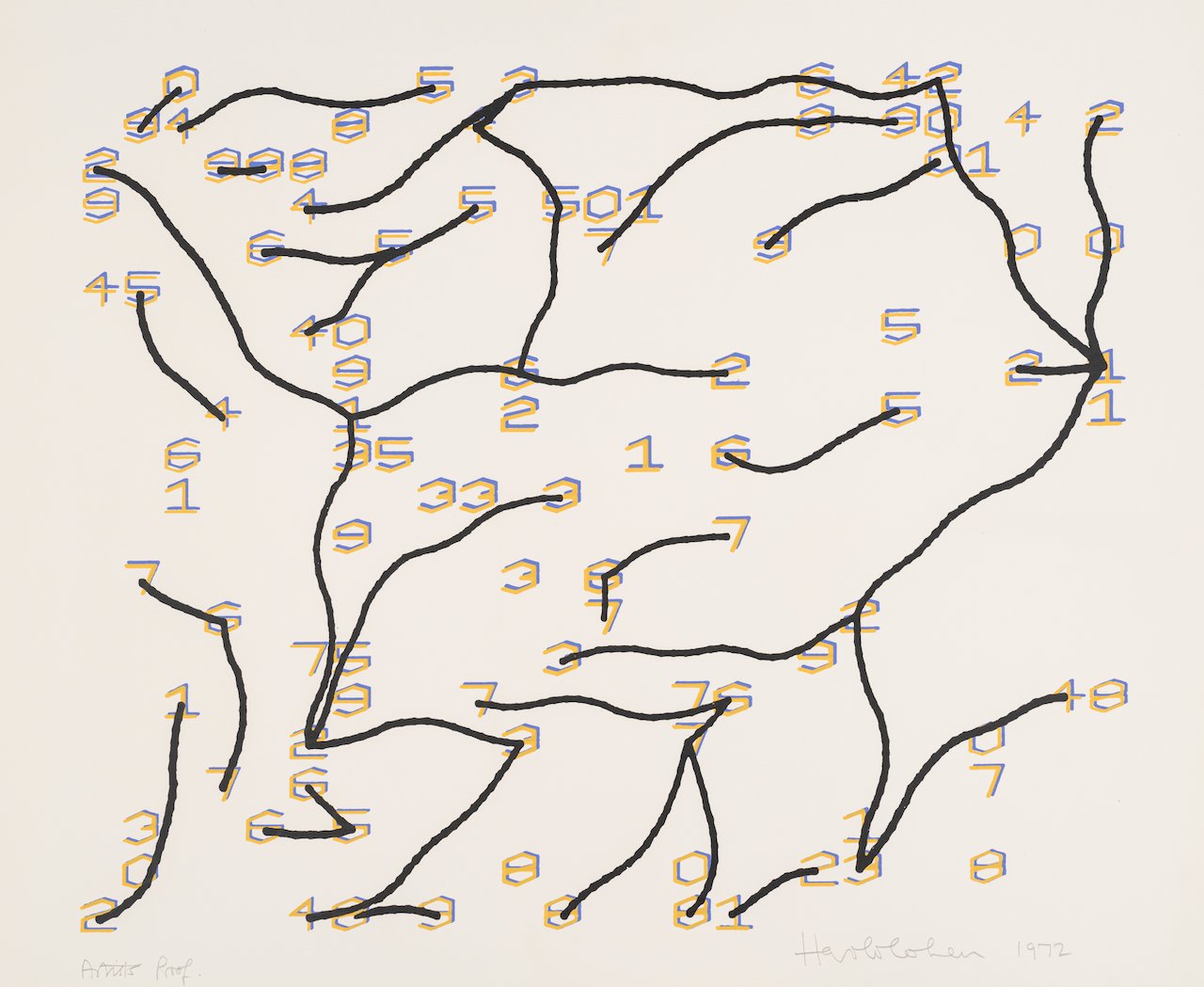
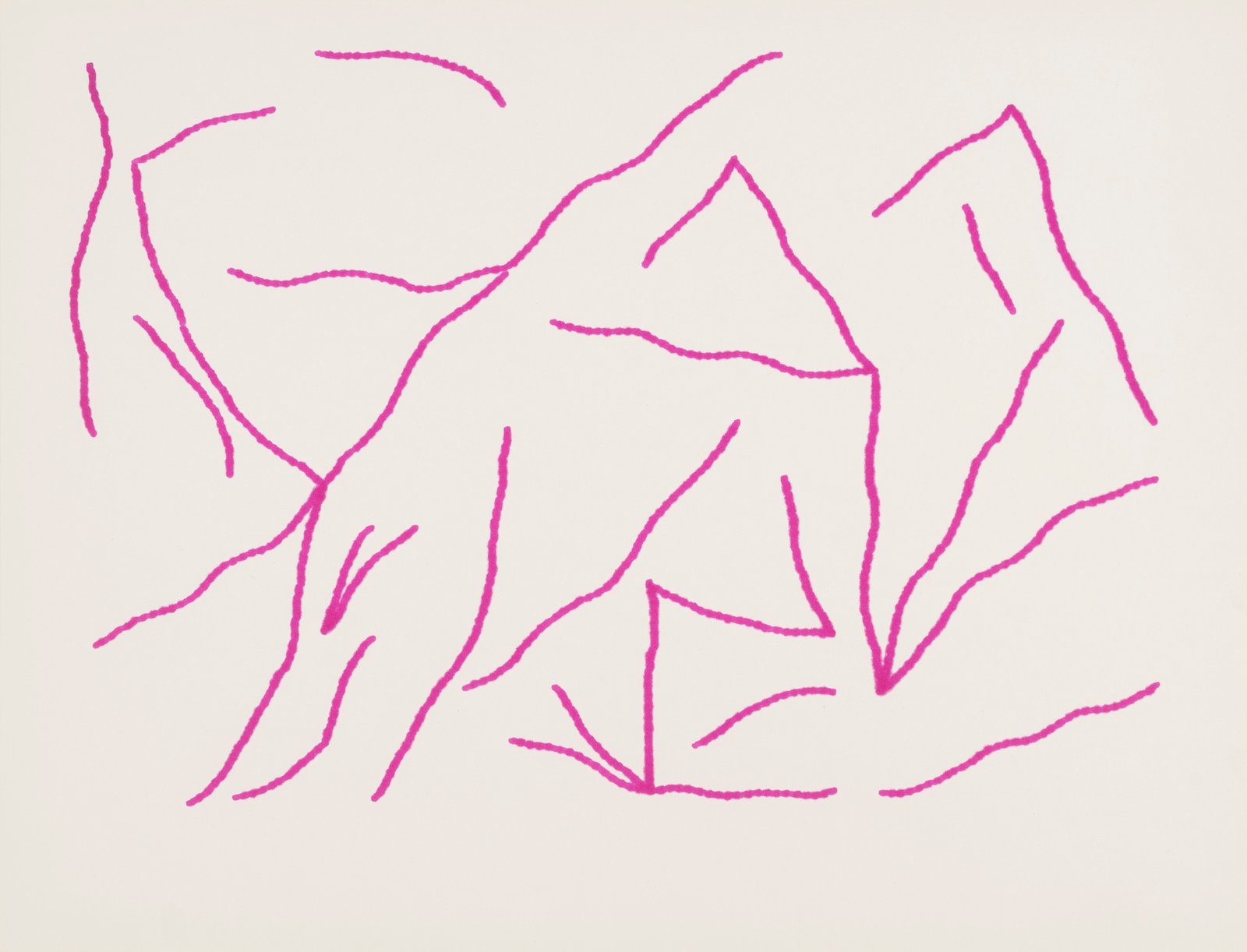
Harold Cohen, Untitled (i23-3505), 1972. Drawing machine drawings in ink on paper. Courtesy of Gazelli Art House & Harold Cohen Trust
The FLA is more than a line-drawing algorithm, it is Harold’s first realization in code of attitudes that he developed as a painter in the 1960s: art should evoke intentionality, and it should seem to be about something even when its forms are abstract.
Harold reasoned that feedback-driven lines would appear intentional because their meanderings are read as corrections, which imply intent. To solve the awkward problem that computers draw precise lines without need for correction, the FLA deliberately injects randomness, thereby simulating the imprecision of human hand-eye coordination.
Now it’s clear why Harold rejected straight lines and mathematical curves: they squander an opportunity to evoke intention, and no human can draw them. They scream, “MADE BY MACHINE”.
Harold Cohen, Untitled (i23-3938), 1973. Unique plotter drawing in ink with addition of pencil on paper. Courtesy of Gazelli Art House & Harold Cohen Trust
Of course, FLA lines are made by a machine. Moreover, the intention-evoking feedback of the FLA is a response not to the state of the image, but to endogenous randomness. Harold acknowledged this artificiality by calling the FLA a simulation that creates an illusion of intentionality. However, he dropped these words when AARON started to use distinctly non-human methods for composition and, most impressively, for color.
Harold knew that human color choices are driven by visual feedback, but AARON had no visual system and, even if it had one, Harold was not able to explain how he made his own color choices.
There was never a question of AARON being a simulation of Harold’s coloring, or that of any human colorist. Its coloring strategies were so non-human, so alien to human practice, and so good that Harold regarded AARON as an expert colorist in its own right.
If you sense in AARON’s images a recognizable “hand” or personality, you aren’t wrong. Harold used the FLA for four decades, and in every iteration of AARON until 2012. In little projects of my own, I find that the FLA gives any drawing a familiar “Harold Cohen” character. As part of its 2024 exhibition on Harold Cohen, the Whitney Museum of American Art acquired my reimplementation of the FLA for its permanent collection, recognizing Harold’s algorithm and its implementation of humanlike feedback as a fundamental contribution to digital art.
Paul Cohen is a professor of Computer Science at the University of Pittsburgh and the CEO of Causerie.AI, which extracts knowledge from text at scale. Prior to becoming the Founding Dean of the School of Computing and Information at Pitt in 2017, he was a program manager in DARPA’s Information Innovation Office, where he designed and managed the Big Mechanism, Communicating with Computers, and World Modelers programs. He worked at DARPA under an IPA agreement with the University of Arizona, where he founded the School of Information: Sciences, Technology and Arts, now the School of Information. His research is in aspects of artificial intelligence and cognitive science, with interest in how language, communication, and AI methods can foster understanding of highly complicated systems such as cell signaling pathways, biophysical, and socio-economic systems. He is the son of the artist Harold Cohen.
With thanks to Alex Estorick, who conceived, commissioned, and edited this series.
¹ H Cohen, “How to Draw Three People in a Botanical Garden”, Paper presented at University of California, San Diego, 1987, 3.
² H Cohen, “The Material of Symbols”, Paper presented at First Annual Symposium on Symbols and Symbol Processes, University of Nevada, Las Vegas, August, 1976, 18.
³ Ibid., 16.
⁴ H Cohen, “What is an Image?” Paper presented at University of California, San Diego, 1979, 21.