·
Article Discussion
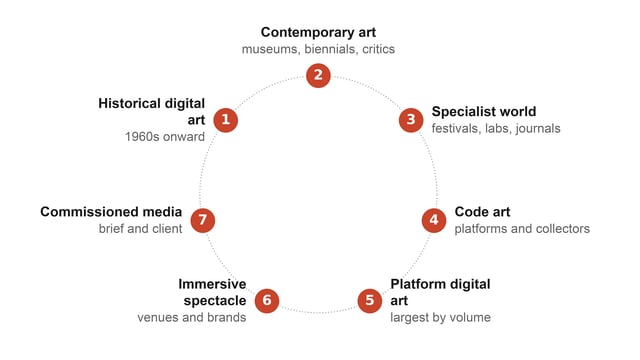
Seven Worlds of Digital Art | A Visitor’s Guide
by Lev Manovich
The media theorist Lev Manovich proposes a new approach to categorizing digital art based on ideas from the sociology of culture, and his own experiences as a digital artist

Thanks for a very interesting read!
In my opinion, there are also a few smaller art worlds adjacent to these that could be worth adding.
The first is the world of digital art native galleries and institutions. We've seen a rise in new galleries specializing in digital art, such as Artverse, Galerie Met, Heft, &others, alongside platforms with no fixed physical presence, like Fellowship and Verse. Perhaps they already are, or will eventually be, part of Art World 2, but I'd argue that for now they operate outside it, in a separate ecosystem with its own collector base, one that has much in common with that of Code Art. NODE also sits outside Art World 2 in this same way.
The second is the community based digital art world of peers. It exists mostly on Slack and Discord, where artists share code, talk through ideas, and put together DIY shows. This art world was most active before the NFT boom, when monetizing digital art wasn't yet possible and peers simply shared their outputs with one another. Web3 culture was built on top of that foundation, but now that the hype has cooled, interest in it may return, since there are still many artists coding and experimenting purely for pleasure. Some of them aren't even looking to be part of the art world at all, working underground and holding other full time jobs.
On that note, I'm wondering whether Code Art is the right classification, given that it's really a subset of a larger tokenized art world, one with more platforms and artists who don't always use code but still define their practice as digital, such as post-photographers, digital collage artists, digital illustrators, artists working with 3D or point clouds etc. Since there are also other platforms like Objkt, Superrare, Verse , perhaps the clearest distinction between Art Worlds 4 and 5 is simply whether the works are sold on the blockchain.
I'd also add, to the commissioned media art world, that more and more brands are now looking for validation and promotion from artists, engaging them in projects that fall outside a typical designer brief. This lets artists work in their own style with few limitations, while brands use the artist's name and reputation as a promotional asset. So it's not only about finding artists for hire, but also about drawing on personal brands that artists have built on external platforms, or sometimes within an institutional context.
Hi Ivona, thank you for this thoughtful comment. I read a few of your points a little differently.
On the digital-native galleries: I took Lev's worlds to be defined by who validates the work and on what terms, not by the institutions themselves. He places each artist according to where the work is principally received, and treats movement between worlds as the subject of the second half. Galleries like Heft or platforms like Verse seem to me less a separate world than places where worlds 2 and 4, and sometimes 5, are currently negotiating with one another. Presence in one does not cancel presence in another.
On peer communities: I think the essay already makes room for them. World 3 names creative-coding communities outright, and world 5 includes artists who post for the recognition of peers working in the same medium. DeviantArt, which Lev references, was doing exactly this for more than 10 years before Discord existed.
This also bears on the line between worlds 4 and 5. World 5 already lists marketplaces for editions, and the essay notes that the NFT boom opened a direct market to world 5 artists without giving them a new authority to judge them. Drawing the line at whether a work sells on-chain would sort by infrastructure, which is the approach Lev sets aside in his opening paragraph. A digital illustrator on Objkt and a long-form generative artist on Art Blocks share a sales mechanism, but not criteria.
On code art as a subset of tokenised art: the practice predates tokenisation by roughly half a century. Molnar, Mohr and Nake were writing programs to generate works in the 1960s. What 2020 added was a market model in which the algorithm itself is sold and each output is generated at the moment of purchase. Tokenisation gave code art a market; but I strongly believe that it didn’t produce the practice.
I agree with you on brands. I would place that shift closer to world 6 than world 7, though: once the artist's name is the attraction, it is no longer the uncredited brief-work Lev describes in world 7.
Thank you for your food for thought!!