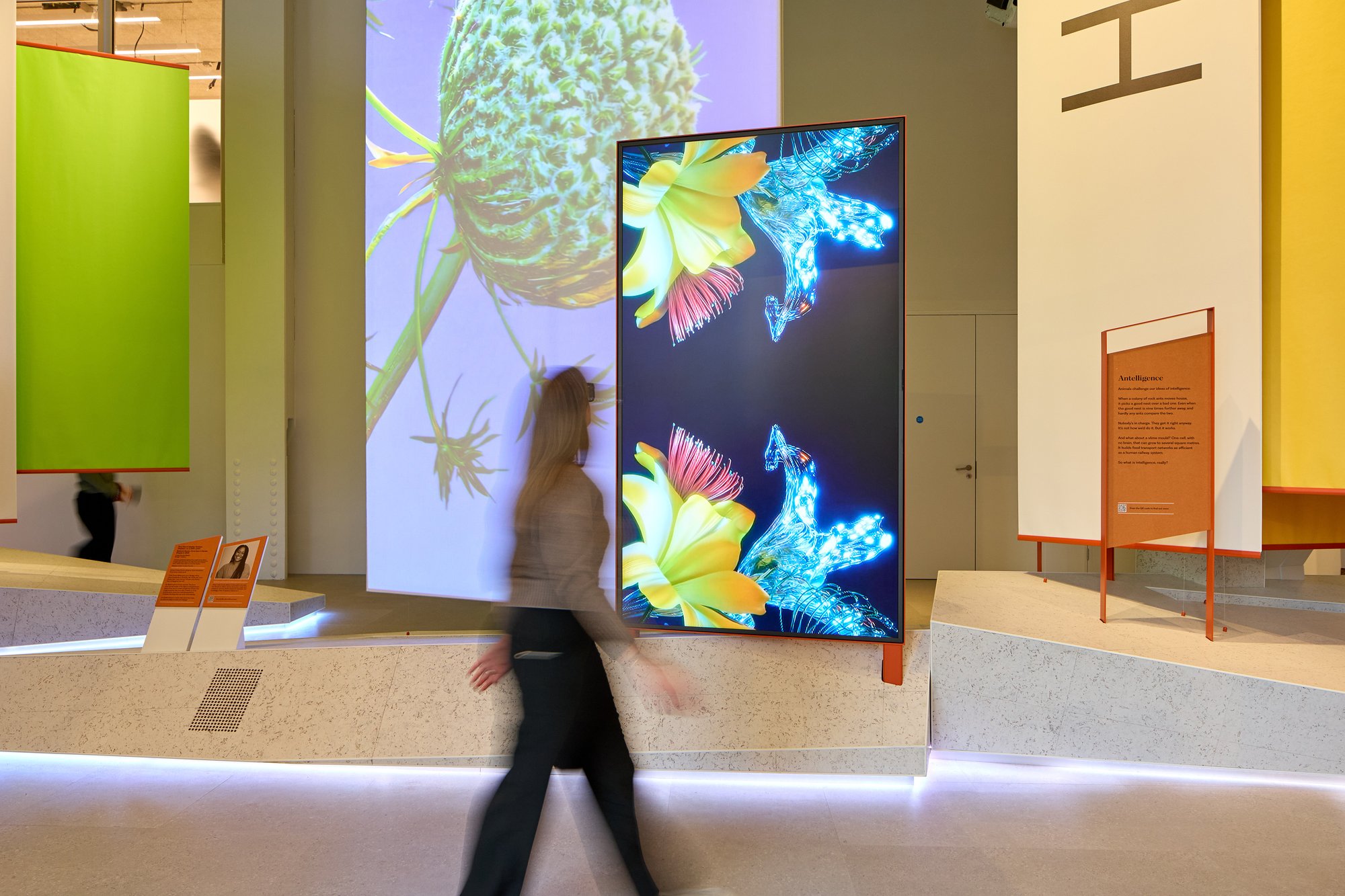
Installation view, “Intelligences”, Ai Exchange, London, with work: Linda Dounia Rebeiz, Once Upon A Garden (2021-23/2025). Photography by Fisher Studios
The new London space, housed in Google’s Platform 37 building, opens on December 9 with an interactive exhibition, “Intelligences”, featuring the work of a cohort of artists and designers who offer evergreen insights through a critical exploration of advanced technologies
“Intelligences” is at AI Exchange, Platform 37, 6 King’s Boulevard, King’s Cross, London, from December 9, 2026 to August 2027. The exhibition is free to visit seven days a week, and is supported by Google DeepMind. It was organized by Daniel Glaser, AI Exchange’s Curatorial and Content Lead, and Hannah Redler-Hawes, lead curatorial and art consultant. Ben Gammon acted as interpretation consultant; Orlando Mathias as design consultant; and Jen Wong and Alex Estorick, Founding Editor of Right Click Save, as art consultants.
A Gallery for Questions about AI | AI Exchange - Right Click Save
The AI Exchange, a free civic space designed to demystify AI, opens in King’s Cross, north London, on December 9, 2026. “Intelligences”, the inaugural exhibition in the new space at the north end of Google’s station-sized Platform 37 building, features an international cohort of artists and designers, whose work invites questions around different forms of intelligence, from AI to emotional intelligence.
The exhibition features works by a group of cutting-edge contemporary artists and interactive designers. The featured artists include Alexandra Daisy Ginsberg, Anna Ridler, DeeKay, Hermine Bourdin, Linda Dounia Rebeiz, and Tomo Kihara + Playfool. The designers exhibiting are Eilidh Nicoll, Gemma Green-Hope, Liquid City, Magda Kreps, Preloaded, Qianhui Yu, and Tellart.
The inaugural exhibition opens at a pivotal moment for society’s engagement with AI, a matter of weeks after existing concerns about data scraping, job security, and AI models going rogue were reinforced by a series of landmarks in political and economic discourse around the industry. The first was the democratic rebuke, in the US midterm elections, to the spread of massive AI data centers without public consultation on their ecological and social costs. The second was the raw demonstration of the AI industry’s financial (and political) heft with Anthropic’s $1.5 trillion IPO, and the market-sensitive resignation, then reinstatement, of Jensen Huang as CEO of the leading AI chip maker Nvidia.
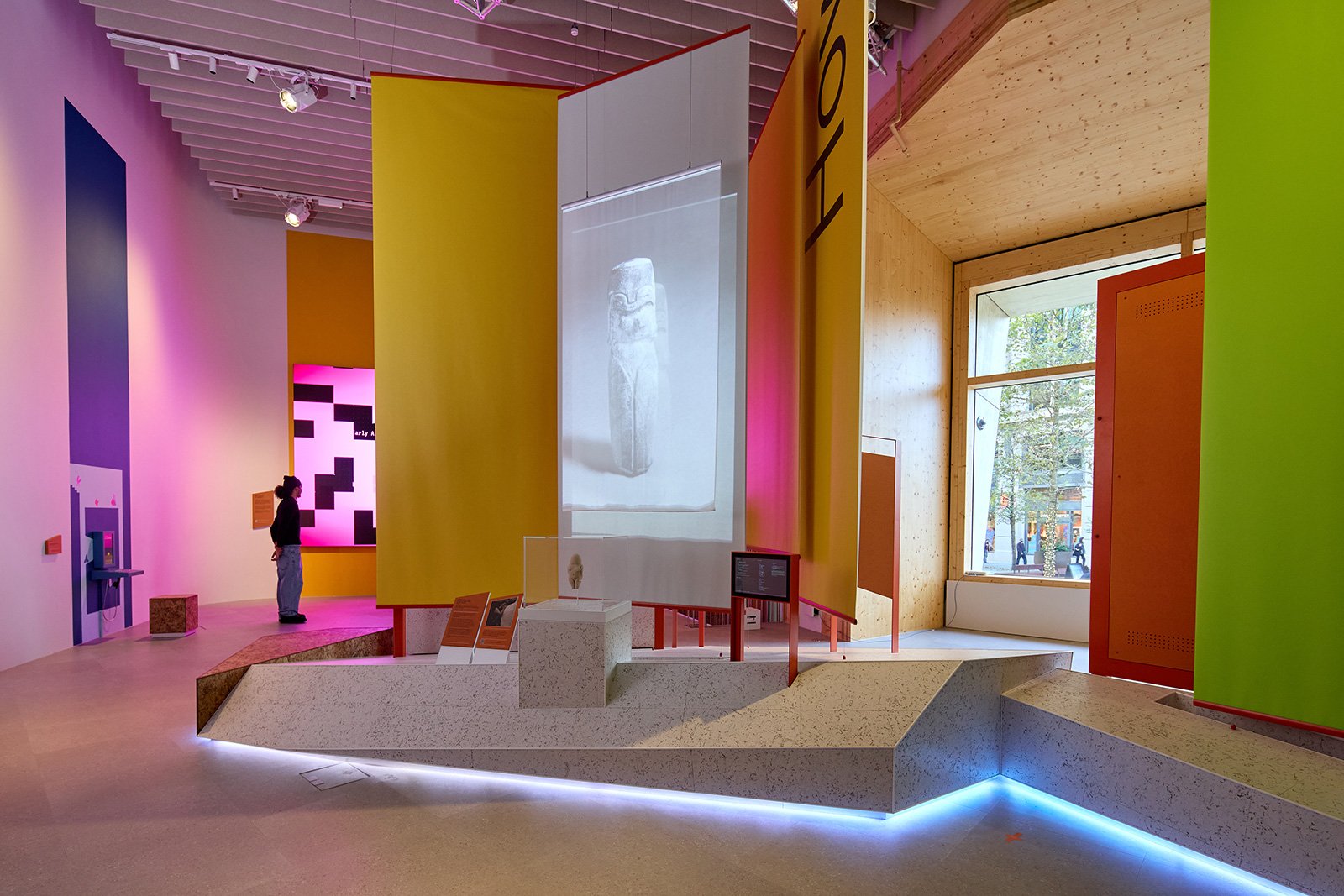
Installation view, “Intelligences”, Ai Exchange, London, with work: Hermine Bourdin, The Idol of Kůlna (2026). Photography by Fisher Studios
“Intelligences” opens at the end of a year when leading artists working with AI have engaged more than ever at institutional level with questions of AI ownership and ethics. In April, Beeple spoke at Stanford during his retrospective at NODE, Palo Alto. In May, Refik Anadol and Holly Herndon were on stage at the Schwarzman Centre for Humanities, Oxford University discussing the ethics of creative AI. Their contribution demonstrated the importance of artists with critical framing training playing a role in occupying what Professor Raphaël Millière, of the Institute for Ethics in AI, Oxford University, referred to, at the same event, as the “rich middle ground” between the view of AI good and AI bad; linked to the importance of doing what Millière called “good empirical research to arbitrate these difficult questions about the capacities and limitations of current and future AI systems”.
The opening of “Intelligences” at a moment of heightened debate on AI is an opportunity for the exhibition’s organisers, Daniel Glaser, and Hannah Redler-Hawes, to emphasize the evergreen value that an artist’s advanced practice can bring to addressing subjects of such existential concern. "The AI conversation is playing out in a very dynamic environment where public opinion, news stories and developments in existing and emerging tech are seeing dramatic shifts at pace — weekly, daily and sometimes even hourly,” Redler-Hawes tells Right Click Save. In “Intelligences”, Ridler, Dounia Rebeiz, Ginsberg, and Bourdin demonstrate the use of AI as both a tool for synthesis and a subject of critical engagement.
“We have been very intentional, about working with visionary artists and designers whose advanced practice thinking is borne out through pieces whose meaning expands in the light of these dial shifts — even the works made some time ago deepen in relevance over time. They are living testimonies to the vision of creators whose constant exploration helps us find our place in these systems". (Hannah Redler-Hawes)
(AI Exchange is backed by the AI research lab Google DeepMind and is housed in the London headquarters of Google. The tech giant has a leading market position in the AI industry, with its Gemini consumer app holding more than 25% of worldwide AI chatbot market share, surpassing 1 billion monthly users in August 2026, and through its advanced models, such as Gemini 4 Neon which ranks near the top of AI "frontier" indices.)
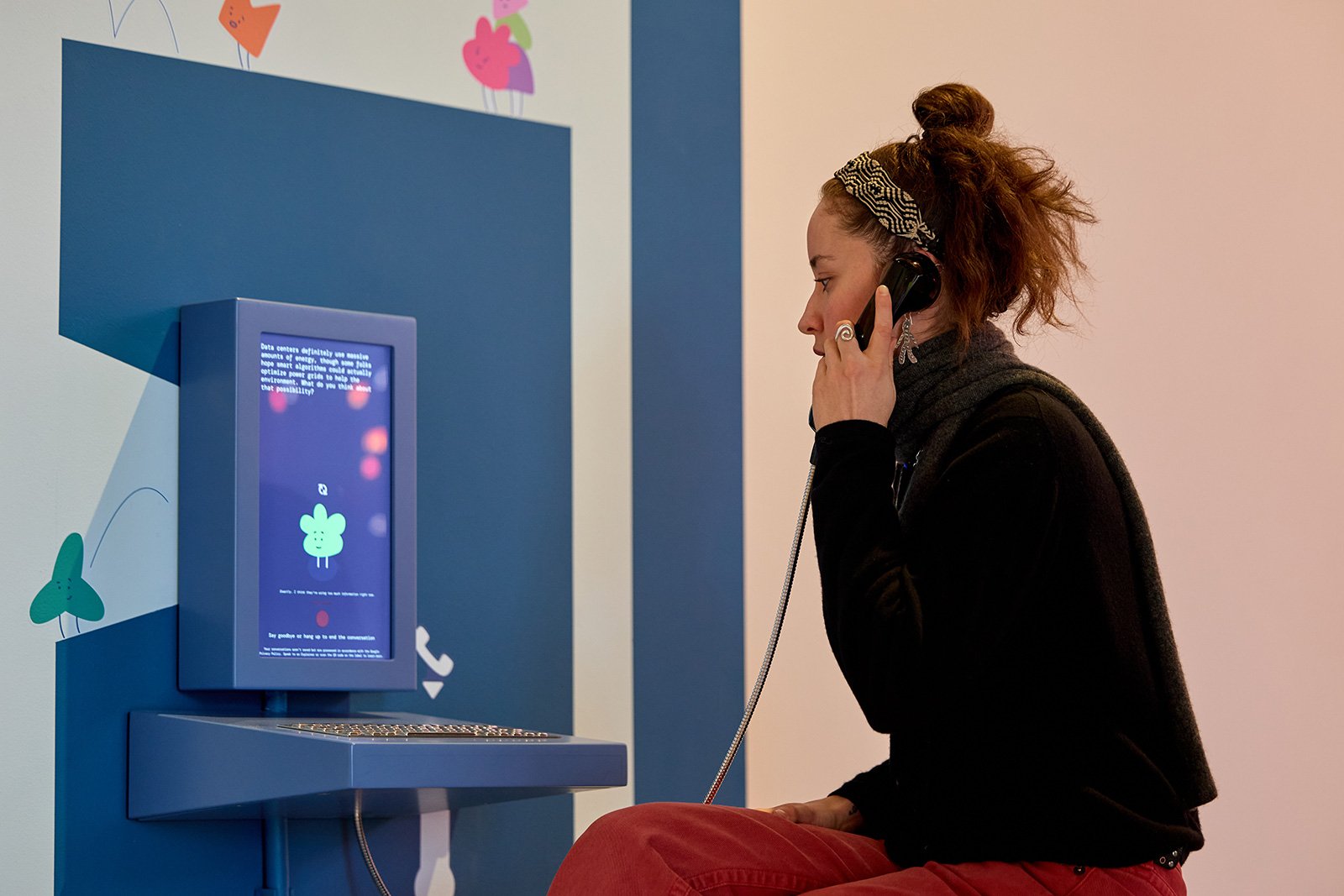
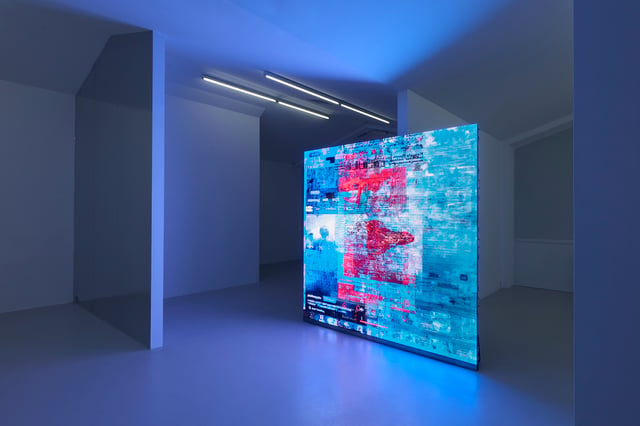
Installation view, “Intelligences”, Ai Exchange, London, with a visitor using a Group Chat console. Photography by Fisher Studios
Explainers and Group Chat
The doors of AI Exchange, which will be open seven days a week, face on to a pavement with massive footfall, on the pedestrian route that leads from King’s Cross and St Pancras stations and Coal Drops Yard, a teeming, recently developed, canalside area of bars and restaurants. The area is known as the Knowledge Quarter of London and Central St Martins art school is a short walk from AI Exchange. The space has been staffed with a young team of Explainers to help welcome and familiarize spontaneous visitors, as well as pre-planned school groups. Those attending Google’s nearby AI Campus for local schools, have already helped stress test the space.
The exhibition is for all but was designed, Glaser says, with Gen Z in mind: the generation of 14 to 29-year-olds who the curatorial team see as the behavioral magnet for both older and younger age brackets. Visitors are met by a team of Explainers who come from that target age bracket, and are trained to engage with and familiarize walk-in visitors. Besides engaging with interactive, animated and more contemplative installations, visitors are encouraged to join in the AI conversation via a system of consoles, with voice or keyboard interaction with AI agents. The conversation, developed over recent months, is synthesized and animated on a giant Group Chat screen, created by Liquid City, at the end of the show.
“Intelligences”, and the whole AI Exchange experience — there is an upstairs studio for project work with community partners — has been designed to appeal to the curious, the cautious and the expert in that order, according to Zoe Stern, Managing Director at AI Exchange. Glaser and his curatorial team have laid the exhibition out so that it may be entered at any stage, with the different intelligences — spatial, emotional, social, general and artificial — evenly spaced through the installation. The variety is designed to appeal to the range of generations and the mix of emotional and creative make-ups of visitors to the show.
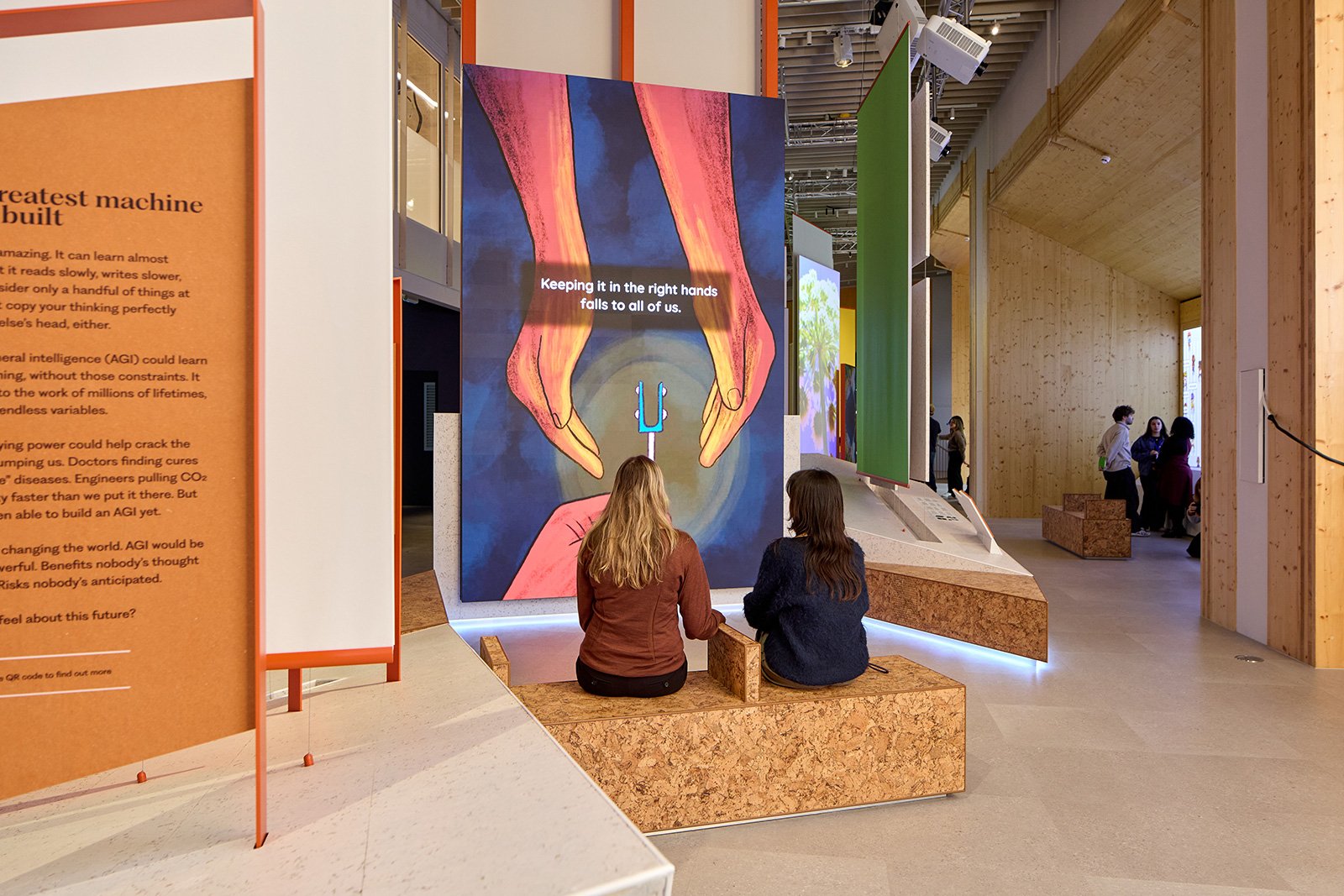
Installation view, “Intelligences”, AI Exchange, London, with work: “One key for many locks”, by Qianhui Yu, Gemma Green-Hope, Eilidh Nicoll and Magda Kreps. Photography by Fisher Studios
The charm of hand-drawn animation is to the fore at the first installation, “One key for many locks”, placed closest to the exhibition entrance, where Qianhui Yu, Gemma Green-Hope, Eilidh Nicoll and Magda Kreps have imagined future stories about the big challenges in climate, health and energy that could potentially be addressed in the event that Artificial General Intelligence (AGI) is achieved.
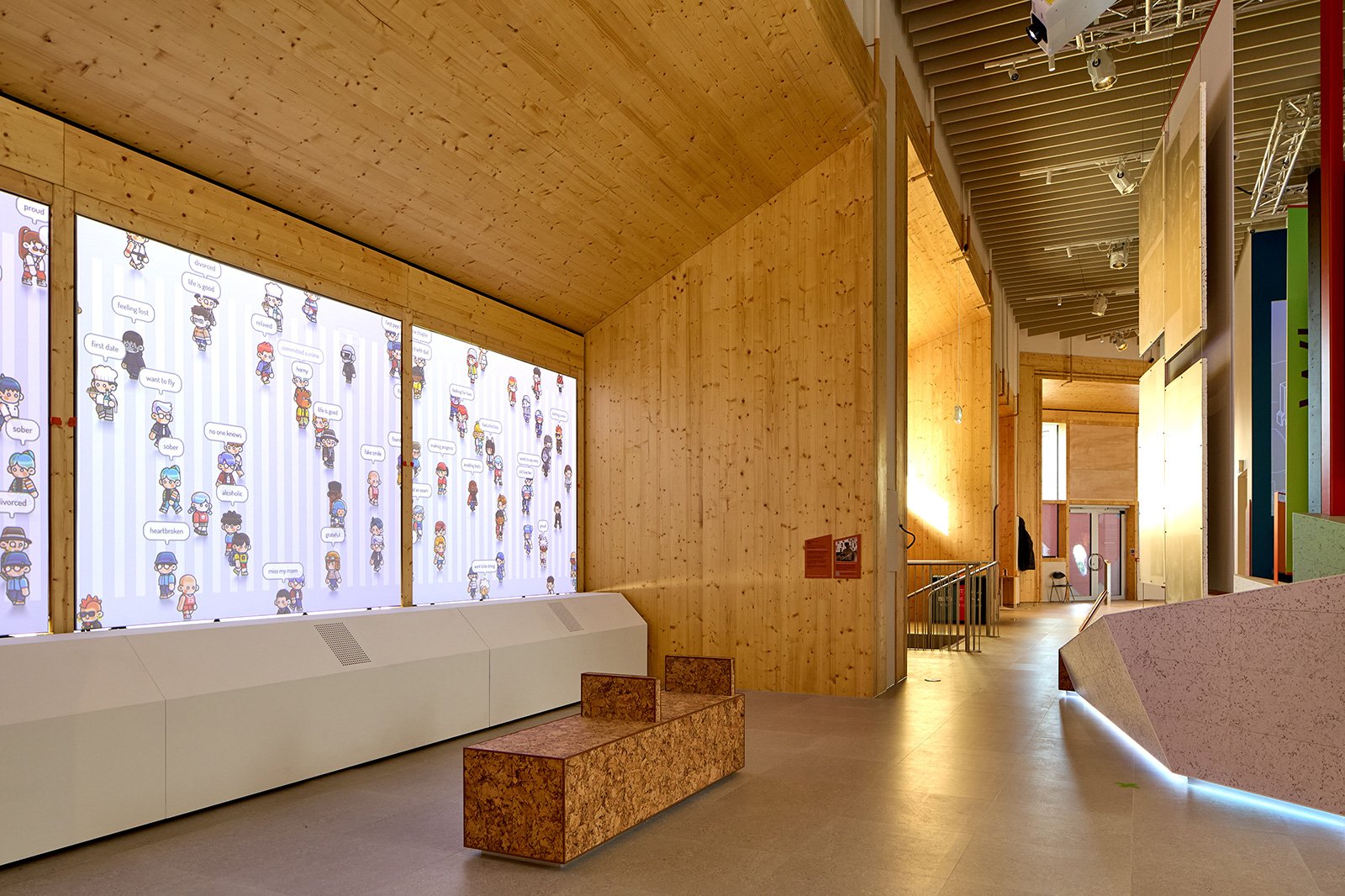
The animations of the artist DeeKay have a charm of their own, and his Invisible Stories, which featured in the Zero 10 initiative for art of the digital era at Art Basel Hong Kong, in March 2026, addresses emotional and social intelligences (the piece does not make use of AI). When the exhibition opens on December 9, the work, which depicts figures deeply consumed in their personal thoughts (expressed as speech bubbles) as they busily pass each other on a road crossing, will face both into the exhibition and out to the street and the passers-by no-doubt absorbed in their own “invisible stories”.
The instinctive way in which DeeKay’s figures pass each other on the road-crossing, without colliding, brings to mind another piece in the show, Antelligence by Preloaded, an interactive work where visitors are asked to challenge the hive mind of an ant colony in how quickly they may complete, on screen, a complex, piano-moving type, challenge. Another interactive experience is Think Inside the Box, by Preloaded, where visitors can test the intelligence, and spatial awareness, around corner kicks in soccer, based on the AI model TacticAI, based on real match stats, which has been used by soccer clubs around the world.
Installation view, “Intelligences”, AI Exchange, London, with work: DeeKay, Invisible Stories (2026). Photography by Fisher Studios
The generative artist Anna Ridler is presenting hand-finished outputs from the latest iteration of her “A Catalogue of Exceptions”, a commission for the Schwarzman Centre, Oxford, inspired by the doomed attempt of the 17th-century Oxford scholar John Wilkins to classify every object in the world in a rational, ordered system of his own making. Wilkins failed, and Ridler, who builds her own datasets and has long been concerned with the act of classification, is fascinated by how AI models are ultimately bound to fail in the same task. “There is something very human about this desire to try and contain everything, and the knowledge that it will always fail that I find strangely moving.” Ridler said in an exhibition statement.
Linda Dounia Rebeiz’s Once Upon A Garden, Archives, Chapters 1, 2, 3, (2021–2023), and Nadime’s Garden, Once Upon A Garden, Chapter 5 (2025), use AI as a means to reconstruct lost nature. “I grew up in Senegal, Africa, where biodiversity is shrinking,” she said in an exhibition statement.
“My grandmother saw more flowers than my mother did. My mother saw more flowers than I ever will… I will see more flowers than my daughter ever will.” (Linda Dounia Rebeiz)
In choosing exhibits made through working with AI, Redler-Hawes says, the curatorial team of Glaser, herself, Jen Wong, and Alex Estorick, founding editor of Right Click Save, looked for artists such as Ridler, Dounia, Hermine Bourdin and Alexandra Daisy Ginsberg, who are “really interrogating these systems and really seeing what they mean in the real world in real life and everyday experience, how they change our thinking, how they progress things”. Artists who work “critically but also collaboratively with AI. So … there’s a sort of constant dynamic. We think that's a really interesting approach, and form of practice, to platform.”
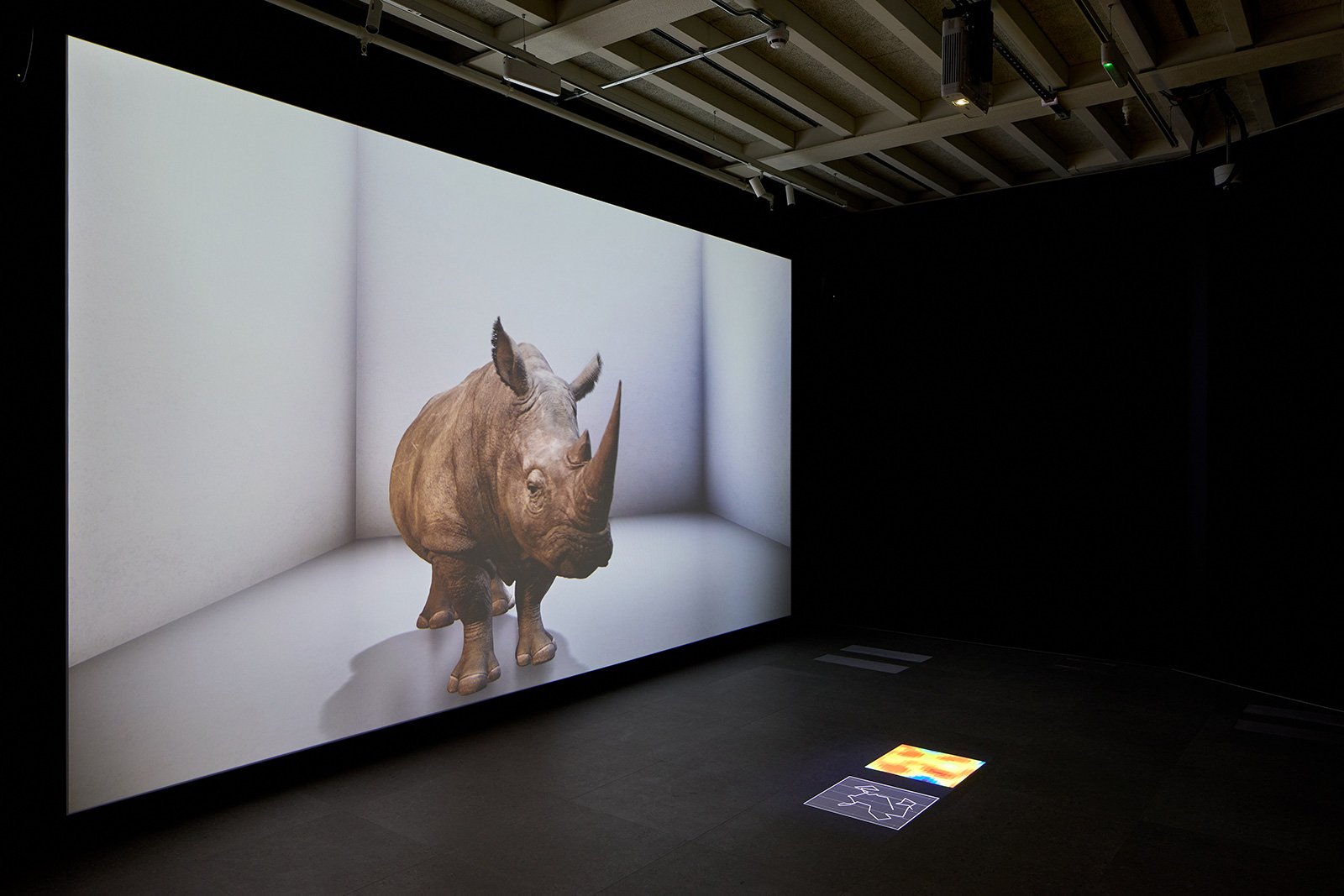
Installation view, “Intelligences”, AI Exchange, London, with work: Alexandra Daisy Ginsberg, The Substitute (2019). Photography by Fisher Studios
Bourdin is presenting The Idol of Kůlna, a stone carving from her “Universal Venus” series, which captures, through AI modelling, a speculative take on the characteristics of a handful of extraordinary surviving Venus figures that first appeared in different parts of the world 30,000 years ago. It was a moment, Glaser says, “when tool use, language, social cognition and social organization, and the making of art (represented by the Venus figures) all happened at the same time”. The moment that represented the emergence of general intelligence.
Ginsberg is showing her The Substitute (2019), in which she used real data from white rhinos and, worked with AI to create a lifesize digital version of a rhino by allowing the model to infer what a rhino looks like. The piece addresses the trade-off, Glaser says, between the investment in the creation of substitutes “at a time when natural life forms across the planet are dying out; where habitat loss and biodiversity loss is a significant factor. But also it's challenging our imagination at this stage about what it might be like to make a life form through artificial means.”
The final interactive piece in the exhibition is Deviation Game, where the artist Tomo Kihara and Playfool (Daniel Coppen and Saki Maruyama) have riffed on Imitation Game (1950) by the computing pioneer Alan Turing. Users attempt to identify a hand-drawn piece live on screen more quickly than an AI can. “AI is able to imitate many of the intellectual tasks that were once exclusive to humans, sparking considerable concern among artists and creators,” Kihara said in a launch statement.
“History has shown us that whenever a new technology emerges that can replace human acts of expression, people have found ways to deviate and create unique forms of expression that cannot be replicated by that technology. In Deviation Game, our aim is to utilise AI not to imitate past expressions, but to identify what has already been expressed, allowing one to deviate from it.” (Tomo Kihara)
Ultimately it is the Group Chat element, and its graphic presentation of verbal exchanges about artificial intelligence that summarises the dynamic purpose of AI Exchange and its inaugural exhibition. To ask, and listen, to difficult questions about intelligences and in particular the unavoidable ones, for all generations and all societies, about living with AI.
Louis Jebb is Managing Editor at Right Click Save.