Art in the Postdigital Condition - Right Click Save
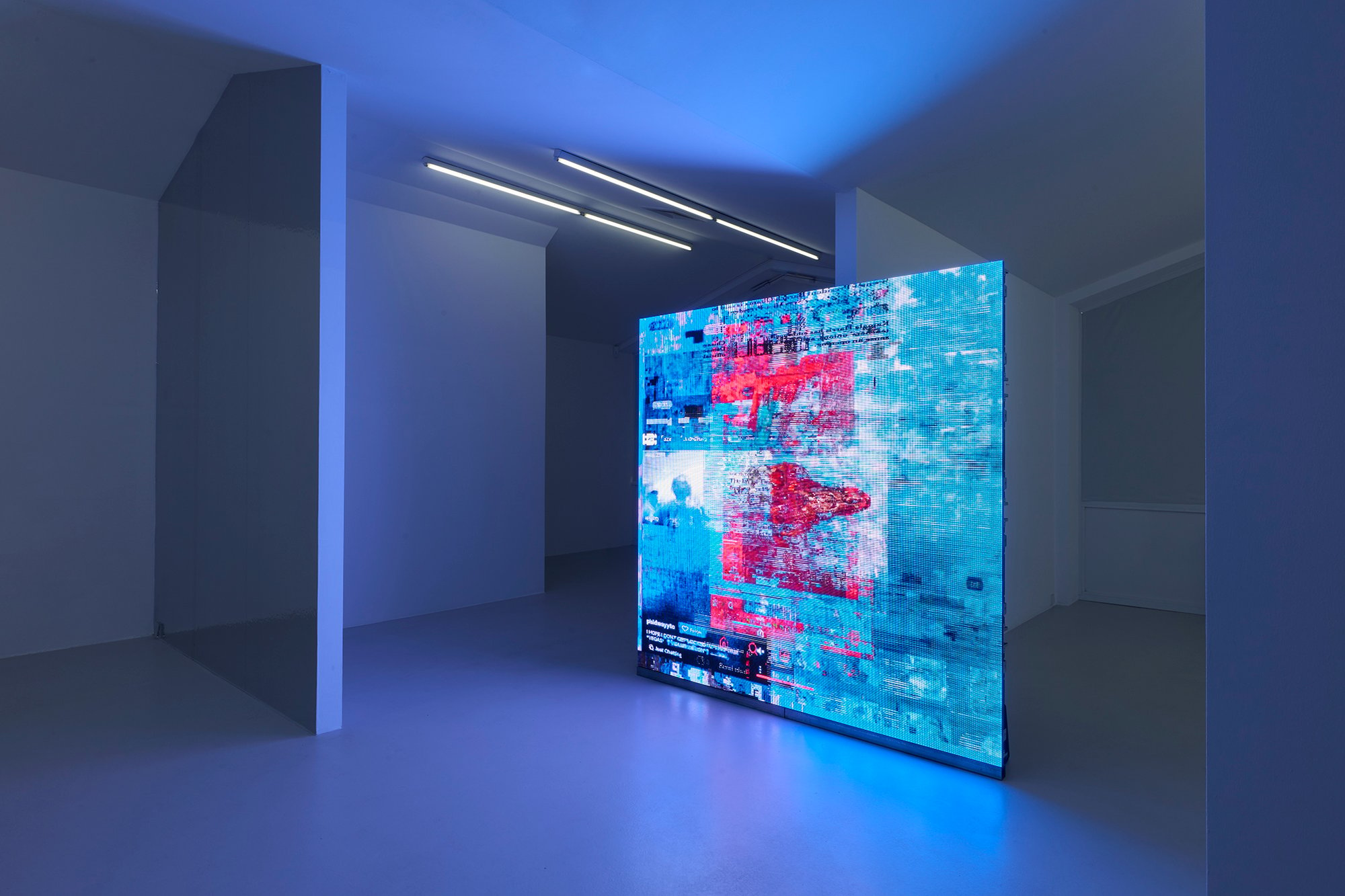
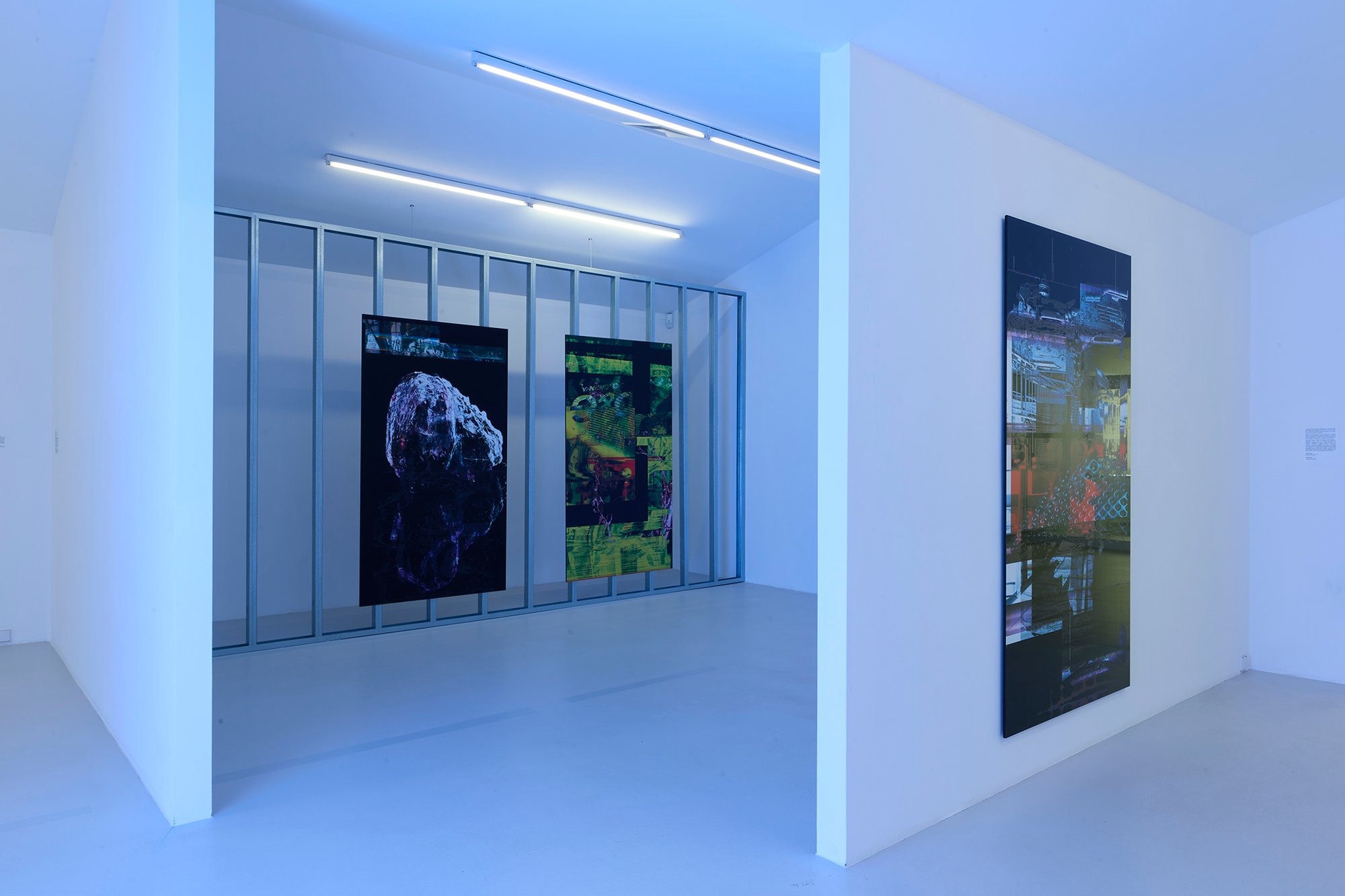
Installation view of Chris Dorland, “Chrome Shelter,” at Museum gegenstandsfreier Kunst, Otterndorf, Germany, 2026. Photography by Volker Renner. Courtesy of the artist
Chris Dorland and Josephine Meckseper are, on the surface, unlikely conversational partners: Dorland works between painting, moving image, and architectural intervention to picture the corroded infrastructures of digital culture, while Meckseper’s large-scale shopping vitrine installations and wall assemblages challenge the conventional reading of familiar cultural imagery and systems of circulation and display.
Both were born outside the United States — Dorland in Canada, Meckseper in Germany — but came of age as artists in New York, absorbing American culture from the inside while remaining somewhat outside of it. This year, that binary position found a new stage with each opening a solo exhibition in Germany: Meckseper at the Kunstverein Heppenheim, a former bakery turned exhibition space with a cult reputation among younger German artists; and Dorland at the Museum gegenstandsfreier Kunst, an institution dedicated to non-objective art.
What emerges from the juxtaposition of these two artists and their respective exhibitions is a shared interrogation of the fragility of painting, analog practices, and American cultural prominence at a moment when all digital production is being channeled into a deep-learning algorithm. Ranging between the mechanics of exhibiting in a shop window to the speculative territory of quantum physics, their conversation returns continuously to the meaning of discrete, physical objects at the exact moment they are becoming raw material for more-than-human operations.
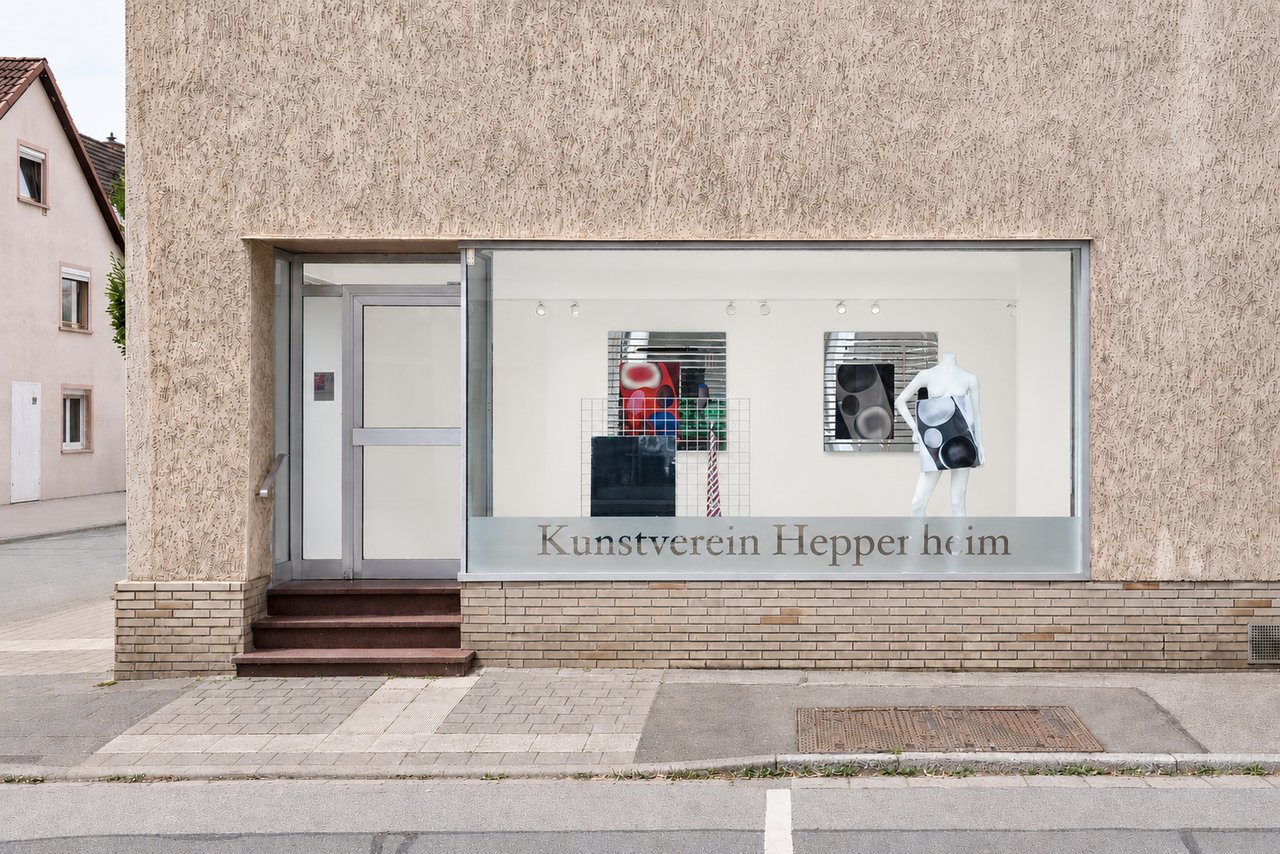
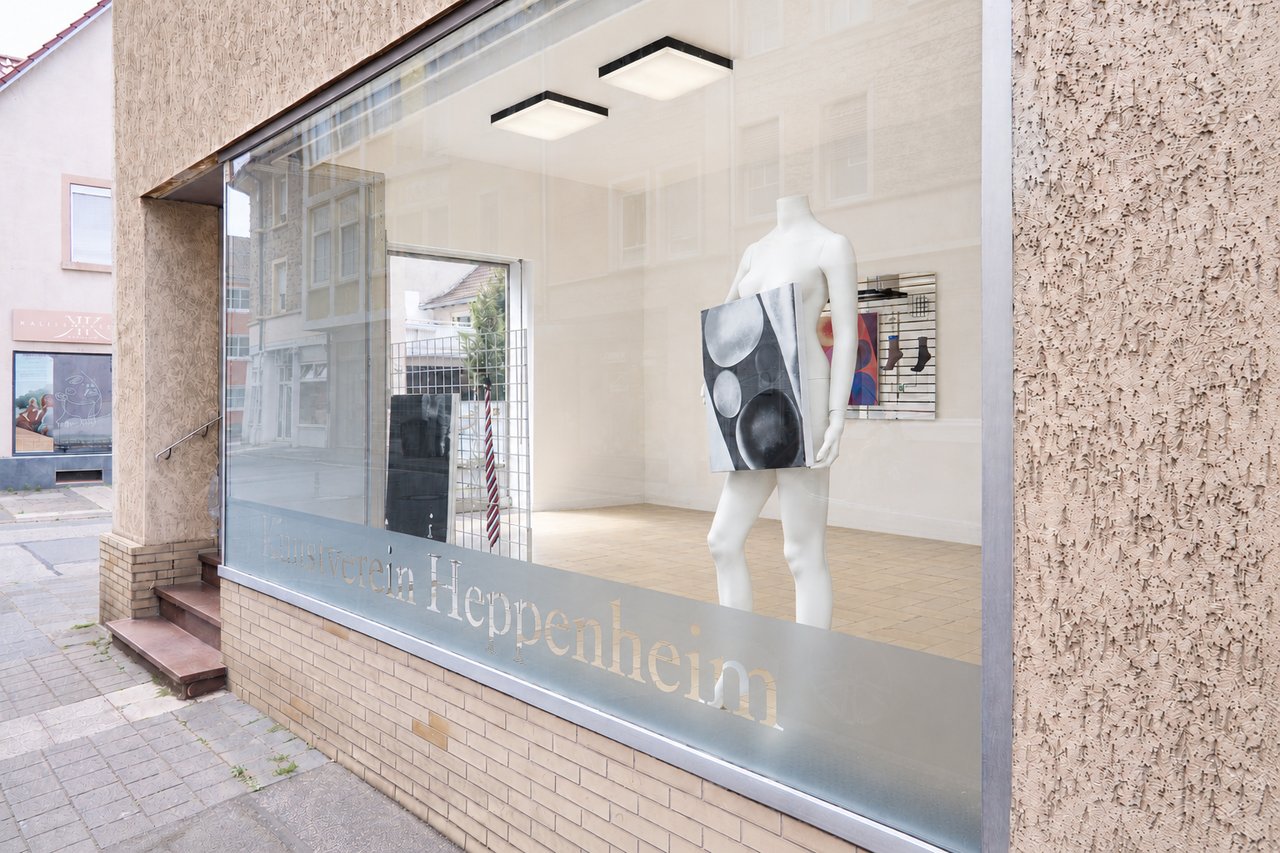
Exterior view of “Sechs Fünf Vier Drei Zwei,” Kunstverein Heppenheim, Heppenheim, Germany, 2026. Courtesy of the artist
Josephine Meckseper: The show materialized through an artist friend in Berlin, Gregor Hildebrand. He has his own small project space within his studio complex, and I did a show there in 2019. The director of the Kunstverein Heppenheim came by to see the show and invited me to do a project in his space.
Kunstverein Heppenheim has almost a cult status in the younger art scene in Germany — it’s very small, but has a cutting-edge program. Thomas Zipp, the German conceptual artist, founded it in the old bakery that his parents ran in Heppenheim, and transformed it together with the director into this super hip place for younger artists to show.
Alex Estorick: And Chris, how did your show in Otterndorf come about?
Chris Dorland: Museum gegenstandsfreier Kunst roughly translates as “Museum of Non-Objective Art.” The newly appointed director of the museum had just recently joined and was in the very initial stages of thinking about programming. He was interested in opening up the question of what non-objective art might mean in the 21st century, and curious about the dialog between abstraction, digital systems and digital art. He saw my work in Brussels and got very excited about how it might fit with the museum. I was excited too because of my own relationship to non-objective painting, minimalism and post-war industrial processes, which is an important part of my artistic DNA.
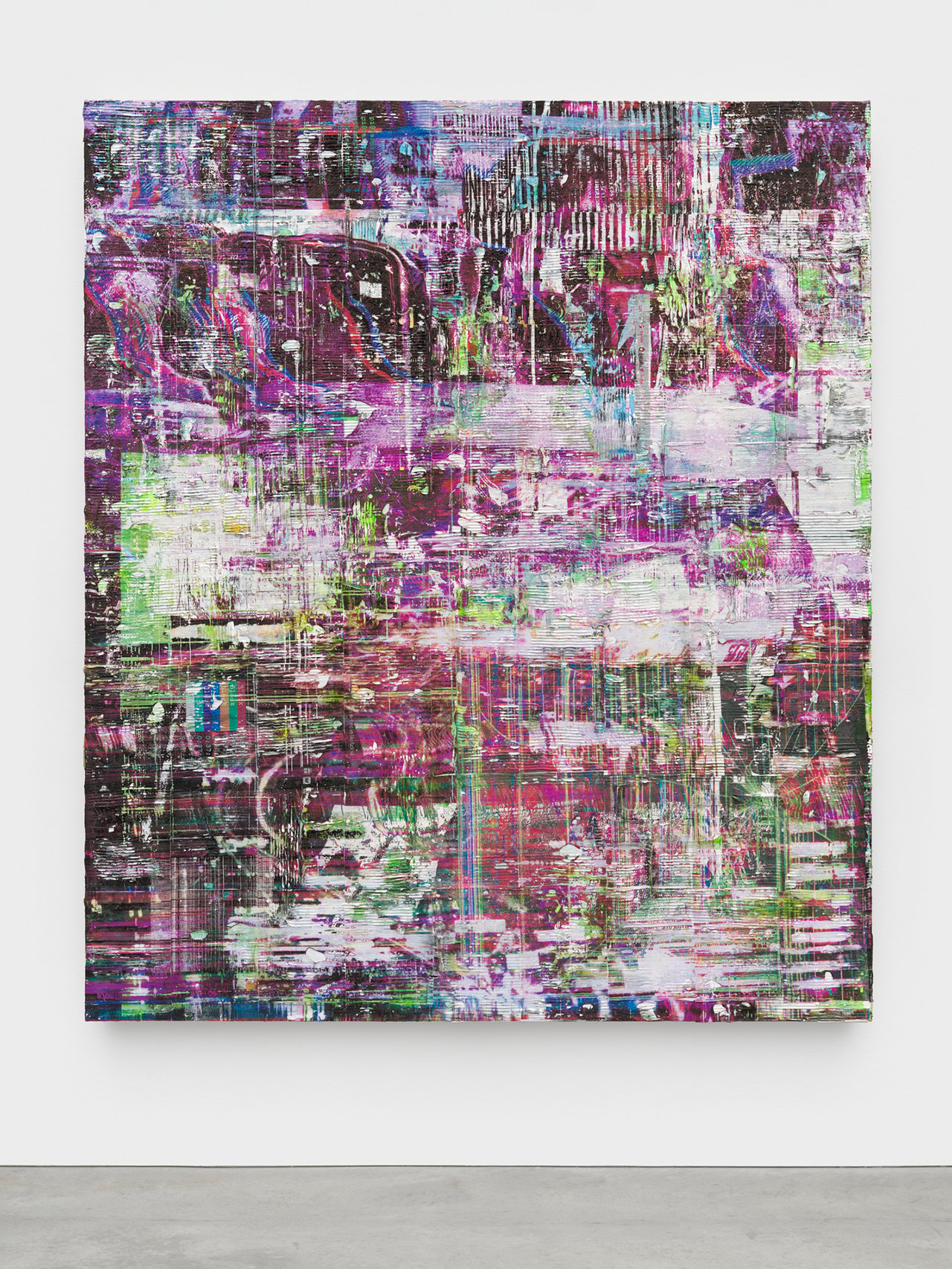
Installation view of Chris Dorland, “Chrome Shelter,” at Museum gegenstandsfreier Kunst, Otterndorf, Germany, 2026. Photography by Volker Renner. Courtesy of the artist
AE: I wonder whether there was anything about showing outside New York that felt different, given that city’s very specific art ecology.
CD: This was my first large-scale solo museum show, which made it extraordinary, because my experience has largely been showing in commercial galleries. Museums operate in relation to culture differently from galleries — galleries have a relationship to commerce that museums don’t, and museums have a relationship to the greater public that galleries don’t.
So much of my artistic lineage has been informed by German artists, even though I don’t have any personal relationship to Germany, so it was a great honor for that exhibition to be there.
The German general public is very sophisticated, very open to art, and open to ideas. I really enjoyed meeting people who weren’t great connoisseurs of contemporary art but were so open and excited to engage with the ideas and the work.
AE: Josephine, does the Heppenheim space also live outside the commercial art world?
JM: In Germany, every city has a Kunstverein (art association) and a Kunsthalle (exhibition hall), a tradition that dates back to the 19th century when it was part of bourgeois education for the public to be schooled in art. France has a similar system with the FRAC museums; so there’s a long tradition of the broader public being mindful and curious about historical and contemporary art, which is the reverse of my experience coming to the United States, where artists tend to be considered radicals or misfits by the mainstream while the “art world” is quite elitist.
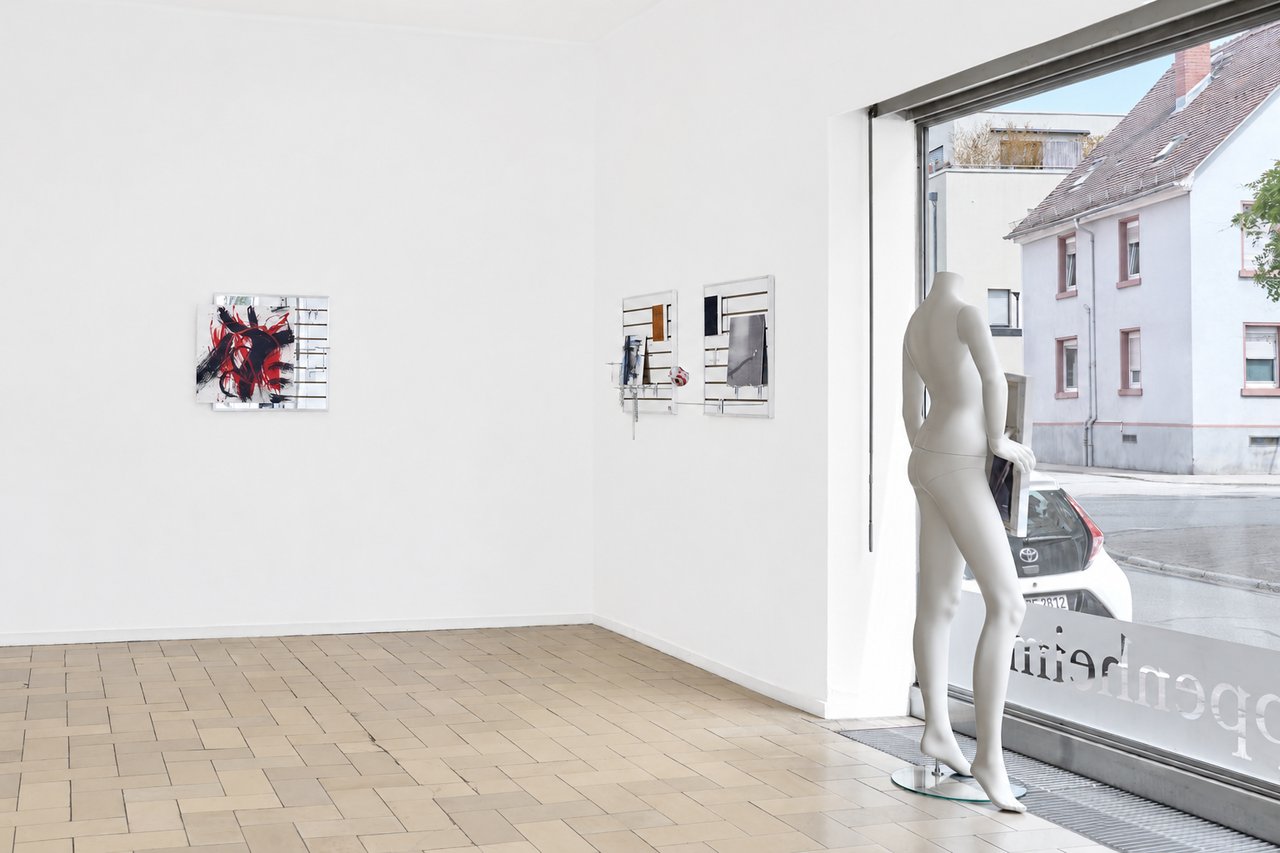
Installation view of “Sechs Fünf Vier Drei Zwei,” at Kunstverein Heppenheim, Heppenheim, Germany, 2026. Courtesy of the artist
Heppenheim is a rather small medieval town on an ancient Roman trade route, and you wouldn’t necessarily expect a contemporary art institution there. But a Kunstverein can be a private initiative, as it is here, and still eligible for state and federal funding. This system allows younger artists much greater exposure all over Germany without needing to find a commercial venue.
My work often has a site-specific aspect to it — I look at the architecture of the space but also the immediate neighbourhood. I sometimes utilize an institution’s windows as part of the concept of my exhibitions. This former bakery-as-Kunstverein has two large windows facing a pedestrian access route to the town’s train station, situated at the end of a shopping district built after the war.
There’s a correlation between the disruption wrought by the Second World War and fascism, and how the architecture of early modernism manifests in my vitrine works. My earlier window-display installations were inspired by New York storefronts, especially on the Lower East Side, but storefronts also signified the ultimate target for a protester.
Windows frame the street as a site of protest as well as a commercial zone, and those two factors informed the content of my earlier works.
Exterior view of “Sechs Fünf Vier Drei Zwei,” Kunstverein Heppenheim, Heppenheim, Germany, 2026. Courtesy of the artist
AE: Can you explain in a practical sense how you integrate the windows?
JM: In this case, I used the window as it was, because it was already like a large vitrine in itself. By including the mannequin holding some of the artworks, the window blended into the commercial infrastructure of the area rather seamlessly.
AE: I’m interested in your shared ability to operate between media — in your case Josephine in the way you often combine painting, ink, and sculptural assemblage; Chris, in the way you dovetail new media strategies with painting.
CD: My earliest desire was always to be a painter, and I still identify that way. But the longer I developed my practice, the more I brushed up against painting’s limitations. I’ve wanted to expand what I do while keeping the logic of what it is to paint, without being limited by that envelope. That has led me to expand into digital space more aggressively, as well as printing, moving images, and architectural interventions. But it all derives from the nexus of painting. If you do that enough you end up in a hybrid space, because you’re pushing your own boundary lines.
Chris Dorland, Untitled (chrome shelter) (detail), 2026, single-channel video. Audio by Leon Louder. Courtesy of the artist
Artists have to be responding in real time to the world they’re living in. But in the last 25 years, something has happened to reality where there’s this back door to it — this constructed digital reality that has expanded to a point where my conversations with friends are prefaced with “I don't really know if this is real or not, but I saw it on Instagram”.
In 2026, we’re living in a hybrid state, and so it’s natural for artists to be working in the digital space.
JM: My practice is primarily conceptual — it’s the idea that motivates me first — but in a broader sense I’m interested in a form of cultural critique. As Chris was saying: you look at the contemporary world around you for a way to bring it into the work.
Having studied at CalArts in Los Angeles with Michael Asher, and having attended lectures by Félix Guattari, Jean Baudrillard, and Jacques Derrida, we were already engaged in looking at these hyperrealities that are now manifesting through artificial intelligence. I was very interested in the idea of the American media spectacle because, as a German, I barely watched TV growing up. Then suddenly I was exposed to an environment informed by Hollywood along with the shopping malls that surrounded CalArts.
Once I arrived in New York, the architecture of commerce became a staple of my work — the shop window, the department store — but also filming anti-capitalist protests and anti-war demonstrations, to bring together the idea of commerce and the antagonism against it.
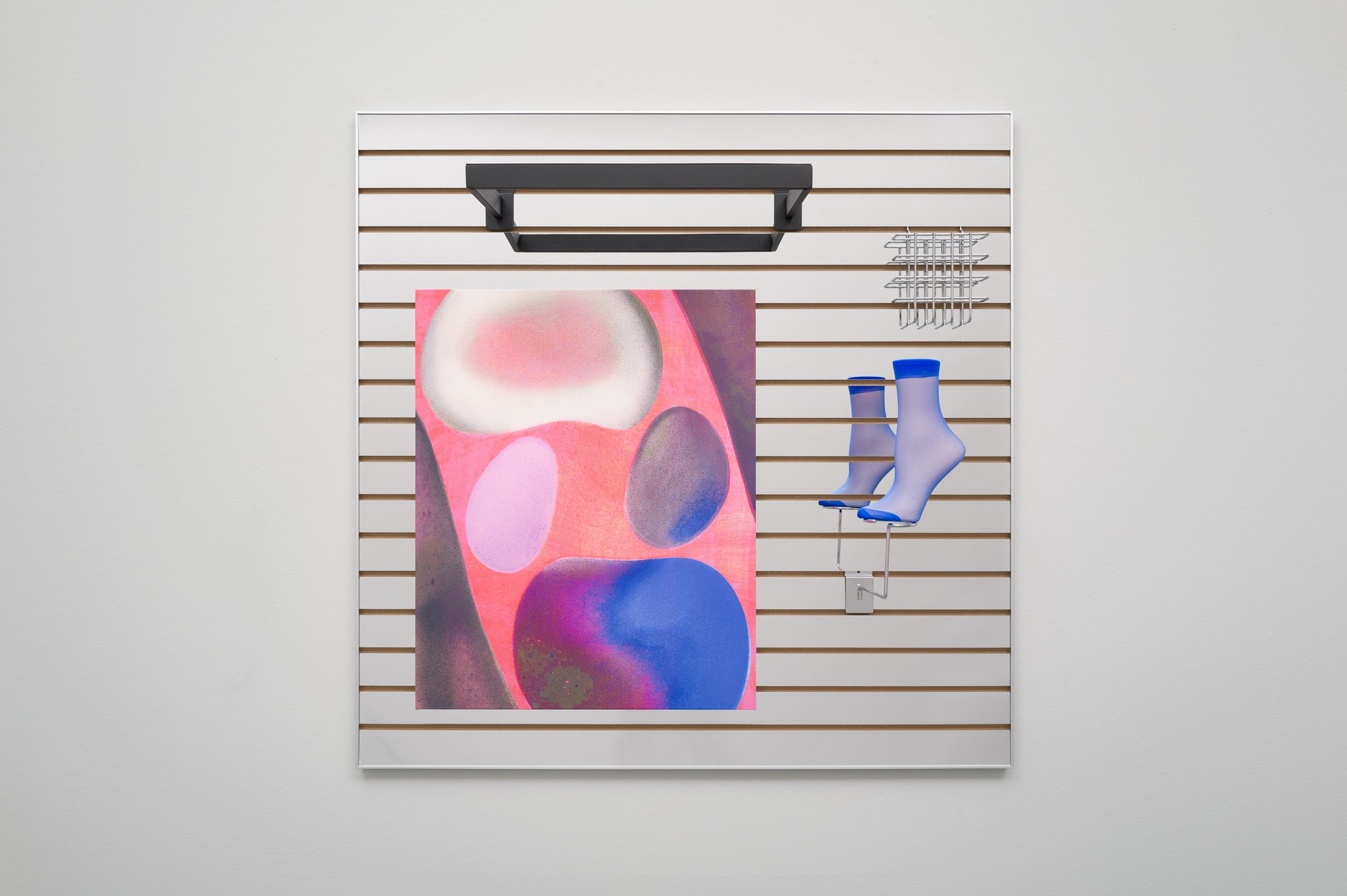
Josephine Meckseper, The Ruler, 2024. Courtesy of the artist
When you set out with a theoretical perspective you immediately end up in this in-between space of media, because everything becomes a signifier of both culture and antagonism. There’s always a narrative in my work stringing together this story of who we are as people on this planet, while elevating the banal object to undermine the elitist quality of art.
CD: I think we’re both highly invested in images, but you come at it with objects coming together to create images, whereas I’m thinking about invisible structures and networks. We’re both interested in systems, but approaching them differently in how an image gets put together. I’m still very much a painter — identifying that way is still a commitment to a contained, framed image, even on a screen. It only enters the third dimension when it becomes an installation that bodies move through. You’re constantly working in the third dimension — there’s a vitrine, objects that protrude, things you walk around.
JM: I actually trained as a painter too, which included figure drawing, as part of an old-school academic training at the Universität der Künste Berlin. What I love about your work is that you’re deconstructing technology to get to a different form of truth — there’s a playfully sophisticated way you use the deterioration of the image and the distortion of digital media and of the monitor.
In my work, I’m always engineering worlds that fit a theory I’m interested in. Chris is the deconstructor and I’m the constructor, who is also a destructor — I’m alluding to tearing down worlds while Chris is building new ones. Our language somehow meets there.
CD: Whenever I hear you talk about your teachers at CalArts, I think of my parents who were both academics and media theorists, very interested in Baudrillard; those were ideas at my house when I was very young. I knew what Semiotext(e) was before I could really understand it. My dad let me run wild with media in a perverse way, mainlining me with contemporary media as a kid who was way too young to understand what I was absorbing. I’m still processing that.
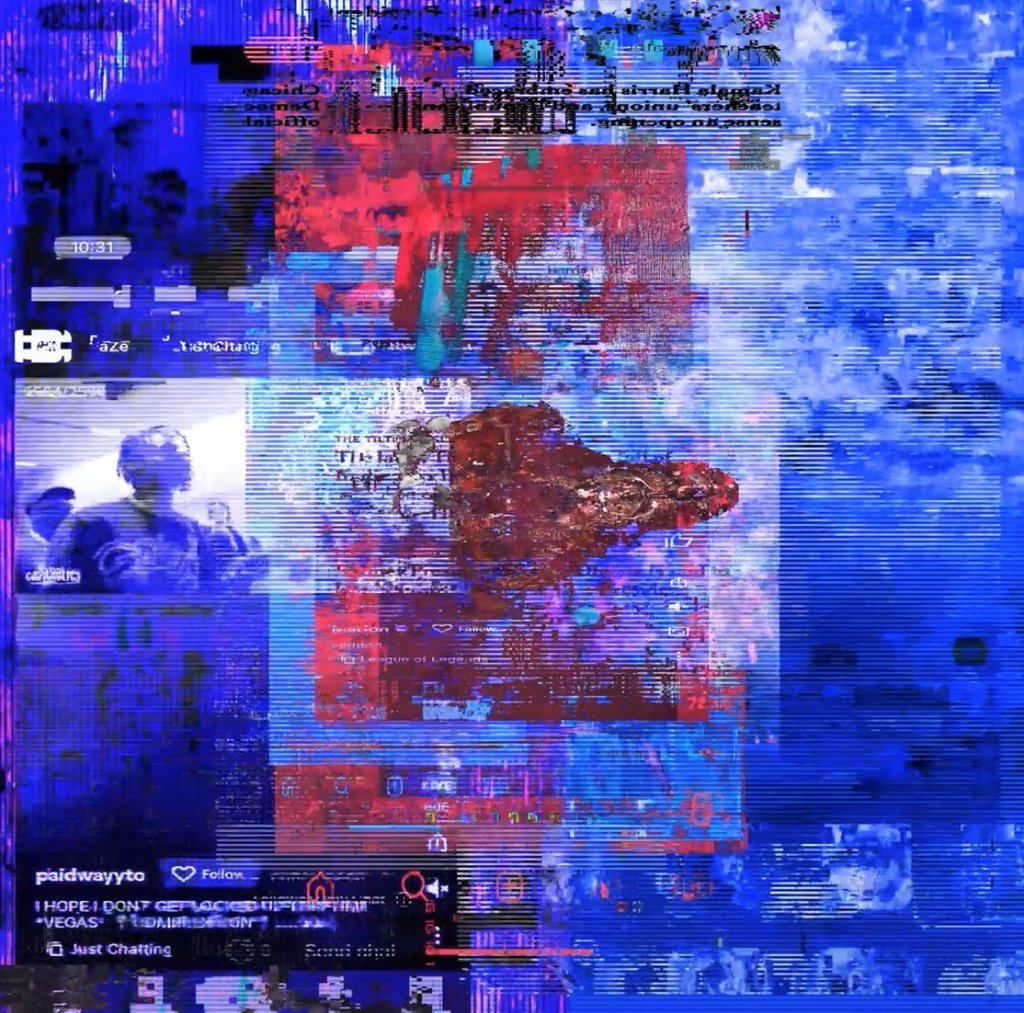
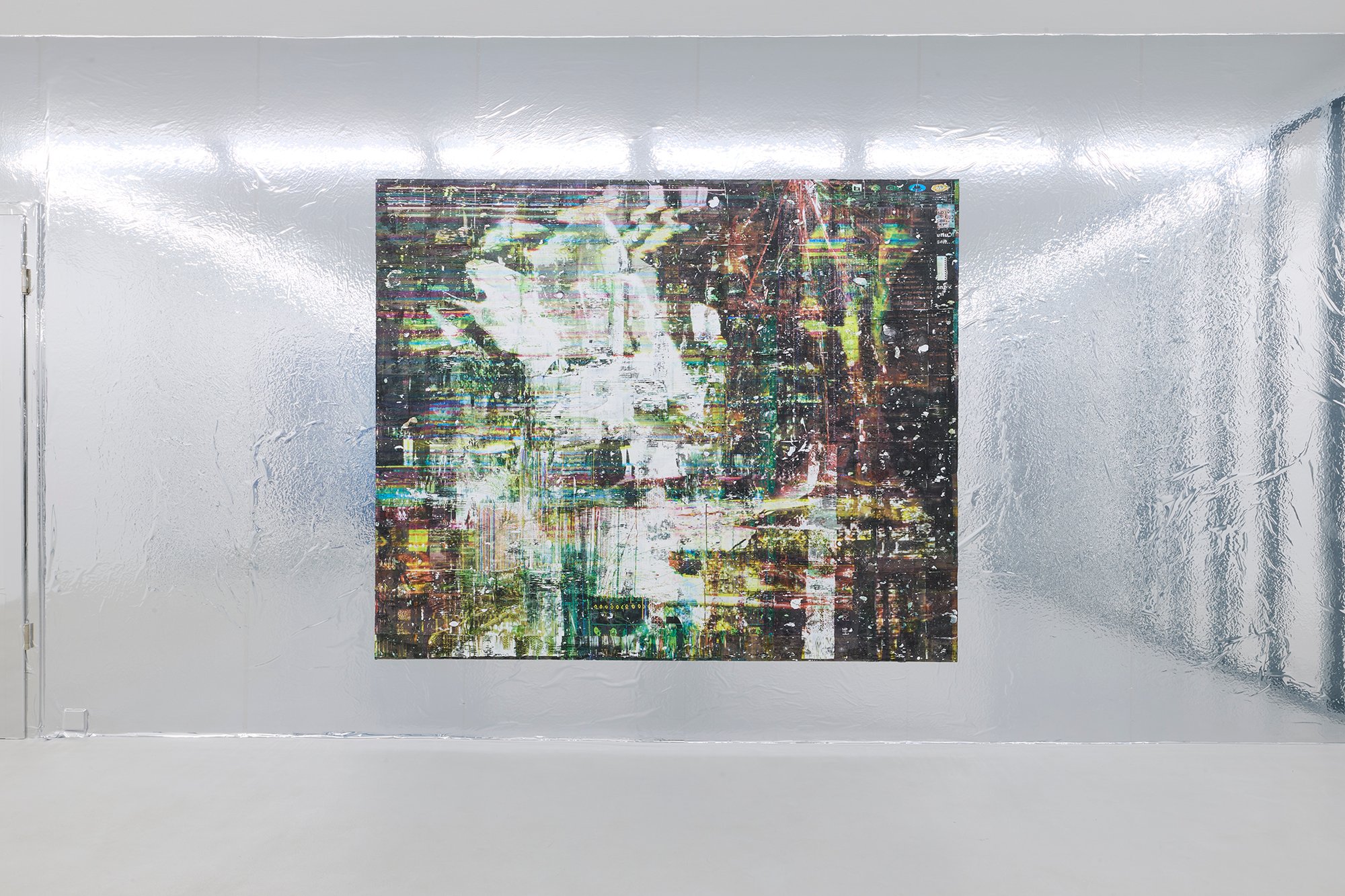
Chris Dorland, Untitled (background host), 2024. Photography by New Document. Courtesy of the artist
Once I made a conscious decision to be an artist, I was trying to understand the aggressive, no-limits expansiveness of capitalism, which is what so many of your teachers were looking at. Now, decades later, we’re living in the full expression of what they understood in its early stages, except now with absolutely no guardrails. Today, we’re surrounded by an increasingly alarmed discourse and apocalyptic predictions about where these technologies are headed.
AE: What I find fascinating about you both is that you’re dealing with painting almost as a marginal medium, or at least one of any number of media that is ripe to be pulped into a dataset. The fragile state of analog media comes through to me in your work — if I see a painting by one of you, I’m in no doubt that I’m in 2026.
JM: There’s a correlation between how Chris and I process pop culture — you’re looking at the screen, but also the highly distorted TV commercial within the language of popular culture. My window displays are meant to be democratic in a sense that they speak to a broader audience.
TV changed culture, and so will AI, but I do not think it will undermine analog art.
There is already a weird backlash happening, a widespread desire for art that is handmade as a result of distrust and fear of AI. People want stable objects made by hand. I think that AI’s real risk is less its competition with creativity, than the energy crisis that it’s causing and the current scramble to reopen old, unsafe nuclear power plants to fire up data centers.
CD: The history of art is filled with retrograde returns. Fragility is the perfect word to describe the moment we’re living in. I find it both exciting and terrifying, but I’m more excited about working in an environment of total precarity than one of stability, because the rules are all breaking or eroding, and that gives artists more latitude to work on what they’re interested in.
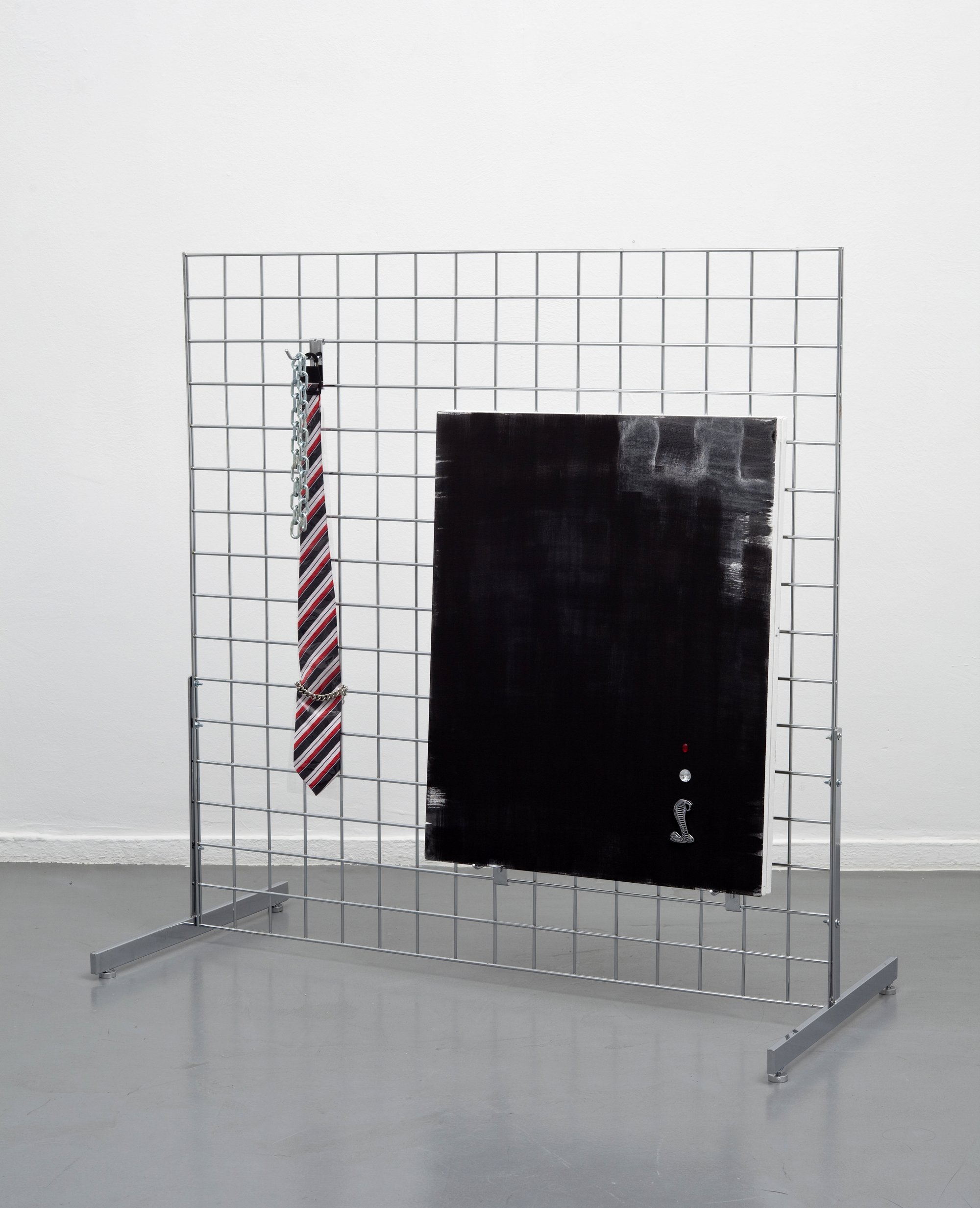
Josephine Meckseper, Untitled (Cobra, Tie), 2010. Courtesy of the artist
AE: I want to bring this back to your exhibitions. Generally, when you’re exhibiting in a commercial gallery your works have a critical thrust because they’re living within the systems they critique. Having displayed those same works in a non-commercial context, I wonder if they landed differently.
JM: Accessibility is always of interest to me, for example, when I elevate a stocking or a man’s tie in one of my assemblages.
I’m interested in the vocabulary of capitalism, but I don’t want to create works that only function within the context of contemporary art.
Seeing Chris’s show in person, I felt the same mechanism at work — by showing the architecture of art’s display, the studs of the wall, he’s inviting the viewer to see the museum space less as neutral, but as a place to exercise a form of critique. Both of our shows are integrating the viewer, not only pursuing our own artistic goals.
I don’t really see this doomsday scenario with AI yet. Rather, I see AI as an extension of other technologies we’ve been inventing. We’re sitting on this mountain of information, including an archive of trillions of images that is now being sucked into AI. But I don’t think that changes the artist’s status as an agent looking at culture with the capacity to subvert it. We shouldn’t let that agency be taken away by AI alarmism because if you throw a million pictures into a soup and stir it, what comes out is probably going to be quite mediocre.
Installation view of Chris Dorland, “Chrome Shelter,” at Museum gegenstandsfreier Kunst, Otterndorf, Germany, 2026. Photography by Volker Renner. Courtesy of the artist
AE: Chris, Robert Hobbs has written of how your work “represents the post-digital condition — more than that, inhabits it”. But I wonder if that idea resonates with you Josephine.
JM: My theoretical interest was always aligned with Guy Debord and the Situationists, creating situations outside the capitalist system. I see art as a tool for setting up those situations. I also regard the more interesting development to be in quantum physics rather than AI.
Any type of mystical understanding of reality is likely to be answered by quantum physics — there is no linear time, and communication between the smallest particles can happen at any given time and space. As artists, we might have a different set of tools that lets us access those paths, and foresee things earlier. AI is principally a tool for feeding markets and creating profit margins — it’s not really meant to be a cultural tool, that’s merely a side effect.
CD: What you’re opening up, Josephine, feels like a vastly different present or future. I’m definitely more interested in making things for the future than for the present, and I don’t necessarily imagine a stable future. Art as we experience it via museums, those are relics — whatever got saved, or was found after the fact and protected.
The contemporary art world is exciting and vital today, but really art exists for the future looking at the past — we’re all just making things that are going to be relics; maybe they’ll get saved, maybe they won’t. That’s the state of mind I make things in, and I find it inspiring.
JM: I often refer to my practice as an architecture of the present for the future, like a time capsule. Your work, Chris, touches on the broader context of science and physics, and presents itself as more digital than mine. My work is more an architecture of the present within western culture, and it might come off as slightly more capricious because I’m also looking at art-historical precedents. But it’s interesting that we phrase these things in almost opposite terms while engaging in similar strategies.
Chris Dorland is a New York-based artist working across painting, digital media, moving image, and installation. His work examines the increasingly unstable relationship between human perception, technological systems, and the built environment. His recent solo exhibition, “Chrome Shelter”, was presented at the Museum gegenstandsfreier Kunst in Otterndorf, Germany, with an accompanying monograph forthcoming from DCV in fall 2026. Future Ruins, by the art historian Robert Hobbs, was published by Hirmer in 2026. His work has been exhibited internationally and is held in public and private collections in the United States and abroad.
Josephine Meckseper is a German-born artist based in New York. Her practice spans photographs, films, videos, installations, paintings, and sculpture, examining intersections of politics, capitalism, and consumerism. Her critique of capitalism is perhaps best known through her large-scale displays of invented shopping vitrines. Her work has been exhibited at institutions including the Guggenheim Museum, MoMA, the Whitney Museum of American Art, and the Taipei Biennial, and is held in collections that include the Metropolitan Museum of Art, MoMA, the National Gallery of Victoria, and the Princeton University Art Museum.
Alex Estorick is the Founding Editor of Right Click Save.
1 R Hobbs, Chris Dorland: Future Ruins (Munich: Hirmer Verlag, 2025), 3.