·
Commentary#ai #online art culture #commentary
Are you yearning for the past?
JK
Joana Kawahara Lino@joanakawaharalinoabout 2 months ago
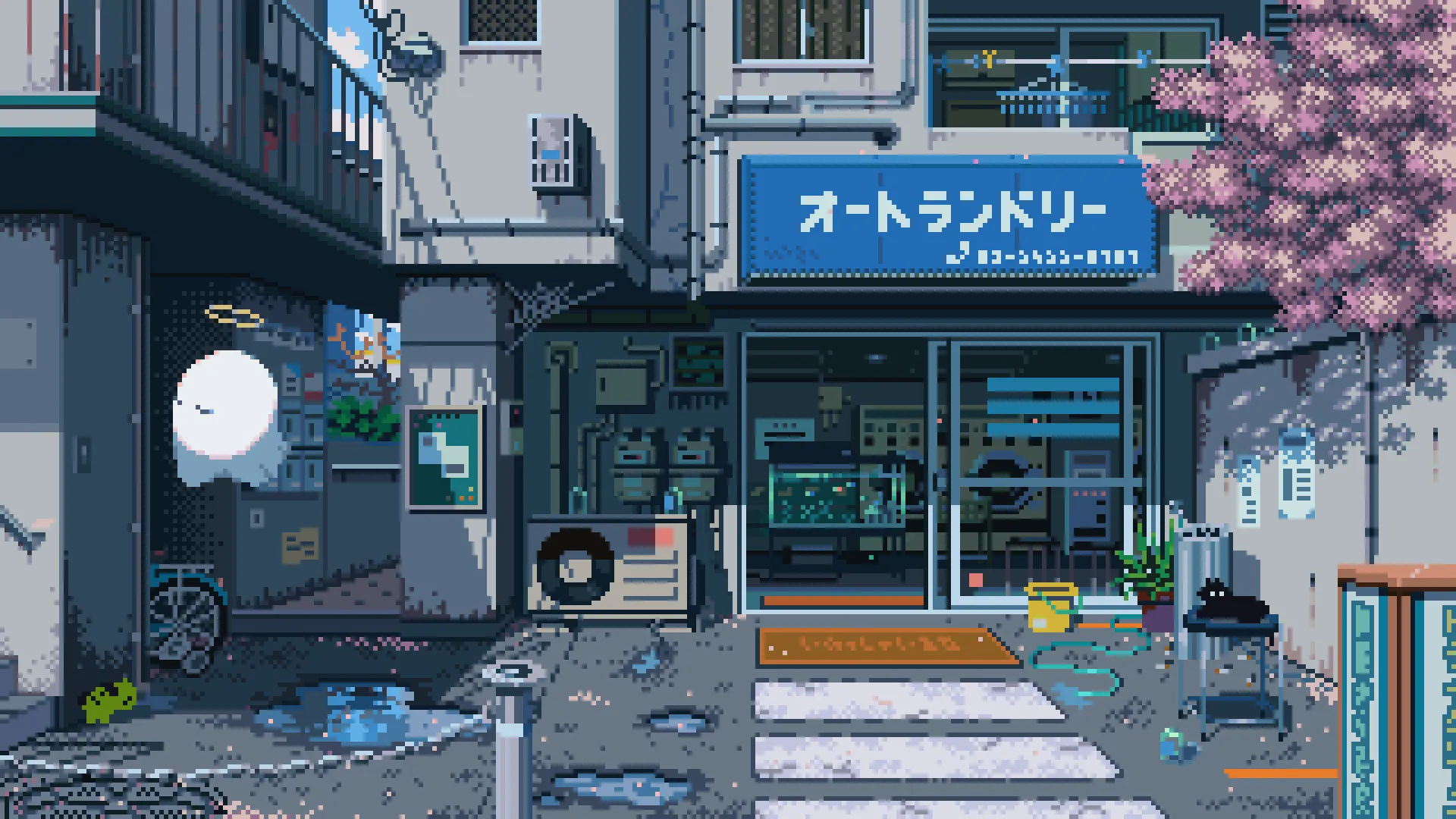
Swim in Still Days, Yosca Maeda
Scroll an art feed right now.
You’ll hit dithered gradients, 32-colour palettes, faceted meshes with visible seams. Work that looks like it was made on hardware that no longer exists.
The two styles that come to mind (also some of the most cited), are pixel art and low-poly. Low-poly is 3D. It is rendered, it IS CGI, and it sits on exactly the technical stack the polished work sits on. So the line being drawn here is not between 2D and 3D, and it is not really between rough and finished either.
What pixel art and low-poly share is that the constraint is visible in the output.
The grid and the polygon budget are both legible as a decision made by a human.
None of this is new. Fez shipped in 2012, Shovel Knight in 2014, and vaporwave had exhausted itself as a genre before most people had heard of a diffusion model. The taste for the visible limits predates generative image tools by more than a decade, and any account that treats AI as the cause is going to have a timing problem.
What changed is not the preference, but what the preference does.
Polish used to cost something, and it was legible as costing something. Rendering time, budget, a person who had spent years learning how to light a scene. Then the floor dropped to zero, and the signal broke. Not all polish either. What people are actually avoiding is a specific visual dialect: the hyperreal lighting, the chrome, the shallow depth of field, the residue of a prompt. Value has moved to whatever stays expensive in ways a model cannot fake, and visible constraint is expensive in exactly that way, because the constraint is its own proof. Choosing pixels in 2014 was a stylistic decision, legible mainly to people who cared about games. Choosing them now is a claim about how the work was made.
Susan Kare drew the original Macintosh icons on a 32 by 32 grid because that was the grid. The rubbish bin, the watch, the bomb: each pixel placed by hand, not as a style, but because the machine offered no other choice. The constraint was invisible as a decision precisely because it was not one. What is being made now looks similar and means the reverse. The grid is chosen, and it is chosen in order to point at the older condition, when a limit was a limit.
That’s the difference between work that was made under a constraint and work that cites one.
So... is pixel art actually nostalgic, or just legible?


I am secretly obsessed with pixel art, and it’s a goal of mine to begin really foraging through generative pixel art systems. On one hand, a good pixel artist is making critical decisions on a pixel-by-pixel basis, carefully making their own anti-aliasing and dithering - thinking as the renderer would.
On the other hand, these assets can be leveraged to make worlds, as we see in games. But what if we remove the interactivity, keep the procedural creation, and utilize pixel art? It’s a daunting and exciting opportunity.
I’m completely in agreement here @jamesmerrill but fear your secret is out ..