An Artist Who Keeps Technology in its Place | Theo Triantafyllidis
He loves new technology and he hates it. Theo Triantafyllidis, recently winner of the Frieze London Artist Award and the Lumen Prize Systems & Structures Award, on living through the VR boom and bust, and why he treats AI as just another tool
Theo Triantafyllidis loves technology. He also hates it. The Greek artist creates virtual worlds, inhabits digital bodies, and experiments with emerging technologies, while questioning whether they actually improve our lives or simply create new forms of control. His work combines the absurdity of video games with a critical examination of the systems behind them, from the tech industry's recurring hype cycles to the environmental costs of artificial intelligence.
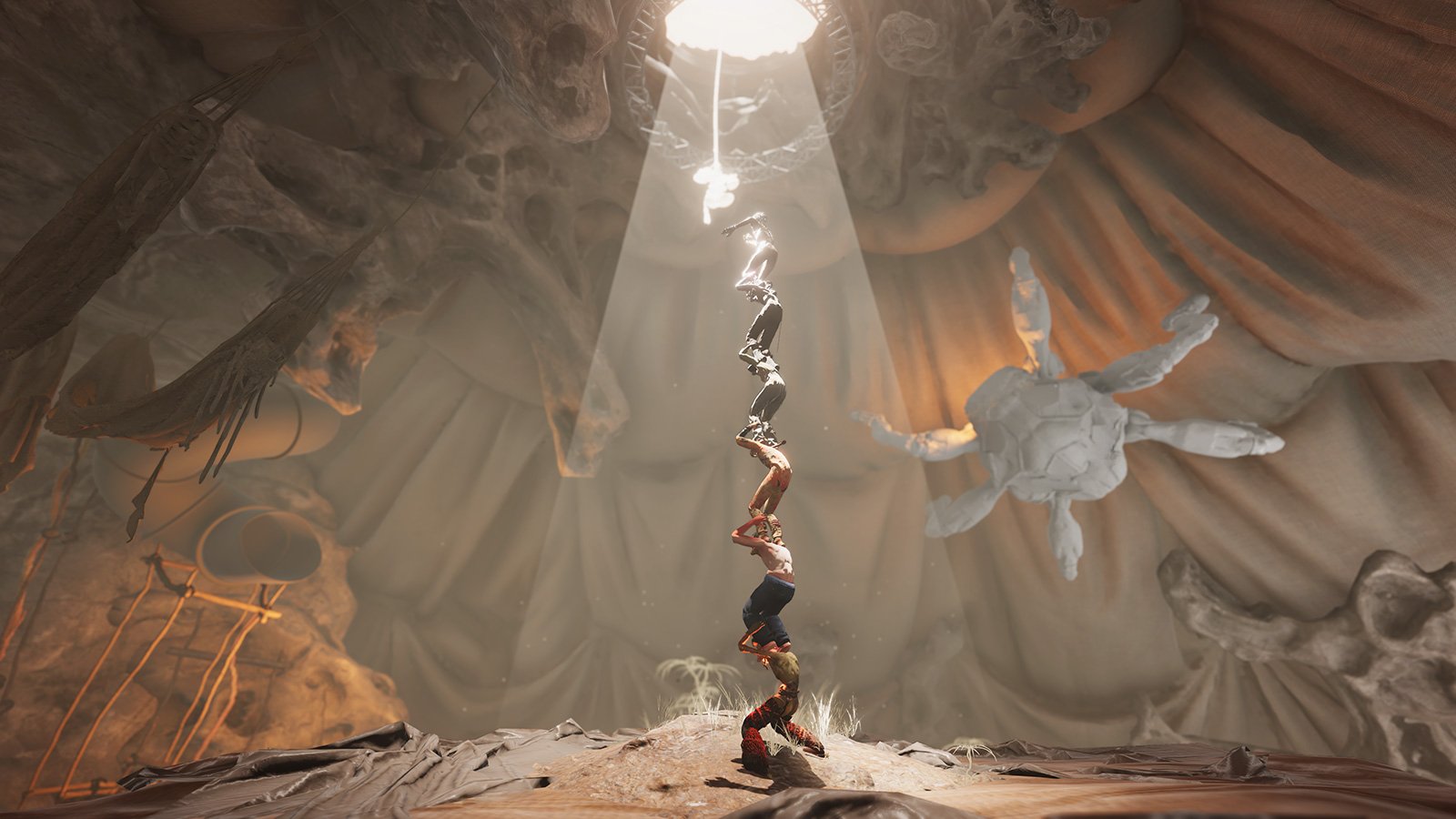
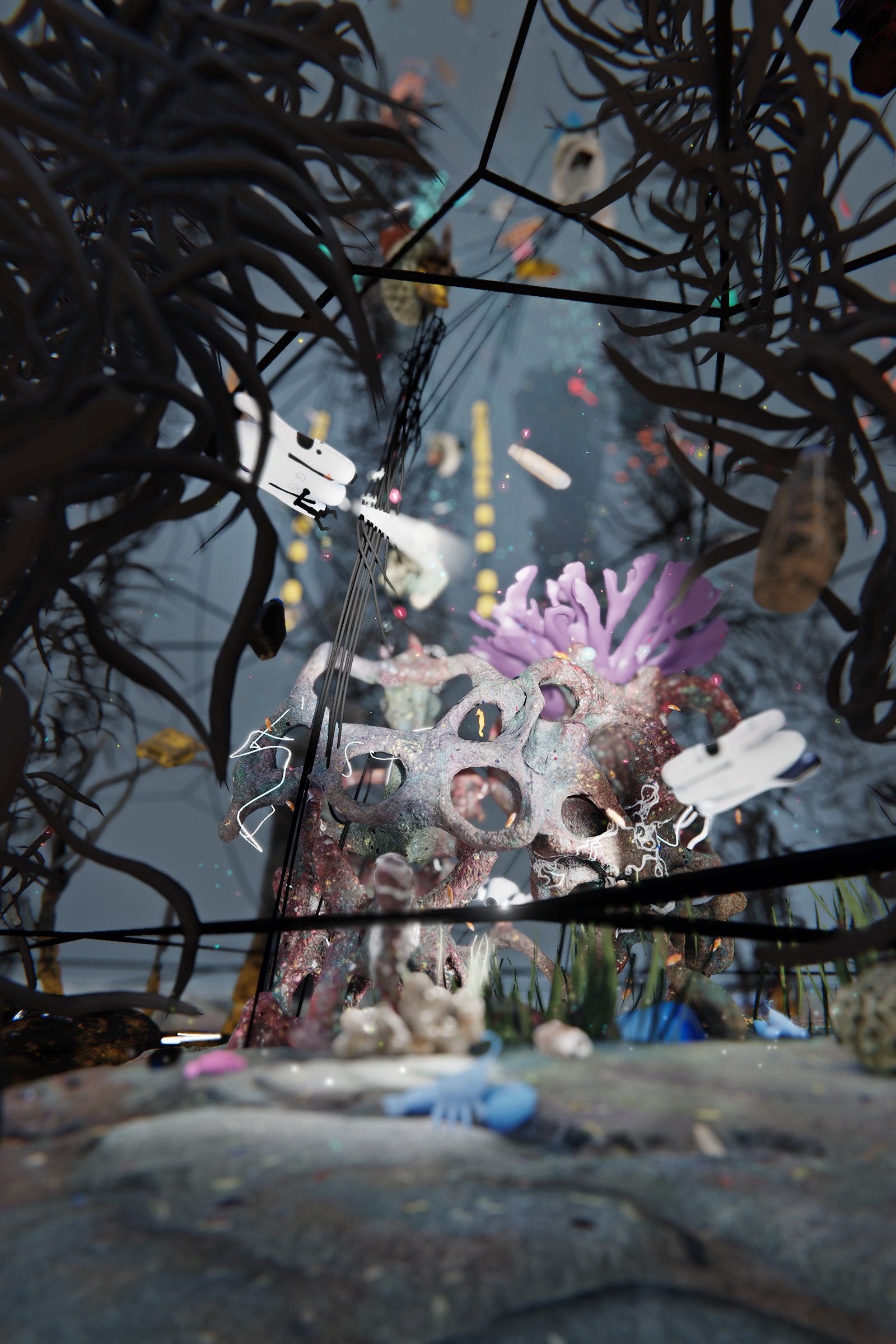
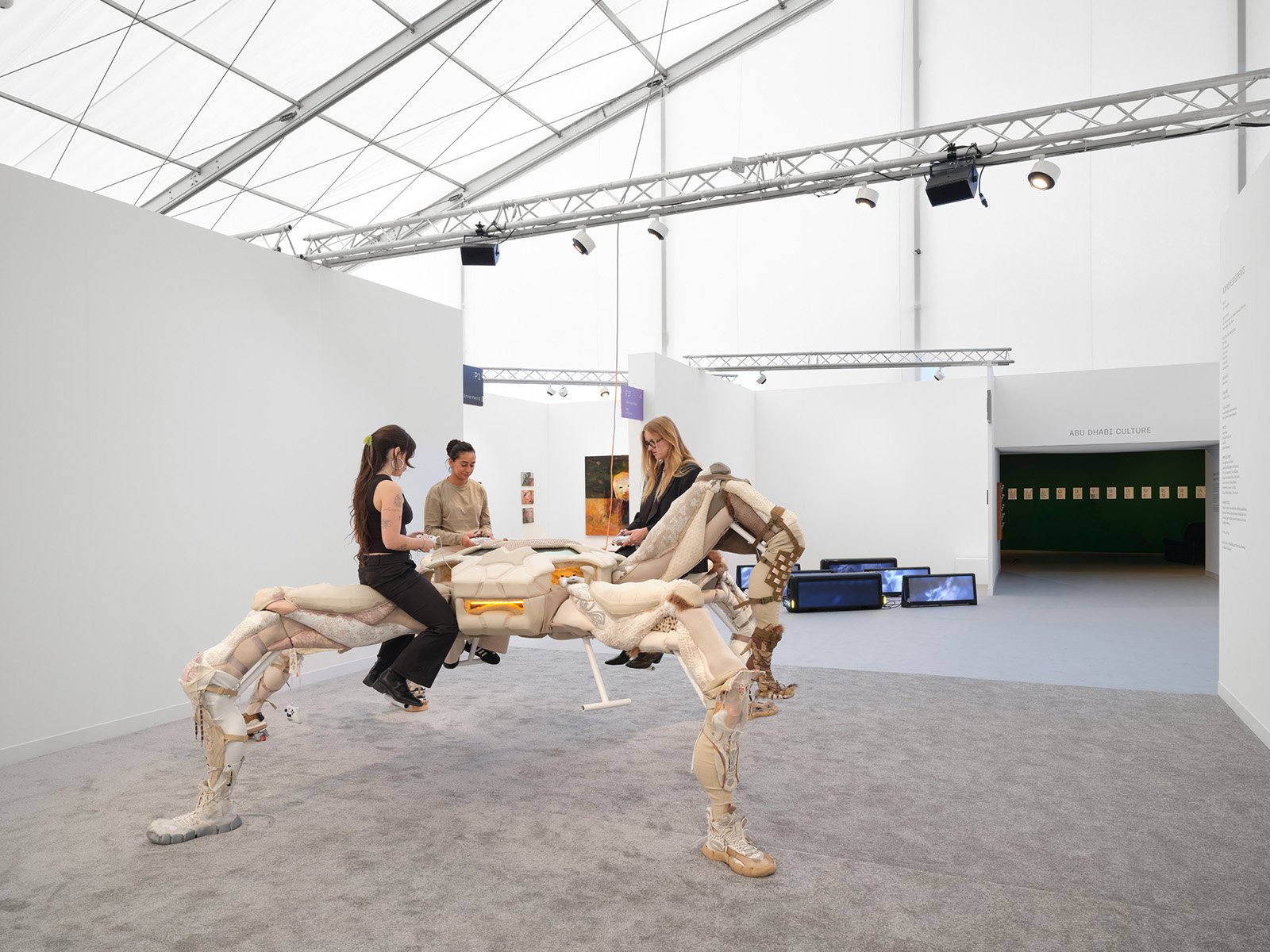
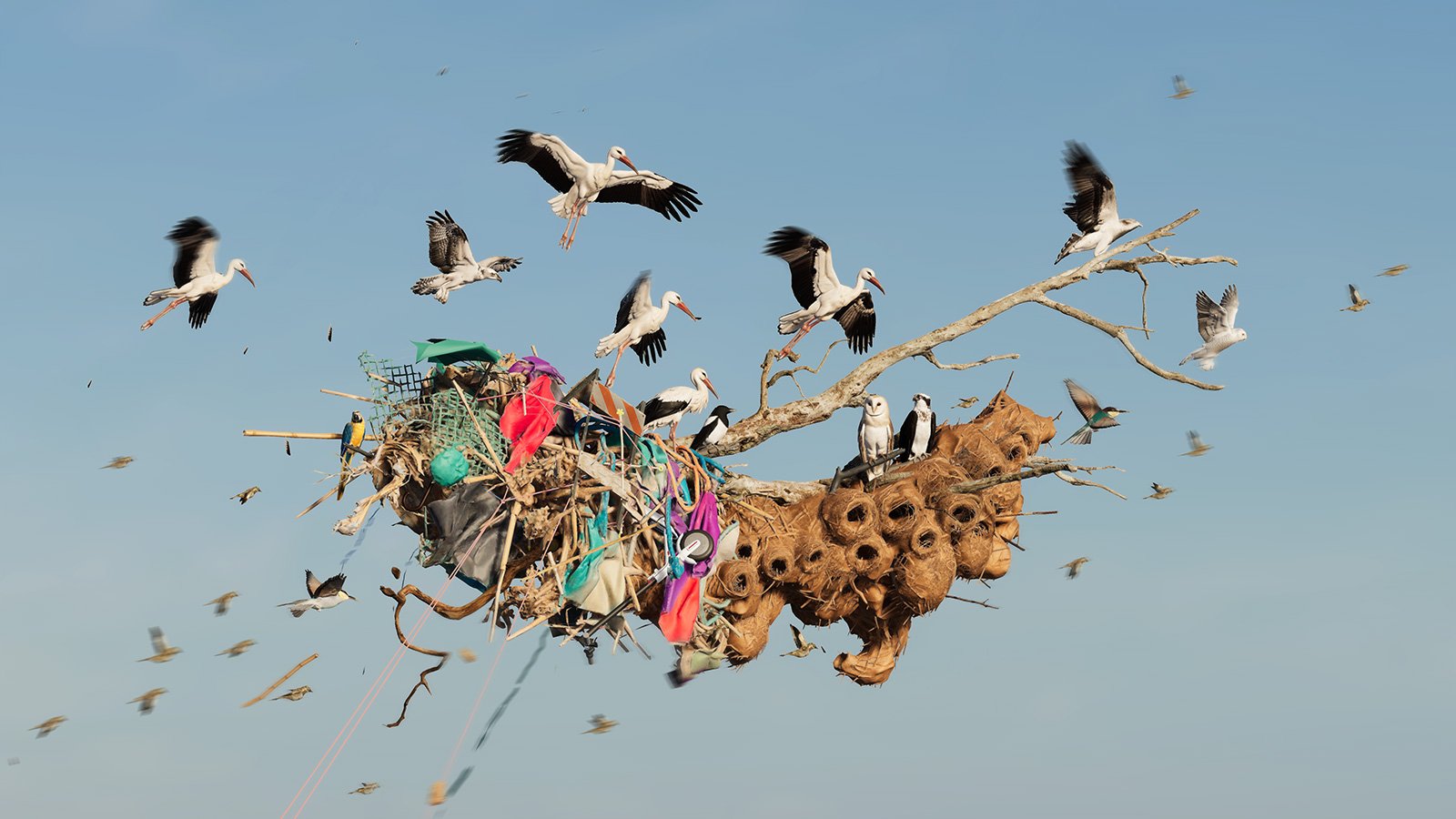
Triantafyllidis received the Frieze Artist Award for Feral Metaverse (Spider), 2026, a multiplayer game in which visitors climb onto a giant spider sculpture before working together to escape a virtual cave, which he presented at Frieze London in October 2026. More recently, he won the 2026 Lumen Prize Systems & Structures Award for Drift Lattice, 2025, a live simulation of an underwater ecosystem where marine life, plastic waste, and autonomous machines coexist in a fragile balance. While one work explores how people interact in virtual spaces, the other examines the complex relationships between natural and artificial systems.
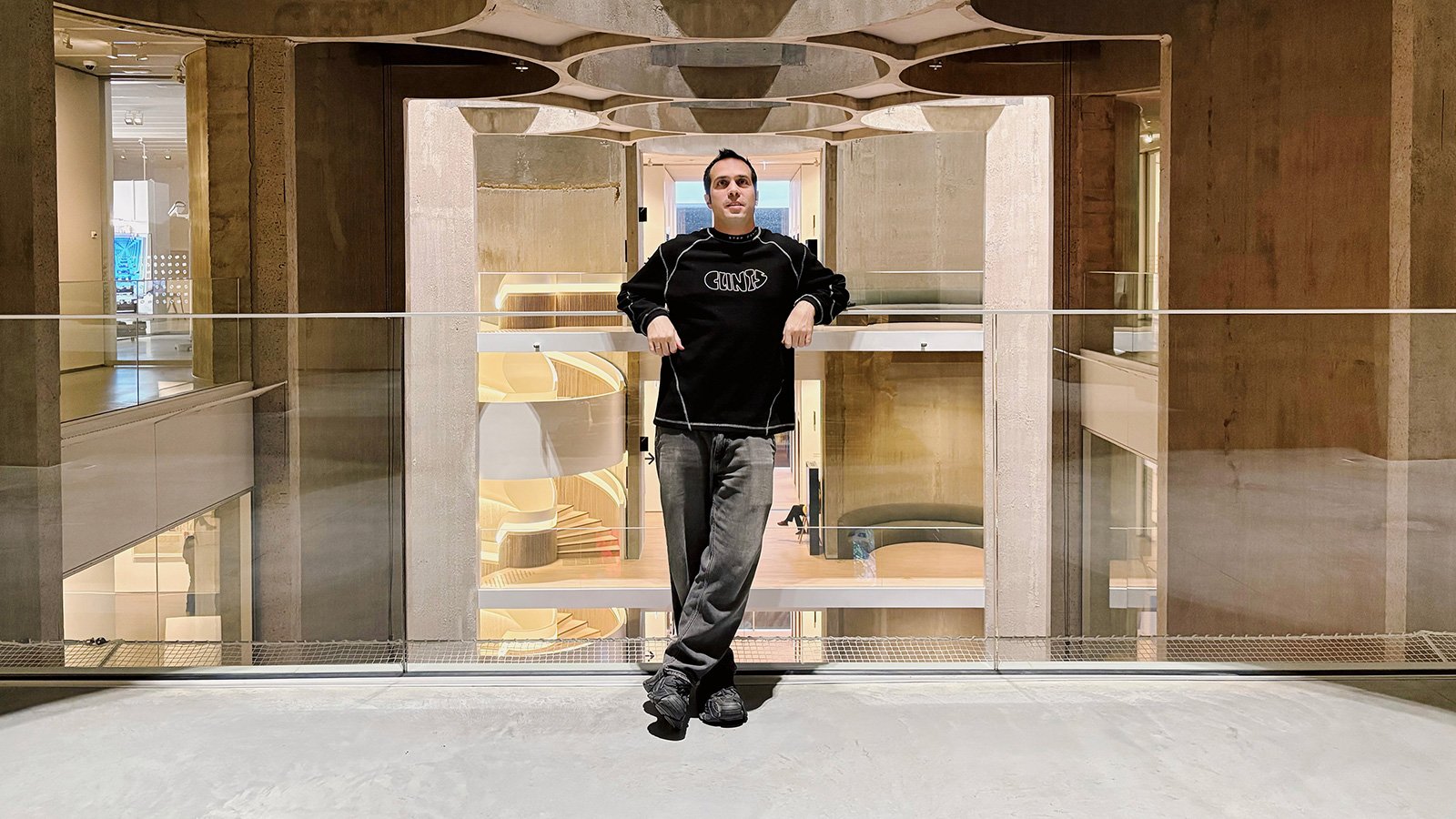
I met Triantafyllidis at Kunstsilo in Kristiansand, Norway, on the occasion of the Lumen Prize awards ceremony. His growing interest in climate change raises a question that runs through his practice: How can artists use technologies to imagine alternative futures while remaining critical of the industries that produce them?
Theo Triantafyllidis, Feral Metaverse (Spider), 2026. Courtesy of the artist
Anika Meier: Video games play a central role in your artistic practice. What is your earliest memory of playing them?
Theo Triantafyllidis: I’ve always had a love-hate relationship with games. I’m really not a dexterous player. As a kid, I preferred slower RPGs [role-playing games] and strategy games. One of my most formative gaming memories is Monkey Island 3, a LucasArts point-and-click adventure. It had beautiful hand-drawn animation, great dialogue, and a wonderful sense of humor. You spent a lot of time talking to characters, figuring out the right dialogue options, and finding ways to scam them.
AM: You studied architecture before moving into art. Why did you choose architecture in the first place?
TT: I was a teenager making that decision, so I don't know how wise it was. I think there was some outside pressure.
AM: Did they tell you to study something useful?
TT: Not exactly. It was more like, “You're good at math and you're good at art, so why not study architecture?”
AM: As an architect, you would have designed physical buildings. Now, as an artist, you create virtual environments. Is that really so different?
TT: Even in architecture school [at the National Technical University of Athens], I was already asking myself these questions. We were learning how to design spaces for the human body, but at the same time, people were spending more and more time in front of screens.
I started wondering how we could rethink virtual space, from websites to three-dimensional game environments. How could we create more interesting ways for the human body to inhabit and interact with virtual spaces? That's been one of the driving questions behind my work.
Theo Triantafyllidis, Drift Lattice, 2025. Courtesy of the artist
AM: Earlier, you said you weren’t sure whether studying architecture was a wise decision. Do you think becoming an artist was?
TT: I definitely enjoy my day-to-day life now, so in that sense, yes. Financially, I'm not so sure.
AM: How did you make the transition from architecture to art?
TT: After graduating in Athens, I moved to Beijing to work as an architect. At university, we'd developed these crazy, speculative projects, but the reality of the profession was much more grounded. I realized it probably wasn't for me. Because of the language barrier, I started spending more time online. I discovered communities of people making art on and about the internet, began talking to artists, and participated in online exhibitions. At some point, it clicked that I could be doing this instead. After Beijing, I went to UCLA to study Design Media Arts.
AM: There's something cartoon-like about the characters in your work, which reminds me of the games and animation we encountered growing up. How much has the internet culture of that time shaped your artistic sensibility?
TT: I see my practice as a continuation of net art and post-internet art. Even when I was studying architecture, I was following net art communities and looking at how artists were messing with the internet as an infrastructure. They were making art outside galleries, creating works that existed entirely in virtual spaces, and challenging how online communities and interactions were organized. There was something fundamentally subversive about that approach. Later generations of digital artists have lost a little of that spirit.
AM: But hasn’t digital art itself become much more institutionalized? Your work is shown in galleries and at art fairs. Is it still possible to be subversive from within those structures?
TT: Digital art has become more institutionalized, but I think it’s still on the fringes within those structures. That cuts both ways: there’s sometimes a lack of understanding of what’s happening on the screen and within the infrastructure of digital work, but that can also leave more space for subversion.
AM: Your work has a very recognizable aesthetic. When I see something you've made, I can often tell immediately that it's yours. How did you develop that particular visual language?
TT: I like to think of each work as a separate chapter or a little universe. The ideas and concepts often determine the visual language, so it can change significantly from one project to another. For me, the connective tissue isn’t necessarily the way things look. It’s more about how they behave, move, and interact, and the relationships they form with one another. What makes the work coherent is the inner workings and feel of these systems.
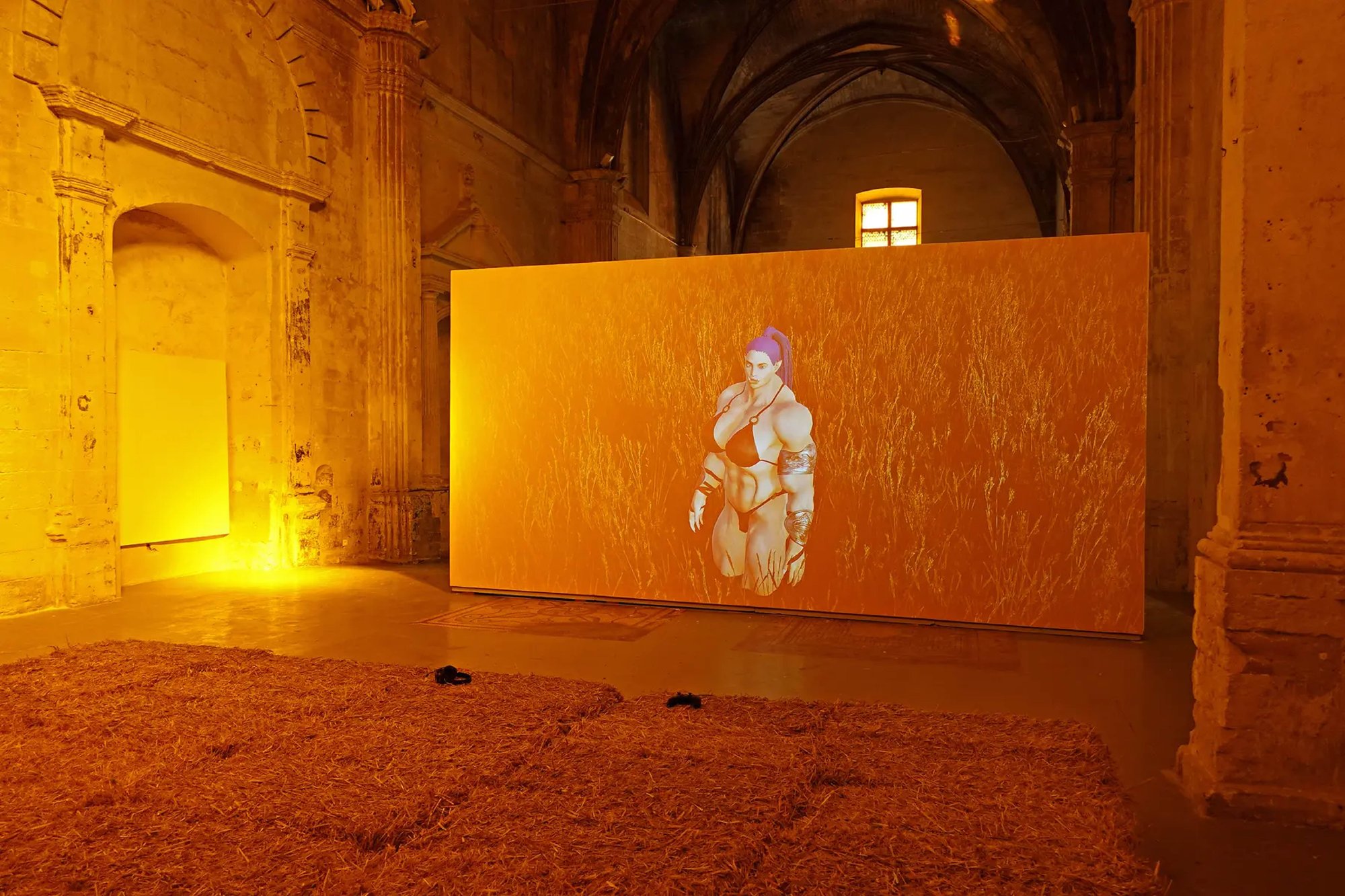
Installation view, “Theo Triantafyllidis at Chapelle des Trinitaires”, Octobre Numérique – Faire Monde, Arles, 2021, with work: Pastoral (2019). Courtesy of the artist
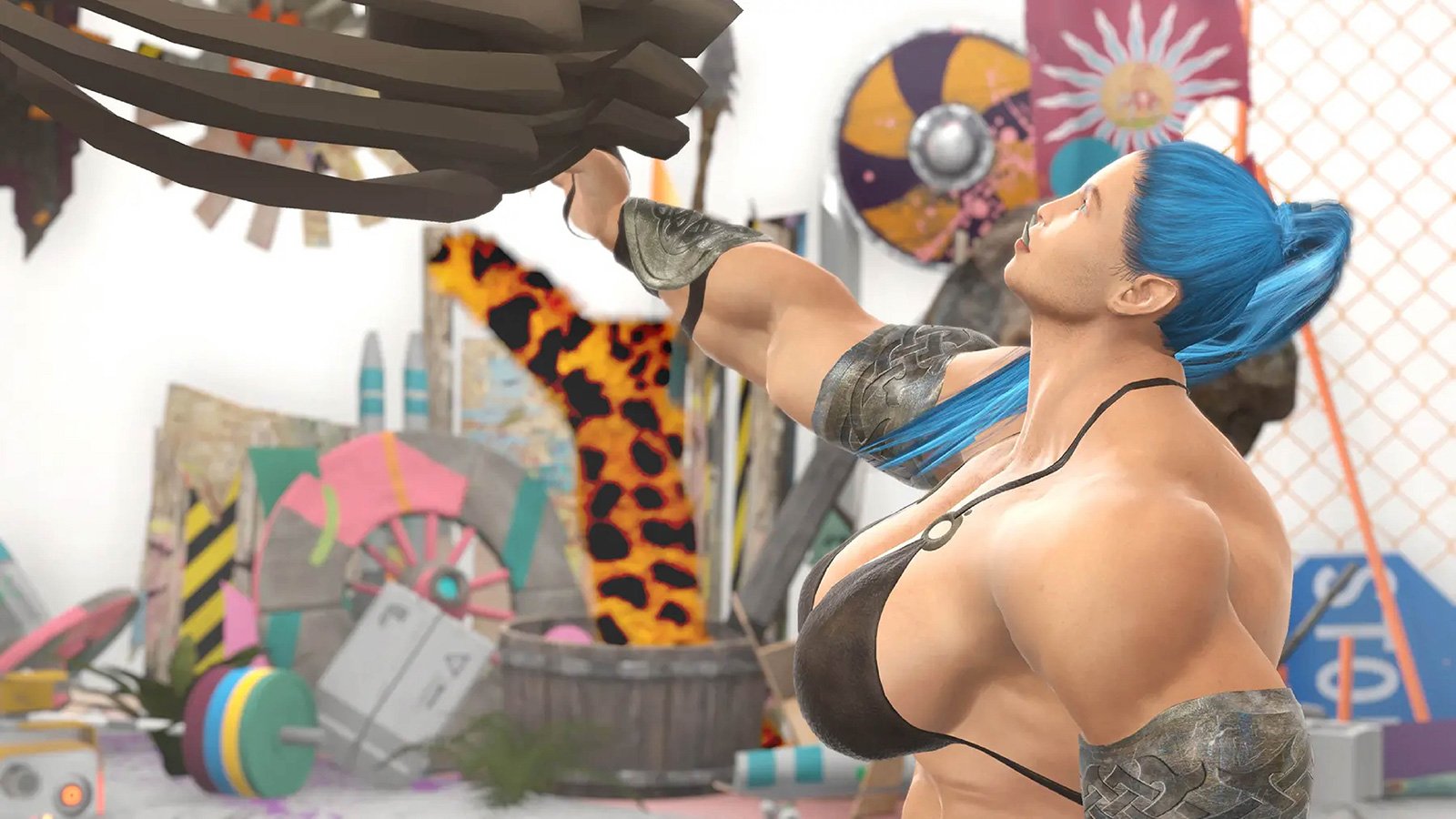
AM: There's a lot of humor and absurdity in your work. I’m thinking of that enormous Ork character with blue hair, for example. Is humor also a way for you to question the technologies you're working with?
TT: I have a strange relationship with technology. I’m inspired by new technologies and the possibilities they offer, but at the same time, I really hate them. I’m very critical of whether they're actually improving our everyday lives or ultimately becoming a burden and a means of control. Humor and absurdity are ways of holding up a mirror to these technologies. Are they really as smart and amazing as they’re presented to be? Or are they just glorified bots spewing out content that we assign meaning and value to, even when it might not be there? I think that's become especially apparent in the conversation around AI.
AM: Can you give me an example of a technology you've worked with that you also came to hate?
TT: As a media artist, there's this constant pressure to chase the tech industry's latest hype or be left behind. I've played along with that, working with augmented reality (AR), virtual reality (VR), flirting a little with blockchain, and more recently working a lot with AI.
With VR, I experienced an entire hype cycle firsthand. I got access to one of the early Oculus Rift VR headsets [funded by that company’s Kickstarter campaign], at the UCLA Gamelab in 2014-15. People were incredibly excited, and new generations of headsets kept coming out. I was finishing grad school and started making projects that involved spending more than eight hours a day inside a headset, for months on end. It was really fucking with my brain, but I was also curious to see what would happen.
That early project, the Role Play series (2018), was an experiment in virtual embodiment. What does it mean to have a body in virtual reality? Video games have a long tradition of elaborate avatars, but in that wave of VR, you were often reduced to a pair of floating hands, or nothing at all.
I decided to become an Ork artist, living and working inside a virtual studio, making sculptures and paintings [of this fantasy character from the Warhammer gaming universe], and developing a personality and artistic practice for this character. I wanted to see what would happen if I spent enough time inhabiting this other body.
Theo Triantafyllidis, Pastoral, 2019. Courtesy of the artist
AM: How did you try to make yourself physically feel like that character?
TT: I imagined this Ork as a kind of hyper-body, an amalgamation of video game bodies layered on top of one another. I used 3D character creation software called Daz3D, which has an incredible range of parameters for manipulating bodies. You could be 80% muscular, 20% elf, 30% pregnant, with goat feet and Ork features. The software has a history in amateur fantasy art and pornography, so assumptions about gender, sexuality, and ideal bodies were already baked into it. I ended up with this gender-ambiguous figure that felt very personal. I built my own rudimentary motion-capture suit and even wore sandbags and weights to make myself feel like a gigantic bodybuilder. I spent months rehearsing in front of a virtual mirror, trying to find the character’s voice, how they would move, what they believed in, and what kind of art they would make.
For the exhibition, I hacked the [HTC Vive virtual reality headset] system to create augmented reality portals, so visitors could encounter the Ork without wearing a headset. I disliked the idea of people queuing up to enter VR one at a time. Instead, they could move a sculptural viewing device together, performing a little choreography while searching for the character.
Meanwhile, I watched the VR hype collapse. Funding was cut, projects were frozen or shelved. It was fascinating to witness an entire tech-industry hype cycle from beginning to end. I’ve come to feel that these cycles just keep repeating themselves.
AM: But as an artist, you also benefit from these hype cycles. New technologies attract funding, commissions, and institutional attention. How do you remain critical of a system you're also part of?
TT: My approach is to have a clear artistic vision, develop my own narratives and systems, and maintain a coherent strategy for working with technology. Then I wait for a new technology to emerge that aligns with the story I want to tell. I also try to make sure the technologies I use remain in the background and are critically examined, rather than being foregrounded or regarded with religious awe.
AM: You wanted people to experience virtual worlds without being isolated from one another. Was that also part of what interested you about augmented reality? I'm thinking of Genius Loci (2021), the giant worm you created for the Grand Palais in Paris.
TT: I imagined this gigantic, awkward worm-like creature inhabiting the building, almost like Quasimodo, as a kind of spirit of the place. Visitors could interact with it through their phones. I was interested in exploring AR as a medium. How could you create something site-specific that responds to the architecture, allows for interaction, and opens up narrative possibilities? AR seemed particularly well suited to that.
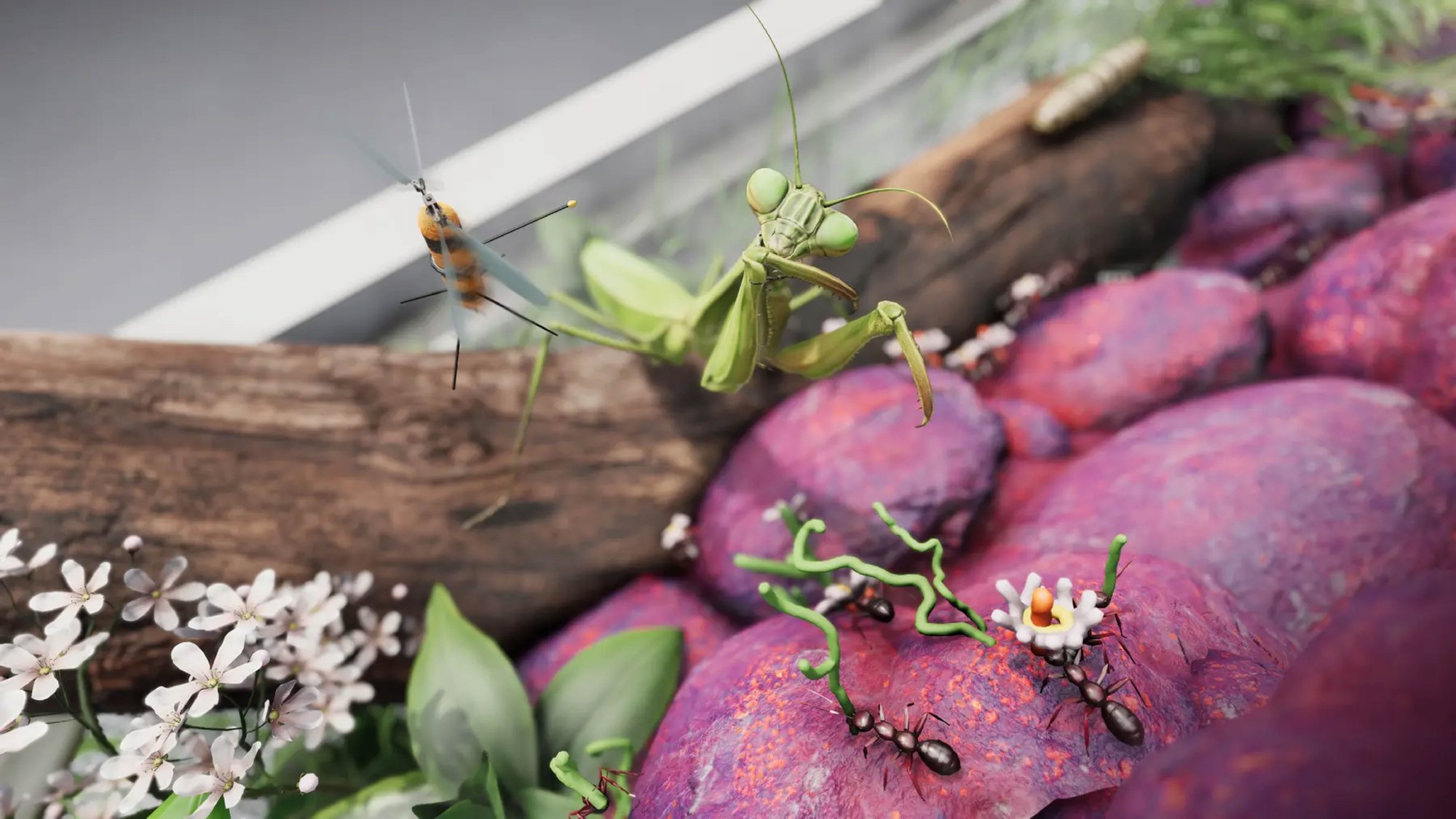
Theo Triantafyllidis, BugSim (Pheromone Spa), 2022. Courtesy of the artist
AM: You’ve worked with VR, AR, and other technologies as they've become popular. To what extent have these developments influenced your artistic practice?
TT: These experiments are one side of my practice. I'm interested in virtual space, so VR, AR, and simulations are meaningful things for me to explore. But I don't want the work to be entirely about a particular medium. I'm more interested in taking certain ideas and exploring them through different media to see how they mutate or what unexpected directions they might open up. The other side of my practice consists of live simulations. These are much more enclosed software systems. They don’t depend as much on specific hardware, and they don’t involve user input or interaction. In some ways, they're much more resilient to the tech industry’s hype cycles.
AM: You also experimented with NFTs when that market was taking off. I remember you working with Kenny Schachter and Galerie Nagel Draxler. What interested you about that scene?
TT: I was already close to Kenny Schachter through Meredith Rosen Gallery in New York, which I work with. Kenny had all these crazy ideas for early NFT exhibitions, and we did our first show together in Cologne. I remember it as one of the first really refreshing things to come out of the pandemic.
I showed Pastoral (2019), a video game featuring the Ork character. It was a continuation of the earlier project I described, but in this new game, the Ork goes outside into a hayfield at sunset and just chills. It's a very relaxed, interactive anti-game. We also showed videos of the Ork, and some of these works were packaged as NFTs. You could download the game, for example. But I never really figured out a satisfying way to make the NFT format fit the work.
AM: You never quite found a satisfying way to make NFTs fit your work. But the experiments with online games continued. Is that how Feral Metaverse developed?
TT: We did a few more group exhibitions with Kenny Schachter, and I also had a solo exhibition at Nagel Draxler's Crypto Kiosk in Berlin. That's where we presented the first version of Feral Metaverse, a larger online multiplayer video game I've been developing, which also has a physical sculptural installation component. The project has gone through several iterations and expansions since then. One of those eventually led to the Frieze Artist Award. The Feral Metaverse (Spider) we presented there is essentially the latest, refined and developed version of that project.
Theo Triantafyllidis, Feral Metaverse (Spider), 2026. The work was presented at Frieze London 2026. Courtesy of the artist
AM: The Frieze Artist Award gave you the opportunity to realize a much more ambitious version of Feral Metaverse. What did that commission make possible for you?
TT: It came at exactly the right moment. I already had ideas for larger-scale works, but I didn't have the resources or the platform to realize them. At the same time, it was a big challenge. I had to step up what I was doing.
AM: With Feral Metaverse, you're creating something that exists both as an artwork and as a video game. Do art audiences and gaming audiences approach the same virtual world differently?
TT:Feral Metaverse explores our lives online, how we interact with one another, and how virtual spaces shape our social behavior.
The project started during the pandemic, when I was thinking about the need for new kinds of online commons: a more open, primal space where people could come together, free from the structures of competition, ownership, and consumption that dominate so many online platforms.
But there's also the question of what an art audience expects from a video game, and what an online gaming community expects. How do you bridge the thirty-second attention span of someone visiting a gallery and the several hours a gamer might spend inside a virtual world?
AM: I've experienced that difference myself. When I worked with the artist Thomas Webb on The World Wide Webb (2020/2021) for KÖNIG GALERIE, we had a virtual [Berlin night club] Berghain that players couldn’t enter. We thought it was an obvious joke, but people kept returning to the avatar store, trying on every outfit to see whether one would get them past the door. Some even messaged me asking what they had to do to get in. They were treating it as a challenge they had to solve.
How do you navigate those expectations in Feral Metaverse? Do you give players goals, or is it more about exploring a virtual world?
TT: I've struggled with that question myself. I'm drawn toward digital worlds that function as social spaces, where you can hang out with friends or strangers. That’s where the idea of Feral Metaverse came from. There are things to do and ways to interact, but not necessarily a single goal everyone is working toward.
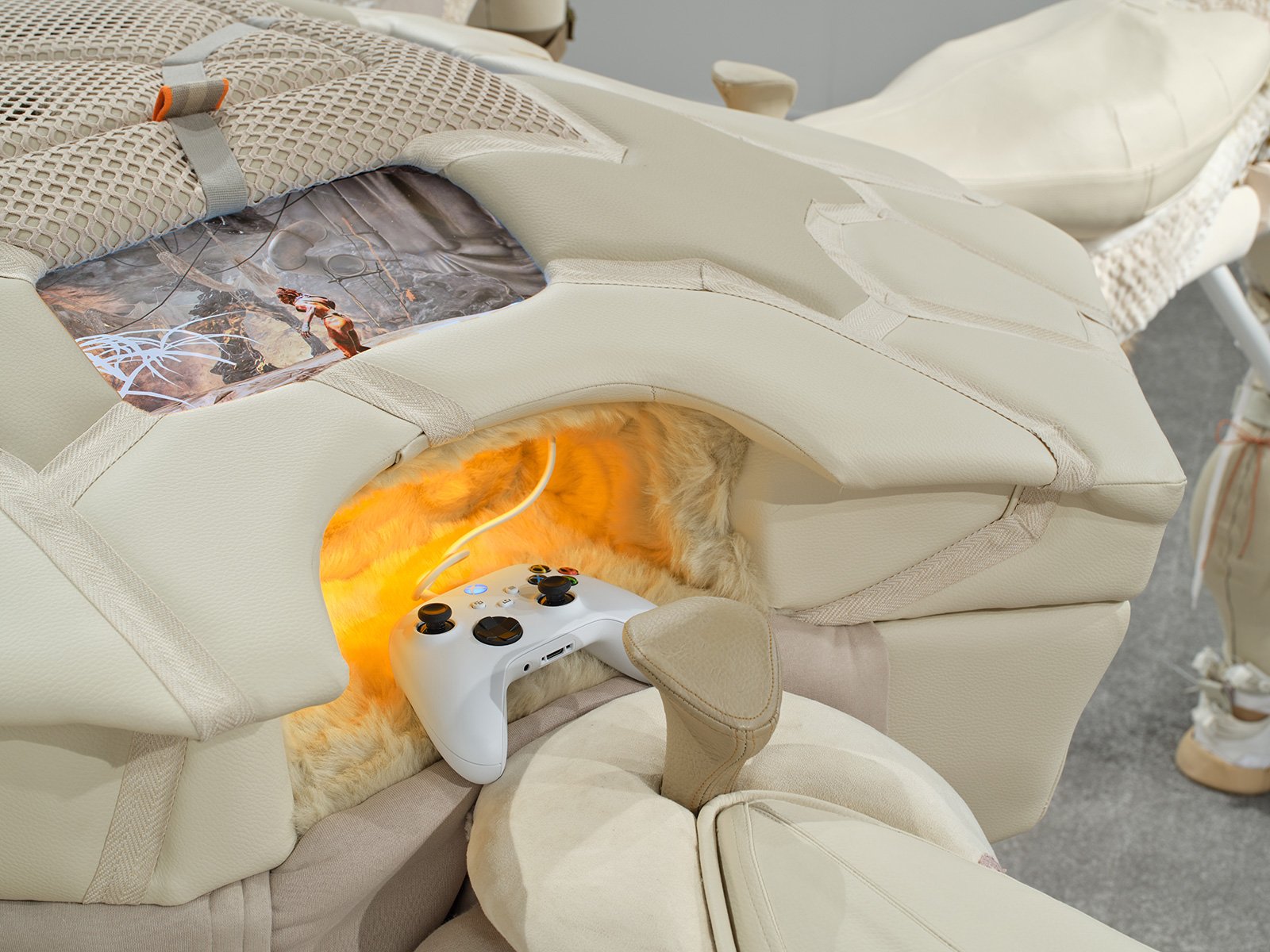
Sometimes, though, game mechanics can be useful. For the Frieze version, we created a simple challenge. Four to six people could play together in a cave where a spider-like creature was shooting things at them. To escape, they had to climb on top of one another, form a human ladder, and reach a rope hanging from the ceiling. The goal was easy to understand, but achieving it was difficult, funny, and sometimes frustrating. You had to cooperate. If some players weren't paying attention, nobody could win.
We designed the experience for an art fair audience that might not have much time for a game. It was fast, playful, and a little chaotic. A lot of people who had never touched a gamepad before ended up playing.
Theo Triantafyllidis, Feral Metaverse (Spider), 2026. The work was presented at Frieze London 2026. Courtesy of the artist
AM: But how did you persuade people who weren't used to video games to pick up a controller in the first place?
TT: I think people are almost as allergic to gamepads in exhibitions as they are to VR headsets. That’s why I use the physical installation as a kind of lure. At Frieze, people had to climb onto the giant spider sculpture to play the game. Often, they needed someone to help them up. By then, they were already physically involved in the work.
The sculpture helped break the ice. Some people initially climbed onto the spider to take a selfie. But once they were up there, they ended up playing.
AM: You've just received the Lumen Prize Systems & Structures Award for Drift Lattice, a work that takes a very different approach to virtual worlds. Rather than creating an environment for people to inhabit, you're simulating an entire ecosystem. What interests you about these artificial environments?
TT:Drift Lattice is a live simulation imagining an autonomous kelp farm in the near future, operated by underwater drones. Kelp farming is being investigated as a potential source of mass nutrition and a way of capturing atmospheric carbon. I imagined an underwater farm inhabited by fish, microorganisms, and other marine life. There are also marine plastics that start merging with organic matter into strange clusters. All these elements are constantly negotiating their boundaries and trying to maintain a balance.
It's part of a series in which I've been representing simplified versions of natural ecosystems inside a game engine. For me, that's a way of understanding complex systems and the delicate relationships within them. It makes me more aware of how fragile and interconnected they are.
AM: Is that interest in interpreting natural systems also behind Funny Weather?
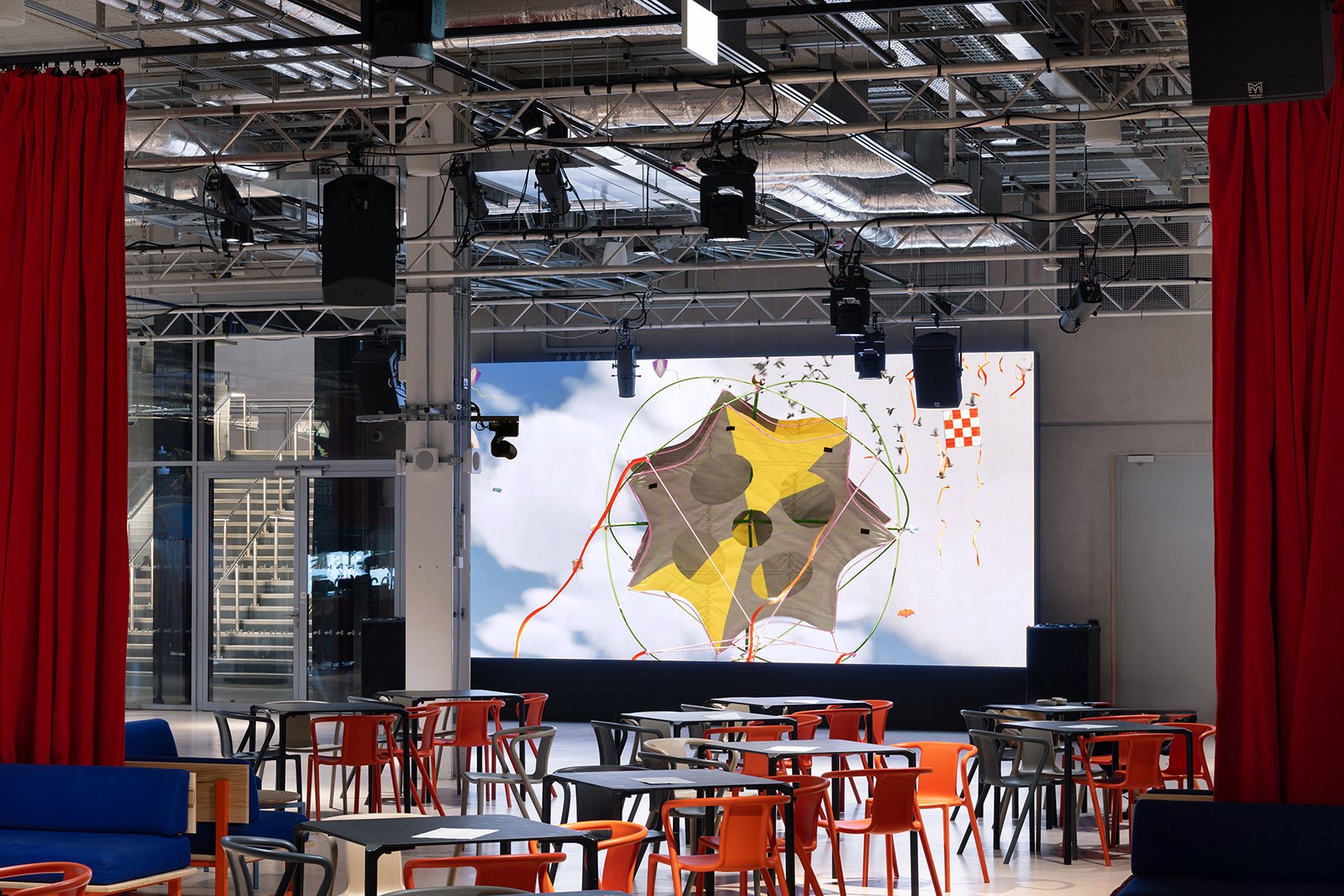
TT:Funny Weather is a new work produced by Factory International, in Manchester, and commissioned together with ACMI in Australia, Onassis ONX, and M+ in Hong Kong, as part of the Behind the Screen initiative. It’s a performative system that treats the weather as a main character in our lives. Climate change is becoming increasingly perceptible in everyday life. The work draws on three sources: local weather conditions, flights passing overhead, and recent bird sightings recorded by birdwatchers.
The system adapts to wherever it's exhibited. In Manchester, for example, all this data feeds into a custom large language model that attempts a kind of divination. I was thinking about how people once interpreted changes in humidity, cloud formations, or birds' behavior to anticipate the weather. The language model takes these seemingly unrelated observations and tries to predict the future. Sometimes its predictions are incredibly specific. At other times, it makes sweeping, almost apocalyptic statements about humanity.
Installation view, Theo Triantafyllidis, Funny Weather, 2026, Aviva Studios, Manchester. Photography by Michael Pollard. Courtesy of the artist and Factory International
AM: Earlier, we talked about your interest in virtual worlds. With Drift Lattice and Funny Weather, you seem increasingly concerned with the physical environment and climate change. Has your focus shifted?
TT: These questions were always in the background of my work, but with each project, they’ve moved further into the foreground. I’ve been reading more about climate change and how much depends on the decisions our generation makes. I've also realized that game engines and artificial systems are particularly well suited to exploring the complexity and fragility of real-world systems and how our actions affect them.
AM: In Funny Weather, you’re using a language model to interpret the world around us. Has AI changed the way you work as an artist?
TT: There’s an enormous polarization around AI. Many communities are understandably angry about how it’s being implemented and disrupting entire industries and jobs. I completely understand that. As an artist, though, I feel like I can see through some of the hype and bullshit surrounding it. To me, AI is ultimately another digital tool, perhaps an overglorified one, but a tool nonetheless.
What interests me is investigating what these technologies can actually do, where their limitations lie, and what biases they have. And then figuring out how to integrate them into my practice without making the work about AI.
In Funny Weather, the language model plays a slightly unreliable oracle, extracting meaning from seemingly unrelated information. Sometimes it's poetic, sometimes ridiculous, and sometimes strangely convincing. I'm interested in that ambiguity, especially as we increasingly rely on these systems to interpret the world for us.
Theo Triantafyllidis, Funny Weather, 2026. Screenshot. Courtesy of the artist and Factory International
AM: You describe AI as just another tool. But it raises fundamental questions about labor, authorship, and the resources it consumes. Can an artist really separate the tool from the system behind it?
TT: I don't think artists can separate AI as a tool from the political, economic, and environmental systems behind it, and I don't think they should.
Every technology comes with its own politics and economics, and AI makes some of these contradictions particularly obvious.
There's a paradox at the heart of Funny Weather: we're looking at AI as a potential solution to climate change, while its development is driven by enormous energy demands and an economic model of perpetual growth. Can AI really help us imagine sustainable futures when the industry behind it might be working against them? It's possible that the advancement of AI and efforts to address climate change are fundamentally at odds.
Theo Triantafyllidis builds performative systems where natural and synthetic intelligences rehearse their coexistence. Working with games, live simulations, performances, and installations, he creates volatile arrangements presented as darkly playful procedural worlds. His work uses the logic of play and simulation to approach phenomena too vast to narrate: ecological collapse, social entanglement, and networked desire, turning them into experiences that can be felt rather than verbally explained. At the center of his practice is the body: primal, sexual, comedic, and often overwhelmed. Triantafyllidis explores the uneasy fit between our ancient instincts and the accelerating systems we inhabit, exposing the eternal absurdity of that mismatch. His characters—human, animal, monster, or machine—balance between control and surrender, humor and dread, intimacy and spectacle. The outcome is a continuously evolving ecosystem of works that searches for a tender, hormonal core inside an overstimulated world. He holds an MFA in Design Media Arts from UCLA and a Diploma in Architecture from the National Technical University of Athens. He has exhibited his work at museums including the Whitney Museum in New York, Centre Pompidou-Metz, Buk-SeMA in Seoul, House of Electronic Arts in Basel, Ujazdowski Castle in Warsaw, Sapieha Palace in Vilnius, and NRW-Forum in Düsseldorf, as well as at galleries such as Meredith Rosen Gallery, The Breeder, and Nagel Draxler. He has participated in the 2021 Athens Biennale: Eclipse, Berliner Festspiele 2021, Sundance New Frontier 2020, and HyperPavilion at the 2017 Venice Biennale.
Anika Meier is a Berlin-based writer, moderator, curator, and lecturer specializing in art, technology, and digital culture. She teaches at the Department of Digital Art at the University of Applied Arts Vienna, is the co-founder of the curatorial collective The Second-Guess, and is the curator and program lead of the objkt labs Residency. She regularly contributes to Monopol, Kunstforum, Spike, SLEEK, Numéro Berlin, and The AI Art Magazine, and has moderated conversations and spoken at events including Art Basel, re:publica, and Ars Electronica.