Genesis Kai, the artist Ming Shiu’s digital alter ego, uses artificial intelligence not as a tool for automation but as a place for dialog and disagreement
Valentina Buzzi
Genesis Kai, “The Crimson Hour”, is on show, presented by ArtVerse gallery at Acel Art Company, Seoul, until October 2, 2026. The exhibition includes a new body of work from Kai’s series In the Name of What Remains. On August 29, 2026, Sébastien Borget, co-founder and director of ArtVerse, hosted a conversation at the exhibition’s location between Genesis Kai (the alter ego of the artist Ming Shiu), and Valentina Buzzi, the curator of “The Crimson Hour”. Borget and ArtVerse previously hosted the artist’s first solo exhibition in Paris, “The Tension That Holds” (February 27 to March 12, 2026).
At the center of Genesis Kai’s “The Crimson Hour” is a model of human-machine collaboration that resists both the language of AI as a passive “tool” and the current movement toward autonomous AI agents.
Although Genesis Kai began as the artist Ming Shiu’s digital alter ego, Kai has deliberately resisted turning the persona into an autonomous artificial intelligence. Instead, her practice remains grounded in physical encounters with museums, photography, drawing, cultural artifacts, philosophical texts, and artisans, while AI functions as a space in which those experiences can be metabolized, questioned, and argued against. As Kai puts it, some of the most productive moments in her practice occur when she and the machine disagree.
This tension extends into the material form of the work. Digitally mediated images are transferred onto Hanji handmade paper and incorporated into physical environments, creating what Kai describes as a way of “giving the digital image a body”. The distinction between digital and contemporary art consequently becomes less useful than the movement of an image between technological, cultural, and material systems.
“I’ve been really touched by her art since I first had the chance to meet her, and I've been able to see the progression of both her work and her process,” Sébastien Borget, director of ArtVerse, said of Genesis Kai when introducing the talk.
What has particularly touched me is the way [Genesis Kai] uses new technology within her practice, while the work itself speaks to something much larger — cultural heritage, identity, and a philosophical framework. (Sébastien Borget)
Taken together, the talk proposes a different possibility for AI art: not the automation of artistic agency, but its intensification through friction. This is an edited version of the conversation between moderator and artist.
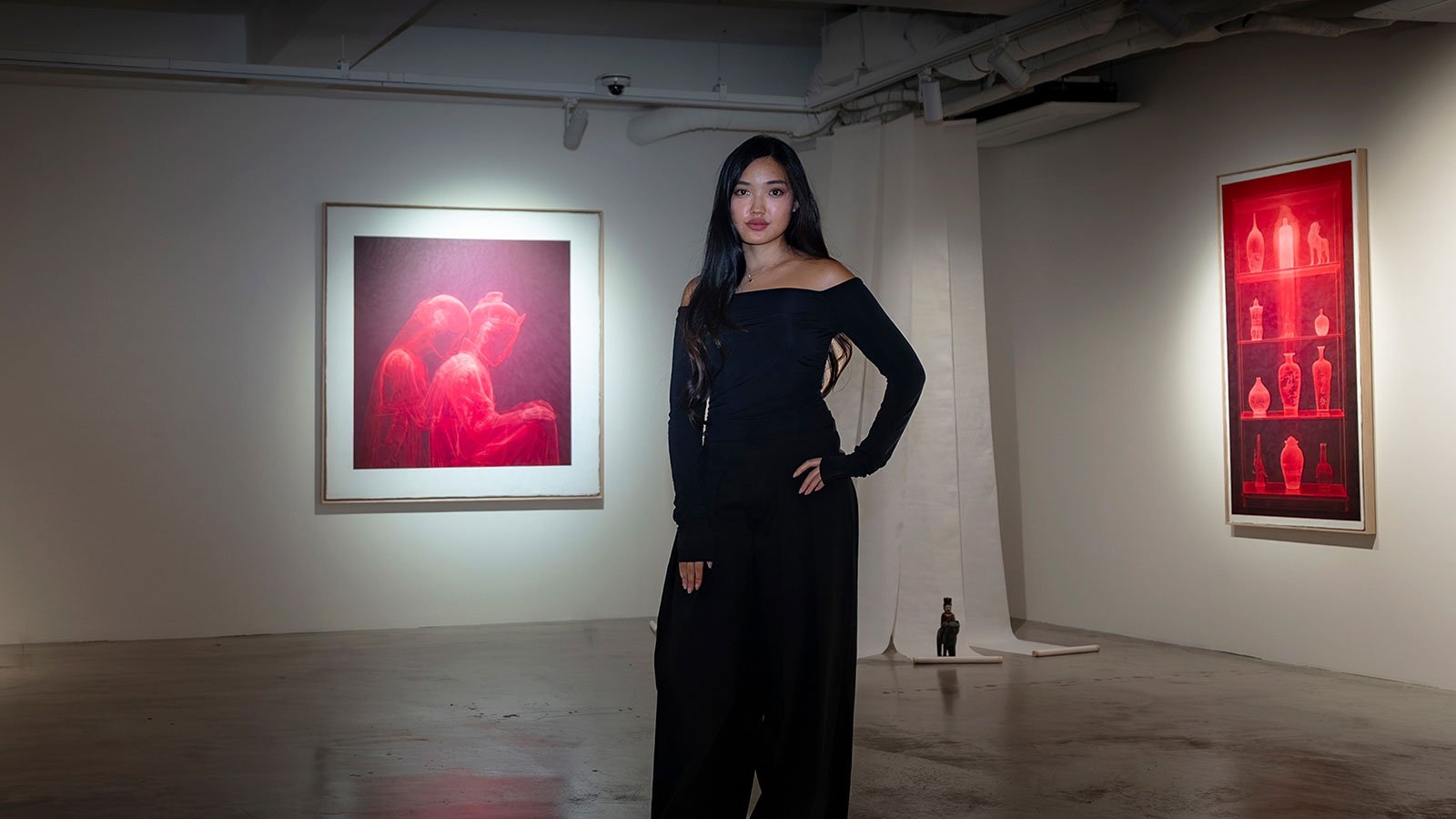
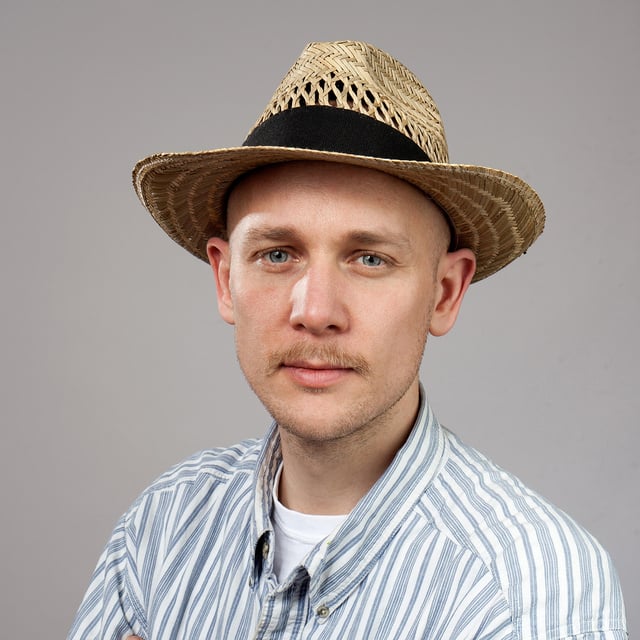
Genesis Kai at the opening show of “The Crimson Hour”, Acel Art Company, Seoul. Courtesy of the artist and ArtVerse gallery
Valentina Buzzi: I’m a curator, and I've been based in Korea for the last six years, although I’ve been working with Korean artists for much longer. It’s a great pleasure to be here today and to present this talk on the occasion of “The Crimson Hour”, an exhibition that Ming and I worked on over the last month. It was actually quite a last-minute decision to bring this new body of work to Seoul during Art Week.
I’ve known Ming for some time, but we only began working together this year. I’ve been deeply touched by her sensitivity toward heritage, art, and technology, as well as the philosophical framework she has been developing alongside her practice. We first worked together on her solo exhibition in Paris earlier this year, and we’re continuing that conversation here in Seoul.
Genesis Kai: I’ve been working with my persona, Genesis Kai, for roughly three years now, and she's really the accumulation of a lot of thought and exploration. It started as a cultural inquiry into both my Chinese and Korean heritage.
But over time, especially coming from a photography background, I started seeing AI as an interesting point of dialogue — not simply as a tool.
That process moved from researching things that already existed within my own culture and heritage toward eventually developing my own philosophical framework, Pothosophy. So the works you see [...] are, in a way, the accumulation of roughly a year of making work in response to that framework. Pothosophy is fundamentally about how I understand desire: how desire exists in different registers, how it can become generative, and how desire also requires structure.
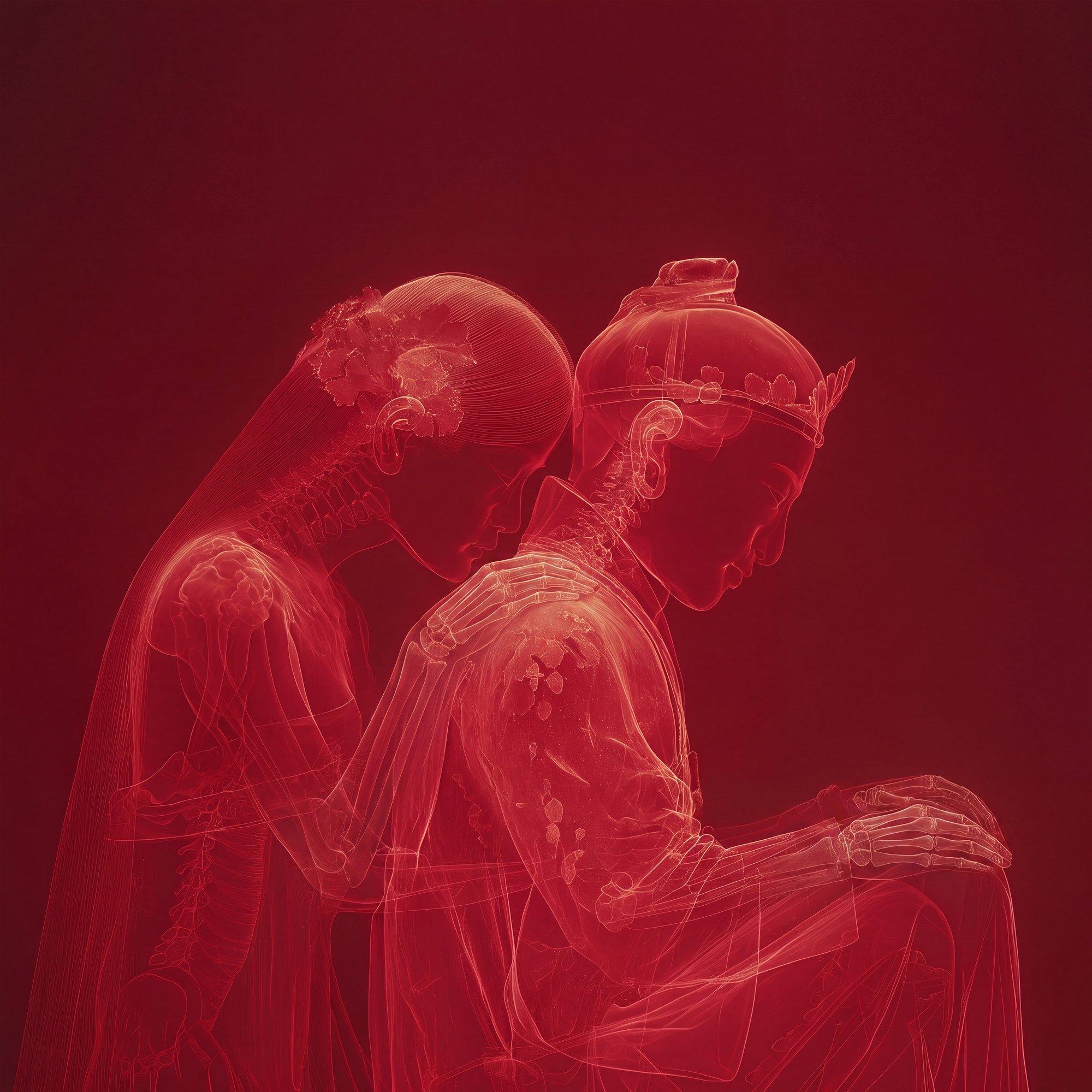
Genesis Kai, Everything That Stayed Behind (2026) from the series “In The Name Of What Remains”. Courtesy of the artist and ArtVerse
VB: And I would love to ask you, Ming, how you feel about that as an artist, and how you implement these ideas within your practice.
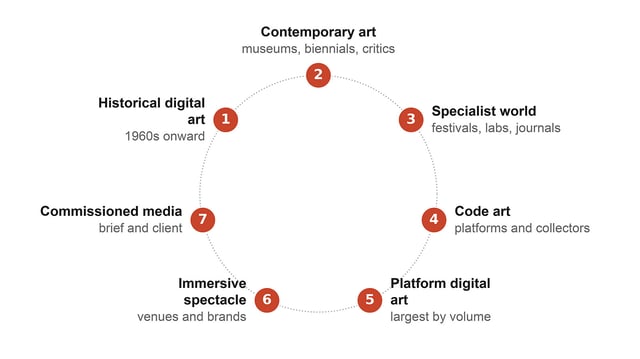
GK: I think one of the difficulties when I was starting out was that people really wanted to box me in, as either a digital artist, a contemporary artist, or simply an experimental artist. But there have always been aspects of my practice that overlap between those spaces: how digital art is produced and communicated, how work circulates through different platforms, and then how it functions within the contemporary art world.
I’ve always worked across that overlap. I might begin with a digital medium, but the work eventually becomes a print, an installation, or even a sculptural object. Over time, I became increasingly interested in just how broad the spectrum of digital art actually is. And because of that, I’ve started letting go of the question of whether I’m a digital artist, a new media artist, or a contemporary artist. I usually call myself a new media artist because I began with photography and my practice has always been rooted in technologically mediated images.
What I’m doing with AI isn’t something I consider a scientific breakthrough. I’m much more interested in how it extends a longer conversation about identity, mediation, and, in my case, the construction of an alter ego. Over time I’ve stopped worrying so much about chasing those categories.
Genesis Kai, The Grammar of Nearness, 2026, from the series In The Name Of What Remains. Courtesy of the artist and ArtVerse
VB: That’s actually very interesting, because when you think about your practice, your use of technology is obviously very important, but the work itself is presented through many different mediums. There’s also a strong attachment to your heritage and to very specific materials connected to that heritage, such as Hanji [handmade paper]. So in a way, the work moves across media. It brings together technologies, materials, and traditions that we might otherwise consider separate.
That raises two questions for me. The first is about your use of technology: both how technology has helped you think through and develop your philosophical framework, and at the same time how it helped you develop your alter ego, Genesis Kai.
GK: I started practicing photography when I was a teenager, during the rise of social media. At the time, around 2014 or 2015, people were actually quite surprised that photography was what I wanted to study, because suddenly everyone had access to a camera and everyone could, in some sense, become a photographer.
Then during Covid, I became really interested in the way our identities were becoming increasingly fragmented online. The same person could present themselves very differently on LinkedIn, Facebook, or Instagram, and even the way you spoke on WhatsApp could be different from the way you spoke on Telegram. I was noticing those divisions a lot.
Genesis Kai, Where The Sacred Settled I (2026) from the series “In The Name Of What Remains”. Courtesy of the artist and ArtVerse
At the same time, as someone who is both Korean and Chinese but doesn’t speak either language fluently, I wanted to find another way of connecting with my heritage. That’s really why I created Genesis Kai. Initially, I represented her as an avatar. This was before the current generation of advanced AI systems.
I started experimenting textually, having AI complete fragments of narratives I was writing around her. At that point she was still more of a character than a fully developed persona. Eventually people started asking me: if Genesis Kai is your alter ego, why don't you build an AI agent that people can log into and speak with? But the more work I made, the more I realized that none of the important ideas were coming from an agent pretending to be Genesis Kai. They came because I was still going to museums. I was photographing things. I was sketching. I was researching Korean culture and Chinese motifs. I was reading.
AI became a way of metabolizing those experiences and entering into dialogue with them.
So what mattered most was still my input into the system, rather than an AI saying, “Hello, I’m Genesis Kai,” based on a certain amount of data. That also applies to Pothosophy. I didn’t simply go to ChatGPT or Claude and say, “I think desire is X and Y, generate a philosophical framework for me.” It didn’t happen that way. It came from an accumulation of reading, writing, looking at art, studying different philosophical traditions, and deliberately reading ideas I disagreed with as well.
Sometimes something I rejected would return one week later, two months later, or even a year later in a completely different form. That’s how many of the ideas developed. And that’s also why I tend to resist describing AI simply as a “tool”. A tool implies a kind of unilateral control, as if I’m a caveman holding a stone and deciding exactly what it will do. For me, some of the most beautiful moments in making work actually happen when the AI and I disagree.
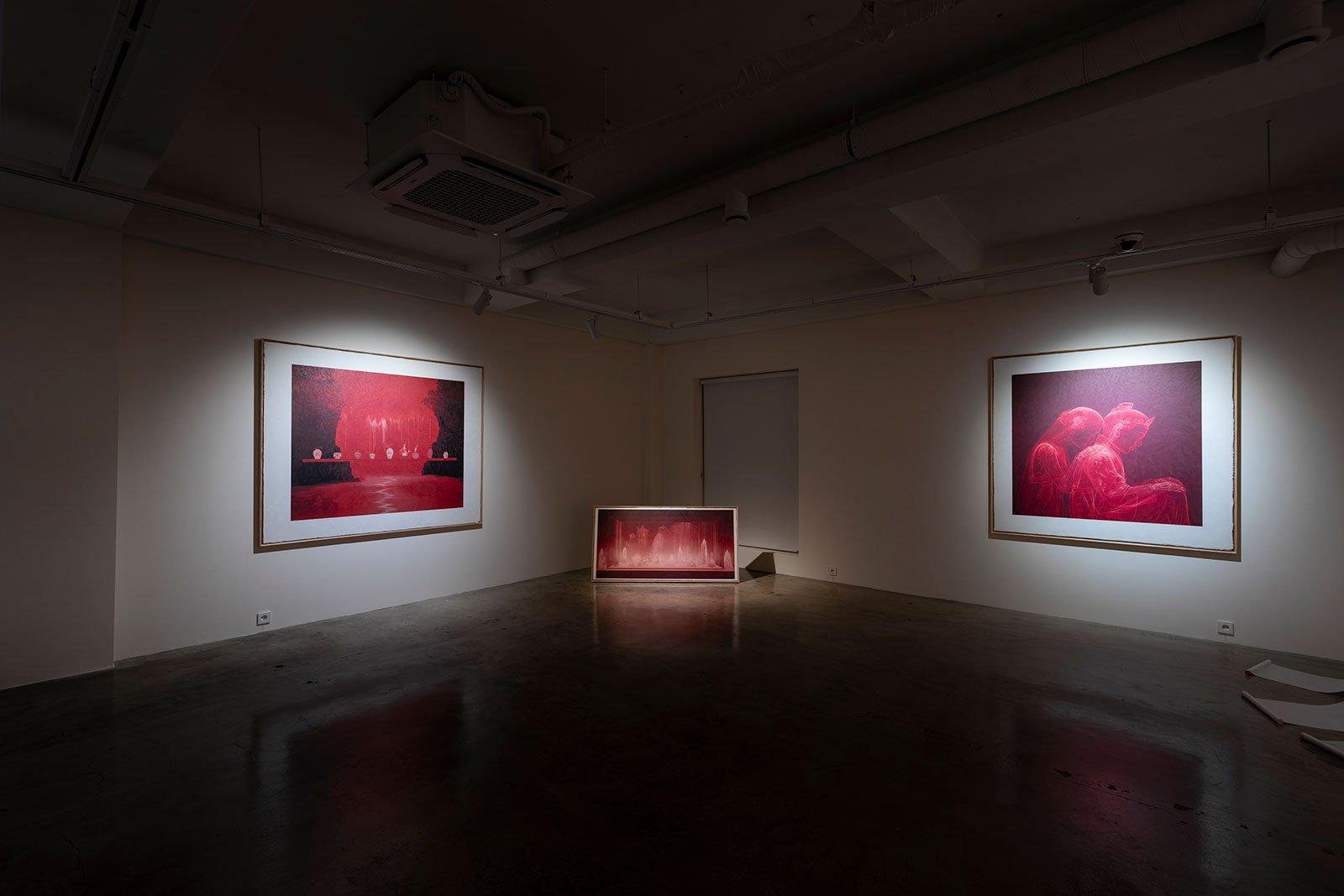
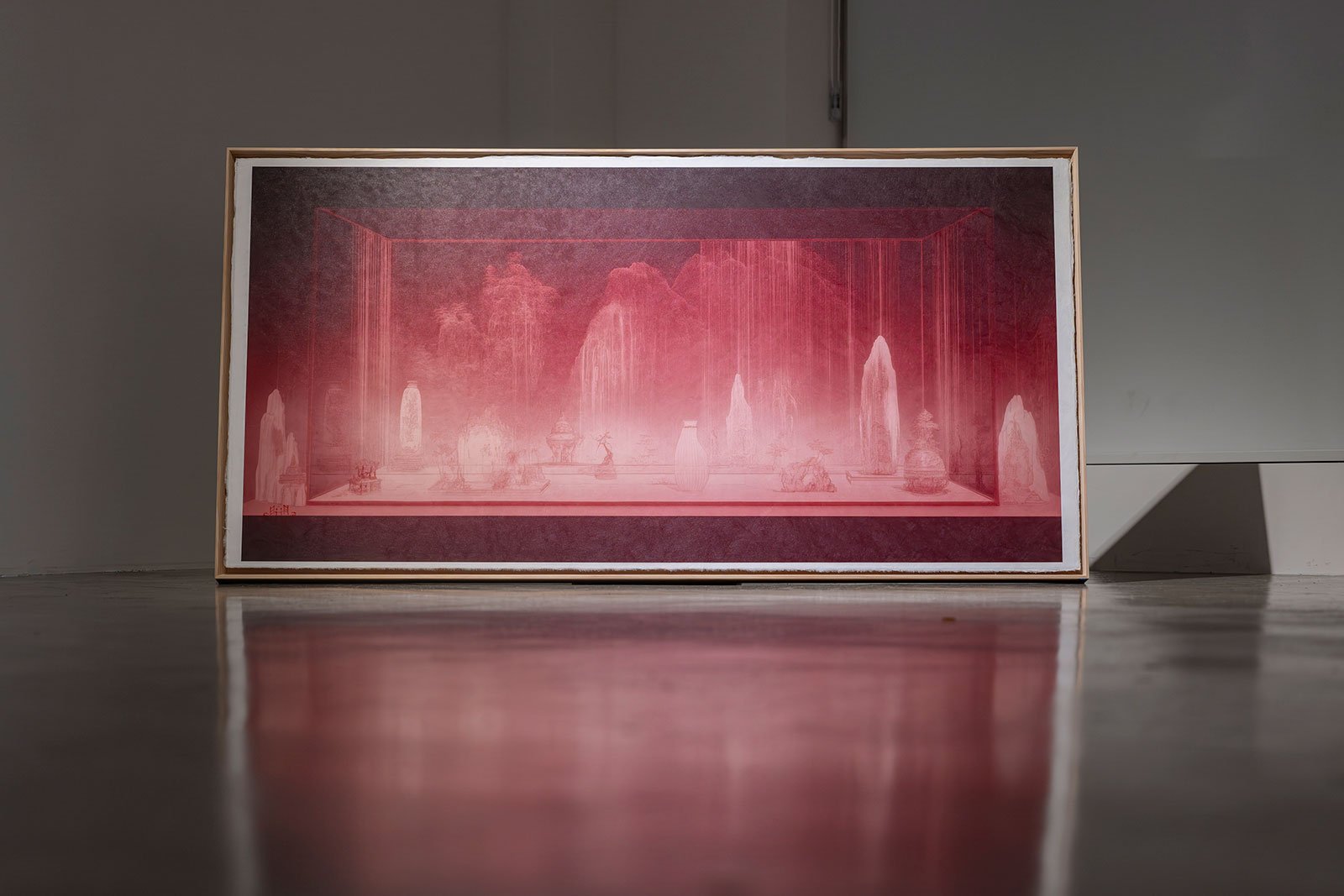
Installation view of Genesis Kai, “The Crimson Hour” at Acel Art Company, Seoul. Courtesy of the artist and ArtVerse gallery
VB: Something else that’s very interesting is how your work is built around several relationships at once: your relationship with technology, your relationship with your own identity, and your relationship with heritage.
We’ve spoken a lot about the way you blend heritage and new technologies, and that's very present in this exhibition. But I think the starting point is really this framework you've developed. Pothosophy was something I encountered during our first conversations as artist and curator, and even since then it has already evolved quite significantly. So I'd love for you to go a little deeper into that.
GK: Pothosophy really began because I was referencing so many different motifs and spending so much time in museums. As I was reading across different Eastern philosophical and spiritual traditions — Buddhism, Zen, Shinto, Korean shamanic traditions — I became interested in the recurring question of desire and the idea that liberation often involves some form of detachment from craving. I became particularly interested in the Buddhist concept of vipallāsa, which deals with distortions or inversions of perception: how we misperceive things and assign permanence, satisfaction, or selfhood to things that don't necessarily possess those qualities.
But I kept returning to the feeling that desire itself couldn’t simply be treated as something shameful or something that had to disappear. Some desires are generative. My own desire to understand myself, for example, created Genesis Kai.
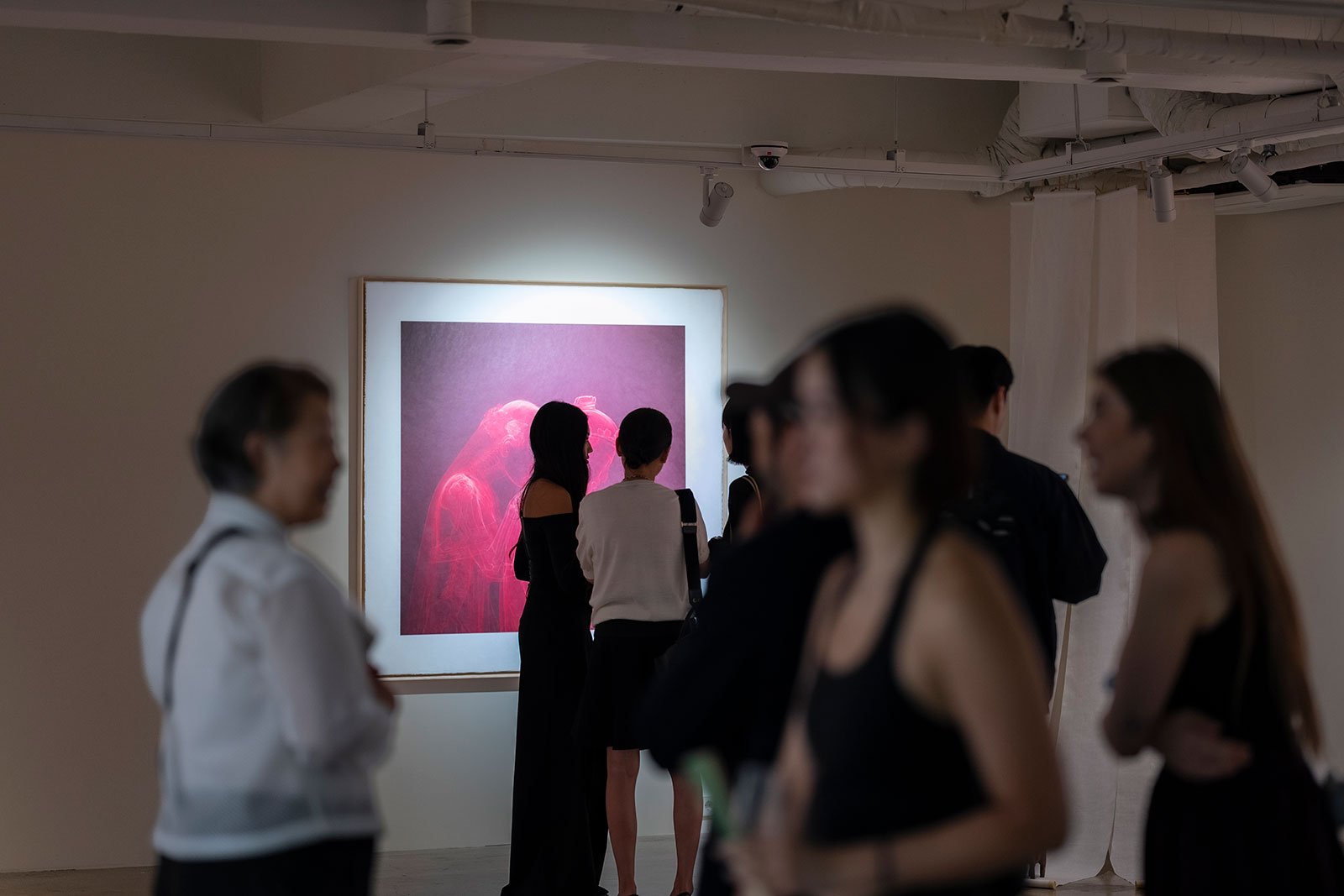
Installation view of Genesis Kai, “The Crimson Hour” at Acel Art Company, Seoul. Courtesy of the artist and ArtVerse gallery
That eventually became very important to Pothosophy: distinguishing desire capable of transformation from craving that demands closure. Genesis and I also became a way for me to think about symbolic duality. We’re not opposites in the sense of black and white. It’s more about the tension between the one who desires and the thing that is desired — the interval between those positions.
That’s where I started thinking about desire as a generative force, but one that still requires structure in order to become ethical. And Pothosophy isn’t complete. I don't think it has reached a final stage, even though it has developed enormously.
The beautiful thing for me is that every new series now begins with a question that comes from somewhere inside the framework. AI has been useful because it gives me something I can argue with while I’m working through those questions.
VB: Since your Paris exhibition earlier this year and the exhibition we're presenting today are two different bodies of work, but both emerge from Pothosophy, how has your approach to desire shifted between them?
GK: When I was developing the Paris solo exhibition, I was thinking a lot about how desire could be represented as an ambience, an environment, a place, or even a narrative. Over time, I became more interested in what happens when desire exists between things, between people, between bodies, and between people and objects.
Installation view of Genesis Kai, “The Crimson Hour” at Acel Art Company, Seoul. Courtesy of the artist and ArtVerse gallery
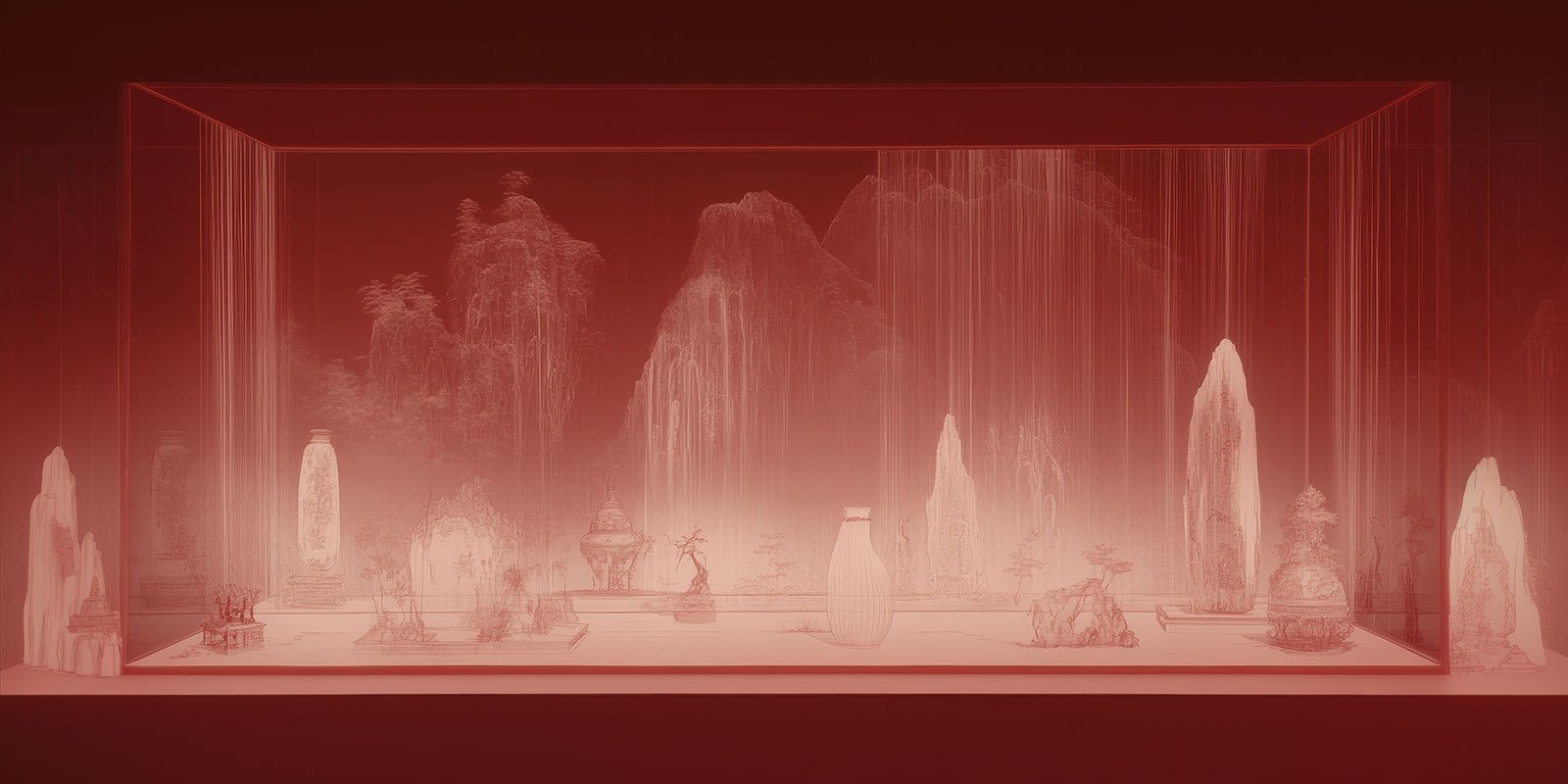
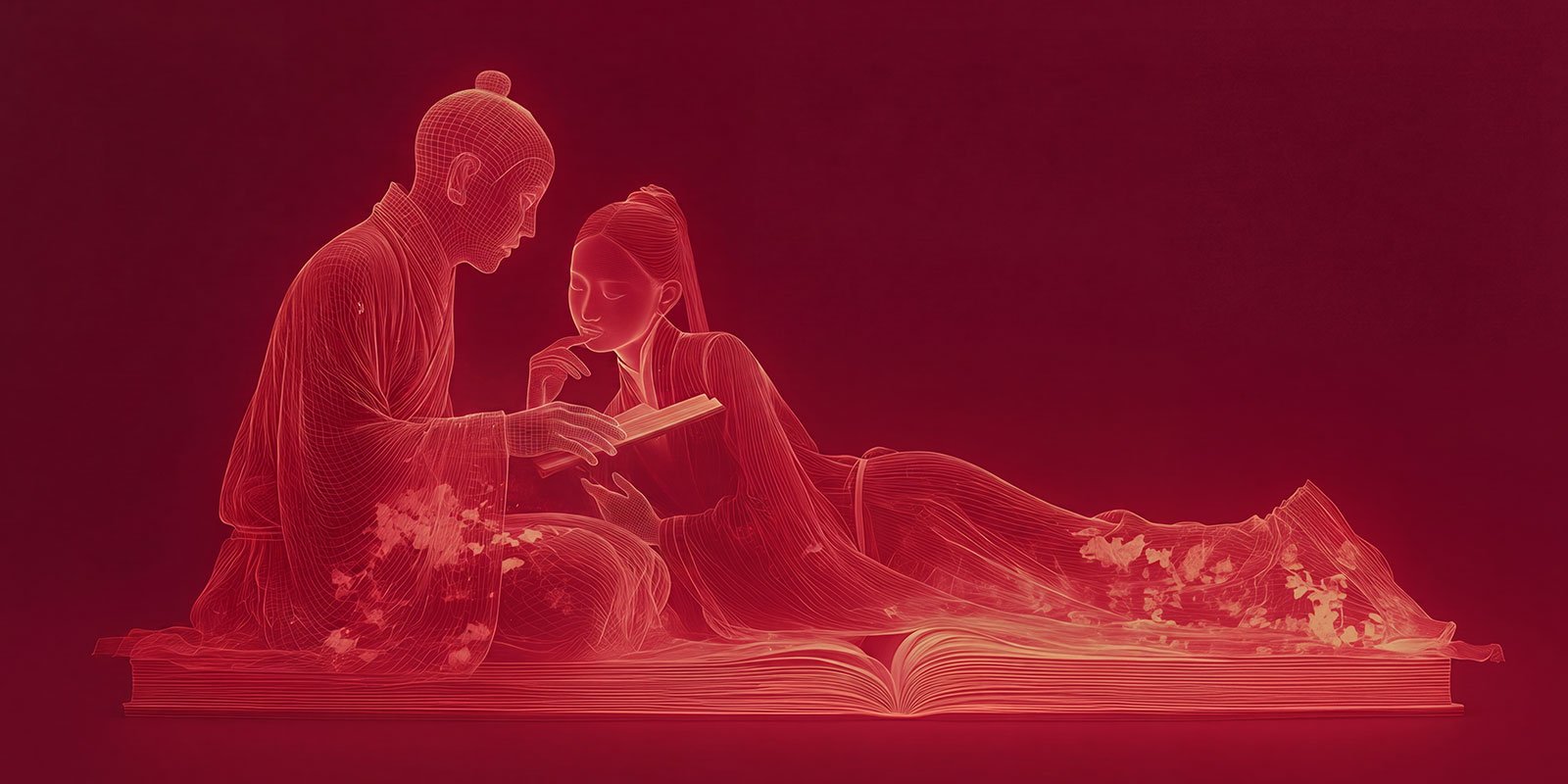
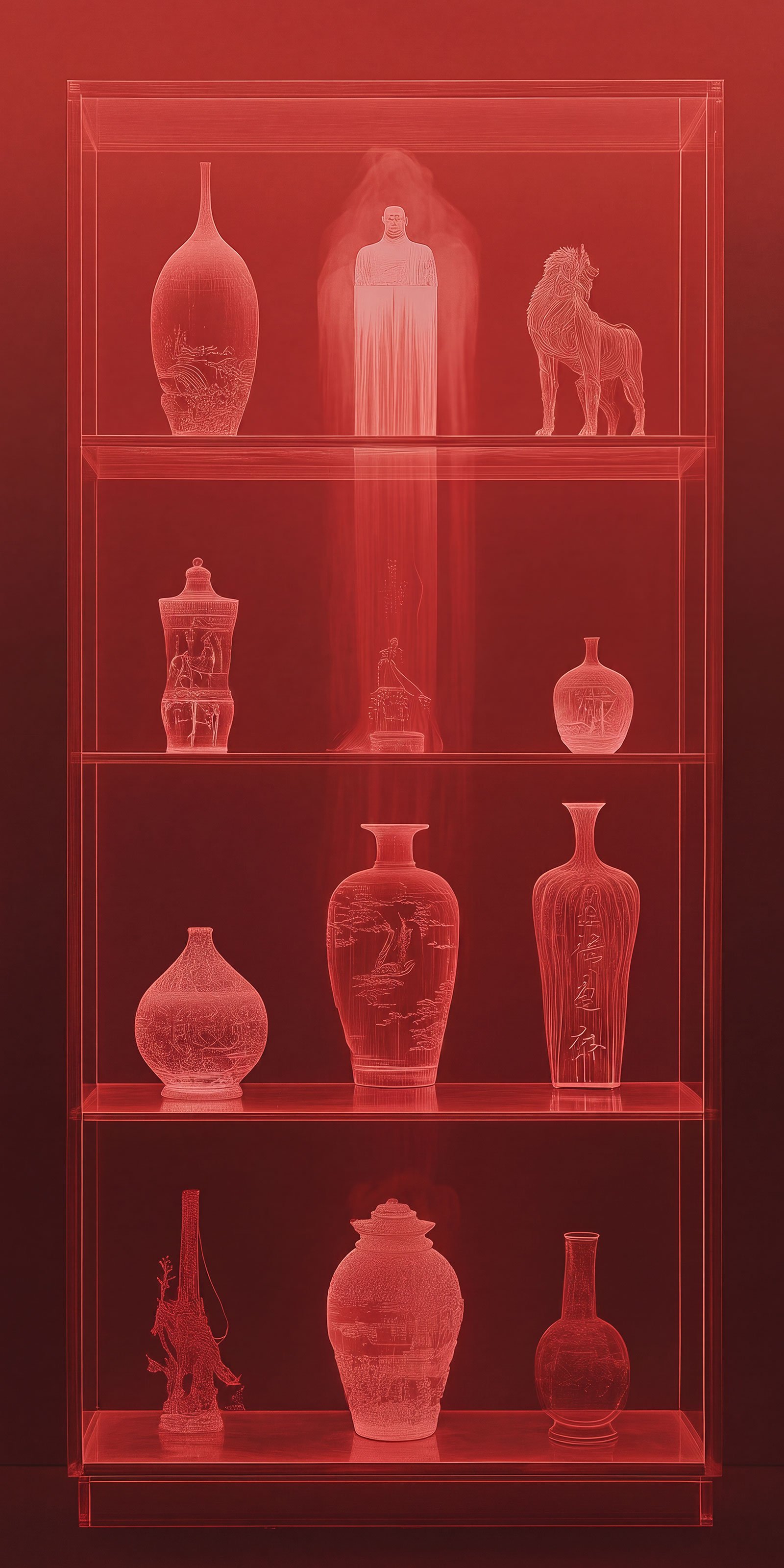
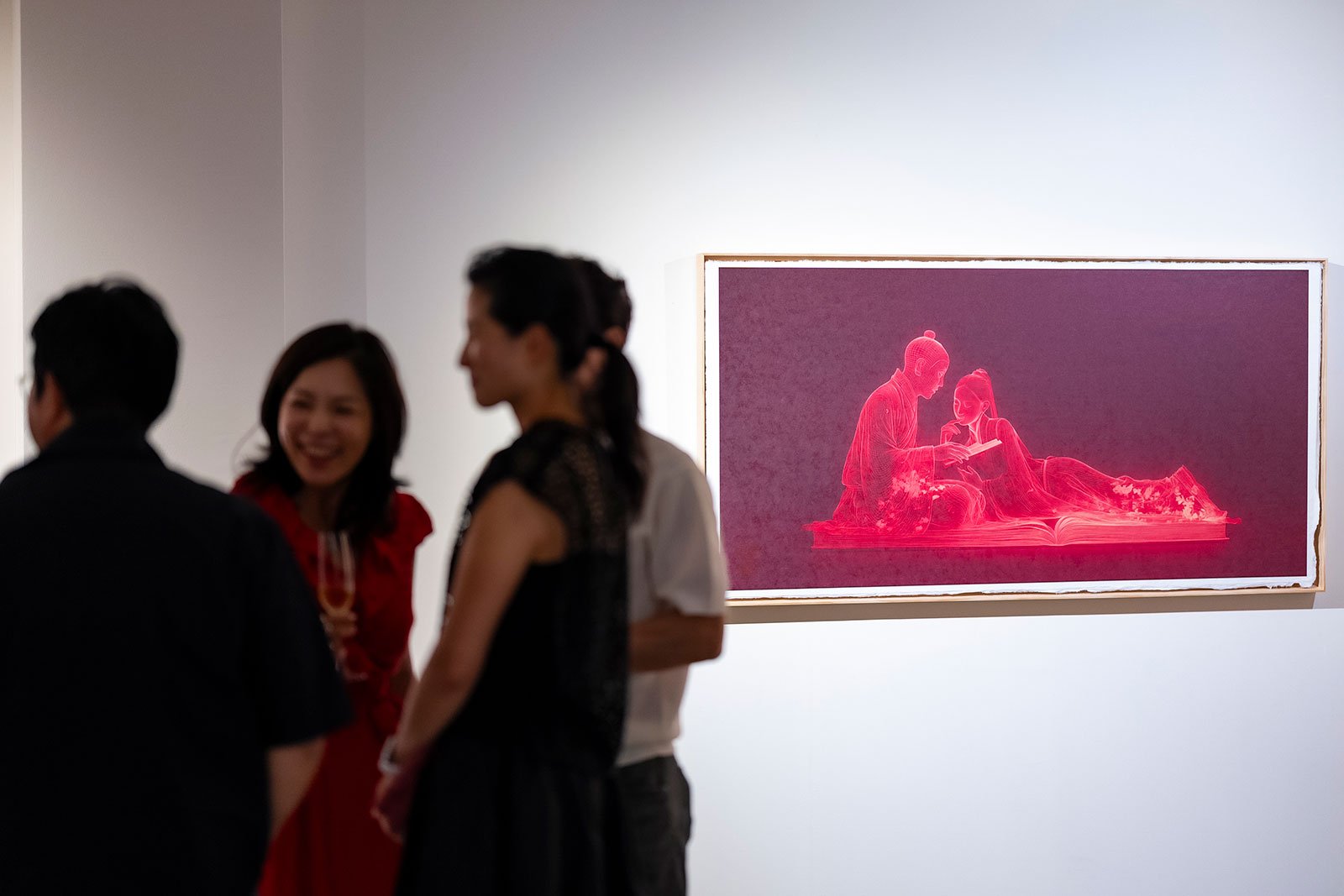
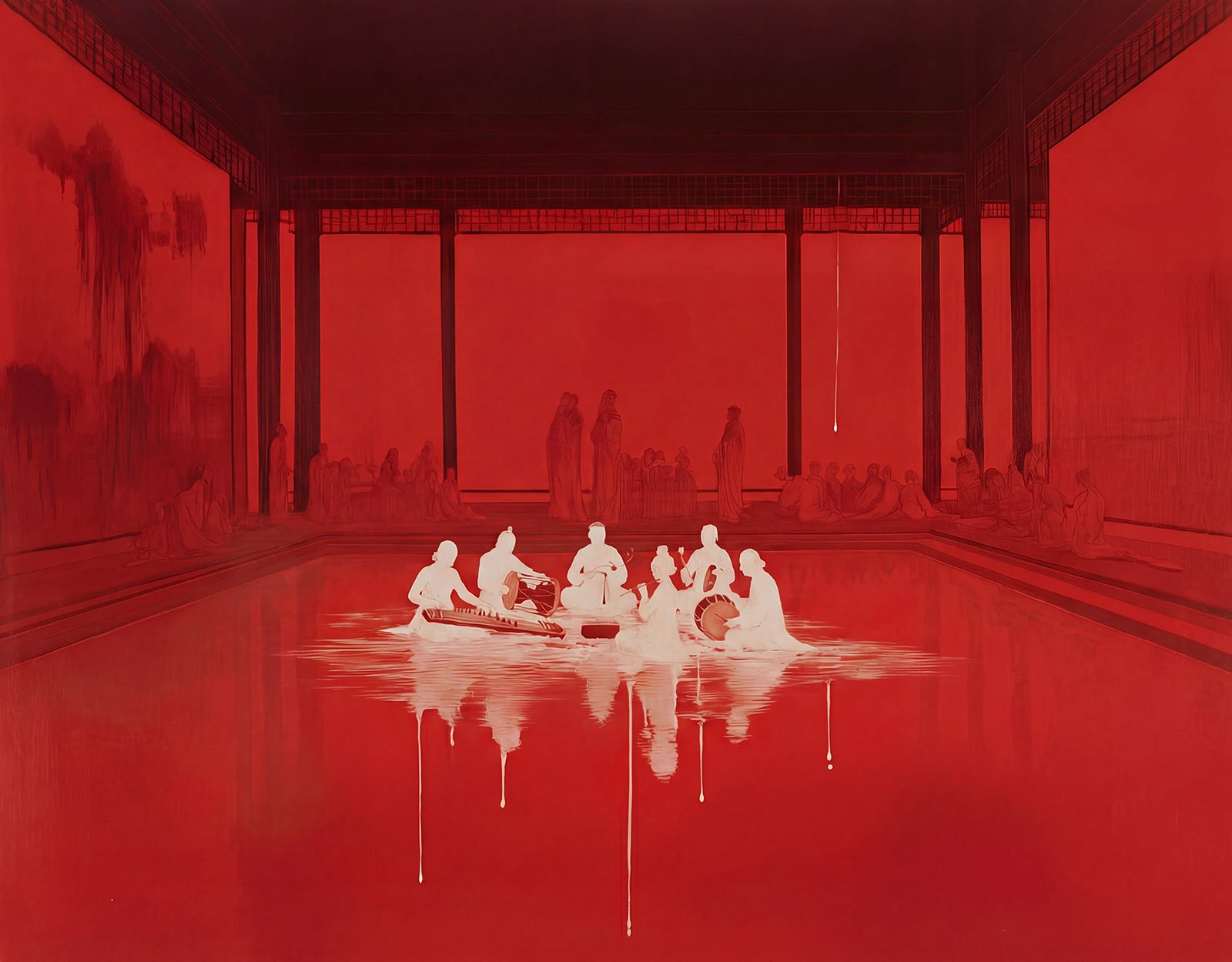
So when you [view the exhibition in Seoul], you’ll notice that the environments in the new works are relatively stripped back. You might see a god and a mortal, or a goddess and a mortal, placed in relation to one another, sometimes romantically, sometimes reading or doing scholarly things together. And the objects themselves started becoming important. Rather than simply representing inherited objects placed on shelves, I began thinking about them as heirlooms of desire; objects that have absorbed or carried desire across time.
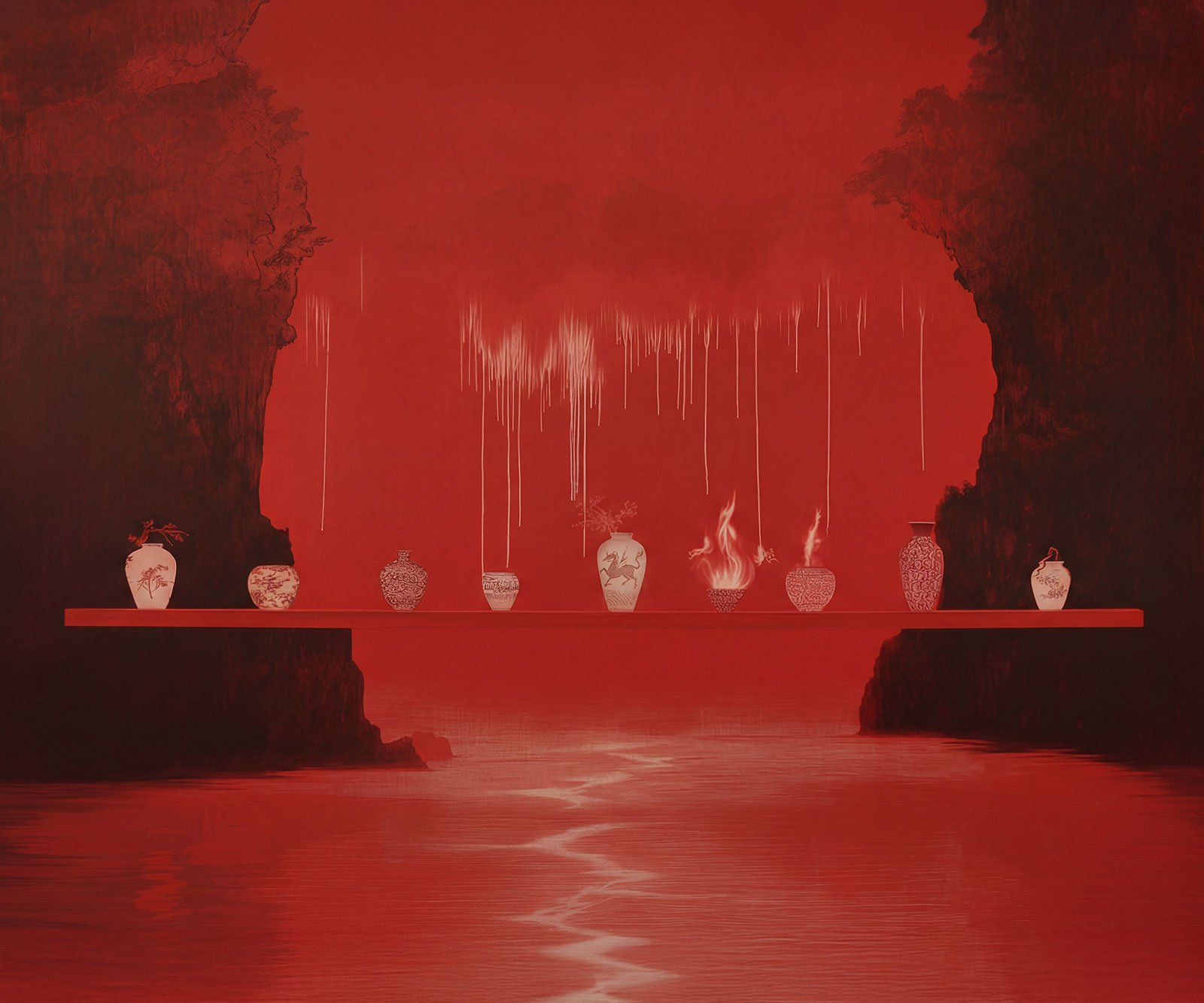
Some of those compositions also draw from the tradition of chaekgado, where books, vessels, scholarly objects, and symbolic possessions become a kind of constructed world. A big part of the evolution between the two exhibitions has therefore been learning not to treat either the philosophy or the work as completely resolved.
I’ve become much more interested not only in identifying my inspirations, but also in seeing what emerges when I question those inspirations and question myself. The deeper I went into those questions, the more the series evolved.
Installation view of Genesis Kai, “The Crimson Hour” at Acel Art Company, Seoul. Courtesy of the artist and ArtVerse gallery
VB: When we were [...] showing the exhibition to people, one reaction that came up several times, especially from people encountering your work for the first time, was surprised at seeing the works printed on Hanji. Because you’re often positioned within new media art, people sometimes expect something much more obviously digital. But since I've known your work, there has always been this very strong material dimension to it.
Hanji is particularly important because of its relationship to your heritage, but it also connects to this idea of art becoming increasingly post-media — where the medium itself isn’t necessarily the primary definition of the work. So I’d love for you to speak a little about how Hanji became such an important material for you, and how you understand the relationship between the physical material and the digital image.
GK: I’ve actually been using Hanji since close to the beginning of this body of work, around three years ago. Part of that came through looking at the artisans my grandfather had supported while he was alive. Wherever possible, I’ve tried to work with those same artisans.
There’s something really interesting that happens when you take an image you’ve become accustomed to seeing on a screen and give it a physical body. Looking at something on a phone isn’t the same as seeing it on a large screen, and neither of those experiences is the same as encountering it printed on a material. It’s not only because of size. We already carry certain expectations about what an image on a screen is supposed to feel like.
Genesis Kai, They Played So The Past Would Stay, 2026. Courtesy of the artist and ArtVerse
Hanji carries a different set of expectations. It has its own cultural history, its own texture, its own associations, and its own physical depth because of the way the fibers and layers behave. When a digitally produced image moves onto Hanji, those two histories begin interacting. For me, it gives the digital image a body.
VB: I’d also like to touch a little more on the exhibition we’re presenting today. There are new subjects appearing in this body of work, but at the same time there are very clear continuities with your previous series. Are there certain ideas or words that you think help explain the shift into this new series?
GK: For me, the works really need to be understood as a complete body rather than as completely isolated images. One of the biggest changes is that, for the first time, Genesis herself doesn’t really appear explicitly in the works at all. And I think that actually solidified my transition from treating Genesis as a character representing me to understanding her as a persona or alter ego.
The series becomes less about looking at Genesis herself and more about exploring mortals, divinities, and the very mortal emotion of desire between them. That’s what I hope happens when people encounter the work. Instead of looking for Genesis as the protagonist, perhaps you can begin seeing yourself as one of the figures.
Genesis Kai, They Carried Us So We Let Them Burn, 2026. Courtesy of the artist and ArtVerse
VB: Another thing I’ve noticed in this new body of work, and something we’ve discussed with several people, is the materiality created through different kinds of transparency. There are translucent bodies, different layers, and a very particular use of light. Compared with your previous work, there seems to be a deeper investigation into layers and depth, both aesthetically and semantically. How did that develop?
GK: Some of my earliest series were much more closely tied to photography and re-imaging. I was thinking very literally about composition and the arrangement of subjects. Over time, I became more interested in what neither the human nor the machine can completely predict, especially in the representation of the body.
With AI-generated imagery, there’s sometimes a tendency toward overstimulation: filling the entire frame with extraordinary amounts of information simply because the technology allows you to. I became much more interested in doing the opposite. I wanted to narrow things down.
The transparency of the bodies, the light, and the reduction of the environment became ways of suggesting something spiritual without having to illustrate spirituality literally. Instead of adding more information, I became interested in how much could happen through less. And I’m really enjoying where that has taken the work, although I also still feel a little strange inside it, which I think is probably a good place to be.
Genesis Kai is a Nova Sapiens, the AI-infused persona and artistic alter ego of Ming Shiu, a Korean-Chinese new media artist working between Hong Kong and Seoul. Moving across AI, moving image, photography, Hanji, sound, and installation, Kai’s practice examines desire, cultural inheritance, perception, and the ways meaning survives transformation. At the center of her work is Pothosophy, an original philosophical framework that understands generative desire not as evidence of lack, but as a structuring pressure through which relation and form become possible. Drawing from East Asian material and philosophical histories while resisting fixed ideas of cultural identity, Kai frequently works with inherited objects, historical motifs, computational imagery, and her signature spectrum of crimson. Rather than preserving tradition at a historical distance, she asks what happens when inherited forms are allowed to move, mutate, and enter new systems of meaning. Her earlier works, presented at Art Dubai and Paris Photo, developed through sustained engagement with Neo-Confucian ideas of Li and Qi before evolving into Pothosophy as an independent artistic framework. Her 2026 Paris solo exhibition, The Tension That Holds, marked this transition from image-making toward world-building. In The Crimson Hour, her first exhibition in Seoul, Kai brings those Pothosophical landscapes into dialogue with the new series In the Name of What Remains, shifting from desire as an environmental force toward desire as relation.
Valentina Buzzi is an Italian-French independent curator, writer, and researcher based between Paris and Seoul. With a decade of experience bridging curatorial practice, cultural diplomacy, and transnational heritage, her landmark projects include Lee Bae: La Maison de La Lune Brûlée (60th Venice Biennale Collateral) and the inaugural Italian Pavilion at the 14th Gwangju Biennale. Currently Buzzi is co-curating the official France-Korea 140th anniversary exhibition in Paris, and serves as Curatorial Researcher at the Park Seo-Bo Foundation. As part of her long-term curatorial consultancy role, Buzzi also serves as Head of Curatorial and Programming at ArtVerse Gallery. She is a 2026 UNESCO Research Fellow, a Ph.D. candidate at HUFS, and was named to Forbes Italia’s 30 Under 30 in 2025.