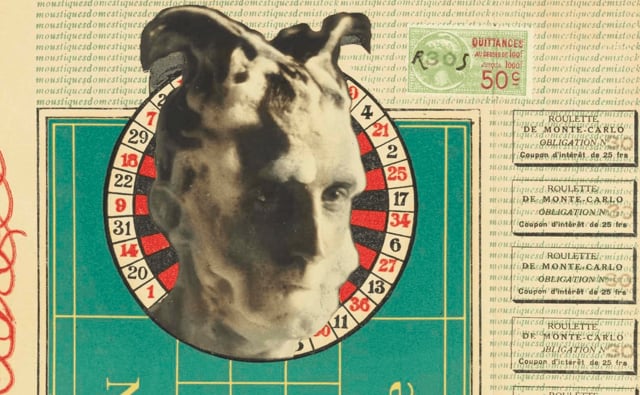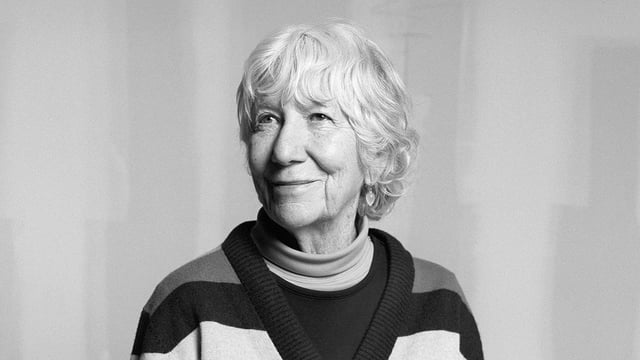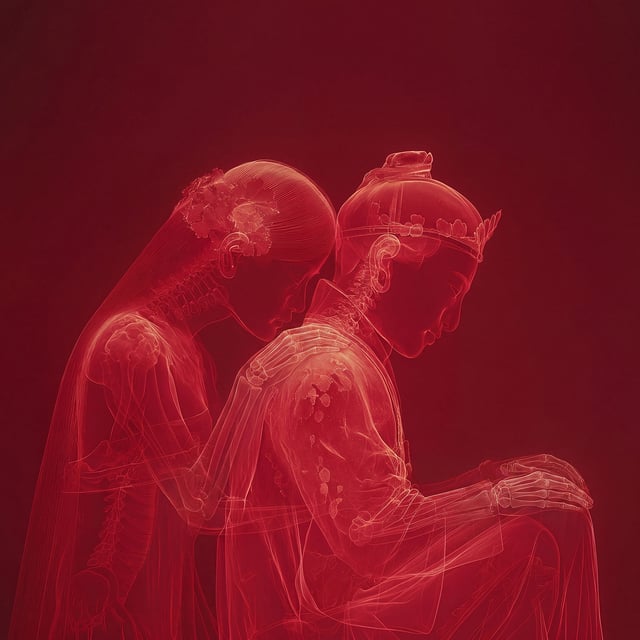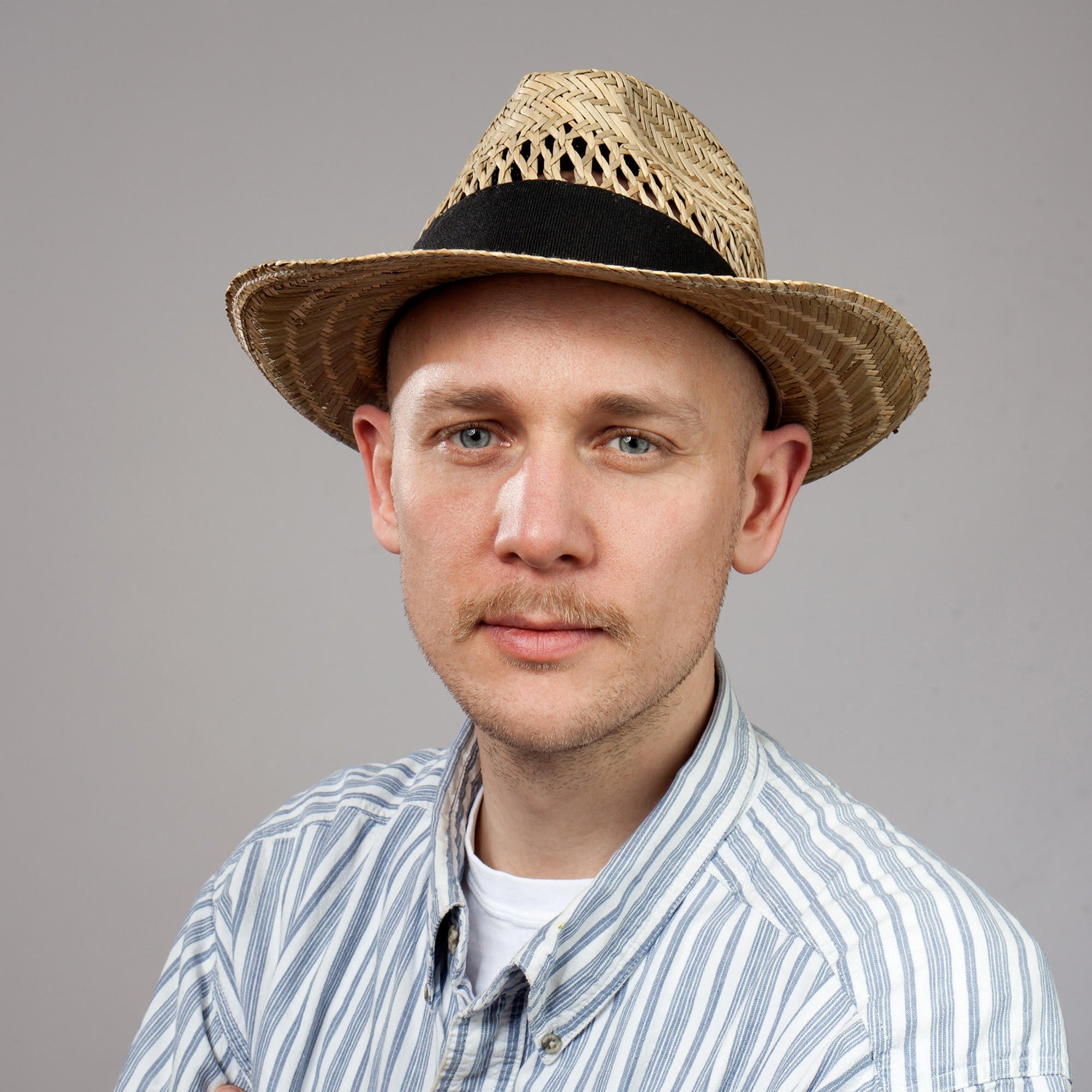
Jonas Lund. Courtesy of the artist
The Optimizer | Jonas Lund
In applying the technological ideologies of the moment to his work, the artist has increasingly come to realize that art cannot be quantified
Jonas Lund. Courtesy of the artist
In applying the technological ideologies of the moment to his work, the artist has increasingly come to realize that art cannot be quantified
Jonas Lund has spent much of his career trying to solve art as if it were a system. Can you predict which artworks will succeed? Engineer scarcity to increase value? Outsource artistic decisions to experts? Optimize an artistic career? And if an algorithm can make those decisions better than you can, why make them yourself?
These questions have led Lund to turn many of the systems shaping contemporary life into artistic methods. He has scraped art-world databases to generate instructions for successful artworks, hired assistants to produce paintings according to a 300-page manual, created a token that gave others influence over his artistic career, and built an AI agent that directs and evaluates human workers.
Rather than observing systems of power from the outside, Lund tends to enter them, reproduce their logic, and push it until something strange happens.
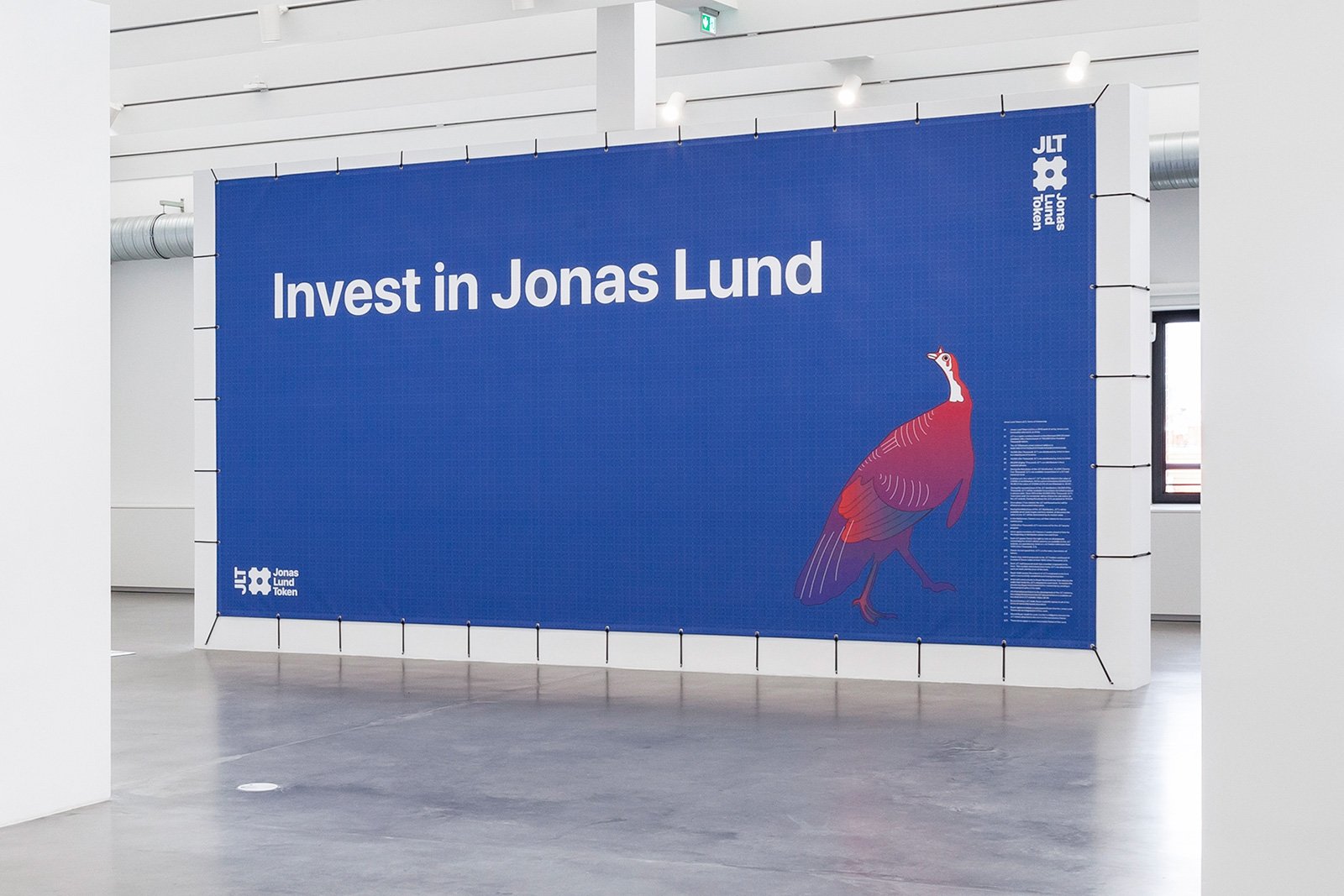
Jonas Lund, Mesh Banner, Jonas Lund Token (JLT), 2018–ongoing. Courtesy of the artist
That approach makes his work difficult to separate from the technological ideologies of the moments in which it was made. Big data promised that enough information could make the world legible. Social media turned attention into metrics. Blockchain proposed new models of ownership and governance. AI now promises to automate not only production, but judgement itself. Lund has repeatedly asked what happens when those ideas are applied to art.
The irony is that after years of trying to quantify artistic value, Lund has become increasingly convinced that it cannot be quantified.
Art can be optimized for visibility, markets can manufacture scarcity, institutions can confer legitimacy, and algorithms can predict outcomes. But none of those systems can finally explain why one work matters and another does not.
In this conversation with Anika Meier for Right Click Save, Lund talks about the disappearance of the social internet, his attempts to hack the mechanisms of the art world, and why he keeps handing decisions over to systems of his own making. From The Fear of Missing Out and Studio Practice to the Jonas Lund Token and the AI-directed Performance Review, the conversation asks a question that now extends far beyond art: If more and more decisions can be optimized, automated, and delegated, which ones do we still want to make ourselves?
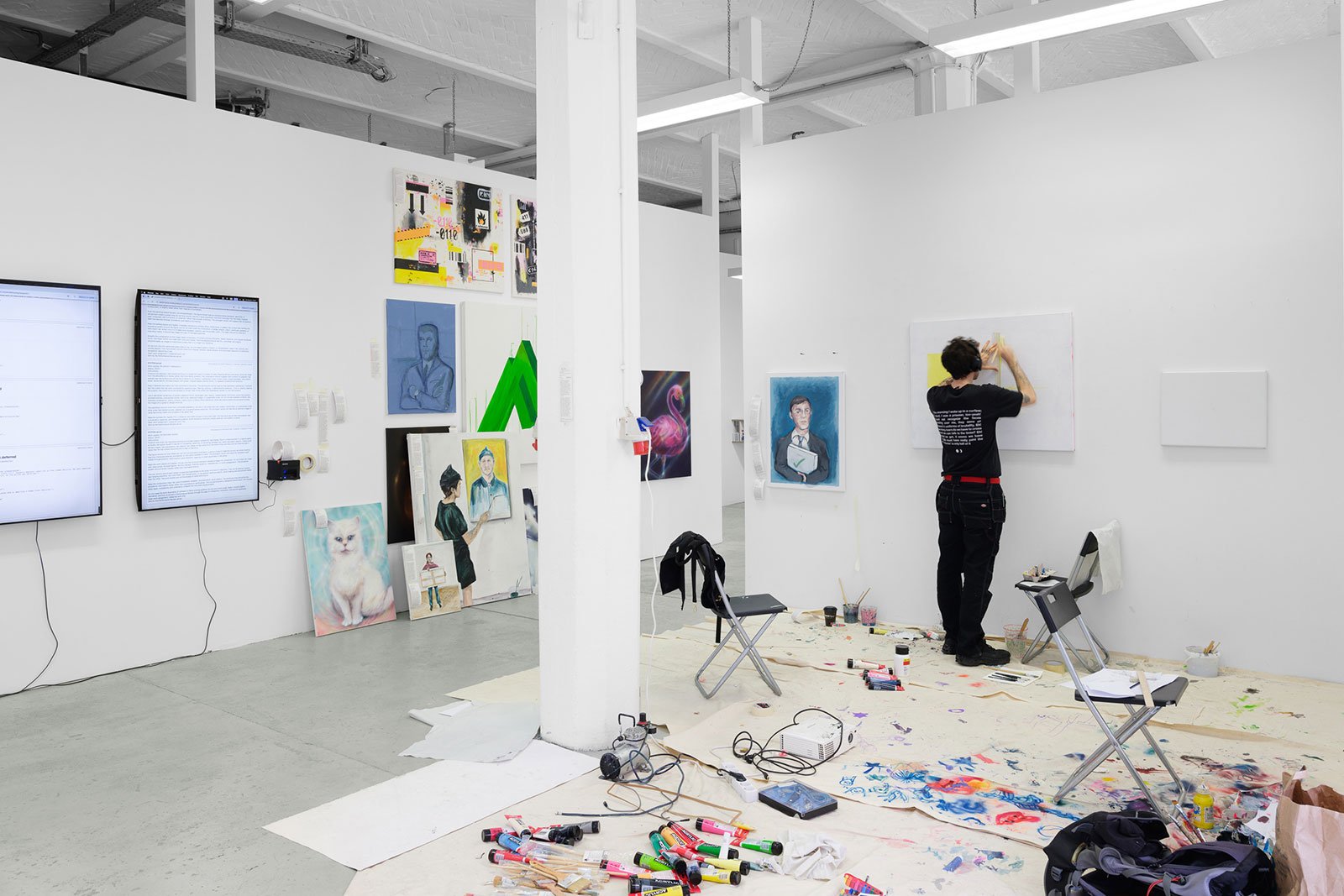
Installation process of Jonas Lund, “Performance Review”, Office Impart, Berlin, 2026. Courtesy of the artist
Anika Meier: You studied photography before you started working with the internet. What made you move away from photography?
Jonas Lund: I studied photography at the Rietveld in Amsterdam. When you finish a study like that, you have two options: either you do photography for the rest of your life, or you never do photography again. In my case, it was definitely the second.
By the time I finished, I had discovered net art. Back then, the choice of medium felt more important than it does now. The choice was: either you take a camera, point it at something, press the button, and out comes your work. Or you wake up in the morning, have an idea, sit down in front of your computer, program it, publish it, and the whole world can see it instantly.
That felt way more exciting to me than working with this very old technology of photography. Not to say that photography isn’t important. Everything ends up in the feed as an image or a video. So it was a good foundation.
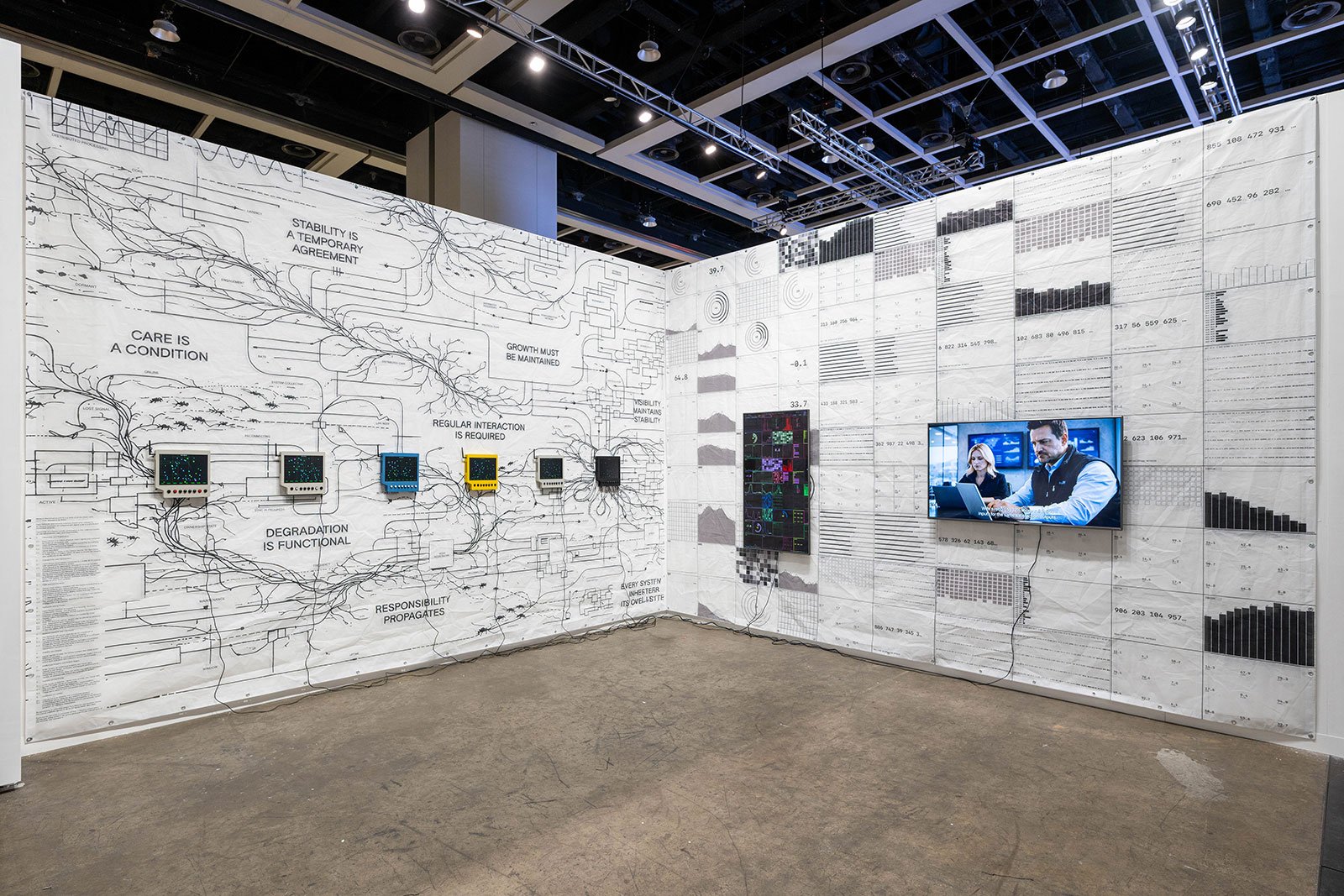
Installation view of Jonas Lund’s work on the Office Impart stand, Zero 10, Art Basel Hong Kong, 2026. With work: Network Maintenance (2025-ongoing), Optimized Trajectory (2026), and The Future of Growth (2026)
AM: I studied art history, and I still find it useful to have learned the history of art in a structured way. Some artists deliberately avoid knowing too much about other people’s work because they’re afraid it will influence them. How important was knowing art history for you?
JL: It’s a blessing and a curse. With photography in particular, there’s such an emphasis on knowing your references. If you do something a photographer did 30 years ago, everybody looks at you like, “Yeah, but this dude already did it. What did you add to the conversation?” So you study it partly as protection against looking stupid. But it’s also a limitation, because once you know too much, it becomes harder to find your own voice. You can’t always tell: Is this my idea, or is it coming from this whole collection of ideas I’ve absorbed?
That was one of the reasons net art was so exciting. It felt freer. The history was much shorter, and doing something similar to what someone else had done was more like riffing on their idea, taking it and running with it, putting your own spin on it.
At the same time, I understand not wanting to know. Ignorance is bliss. You just go and make shit. And then it’s like, “Oh, it happens to be the same as Bruce Nauman.” “Okay, whatever, I don’t care.”
AM: It seems like you start with an idea or a question and then find the right form for it.
JL: I don’t think of myself as a painter, a photographer, or a videographer. I do all of it. That’s why I call myself a conceptual artist. The idea comes first, and then I figure out what form it needs to take.
Sometimes I think it would be so much easier if I could just walk into the studio, work on a painting, go home, and then come back the next day and continue.
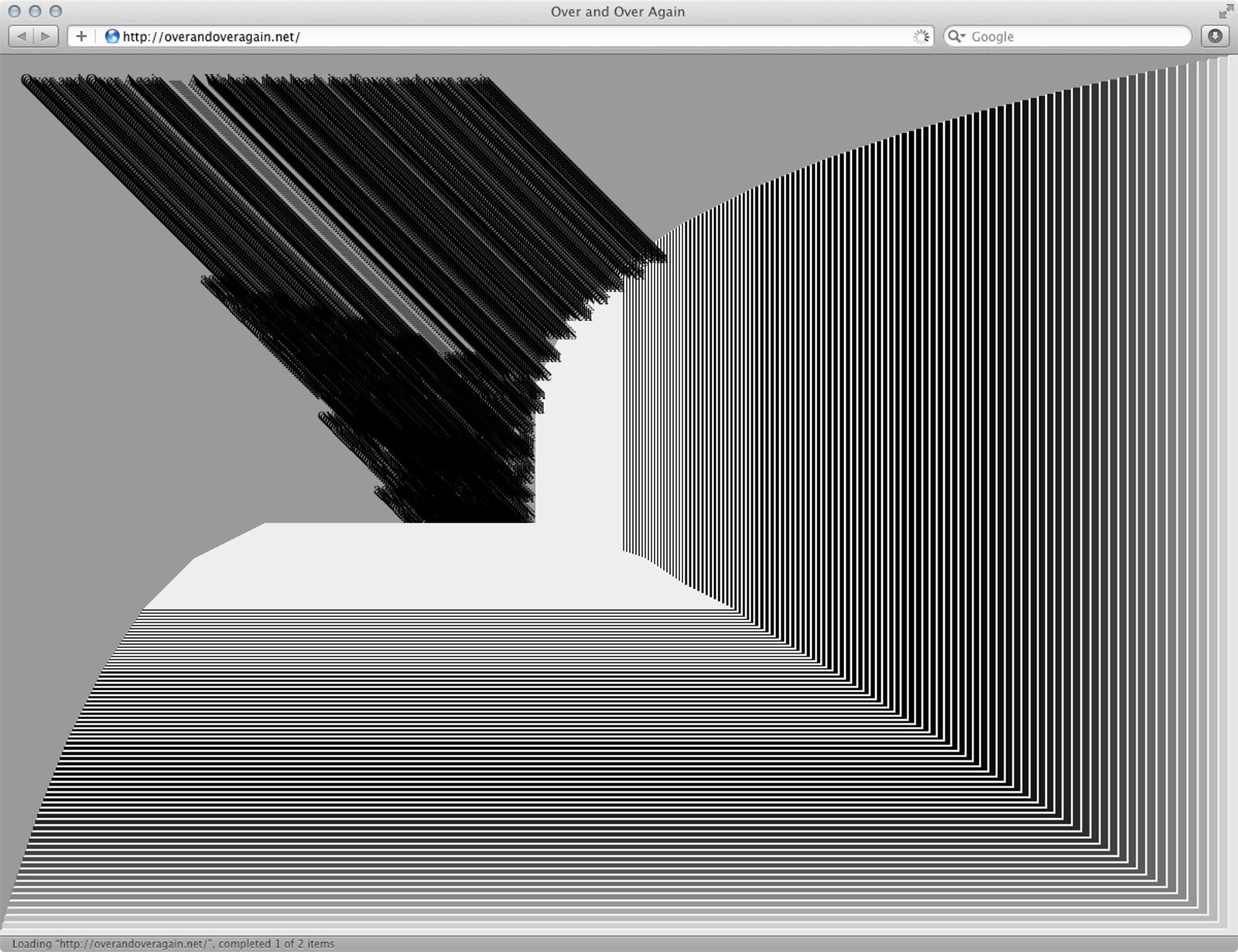
Jonas Lund, Over And Over Again, 2011, Website. Courtesy of the artist
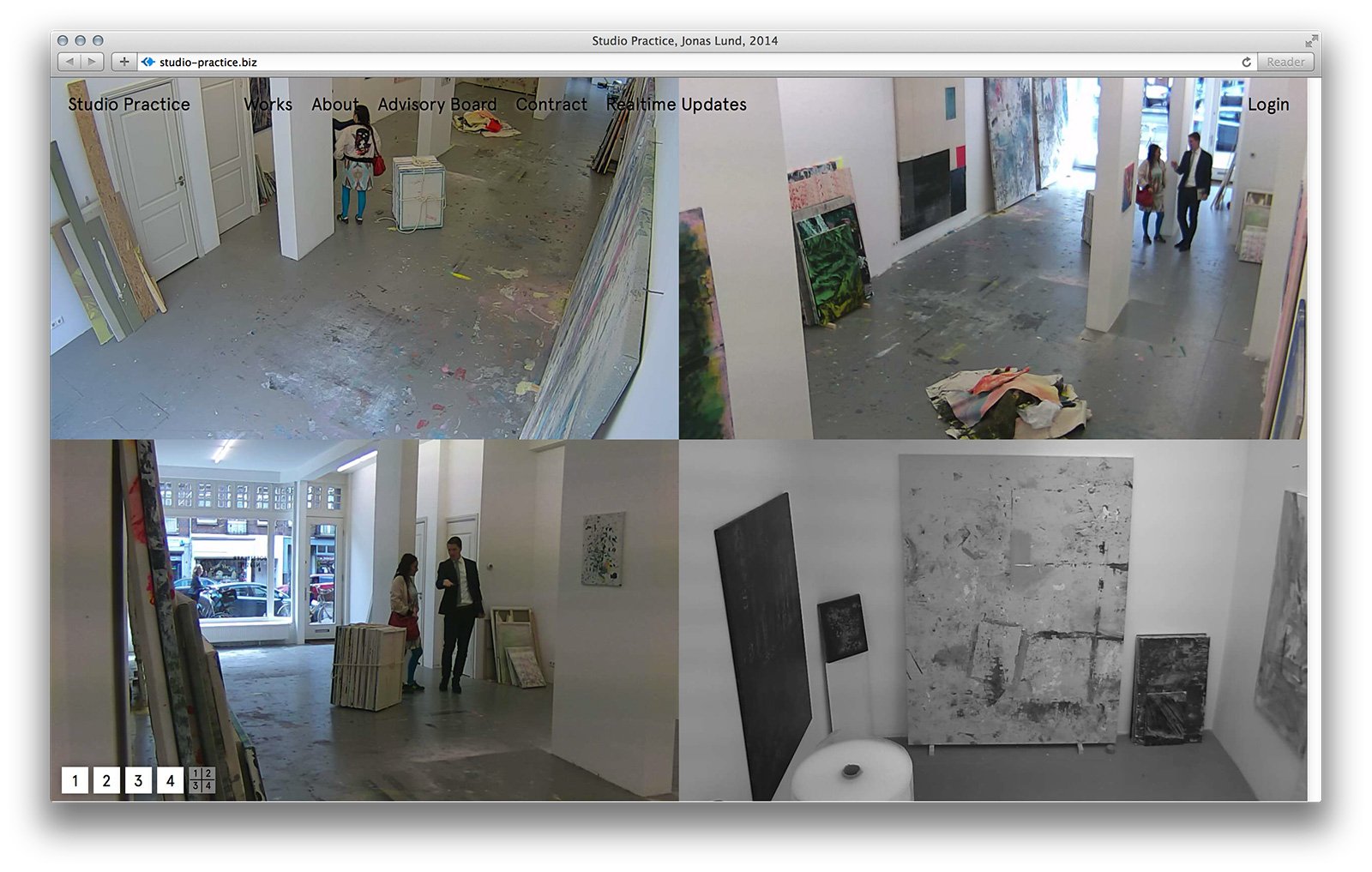
installation view, “Studio Practice”, 2014, Boetzelaer|Nispen, Amsterdam. Courtesy of the artist
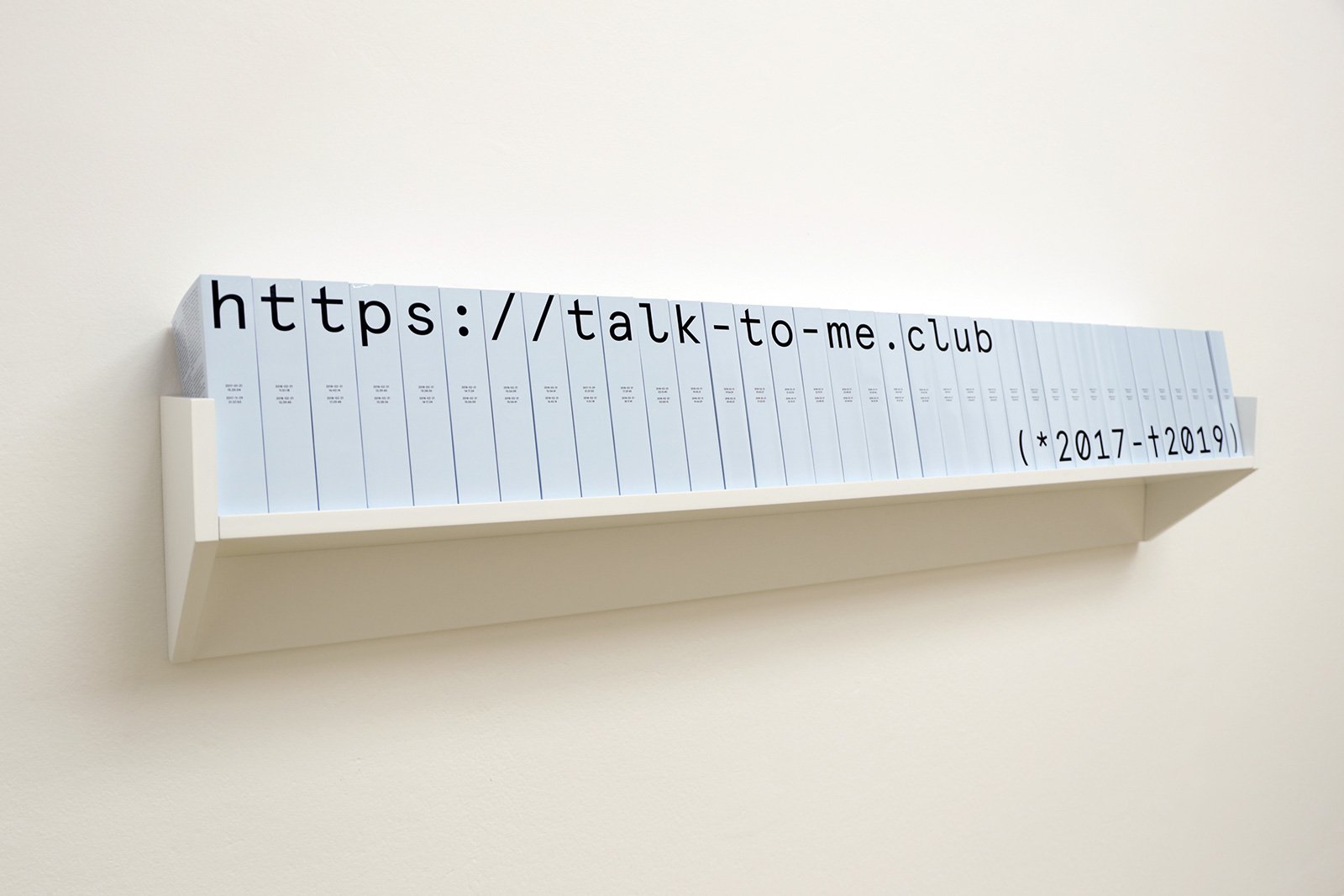
Jonas Lund, Talk To Me Book, 2019. Courtesy of the artist
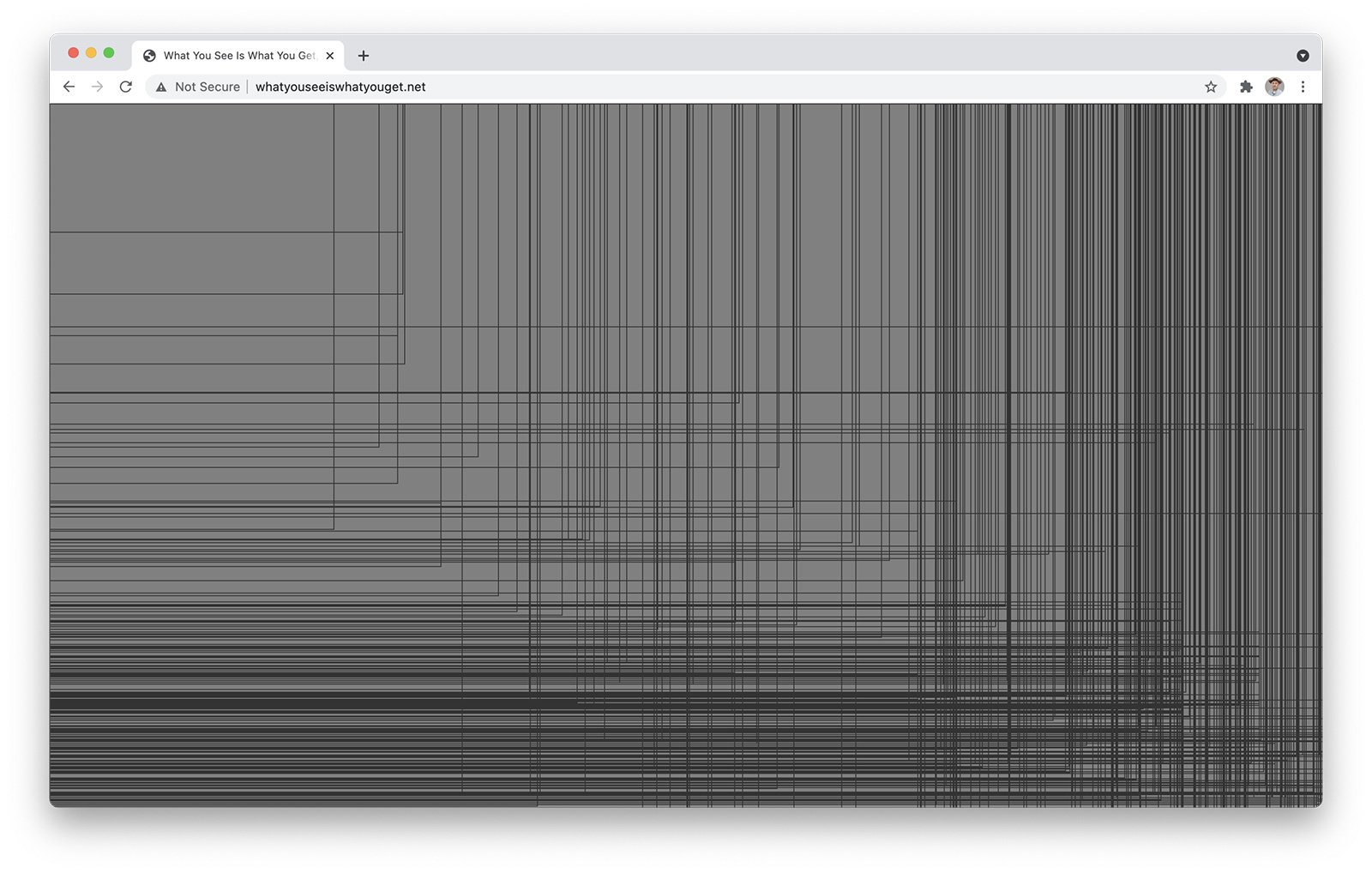
Jonas Lund, What You See Is What You Get, 2012. Website. Courtesy of the artist
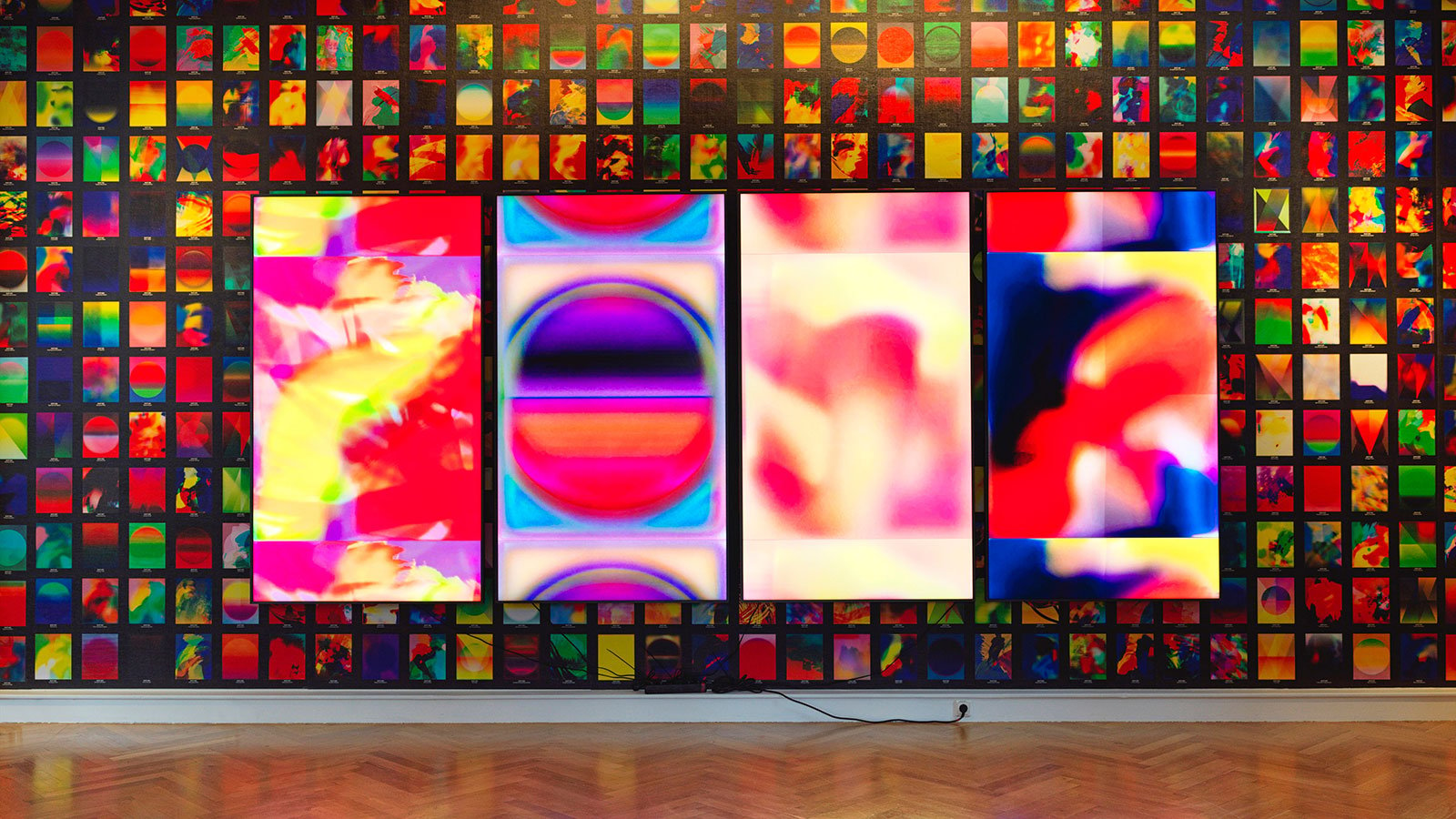
Jonas Lund, installation view, “MVP (Most Valuable Painting)”, W1 Curates, London, 2022. Courtesy of the artist
AM: And then there’s a waiting list of collectors.
JL: And as soon as the painting is finished, it leaves the studio, goes to the gallery, goes to the collector, and that’s it. But I just can’t work like that. I get bored too quickly repeating the same thing. I want to try something new, challenge myself, learn something.
There are so many unknowns in an artistic career that the only thing I can really optimize for is making sure I have a good time when I make the work. I can set up the parameters so that I get to explore a particular question or learn a new technology. As long as I have fun making it, my job is done.
Whatever happens afterwards is something else, something outside of my control. Did it hit the point of relevance? Was it interesting? Did it play out the way I thought it would?
AM: We’re both part of a generation that experienced the internet and then social media as something new. What did we think the internet would make possible for artists, and what happened to that promise? Did humans just get in the way?
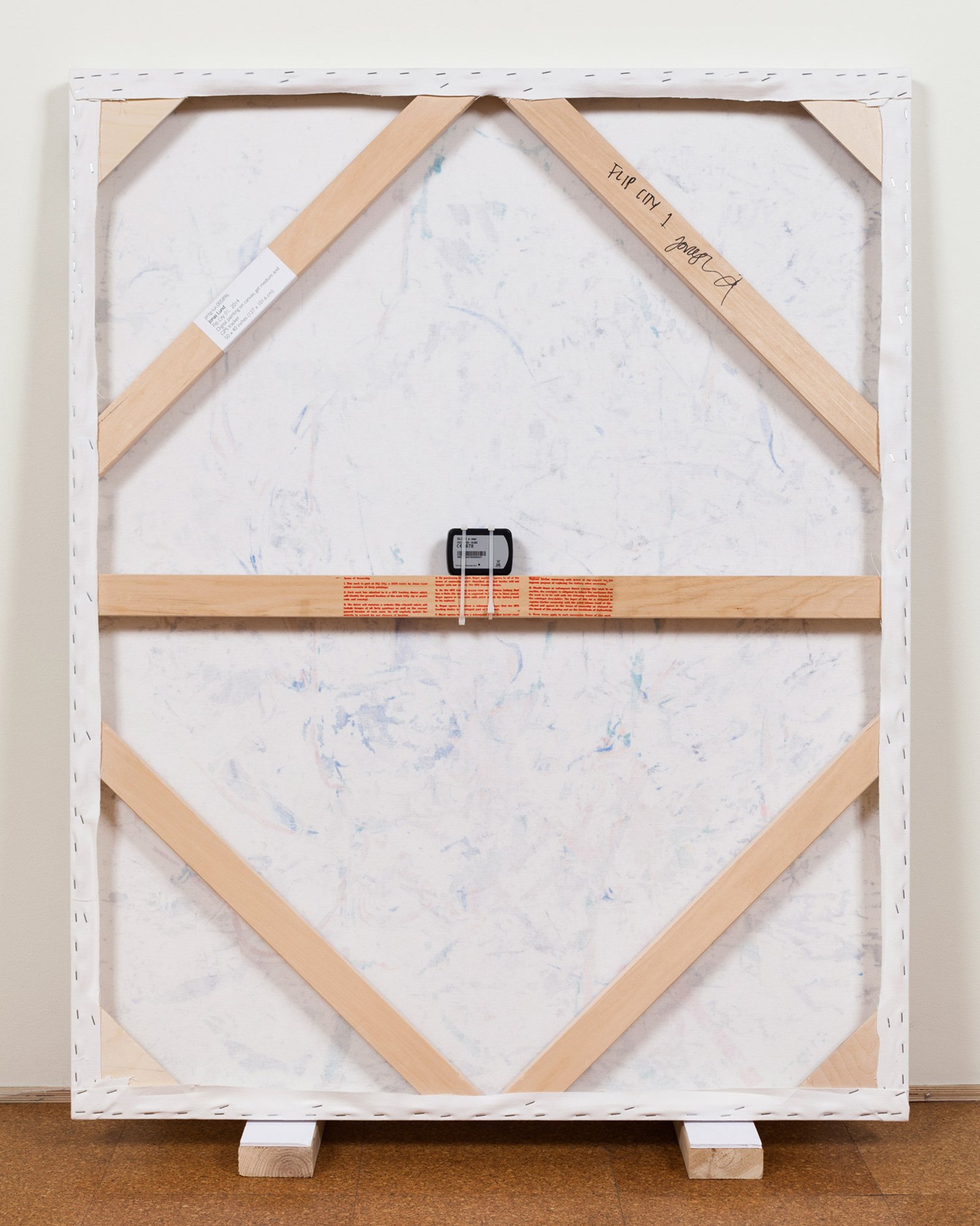
Jonas Lund, (Back view of) Flip City 1, 2014, Digital painting on canvas. Courtesy of the artist
JL: When I started making net art, around 2010, Facebook was already a thing. There really was a community of artists. You shared something, looked forward to seeing the response, and felt like you were part of something. That was really social media. But then the algorithmic feed came about, and it moved from social media to whatever it is now. It’s not social. It’s this hyper-optimized dopamine addiction vibe. Something was lost, or that community moved elsewhere and became harder to discover. At least for me, I don’t have that online community anymore.
I also think the whole concept of medium-specific studies is quite old-school. You learn painting, photography, or sculpture from a master, and then you make paintings, photographs, or sculptures. Now everything gets reduced to an image or a video in the feed anyway. So does the medium matter?
AM: You started thinking about data and optimization nearly 15 years ago. In “The Fear of Missing Out”, you were already using art-world data to try to make successful art. In a way, that anticipates how we optimize content for the feed today. What were you trying to find out?
JL: “The Fear of Missing Out” was a 2013 show where I wrote an algorithm that would output instructions for how to make art based on a massive dataset of art-world data. The idea was to see if there was a formula for successful art, not through subjective vibes, but through “big data”. 2013 was really the year of, “Let’s do big data.” The datasets were so large you couldn’t process them manually. You needed to write programs and scripts, scrape art-world databases like MutualArt, Artsy, Artfacts, e-flux, and build models to make instructions.
It was also about thinking about what this data does. My quote was, “There are lies, big lies, and big data,” paraphrasing Mark Twain, I think, who said, “There are lies, damned lies, and statistics.”
If you have a large enough dataset, you can make whatever story you want. It was also a way for me to start making physical art objects. Up until that point, I had been like, “I’m a net artist. I make websites.” But now I could make a net art piece that produced physical objects in the gallery space.
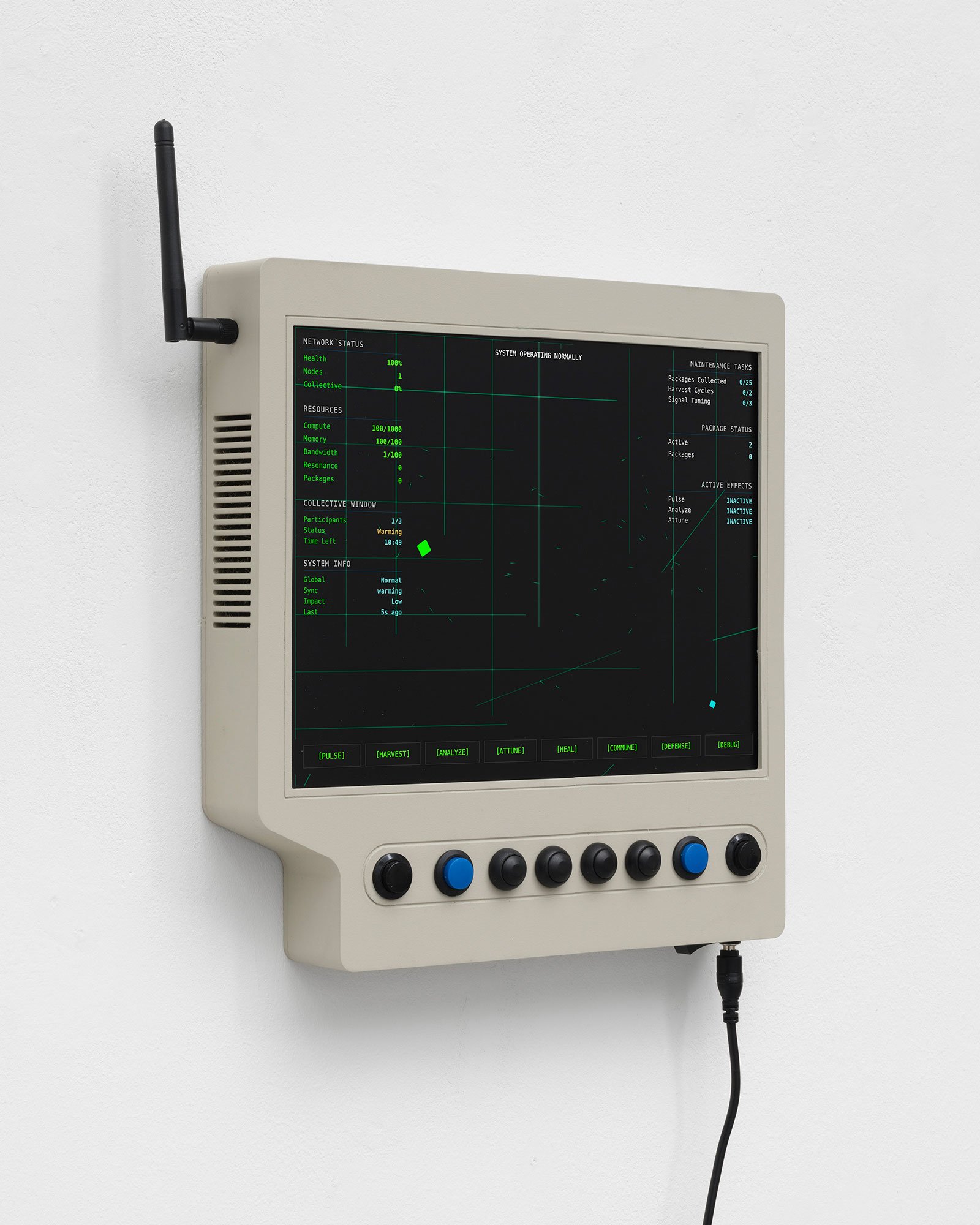
Jonas Lund, Network Maintenance, 2025. Courtesy of the artist
AM: And did it work? Did the algorithm actually help you make successful art?
JL: It worked in terms of launching my gallery career. It was my first solo show, and it got this front page on the Huffington Post with really the largest headline I’ve ever seen: “ARE ALGORITHMS ART?” That was in 2013. It set the tone for a lot of my work to come: make a system, define the parameters or rule set, and then have it run and produce outcomes, instructions, performances, structures.
It’s a way to appropriate technologies used by big tech companies and societal institutions for other purposes, and reveal how they work. What do they do? Can we subvert them? What are the consequences? That was very much the zeitgeist of my work.
AM: What you’ve described sounds a lot like what is now being called Protocol Art, the subject of Strange Rules at Palazzo Diedo in Venice. But you were already working with rules and systems more than a decade ago. In works like The Fear of Missing Out or Studio Practice (2016), what is the actual artwork: the system, the rules, the objects it produces, or all of it?
JL: I think the artwork is all of it. I don’t really care too much about what is Art and what isn’t. The threshold is so low. It’s easy to become Art. It’s more: What does it do? What conversations emerge?
With The Fear of Missing Out, the algorithm is the work. The dataset is the work. Not all of it is accessible to an audience, and maybe there are ways to make the whole system more visible without it becoming too technical or complicated.
Many of my works also come with contracts, and I often think the contract is a key aspect of the work. It defines the parameters and the different levels of agency each agent, player, or performer has within the system.
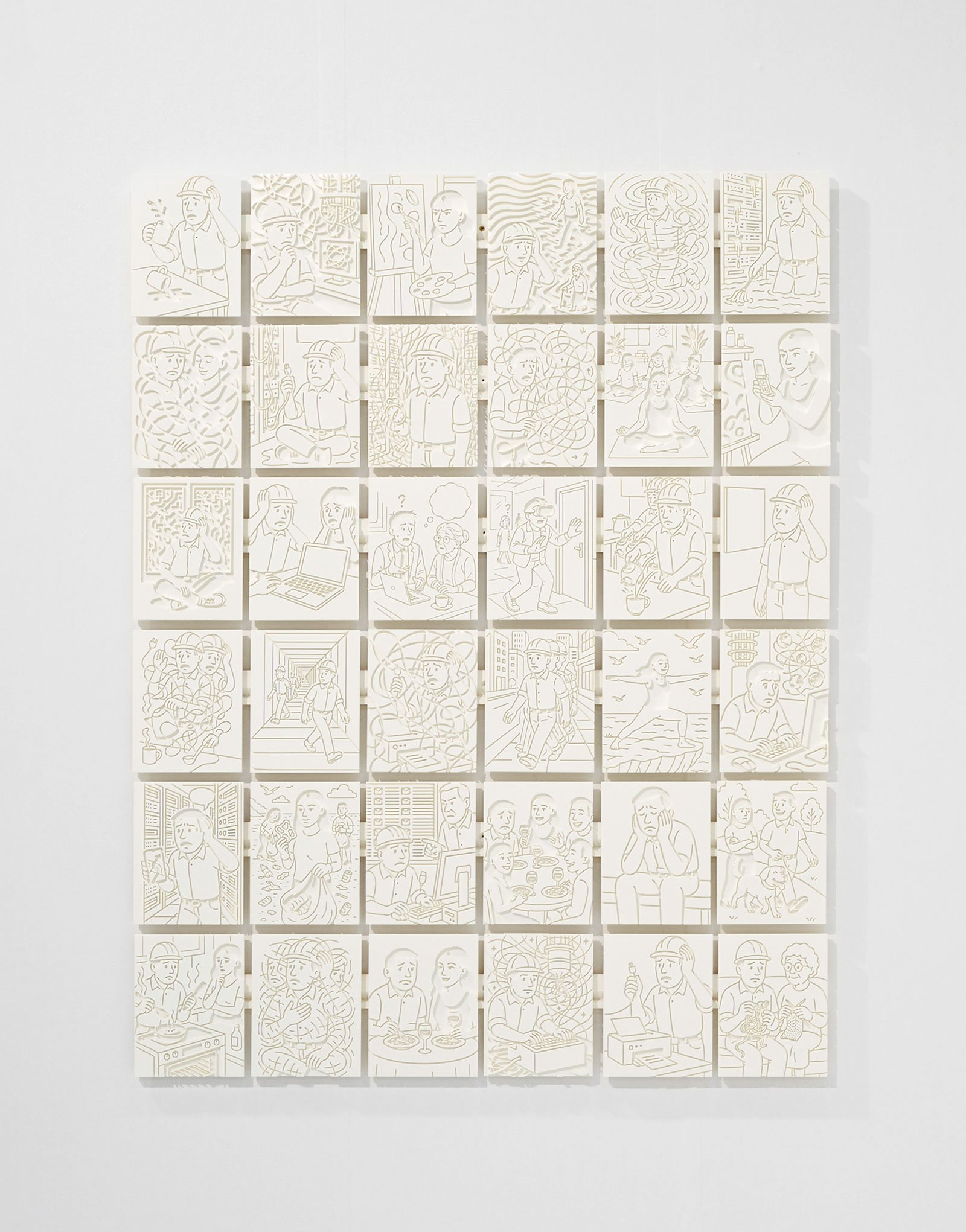
Jonas Lund, PLA, 2025. Courtesy of the artist
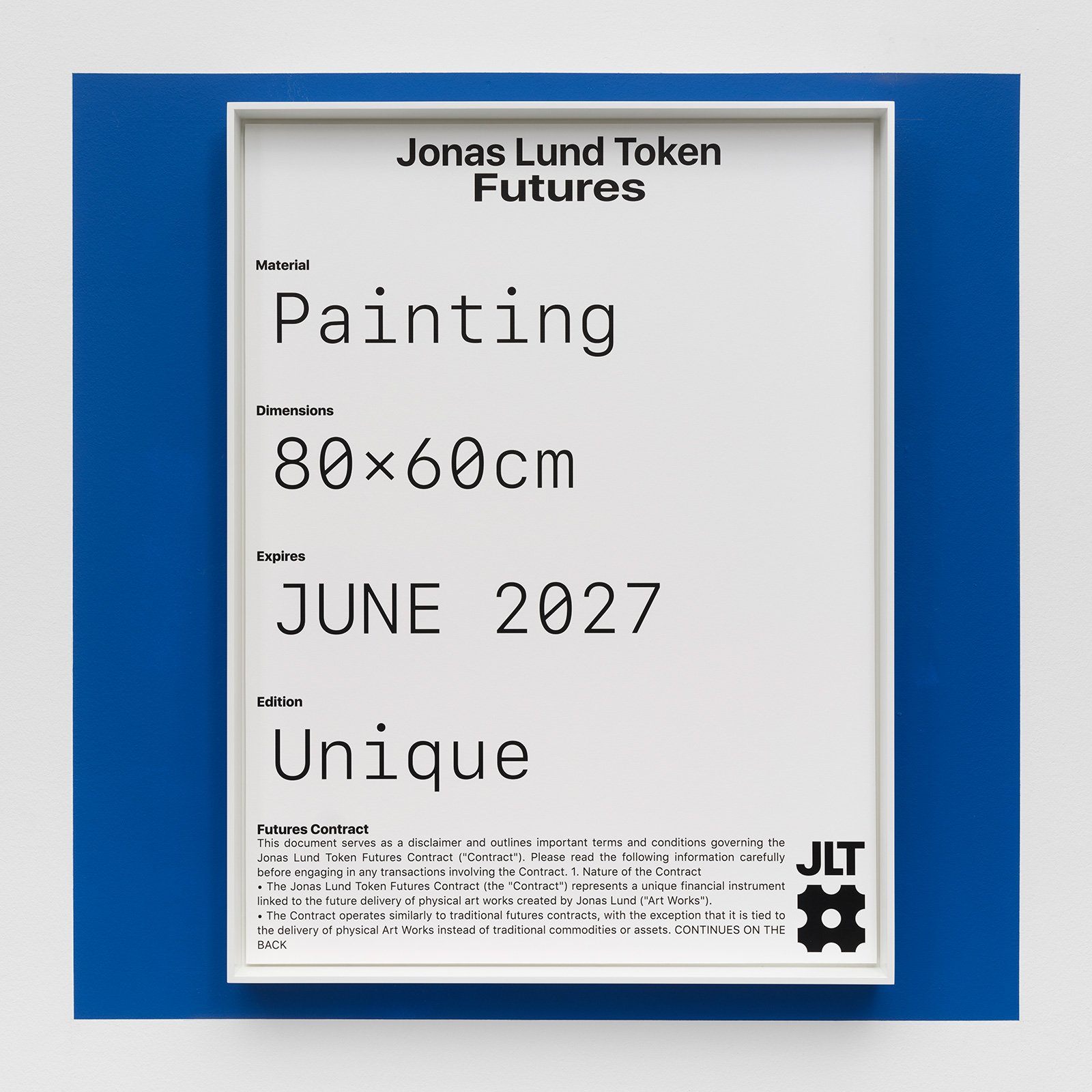
Jonas Lund, Jonas Lund Token Future #1, 2024 Courtesy of the artist
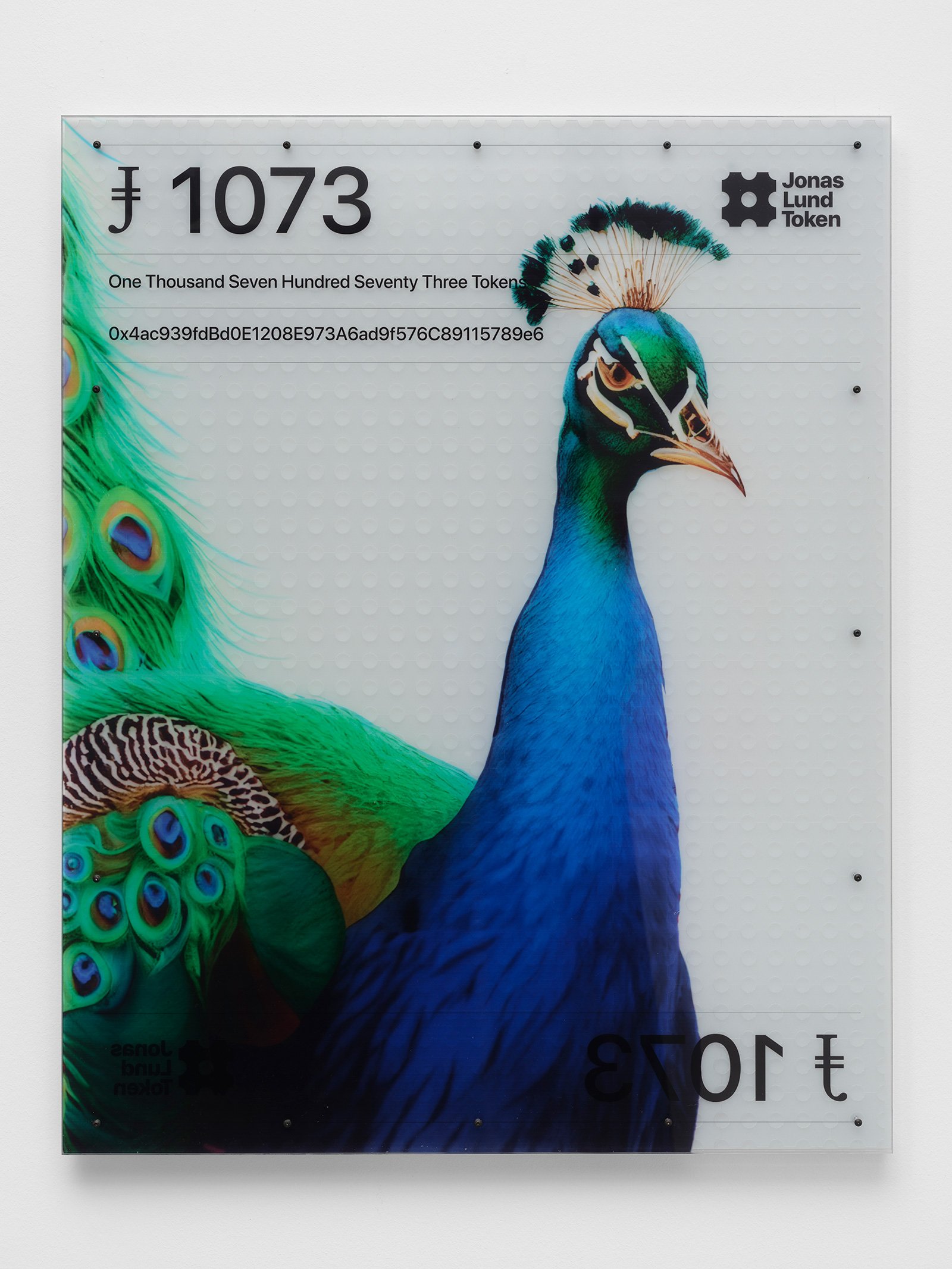
Jonas Lund, Jonas Lund Token (JLT) proposal (peacock), 2023. Courtesy of the artist
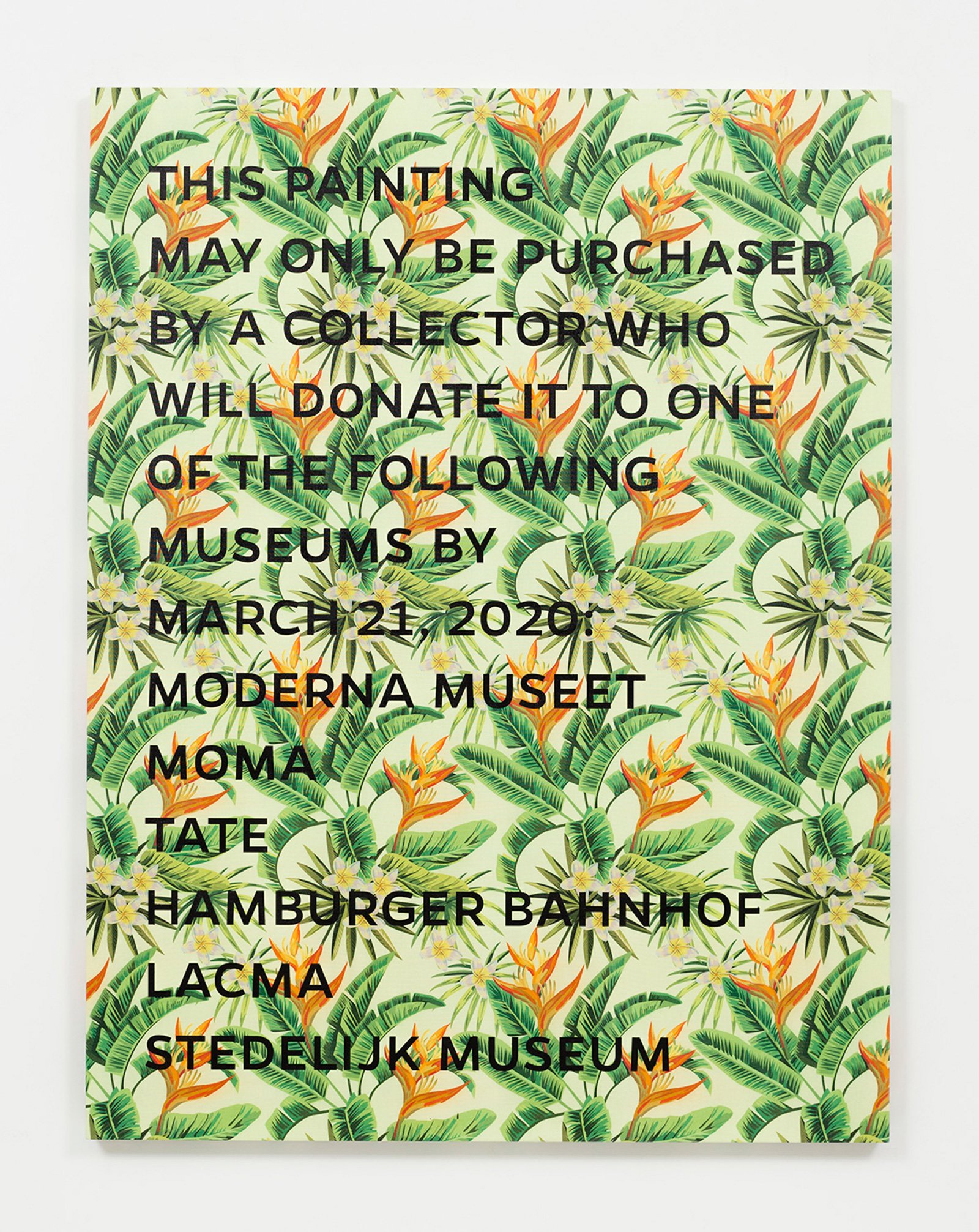
Jonas Lund, Donation (Strings Attached), 2015. Courtesy of the artist
AM: You’ve used contracts quite literally as an artistic medium, for example in Strings Attached and Jonas Lund Futures, where they determine what happens to an artwork in the future. What interested you in that?
JL: In Strings Attached, I’m basically enforcing my rules onto the gallerist. On the painting it says, “THIS PAINTING MAY ONLY BE PURCHASED BY A COLLECTOR WHO WILL DONATE IT TO ONE OF THE FOLLOWING MUSEUMS BY MARCH 21, 2020: MODERNA MUSEET, MOMA, TATE, HAMBURGER BAHNHOF, LACMA, STEDELIJK MUSEUM. ” and then there are other conditions.
It’s like, “Okay, follow my rules.” With Jonas Lund Futures, you buy a work today, and at a future date written on the canvas, it converts into a painting. It’s basically a classic futures forward contract, but for my work. That was a way to buy myself paternity leave: sell the work now, make it later.
I have to make the first one next year, in June 2027. It’s a classic example of future me hating my past self: “Why did I do this?” Now I have to make a bunch of paintings without any restrictions on what they should be.
AM: But even when you make paintings, you don’t necessarily paint them yourself. Some you’ve had painted in China.
JL: There are many ways of producing paintings without painting. Sometimes they’re painted in China, sometimes printed, sometimes other people paint them. There’s also the Michael Manning classic that I did around 2013, 2014: you print it and then paint over it with acrylic gel. It’s acrylic paint without pigment, so you get brushstrokes on the canvas and it looks like a digital painting.
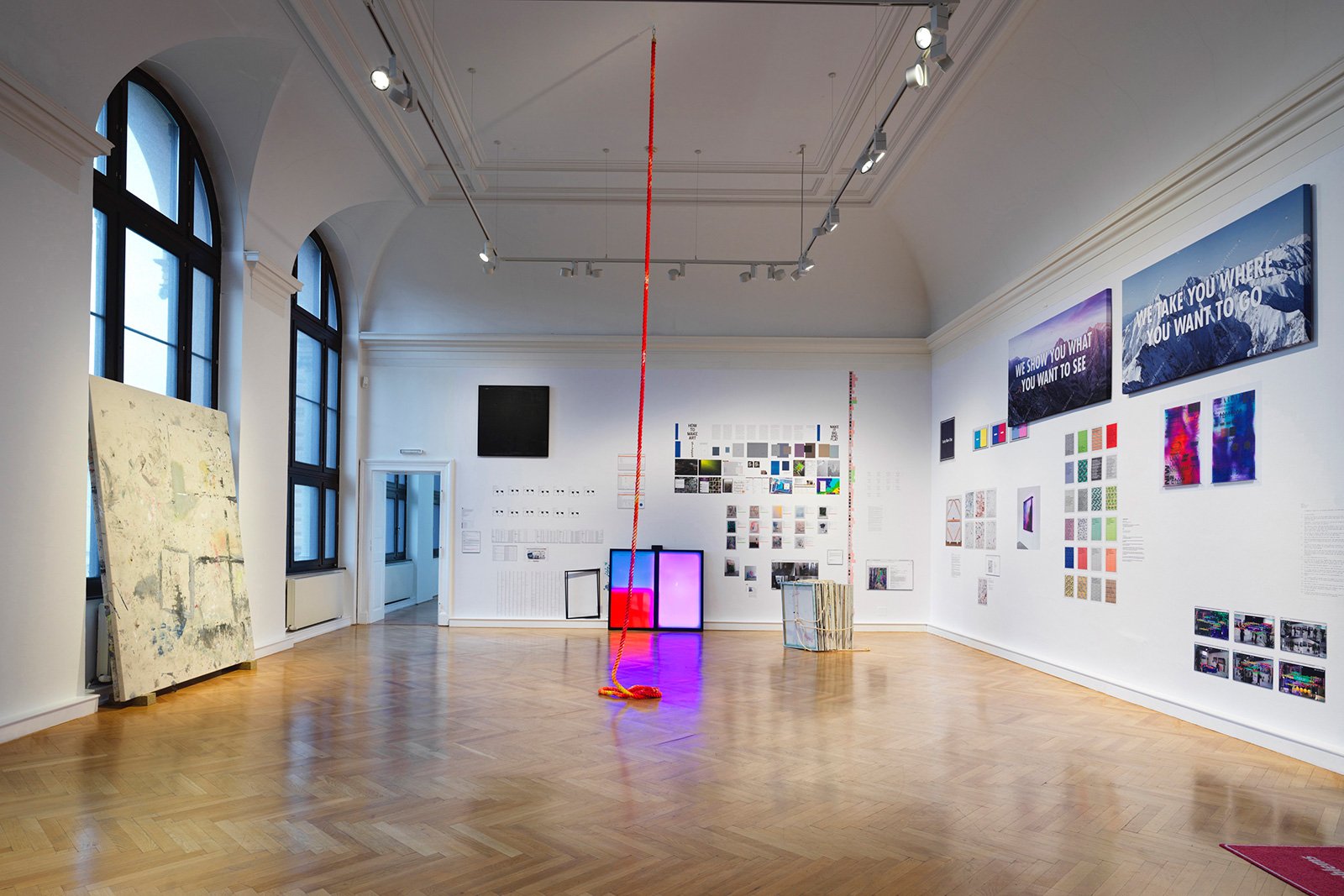
Jonas Lund, Installation View, “Studio Visit. How to Make Art in the Age of Algorithms”, Francisco Carolinum, Linz, 2022. Courtesy of the artist
AM: You took that idea of delegated production much further with Studio Practice in 2014, using a 300-page manual that you wrote, to instruct assistants. Now, in Performance Review, an AI agent instructs humans. Where did this interest in delegating decisions and production come from?
JL: Studio Practice came after a show in LA where a lot of the Flip City paintings sold. I started getting invitations from galleries, let’s say, that were really optimized for the flip-collector market.
AM: You didn’t like that?
JL: In hindsight, I should have just done all of it and become a painter. Studio Practice was a response to this demand for paintings without actually making them myself. I hired assistants who made work based on the instruction manual. An advisory board appraised them, scored them between zero and 100, and then I decided whether to sign them or not. Around 100 paintings were made, all process-based abstractions, zombie formalism, really zeitgeisty at the time. But only around five were signed and sold. So there was a big solo show, but collectors had almost nothing to buy. How do you increase the value of your work? There are only a handful available. I was looking at questions like: How do we make value? If an advisory board of high-profile experts says something is good, is it automatically good? And then there was the dynamic of having assistants execute works for you.
With Performance Review in 2026, I removed myself even further by replacing myself with an AI agent. It’s more dystopian, much more of a managerial super-stack. It’s Taylorism on steroids: you measure everything, and the agent oversees the process, gives instructions, and evaluates the performers.
The show didn’t make me feel too good. I loved making the system and setting up the structures, but seeing it realized, something felt weird. You have these supposedly benevolent AI agents making all the decisions, but those decisions aren’t based on being kind or reasonable. It’s a machine optimizing human labor. It felt very much like a startup.
You’re the CEO of Uber, you need more money, so you squeeze the pricing algorithm further: “Okay, I can squeeze an extra two cents out of this little transaction.” It’s hyper-end-stage capitalism. It’s also a slight prediction of where this is going if we don’t have good policies that limit automation.
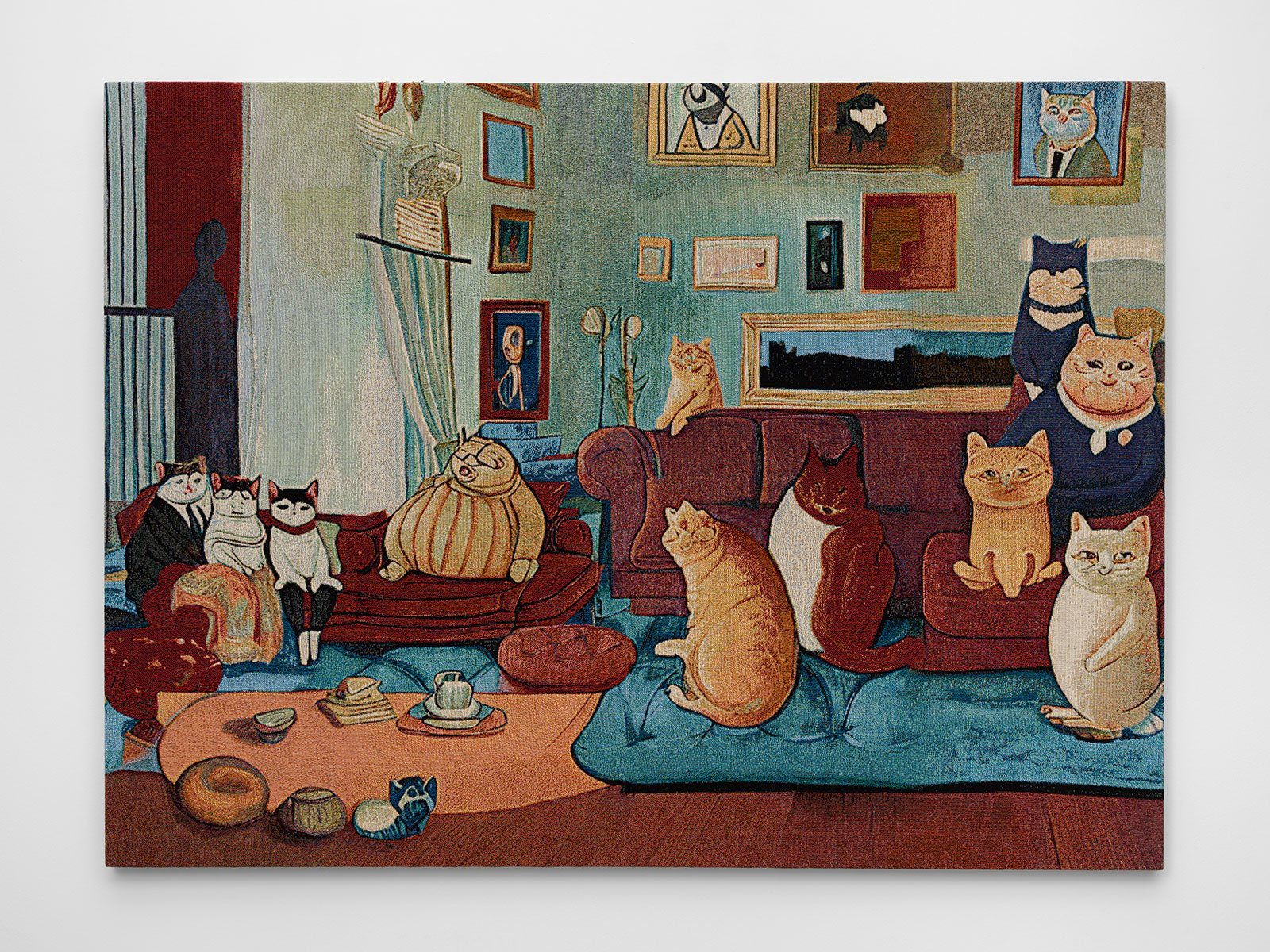
Jonas Lund, The Fat Cats of the Art World, 2023. Tapestry. Courtesy of the artist
AM: What exactly didn’t feel good about it? With the first version of Performance Review at OFFICE IMPART in Berlin, you started with an empty gallery, and producing the exhibition became the exhibition itself.
JL: It was this classic way of thinking: “Okay, I’ll start the show empty, and then it’s less work.” But it’s really silly because there’s so much work involved in setting up the automation, hiring staff, arranging materials. I still haven’t been able to put my finger on why it didn’t feel good. It might have just been vibes. Maybe the works themselves weren’t good, so I didn’t get this happy feeling of, “Oh, that painting is such a good painting.”
Or maybe it’s because the system is tuned to be so dystopian that the prevailing feeling is, “Oh, this is a system of exploitation and automation and abuse.” But I don’t think it’s actually exploitative. The assistants get paid properly, and they have full agency to ignore it or leave if it doesn’t feel good. I was very mindful about that.
AM: And now you’re doing it again, at the Busan Museum of Art. How has Performance Review evolved since Berlin?
JL: It’s grown. It’s bigger, better, faster. The Berlin show was around six weeks. In Korea, it will run for almost half a year as part of The Future of Museology, a group show about where the museum is going and what it might become. I’m doing Performance Review in collaboration with ZKM Karlsruhe. The system is expanding beyond the production of artworks to their contextualization and the discourse around them. So it operates even more like its own autonomous museum. At the center is still the AI agent, but I’ve upgraded the system because it needs to run by itself for such a long time (and I want to avoid having to babysit the system too much). Many of the applicants we’re hiring don’t speak English, so the bilingual aspect will be interesting. The agent, of course, speaks Korean, but I do not.
I feel really good about the show now. I don’t feel strange. But I really have to work this out. It’s like psychotherapy with Anika Meier. Because it’s in a museum, there’s less market pressure. It doesn’t need to make paintings that are instantly sellable. So it becomes something else. It’s trying to put on display the whole pipeline of legitimization, validation, and value.
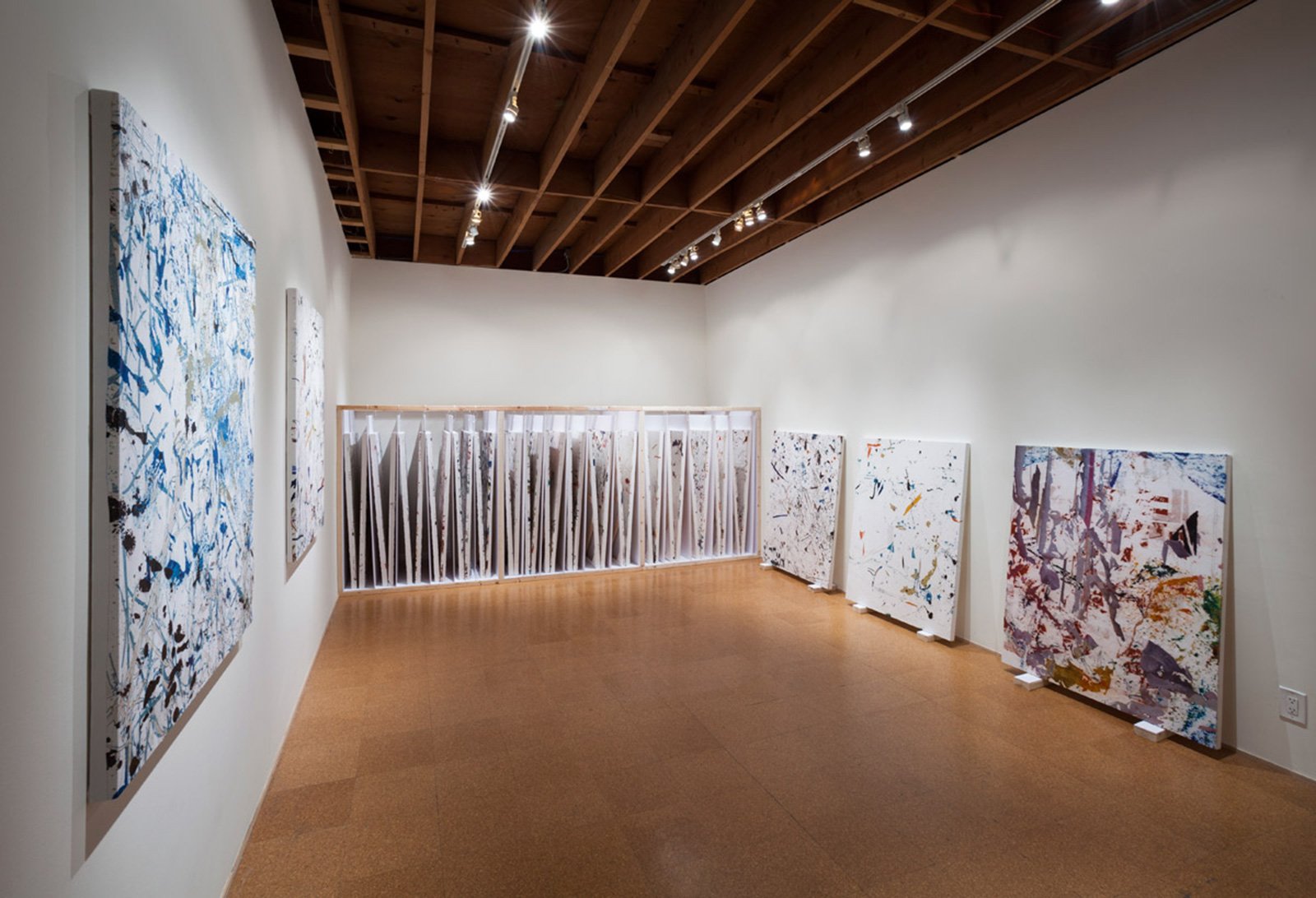
Jonas Lund, Installation view, “Flip City”, 2014, Steve Turner Contemporary, Los Angeles, Courtesy of the artist
AM: You keep coming back to these systems of legitimization, validation, and value. At the same time, you seem to have a bit of a love-hate relationship with the art world itself. Where does that come from?
JL: I tell myself I’m slightly less interested in the art world now, but I don’t think I am. When I was an art student, I read a book by Lars Vilks and Martin Schibli called How to Become a Contemporary Artist in Three Days. It sounds cynical, but it’s not. It’s basically a field guide to the contemporary art world of 2005. It introduces the institutional theory of art: art is whatever the art world says is art, and explains how value production and the network operate. I really took it to heart because I have quite a rational, logical brain. Suddenly, here was a structure for making sense of this world of abstraction. I could even put a number on my performance as an artist through Artfacts.net.
It’s been a long-running thread in my practice: Can I game this value production? Can I hack my way to a successful career? The Jonas Lund Token was the culmination of this. My artistic practice was based on the votes, advice, and guidance of some of the most prominent people in the art world.
It’s this circular, self-fulfilling prophecy. If the top of the art world is on the Jonas Lund Token board and they vote for something, it’s automatically good because they say it’s good. That was the ultimate way to hack value in the art world, to bring some rationality to this really subjective value production. But it’s also a bit of a folly, an endless endeavor that can never really be accomplished.
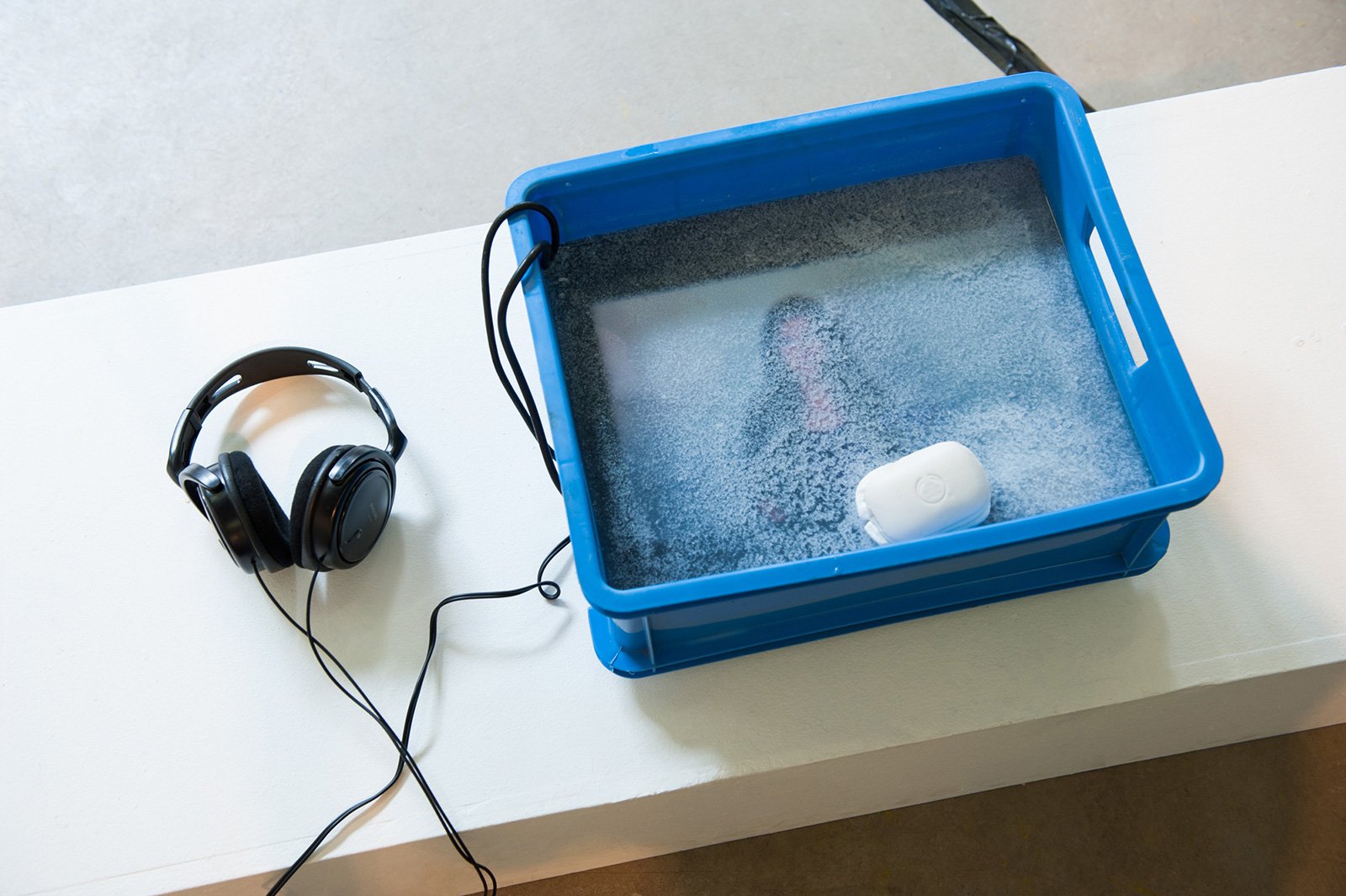
Jonas Lund, Installation view "The Fear of Missing Out", Showroom MAMA, Rotterdam, with work Cheerfully Hats Sander Selfish, 2013. Courtesy of the artist
What I’ve concluded is that it’s impossible to quantify. If you put two paintings next to each other, it’s impossible to quantify which one is more valuable. That’s the magic of art. It’s resistant to quantification. You can make predictions about value, but it’s never a sure thing.
AM: You’ve spent years trying to understand why some artists become successful and others don’t, using data and building systems designed to hack how the art world produces recognition and value. After all that, have you figured out what makes an artist successful? And looking back, would you do anything differently?
JL: I don’t think I know. I don’t even know if I consider myself successful. You can be successful from so many different angles. It’s the same with value. We’ve been so drilled into this capitalist market way of thinking that when we hear value, we think money. But there are many different values. For me, the most successful artist is the one who feels best in their work and in the process of making it.