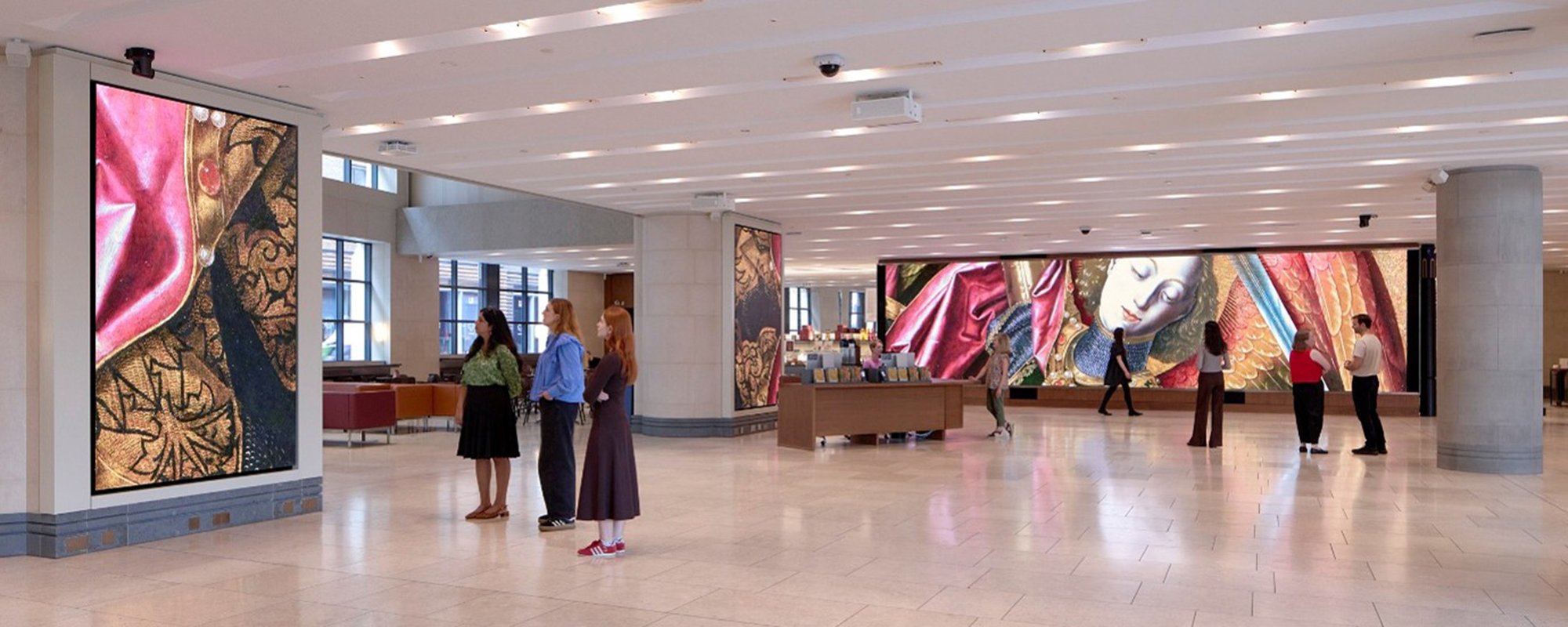
The National Gallery London has announced an open call for a £15,000 commission for a “bold” digital experience to be shown on the linked array of three high-specification screens in the gallery’s Sainsbury Wing foyer. The commission is for a “playful and experimental” digital experience that examines the human stories behind the gallery’s exceptional collection of paintings in the Western European tradition, and to “help visitors make meaningful connections” with the collection. Applications close on November 17, 2026, and the selected commission will be shown during Friday late evening openings in April to June 2027.
The commission marks a new stage in the use of the triple-screen array of micro-LED Samsung screens, known as Connected Canvas and overseen by the gallery’s Digital and Innovation team. The screens were installed in the Sainsbury Wing as part of its renovation, in 2023-25, by the New York-based architect Annabelle Selldorf.
When plans for the screens were first revealed in December 2024, Paul Gray, Deputy Director of the National Gallery, indicated how they would be used to show works from the collection — with high-res scans moving across all three connected screens — and potentially digital artists’ interactions with the collection. For Selldorf, the screens made the entrance welcoming and reduced the “threshold anxiety” that visitors would feel at entering the historic gallery.
In January 2026, the National Gallery appointed Patrick Elliott as its first curator of Modern Paintings, as part of the gallery’s Project Domani, which includes a move into collecting art of the 20th and 21st centuries for the first time. Right Click Save asked the gallery at the time whether Elliott’s remit would include art made with technology.
“It is a new position, and a new collecting direction so I think we are very open to possibilities,” a National Gallery spokesperson said. “However, as our collection will remain focused on paintings, it is unlikely that we will collect digital art.”
The open call is restricted to creatives in the first five years of professional practice, based in the UK, and outside full-time formal education. “Technology should be used purposefully to deepen human connection,” the gallery says of commission applications in a launch statement, “rather than simply to demonstrate technical innovation.” The project is supported by Bloomberg Philanthropies, the gallery’s digital innovation partner for 2026-28.