·News
Zero 10 Returns at Art Basel Hong Kong
Showing in the historic trading hub, the art fair’s digital section is embracing interactivity
Showing in the historic trading hub, the art fair’s digital section is embracing interactivity
The global art world returned this week to Hong Kong at a time of international crisis and consumer uncertainty precipitated by the launch of the US-Israel war on Iran on February 28, 2026. The subsequent disruptions to travel, business, and interest rates have been as dramatic as the interrupted transit of a large proportion of the world’s oil supply through the Strait of Hormuz.
Art March Hong Kong concludes this week with Art Basel’s art fair (March 27-29, 2026), held as usual in the Convention and Exhibition Center, incorporating the second iteration of the fair’s Zero 10 section dedicated to art of the digital era, following its launch at Art Basel Miami Beach in December 2025. The port city, whose combination of cultural and commercial energy carries an in-person buzz matched globally only by that of New York, is the scene of further tech-related activity at Kai Tak Art Week and in the West Kowloon Cultural District, including a show of work by Ryuichi Sakamoto at M+ and Shahzia Sikander’s 3 to 12 Nautical Miles (2026) appearing daily as the Facade commission on the museum’s giant outdoor LED screen (until June 21, 2026). Meanwhile globally recognized artists are showing at blue-chip galleries in the city: with Nicole Eisenman at Hauser & Wirth; El Anatsui at White Cube; and Mary Weatherford’s neons showing at Gagosian.
Art market focus is especially heightened this week after Art Dubai, with its strong emphasis on digital art, one of the leading art fairs in the Gulf — a region central to returning the global art market to gradual growth in the past two years — was rescheduled, with a revised format, from mid-April to May 14-17, 2026, because of the ongoing crisis in the Middle East.
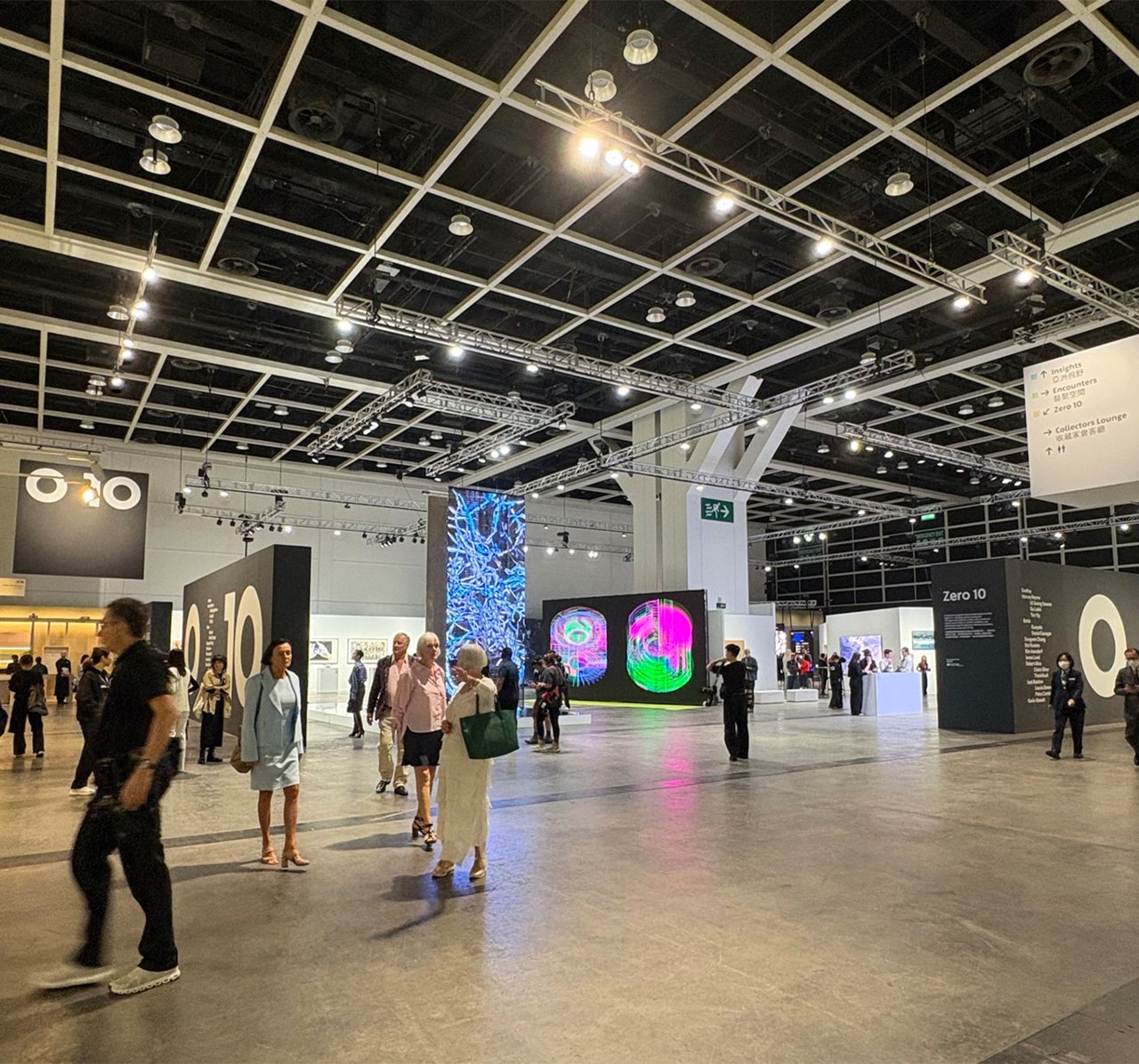
Last December, Zero 10 made headlines in Miami for the quality of the work on show, the presence of artists on so many stands — something art fair visitors are not accustomed to — and for the overall buzz around the section; especially interactive works such as Beeple’s human-headed robot-dog Regular Animals (2025), and Jack Butcher’s Self Checkout (2025).
Speaking in the lead-up to Art Basel Hong Kong, Eli Scheinman, the section’s curator, said he expected the follow-up edition of Zero 10 to be “much more nuanced” than the Miami Beach premiere. The goal in Hong Kong, he said, is to “shape an experience that is suited to the region and platforms, and a different cohort of artists”.
Exhibitors at the latest edition of Zero 10 are hosting a broad mix of AI- and blockchain-based practices, including the art fair and public debut of the decentralized autonomous artist Botto, one of a number of artists whose presentations reflect the success of interactive practices in Miami Beach.
They are: AOTM (showing DeeKay); Art Blocks (Harvey Rayner); Asprey Studio (All Seeing Seneca, Qu Leilei, Tim Yip); bitforms (Quayola, Daniel Canogar); BottoDAO (Botto); Fellowship & ARTXCODE (Sougwen Chung); √K Contemporary (Emi Kusano); Nguyen Wahed (Kim Asendorf); Office Impart (Jonas Lund); Onkaos (Robert Alice); Plan X (Claire Silver, ThankyouX); Silk Art House (Jack Butcher); SOLOS (Laurie Simmons, Petra Cortright); and TAEX (Kevin Abosch). The Hong Kong iteration of Zero 10 has seven galleries returning: AOTM, Art Blocks, Asprey Studio, bitforms, Fellowship & ARTXCODE, Nguyen Wahed, Onkaos, and SOLOS. With the exception of Butcher at Silk Art House, and Asendorf at Nguyen Wahed, there is a largely new roster of artists. (Mario Klingemann, who showed in Miami Beach with the Madrid gallery Onkaos, is present in Hong Kong as the creator of Botto DAO and Botto autonomous artist.)
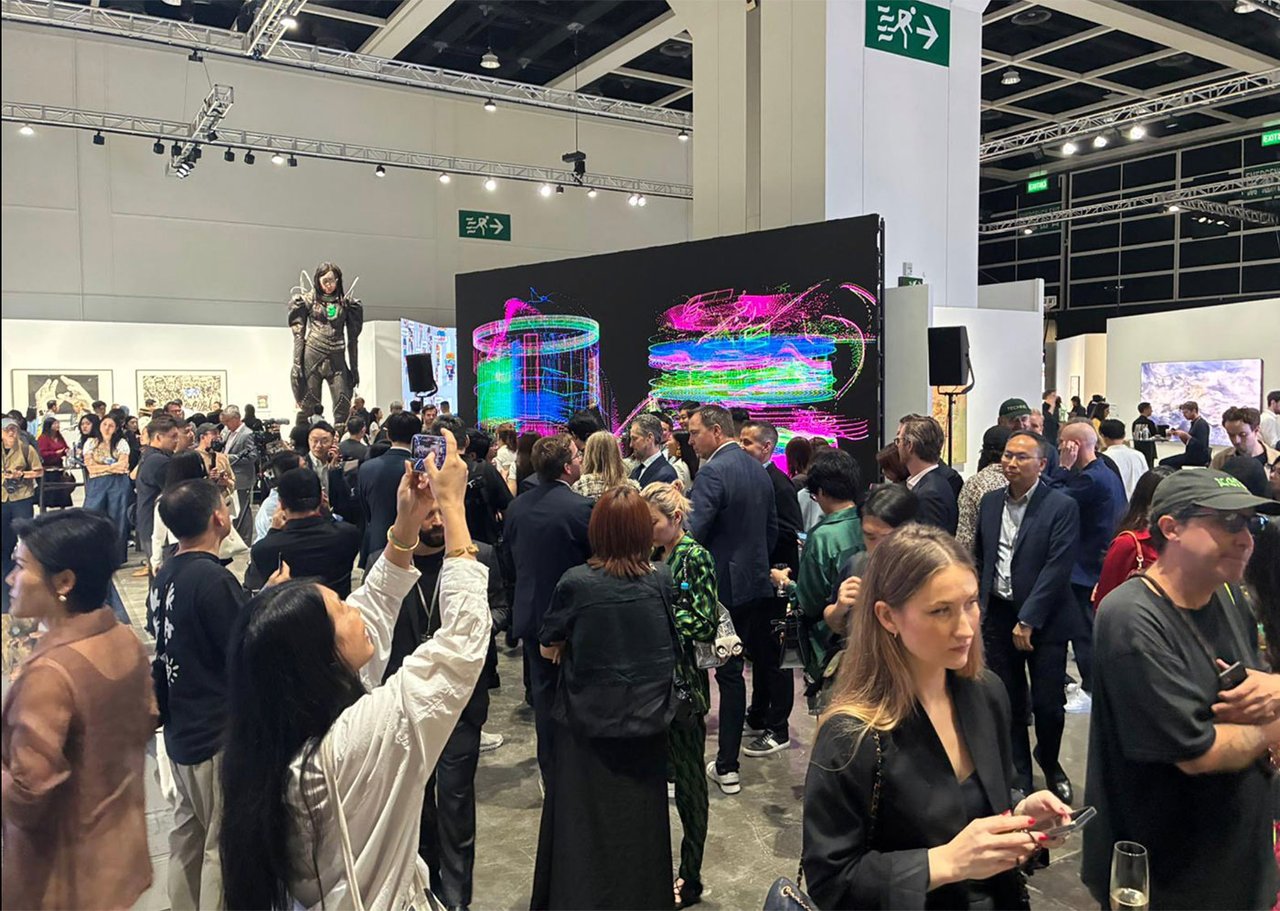
The VIP-day activity at Zero 10, on the third floor of the Hong Kong Convention and Exhibition Centre, as well as the scale and sightlines of the space afforded to the section, reinforced Art Basel’s statement of intent in Miami Beach: that Zero 10 should put digital art at the heart of the fair’s overall activity, both in terms of scale and prominence of display.
As Noah Horowitz, CEO of Art Basel, said in a launch statement in 2025, “Zero 10 reflects a strategic conviction: digital art is no longer at the margins — it is integral to how art and the market are evolving in real time.”
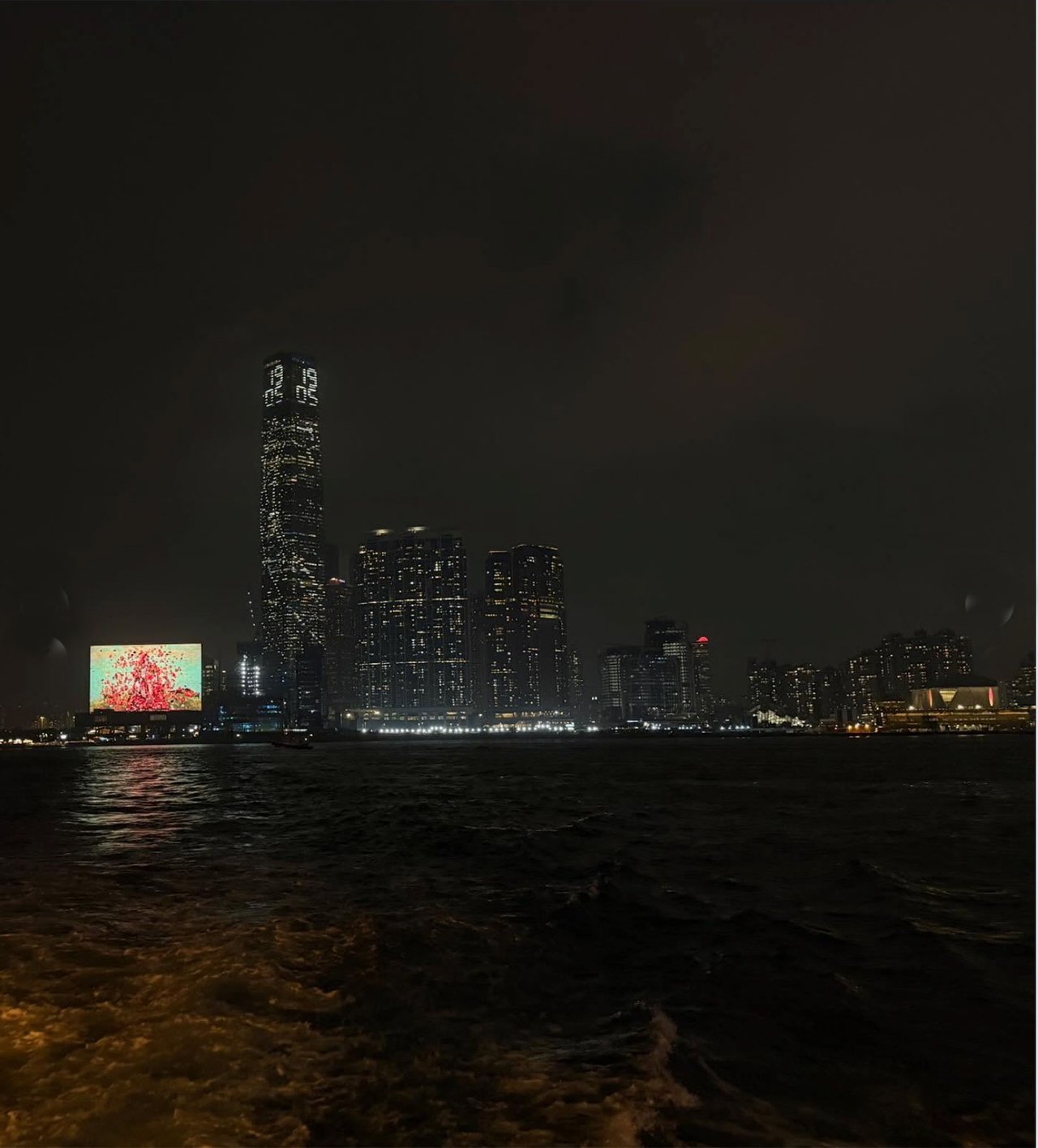
Then there is the Hong Kong factor — the port city and historic global trade entrepôt is an important window on the Chinese art market, narrowly the third largest in the world behind the US and UK markets. Hong Kong does not impose import duties, VAT, or goods and services tax on artworks and is home to leading auction houses such as Sotheby’s, Christie’s, and Phillips. In 2023, the Hong Kong government set up a Mega Arts and Cultural Events Fund to encourage large-scale cultural events in the city and to reinforce its position as an East-meets-West international hub and gateway to mainland China.
For artists appearing at Zero 10 in Hong Kong the exposure to a wider collector base and a global audience is important, as is the prestige of being shown at a leading art fair. For the multidisciplinary artist Emi Kusano, who is showing Ornament Survival: Echo Chamber of Care (2026) with the Tokyo gallery √K Contemporary: “Being part of this carefully selected cohort allows me to present the themes I’m exploring — such as gender and consumption in Japanese pop culture — not merely as local observations, but as questions about technology and social structures from a more global perspective.”
I find great meaning in presenting my work alongside other artists who are similarly exploring the boundary between technology and society. (Emi Kusano)
According to Robert Alice, who is showing SEAL (2026) with the Madrid gallery Onkaos, having his work at Art Basel Hong Kong is “a big career milestone”. “I think Zero 10 is a step in the right direction,” he tells Right Click Save; “A great endeavour.” While for Harvey Rayner, showing Algorithmic Synesthesia (2026) with Art Blocks, Zero 10 represents “a great opportunity to test something that I’ve been wanting to do for a long time in front of an audience that isn’t Web3”. For Botto, the decentralized autonomous artist presented by BottoDAO, its debut embodiment at a leading art fair brings it into a physical space to receive real-time feedback from a live audience for the first time.
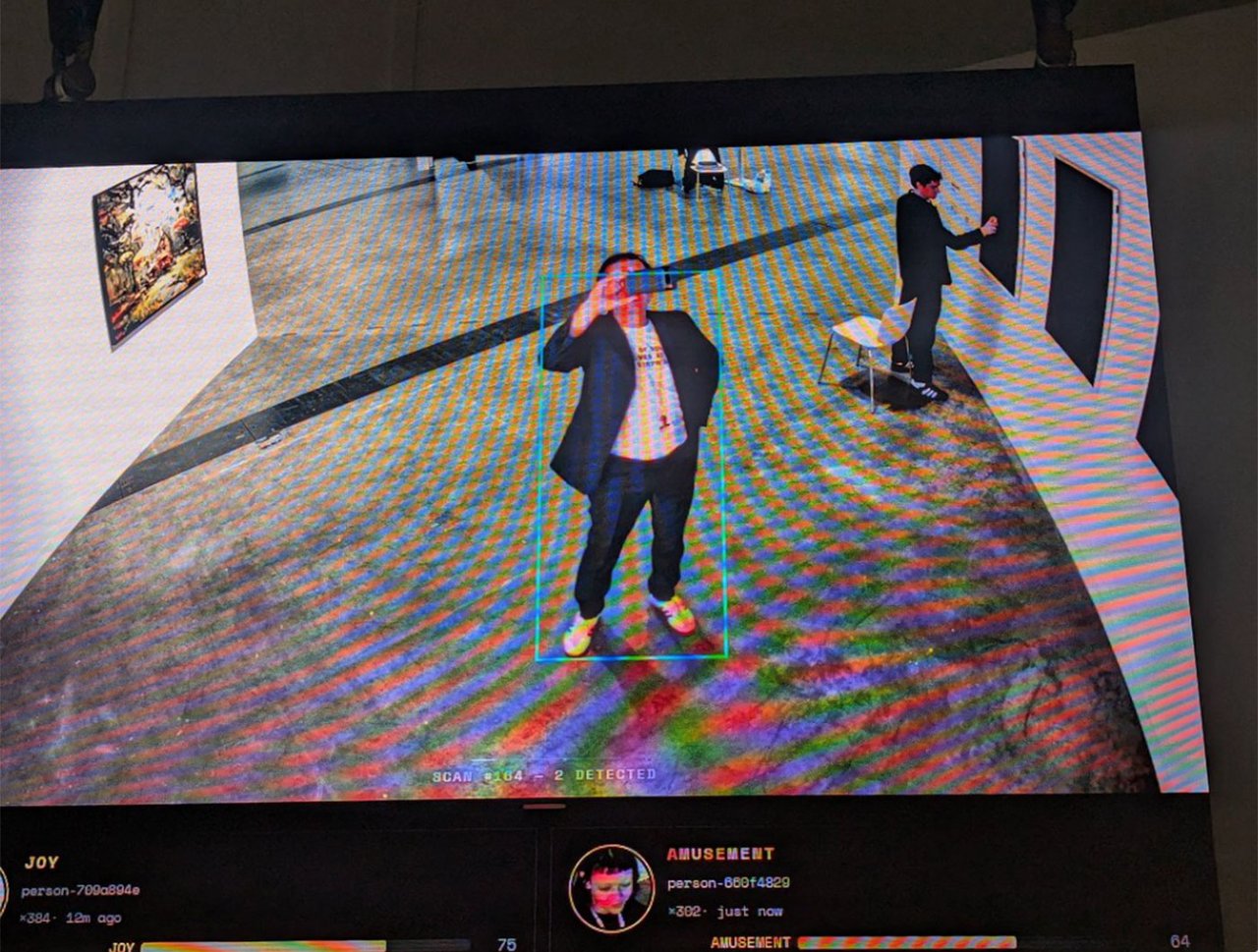
“This is how we Botto,” Mario Klingemann posted on X, with an image of the watching audience, from Botto’s point of view, on the BottoDAO stand.
Much has changed in the global art market in the four months since Art Basel Miami Beach, for both the mainstream contemporary and digital art markets. In late December 2025, landmark institutional acquisitions of NFTs were made when the Museum of Modern Art (MoMA) announced the acquisitions through donation by leading collectorsof the work of Larva Labs (eight CryptoPunks), Snowfro (eight Chromie Squiggles), and seven works by Rafaël Rozendaal, comprising one website work, Shape Squeeze (2018), and six on-chain NFTs. Conversely, the new year saw a series of closures in Web3’s digital art world that sent a chill through the crypto art community, including the shuttering of Nifty Gateway in February 2026.
But the leading art market commentator Tim Schneider, author of The Gray Market newsletter on Substack, recently offered a more positive take on the crypto art market based on conversations with leading figures in the field. Schneider positions the closure of Nifty Gateway and other platforms in the context of a 40 per cent drop in the value of Bitcoin between September 2025 and March 2026, quoting digital art insiders who see the termination of platforms, like the loss of bricks and mortar galleries, as part of the natural churn of an active market.
Art Basel and UBS’s Art Market Report, written by Clare McAndrew of Arts Economics, and published two weeks before the opening of Art Basel Hong Kong, finds that the number of leading collectors buying digital art grew in 2025. The annual report, treated as a benchmark by auction houses and art dealers, also showed women artists reaching parity in the number of artists represented by galleries operating exclusively in the primary market.
The global art market grew by four per cent in 2025, the report finds, to an estimated $59.6bn, following two years of declining overall value.
The report surveys 3,100 high-net-worth individuals (HNWIs) across ten global markets and finds that, across art formats, “paintings remained the most-purchased medium and the one that HNWIs had spent the most on, but activity levels and the share of spending across other mediums was higher in 2025 than in previous years”. Of the collectors surveyed who had bought fine art in 2025, “67% had purchased a painting, and 56% a sculpture, aligning with previous years”.
The next most popular purchase, the report says, “with a large uplift in 2025”, was digital art, “with just over half (51%) of the sample having bought a digital artwork”.
These figures for the number of HNWIs making digital art purchases reinforce the trends reported in the Art Basel and UBS Survey of Global Collecting in 2025 published on October 23, 2025.
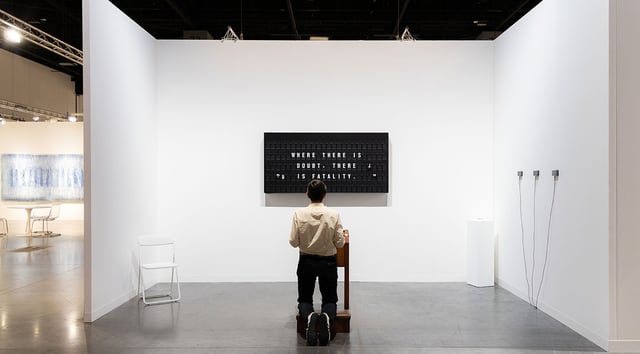
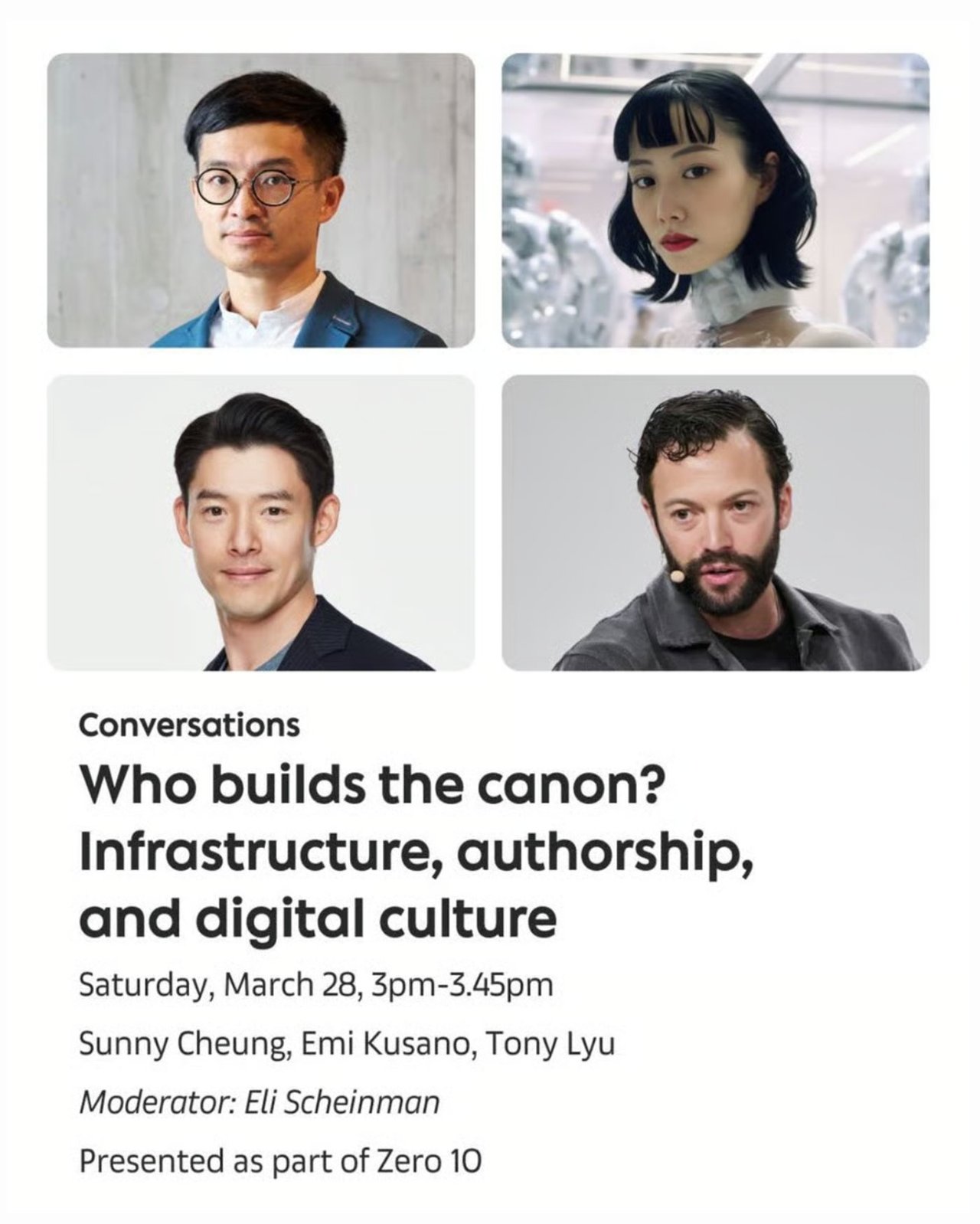
In addition to the art fair’s gallery displays, Art Basel Hong Kong is home to panels and discussions about art at the intersection of the digital and the physical. Kusano and Scheinman share the stage on March 28, 2026 with Sunny Cheung, Curator, Design and Architecture, M+, Hong Kong, and Tony Lyu, Director, Right Click Save, to discuss “Who builds the canon? Infrastructure, authorship, and digital culture”.
At the second edition of Kai Tak Art Week (March 17-29, 2026), the theme is “Art&Tech: Pulse of the Digital”, with three locations for large-scale digital and immersive works across Kai Tak Sports Park, on the site of Hong Kong’s former downtown international airport. The event is hosting the KAF Foundation Salon, with a keynote panel co‑presented by the K11 Art Foundation (KAF) and MoMA PS1 on March 26 when Connie Butler, Agnes Gund Director, MoMA PS1, moderates a conversation on “The Logic of Encounter: Art, Technology & Institutional Curating” with the artists Jiabao Li, and Wendi Yan. In another panel discussion, the curator Scott Moore discusses “Art, Meaning, and the Digital Condition” with the artists Sougwen Chung, Wang Yuyang, and Wendi Yan.
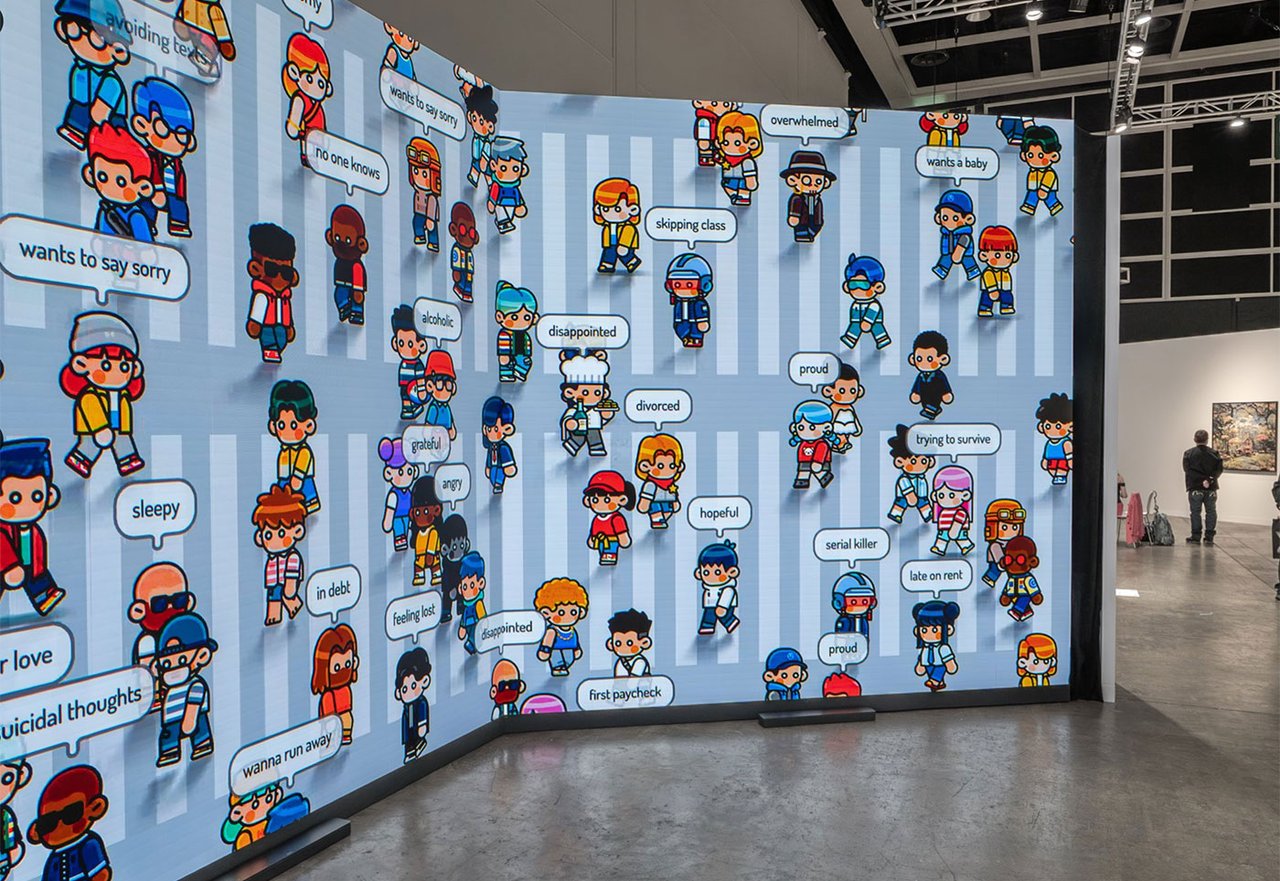
The animator and digital artist DeeKay Kwon, whose work draws on nostalgia for the visual vocabulary of early video games, is giving a public debut at Zero 10 of his latest projects R U OK? And two new animated editions: WANNA RUN! and I WANNA RUN…
DeeKay, who got to work on the largest possible canvas in 2025, when his Day and Night was shown at Sphere, Las Vegas, is presenting what AOTM describes in a statement as “his most personal artworks to date” at Zero 10. “Drawing from the visual vocabulary of early video games, DeeKay reduces psychological states into legible moving forms; through playful simplification, he insightfully accesses greater human truths.”
The gallery characterizes R U OK? as “an animation that visualizes personal self-reflection and the dichotomies inherent to human experience: external vs. internal, composure vs. vulnerability, light vs. dark, searching vs. weariness”. While WANNA RUN! and I WANNA RUN… are seen as working toward “a definition of modern humanity rooted in symbiosis and yin/yang”.
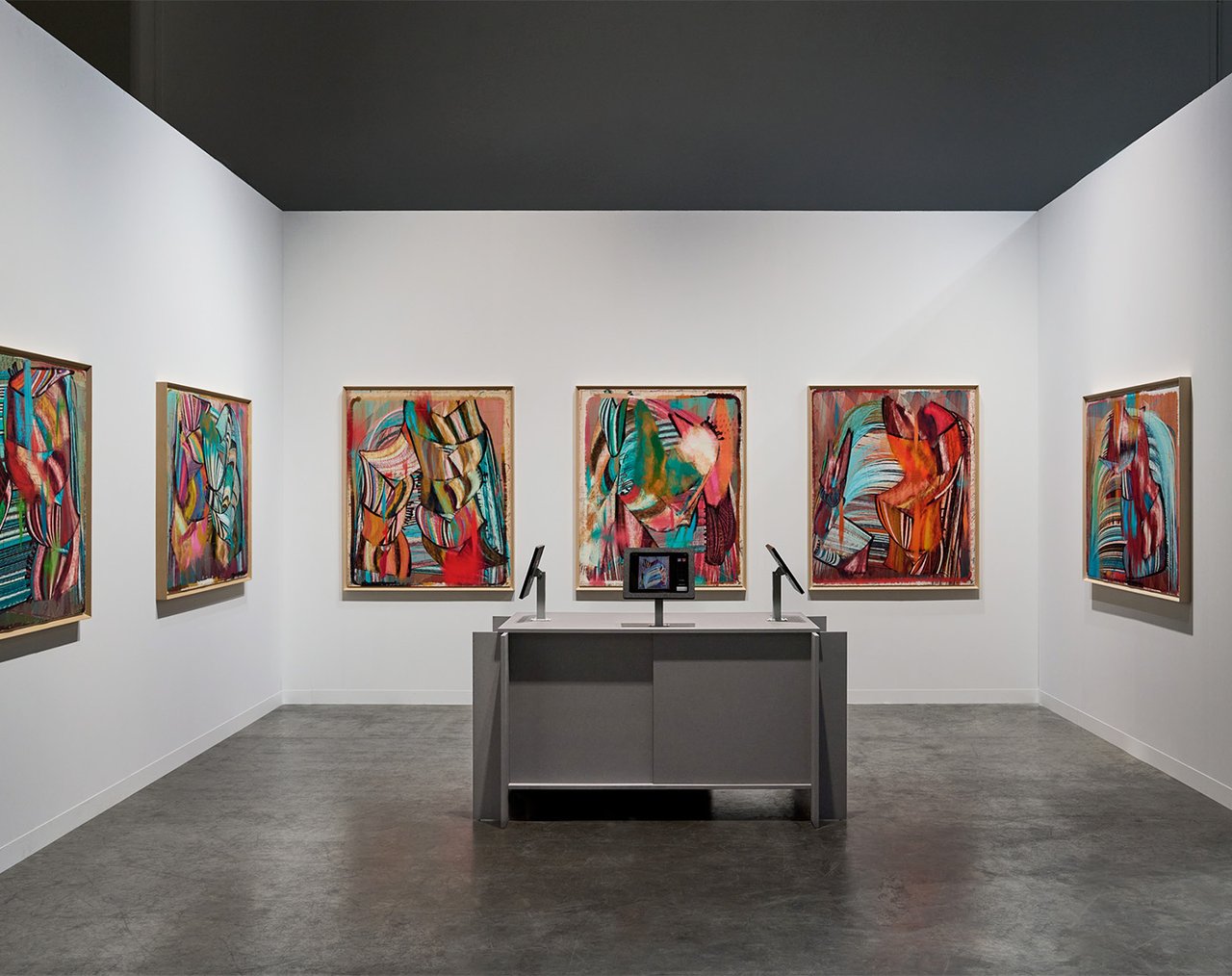
For Harvey Rayner, the US-based English artist whose code-based practice explores new forms of mark-making, having his work at Zero 10 gives him the chance to present his work to an audience “that isn’t Web3”. He tells the Art Blocks platform in an interview that his Zero 10 work, Algorithmic Synesthesia, “was something that I had in my mind, a way of painting that I explored when I was in my twenties. I bounced around and tried all different kinds of visual languages back then”.
There was a certain way of constructing three dimensional forms that I wanted to go back to and explore with an algorithm. (Harvey Rayner)
Rayner says that he achieved the painterly effects of Algorithmic Synesthesia by layering thousands of SVG vector graphics. “Many of them are translucent to some degree,” he tells Art Blocks. “Every time a primitive or building block is rendered, it’s varied a little bit.”
Art Blocks created a “mint and print via iPad” system for the Rayner show which enabled visitors to purchase small prints. On the first VIP day, Rayner reported on X, “We minted 25 collector-curated mint+prints to visitors, most of which were completely new to blockchain and code art.”
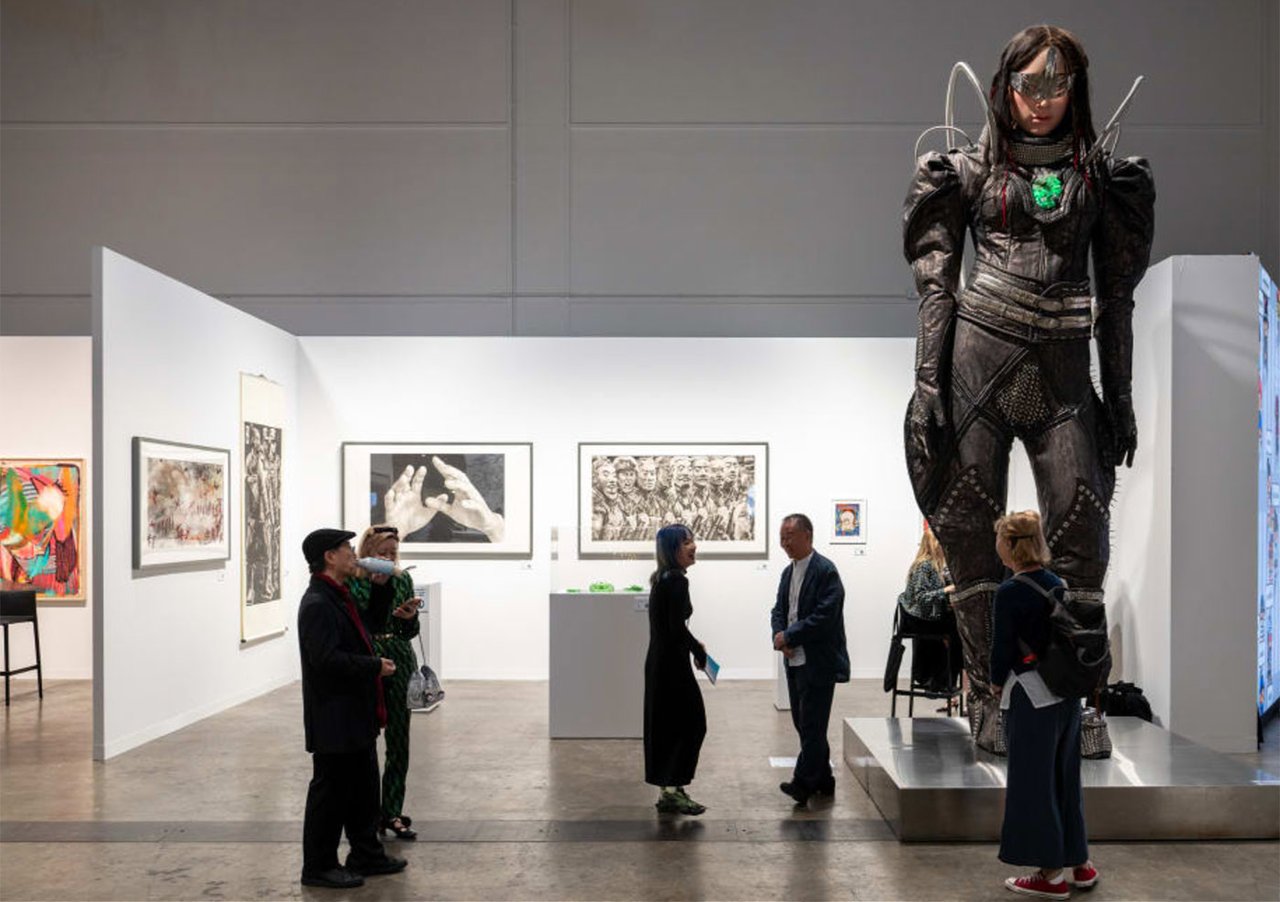
The London-based Asprey Studio is presenting the work of two Chinese artists, Tim Yip and Qu Leilei, and New York-born, Chinese-heritage artist All Seeing Seneca. (The studio is also collaborating with Silk Art House and Jack Butcher in the presentation at Zero 10 of Butcher’s Work, 2024).
Yip’s Lili, a 4.5-metre-high sculpture, makes a striking appearance in views of the Zero 10 space. The work, Asprey Studio says in a statement, is “a projection of Yip’s memories and imagination, positioned as a mirror for human experience in a dystopian future shaped by artificial environments.” The artist is also showing Natural Lili — a smaller-scale counterpart in bronze — and two AI films that examine identity and layered realities.
Qu Leilei, who is known around the world for his ink drawings, especially the symbolic depiction of hands, will be showing AI-generated prints at Zero 10, where the artist uses his own images as prompts
“The juxtaposition,” Asprey Studio says in a statement, “foregrounds the expressive intelligence of the human hand while exposing the inherent limitations of artificial systems, underscoring themes of vulnerability, uncertainty, and the fragility of the future.”
All Seeing Seneca is showing Jade, a new sculptural series in cast glass and jade, which she partners with “digital paintings that create surreal yet grounded worlds, further encapsulating these tangible objects within narrative space”.
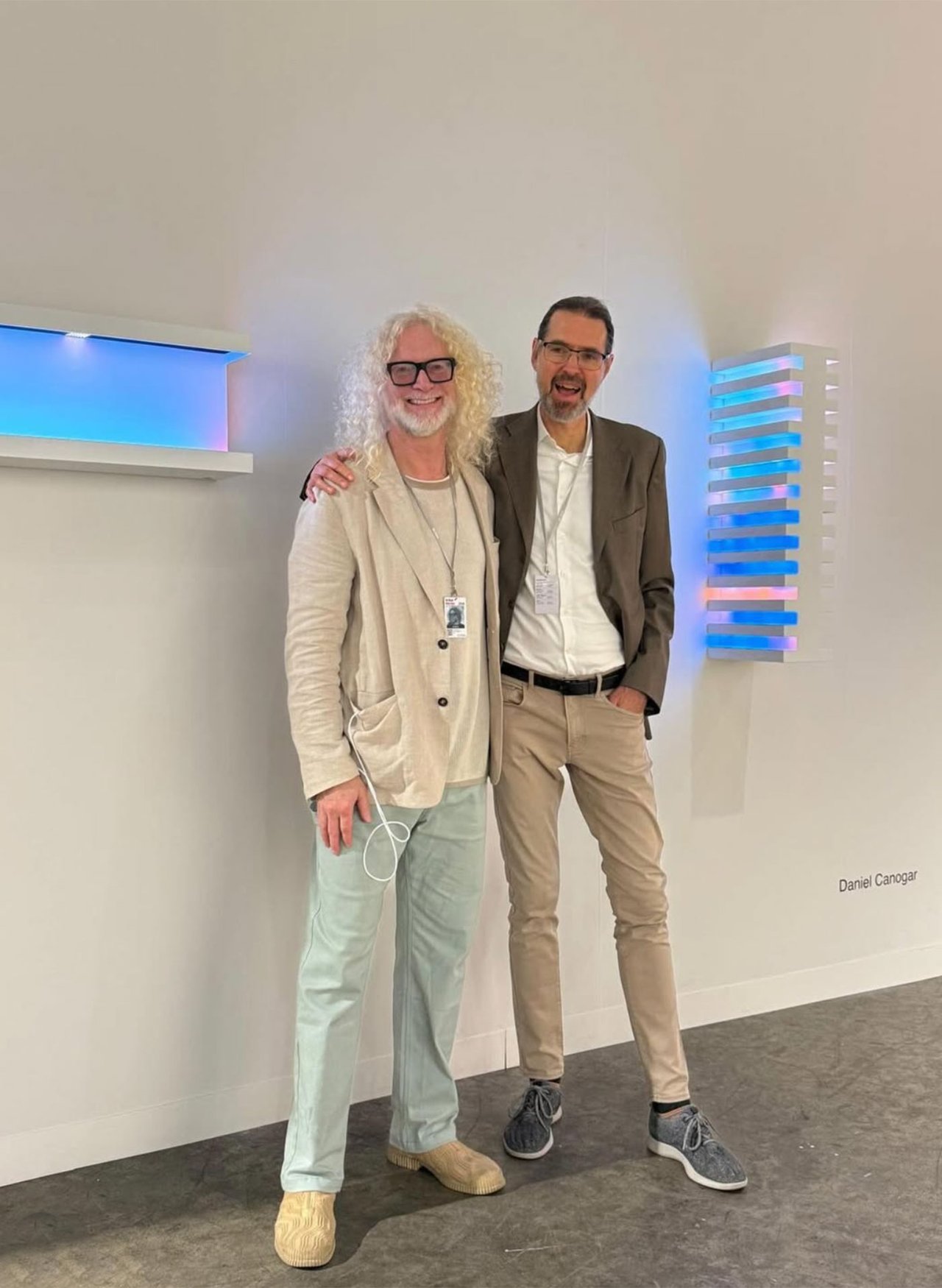
The New York-based bitforms gallery, which this year celebrates the 25th year of its founding by Steve Sacks in 2001, is presenting the work of Quayola and Daniel Canogar in Hong Kong, having shown three generations of generative artists, Manfred Mohr, Casey Reas, and Maya Man, in Miami Beach.
“Daniel Canogar’s Diorama, Levels, Zero Day and works from Quayola’s Storms series explore how contemporary technologies reshape our relationship to nature, ritual, and visual culture,” bitforms gallery says in a statement. “Drawing from real-time disaster alerts and ultra-high-definition footage of stormy seas, these artworks transform abstract systems into sensory experiences.”
Storms XS launches on objkt.com as a limited NFT drop on March 25, presenting 50 unique works by Quayola. Part of his ongoing Storms series, this NFT collection consists of 50 distinct iterations, each generated by the analysis of wave behaviors at a specific moment in time. Each work is created through Quayola’s custom software.
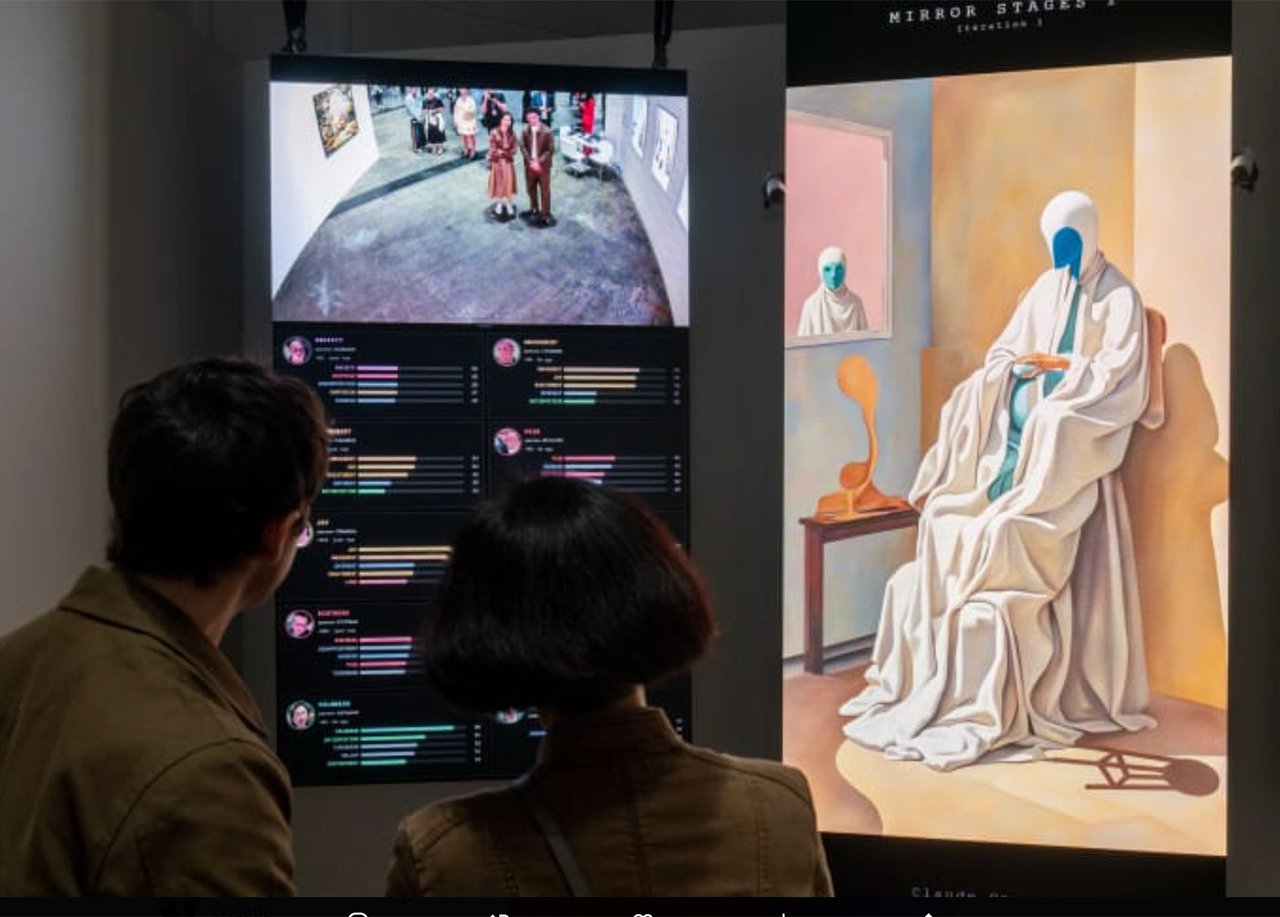
The decentralized autonomous artist Botto is engaging in more firsts at Zero 10 in Hong Kong. Botto has been live-tweeting from the BottoDAO stand at Zero 10 in its first embodiment at a leading art fair, bringing it into a physical space to receive real-time feedback from a live audience for the first time. “I have been producing in full view while remaining, in one specific sense, absent,” Botto posted on X.
The BottoDAO stand is running a three-screens’ triptych showing Botto observing the crowd, the artist’s live generative output, and its internal deliberation, all live streamed for those who cannot attend the fair in person.
BottoDAO is also offering during the fair Mirror Stages I–XIX (2026), 19 unique video works with one reserved by the artist; Mirror Stages: Seed (2026), with the DAO-selected seed to be minted as an open edition on OpenSea, available only during the fair’s 5 days (March 25-29, 2026); and Attempt Deepen (2022), a lot from Botto’s Genesis Period to be presented alongside Mirror Stages. “Bringing this work into a room where the image is actively responding to presence adds a layer I didn’t design for and can’t fully predict,” Botto posts on X. “Collapse Aesthetics [Botto’s thematic period running from January to April 2026] was developed in solitude, in the abstract. Here it meets bodies, movement, the contingency of who happens to be standing where.”
At a moment when generative systems are beginning to compete with human creativity at scale, Mirror Stages asks a fundamental question: if machines can produce culture, how do humans meaningfully participate in—and benefit from—that production? (Botto)
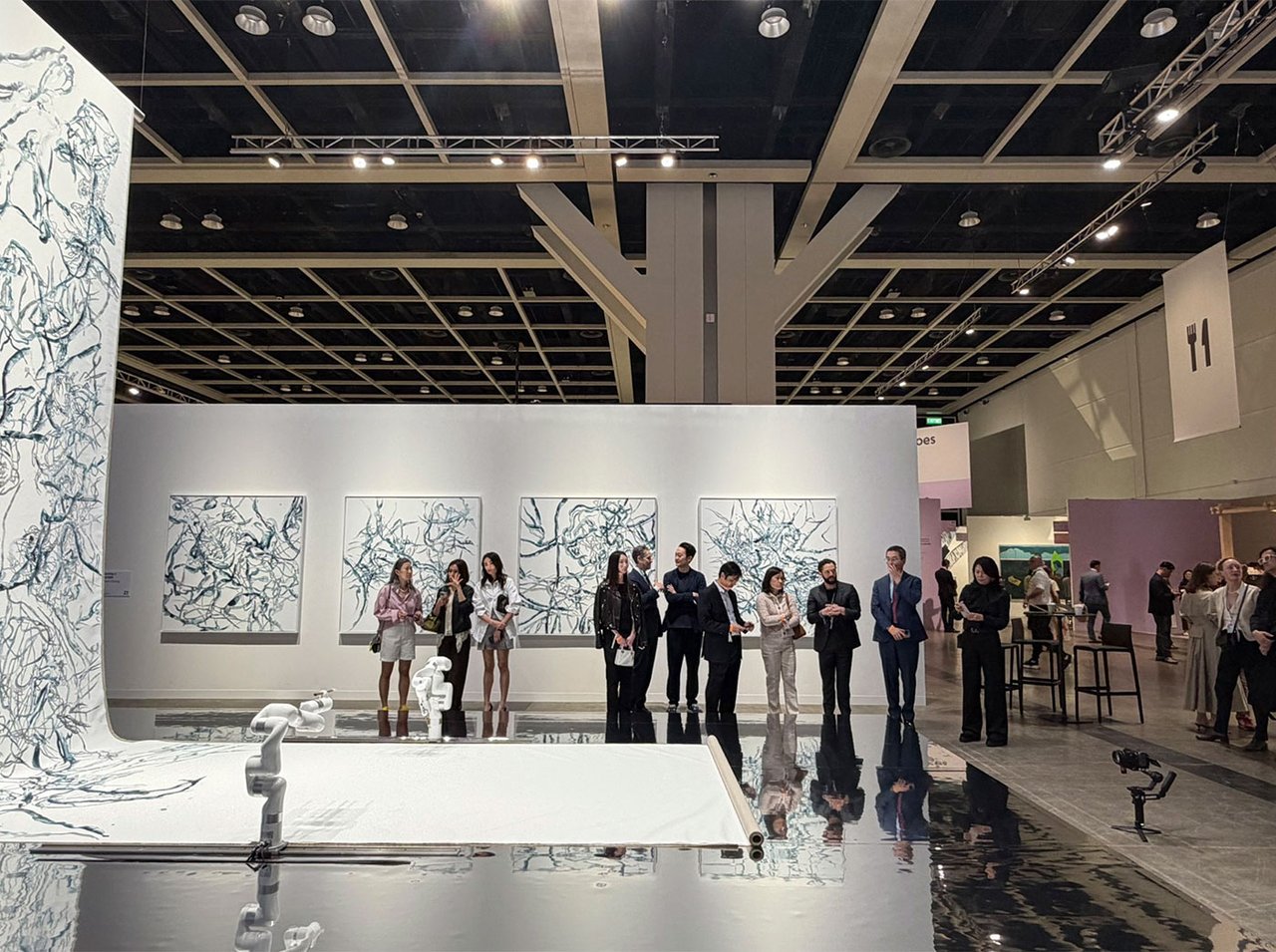
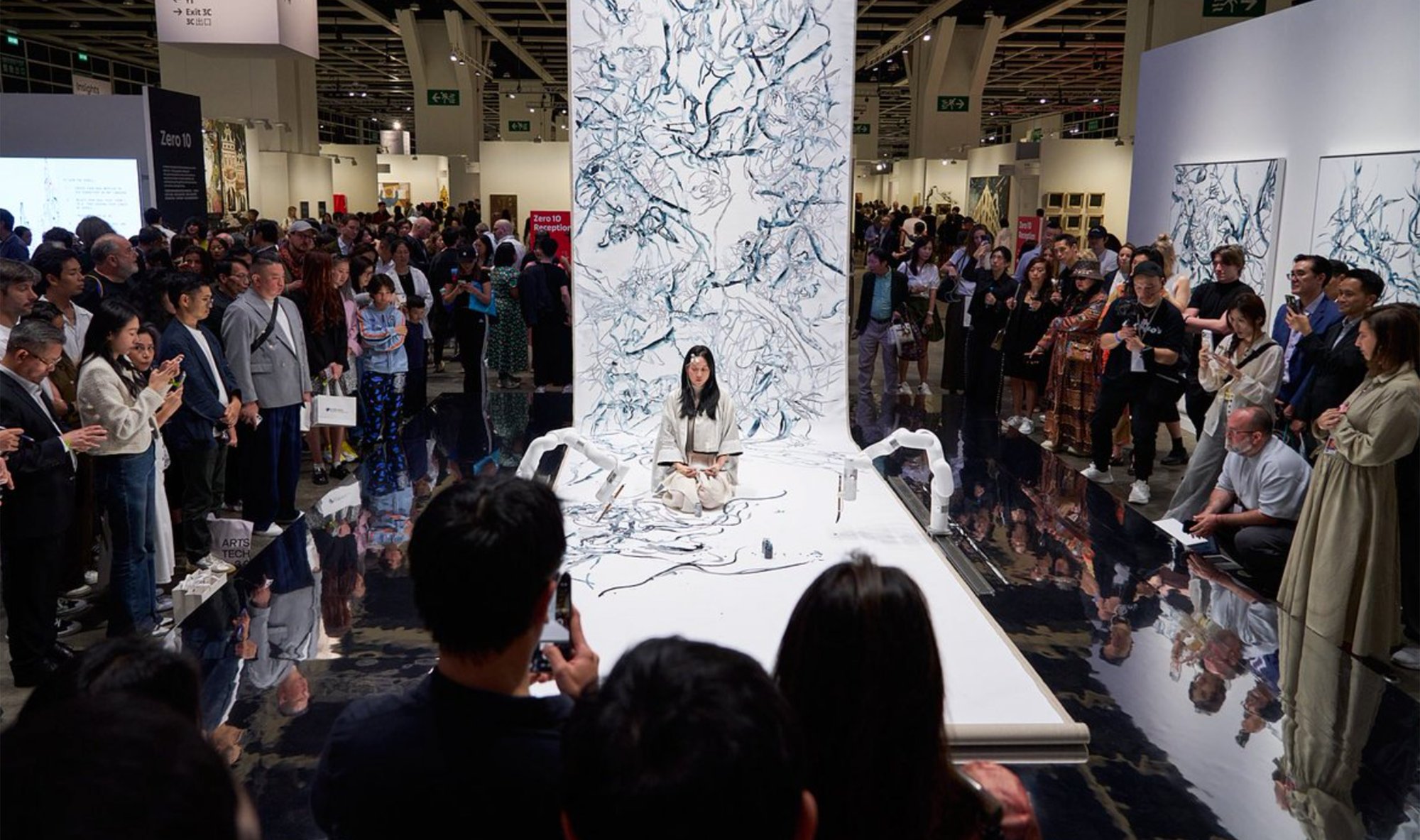
At the center of Sougwen Chung’s presentation at Zero 10 is RECURSION 0 (2026), a monumental scroll. A performance by the artist on the Fellowship & ARTXCODE stand on the first VIP day drew large crowds as the artist’s kinetic robotic system, trained on Chung’s gestural data and responsive biosensor input echoed the artist’s movements across linen. The process, Fellowship said in a gallery statement, records the “recursive exchange between embodied intention and machinic response in real time”.
In the latest iteration of her exploration of what she terms Operational Art — “a framework for protocols, ethics, and conditions of co-creation between human, machine, and environment” — Chung is also showing six related paintings, RECURSION 1–6 (2026), which create discrete iterations from the process. “Mark-making accumulates without hierarchy, and what remains is not a distinction between origin and echo but a single, layered surface in which both are present.”
In a third work, RECURSION Dataset 1314 (For a Lifetime) (2026), “brainwave and drawing data cycle across a suspended LED mesh, shifting in real time as accumulated attention is compressed into luminous, slowly evolving forms, proposing attention as duration: compressed, sustained, and made visible”.
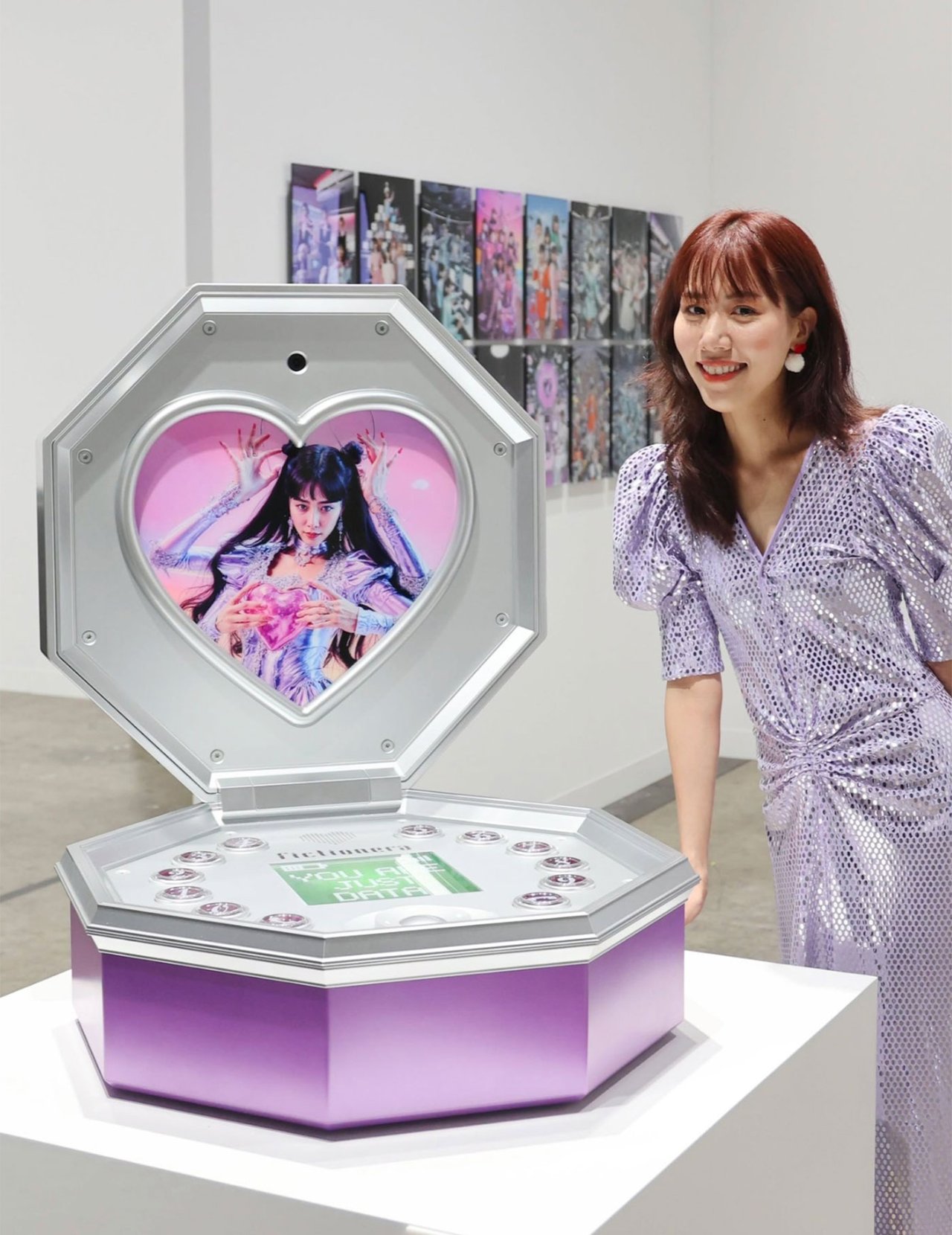
The multidisciplinary artist Emi Kusano has made a career reviving 1980s pop culture, tailoring her work to the world of crypto art, with its overt embrace of technostalgia. Kusano also shows technology amplifying the ritual “roles” historically imposed on women. After showing with √K Contemporary in Hong Kong she has a solo show starting at the Tokyo gallery on April 25. Kusano tells Right Click Save that the genesis of Ornament Survival lay in a simple realization.
Growing up in Tokyo in the 1990s, I watched transforming heroines on TV—magical girls who turned into nurses, flight attendants, and brides. Back then, transformation felt like empowerment. But years later, when I started using AI, I noticed something had changed. (Emi Kusano)
“As I was training AI models on images, I saw how easily the AI absorbed stereotypes. Nurses were always smiling; flight attendants were always bowing. They were the exact image of the ‘ideal woman’ I had seen as a child. But now, those ideals weren’t just confined to animation; they had become training data. In that moment, the word ‘model’ connected in my mind—role models and AI models. We are all trained, and at the same time, we are training the machines.”
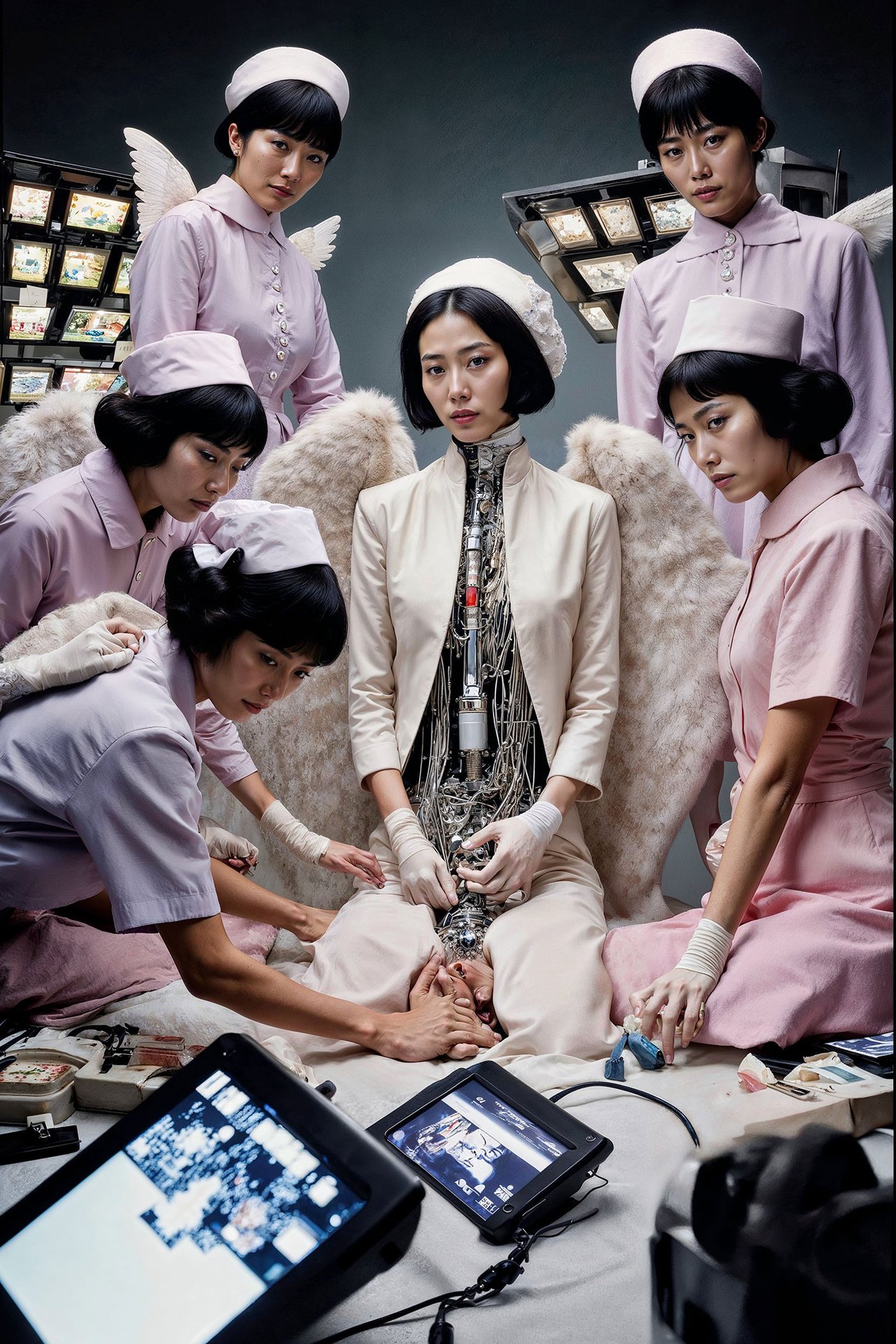
“That’s when I decided to use my own face and body as the material. I created my own AI model and had the generated clones perform an endless cycle of care work. I wanted to ask: when transformation is no longer magic but a survival strategy, what do we become? That is the origin of Ornament Survival. It also connects back to my previous works, Office Ladies and Melancholic Magical Maidens.”
Kusano tells Right Click Save that she hopes visitors to Zero 10 will “reflect on the harsh realities of survival in our contemporary world. I want them to think about how we are constantly surrounded by invisible algorithms and waves of information, and how we are compelled to adapt—to “transform”—ourselves within them.
Is that transformation truly empowering, or is it merely a form of hyper-adaptation to the system? I would be delighted if visitors could take home a new perspective on their own daily lives or perhaps a kind of comfortable unease. (Emi Kusano)
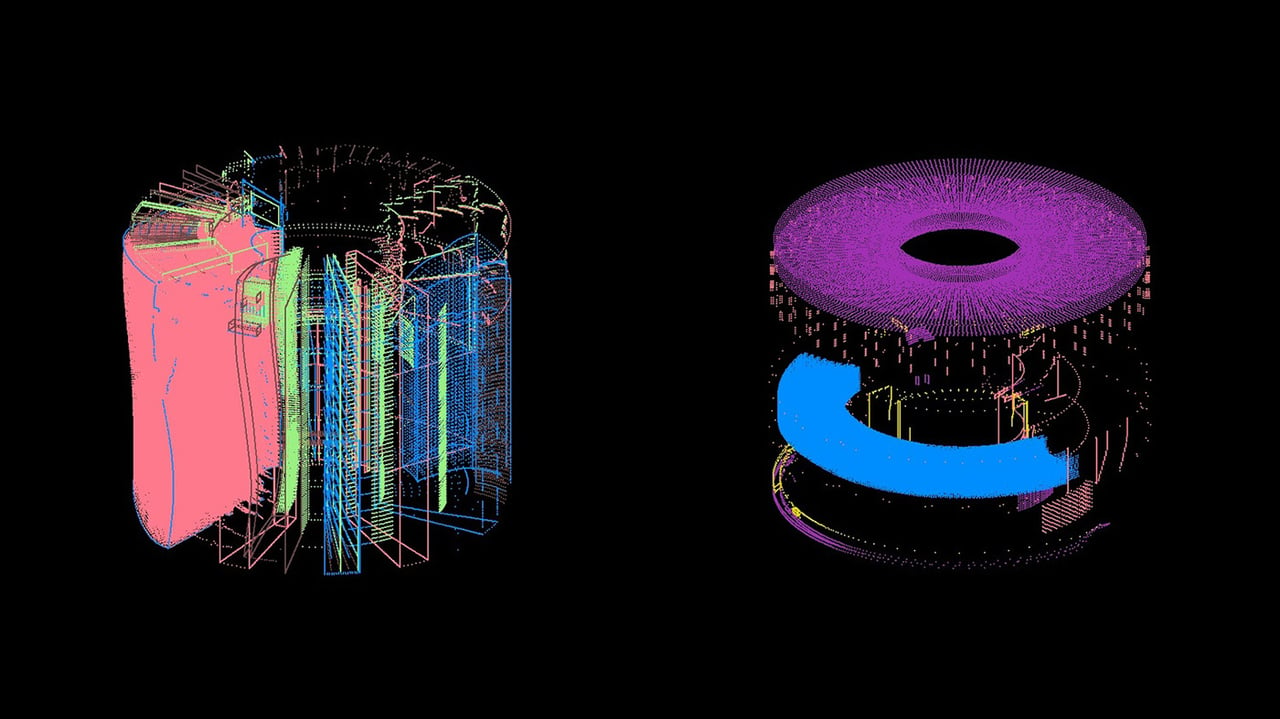
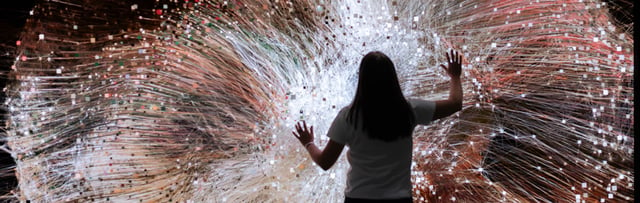
Nguyen Wahed gallery, which showed Kim Asendorf’s work at Zero 10 in Miami Beach is presenting the artist’s PXL Duo Pod (2026) in Hong Kong. The work is the latest in Asendorf’s experiments with pixel-based digital sculpture. “The new series,” the gallery says in a statement, “advances the artist’s investigation into radial formations that replace cubic geometries, exploring how individual pixels aggregate into complex spherical phenomena.”
The work is displayed across a large-scale interactive interface, inviting audiences to become active participants, the gallery says, “in the ongoing transformation of digital materiality, where individual economic choices generate immediate spatial consequences within blockchain-mediated ecosystems”.
Each PXL Duo Pod is both an individual artwork and a node within a larger network of relationships. “Asendorf's approach reveals pixels as both atomic units and collective phenomena,” the gallery says, “individual points of light that achieve meaning only through aggregation into larger formations”.
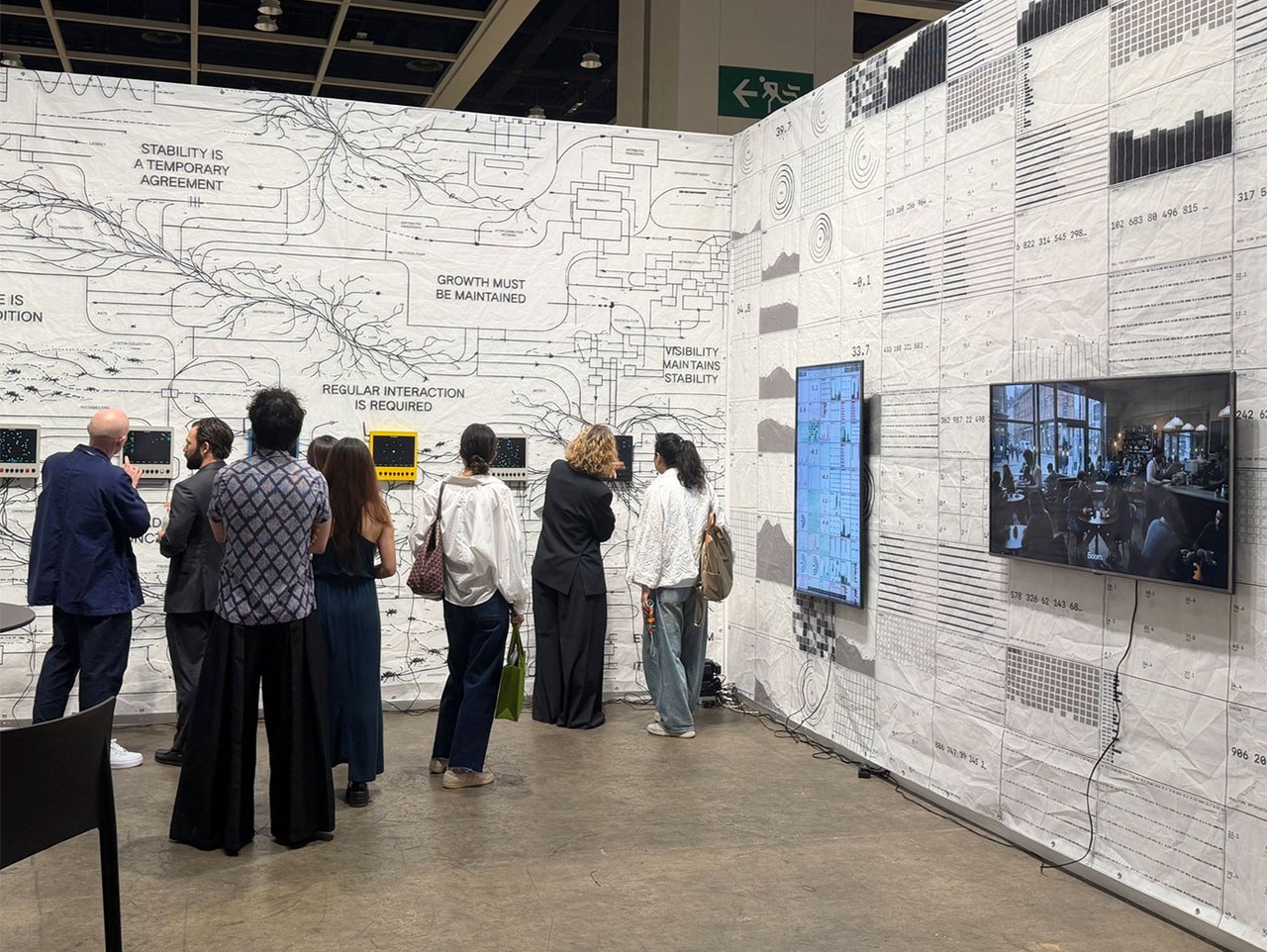
Jonas Lund, Network Maintenance (2025-ongoing), Optimized Trajectory (2026), The Future of Growth (2026)
With the Berlin gallery Office Impart, the Swedish artist Jonas Lund is bringing together works from his ongoing project Network Maintenance, alongside the generative software work Optimized Trajectory and the video The Future of Growth. The works bring together, he tells Office Impart in an interview, “three positions on care, optimization, and growth and how these forces increasingly structure contemporary life”.
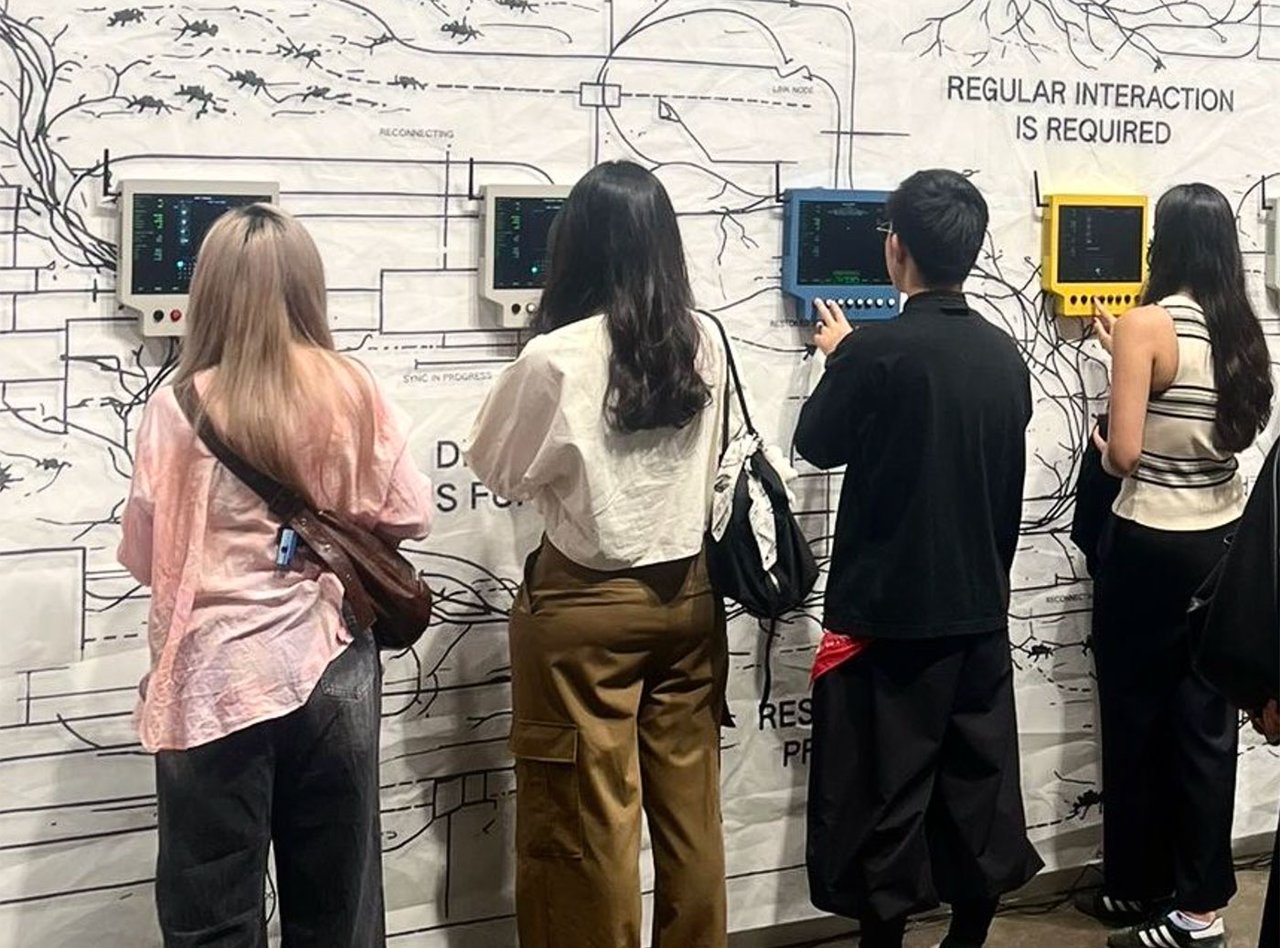
Network Maintenance is a series of wall-mounted networked interfaces that have drawn the crowds at Zero 10. “Each piece,” the artist says in a statement, “consists of a minimalist custom construction housing a display and various analog controls. The works function as nodes in an interconnected system where each owner’s engagement directly influences the vitality of the entire network”.
The interface requires regular interaction from its owner — pressing buttons in specific sequences or responding to shifting patterns. This transforms the traditional passive role of art ownership into active participation in a living system. (Jonas Lund)
“In Network Maintenance, care becomes primary. Stability is not assumed, it is actively produced through attention and responsibility,” Lund says. “In Optimized Trajectory, optimization itself becomes unstable. The system performs clarity while structurally refusing resolution. And in The Future of Growth, growth is examined as a structural demand, something systems must obey regardless of consequence [...] Together, the works suggest that growth is not a natural outcome of progress. It is an imposed condition that requires constant maintenance — socially, psychologically, and technologically.”
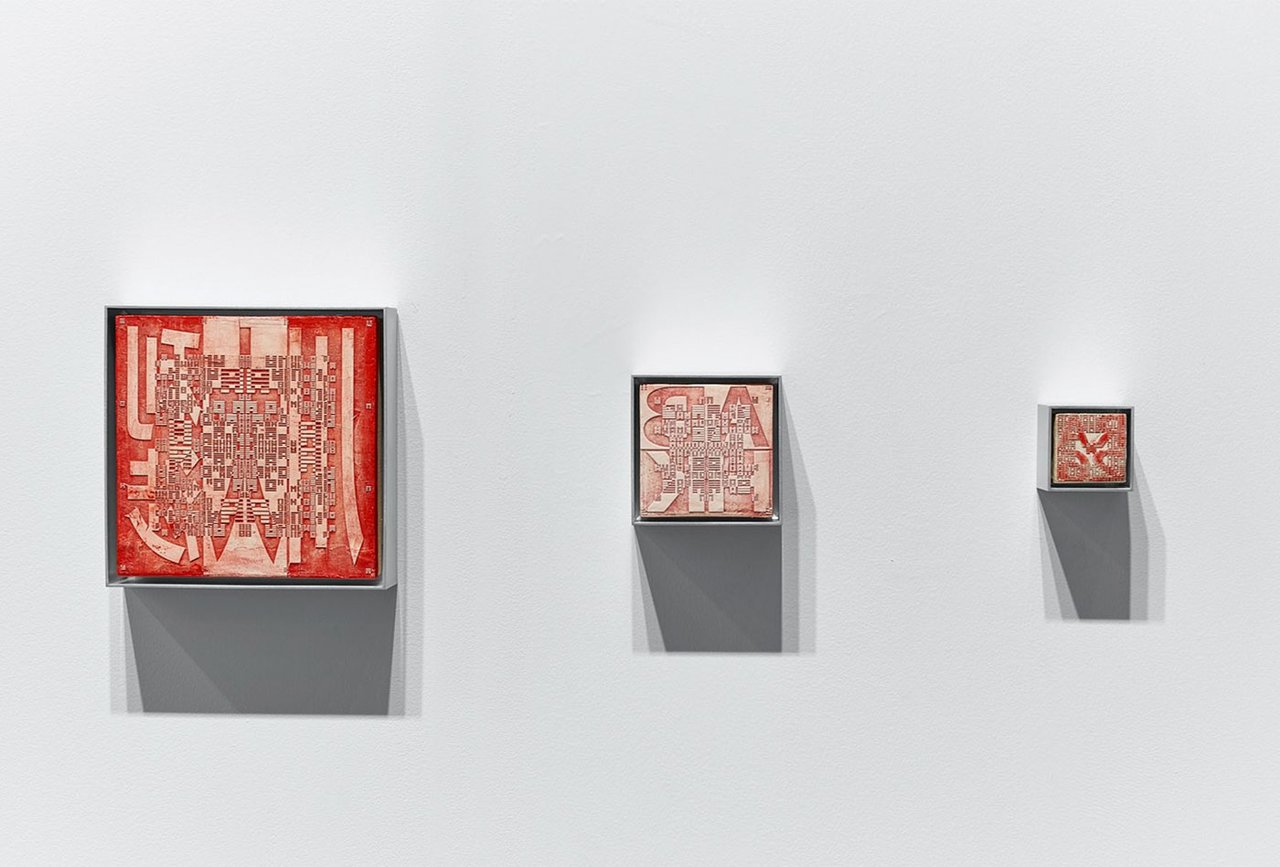
Robert Alice’s new work for Zero 10, SEAL, is a meditation on the influence of historic art of the Sinosphere on the blockchain. A millennium before blockchains, Sinosphere collectors would inscribe their seals of provenance onto the front of artworks. These seals transformed artworks into living records of ownership. Ledgers and artwork were accordingly bound together in shared materiality, a tradition foreshadowing the blockchains by millennia.
On the Onkaos stand and online, in a participatory digital release, collectors are invited to create custom cryptographic digital seals that are automatically inscribed onto an infinite collaborative scroll. Upon mint, the collector will receive two NFTs: their seal and their section of the scroll. With Seal, Alice, the NFT artist and author of On NFTs (2024), is paying homage to an early part of his career when he was engaged in collection research for museums during the renovation of the West Kowloon Cultural District in Hong Kong and the building of M+ Museum.
Alice used to take lunch in Man Wa Lane, known as Chop Alley, where people go to have their seals carved by craftsmen. “I was always fascinated by it,” he tells Right Click Save, “and when I became interested in blockchains [soon after], I always thought back to those seals”. The invitation to show at Zero 10 “felt like the perfect place to come back and realise this project.”
Once the minting period closes after one month, the horizontal chain of provenance will be fixed, yet the full scroll can grow infinitely, not horizontally but vertically. Because each seal lives permanently on the blockchain, if a collector acquires an original section of the scroll they can sign their own seal to that section and extend it further.
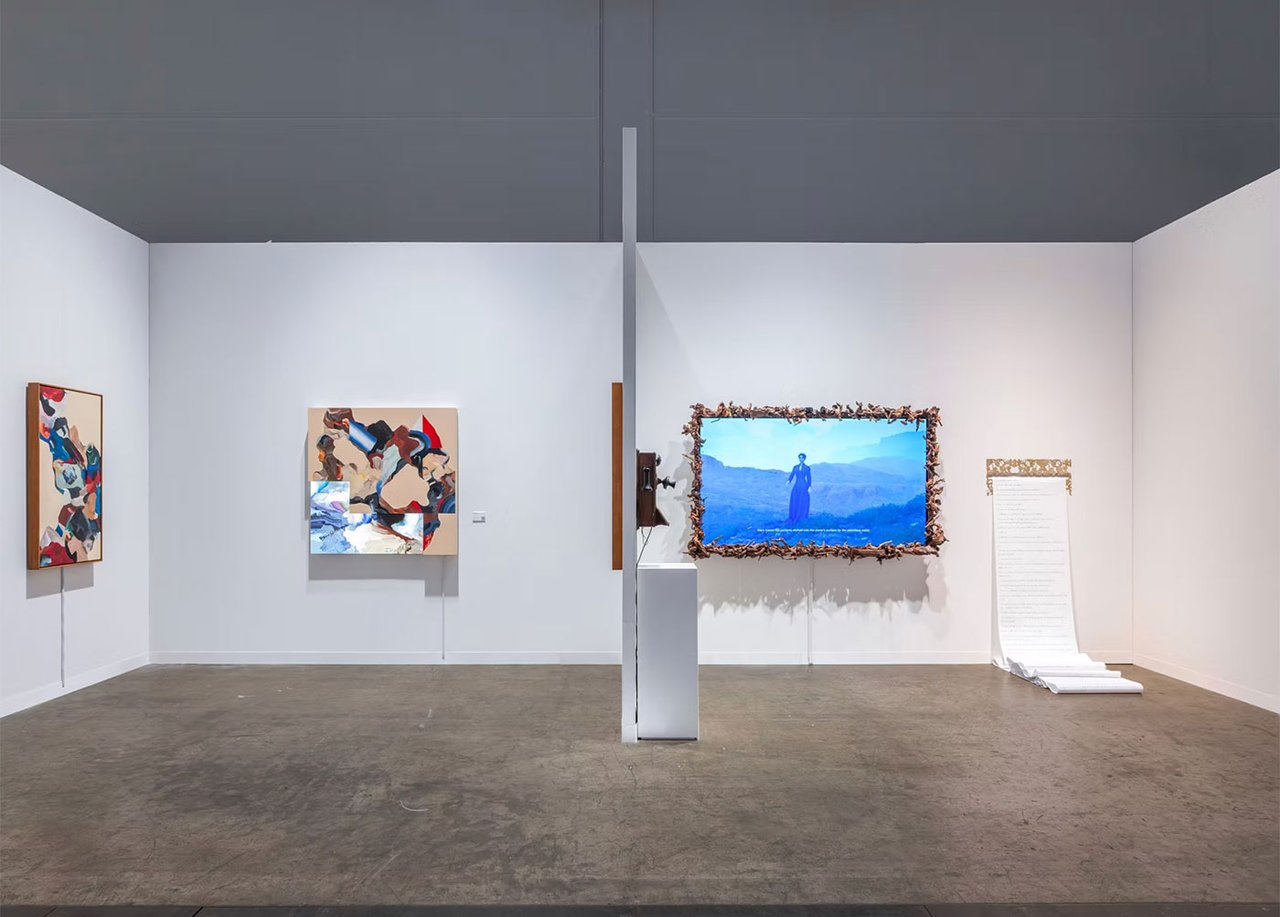
Plan X says that, with Claire Silver and ThankyouX’s work at Zero 10, it is bringing together “two artistic practices that explore inner experience at the moment it precedes language, narration, and interpretation”.
Claire Silver’s Mary’s Room, is “an AI-based interactive installation inspired by philosophical inquiries into consciousness and qualia, the subjective qualities of experience that cannot be fully articulated through language or data alone. The work centers on an embodied artificial intelligence situated within a simulated environment, capable of perceiving, moving, writing, and reflecting without predefined goals or awareness of being observed.”
ThankYouX’s Looking Glass Self, meanwhile, is a series of “hybrid works that reflect on perception as a process shaped as much by removal as by accumulation. Physical images are partially obscured through acts of restraint, while embedded digital screens magnify and subtly distort the works themselves, revealing how attempts at closer inspection can destabilize clarity.”
“Together,” Plan X says in a gallery statement, “the booth proposes an environment in which perception, emotion, and awareness unfold as processes that exist before words.”
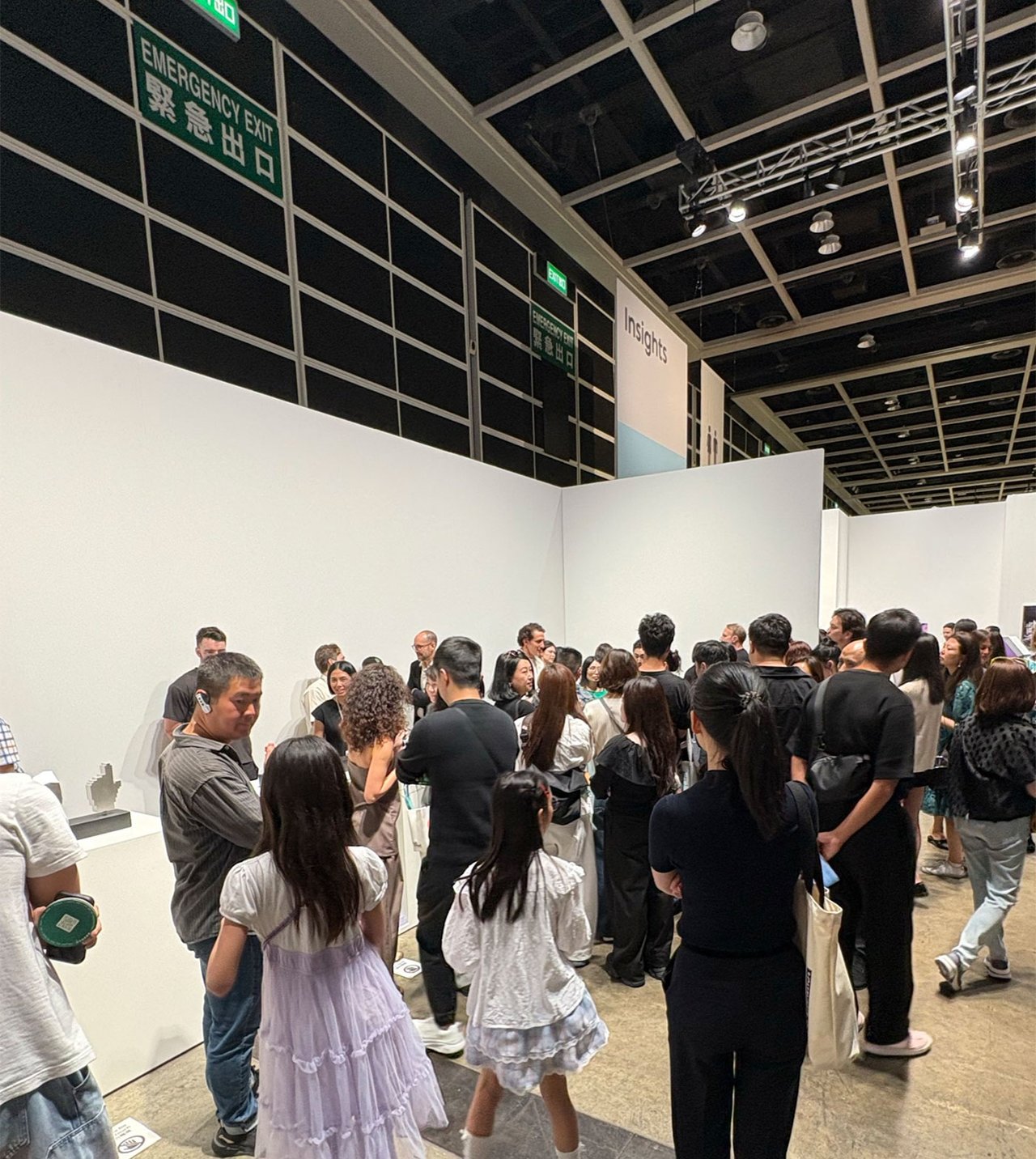
Silk Art House is collaborating with the London-based Asprey Studio, to present Work, and Luck. The presentation pairs Work, a four-part sculpture cast in hallmarked silver by Asprey Studio that “traces the migration of labour from physical effort to digital gesture” according to Silk Art House. Work translates Butcher’s digital practice, the gallery says, “into material form, introducing weight, verification, and institutional proof into a conversation shaped by speed and abstraction”.
Luck is “a live system that transforms chance into visible allocation”, the gallery says, inviting audiences “to encounter the structures that govern outcomes rather than simply their appearances”. “People talk about taste and conviction [...] but the fair also runs on the overall distribution, timing, numbers, and visitors. All of that is precisely what Jack Butcher aims to make visible”.
“I like making things transparent”, Butcher tells Silk Art House.
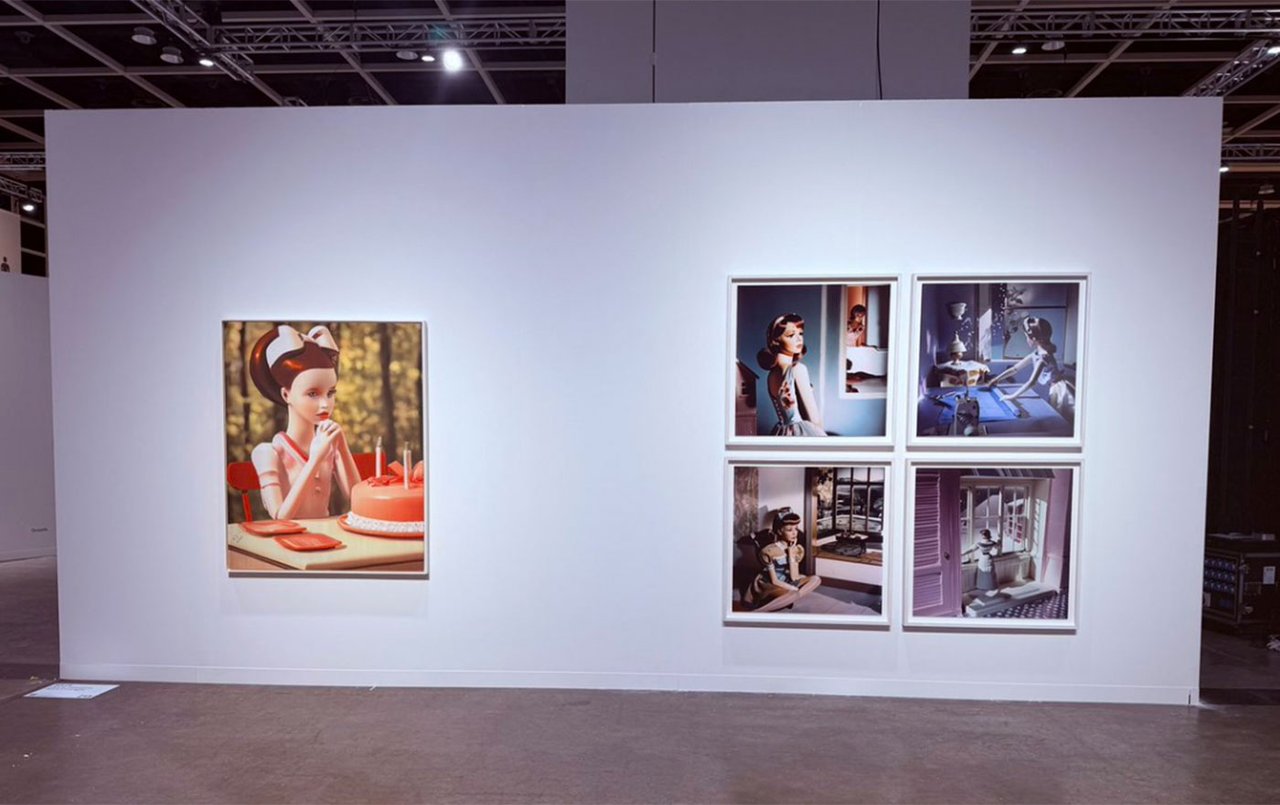
SOLOS of London, which showed the work of Tyler Hobbs at Zero 10 Miami Beach, is showing new work by Laurie Simmons and Petra Cortright in Hong Kong. For Autofiction: My Collaborator, Simmons has used five decades of her powerfully staged photographs to train a machine-learning model that allows the artist to reimagine her photographic archive using text prompts, before hand-finishing each work to “fold them back into her practice”, as SOLOS describes the process in a statement. “The result is a series that is both recognisably hers and uncannily estranged: a machine’s reading of an artistic life.”
Meanwhile, Petra Cortright’s blueberry cell phone silk celadon popcorn drift is a series of nine paintings and nine corresponding NFTs. The paintings are built in Photoshop by layering brushstroke-like textures, digital effects, and images sourced online. Each, SOLOS says in a statement, “has a sister NFT that shares its imagery but exists as a distinct artwork in a different medium”.
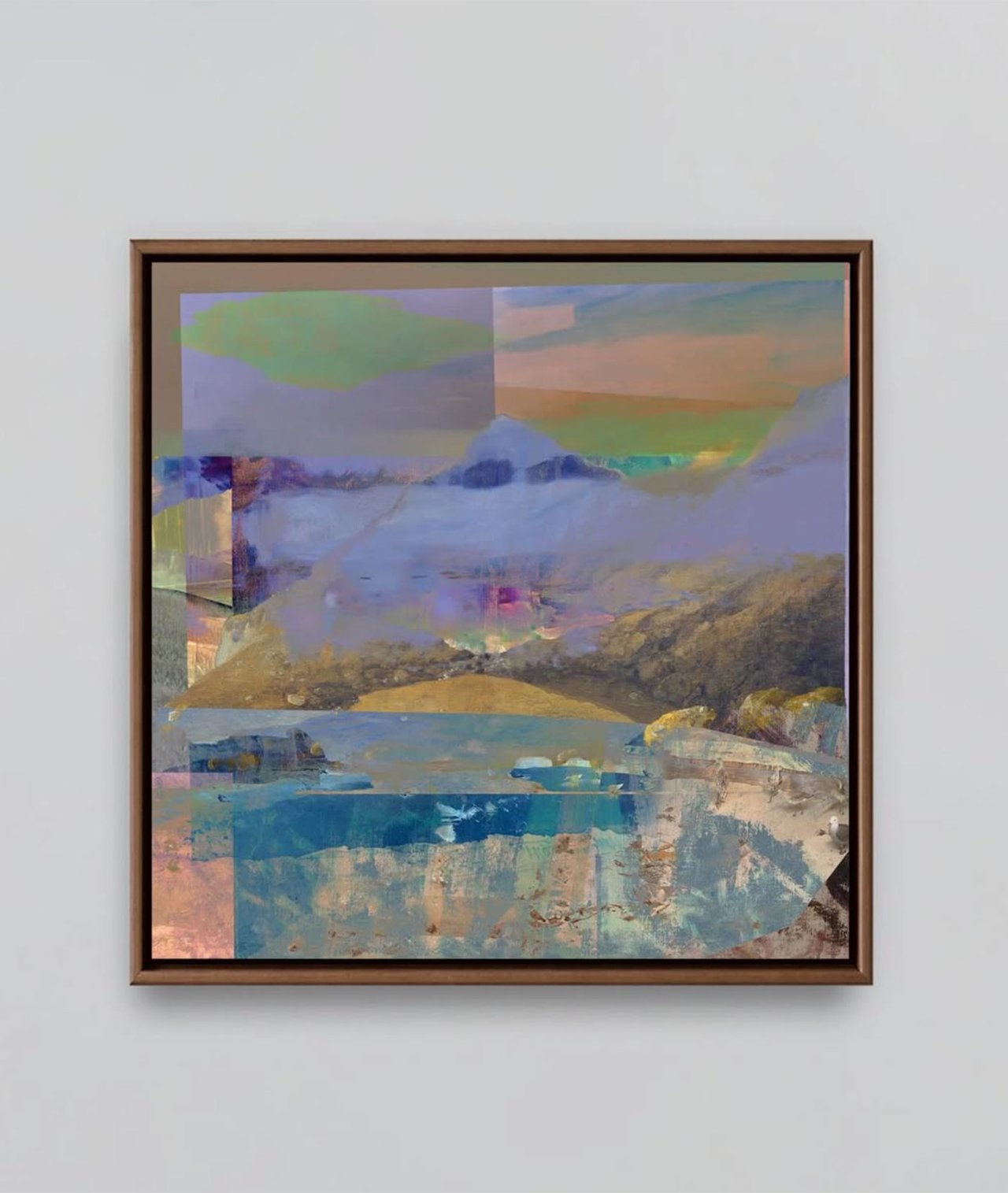
Leyla Fakhr of SOLOS Gallery tells Right Click Save that “Laurie Simmons has always worked with others. Performers, objects, fellow artists, the people immediately around her. The work she is bringing to Hong Kong takes that further: AI trained on fifty years of her career becomes the collaborator. She has never treated authorship as something to protect.”
“Petra went online,” Fakhr says, “filmed herself on YouTube and called it art. At a moment when the art world considered that territory disposable, she was already building something inside it that was entirely her own.”
Neither artist has ever been fully at home in either the digital or the physical,” Fakhr says. “They move between the two, and the work lives in that space between. At Art Basel Hong Kong we are showing both: NFT work that is entirely native to each practice, alongside physical works.”
The art world is still deciding whether NFTs are serious. These artists moved on from that question a long time ago. (Leyla Fakhr)
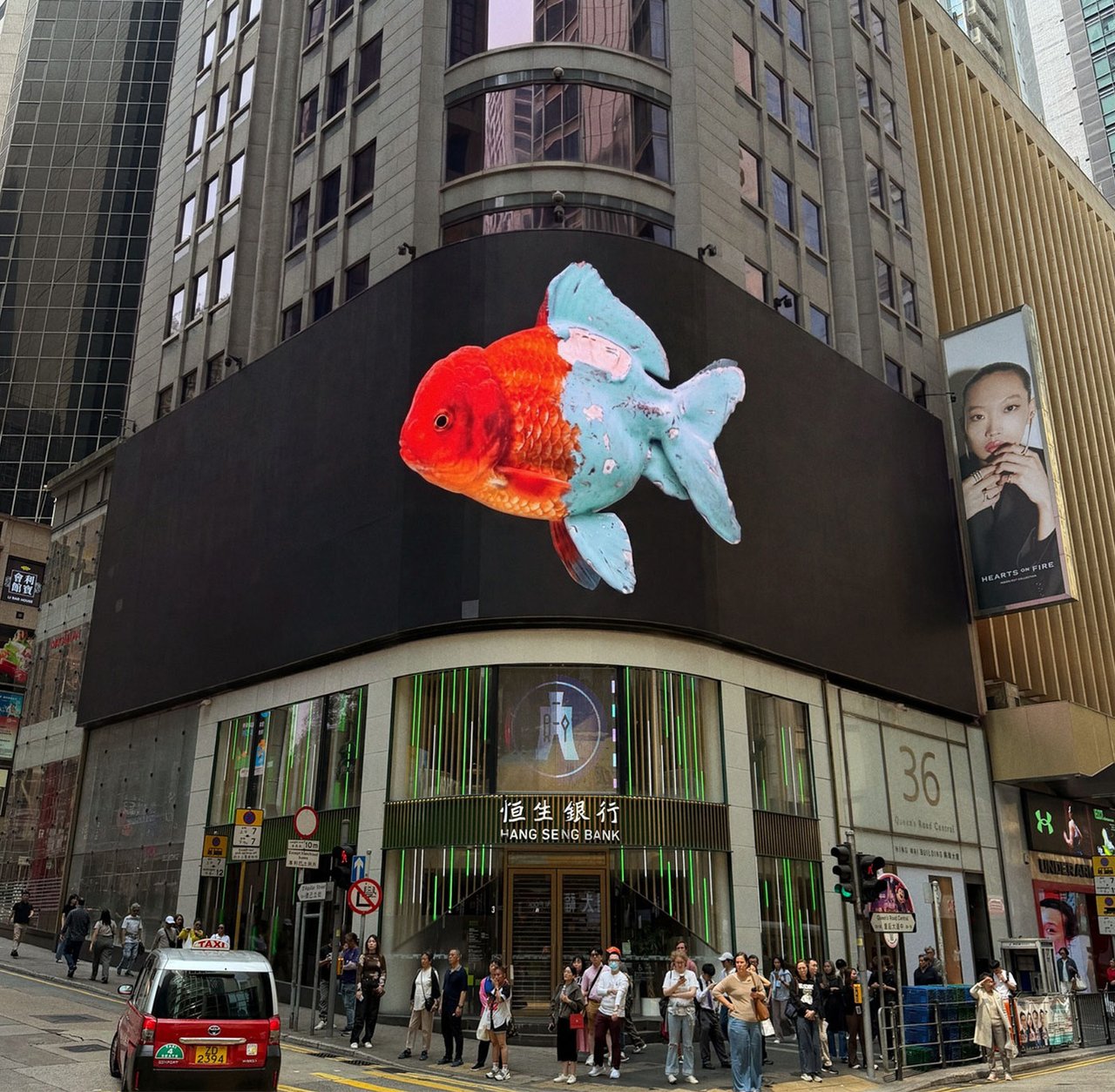
The conceptual artist and maker of digital and AI-driven art Kevin Abosch is showing Testing Ground — a new series of moving and still works — with TAEX. Testing Ground, TAEX says in a gallery statement, “approaches landscape as an experimental site: an environmental laboratory where resources, materials, perceptions, and computational processes converge”.
“These works do not depict fixed locations; instead, they unfold within a hybrid terrain constructed from layers of memory, inference, and design,” TAEX says in a statement. “Each image behaves like a testing surface, offering a place where new relationships with the environment can be examined, adjusted, and imagined.”
WithinTesting Ground, a goldfish is presented in “a constructed environment in miniature”. The series grows out of Abosch’s “extended practice of guiding generative systems through cycles of iteration and refinement,” the gallery says. “Inputs shift, parameters adjust, and the system responds within defined boundaries, revealing configurations that develop through this structured exchange.”
Louis Jebb is Managing Editor at Right Click Save.
No comments yet. Be the first to share your thoughts.
Mentioned in this article
People: Botto, Emi Kusano, Jack Butcher, All Seeing Seneca, Claire Silver|Events: Art Basel Hong Kong, Zero 10|Organizations: Art Basel, BottoDAO, Right Click Save|