·
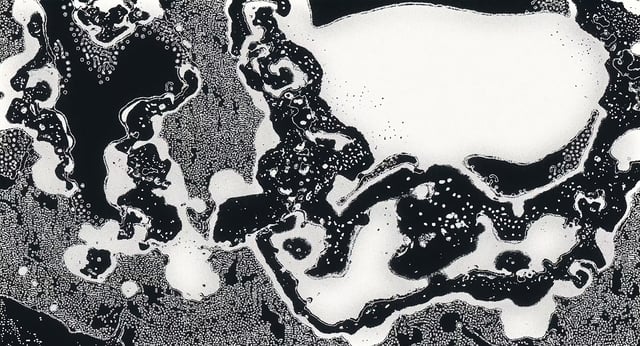
Every work I make begins in code and machine logic, but ends as a single unique hand drawing on paper. When it's finished, I delete everything: the source files, the intermediate states, the whole digital trail. What remains is one signed object that can never be reproduced, re-edited, or minted. People in this space tend to react to that as if I'd burned money.
But I keep wondering if we've got scarcity backwards. We invented elaborate cryptographic machinery to make infinitely copyable files behave like unique objects, while the oldest and simplest form of digital scarcity was sitting right there: destruction. No token, no edition of 50, no artist's proof quietly held back. Just an object with the same relationship to its digital origins that a bronze has to its melted-down mould.
I'm not against editions, and I understand why provenance infrastructure matters. But there's something odd about a culture that celebrates "digital scarcity" as an innovation while treating the actual elimination of the digital as a waste. If the file still exists, is the work really unique, whatever the contract says?
Curious how others here think about this, especially those who work across chain and physical media.
1 comment
I mean, you can do it :) Destroying source code sure feels radical to me.
(avoiding screens, imvho less so, because plotted work, printed work, 3D printed work and sonic/audio works exist--but it definitely fits the narrative)
I wouldn't do it myself, because for my own work, the code is an intrinsic part of it. If I would delete it afterwards, there are a lot of shortcuts I could/would take, because only the outcome matters. And I decided not to :)
But I get it, it's radical and intriguing. Are you familiar with Jorge Luis Borges writings about "writing under erasure"? It's about writing things only to delete or erase them later, maybe you find some more inspiration there :) Actually I thought it was Borges, but it might have been Derrida, see: https://en.wikipedia.org/wiki/Sous_rature
Another thing I think is interesting about it, considering what I do with my own code. I've always felt that if my code is supposed to be the art, then it should be perfect, or of some very high quality, for some (arbitrary) measure of "quality". It should be exactly enough and also no more than that. So far I've come up with two ideas for this. First one would be to write it very neat, with clear variable names and comments, as to be the canonical "classroom example" of that code, that does that one thing. The other is to size optimize it to smithereens, to make it the smallest possible code, that does that one thing. I’ve done both (though usually the latter). Both are attempts to "finalize" a piece of code, to make it the "best" version of the code that does that one thing, that it can be. It feels to me similar to putting the lacquer or fixative over painting/drawing and framing it, so to say. After all, neither of these two ideas are then to be touched afterwards.
But you present a third option: Destroy it :) Which in my opinion is perfectly valid, finalizing the piece in a similar manner. I guess it must also give you a way to say “this is no longer a work in progress” (which can be a pitfall when making art, sometimes), and maybe even gives you a feeling of catharsis?
It also reminds me of a digital art project I encountered a very long time ago called "Illicit Art" (if I remember the title correctly). They had programmed a computer to (autonomously) visit the darknet, download some "illegal imagery" (they didn't say what kind, but you can imagine), and then without displaying them or anything, the computer would encrypt these images with random keys generated only on that computer. The encrypted images were the only things exported from the computer, and afterwards the computer, its harddisk, the decryption keys and everything were physically destroyed. The encrypted images were then printed out (looking like random RGB pixel noise, as any encrypted data looks indistinguishable from random noise) and framed. I thought this was a very powerful idea -- the illegal (and possibly terrible) information is in the images, but without the key they look indistinguishable from random noise, and it's impossible to find out the key because it would take 200x the age of the Universe to brute force, or something. Also, if the computer program had a mistake, and it encrypted something else, we would never know. This raises so many interesting questions that it left an impression on me I'm now sharing decades later :)