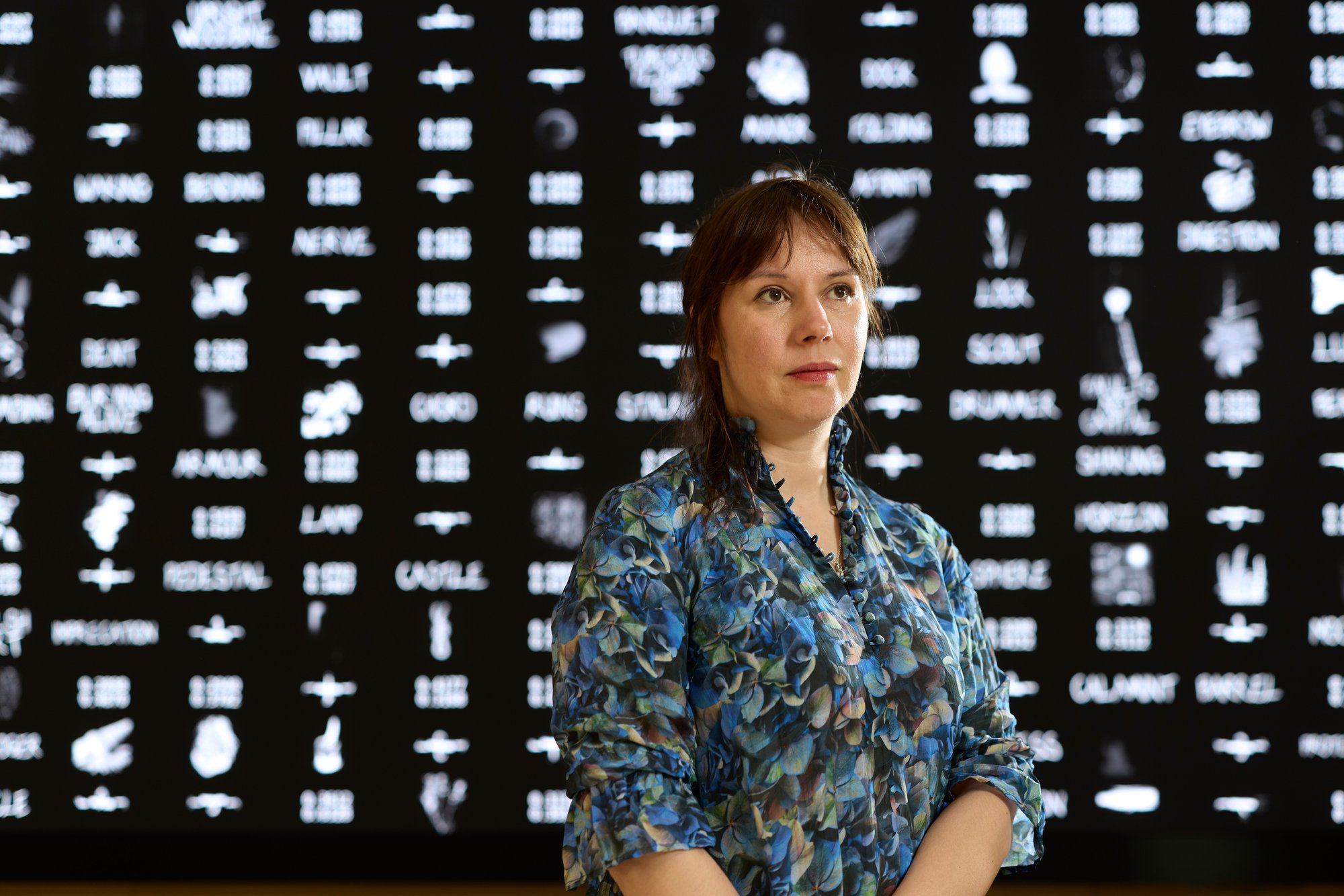
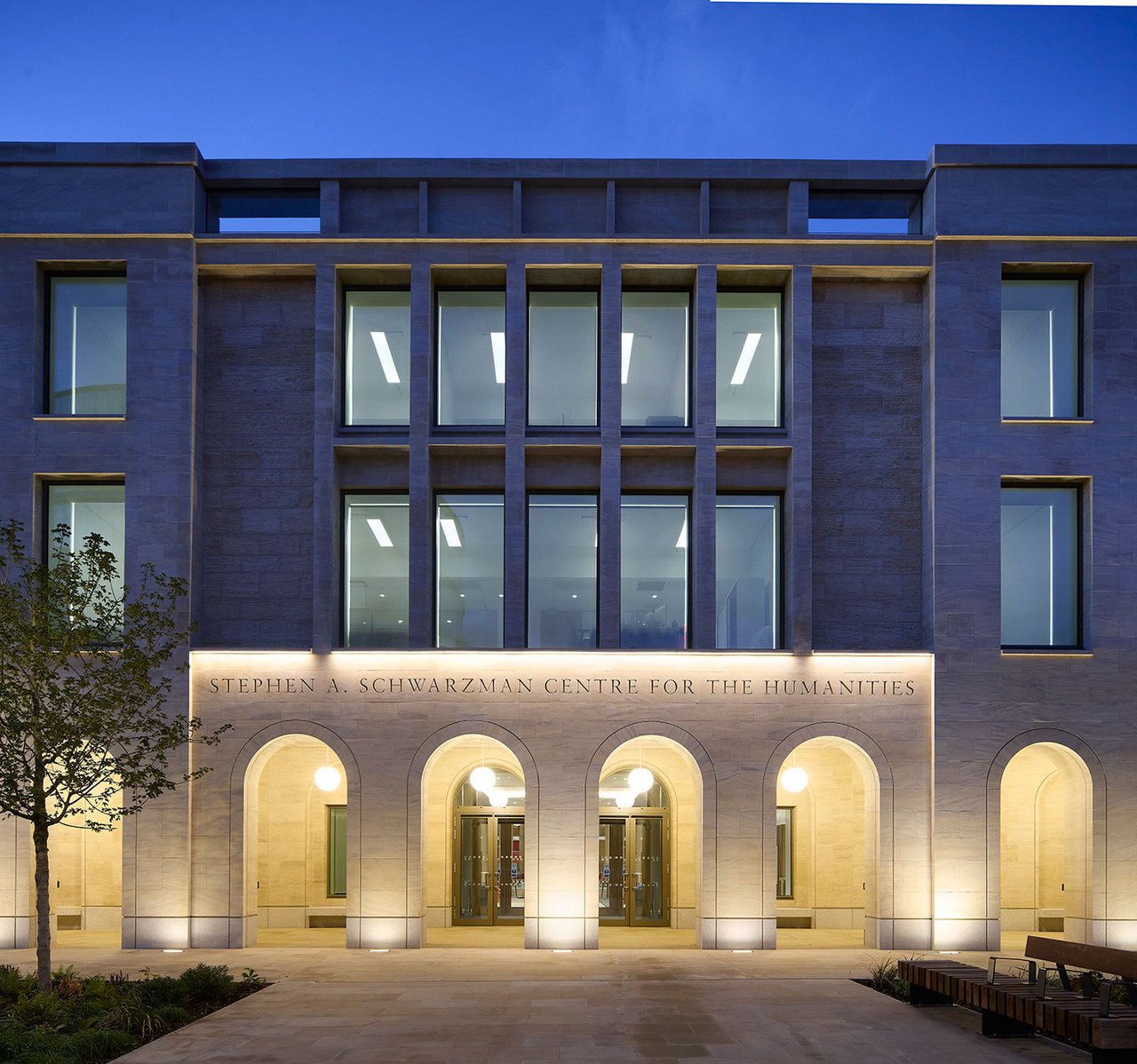
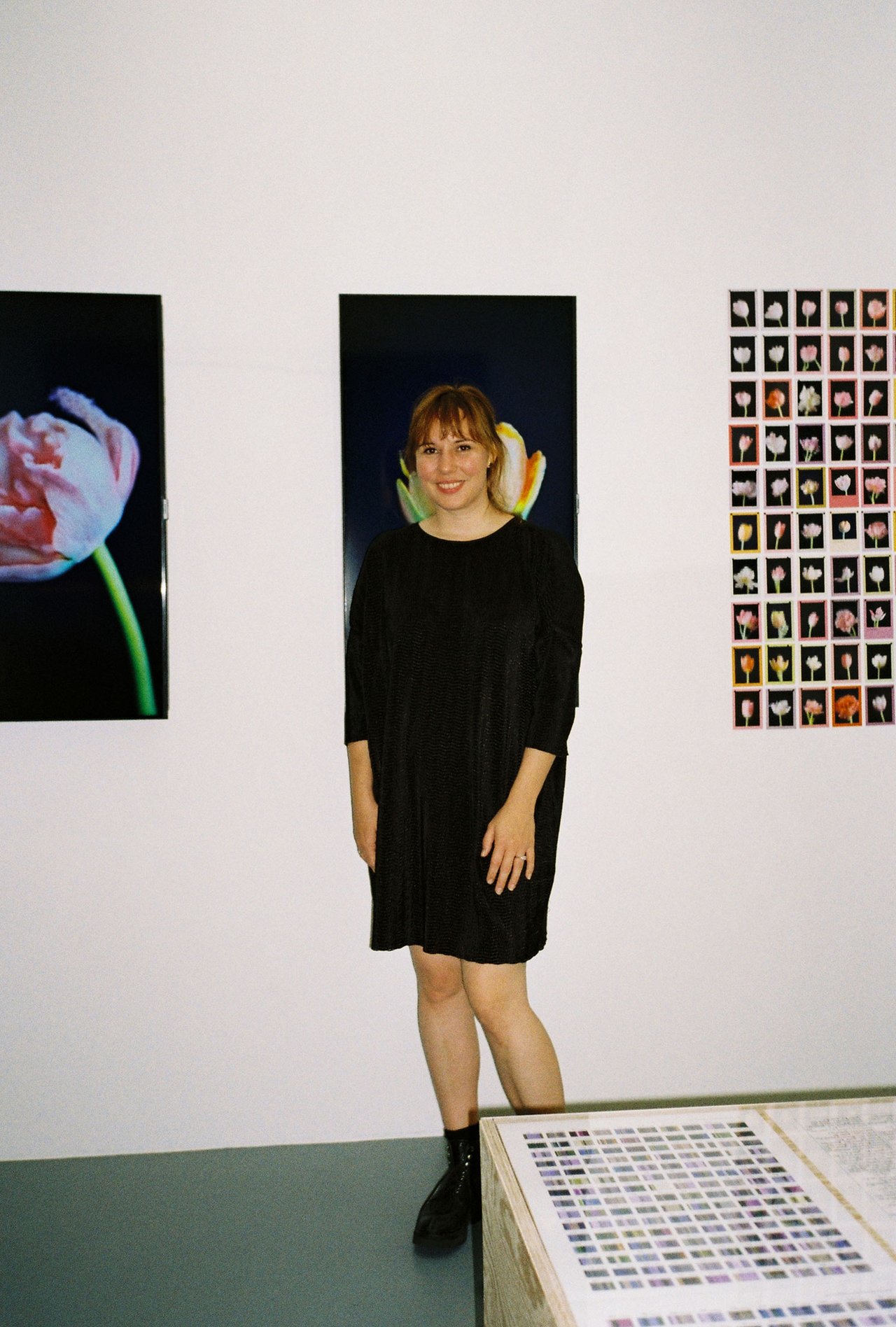
Anna Ridler with An Infinity of Lists, 2026, one of three works that make up “A Perfect Language of Images”, one of the first arts program commissions for the Stephen A. Schwarzman Centre for the Humanities, Oxford University. The work was created in collaboration with William Poole of the university’s English Faculty. Courtesy of the artist and the Schwarzman Centre. Photography by David Levene
“Anna Ridler: A Perfect Language of Images” is at the Stephen A. Schwarzman Centre for the Humanities, Oxford University, until August 25, 2026. Anna Ridler, “Traces Remain” is at Nagel Draxler, Cologne, until August 31, 2026.
For more than a decade, the artist Anna Ridler has been exploring, and sharing, the possibilities of working creatively with artificial intelligence. She makes her own datasets to train neural networks, and investigates how knowledge, and the language that describes it, is displayed and shared.
Ridler has a special interest in the process and patterns of classification, and in the challenge of attempting objectivity in recording the natural environment, whether working solo or with her regular collaborator Sofia Crespo.
Her investigations as an artist are expressed in a series of richly conceptual, archive-based works, which address questions of time, attention, and market value, many focused on plants; pieces that explore the beauty to be found in attending to growth, as well as the inevitability of decay, in the natural order.
“A Perfect Language of Images”, Ridler’s recent commission for the Schwarzman Centre, made in collaboration with William Poole from the Faculty of English at Oxford University, was inspired by the work of the 17th-century Oxford scholar John Wilkins, whose publication An Essay towards a Real Character and a Philosophical Language (1668) sought to classify every object in the world in a rational, ordered system of his own invention. The work also addresses how, nearly three centuries later, in the essay The Analytical Language of John Wilkins (1942), Jorge Luis Borges looked with wry affection, and all due historical context, at Wilkins’s doomed attempt to create an artificial “language of all things”, with Borges concluding that all classification is somehow negotiated, incomplete, and incapable of containing what it describes.
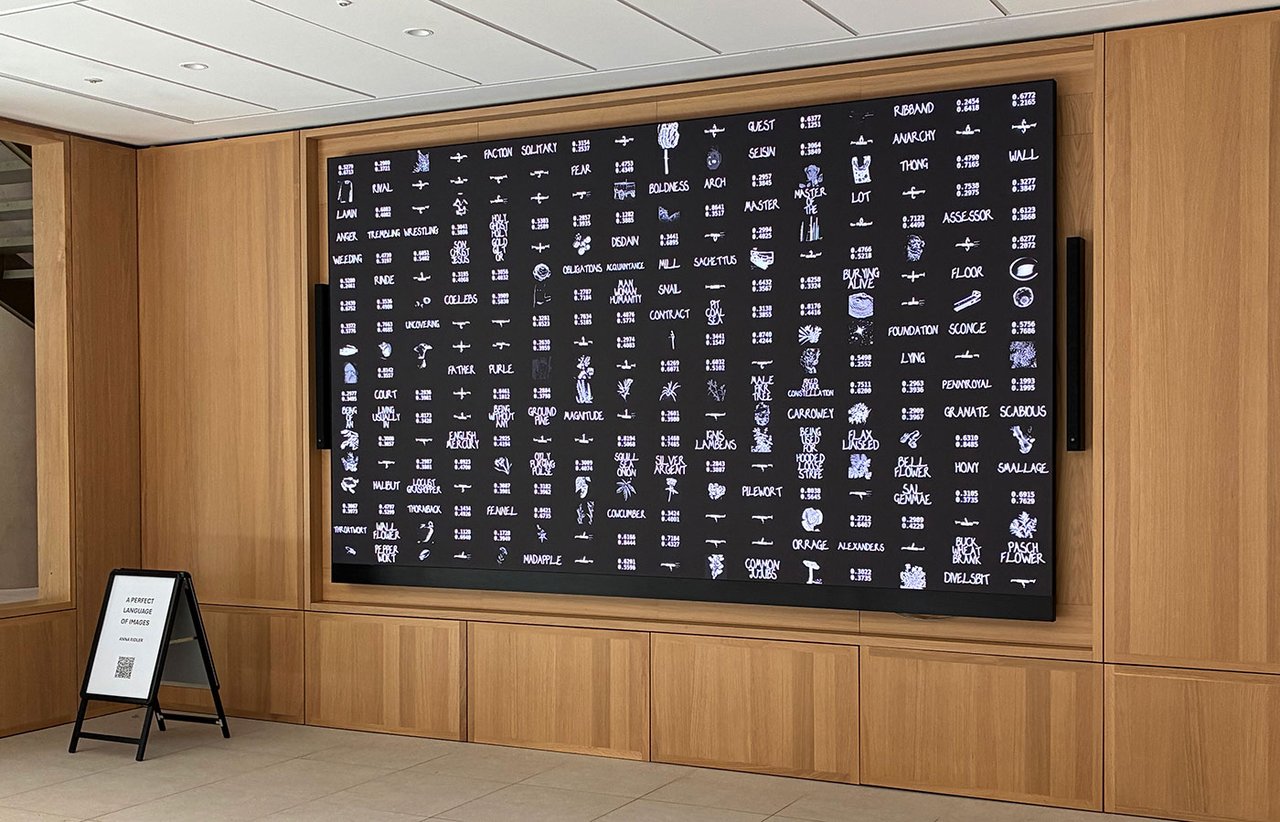
Installation view of “A Perfect Language of Images” at the Stephen A. Schwarzman Centre for the Humanities, Oxford University, with work: An Infinity of Lists (2026) by Anna Ridler. Courtesy of the artist and the Schwarzman Centre. Photography by Right Click Save
Wilkins’s concept was to organize everything in the universe into a system of linguistic building blocks that represent divisions and subdivisions, each of them assigned syllables, consonants, or vowels, which could be combined to represent anything. An example, cited by Borges, is “de, which means an element; deb, the first of the elements, fire; deba, a part of the element of fire, a flame”. Ridler’s work with Poole shows how Borges’s reflection on Wilkins’s fruitless venture — the basic flaw, or tragedy, for Borges, being that no one can understand the entire universe any more than anyone can pretend to express verbally the infinite gradations of human experience — applies equally to machine learning. Because the “desire” built into generative models to totalize knowledge is a quest that is itself doomed to distortion.
“I’ve been deeply interested in classification and its relationship to artificial intelligence for over a decade,” Ridler said at the launch of “A Perfect Language of Images” at the Schwarzman Centre in April 2026. “I’ve been building all of my own data sets by hand, making photographs, [assembling] archives, training neural networks, on material that I’ve made myself. The process, the labor, the choice of what to include and what to exclude has always been the subject, not the method. And I’m interested to see what it means to teach a machine to see and to think and what that reveals about the limitations, especially when things are classified.”
“John Wilkins wanted to create a perfect language where every object, every abstract concept had a unique symbol that exactly described what it was. But he failed. And what I found moving is that he knew that he was failing when he was trying to do it.” (Anna Ridler)
“What Anna Ridler and I share,” Poole said in a launch statement, “is a sense that the grandeur and ambition of such a project is also distinctly ‘Babelic’: and, paradoxically, it is in its limitations that it is most revealing.”
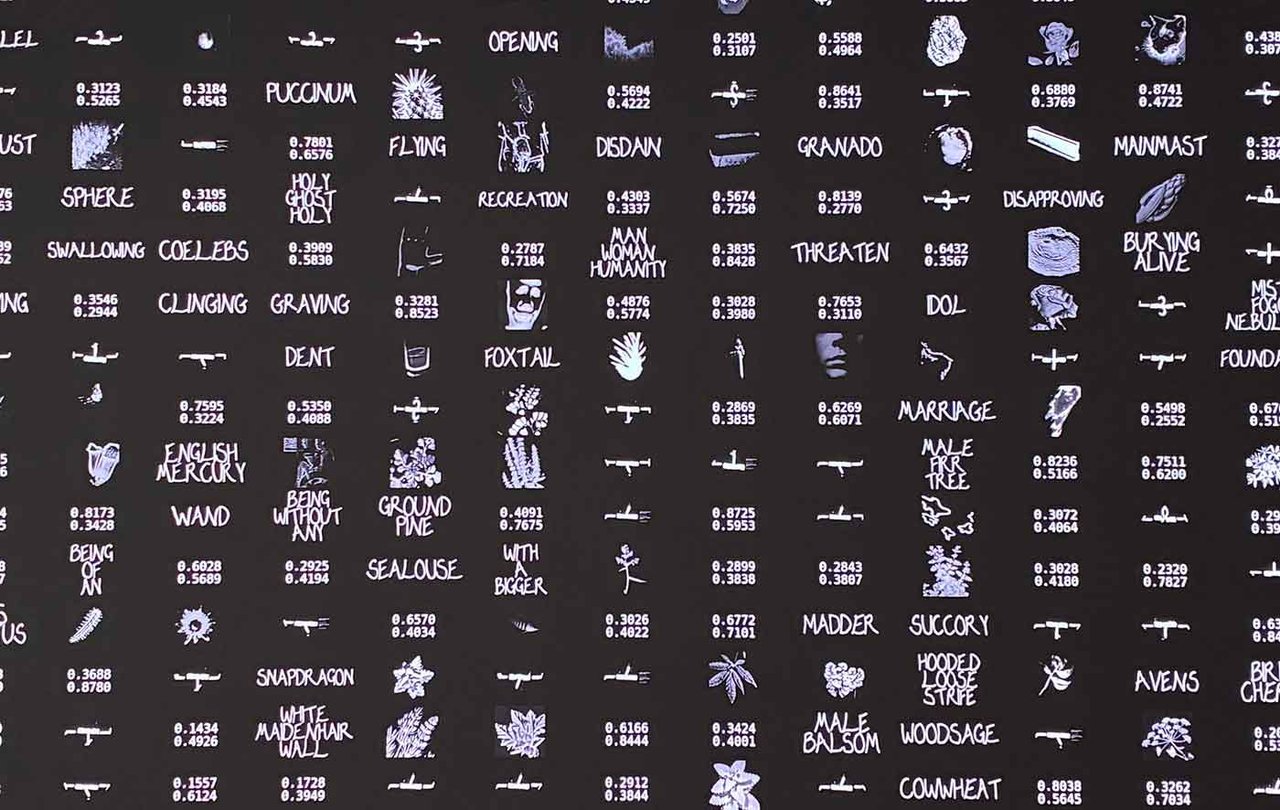
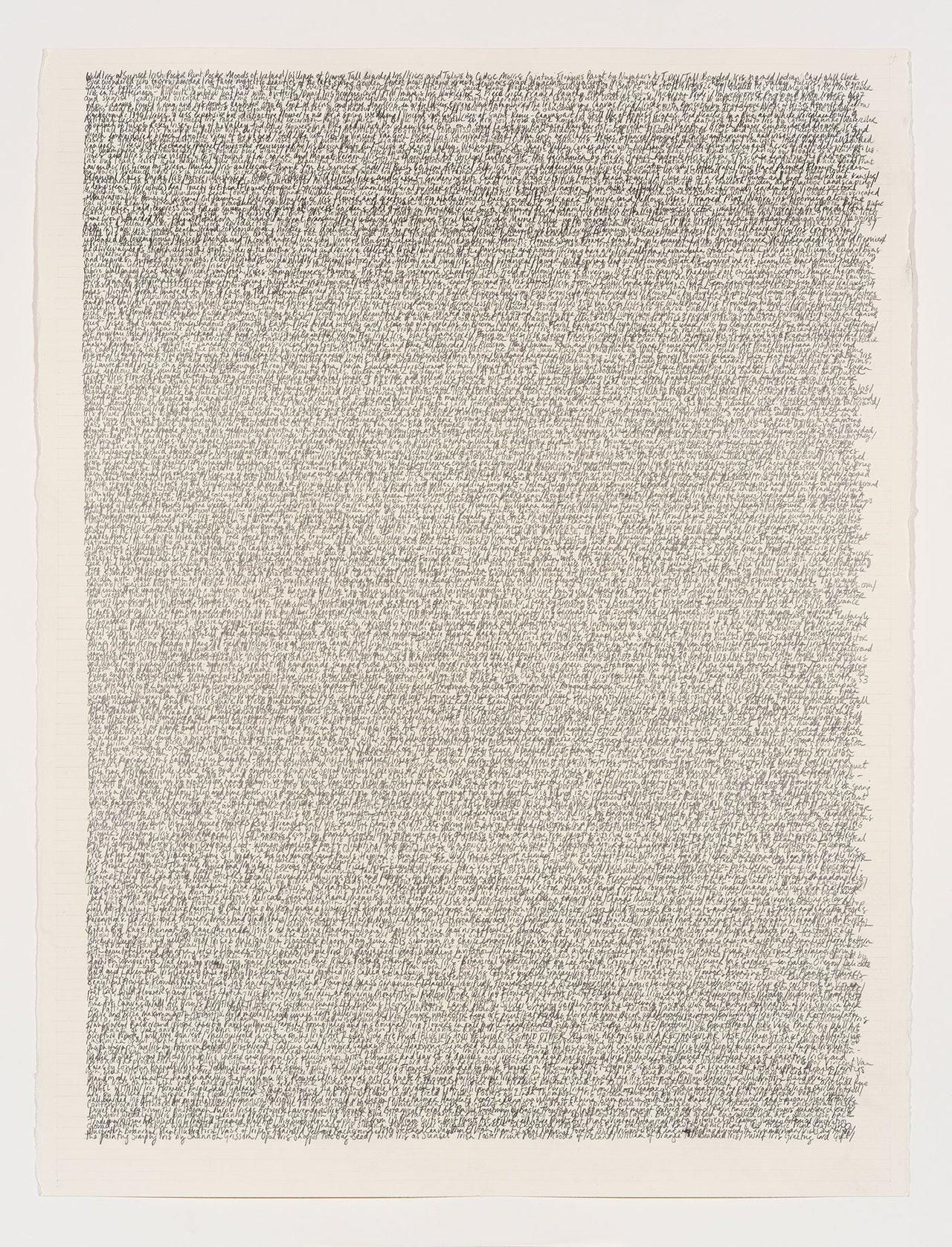
Anna Ridler, An Infinity of Lists (detail), 2026. Courtesy of the artist and the Schwarzman Centre. Photography by Right Click Save
“Across all of the different pieces, across Wilkins, across Borges”, Ridler tells Right Click Save, “is this very human impulse to try and label and classify the world. It is ultimately one doomed to failure. Nothing will ever fit into a perfect language. There will always be things that don’t fit, things that fall out. Showing this lineage and this history [is important] because people are talking about it in relation to machine learning and artificial intelligence. [The] eternal problem of how to capture the world and make it understandable.”
Ridler finds it interesting that Wilkins started his project immediately after the English Civil War, which had led to the temporary replacement of the monarchy with an 11-year Commonwealth.
“It’s a very Utopian idea; that if you have a language that everyone speaks, there will be no misunderstanding. So it’s a very hopeful piece; it acknowledges hope for a ‘perfect’ language; but ultimately it is about how that won’t happen.” (Anna Ridler)
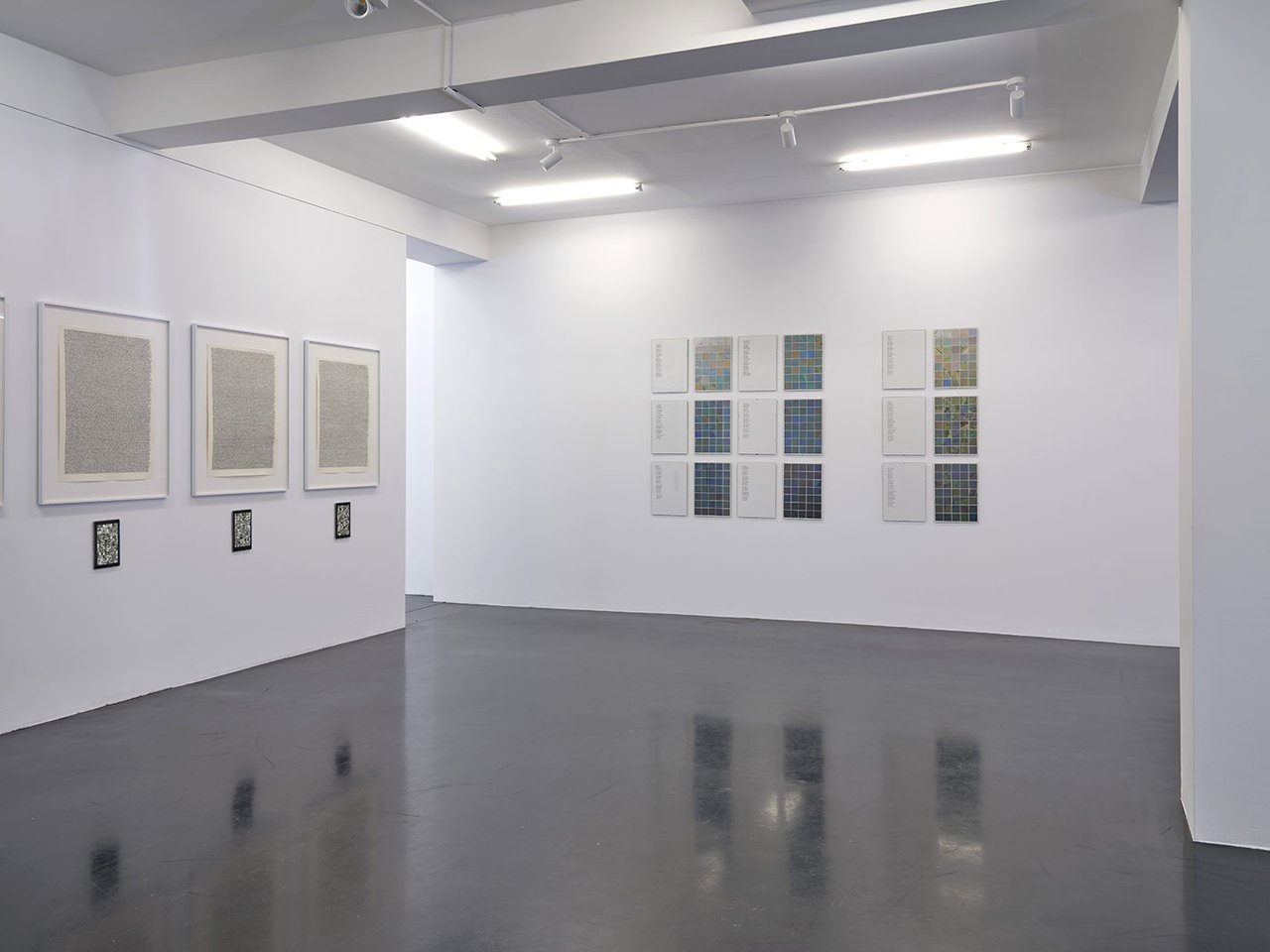
One part of “A Perfect Language of Images” — A Catalogue of Exceptions — analyses the objects that struggle or fail to fit the Wilkins taxonomy; a second, Between Things, presents examples of Wilkins’s phrases that demonstrate “evidence of classification under pressure”, where his system cannot decide; the third, An Infinity of Lists, shows every coded word used in the Wilkins system, but shifting between the Wilkins artificial order and purely statistical relations, with the visual expression “fluttering”, as Ridler puts it, between word, image, and symbol.
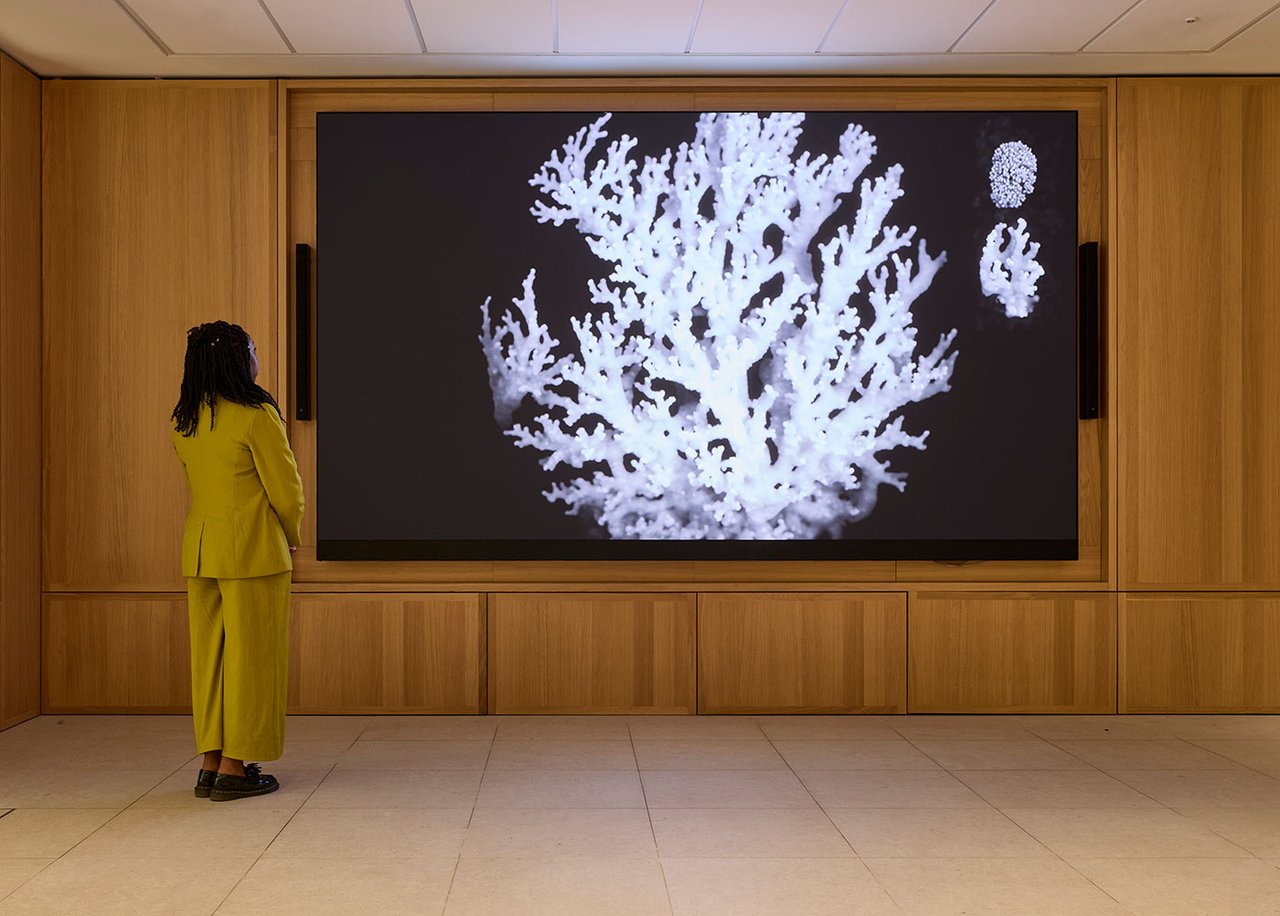
Installation view of “A Perfect Language of Images” at the Stephen A. Schwarzman Centre for the Humanities, Oxford University, with work: A Catalogue of Exceptions (2026) by Anna Ridler. Courtesy of the artist and the Schwarzman Centre. Photography by David Levene
A Catalogue of Exceptions is the piece that Ridler found most interesting, she said at the work’s launch. “The things that he couldn't classify at all: like coral, fungi, weird things like jellyfish. I generated those things using a decade’s worth of generative models [created since] 2016, and the AI can't properly render them either.”
“So you have Wilkins in 1668, semantic models [now a decade old], and contemporary diffusion models, all attempting the same impossible task, all failing differently.” (Anna Ridler)
For Ridler, an artist as concerned with recording the provenance of creative inspiration as she is with the use and hidden meaning of words and their expression through handwritten script, the Schwarzman Centre commission, and working with Poole, has been like coming home. She studied English Language and Literature as an undergraduate at Oxford, a time when she first discovered both Wilkins’s work and Borges’s response to it, some years before taking a Master’s in Information Experience Design at the Royal College of Art, London.
Installation view of Anna Ridler, “Traces Remain” (2026) at Nagel Draxler, Cologne. Courtesy of the artist and Nagel Draxler. Photography by Simon Vogel
The fragility of archives
Meanwhile, Ridler’s “Traces Remain”, her second solo show at Nagel Draxler, Cologne, examines another kind of informational frailty: the ephemerality of archives, language, and memory “in an age shaped by automation and disappearing online infrastructures”.
The exhibition covers work from the last decade of Ridler’s practice, including No Replacements Found (2015) in which the artist investigates how the autocorrection results of big online platforms reveal “the implicit conservatism of large corporations around topics such as abortion, suicide, sexuality, and non-stereotypical sexuality”. In the process, the work becomes a meditation on online absence and the challenge of archiving loss.
The Cologne exhibition also features Ridler’s latest work focused on handwriting, a device which appears across her practice, including the Schwarzman commission, and which she sees as a counterbalance to automated data extraction.
“The mark-making, the idea that it is made by a body rather than a machine in what is otherwise a very digital process, keeps coming in,” Ridler tells Right Click Save, talking about the use she makes of handwriting in “A Perfect Language of Images”. “And the fact that there is this large amount of labor that goes into almost every project.”
Anna Ridler, Every Iris Flower, Percentage Vincent Van Gogh: 7.40%, 2025. Courtesy of the artist and Nagel Draxler. Photography by Sascha Herrmann
“Writing by hand is one of the oldest recording technologies, requiring time, physical presence and sustained attention,” Ridler says in a statement. “Set against the scale and speed of automated data extraction, it becomes a deliberate countermeasure to digital decay.”
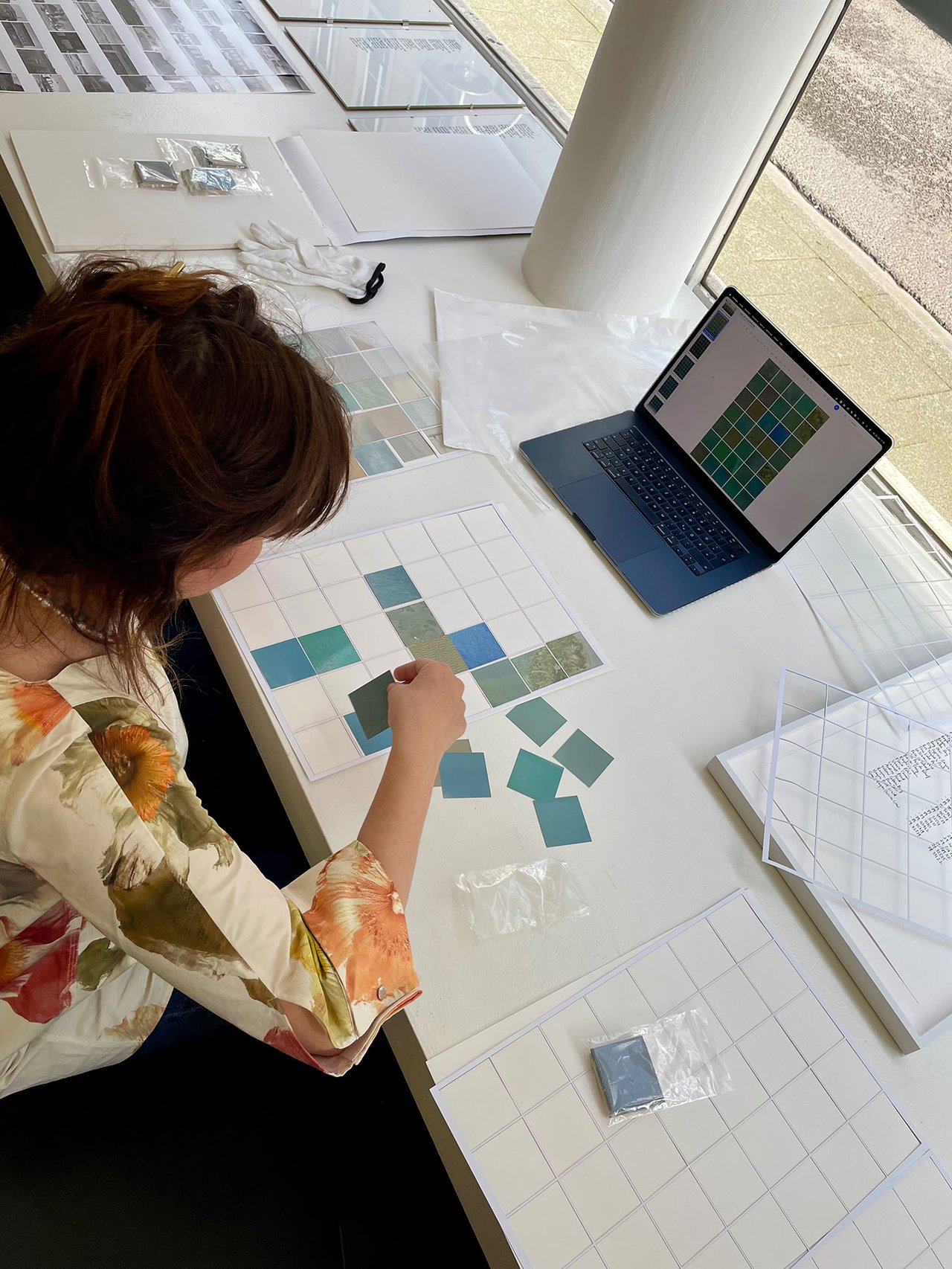
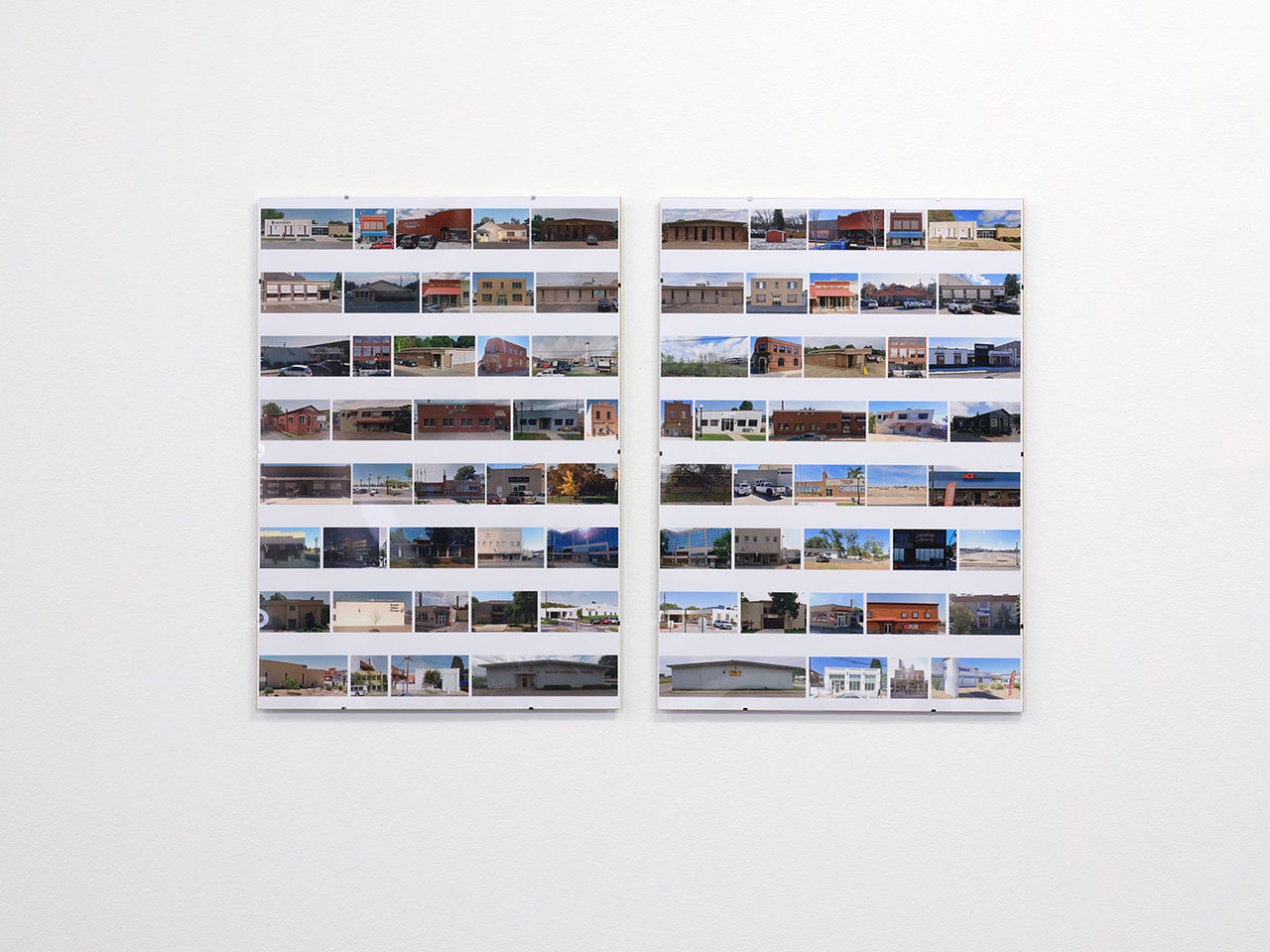
In “Traces Remain”, the artist’s handwriting is deployed in parts of her “Every Iris” series — an examination of datasets and the word as a name for a woman, a flower, the heart of an eye — in A Partial Atlas of the USA, Lost Islands (2026), and A Partial Atlas of the USA, Lost Lakes I (2026), which catalogue islands lost to climate change and human intervention; and in the handwritten captions for the latest installments of Final Edition (2020/2026). In Final Edition, Ridler is recording, often through on the ground research, the archives of the ever-growing list of local newspapers that have closed in the US since 2004.
“By transcribing captions onto paper, the work attempts to hold onto fragments of an internet that is otherwise slipping out of reach, preserving what would normally remain abstracted, compressed, or lost.” (Anna Ridler)
Anna Ridler works on the completion of A Partial Atlas of the USA, Lost Islands (2026) for “Traces Remain” at Nagel Draxler, Cologne. Courtesy of the artist and Nagel Draxler. Photography by Maja Funke
The artist’s role in an age of new institutions
Ridler has been a compelling voice for years, able to address the challenging beauty of working with AI in the expanding art world of the 2020s, at global festivals, conferences, and museum and university sessions. She has shown or spoken at a wide variety of institutions, including Ars Electronica, Buk Seoul Museum of Art, ZKM Karlsruhe, and the FEMGEN event “Expanding the Art World with New Digital Practices”, at the Victoria and Albert Museum, London, in 2024. Ridler returns to Oxford in September 2026 to give the William Empson Lecture at the Annual Conference of the British Society of Aesthetics, a scholarly forum for philosophy of art in the UK.
The unveiling of Ridler’s Schwarzman commission in April 2026 marked a distinct, and public, moment in a year which has seen the opening of new institutions, or the revival of existing ones — the Schwarzman; NODE, in Palo Alto, California; DATALAND museum of AI Arts in Los Angeles; the remodelling and enlargement of LACMA and of the New Museum, New York — all of which are open to the entangling of art and technology in a wider public debate about existential issues such as climate change and artificial intelligence.
Ridler and Poole’s work was presented in the main hall of the Schwarzman Centre, at the launch of its public arts program, and was accompanied, in the centre’s White Box space, by Archive Dreaming (2026), the artist Refik Anadol’s own deep archival dive using an AI model, created in collaboration with the university’s botany department.
Ridler presented her new work in company with Professor Daniel Grimley, Head of Humanities at Oxford University, in a symbolic demonstration of how the advent of the Schwarzman has enabled the university to work directly with contemporary artists to re-examine parts of its rich archives, built up over nearly a millennium.
A few weeks later, Beeple, in northern California for his mid-career exhibition, “BEEPLE: / INFINITE_LOOP”, at NODE, Palo Alto, was addressing the subject of AI and creativity at Stanford, the academic powerhouse behind the rise of Silicon Valley. Shortly after that, Anadol and the artist Holly Herndon were discussing “AI, Creativity and Ethics” with academics from Oxford University — Professor Raphaël Millière, of the Institute for Ethics in AI, Oxford University, and Dr Kathryn Eccles, of the Oxford Internet Institute — as guests of the Schwarzman Centre, where Anadol is the first recipient of the Lau Fellowship in Creativity and AI.
These examples of artists — Ridler, Beeple, Herndon, and Anadol — being offered institutional space to address society’s most pressing concerns feel indicative of how Schwarzman Centre, NODE, and their companion institutions, represent a genuinely innovative culture.
It is one that places art of the digital era in custom-designed space, working with pre-release software or bespoke AI models, and able to draw on the archival depth and institutional stamina of universities like Oxford and Stanford.
The “back to the future” nature of much of this development is powerfully expressed in Ridler and Poole’s work. Wilkins was one of the founders of the Royal Society of London, the UK’s leading scientific academy, which supported Wilkins in his project, in an example of what Poole describes as “twinning” of what have since been treated as “separate areas of inquiry, namely language and science”. But with the rise of AI — and the work of artists like Ridler with institutions like the Schwarzman, and the wider academic community at Oxford — these areas of study are returning to a closer, 17th-century style, entanglement.
Ridler tells Right Click Save that the Schwarzman commission came with the idea that it would be “something that would reflect some of the research that was happening within the building and [that it would use] machine learning”. “I keep coming back to this moment in history, the 17th century, in various different works,” she says. “It felt quite rich for this particular context [because] it was a moment where a lot of things were happening in Oxford. Discoveries were being made about the natural world, science and philosophy. You would have people who would be [both] philosophers and linguists, or scientists and theologians.
“There wasn’t this hard set-in-stone [division] between disciplines. Which is also one of the things that I think the Schwarzman building is trying to do: to intermingle disciplines and to think of technology through the [prism of the] humanities, which is a very important thing to do.” (Anna Ridler)
Anna Ridler at “Time Within Time”, her first solo show at Nagel Draxler, Cologne, 2023. Photography by Maja Funke
“In the piece, the symbols are taken from scans of the Wilkins manuscript in the Bodleian Library [at Oxford],” Ridler says. “And it’s my handwriting. [There are also images] generated using Wilkins's descriptions [from] his text, which [the model] sometimes gets hilariously wrong: because it will make [a] washing machine for washing because that’s the context which the model holds.”
The resulting visual output exemplifies Ridler’s long-standing interest in organising material in grid patterns, and the cumulative power in the massing of multiple, closely related, small objects; as well as a parallel concern with what she described to Right Click Save in 2025 — when showing work with Crespo at the exhibition “Infinite Images” at Toledo Museum of Art — as her fascination with the historic tradition of making and showing cabinets of curiosities.
“It’s all about a tiny thing doing the same thing again and again and again. And I think that almost every work I make is about that. It’s about something very small, maybe at the scale, like the domestic feminine scale, that you start to understand when it’s repeated or when it’s shown in aggregate. It’s an organic thing.” (Anna Ridler)
Installation view of “Traces Remain” at Nagel Draxler, Cologne, with work: Final Edition (2020/2026) by Anna Ridler. Courtesy of the artist and Nagel Draxler. Photography by Simon Vogel
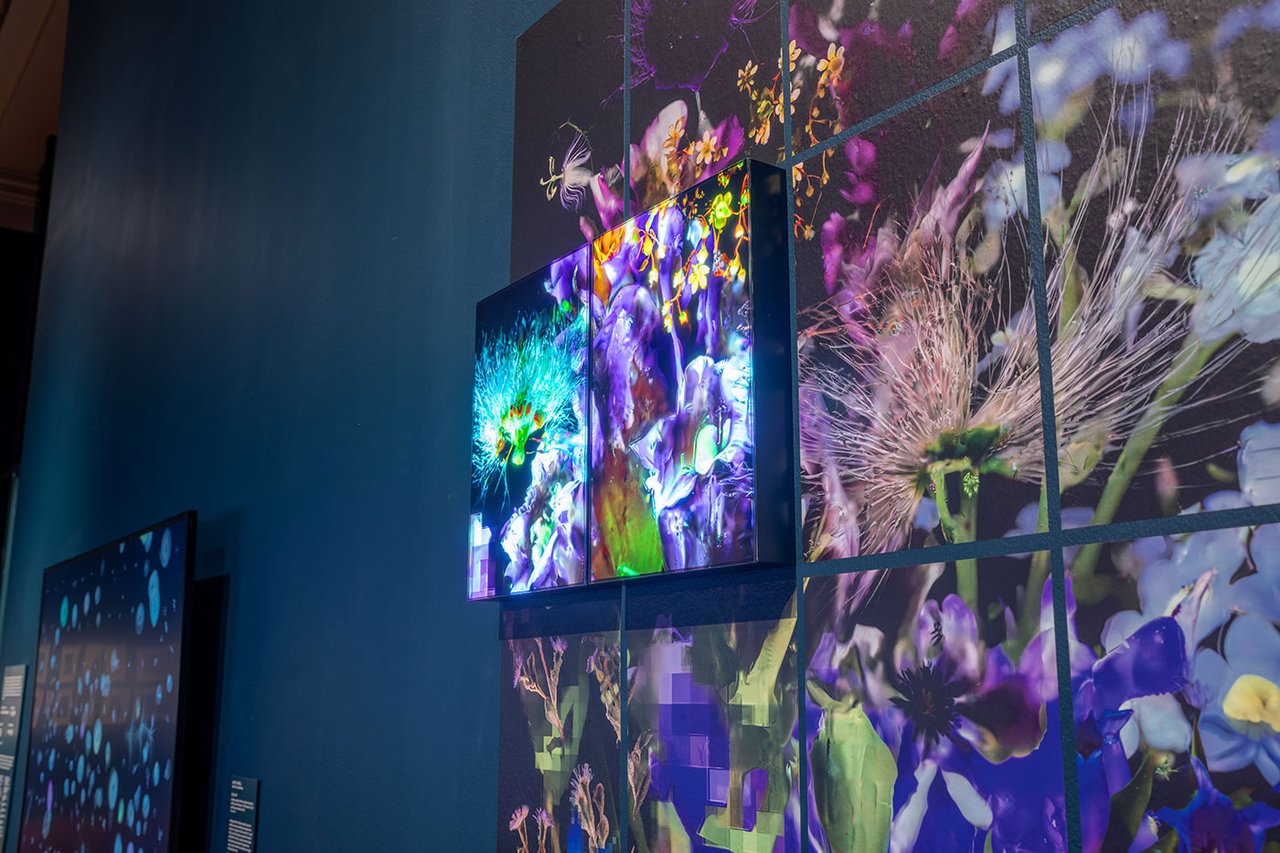
That aggregation to create scale is nicely captured in the collaged prints from a work like Final Edition, on show at Nagel Draxler, or in a recent collaboration with Crespo, 3.31424e+126: clematis armandii, 2025. The latter work is based on a large climbing clematis in Ridler’s London garden, which sports thousands of blooms, which the two artists photographed using a variety of photographic methods, and at different times of the day. What is so nice about this clematis, Ridler says, is that it “heralds the start of spring. It will bloom at the end of March, or the beginning of April, and then, after a couple of weeks, it will be gone”.
The work exists both as a large, tiled, photographic print, and in a digital version that is designed to cycle through all possible permutations of the hanging.
The digital version, Ridler says, “is in theory eternal but it isn’t. All of these things have finite lives. And Sofia and I created this deliberately using very experimental photographic methods so that the prints, too, are shifting and changing”.
The work was originally displayed, at Art Brussels, in April 2025, and in the succeeding months became, she says, less and less pink in appearance.
Installation view of “Infinite Images” at Toledo Museum of Art, 2025, with work: 83 Seeds from a Vanishing Mountain bySofia Crespo and Anna Ridler. Courtesy of the artists and Toledo Museum of Art
On process, and collaboration
In 2025, Ridler and Crespo were joint winners of Arab Bank Switzerland Digital Art Prize, with the jurors citing their “confrontation with AI tools, as well as their commitment to the environment, nature and their quests to better understand the world around us”. A monograph of their work is due to be published in October 2026. Their collaborative work, Ridler says, reinforces both artists’ concern with showing their process.
“When we work together it’s never just about producing an artefact. Both of us are very interested in process and the way of making and that’s certainly something that’s very true in my own individual practice. It’s not about producing an artifact, it is about the process; where making is meaning.” (Anna Ridler)
Ridler enjoys, she says, how rapid her work with Crespo is. “In my individual practice it takes a year to make a single piece. But when Sofia and I work together, it all comes together. We work really quickly. I think that is because we spend a lot of time thinking in our individual practices, so that when we work together we shoot out these pieces. It’s very instinctive, and it's only after we’ve made them that we are [able to see that] ‘It’s this and this and that’s how it connects into that’.”
Anna Ridler, (Still from) Traces of Things, 2018. Courtesy of the artist and Nagel Draxler
At a time when the notion of AI art has been largely “collapsed down to AI slop”, Ridler says, she feels it is “really important to show, or to pull out, the different parts that sit behind [work with AI, giving weight] to process and to experience as a way of making something seem more human, more artistic”. She sees that showing of process — which she expresses by having an Artist Notes (Thoughts & Process) section as a key part of the “Works” entries on her website — as a way to “welcome people in, and to show the different layers and levels, as well as the craft and the skill that runs through it.
“When you look at an artwork, that’s not the work. The work is everything that goes into it, all of the thinking, all of the ideas.” (Anna Ridler)
Ridler sees the emphasis on making and process is important for both ends of the audience “spectrum”: “People who are less knowledgeable about digital art and who want … to see the blood, sweat and tears that goes into it. And then for some of the collectors, who are more in the Web3 space, who are comfortable with the idea of holding these things as assets, showing process reveals the history. and the connections — something not necessarily obvious — that sit behind a work.”
The tulip motif
The tulip, Ridler says, is an “ever-present motif” in her work. “I’ve been working with the tulip since 2017, in various ways, across machine learning, across the blockchain, doing different things with it”. Much of that relates to Ridler’s work with NFTs and her concern with measures of value and time in art on the blockchain, and how the Dutch tulipmania of 1637, one of the world's first speculative financial bubbles, connects to 21st-century cryptocurrency markets.
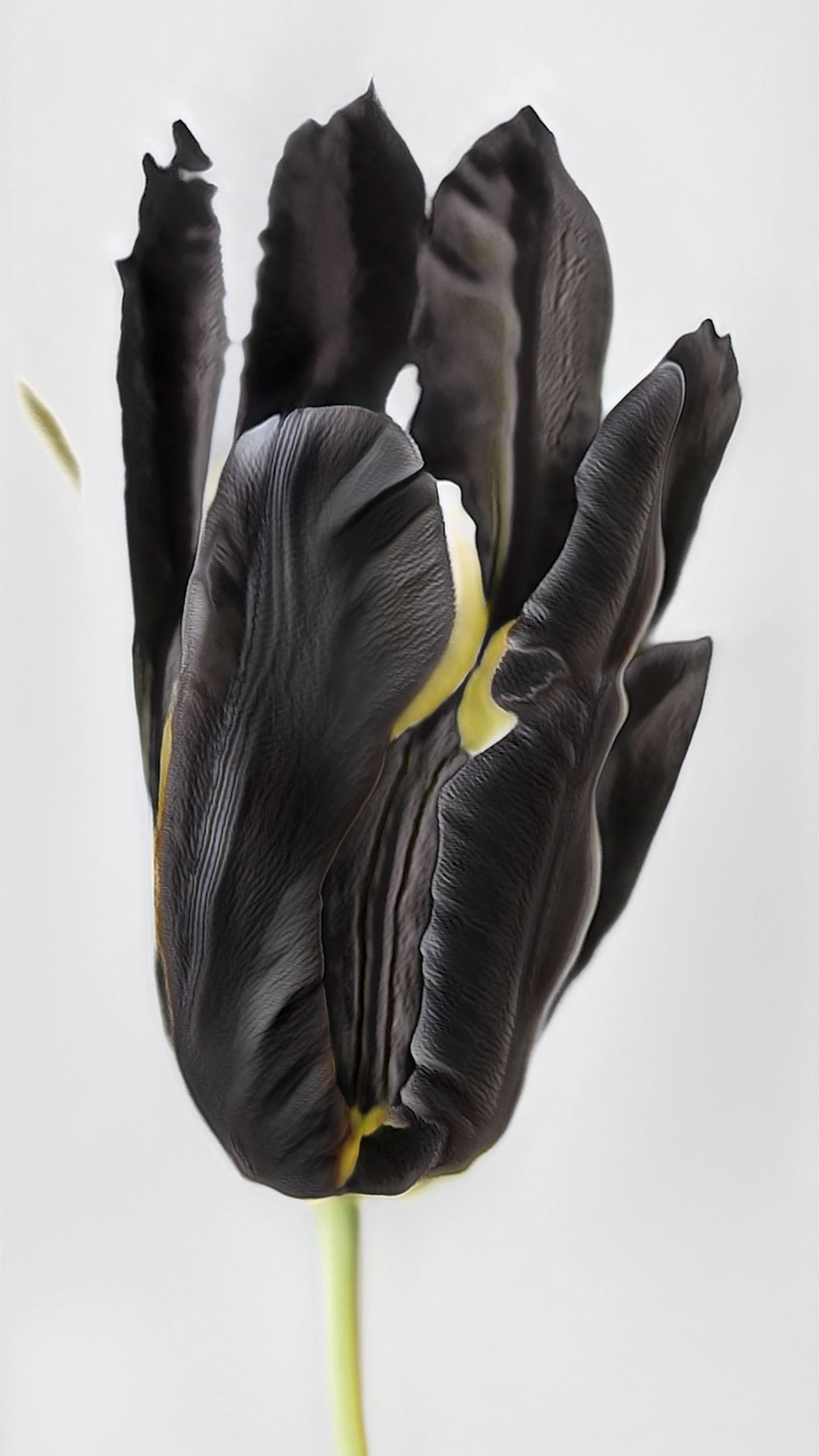
Anna Ridler, (Still from) The Black Tulip, 2023. Courtesy of the artist and Nagel Draxler
Ridler talks of an “incredibly complicated work” such as Mosaic Virus (2018) — a single-screen work displaying a grid of AI-generated tulips, whose colors, shapes and movement are controlled by the price of Bitcoin, changing over time to show how the market fluctuates — where “a lot of the time when people look at it [they say], ‘It’s a beautiful tulip’ … but actually there’s a huge amount of research, connections, and concepts that sit behind [the work] and that are belied by the apparent prettiness of the work.”
“There is something really interesting about making something that’s pretty, because I think people find it hard to square prettiness with the conceptually interesting. And also, the idea of something being at once absurd, and pretty, and conceptually interesting, is often dismissed. That’s something that I’m very conscious of and find very interesting.” (Anna Ridler)
Ridler says she is interested in creating “intellectual frictions” of this sort, because they “help bring in a non-specialist audience”. She is happy when her work is shown away from an art fair stand or outside a white cube gallery. “There is something very powerful,” she says, “about trying to meet people where they are”.
To that end she recently made a Circadian Bloom App (2025), to bring an installation-scaled long-term project on to a smartphone — using AI-generated flowers to tell the time, and drawing inspiration from the 18th-century concept of a “flower clock”, which was devised by Carl Linnaeus, the scientist behind the modern system of naming organisms. Her intention is “to bring art to where people actually consume media — on their phone — or where they live their lives, which is not in a white cube space. I think the internet and people’s phones can be very powerful public art platforms.”
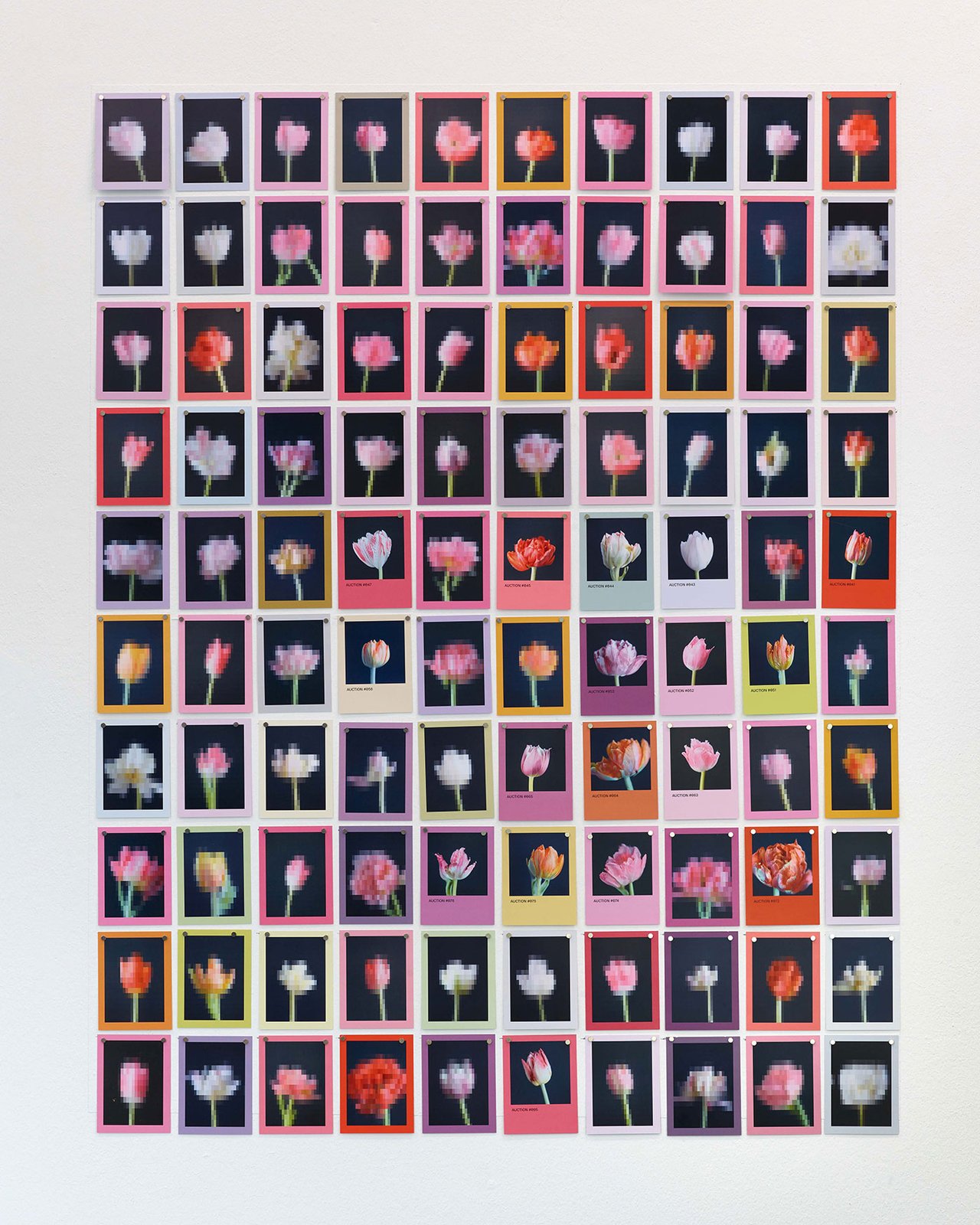
Anna Ridler, Bloemenveiling cards, 2019. Courtesy of the artist and Nagel Draxler
Time, value, and attention
The tulip paradigm has also served as one of the ways Ridler has engaged most pointedly with the world of art on the blockchain. “The vast majority of the NFTs that I make as part of my practice are very difficult to trade or sell or own,” she says. In 2019 she created Bloemenveiling, an online auction of short GAN-generated videos of tulips, with smart contracts on the Ethereum network.
“You could only trade it on a specially designed auction website, and if you bought one it would only last for a week. It was 100 days, 100 auctions, 100 tulips, none of which lasted longer than a week, the same amount of time that a cut tulip would last and then it got blighted and then it disappeared.” (Anna Ridler)
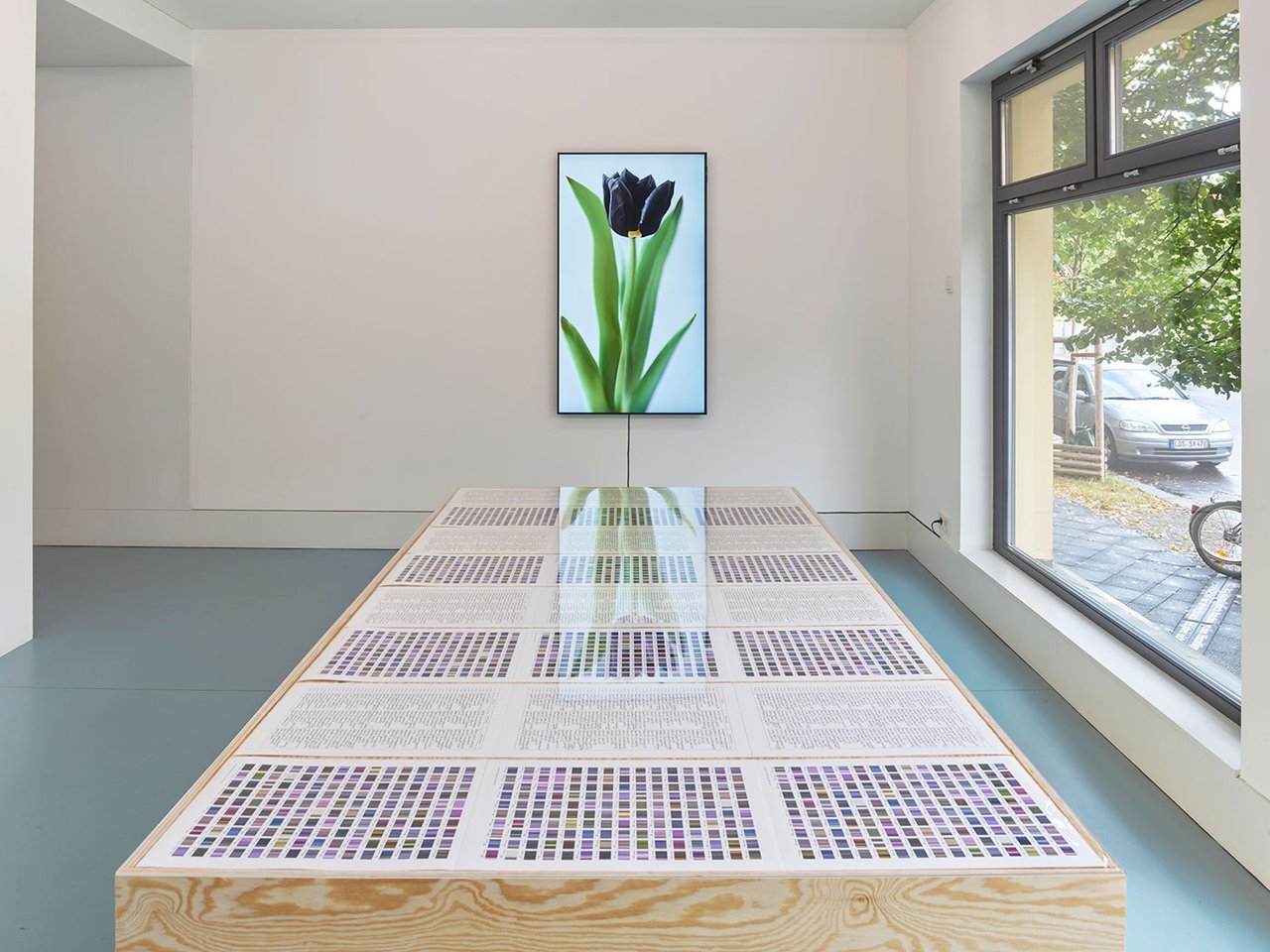
She also made the “anti-speculation” NFT Black Tulip (2023) — named after the feverishly desired but “impossible” variant of the flower that became the subject of Alexandre Dumas père’s 1850 novel of the same title — which could only be traded on one auction site and “for what you pay for it or less”. She has also made “tokens that you can only trade after 200, 400, 800 years”. They are all sold, “for very good sums of money”.
Alongside tulips, Ridler works a lot with shells. In London, she “mudlarks” along the river Thames at low tide, and likes finding shells, “because they're a really nice record of London”, and the Thames is “the oldest open archaeological site in London and you can find oyster shells” that speak to a history when they were eaten in great quantity in the city, or new, exotic, types of shell that represent both globalisation and climate change.
Installation view of “Time Within Time” at Nagel Draxler, Cologne, 2023, with work: Black Tulip (2023) by Anna Ridler. Photography by Simon Vogel
Ridler photographs the shells, trains models on them, and in 2025 made a series of tokens, The Breathings of the Moon, with each “assigned to a different location along the Thames from the mouth of the river to where it stops being so tidal”. And the tokens are only viewable, and tradeable, at low tide (twice in every 24-hour cycle, at a slightly different time each day). Her aim is to “introduce friction or difficulty into these economic systems but also getting people — and this is also one of the reasons why I did it for the tulip in Bloemenveiling — to stop treating art as an asset and to make people enjoy it and experience it”.
“You can only trade it by looking, by paying attention. You have to actually watch the work, you have to look at it.” (Anna Ridler)
That quality of attention is one of the primary concerns of works such as The Breathings of the Moon, Bloemenveiling, and “A Perfect Language of Images”, and in Ridler’s unveiling of process, her taste for a slowing artistic friction, and her use of handwriting as a medium of recalibration and preservation.
At a time of extractive platforms that enforce digital distraction, “attention is the thing” for Ridler. “You have a finite resource of attention. I think paying attention to something is a huge act,” she says. “It’s the thing that makes things good. It’s a form of listening, it’s how you show love, it’s how you can help heal and repair. It’s all of these things.”
Anna Ridler is an artist who works with systems of knowledge and how technologies are created in order to better understand the world. She is particularly interested in the natural world. Her process often involves working with collections of information or data, particularly datasets. Her work has been exhibited at cultural institutions worldwide including Times Square, the Barbican Centre, the Centre Pompidou, HeK (House of Electronic Arts, Basel), the Photographers’ Gallery, ZKM (Center for Art and Media, Karlsruhe), the Ars Electronica Center, and the Victoria & Albert Museum. She received an honorary mention in the 2019 Ars Electronica Golden Nica awards for the category AI and Life Art.
Louis Jebb is Managing Editor at Right Click Save.

I enjoyed this article and have followed both Anna's and Sofia's work. One phrase is really sticking with me, “all failing differently”.