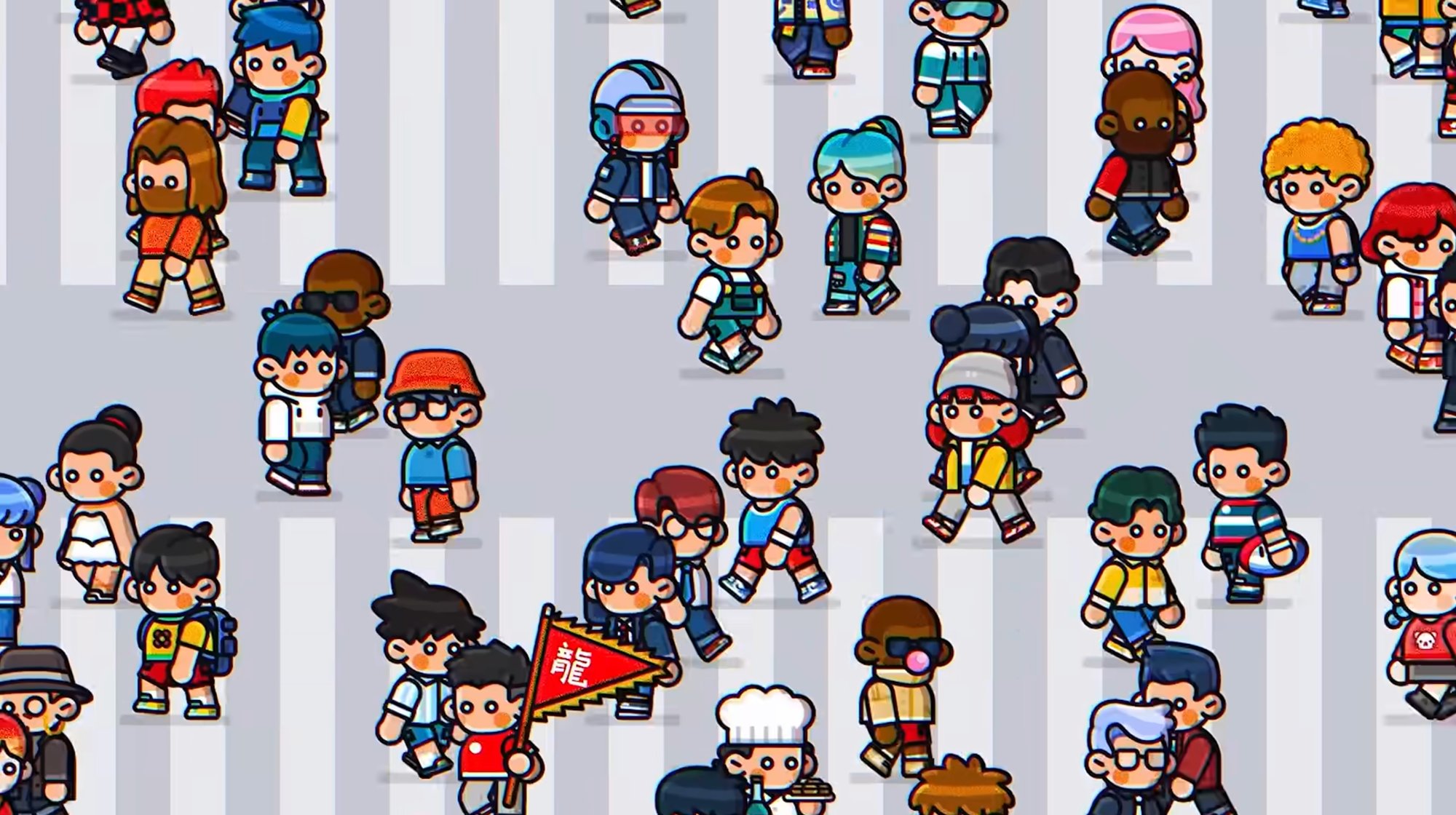
DeeKay, (Still from) Invisible Stories, 2026. Courtesy of the artist
Animating the Everyday | DeeKay
The artist and former motion designer on digital art as a form of critical play
DeeKay, (Still from) Invisible Stories, 2026. Courtesy of the artist
The artist and former motion designer on digital art as a form of critical play
Earlier this year, the artist DeeKay transformed the dense rhythms of Hong Kong into a tapestry of interwoven human stories projected onto the Hong Kong Club Building. Commissioned by Art Basel together with the Hong Kong Tourism Board, Invisible Stories (2026) adapted the artist’s playful aesthetic for a work of public digital art, presenting a bustling intersection populated by dozens of avatars, each carrying their own personal histories.
In collapsing natively digital experience into the urban fabric of Hong Kong, DeeKay revealed himself to be an astute social commentator in a world of entangled realities.
As a former motion designer at Apple and Google, DeeKay is attuned to the nature of human experience in an age of global interconnectedness, with each gesture shaped not by optimization but by the artist’s sensitivity to how people move through physical and virtual worlds simultaneously.
While the artist’s signature style captures a generational technostalgia, his work also reveals the ways everyday life is transformed by cohabitation in online space — where identity is performed and relatability rules all. Viewed through DeeKay’s shrewd gaze, the internet becomes a place where individuality resists reduction to generic categories or customer segments. In his conversation with Right Click Save’s Founding Editor, Alex Estorick, the artist asserts the ongoing value of humanity in the age of AI.
DeeKay, LetsWalk Finale, 2022. Courtesy of the artist
Alex Estorick: At Right Click Save, one constituency we have always sought to uplift is the global community of digital illustrators, many of whom started out working in commercial practices before building successful careers as independent artists. You self-identify as an “animator and digital artist” and I’d like to start by asking how your creative identity has changed since your days working as a motion designer for Apple and Google.
DeeKay Kwon: At the core, I’m still the same person. I still care about making things that feel clear, emotional, and accessible. That part never changed. What changed is why I make the work. When I was at Apple and Google, I was solving problems. A lot of motion design is about communication, clarity, and making something feel polished and effective. I learned a lot from that and, honestly, those years shaped me in a huge way. But at the end of the day, I was helping tell someone else’s story.
Now, as an independent artist, I’m trying to tell my own story. That shift changed everything; my practice became less about perfection and more about honesty. In the beginning, a lot of my work was playful, optimistic, cute, and outwardly approachable. Over time, especially after going through some difficult personal experiences, I started allowing darker emotions into the work too. That felt like a big evolution for me.
I still identify as an animator and digital artist, but now I feel much more like a storyteller. I’m not just designing motion anymore, I’m building emotional worlds.
DeeKay, Am I Dreaming?, 2023. Courtesy of the artist
AE: Can you pinpoint any core literacies among the crafts of motion design, animation, or digital illustration that distinguish those creative disciplines? I imagine that visual clarity and directness of expression are important to you but I wonder whether there are other fundamentals or tricks of the trade that might be unfamiliar to artists trained in analog media or even creative coders.
DK: They overlap a lot, but each one trains a different muscle. Digital illustration is about the single image, composition, silhouette, color, shape, language, and how much story you can tell in one frame. Animation is about time, and timing is everything. A drawing can be beautiful, but if the movement feels wrong, the emotion disappears. It’s all about rhythm, weight, anticipation, release, and spacing. Motion design often leans more into communication, hierarchy, clarity, and guiding someone through an idea or feeling in a highly intentional way.
One thing that people outside animation might not realize is how much it comes down to restraint. Just because something can move doesn’t mean it should. Sometimes the strongest choice is knowing what to simplify, what to hold, and what to leave still.
DeeKay, Mario Metaverse, 2021. Courtesy of the artist
AE: It seems to me that part of your universal appeal stems from the relatability of your visual repertoire, which draws on retro video-game aesthetics. What are some of the foundational motifs and aesthetic principles that guide your work?
DK: A lot of my work is built on simplicity, clarity, and emotional readability. I’ve always loved visuals that feel immediately approachable, strong silhouettes, simple shapes, intentional color palettes, and movement that feels clear and expressive. I want people to feel something first, even before they fully understand the idea. That’s where the retro game influence comes in too.
I grew up loving older games, and I still admire how much they could communicate with so little. Character, mood, and worldbuilding had to be incredibly efficient.
I’m also drawn to work that feels cute or playful on the surface, but carries something heavier underneath. That contrast is really important to me. My influences come from a mix of animation, games, internet culture, and everyday visual language, not just traditional fine art references. That’s part of what makes digital art exciting. It pulls from places that shaped an entire generation, even if traditional collectors don’t always recognize them right away.
DeeKay, I Love NY, 2022. Courtesy of the artist
AE: These days, it’s hard not to observe an all-pervasive technostalgia. Do you think it changes how people engage with art today?
DK: Definitely. A lot of people from my generation grew up in that transition between the analog world and the early digital world. We remember pixels, old game sounds, loading screens, simple interfaces, all of that. When people see those visual languages now, it’s not just nostalgia; it activates memory and reminds them of a specific feeling, a specific age, even a specific version of themselves. That absolutely changes how people engage with art today.
AE: According to Tony Lyu, it is “because of the impersonal nature of generative systems and AI that your humanity shines through your animations”. How does it feel to create digital art in the age of deep learning?
DK: Honestly, it’s complicated, but I’m not afraid of it. AI is obviously changing everything, but I also think it’s making people value humanity more.
When images become easier to generate, intention matters more; taste matters more; voice matters more; imperfection matters more. That actually makes me feel pretty grounded. My work has never been about technical flex for the sake of it. It’s always been about emotional connection, timing, personality, and the small human decisions inside the work. Those things are harder to fake than people think.
I’m not anti-technology at all. I’ve spent my whole life working digitally. But I still care deeply about the human hand, the little weird choices, inconsistencies, and those elements that reveal there’s a real person behind the screen. In a strange way, the age of AI makes me want to be even more human in my work.
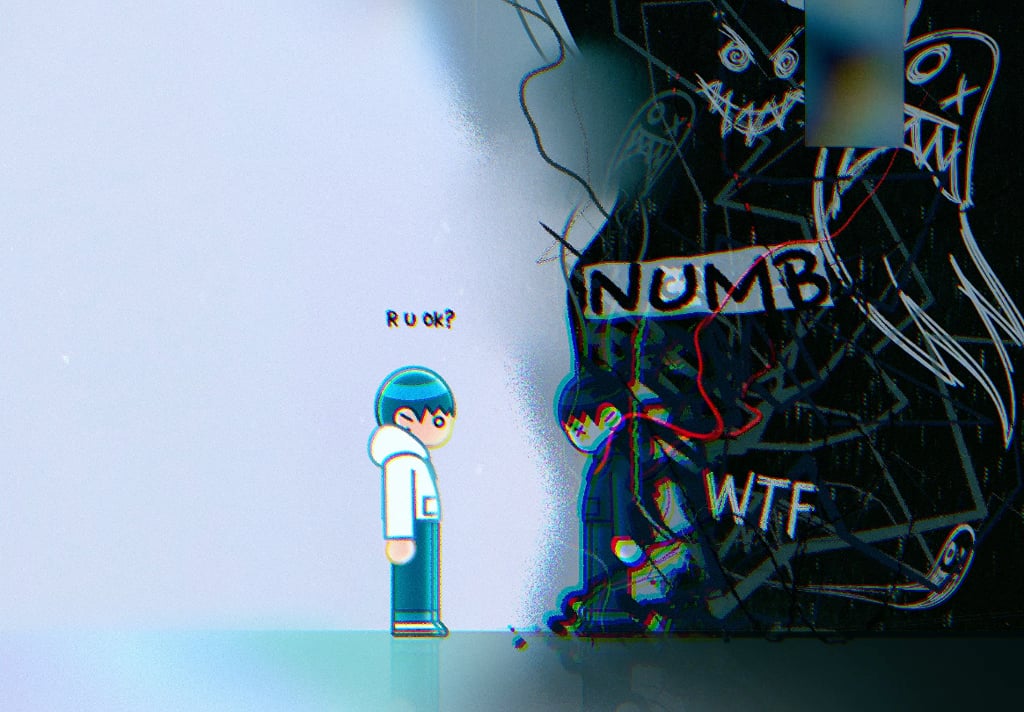
DeeKay, (Still from) R U OK?, 2025. Courtesy of the artist
AE: Your worlds are immediately recognizable for their populations of avatars who reflect a culturally diverse community that is simultaneously real and fantastical. How do these worlds emerge and what is their relation to the real world, which is not always as appealing as those which you bring to life?
DK: My worlds usually start with real emotions, not fantasy. Even if the characters look playful or surreal, they’re usually carrying human emotions: loneliness, hope, anxiety, curiosity, joy, fear. That’s why I think people connect to them.
I’m not trying to escape reality completely, I’m trying to translate it. I take emotions or observations from real life and rebuild them into a visual language that feels softer, clearer, or more poetic. A crowded street becomes a world of little avatars; a dark emotional period becomes something like R U OK? (2025).
I wouldn’t say my worlds are better than the real world. They’re more like emotional filters: ways of making reality easier to look at, process, and feel.
The diversity in the characters matters a lot to me because it reflects how I actually see humanity: different people and different stories, all existing at the same time.
DeeKay, Invisible Stories, 2026. Courtesy of the artist. Commissioned by Art Basel Hong Kong and Hong Kong Tourism Board
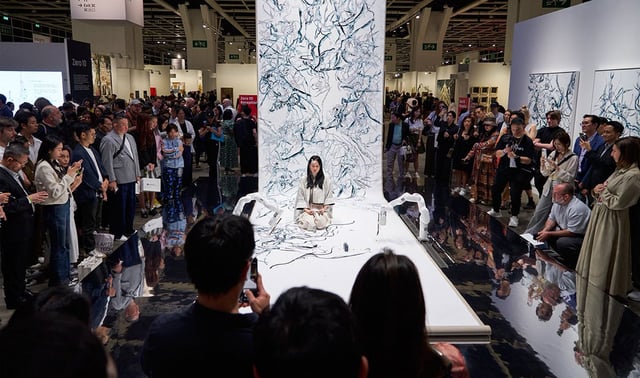
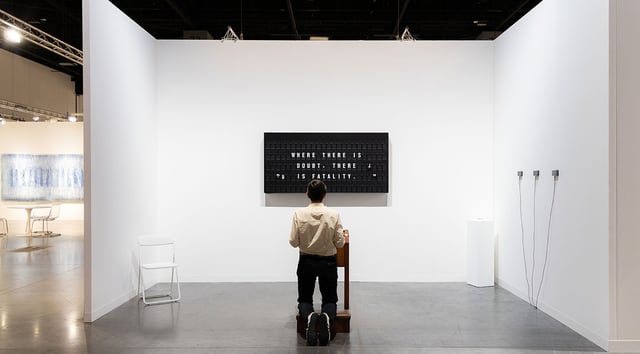
AE: Your work, Invisible Stories — an animation depicting a bustling city intersection — was recently projected onto the Hong Kong Club Building during Art Basel Hong Kong. You’ve spoken in the past of the importance of maintaining a childlike imagination, but I wonder how it felt to see your imagination inscribed into the social fabric of Hong Kong while you were exhibiting at the main fair with AOTM gallery.
DK: Honestly, it felt surreal.
A lot of my work starts in a very private place, usually from a small feeling or simple sketch. Seeing that imagination suddenly scale up into the middle of a city like Hong Kong was really emotional.
Hong Kong already has this incredible rhythm to it: dense, energetic, layered, and always moving. For DeePle The People, which is really about many individual stories moving together in one shared space, the city felt like the perfect place for it. What made it especially meaningful was that it wasn’t just inside the fair but became part of the city itself. People could encounter it unexpectedly while already being part of that same urban movement.
Showing with AOTM at Art Basel at the same time made it even more special because it felt like two sides of my practice meeting at once: the gallery context and the public, living, social experience. I care a lot about both.
DeeKay, Right Click Savers, 2021. Courtesy of the artist
AE: We’d love to hear about any forthcoming projects you might currently be preparing for. How is the future shaping up for DeeKay?
DK: In the last few years, I built a world through my art that felt uplifting, hopeful, and overall positive because I simply wanted to bring smiles to the people who enjoy my work. But, as an artist, I feel like I’m always evolving.
I’m entering a new chapter where I’m exploring more emotions, including darker ones that I haven’t really expressed as much before. I still want to make people smile with my art, but now I also want to move them and make them feel something deeper. Life isn’t just about happiness and positivity — there are always both sides, light and dark. I want to capture all of that and express it through my own visual language.
DeeKay is an artist whose digital animations combine clean, minimal forms with expressive motion. Drawing on visual language from retro video games, his narrative-driven artworks simplify humanity’s complexity. He studied at the School of Visual Arts, New York, and then spent over a decade as a motion designer at companies including Google and Apple. He has been minting his artworks on blockchain since 2021. His work has been exhibited globally, including at Sphere, Las Vegas (2025); The Museum of Contemporary Art Busan, South Korea (2025); and W1 Curates, London (2023), amongst others. His practice is guided by the principle that art should be universally accessible and resonant.
Alex Estorick is the Founding Editor of Right Click Save.
No comments yet. Be the first to share your thoughts.
Mentioned in this article
People: Alex Estorick, DeeKay Kwon|Works: Invisible Stories, R U OK?|Events: Art Basel Hong Kong|Organizations: AOTM, Apple, Google, Hong Kong Tourism Board, Right Click Save|