New Art | An Idea Emerging From a Tech-Centered Society - Right Click Save
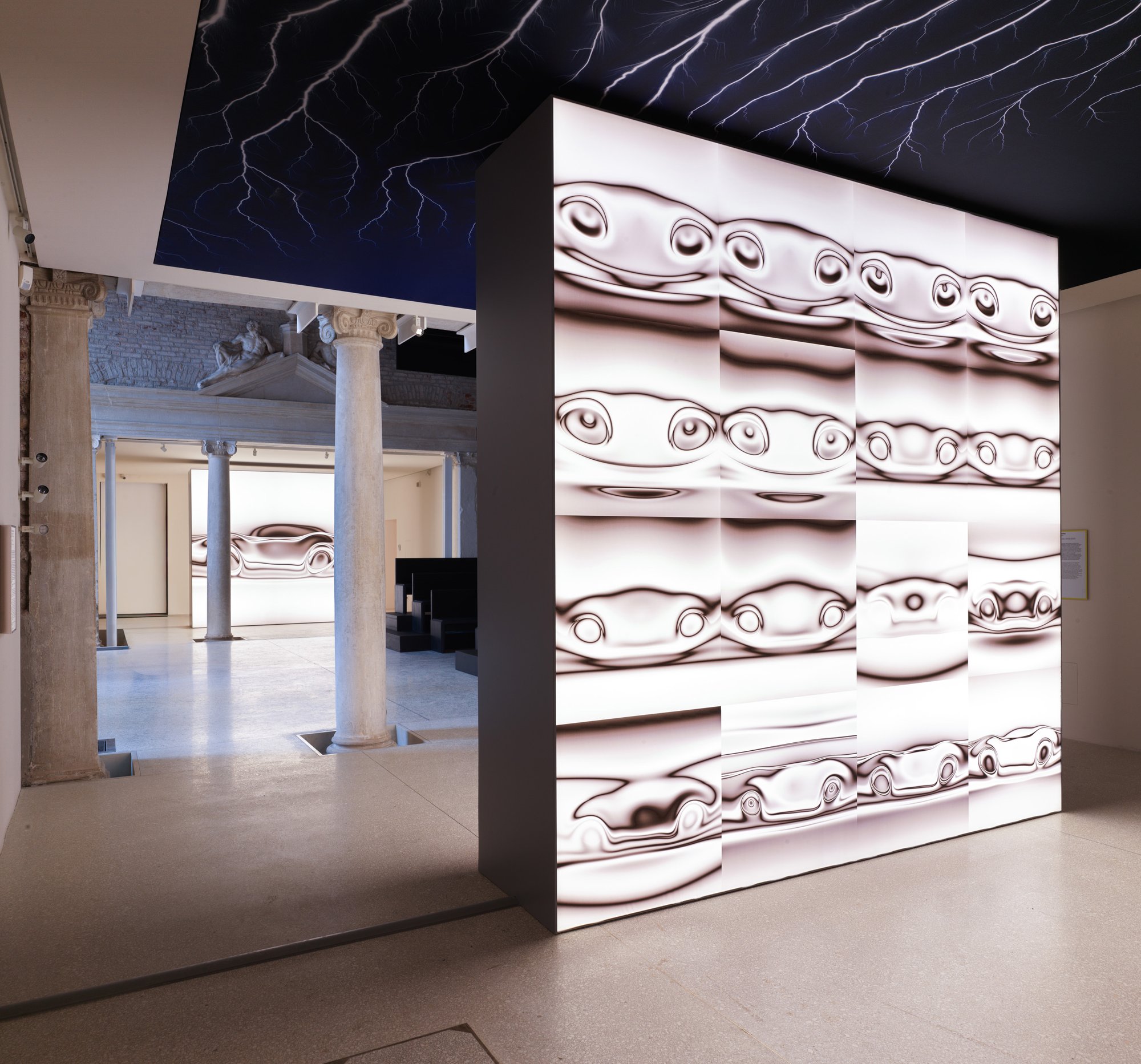
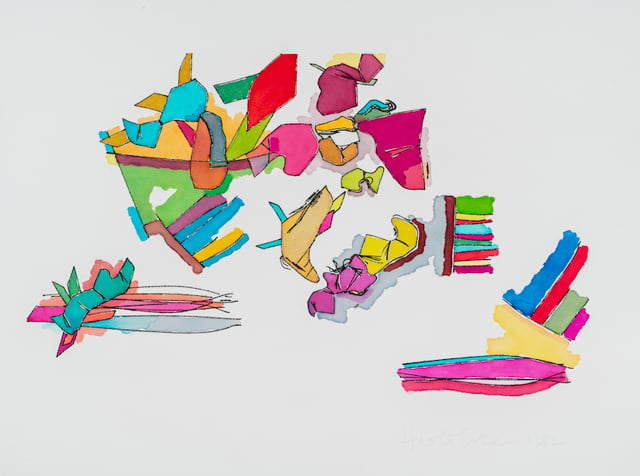
Installation view of “Strange Rules” at Palazzo Diedo Berggruen Arts & Culture, Venice, 2026, with work: Ken Stanley, Picbreeder (2008-2020). Photography by Joan Porcel
New Art | An Idea Emerging From a Tech-Centered Society
The curator Valentino Catricalà proposes the term “New Art” for today’s world of fragmented but connected practices that are reshaping contemporary art
“New Art” describes an expanding world that lives beyond classical rules built around categories and mediums
The term acknowledges a half-century of practice since postmodernism defined technology’s effect on art and aesthetics
It includes artists who operate as industries of innovation or who exhibit at the junction of spectacle and high art
Neither a trend nor a manifesto, it is an “impulse” working toward “a definition of art that is constantly rewriting itself”
A New World: The Foundations
It has been discussed for some time — it is in the air, yet it remains elusive. It likely began with the advent of the “post-everything” movements, or perhaps even earlier. Let us recall the first — the most famous of them all: postmodernism. Launched in various ways by philosophers including Frederic Jameson, Jean-François Lyotard, and Douglas Crimp, it decreed the end of something ... of the modern, of modernism; either way, the end of an era. For Lyotard, postmodernism was defined by “incredulity toward metanarratives.”
Lyotard’s The Postmodern Condition was published in 1979 with a subtitle that is often forgotten but important: A Report on Knowledge. This was a transformed knowledge, which the French philosopher identified in the effects of technology on society. This led him to curate an exhibition — an unusual endeavor for a philosopher — at the Centre Pompidou, titled “Les Immatériaux” (1985). The exhibition was a demonstration both of how societies were changing, and how technology had influenced art and aesthetic categories. Indeed, the show was an eclectic mix of art, science, and industrial technology.
“Les Immatériaux” is one of the foundational milestones toward which we must define explicitly today as “New Art”. From that milestone, the various “post-everything” movements gradually sought to theorize a world in constant evolution, as well as the emergence of new artistic disciplines that had been separated from the traditional art world for years.
Those disciplines formed an entire sector that, for years, justified its existence by being identified under labels that placed art in opposition to technological terminologies. There are many such labels, including “video art”, “computer art”, “software art”, up to more general and inclusive terms like “new media art” and “digital art”.
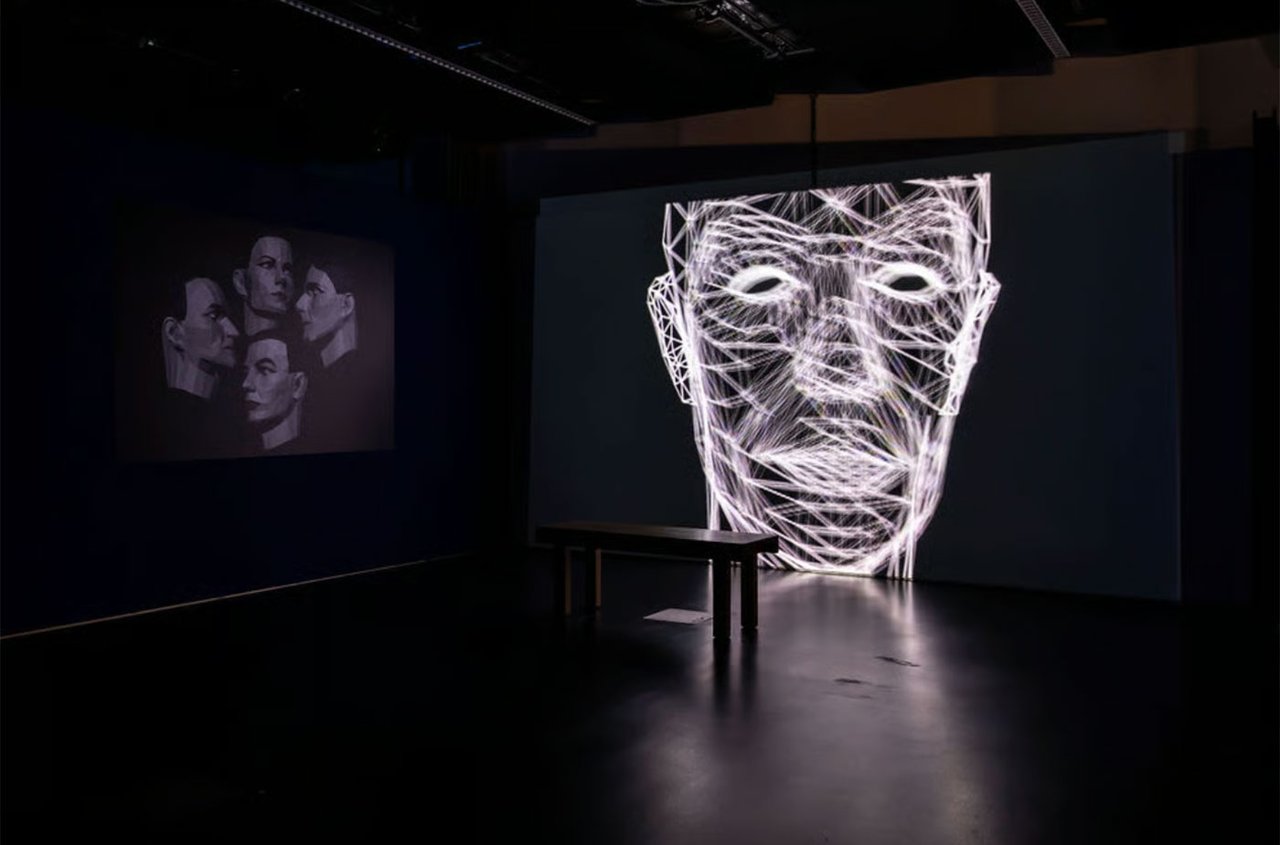
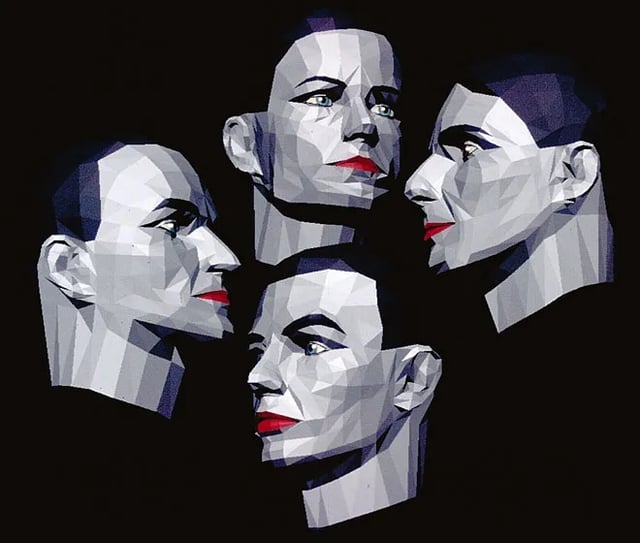
Installation view of Rebecca Allen, “A Tangle of Mind & Matter”, at The School of Digital Arts, Manchester, including Musique Non Stop, 1986. The exhibition was curated by Valentino Catracalà. Courtesy of The School of Digital Arts
These labels delimited more or less precise spheres separate from contemporary art, in which the technological medium used by the artist was the defining hallmark, existing alongside, but without intersecting a contemporary art world that proceeded at a different pace and with different interests. Back in 2011, James Bridle launched the concept of “The New Aesthetic”. Yet, for years, the technological question was sidelined or marginalized, as if it were something secondary. We find evidence of this in the reactions of experts and museum directors.
A few years earlier, in 2008, Ekow Eshun, director of the ICA in London, had declared: “The practice of new media-based arts has its place in the sector, but it is my opinion that, in general, it lacks the cultural depth and urgency to justify a continuous and significant investment by the ICA in a Live & Media Arts department.”
Art criticism of technology has earlier roots. In his famous essay Art and Objecthood (1967) Michael Fried asserted: “Art degenerates as it approaches the condition of theater”, or rather, that art vanishes the moment it becomes a mere demonstration of an effect or a device.
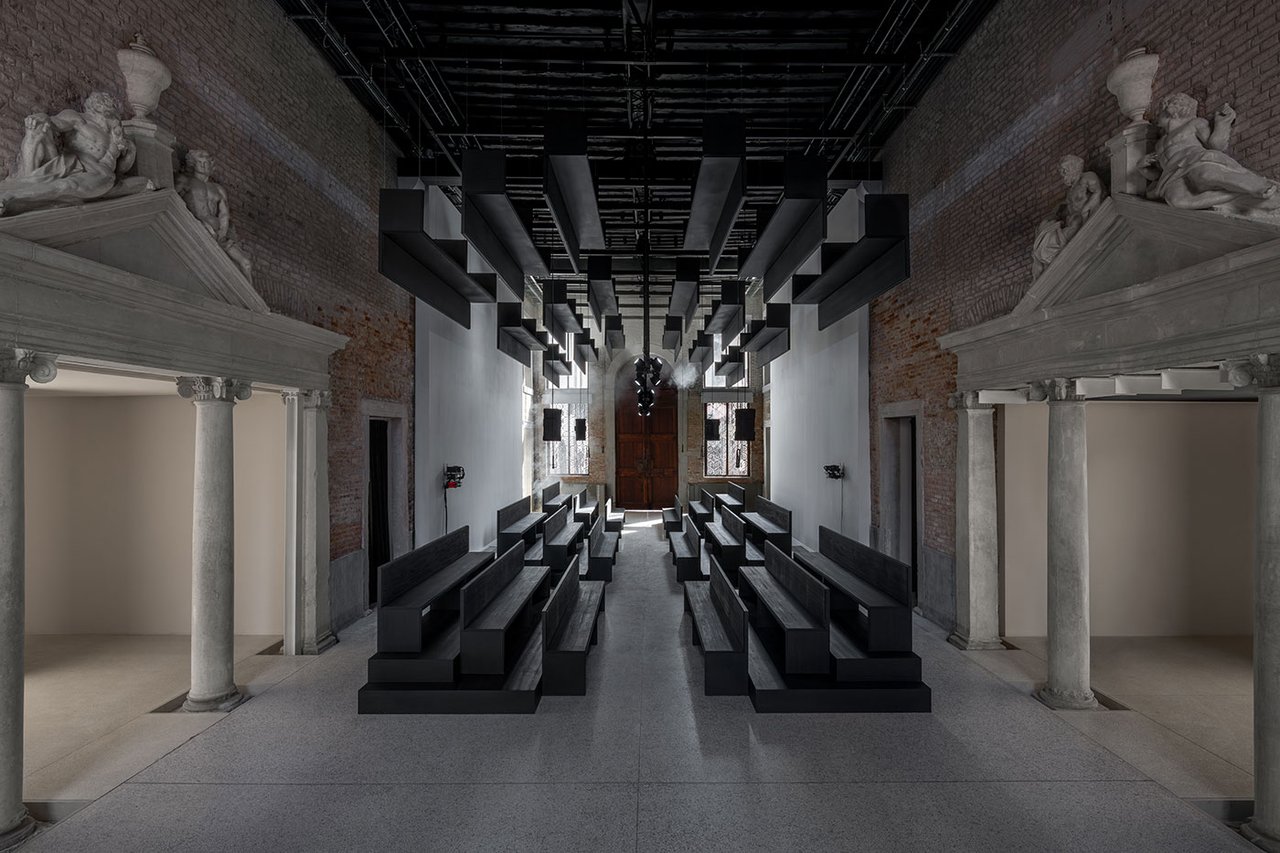
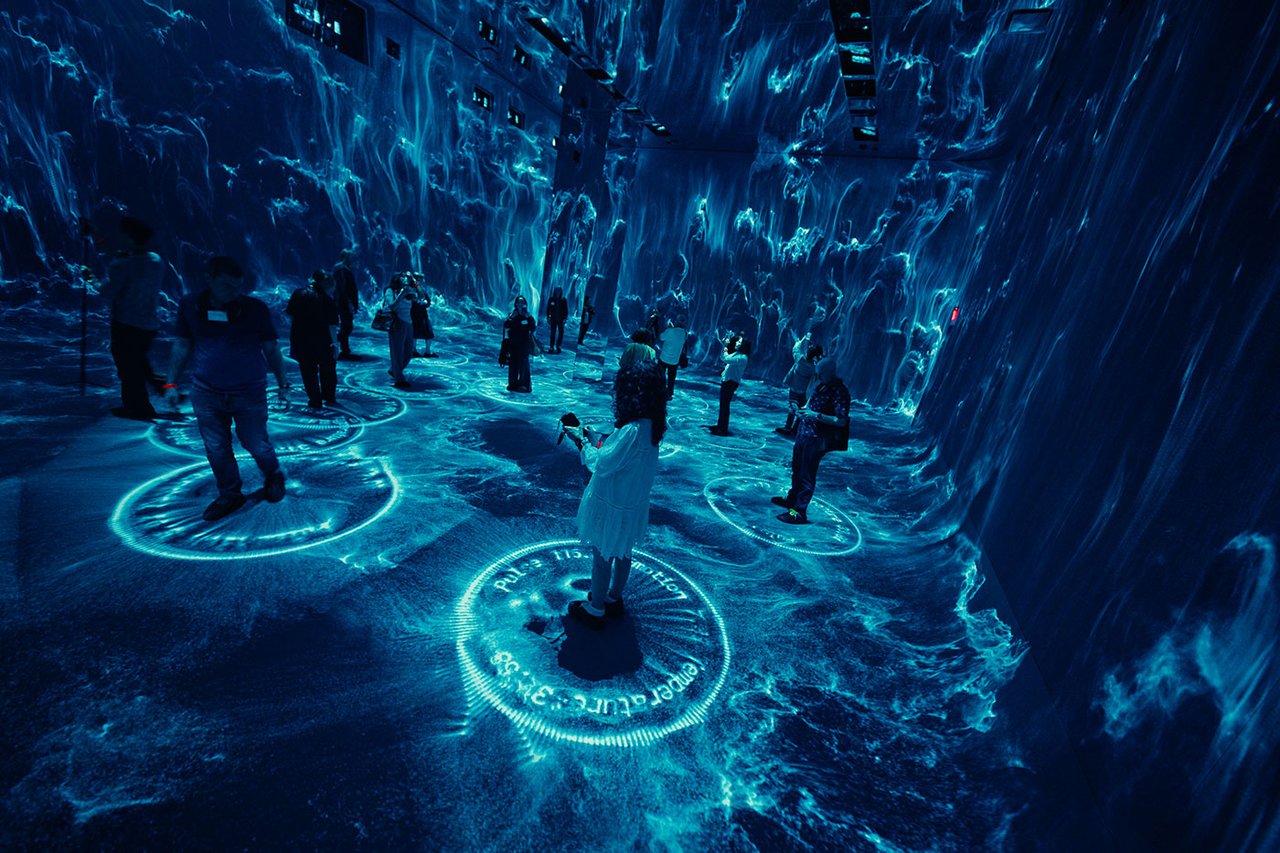
Installation view of “Strange Rules” at Palazzo Diedo Berggruen Arts & Culture, 2026, with work: Attention Guild (2026) by Mat Dryhurst and Holly Herndon. Photography by Joan Porcel
The Double Helix
And so, we arrive at contemporary art, which hides in its very name the idea of something in constant motion. But the concept of contemporary art must be conceived not only in a temporal sense (the “now”) but also in a conceptual one. We might say with Roland Barthes that “the contemporary is the untimely” in that there is always something anachronistic about it; it is a temporal superimposition. Or as the philosopher Georges Didi-Huberman put it: “Anachronism is the way time opens up, splits, and articulates itself.”
However, the contemporary in art is not only a philosophical concept but also a practical one, from the Latin ars, a translation of the Greek techne — the capacity to do, a technical skill guided by rules and knowledge. And this capacity to do, as structured by contemporary art, has, if not rules, at least orientations.
We are at a moment when the orientations that have defined the contemporary art world — which have characterized exhibitions, events, and professional figures, and have been taught in schools, universities, and academies — have been joined, challenged, and radically reshaped by New Art. We are not beyond, but within, contemporary art.
New Art represents new modes of making art, of exhibiting, and of being an artist that can no longer be reduced only to the categories of contemporary art, just as they can no longer be locked into boxes whose boundaries are determined by the simple use of a medium. What we call New Art seems to have been generated by a double-helix process.
Modes from within contemporary art
New modes have gradually emerged — a germ born from within, a parasite, to use the philosopher Michel Serres’s concept, which has influenced the entire sector. Think of the new modes of production that are establishing a new figure of the artist.
When an artist such as Ian Cheng founds a company that pays salaries to engineers and technicians to invent new AI software prior to the creation of his works, we are not only talking about art, nor the traditional workshop, but about new forms of technological innovation applied to art.
The same applies to many artists working with technology today, including Cecile B. Evans, Lawrence Lek, Oliver Laric, Cao Fei, and many others. When painting becomes an extension of technological processes, erasing the distinction between online and offline, we are no longer talking about traditional media, representation, and creative intuition. The body sculpture of Ivana Basic, not to mention the body metamorphosis of Ambera Wellmann’s paintings, recall the digital metamorphosis of tech society, just as Rachel Rossin fuses media. The same is true of FormaFantasma, Forensic Architecture, and Metahaven, who hybridize design, architecture, and fine art in ways that challenge the standard categories of contemporary art.
Experiences are also changing within the exhibition space. Today, entertainment companies leverage artistic credibility to elevate their commercial appeal, all the while the art world seeks out new audiences, immersive formats, and substantial budgets. This intersection has given rise to a new exhibition model exemplified in Refik Anadol’s Dataland museum of AI arts in Los Angeles as well as the sites created by the Tokyo-based digital art collective TeamLab, which live between high art and spectacle, and beyond conventional exhibition experience. “Euphoria: Art is in the Air”, an exhibition of inflatable art that I curated at Le Grand Palais in 2025, offers another example.
The expanding boundaries of contemporary art
Contemporary art itself has expanded beyond its own borders, influencing and incorporating other disciplines, thereby causing the solidity of its own nature to be lost while introducing new cultures. When an artist such as Neil Beloufa founds a company to collaborate with museums to design non-exhibition areas, or when figures like Olafur Eliasson or Tomás Saraceno operate as veritable industries — whose studios are directly influencing scientific research, as with Saraceno’s Aerocene project — are we still talking about art or innovation?
Even if the final output is an exhibition the process is hard to frame within classical rules. The same applies to the old master Michelangelo Pistoletto, whose recent work The Third Paradise is not a physical work nor an object but a symbol that activates social, scientific, political, and technological processes.
The Archipelago and the “New Art”
It would be easy now to announce something bold — the end, death, “post”, or birth of a new and absolute dogma. Or to speak of a new artistic trend like Arte Povera or Minimalism. But I will not, because it is no longer the time for such critical attitudes.
We are not “beyond” contemporary art but in the midst of a broader mutation where New Art takes shape. It is too broad to be understood through narrow categories. Within the art world it can be considered a hyperobject, just as climate change is a hyperobject for the global ecology.
There are overlaps and connections, tendencies to exit and re-enter, and temporal superimpositions. There are also “family resemblances”, to quote Ludwig Wittgenstein: just as in a family, members resemble one another without everyone possessing all traits, so concepts are joined by partial and crossed similarities.
As the Italian philosopher Massimo Cacciari states, to think of an archipelago is “to harmonize, without violently reducing them to One, the different figures, the different islands—all ‘saved’ in the individuality of their own character, but all grasped in their common search, in their common love (philia) for that Name or that Homeland which all of them lack”.
The homeland exists in the archipelago, not in the concrete sense of a place but metaphorically, in the imaginary that makes it possible to conceive of the archipelago. The Center, as Cacciari puts it, is lost in the archipelago, “because the Center is, in truth, nothing but that impulse which compels each one to ‘transcend’ itself by navigating toward the others, and all of them toward the absent Homeland”.
This absent homeland is precisely the concept of “New Art”. It is not a rigid category, a fixed label, or neo-avant-garde manifesto; it is an “impulse”, a dynamic tension that cannot but be found in the parcelling out of becoming so many islands — navigating toward a definition of art that is constantly rewriting itself.
Valentino Catricalà is currently working in Saudi Arabia on a new large-scale project. He was previously the Artistic Director of MODAL Gallery at the School of Digital Art (SODA) in Manchester and a lecturer at Manchester Metropolitan University. Valentino is a member of the Advisory Board of ZKM Karlsruhe, and of ESEA Contemporary in Manchester. He has also curated exhibitions in important museum and galleries, including the largest exhibition about the relationship between art and inflatable at Le Grand Palais, Paris, as well as Fondazione Prada, Milan and Tokyo, Minnesota Street Project, San Francisco, The Hermitage, Saint Petersburg, Palazzo delle Esposizioni, Rome, MAXXI (Roma), Palazzo Reale (Milan), Museo Riso (Palermo), Media Center (New York), Istituto Italiano di Cultura, New Delhi, Ca’ Foscari, Venice, among others. His research is also reflected in his publications, including Afterwards: Art in a Time of Change (2025), Michelangelo Pistoletto. From the Third Paradise to the Formula of Creation (Treccani, 2024), and The Artist as Inventor (2021). He also co-curates the D’ORO D’ART project with Barbara London in collaboration with Marian Goodman Gallery. Valentino was lecturer at Jiao Tong University, Shanghai and IULM University, Milan.