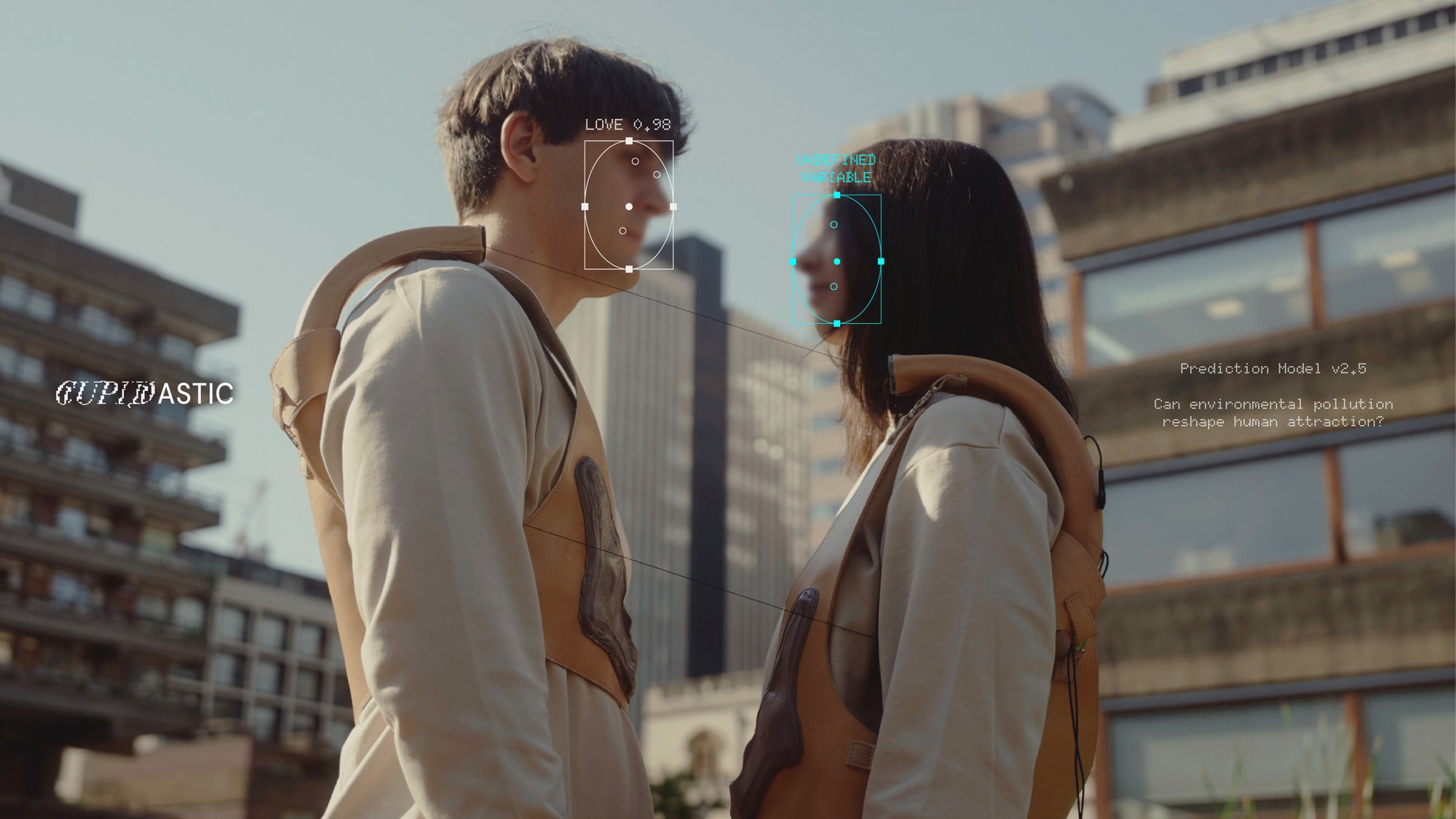
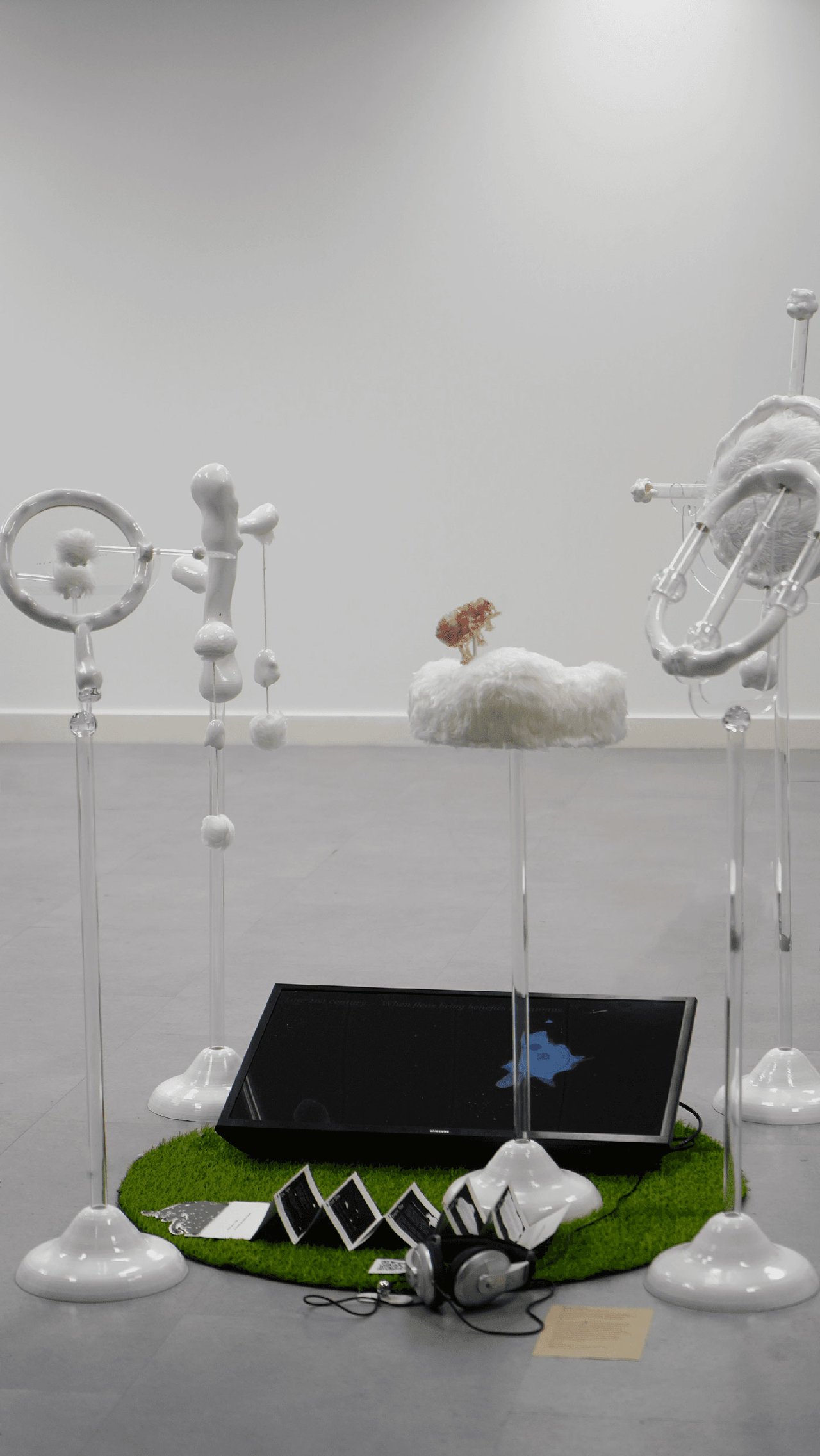
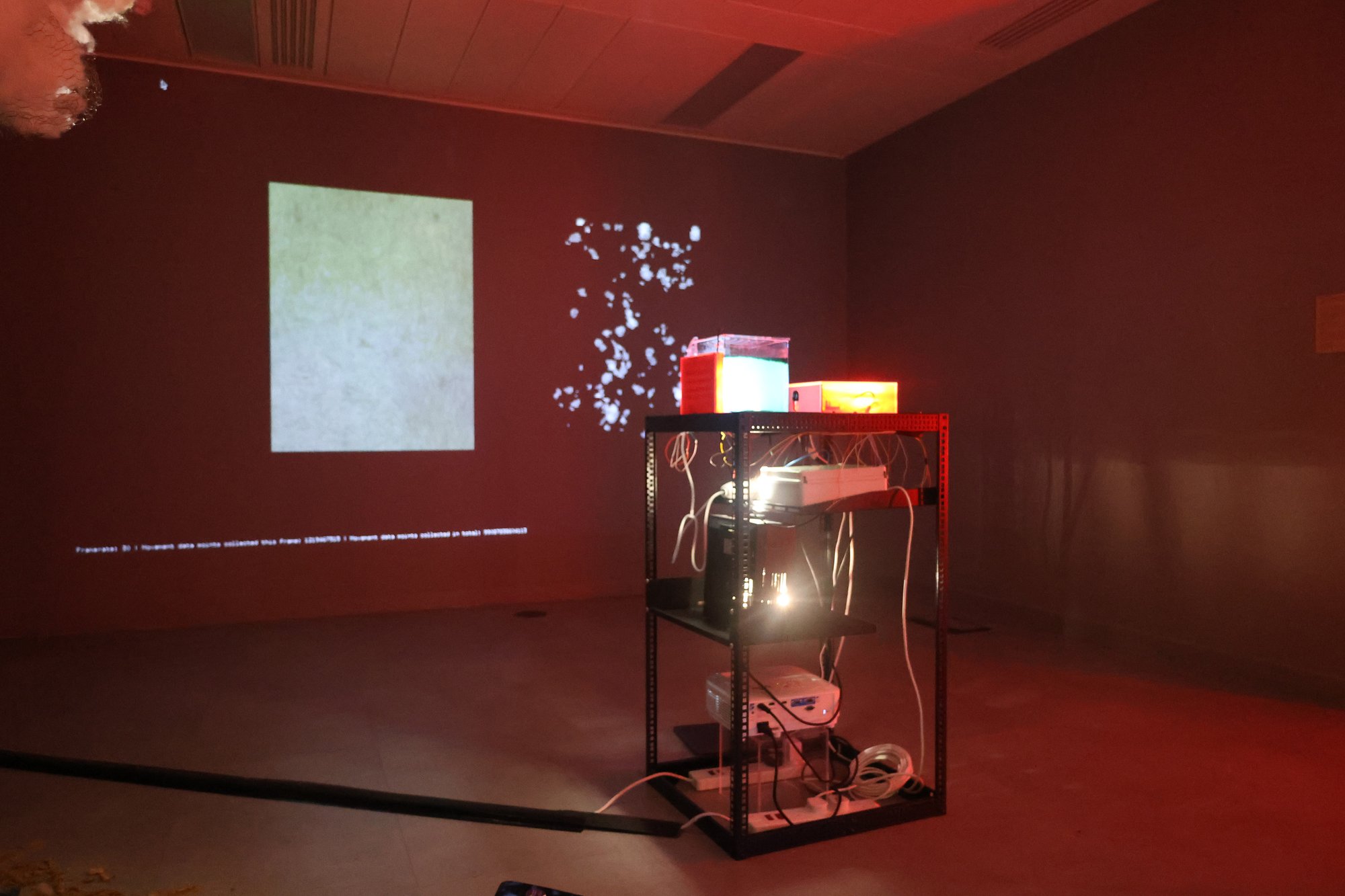
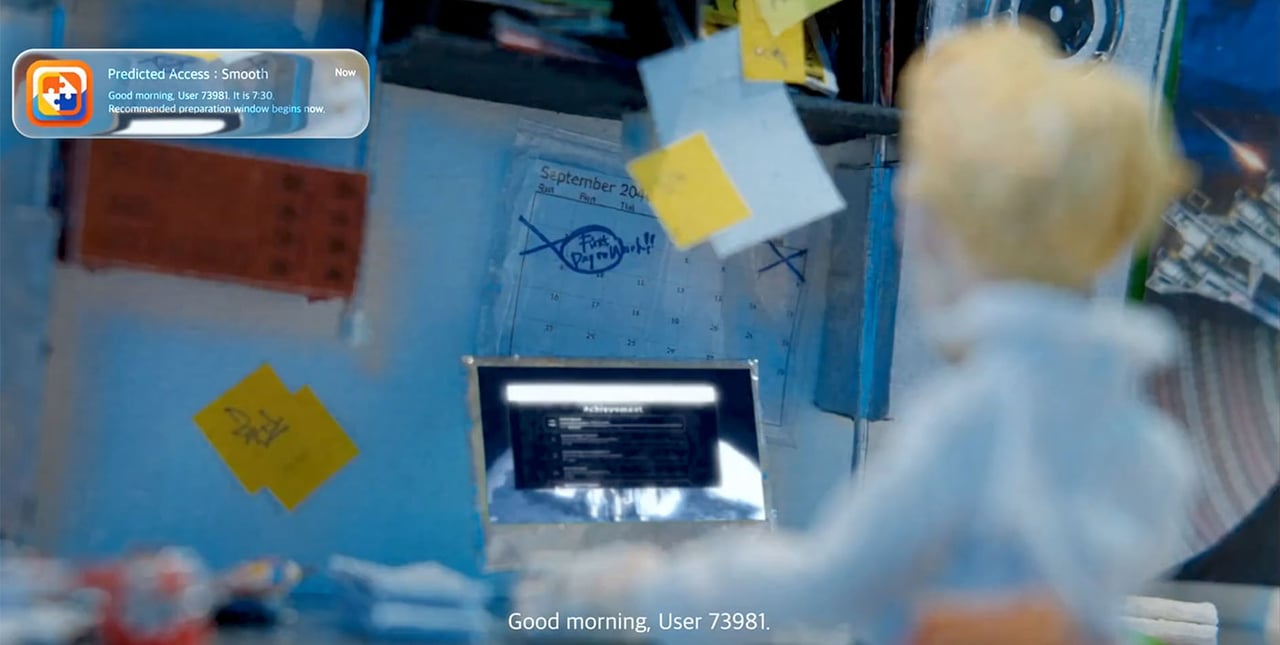
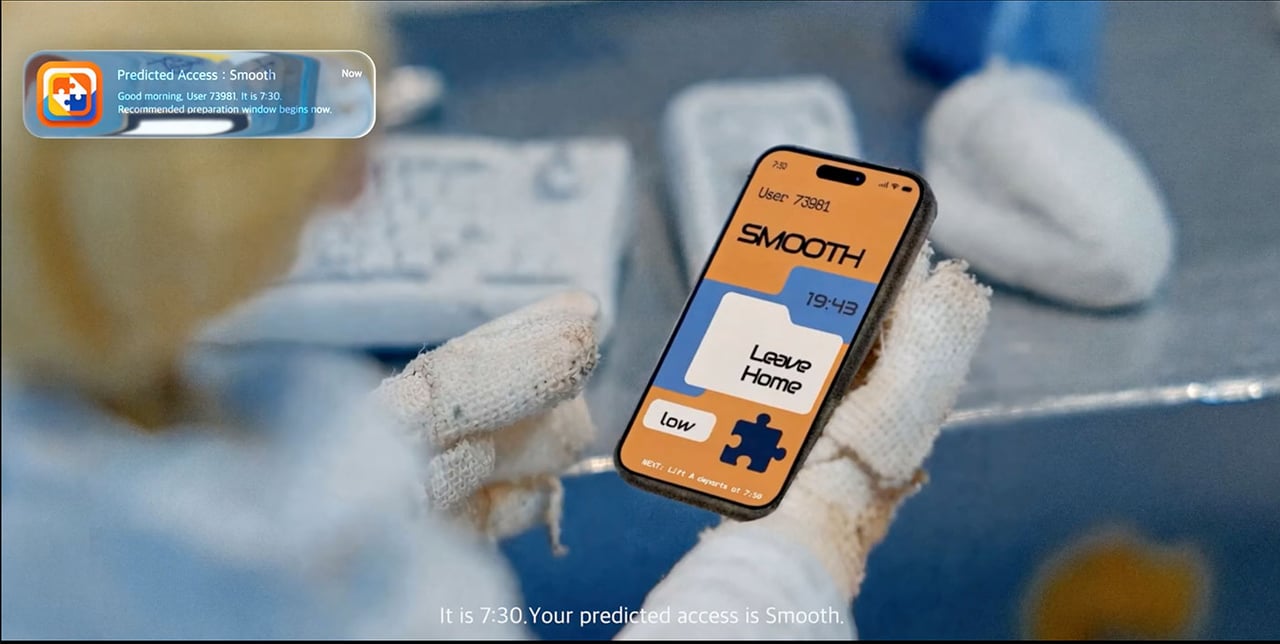
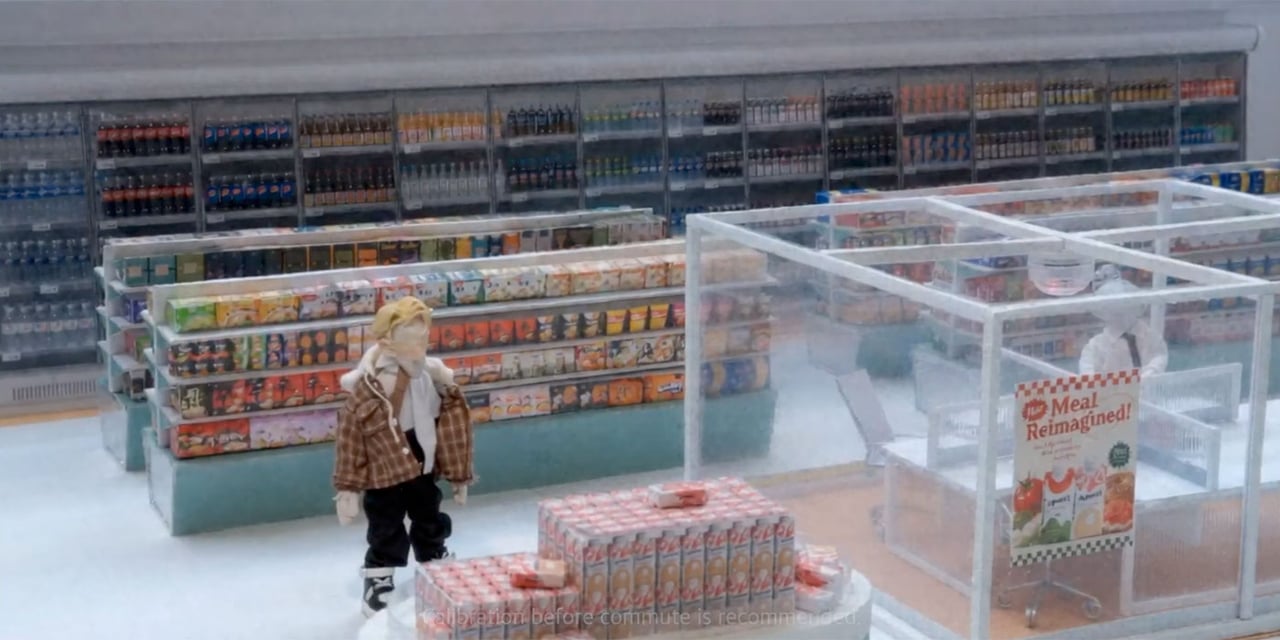
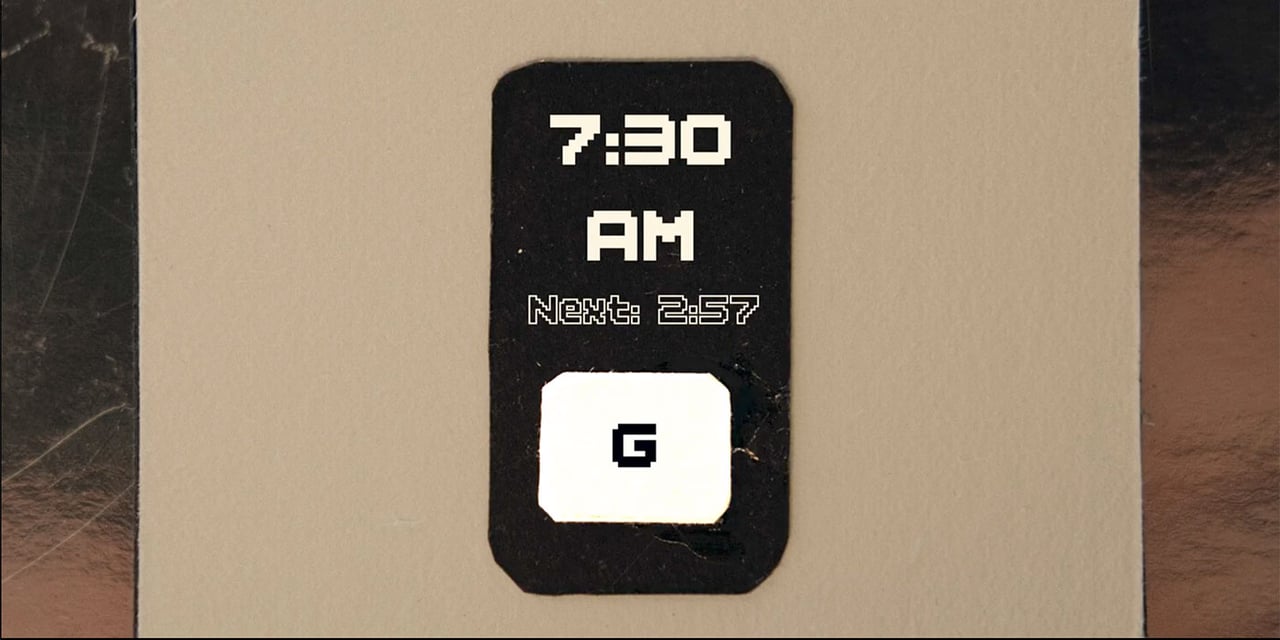
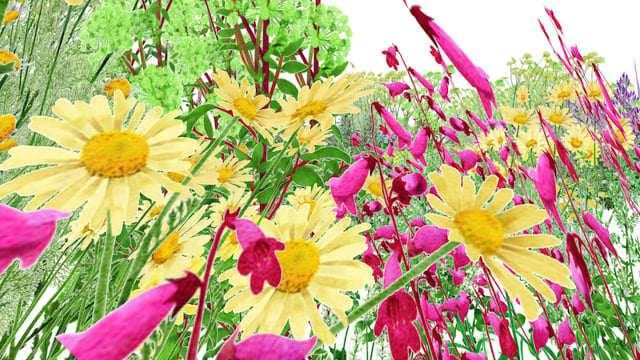
Hanna Park, Cupidastic: Can microplastics hormone disruption be turned into future love sparks?, 2025. Photography, physical prototype. Courtesy of Hanna Park
Designs On the Future
Scholars from the Royal College of Art are rethinking design for the age of AI and its asymmetries of imagination
Since the turn of the millennium, The Royal College of Art (RCA), London, has become a test bed for hybrid creative practices that sit between traditional fine art and design.
For the decade between 2005 and 2015, the design duo Anthony Dunne and Fiona Raby turned the concept of “critical design” — design as a form of critique — into a frame through which to imagine alternative futures. It is no coincidence that a number of graduates of their “Design Interactions” program, including Troika, Sputniko!, and Alexandra Daisy Ginsberg, have gone on to become successful contemporary artists rather than traditional designers, with many involving new technologies in their work.
Since Dunne & Raby’s departure, the RCA has continued to interrogate alternative realities across multiple schools and departments, spearheaded by a new generation of tutors at sites in Kensington, Battersea, and White City. This year, the university hosted its own RCA AI Festival in order to explore the intersections between artificial intelligence and creative practice.
Because of the tendency of AI models to inherit bad habits from their training data, the RCA is placing emphasis on designing AI in a way that is inclusive for all, while questioning its asymmetries of imagination.
Given the university’s incubation of critical approaches to emerging technologies, Right Click Save’s Founding Editor, Alex Estorick, invited four faculty members to share how they think about designing the future in an age of deep pessimism. The four participating scholars are Elise Hodson, academic lead for the Masters of Design in Design Futures; Fernando Galdon, tutor in Innovation Design Engineering; Carolina Ramirez-Figueroa, senior tutor in Information Experience Design (IED); and Gem Barton, Reader in Design Pedagogies & superFUTURES lead Interior Design MA. They begin by sharing responses to a recent provocation from Dunne & Raby.
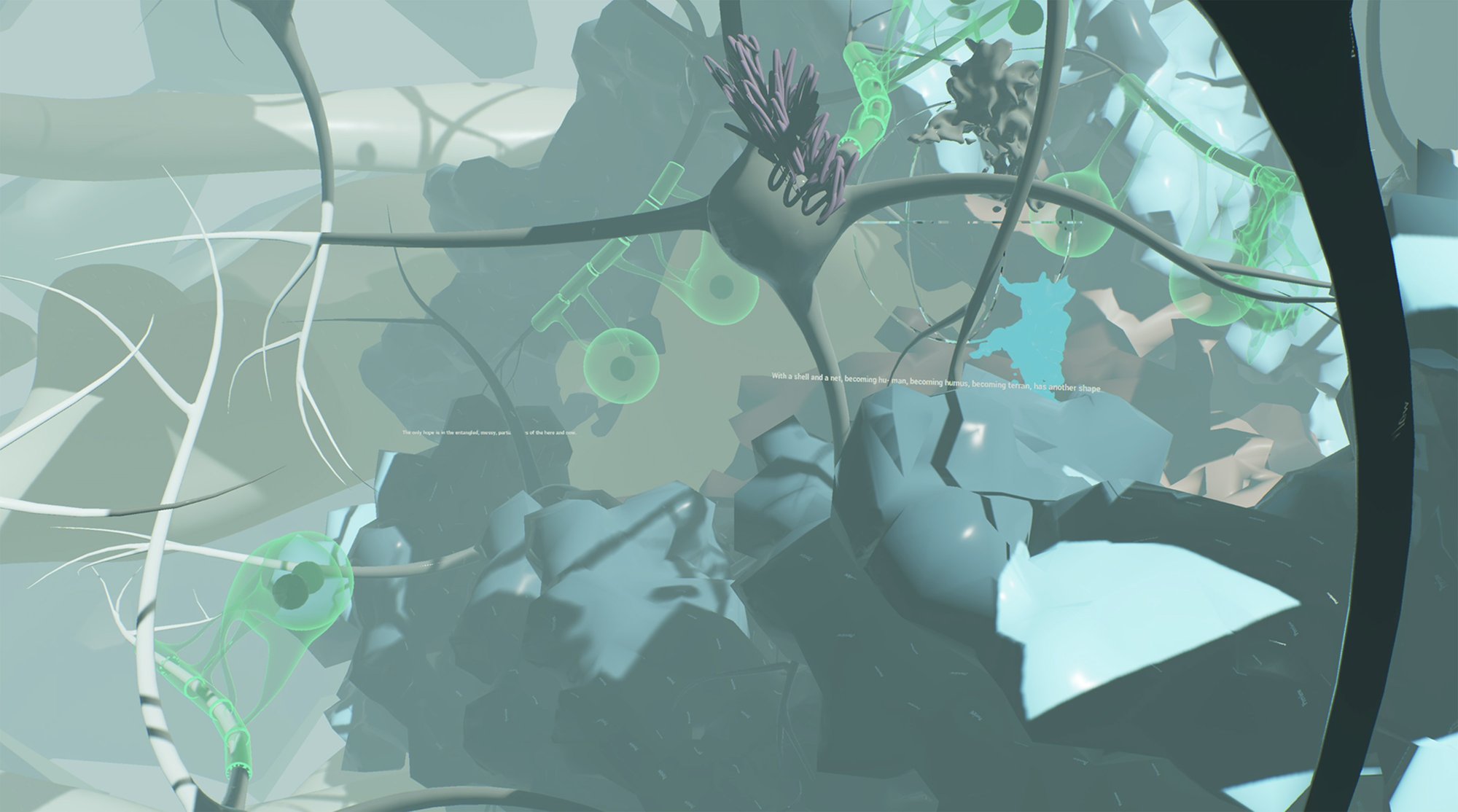
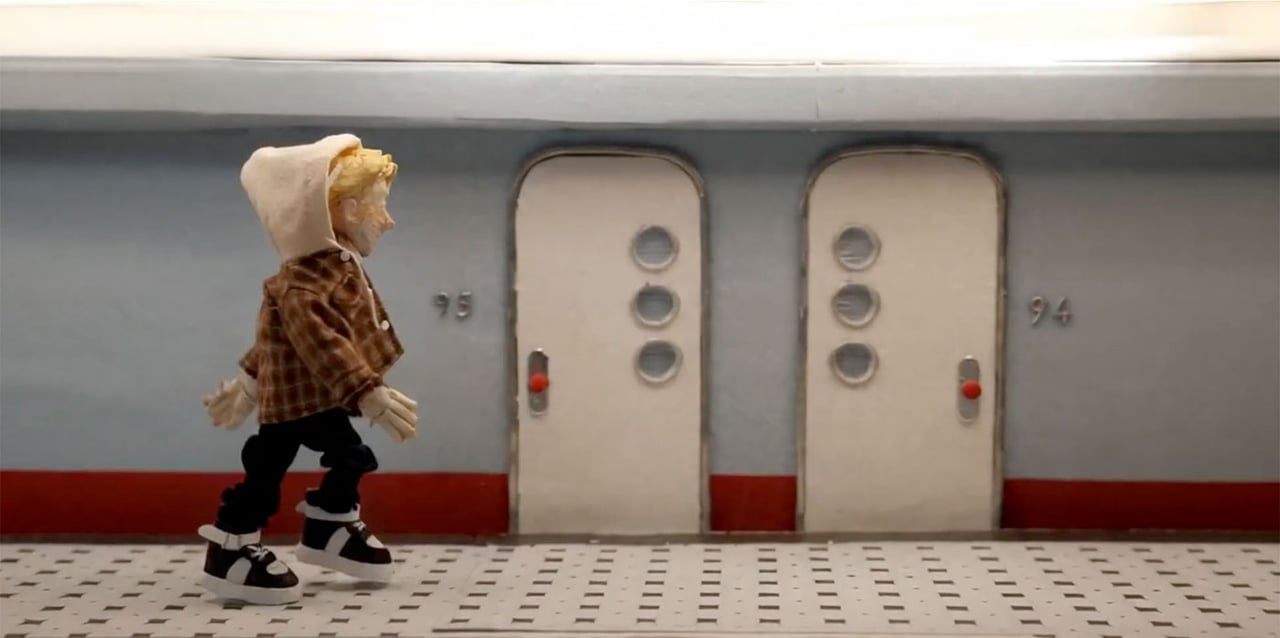
Jane Lee and Seonbin Yun,(Still from) Micro Dérive, 2024. Courtesy of Jane Lee
“The future as a concept for facilitating imaginative thought, in design, has become too restrictive.”¹
— Dunne & Raby
Fernando Galdon: My feeling is that this quote refers to their latest book, Not Here, Not Now (2025), where they position design as a way of understanding reality. They are collapsing space and time (hence the title Not Here, Not Now) to give them a different kind of setup in order to imagine otherwise. There is an advancement in the way that they are positioning design as a way of doing philosophy.
We have two books in the area. [Not Here, Not Now and] Brian Dixon, Philosophy Through Design (2026). The two books have different interpretations of what is reality; in Dunne’s it is the fabric of existence, and for the other it is about values. The first is speculative, the other is pragmatic. These are the two main schools of thought. The second would trace back to [the design theorist] Tony Fry and the other to Tony Dunne. I’m writing a paper, which is going to be a prelude to both works. In terms of the future and whether it is too restrictive, I think the future’s problem is that it is not restrictive enough in the sense that it is very difficult to control the speculation, which normally ends in fantasy.
Talking last year to James Auger, who wrote his Speculative Design thesis at the RCA in 2012, he commented that he was pivoting into this idea of reconstraints — the idea of using constraints to control the speculation. Today, futures are at an intersection with policy and governance, and therefore need to be more grounded. I understand what Dunne & Raby are doing. In their context, the future is too restrictive, but in traditional futures, I think it is too loose.
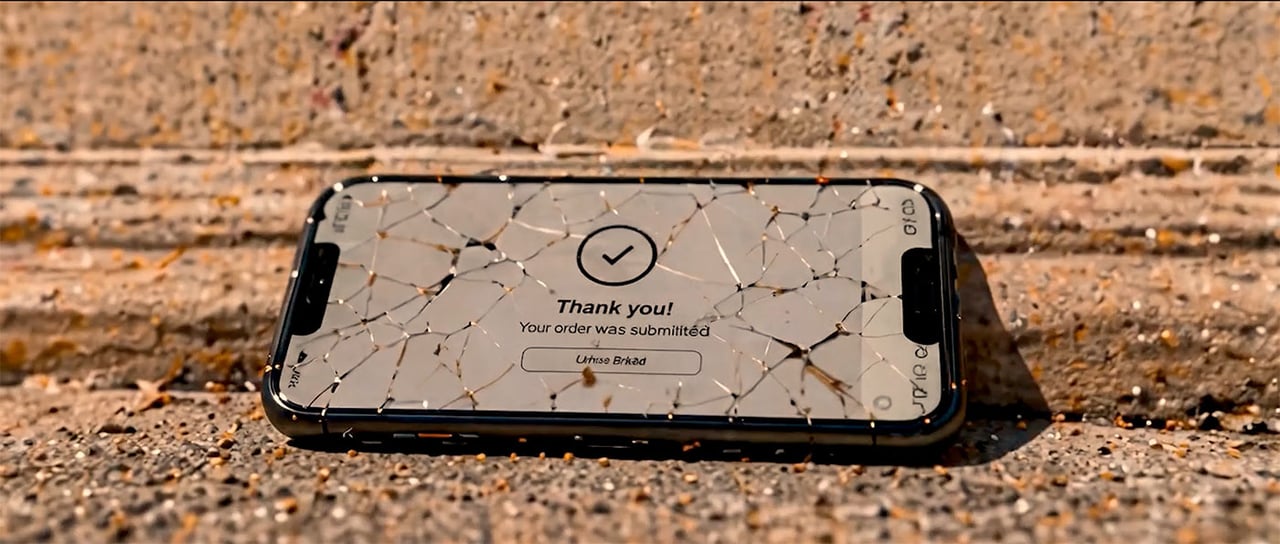
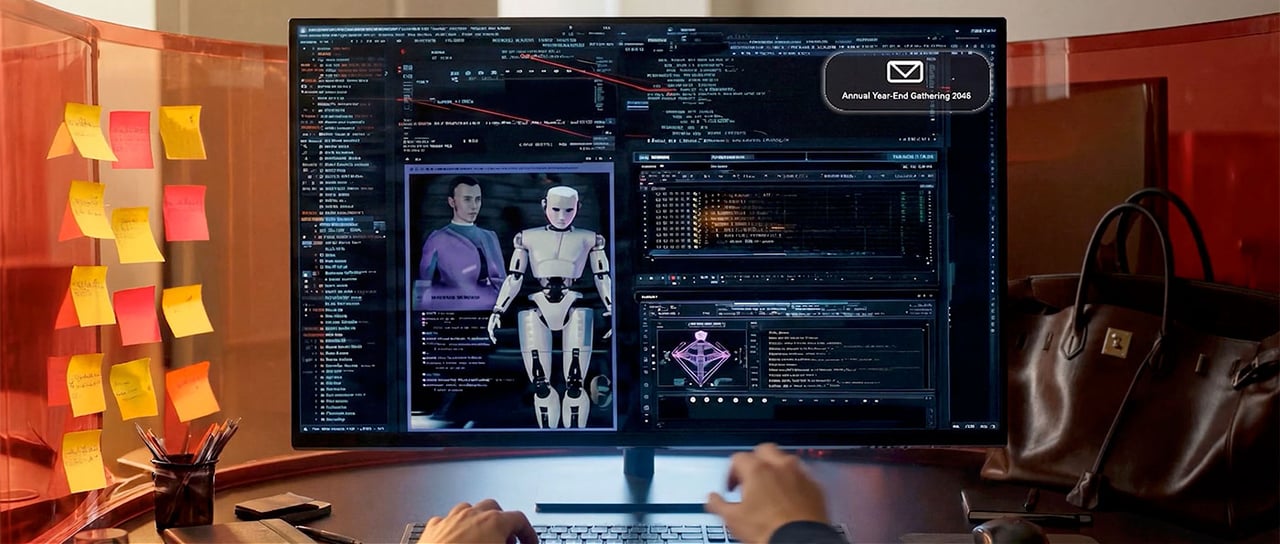
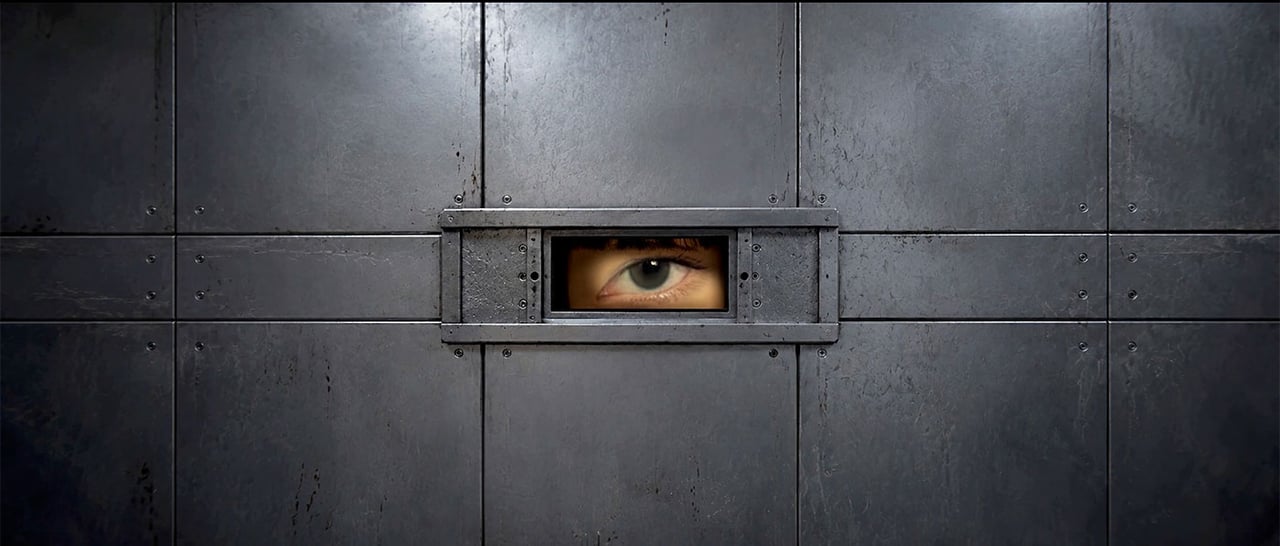
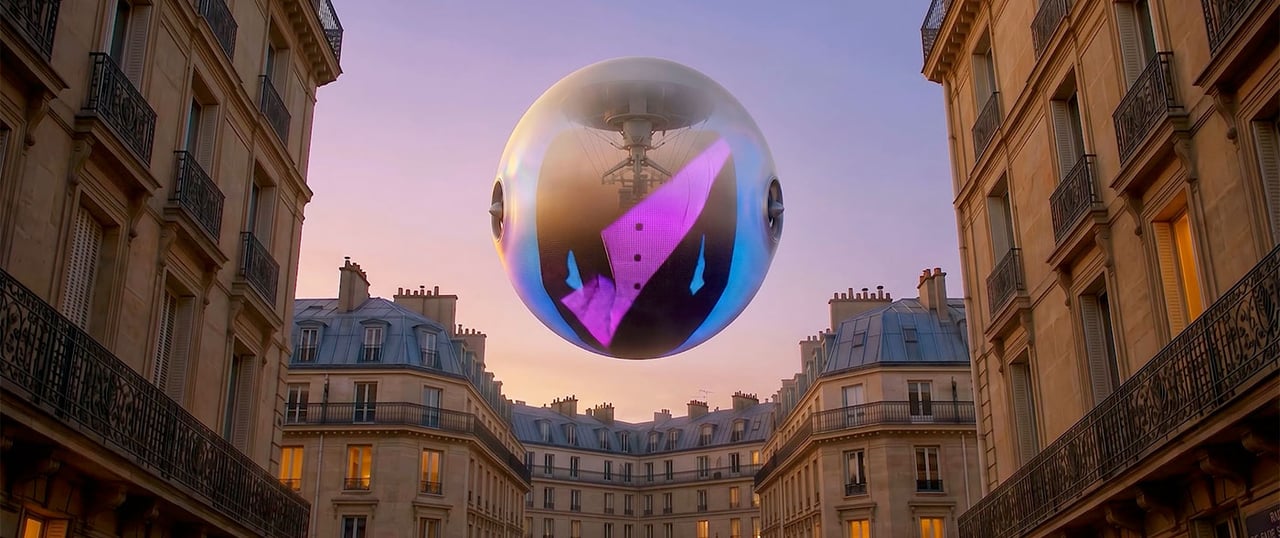
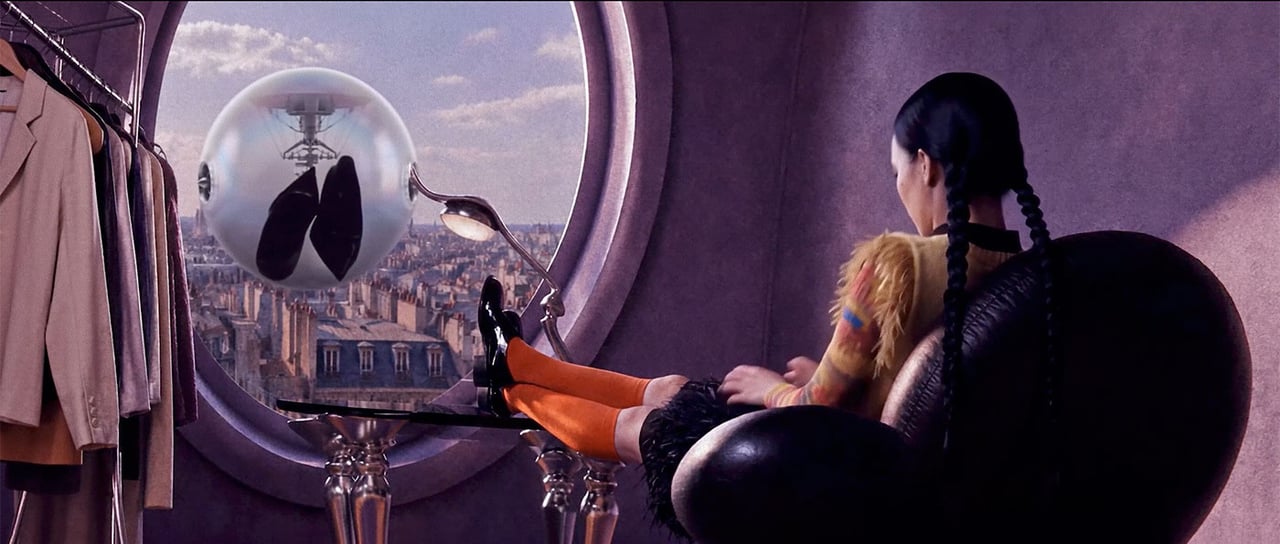
Seyoung Lee,(Still from) 404 Not Found, 2025-26. Courtesy of Seyoung Lee
Seyoung Lee,(Still from) 404 Not Found, 2025-26. Courtesy of Seyoung Lee
Seyoung Lee,(Still from) 404 Not Found, 2025-26. Courtesy of Seyoung Lee
Seyoung Lee, (Still from) 404 Not Found, 2025-26. Courtesy of Seyoung Lee
Seyoung Lee,(Still from) 404 Not Found, 2025-26. Courtesy of Seyoung Lee
Gem Barton: For me, it is not “the future” as a concept that has become too restrictive, but rather that design has limited ways of engaging with the future. I am particularly interested in the role of design in/of futurity: the conditions that determine what can be imagined, whose futures become legitimate, and what design is able to rehearse in the present. I believe this is where they have the potential to become radically expansive again.
Elise Hodson: For me, it’s design that is too restrictive in some ways. In the new MDes Design Futures, we’re up against legacies of design disciplines and approaches that are very well defined in people’s minds. Design is now going in many different directions, such as policy, creating new outputs that don’t necessarily look or behave in the ways that people expect of design. We don’t fit those models anymore, but we are also figuring out what design can do in relation to established and emerging futures approaches, both in design and other fields. Sometimes the future can seem restrictive to design students in the sense that it’s too open-ended and the uncertainty and ambiguity of designing for the future can feel uncomfortable, or out of scope.
Carolina Ramirez-Figueroa: For me as well, it has to do with the design imaginary of the future. We still have a very dominant Western modern idea of the future, where we think about time as linear, as something that moves forward, and where the idea of innovation drives progress. Humans are seen as the primary agents of change. I think a lot of this is still tied to the idea of the future as something that can be designed, controlled, and optimized. For me, that’s what is quite restrictive.
It’s not so much design itself that is restricting the imagination, but rather the dominant idea of design that we still have, one that is very much shaped by Western modernity. Alongside this restriction of imagination, there’s also the question of the asymmetry of imagination: who is allowed to imagine, in which contexts, and why?
In my research, and in my work with students, we often talk about which geographies are allowed to imagine the future, and which ones have a future imposed upon them. That future is then presented as opportunity, ambition, and progress, and they are expected to catch up to it. It becomes restrictive because there’s no space to aspire to something else; the future is already given.
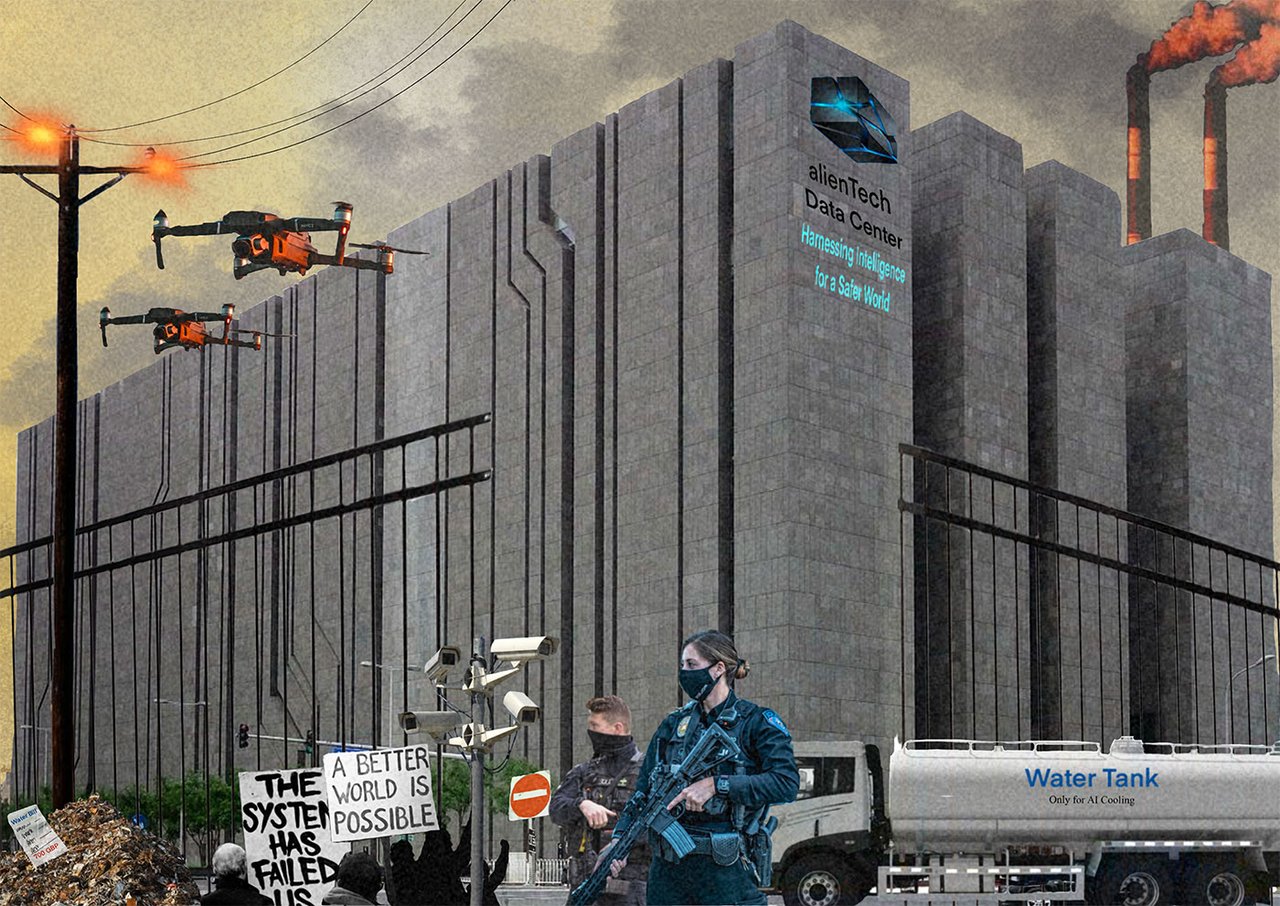
Asmita Mehta, Before the Lock In: Rethinking the future of AI infrastructure in the UK and Ireland, 2025. Courtesy of the artist
EH: That resonates with this idea that the future is already colonized, that it’s already predetermined. And who has predetermined it? Is it big tech? A wealthy elite? The underlying logics can be difficult to see but dominate how people perceive the future.
FG: But that was the approach of Tony Fry in [Defuturing, 1999], no? The idea of defuturing, which actually is refuturing. Which is kind of interesting. I think James Auger is also pivoting in that direction.
In practice, what we have seen is a contextualization of the future. It’s being anchored in regions and constraints, which is the way of framing the imagination within specific sensitivities. But then it’s different from the way that Dunne & Raby want to approach the imagination as making reality or understanding the fundamental fabric of reality. I think it depends on how you use it. Design has expanded so much since the 2008 financial crisis that now we have all these possibilities, and for me, this is the most interesting thing about all this.
My feeling with the maxim we are discussing, this quote, is that it embodies a very specific advancement that Dunne & Raby have made, where they position design in a very sophisticated position never thought of before.
This contrasts with the advancement that they made in 2007 which is now becoming mainstream, with the management consultants McKinsey or the fashion brand H&M hiring speculative designers. That was absolutely unthinkable back in 2008, and that wasn’t the plan Dunne & Raby were envisioning at the time. If you read their a/b manifesto (2009-onwards) it is absolutely clear. But this is how it has been evolving. When you put these tools in the wild, they start to evolve with the affordances of the system.
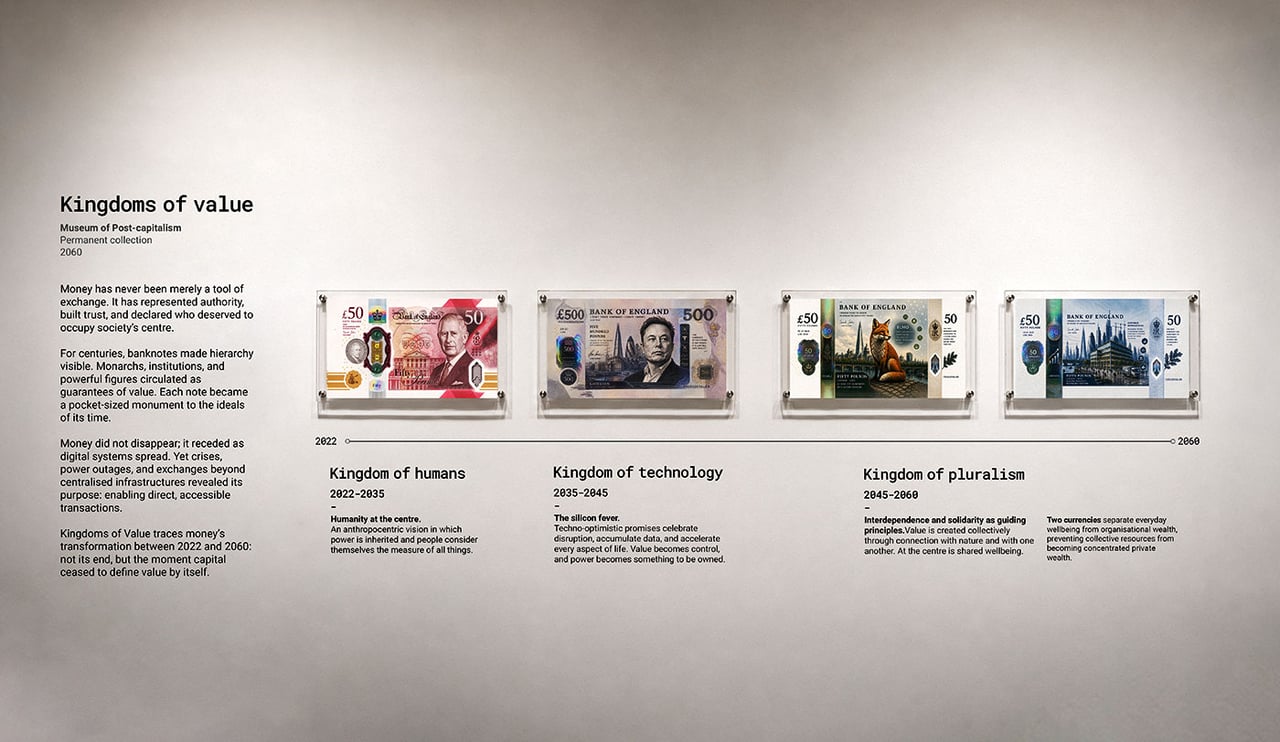
Atahualpa Badillo, Post-capitalism — Imagine a world beyond capitalism in 2060, 2025. Courtesy of the artist
I think what we have to celebrate is this multiplicity of options to implement change. In the RCA we have published eight PhDs on futures between 2012 (James Auger) and 2022 (Joanna Schmeer). We have five PhDs on different methodologies, expanding this idea of who is entitled to make that representation and then whether we need to understand the speculation or not. And then three variations within Speculative Design, which focused on new methods within the methodology; Alexandra Daisy Ginsberg, Austin, and Anima. So it’s been eight PhDs in ten years.
EH: In the Design Futures program, there’s a lot of discussion about different perceptions of time and different perceptions of the future. How do you think about the future from the perspective of nature? Different cycles, different shapes of time — cultures that look backwards to see the future. It’s really fascinating to think about this. One of the models is the Entangled Time Tree (by Terry et al., 2024). This really captured the imagination of the students. How do you bring in multiple histories, presents, and models of the future branching out of one tree? The “Futures Cone” might be in there but there are other models and they all have to coexist.
FG: I think the Cone was very instrumental. It is like the Double Diamond for design thinking. It can explain in a simple way the idea of the future for designers to implement when they go into practice. In reality, it’s a little bit more complicated, and you have to make adjustments to address cultures, identities, and the context. But I think it’s useful. Now, are you saying it is evolving towards a branching tree?
Yuhe Hu (Wendy), Today is 32nd, 2024. Courtesy of the artist
EH: Yes. The Entangled Time Tree is quite organic. It doesn’t look anything like a future cone. It doesn’t go left or right. It’s not linear. You start your project by thinking about the multiple paths of different actors and then they all emerge at a point in the ground. And then the tree goes off in many ways and in many shapes.
FG: But then how do you make a decision? That’s my problem with transition design. They make these beautiful maps. But then you have 100 elements in there, which then you need to design. If each of them needs ten design interventions, that means you have 1,000 interventions. How do you start? What is the criteria for starting the intervention to make that change? Because at the end it’s all about that.
CRF: Yeah, in Information Experience Design, I run the Interspecies Entanglements Field Collective, and a lot of what we do follows the kind of [Entangled Time Tree] model you’re describing. It’s very much about temporalities, but also about relationality. In IED, we work a lot with systems and information, navigating complexity and looking at it across different scales.
One of the things I do with my students is work across the micro, meso, and macro scales. We start by looking at histories, and not just human histories because, as I said, the whole idea is around interspecies thinking. How do we connect beyond the human, and how do we decentralize the human?
We begin with histories so they can develop a timeline of the past. Then they situate themselves in the present at the macro scale of communities and examine how they actually relate to one another. That involves a lot of observation. Finally, at the micro scale, they focus on a particular place, situating themselves within it both spatially and temporally.
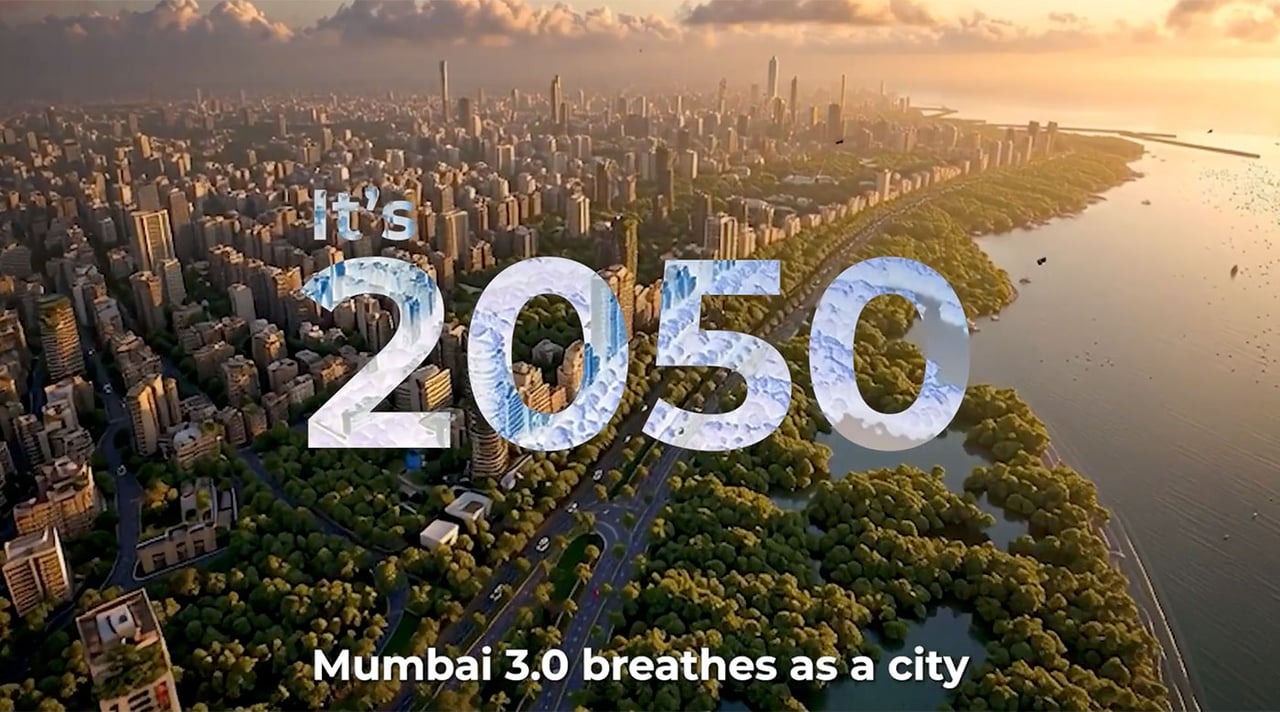
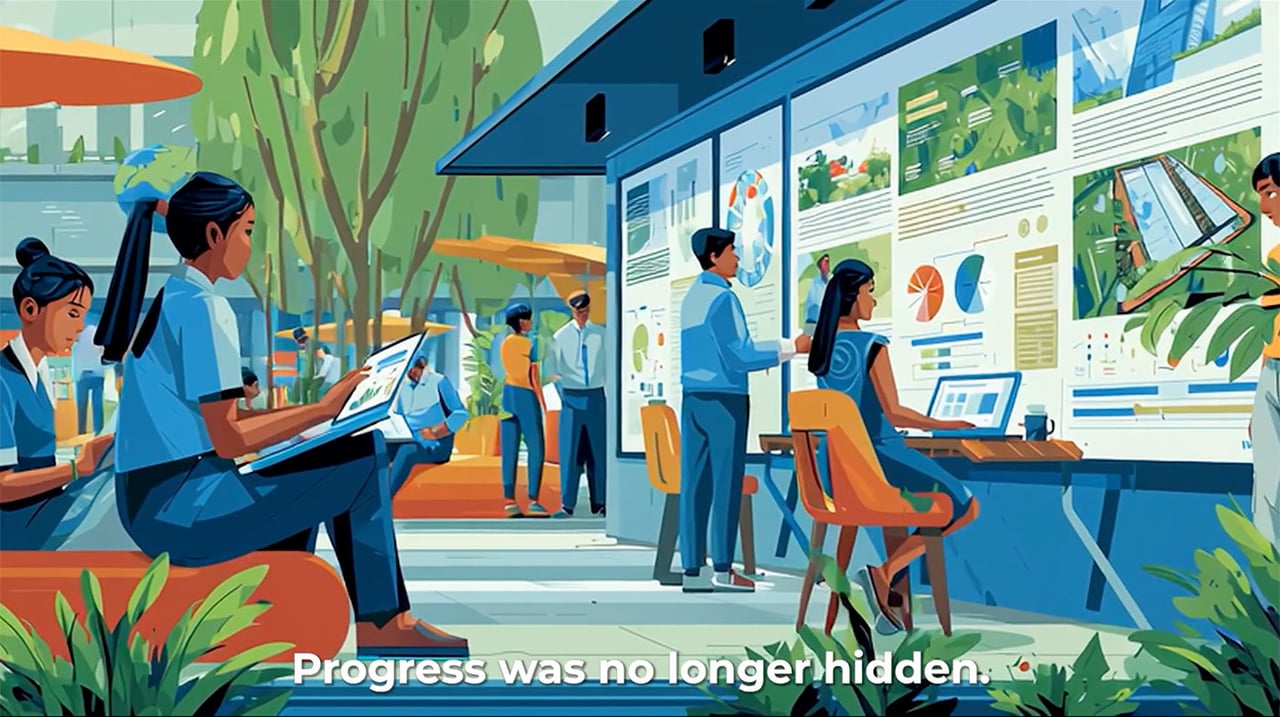
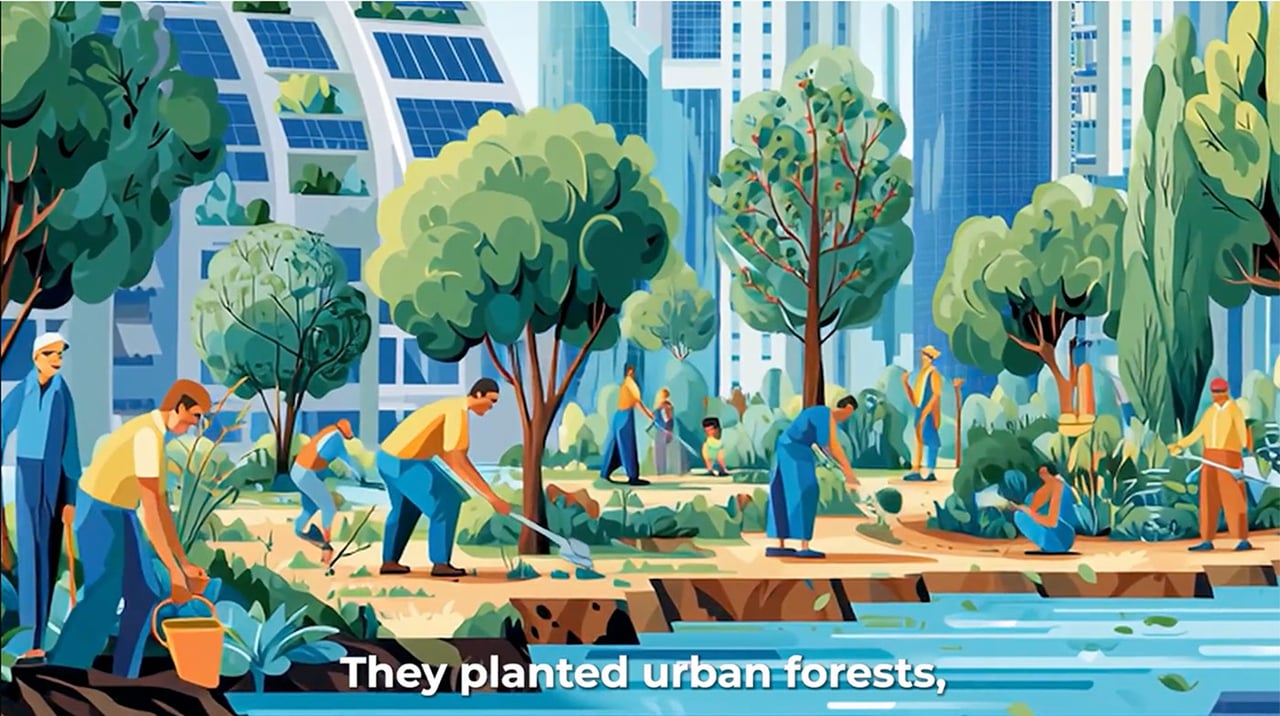
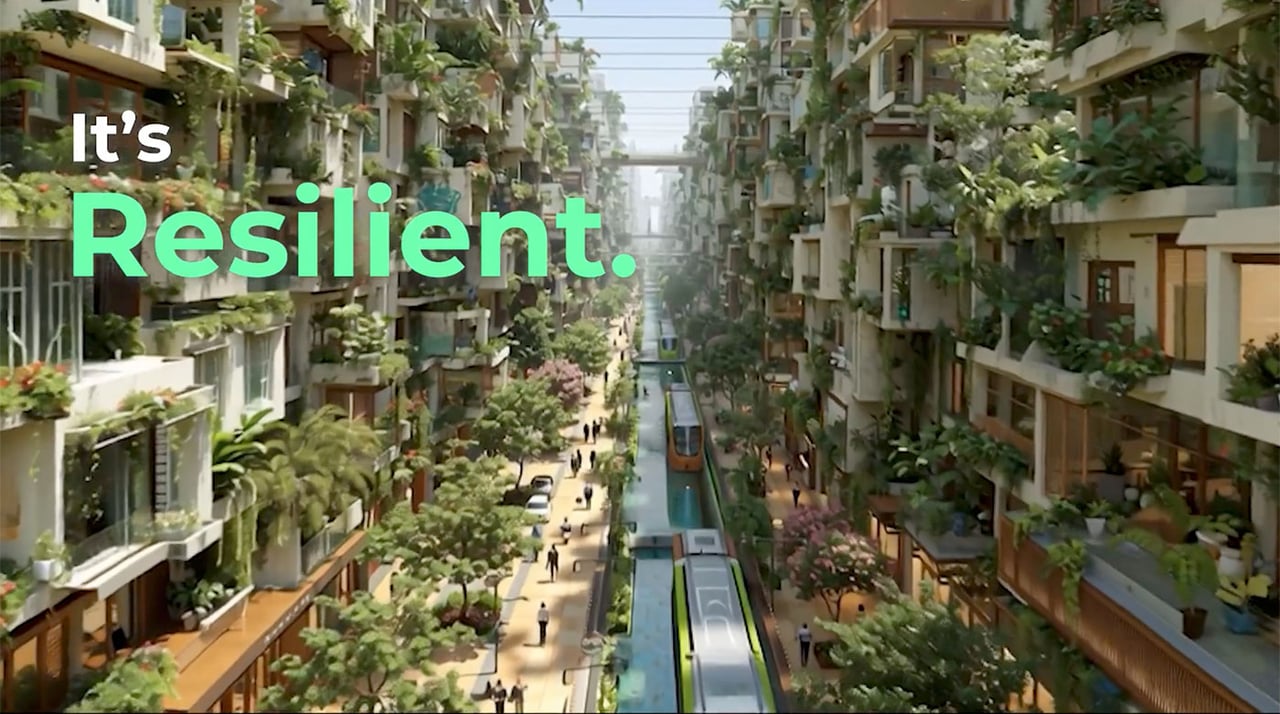
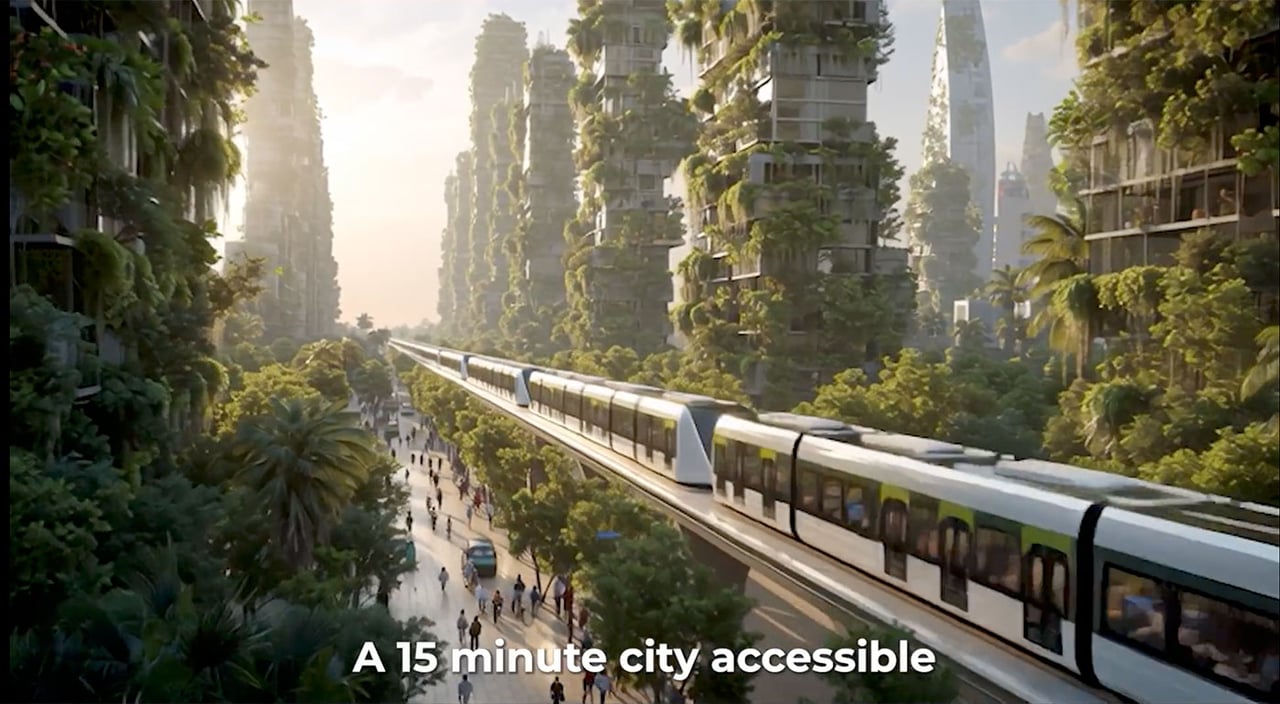
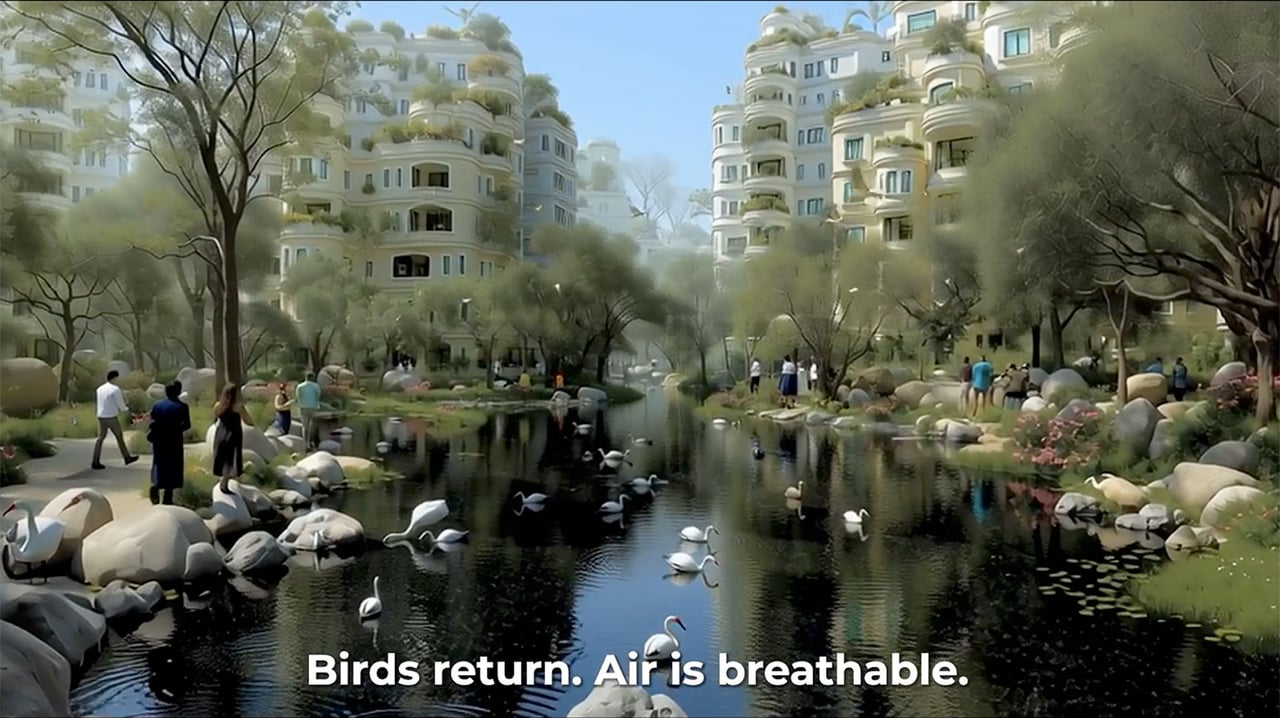
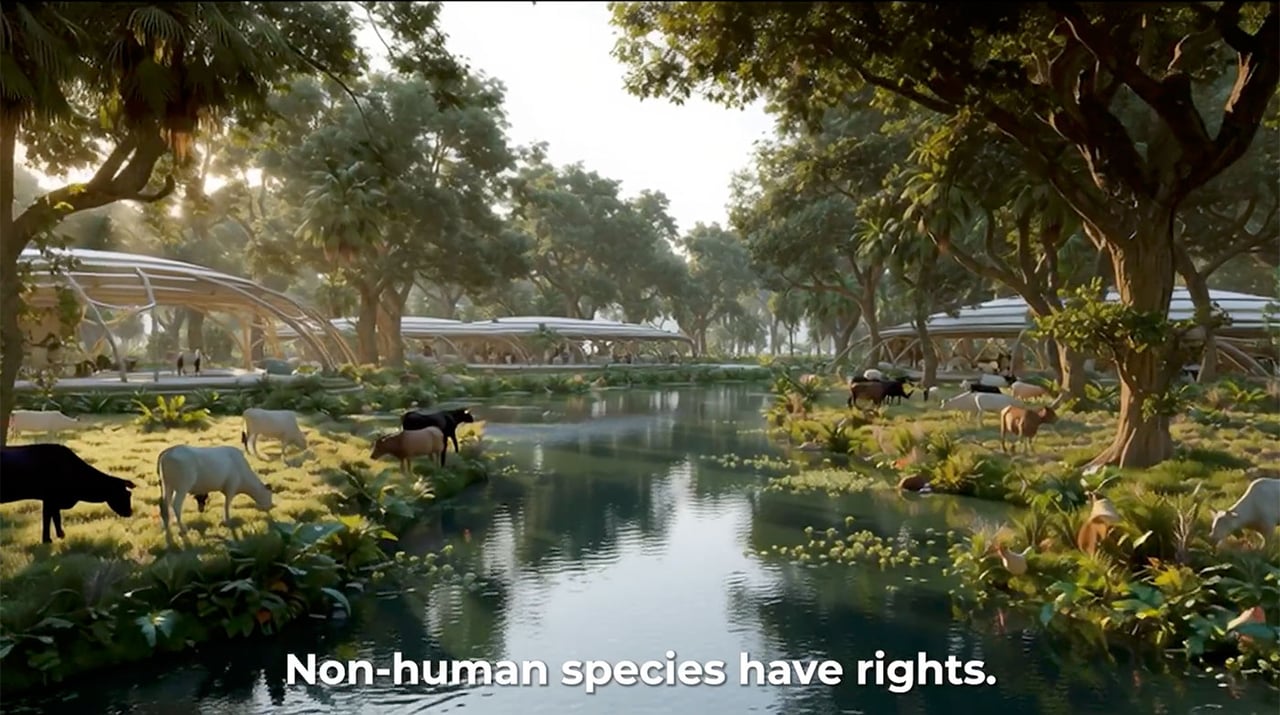
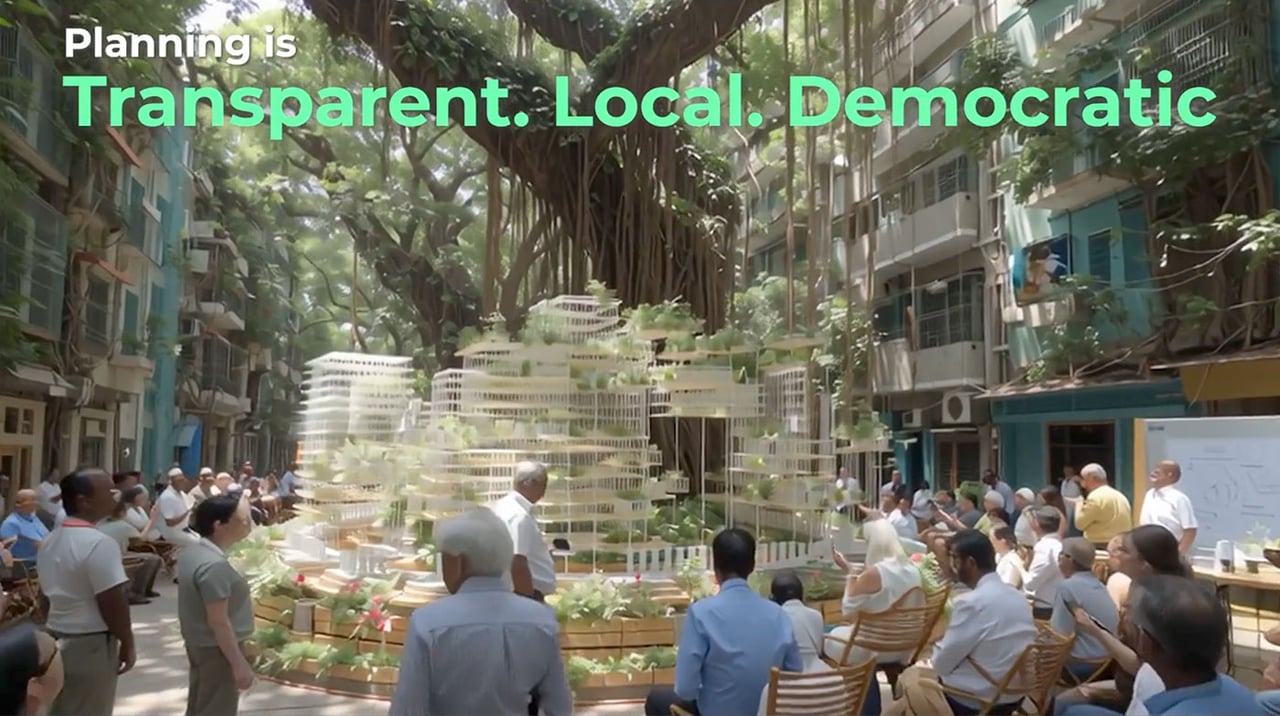
Sanyukta Mathure,(Still from) Breathing Futures: Envisioning the Future of Urban Resilience for Mumbai 3.0, 2025. Courtesy of the artist
Sanyukta Mathure,(Still from) Breathing Futures: Envisioning the Future of Urban Resilience for Mumbai 3.0, 2025. Courtesy of the artist
Sanyukta Mathure,(Still from) Breathing Futures: Envisioning the Future of Urban Resilience for Mumbai 3.0, 2025. Courtesy of the artist
Sanyukta Mathure,(Still from) Breathing Futures: Envisioning the Future of Urban Resilience for Mumbai 3.0, 2025. Courtesy of the artist
Sanyukta Mathure,(Still from) Breathing Futures: Envisioning the Future of Urban Resilience for Mumbai 3.0, 2025. Courtesy of the artist
Sanyukta Mathure,(Still from) Breathing Futures: Envisioning the Future of Urban Resilience for Mumbai 3.0, 2025. Courtesy of the artist
Sanyukta Mathure,(Still from) Breathing Futures: Envisioning the Future of Urban Resilience for Mumbai 3.0, 2025. Courtesy of the artist
Sanyukta Mathure,(Still from) Breathing Futures: Envisioning the Future of Urban Resilience for Mumbai 3.0, 2025. Courtesy of the artist
EH: Speed has become a new interest this year among the students. We have a student who is looking at the pace of urban development, looking at Chinese work culture and how you slow down, and use rest as resistance. And then another who’s looking at the long-term maintenance of high-rise council buildings; the kind of mundane acts and investments in the future, the speed of care and repair versus the speed of decline if you let something go for too long. If there’s no upkeep, buildings that could last a century have their lives cut short, torn down for new developments, creating huge disruptions for residents and their long-term stability. [Students are] overlaying different timelines to understand relationships between the lives of buildings, humans, communities.
FG: But that’s interesting. It’s almost an evolution because the first iteration of the future was very much technological (Critical and Speculative Design). Then, the second wave became much more focused on the social, the intersection with policy and participatory (Co-Speculative, Cybernetics, Prospective). And now what you are suggesting is that there is a third wave, which is much more focused into nature and biology logics (Xeno, ….)
CRF: That third wave, the biological, the more-than-human, is precisely where Interspecies Entanglements sits, and I’d add it’s not just a new subject matter, it’s a new ethics of authorship.
Once a fungus or a microbe has agency in the project, the designer stops being the sole author.
EH: One of the very simple but poetic projects last year was about plankton. It was called Living in Plankton Time (Yike Chen, 2024-25), and it was about multispecies temporality. The student looked at tides and the rhythms of plankton, how humans might move beyond an anthropocentric idea of time and coexist with natural cycles. She looked at the life of plankton, nutrient flows, seasons, how plankton moves through the ocean and when, and the ecosystemic impacts when it is disrupted.
Nahuel Basterretche, Culture Mining, 2024. Courtesy of the artist
The decision point came from how we rethink human activity in the ocean to accommodate plankton time. [The student] created a calendar and a manual, covering things like when ships should travel, or minimize light and sound pollution, reorienting human life around nature’s timelines.
FG: For me, the golden era of design interaction is between 2008 and 2015. It became the main practice after the banking crisis, because after the collapse of the system, we needed a critical space to propose alternative views.
For me they are the hinge between the applied art component of design, that comes from William Morris, in which you are an author, and the transition into much more applied sciences, with the social sciences being the main thing, which is more about impact. They embodied the two souls in that period. If you see the work of James, Anthony, or Fiona, you see the two elements intersecting. They have the sociology and they have the element of authorship. After 2015 the authorship element started to dissolve much more into the collective. And then sociology became much more dominant than art. Currently, and probably consequently, I think there is less emphasis on aesthetics in Design. The methodological turn is affecting this element. Now I’m experimenting with the idea of exo-aesthetics, but it’s still in its infancy.
CRF: I’m so glad you mentioned aesthetics because students come in wanting to do projects using speculation or futures, but there’s still this huge legacy of the aesthetic that Dunne & Raby established a long time ago. It’s a very modernist aesthetic: clean, white, gallery-like, very controlled. There’s still this assumption that this is what future-oriented design should look like. It takes quite a while to move beyond that and ask, “OK, where do these aesthetic representations actually come from? What values do they embody?” It’s important for students to understand that speculative or futures work isn’t defined by a particular visual language. It’s much more about the methods, the questions you’re asking, and the way you’re approaching the work.
Valentin Schmidhuber, (Still from) Day Zero, 2025-26. Courtesy of the artist
The challenge is that those earlier aesthetics are still incredibly desirable and recognizable, so students often default to them. But newer approaches have very different aesthetics. They can be messier, more situated, less clinical, and less polished. They don’t necessarily land as immediately because they don’t carry the same visual legacy, but in many ways they’re much more aligned with the kinds of futures we’re trying to explore.
In Information Experience Design we have a very phenomenological approach to the world. It’s all about how we experience it through our senses — sight, touch, taste, and smell — and how that connects with emotion, cognition, and culture. The whole idea behind the program is that experience is not neutral. It’s shaped by personal histories, social environments, and the spaces we inhabit. We see experiential design as a practice that creates spaces, objects, and systems that allow people to engage with different forms of information in meaningful ways.
We bring together a range of strategies. We work with storytelling, technology, and psychology, and we also use a lot of systems thinking because we’re interested in different ways of engaging with information and shaping it in ways that can open up new forms of understanding.
I run Interspecies Entanglements, which is focused on relationality and on decentering the human. My colleague Nestor [Pestana] runs a unit called Impossible Futures, which challenges current norms through worldbuilding. We also have colleagues working on future cities and other themes. But what connects all of these is the experiential lens. The question is always: how do we inhabit these possible futures in meaningful ways?
Aaliyah Mohammed, (Still from) Emily Zhou, Himanshi Gupta, Arian Ullah Mohal, The aesthetics of disguise, 2025. Courtesy of the artists
EH: Fernando, you kind of build out of IDE [Innovation Design Engineering] through your PhD.
FG: Yeah, I think we have been evolving over the last few years. We used to have a module which was called “X-Y”, and we used to do a lot of space-related interventions and interplanetary contexts. Now with the change of curriculum it’s much more pragmatic. We start with context and normally we give a real-world context, but within the future, that is going to have a range of social and political and climatic impact. Students need to design with those kinds of constraints. So it is open to social impact.
We are not implementing a technology-led approach, rather a context-led approach — technology that comes to service whatever is going to happen if it’s needed. That’s for IDE year one. And then in year two, if projects start to become too pragmatic, we do some workshops, sometimes using cartoons and comic strips. Sometimes, if students are not going green enough, we do a workshop called “The Green Dictator”.
GB: The major distinction between SuperFUTURES and what you two have just described is the spatial perspective. It’s situated in inhabited space. We’re in the school of Architecture. It’s one of the pathways through the MA in Interiors.
I often talk about architecture, futures, and queer theory as this ethically non-monogamous throuple — they all need one another, but none quite speaks the others’ language.
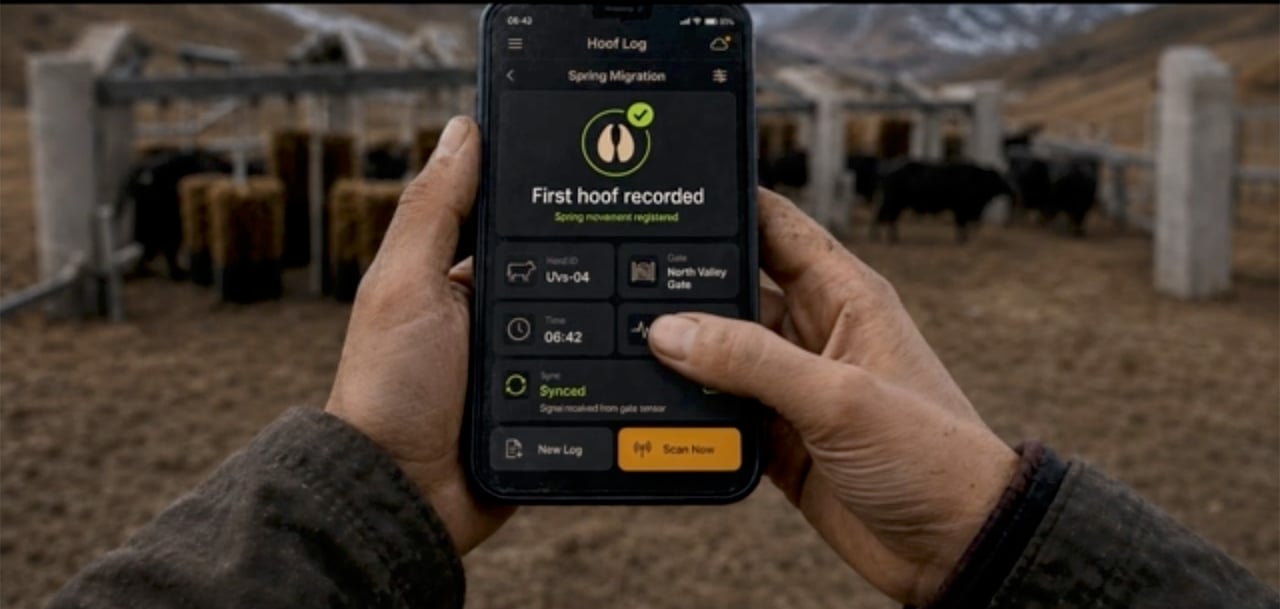
Xunuo Li,(Still from) Under the Hoof, 2025-26. Courtesy of the artist
We work through film with an experiential kind of methodology — spatial design within a filmic lens, not [only considering] the spaces that exist in the film, but film and cinematography as a spatial methodology, and film as a design method, querying all those definitions as you go.
There’s the underlying pedagogic question for me that sits inside my teaching and also inside my research: how do you teach care for things that don’t yet exist in this world where we’re all so blinded and deafened by the present?
How on earth am I supposed to put tomorrow’s next generation, or someone in a different country, or a version of humanity that I don’t yet understand or have never even thought of? How do I understand any of that? And how do we teach others to be open to designing for that or enabling those things? You’ll be hard pressed to find anything architectural or spatial. Nothing about home and domesticity. I’m internally tangled with the profession and the bodies that drive it at the same time.
EH: One of the things the students notice is that the faculty use the same terms to mean very different things. This is partly because we all come from different backgrounds, but also because there are so many interpretations of futures and so much overlap in terminology across fields. We are in a sense creating our own meanings now as the program develops.
You could say that our Design Futures program aligns closely with strategic foresight in terms of a process. It’s very research heavy. It has elements of IED in terms of visualization, technologies, storytelling, and experiences. All projects have to communicate multiple future scenarios based on primary and secondary research. In the end, they need to propose a preferable future and explain who it is preferable for, plus a theory of change.
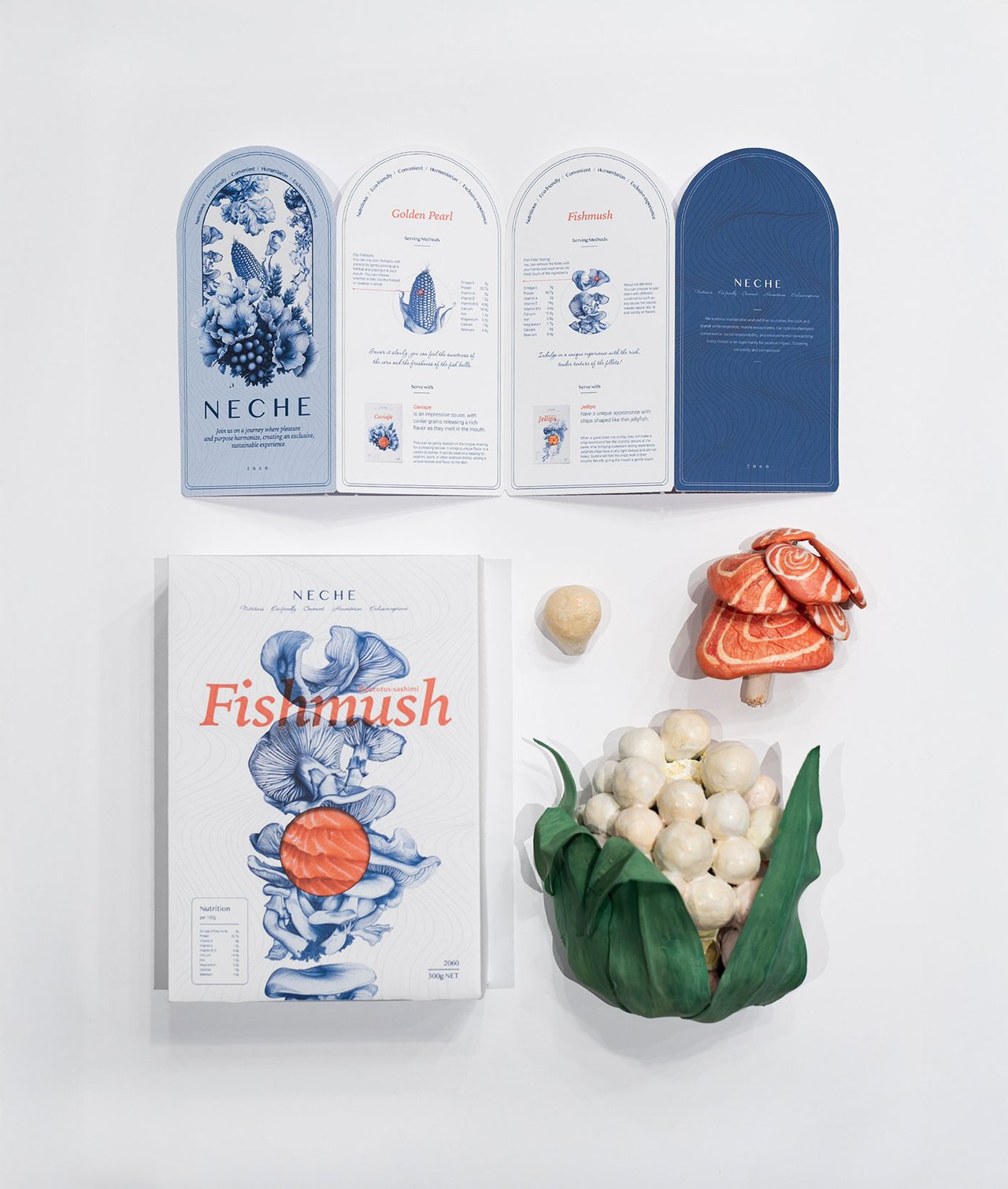
Sha Ma, Yitong Wang, Jun Zhuang, Ziyi Yuan and Xianzhuyue Li, Neche: sustainable seafood for overfishing futures — plants as growth medium for fish cells, 2024. Courtesy of the artists
Some of the best student projects are the ones that get stuck in the research. They end up focusing on facilitating conversations about the future, or first figuring out how to even bring people into conversations about the future. What tools do you need? How to engage people in thinking differently about the future, let alone come up with a plan for the future? How do we even start talking about the future?
CRF: When I was in Design Products and working within the Design Futures pathway, it was very much driven by a commercial output that had to be situated in the market, or at least demonstrate some form of impact. One of the things I noticed quite a lot with students, and why my pedagogy has changed quite significantly, is that this notion of the future often feels very detached from them. They tend to see it as something separate, something external that they have to influence from a distance. As a result, this idea of care doesn’t really come through. It’s quite difficult for them to understand how they themselves are implicated in it, or how relationality works in practice — how they impact, and are in turn impacted by, these systems.
EH: Many of our students choose topics that reflect priorities in their home countries, and we are learning as much from them as they are from us. More are starting to choose London as a context, but they often default to where they’re from.
Future means something different across the cultures in the class.
China has a 100-year plan. I had a student recently explain the country’s previous two five-year plans, and the next five-year plan, as common knowledge. I wonder what kind of impact that has on awareness and comfort with long-term thinking.
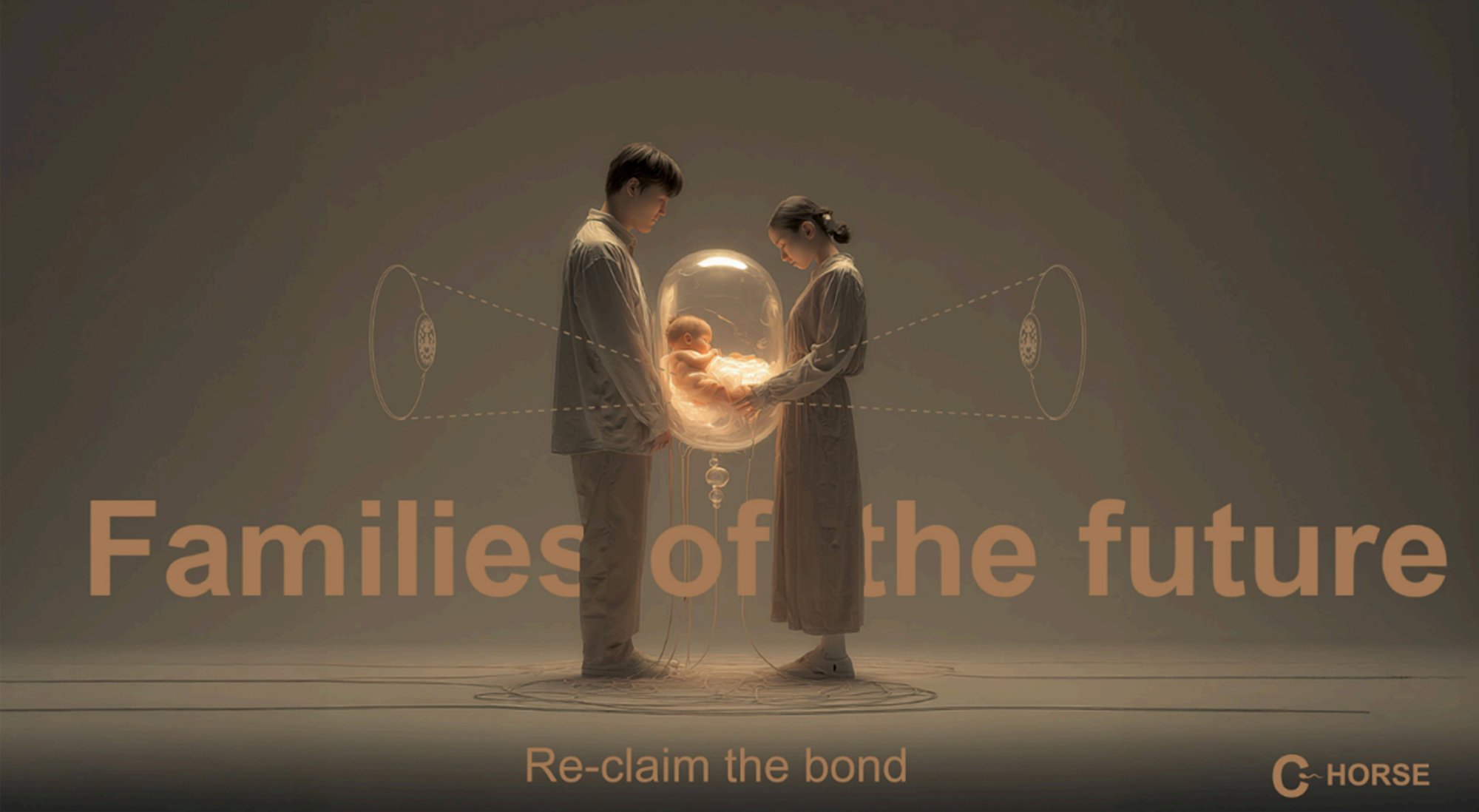
Eloise Lobmeyr, Jimmy Zhong, Joey More, and Naina Pai,(Still from) C-Horse; Families of the future, 2025. Courtesy of the artists
FG: I think the trap is always to guarantee. It is the tension between the two schools of futures — constructivist versus anticipation — the latest with Buckminster Fuller or Herbert Simon versus the former with John Chris Jones.
The problem is that we cannot guarantee, even if you go fully scientific, because you cannot control the main variable, which is the context. This determines the value of things or the direction of things. So, we are all the time trapped into this idea of the guarantee. And I think we need to fight almost every corner to be able to propose different approaches that cannot guarantee but can inform about that future to see how we can operate it in a different way.
FG: Can we talk about the million dollar question. Do we use AI?
GB: Our position is it’s a tool [so] if you want to use it you can. But you must declare at all stages what it has done.
For our students that do use AI in the film animation processes, they are required to demonstrate exactly how they’ve made a typical scene in a film. Part of their submission is to develop a workflow that provides them with consistency. AI rendering and video software are secondary tools that students use alongside the more typical architectural software such as Rhino and Blender. Students design and build the locations that the film scenes take place within, quite similar to the process of building a set for theater or a backdrop in a lot for a movie. In different software programs, they will build their characters and mobilize them. The student’s role extends then into a spatial choreography, instructing AI software to mobilize the characters in the same way a director might “walk from scene left to scene right, scratch your nose, pause, and look out of the window.”
It’s not making the film for them, but it is enabling them to make things that they couldn’t make otherwise. We create the processes for sense-checking those things. Part of their submission is a technology ethics statement that doesn’t come from the program.
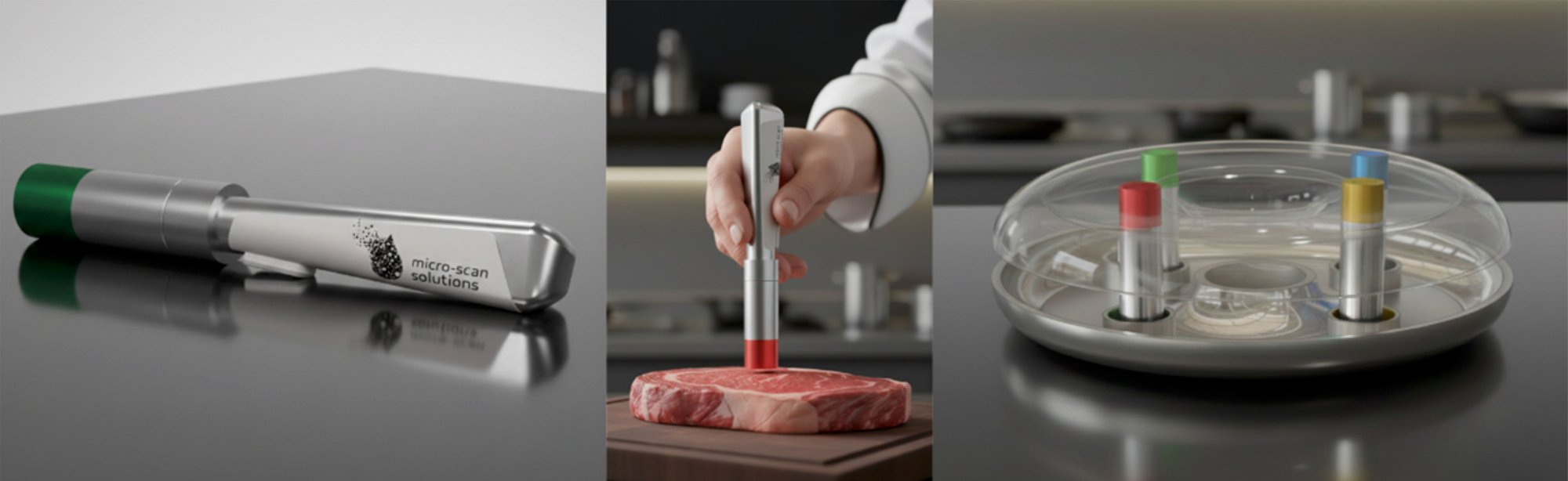
Claudia Nanez, Ewan Atkinson, Alex Li, and Jade Jiang,(Still from) Microplastic Tester, 2025, Courtesy of the artists
EH: We just sent an email to all the students today. Are they using AI for things that they should be using it for, to help them co-create images or help them synthesize well, to help them find sources or help them write? Now the primary research is more important than ever — show us the process, which has to include going to talk to real people, going to real places. I think AI works super well for some students who use it conscientiously and go back to it over and over again, and put so much work into reprompting and redoing and merging it with other softwares. Some really good films have come out of it.
FG: For us, it’s the same. It’s almost a render. It’s kind of a tool. You are in control. So then it can help you a lot [at] different stages. But I think where it’s getting better results [is] at the end, almost as a renderer.
CRF: Beyond AI-as-tool, the thing I find most live for us is AI meeting the more-than-human directly — projects like the Earth Species Project and Project CETI using machine learning to decode animal communication. That’s the speculative-becoming-real moment: “Talking to animals” was a design fiction, now it’s a machine-learning paper. And it raises exactly the critical question our students sit with when we build an AI to “translate” a whale. Whose categories are we imposing? On robotics, it’s less central for us than the biological, but where it surfaces in interspecies work is around sensing and soft/biohybrid systems: machines as instruments for perceiving non-human worlds rather than as autonomous agents.
Yanhua Chen,(Still from) Chameleon, 2025-26. Courtesy of the artist
Yanhua Chen,(Still from) Chameleon, 2025-26. Courtesy of the artist
Yanhua Chen,(Still from) Chameleon, 2025-26. Courtesy of the artist
Yanhua Chen,(Still from) Chameleon, 2025-26. Courtesy of the artist
Yanhua Chen,(Still from) Chameleon, 2025-26. Courtesy of the artist
EH: Could we talk now about London as context. Why futures now in London?
GB: There’s lots of futures work happening all around the world. London’s privilege isn’t that more futures work happens here, it’s that it’s heard. Which carries a responsibility: to platform the geographies that are handed a future rather than allowed to imagine one.
FG: Here in the UK we have an educational model which is very flexible. Some of the decisions made in the 1990s allow for experimentation that in other places doesn't happen. For example, in Spain, it is the government who decides what the curriculum is. The last evolution was 1982. So they are still teaching 1982 design. It’s interesting that a lot of things probably happen here in the UK because there is a much more flexible framework which is open to other kinds of propositions than may be the case in other places.
EH: Are there any particular contemporary artists or academic texts that we’re all using?
CRF: The references we use on Interspecies Entanglements are quite specific: theoretically, Donna Haraway’s Staying with the Trouble (2016) and Anna Tsing’s Mushroom at the End of the World (2015), Karen Barad on entanglement and intra-action, Escobar’s pluriverse, and Jakob von Uexküll’s umwelt, which is really the IED reference because it’s about perceptual worlds. On the artist side: Tomás Saraceno, Pierre Huyghe, Jakob Kudsk Steensen, and especially bio-art practitioners like Heather Barnett, who works with slime mold, and Špela Petrič. They matter to us because the non-human isn’t a metaphor in that work, it’s a collaborator.
Gem Barton is Reader in Design Pedagogies & superFUTURES lead Interior Design MA at the Royal College of Art. Gem is an author and senior academic specialising in the interrelations between human behaviour, speculation and spatial design. Currently teaching at the Royal College of Art, she was awarded a coveted National Teaching Fellowship in 2019, is Senior Fellow of AdvanceHE, and founding chair of QuEAN – Queer Educators in Architecture Network. Gem’s work in the future(s) space comes to life through her advisory, research, teaching and leadership of superFUTURES at the RCA, her directorship of the Experimental Realism platform and consultation services offered through her Office for Speculative Spatial Design (O-SSD). superFUTURES at the RCA is a research-led speculative spatial design unit sitting within the Interior Design MA – where specialist staff and inventive students practise the future together, everyday. We have three core research areas; futures of genders and identities, futures of relationships and interactions, futures of pleasure and entertainment. superFUTURES is a process, a methodology, a practice, a point of view, a mindset, a philosophy centred on widening the scope of our collective imagination, to consider the world as it might be. We are embedded in the plural possibilities of this transformation, not in its prediction.
Dr Fernando Galdon is a design practitioner, researcher and educator whose work brings together design, computer science, neuroscience, philosophy and sociology. His work investigates the social, technological, and political implications of designing trust. As a tutor at the Royal College of Art, Fernando co-leads Innovation Design Engineering modules on Transdisciplinary Practices and Regenerative practices (SuperGreen), in addition to cross-college units AcrossRCA and the Grand Challenge. He has contributed to lectures and crits on MA Design Products, MRes RCA, and Executive Education courses. As part of his research, he has coined novel categories to address, problematise, and operationalise contemporary issues in design practise and research such as; Deep products; Prospective design; Object-Oriented-Upcycling; Exology; Synthetic consequential reasoning; Pluripolar knowledges; Biopoiesis: PolyGenetics; Counterism; or Exo-Aesthetics. Fernando’s research has been published and presented internationally at conferences at MIT, the University of Cambridge, the University of Manchester, the University of Côte d’Azur, UNISINOS Brazil, CHUV Lausanne, UPV Basque Country, EASD Valencia, Harvard, Politecnico di Milano or the Design Museum in London.
Dr Elise Hodson is Academic Lead and Senior Tutor in the MDes Design Futures programme at the School of Design, Royal College of Art. She has been instrumental in building this new programme, launched in 2023, and takes great inspiration from colleagues and students who are pushing the boundaries of design futures approaches and pedagogy, applied to a wide range of complex issues through the lenses of strategy and long-term thinking. Elise’s research combines design culture and collaborative design practice with a focus on global production networks and social sustainability. Recent work examines futures literacy in design education, geographies of responsibility in global design practice, and the power dynamics of codesign with vulnerable groups. Elise holds a Ph.D. in communication and culture (York University, Toronto) and Master’s degrees in design history (Bard Graduate Center, NYC) and museum studies (University of Toronto). Previous roles include Post-doctoral researcher in Design Economies in the NODUS Sustainable Design Research Group at Aalto University (Finland), Chair of the School of Design at George Brown College (Canada); Program Coordinator of the Interdisciplinary Design Strategy post-graduate program at the Institute without Boundaries; and Director of Exhibitions at the Design Exchange, Canada’s former design museum.
Dr Carolina Ramirez-Figueroa is an architect, designer, researcher, and educator whose work explores the intersections of design, architecture, living systems, and critical technologies. As Senior Lecturer in Information Experience Design at the Royal College of Art, she investigates how design can engage with more-than-human worlds to imagine alternative technological, ecological, and social futures. Her practice combines speculative world-building, immersive media, and biological systems to question anthropocentric assumptions and explore new forms of coexistence between humans and other living entities. Carolina completed a PhD by creative practice at Newcastle University, examining how design practices transform when microorganisms are considered design matter. She has collaborated with artists, designers, and scientists on projects spanning biotechnology, immersive technologies, and future ecologies, and her work has been exhibited internationally, including in London, Mexico, Helsinki, Tokyo, Taipei, Montreal, Brussels, Edinburgh, Tel Aviv, and India.
Alex Estorick is the Founding Editor of Right Click Save.
With special thanks to Elise Hodson.
1 F Raby, interviewed by the author on November 1, 2024.