The new edition of our Art & Tech quarterly is devoted to a year of new and reimagined institutions attuned with the expanded art worl
Download your new copy of Art & Tech today.
The new edition of our Art & Tech quarterly is devoted to a year of new and reimagined institutions attuned with the expanded art worl
Download your new copy of Art & Tech today.
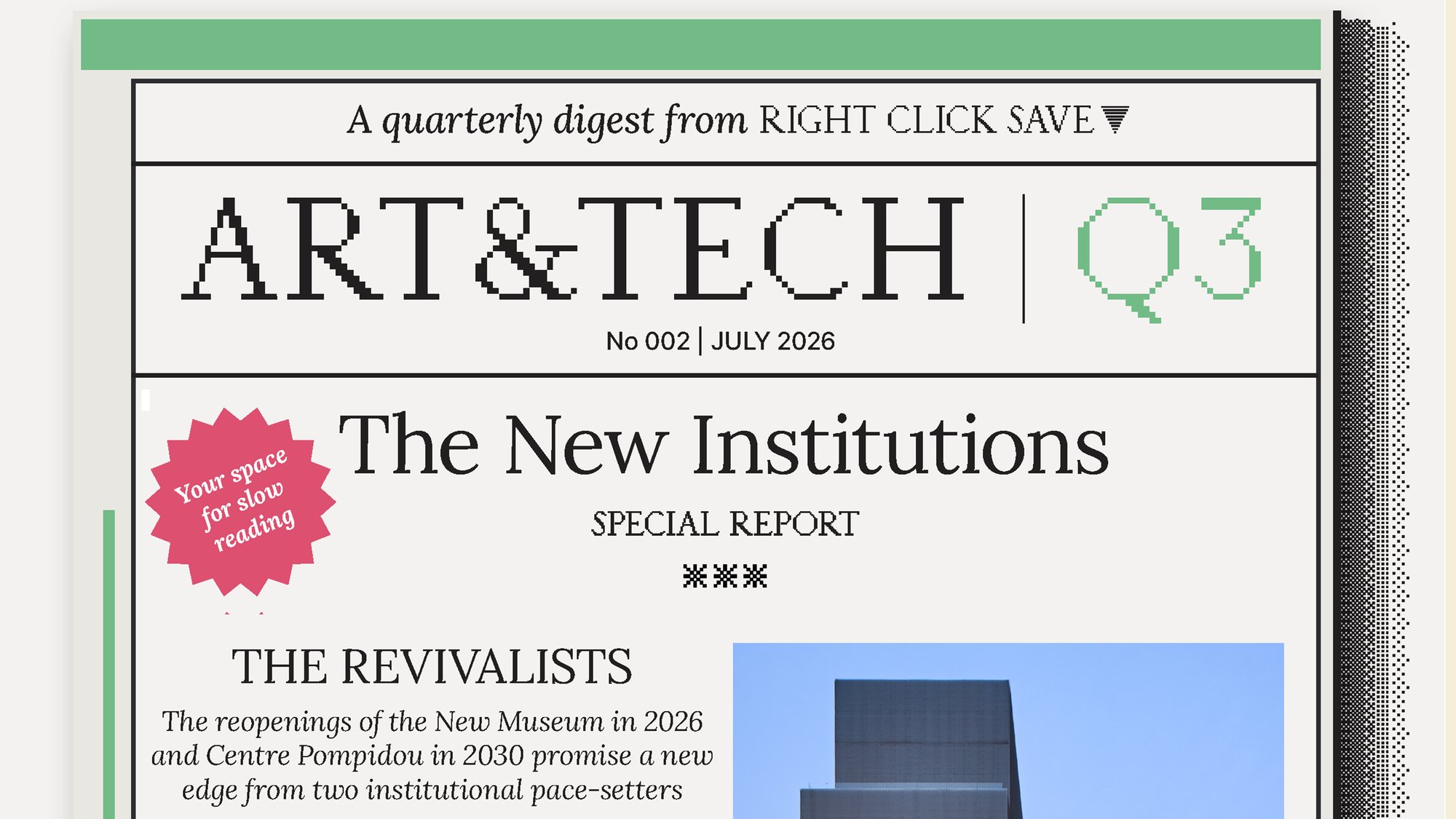
The editors of Right Click Save have published the second edition of Art & Tech, a quarterly digest of the magazine’s recently published articles. It is designed to be a space for slow reading, and an alternative to the always-on culture of the attention economy.
The latest quarterly’s subject is “The New Institutions”: the museums, galleries and educational entities engaging with artists, curators and scholars to drive critical conversation about digital art as part of an expanded contemporary art ecosystem.
In an interview in Art & Tech, the artist Anna Ridler highlights the importance she attaches to undistracted attention. “Attention is the thing”, she says, “paying attention to something is a huge act. It’s a form of listening, it's how you show love, it's how you can help heal and repair.”
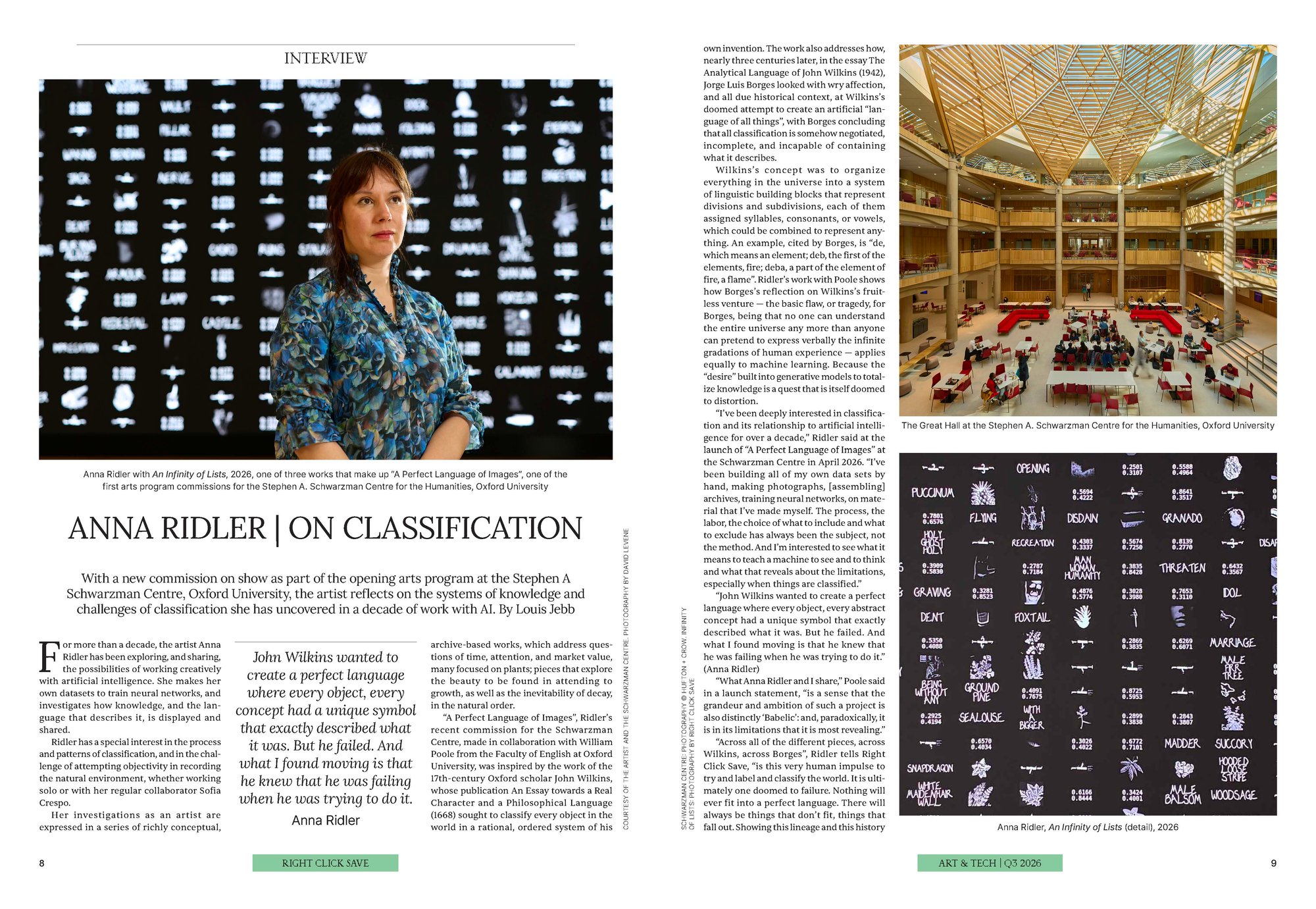
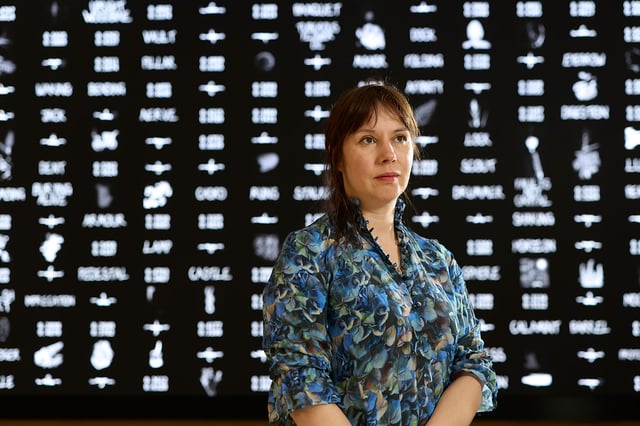
Anna Ridler showed a new commission as part of the opening arts program at the Schwarzman Centre for the Humanities, Oxford University
That article is centered on Ridler’s commission for the opening arts program at the Stephan A Schwarzman Centre for the Humanities, Oxford University. The Schwarzman Centre’s debut, in April 2026, was a distinct milestone in this year’s launch or reimagining of transformative institutions of the digital era. Other highlights include the opening of NODE, in Palo Alto, California, and Refik Anadol Studio’s Dataland museum of AI Arts, in Los Angeles; the remodelling and enlargement of Los Angeles County Museum of Art and the New Museum, New York; the forthcoming unveiling of Canyon in downtown Manhattan, and of Powerhouse Paramatta in Sydney, Australia. There is also the launch in September 2026 of Creative Intelligence, a three-day London festival, bringing together the city’s artists, museums, scholars and creative coders to examine digital innovation and AI’s role in reshaping global society.
These cross-pollinating conversations gain urgency daily at a time when the adoption of AI is re-engineering global culture and when the art world’s creative prism on climate change remains as valuable as ever.
The first edition of Art & Tech — still available as a downloadable pdf — was dedicated to art’s new hybrid ecology, where artists are increasingly adopting interdisciplinary practices while the world adjusts to new ways of doing business across physical and digital domains. In the new edition, the curator Valentino Catricalà continues that conversation in his essay on “New Art”, a term he proposes for today’s world of fragmented but connected practices that he finds are both joining and emerging from within contemporary art, and changing it in the process.
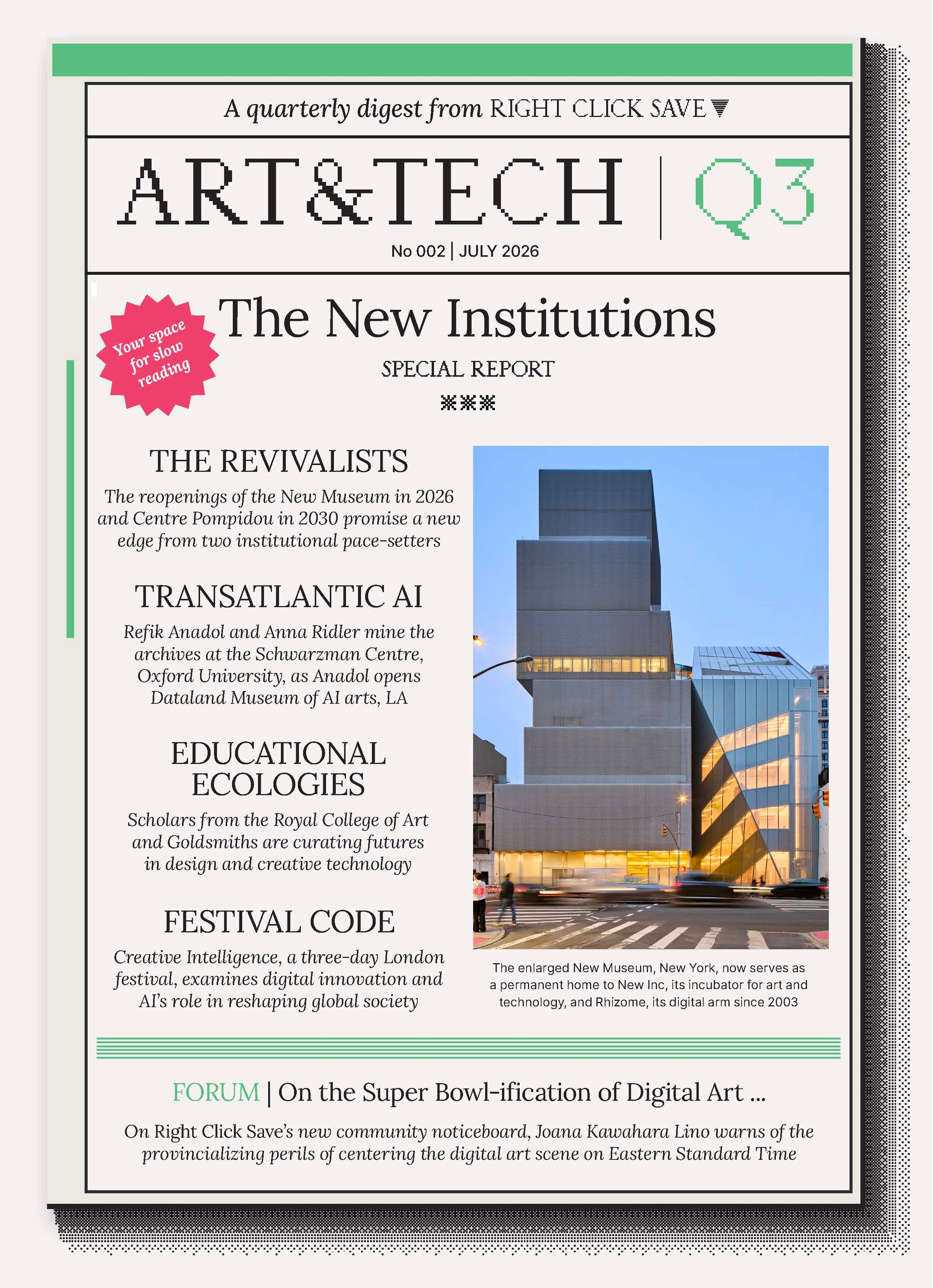
The new edition of the quarterly features two new sections launched by Right Click Save in July 2026: the Forum and the Index
On July 1, 2026, Right Click Save launched a new Forum section as a discussion board for the digital art community around a constantly evolving art world that Catricalà sees through the metaphor of an archipelago — a chain of separated but connected islands. The Forum has attracted posts and comments on a range of topics, not least on working with AI. In a contribution from the Forum published in Art & Tech, Joana Kawahara Lino warns of the provincializing perils of centering the digital art world in Eastern Standard Time: the danger of a monolithic approach that denies the diversity of a true creative archipelago.
The new edition of Art & Tech also covers Right Click Save’s launch, on July 1, 2026, of its Index — a knowledge bank drawn from across the magazine’s editorial coverage which shows how people, artworks, events, organizations, and ideas connect in our archive of more than 430 articles. Readers can use the Index as a way to source texts from the archive, including those related to the Art & Tech essays on creative AI and on the importance of a decentralized art world.
In two conversations moderated by Alex Estorick, founding Editor of Right Click Save, scholars from the Royal College of Art and Goldsmiths, London, address how they are curating futures in design and creative technology. Both are examples of evolving educational institutions. Another is Oxford University. Ridler presented her new work in company with Professor Daniel Grimley, the Head of Humanities at Oxford, a symbolic demonstration of how the advent of the Schwarzman Centre has enabled the university to work directly with contemporary artists to re-examine parts of its rich archives, built up over nearly a millennium. At the same time, the Schwarzman Centre launched a second commission, by Refik Anadol, who worked with an academic from the university’s botany department to draw on the university’s rich archives.
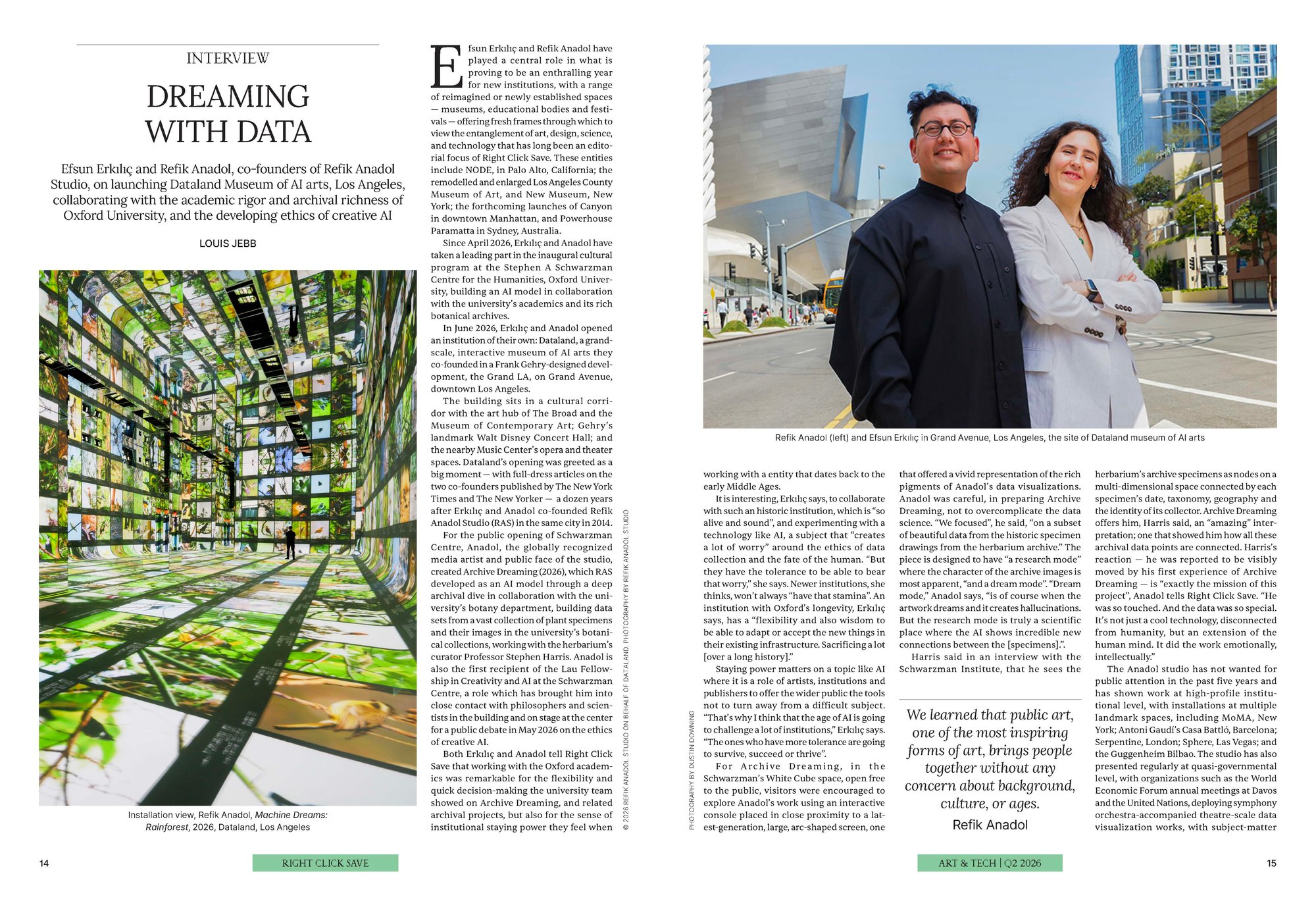
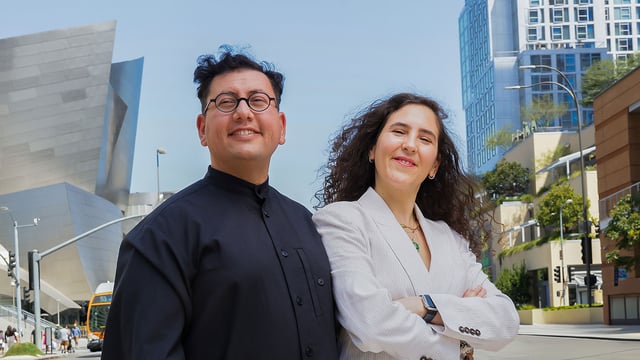
Efsun Erkiliç and Refik Anadol, co-founder sof Refik Anadol Studio and of Dataland, the studio’s new museum of AI arts in Los Angeles, spoke to Right Click Save about Dataland and their work with the Schwarzman Centre, Oxford University
A few weeks later, 6,000 miles to the West, another leading digital artist, Beeple, in northern California for his mid-career exhibition, “BEEPLE: / INFINITE_LOOP”, at NODE, Palo Alto — the Silicon Valley space opened in January 2026 — was down the road addressing the subject of AI and creativity at Stanford, the academic powerhouse behind the rise of Silicon Valley. Shortly after that, Anadol and the artist Holly Herndon were discussing “AI, Creativity and Ethics” with academics from Oxford University as guests of the Schwarzman, where Anadol is also the first recipient of the Lau Fellowship in Creativity and AI.
At NODE, its founder Micky Malka says in an interview, “The architecture, software, lighting, pacing, scale, even the movement of people through the building — all of it becomes part of the artwork itself. That is one of the core ideas behind NODE. We are not simply presenting work on walls. We are producing environments, alongside artists, that could not exist anywhere else.”
The existence of new institutions such as the Schwarzman Centre and NODE is already offering a new kind of space to public-facing artists like Ridler, Anadol, and Beeple, to engage in conversations around topics of existential importance.
In an interview, Efsun Erkiliç, co-founder of Refik Anadol Studio and of Dataland, the studio’s new museum of AI arts in Los Angeles, discusses how an institution like Oxford, where teaching was taking place as long ago as 1096, has the historic “stamina” to handle questions as difficult as the ethics of creative AI. Erkiliç and Anadol discuss setting up Dataland — sited in the Grand, Downtown LA, in a building designed by their long-time friend and collaborator the art-and-tech-adjacent architect Frank Gehry — from scratch in a new shell.
In his essay, Catricalà emphasises that “New Art” embraces ventures beyond the conventional exhibition experience. That includes work living between high art and spectacle and represented by Dataland, by the immersive sites created by the Tokyo-based digital art collective TeamLab, and by “Euphoria: Art is in the Air”, an exhibition of inflatable art that Catracalà curated at Le Grand Palais in 2025.
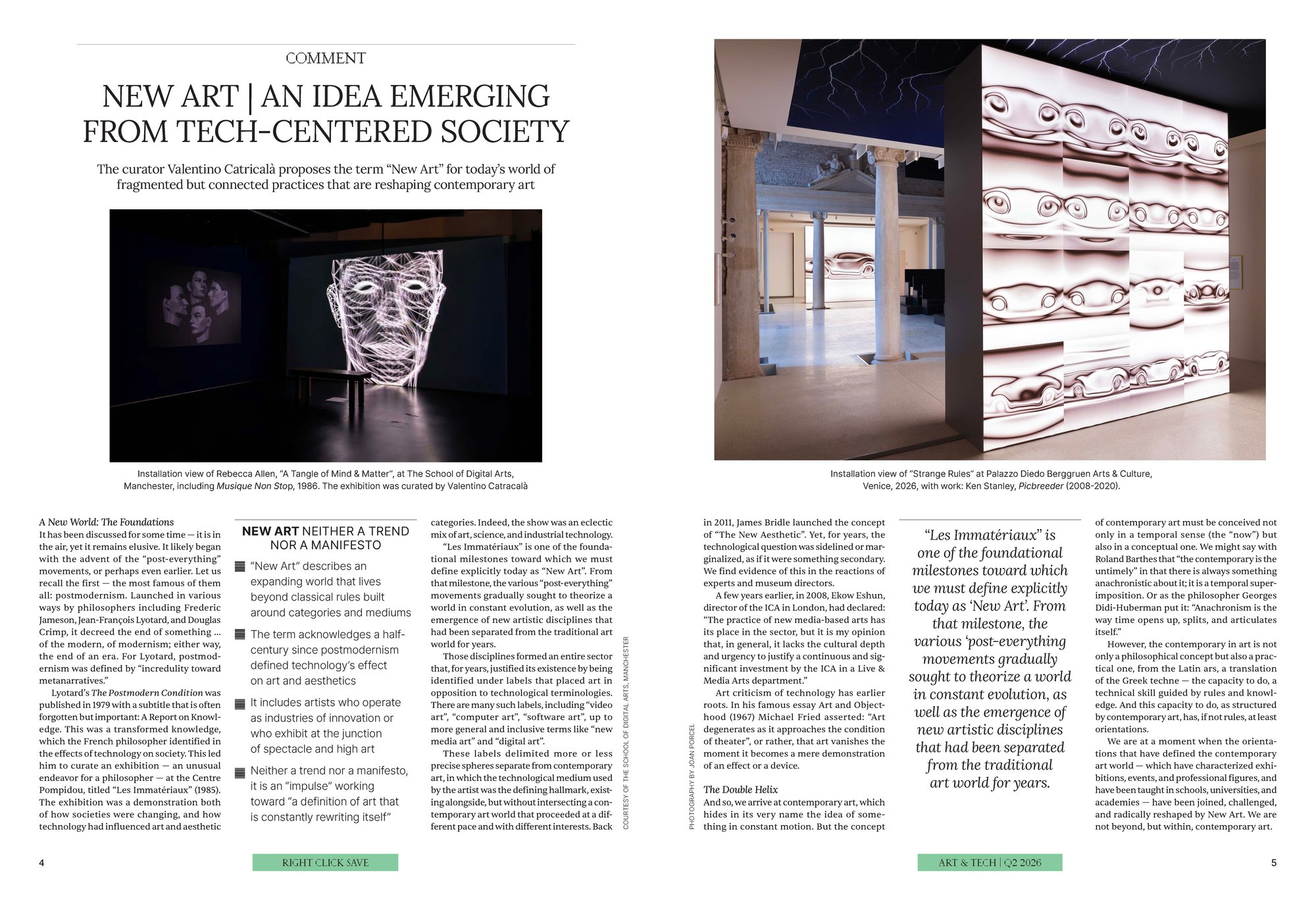
The curator Valentino Catricalà outlines his proposal for the term “New Art”, to cover today’s world of fragmented but connected practices, at once emerging from and changing contemporary art
The interaction between New Art and a new generation of institutions is one that serves to emphasise the wider cultural value of the expanding art world.
Catricalà also honors the historic importance of the 1985 exhibition “Les Immatériaux” curated by Jean-François Lyotard and Thierry Chaput, at the Centre Pompidou, Paris. That show captured a cultural moment: the postmodernist vision of how technology has influenced art and aesthetic categories. Alexis de Bernède references that show’s foundational character in his article on the Centre Pompidou network of museums and the opportunity that exists to redefine the museum world’s embrace of Web3 when the Pompidou’s historic Beaubourg headquarters reopens, following a process of renovation, in 2030.
The design for the cover of Art & Tech, is inspired by a work that captures another distinctive cultural moment, from three decades ago, when the desktop publishing revolution reached a pivotal moment. In the mid 1990s, writers, designers, and artists, sitting at bulky Macs and PCs, around the world witnessed a change, a liberation, enabled by a fusion of developments in screen resolution, word-processing and “What You See Is What You Get” graphic design interfaces, all performing at what them seemd to be a tolerable pace.
It was a moment that delivered on the lessons about the effect of technology on art and aesthetics, that had been expressed in “Les Immateriaux” at Centre Pompidou a decade earlier. That mid-1990s, technostalgia-inducing, era is captured in Jan Robert Leegte’s beguilingly skeuomorphic Window series of 2022, which Right Click Save featured in a 2023 article “Who Owns the News in Web3?”
No comments yet. Be the first to share your thoughts.
Mentioned in this article
People: Anna Ridler, Beeple, Efsun Erkiliç, Refik Anadol, Refik Anadol Studio, Valentino Catricalà|Works: ART & TECH, The New Institutions|Events: Les Immatériaux|Organizations: Right Click Save|