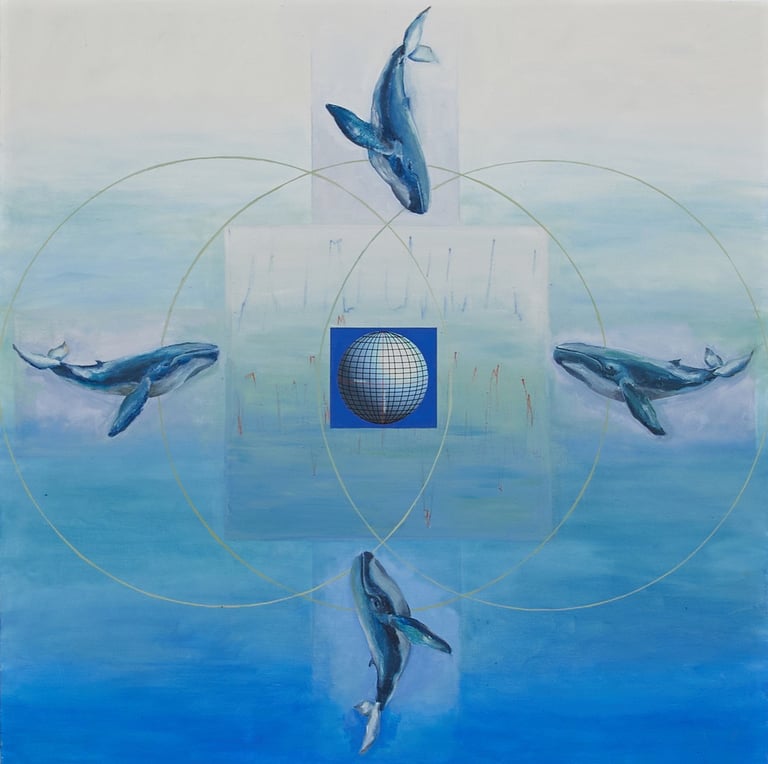
Libby Hoffenberg, To make a home in movement, 2026. Oil, acrylic, paper on canvas. Courtesy of the artist
The Art of Hyperculture | Libby Hoffenberg
The Hawai'i-born artist discusses the visual languages that shape how we grasp the world
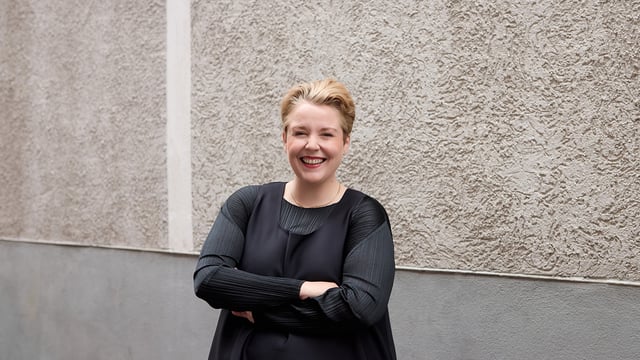
Ana Prendes
Libby Hoffenberg, To make a home in movement, 2026. Oil, acrylic, paper on canvas. Courtesy of the artist
The Hawai'i-born artist discusses the visual languages that shape how we grasp the world
Images share our contemporary sense of uprootedness. Growing up in Hawai'i and now based in London, Libby Hoffenberg works with images that have travelled through geographies and temporalities: scanned, compressed, circulated, and detached from their origins. Hoffenberg transforms both found and mass-produced objects — from beach chairs to pictures of Hawaiian beaches — into mixed media paintings, sculptural assemblages, and re-enacted artifacts. According to the artist, the practice of slowing down images by migrating them from the fast-paced digital realm to the physical world surfaces the cultural codes with which they are inscribed.
The title of her first solo show, “Hyperculture”, at Koppel Collective in northwest London, in April 2026, references the philosopher Byung-Chul Han’s 2005 essay of the same title. Han argues that globalization has detached cultural forms from their territorial roots, which reorganizes culture around networked circulation. Hoffenberg extends this inquiry through her personal research of the visual languages of globalization.
In this conversation with the curator Ana Prendes, the artist discusses transformations of found images, diagrams that orient perception, and the utopian aspirations of New Age culture.
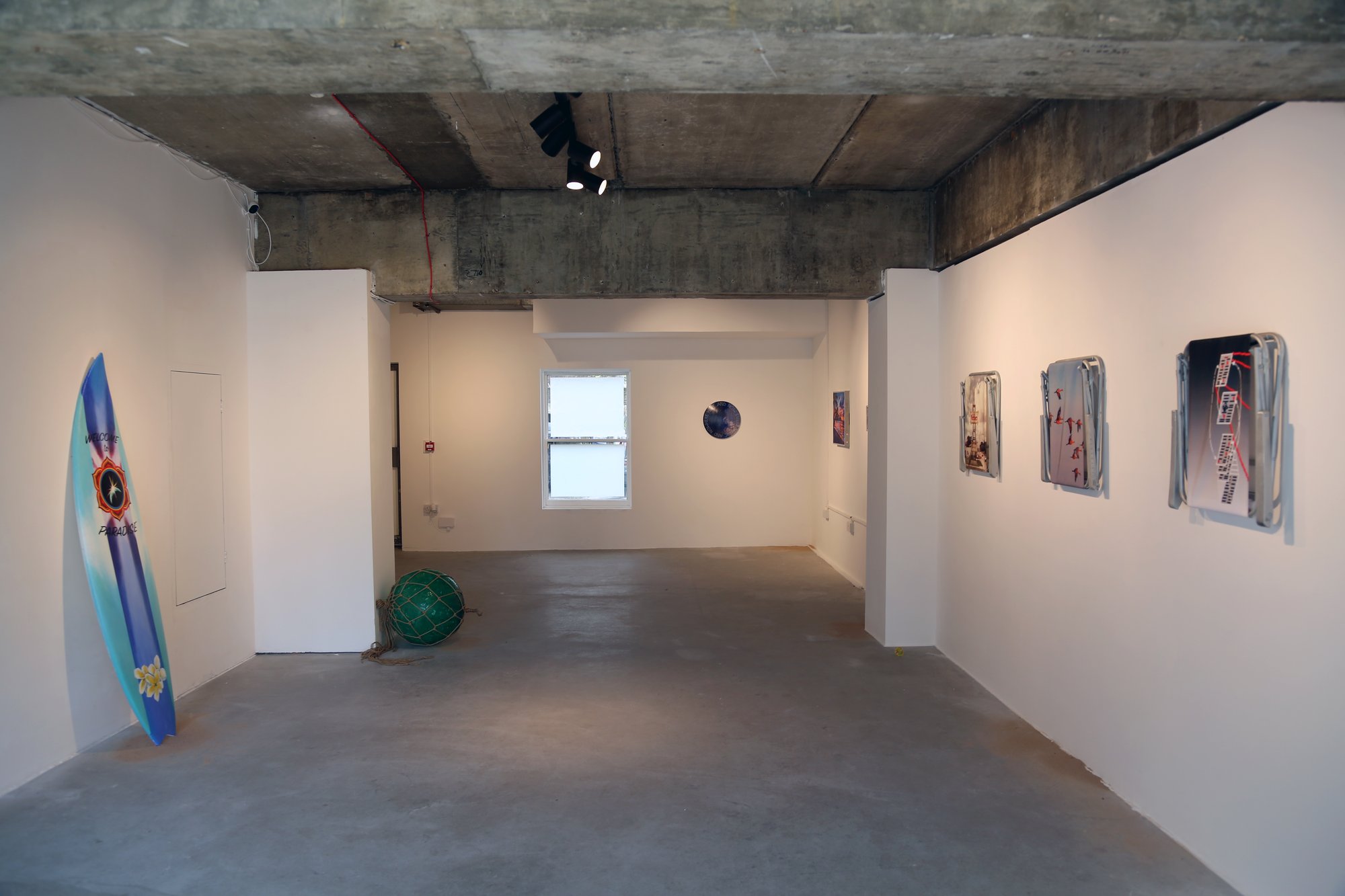
Installation view of “Hyperculture”, Koppel Collective, London. Courtesy of the artist
Ana Prendes: I want to start with something that underlies most of the works: found images like the postcard of the volcano, the 1968 Polynesian-themed tiki bar, and a stock photograph of migrating birds. These images have already travelled, degraded, and been reframed, losing and gaining meaning in transit. What role does the found image play in your work?
Libby Hoffenberg: I am drawn to images that seem like they’ve travelled through time and space — images that arrive partially degraded, reproduced through different media. An image I incorporate may have time-travelled from a book printed in the 1970s and been scanned and uploaded to a website before I distort it further and transfer or print it onto material.
There’s a kind of magic in the translation errors between different media, and uncanniness in the void. There’s also something about these transformations that feels alchemical, a refining or distilling whereby the symbolic structure or affective charge of an image manifests with greater potency.
By slowing down the velocity of images through degradation and material relocation, one can parse the codes that structure perception. This process is important since we are all being hypnotized by images all the time.
The actual process of finding images is chaotic, intuitive, and relies on equal parts serendipity and search. It is a surrender to the flood of images, and the animating power they exert on us in ways that are often subconscious. The process of (re-)materializing these digital images in my work is like trying to attract spectral beings to new surfaces — material substrates like surf boards or wicker chairs that are themselves often also found objects. Our languages and symbolic systems emerge from and erode back, like petroglyphs, into the raw materials of the world; images are not merely representations but transformations.
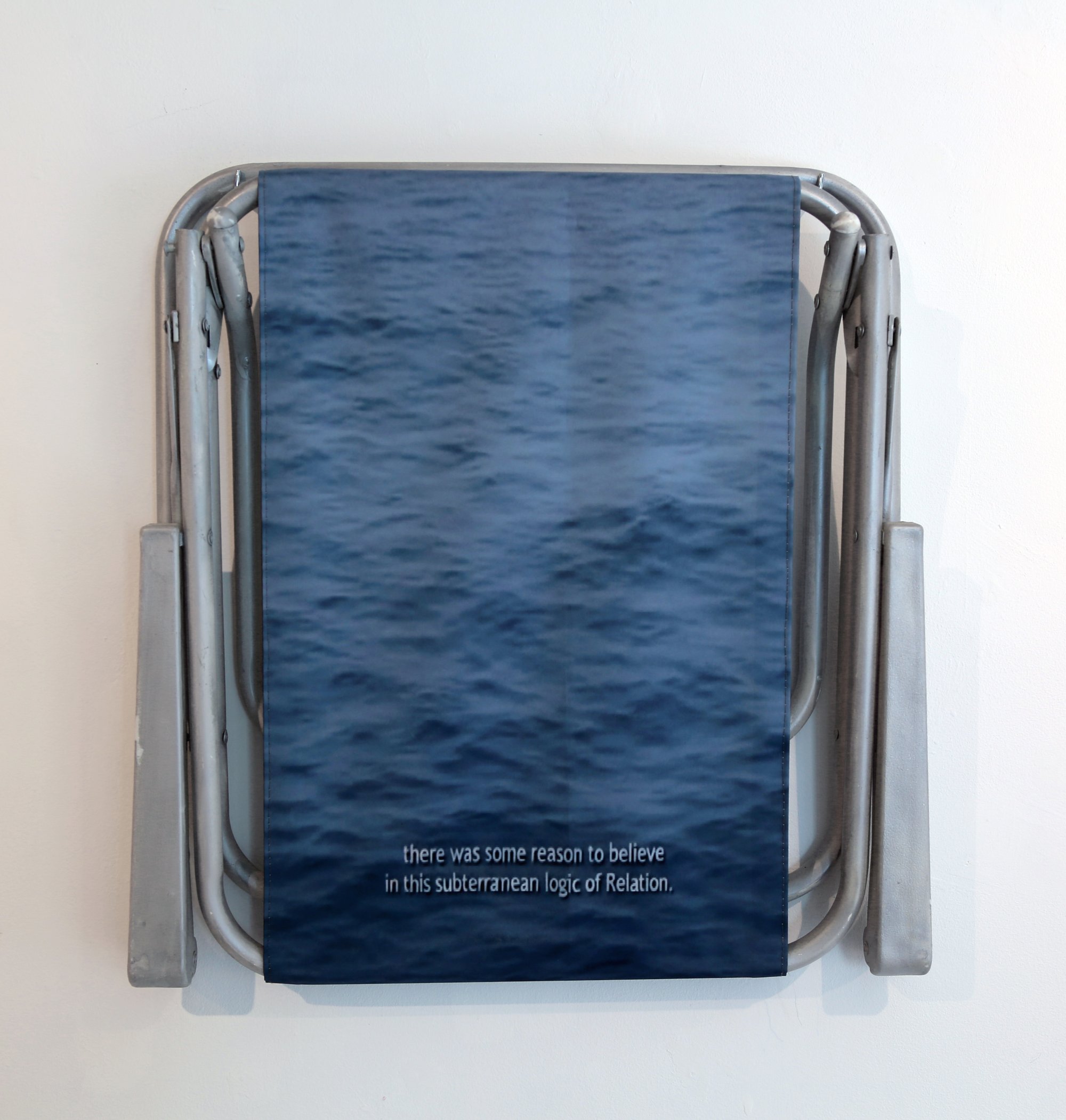
Libby Hoffenberg, Portable image 1: Glissant (One world in relation), 2026. Dye sublimation print on waterproof canvas, beach chair. Courtesy of the artist
AP: The continuity between found images and materials is especially present in the hanging beach chair series “Portable Images” (2026), while the chairs bear very different images: a line from the poet and philosopher Édouard Glissant’s Poetics of Relation superimposed on an image of open water, a network diagram, and a 1960s roadside tiki bar. In this context, the chairs themselves — folded, wall-mounted, stripped of their function — become portable frames. What is the role of the beach chair in your understanding of Hyperculture?
LH: When all images exist without context, infinitely mobile, the frame sets the image in place. Here, the chairs serve a holding function while acquiescing to the mobility of images. The beach chairs have travelled from somewhere else, already objects in circulation, with their own genealogies of production, ownership, and use. They have a nowhere quality.
The cold aluminum folding chair has a banal and mass-produced aura, signalling an ersatz alienation of industrial production. Utility and standardization are formal elements of a technological modernity that is often framed as an uprooting. At the same time, there’s an allure to the smoothness and sheen of the metal that insists on technological futures.
The first beach chair was the German strandkorb (Lit. “beach basket”), but strand is also etymologically connected to the English word “stranded”. To me, the object evokes a feeling of being marooned or washed ashore. The aluminum chair is an almost weightless, portable dwelling — somewhere to sit that you can carry anywhere. Beach chairs also have a particular, sanctified quality for me, recalling countless days idling away the hours staring at the ocean.
Of course, beach leisure is the ultimate emblem of kitsch but the image also contains a commonplace reverence for the natural world. I want the work to hold both the kitsch and the reverence.
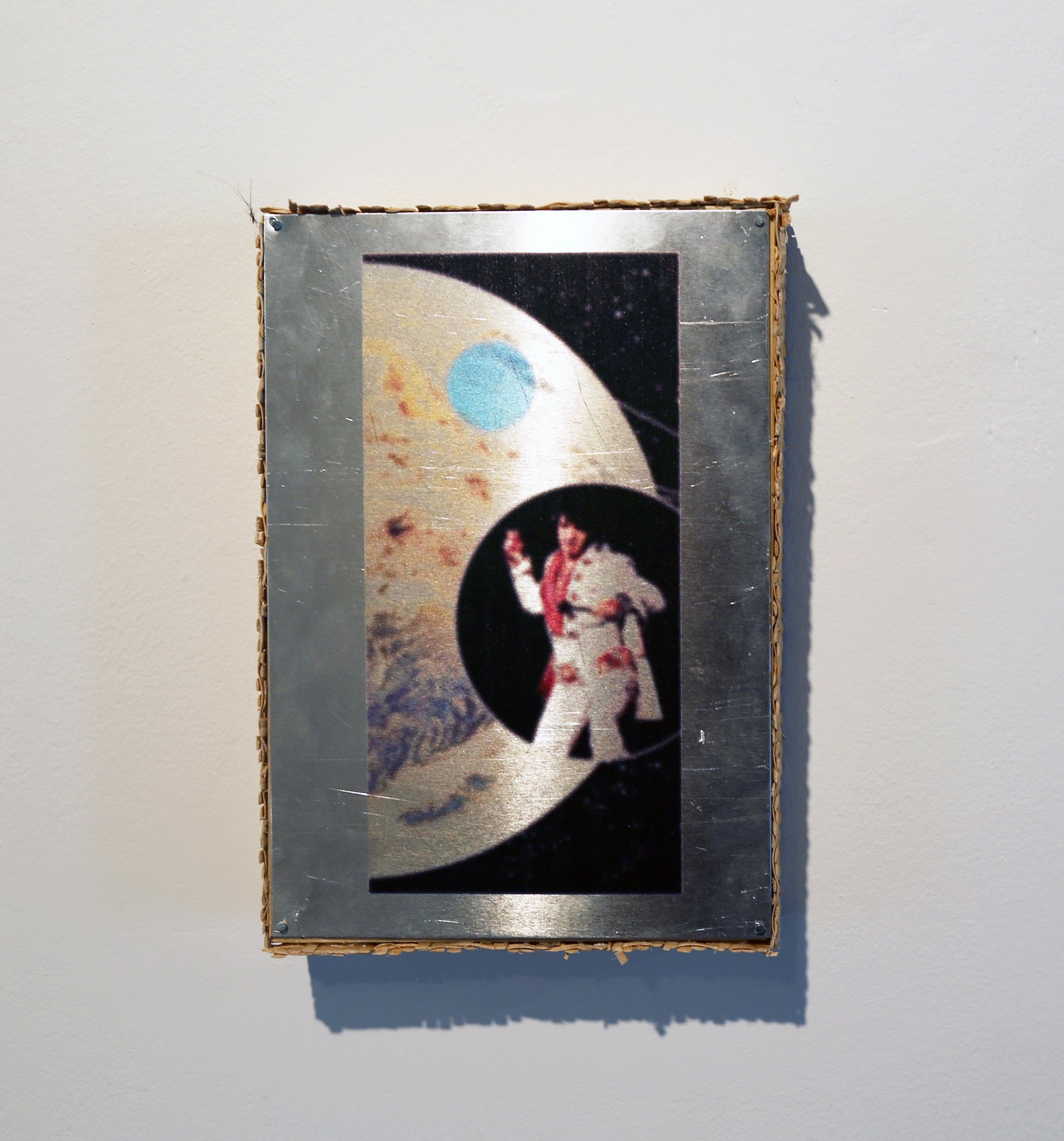
Libby Hoffenberg, Aloha from Hawaii via Satellite, 2026. UV print on aluminium, rattan. Courtesy of the artist
AP: As we speak from London, I wonder how you are personally embodying that feeling of transience. The album cover of Elvis’s Aloha from Hawaii via Satellite, the found volcano newspaper in Absolut Vitality, and the oversaturated painting of a Pacific beach in Hawaii_images_paradise.jpeg all show how the image of paradise has travelled. The Pacific world became visible to the United States through a set of references that flattened Hawai'i, Polynesia, and the broader Pacific into a single commodified fantasy. Such images in turn fed tourist infrastructures on Pacific islands, not to mention tiki bars around the world, reproducing a Western ideal of the Pacific. What is your relationship to Hawai'i and its representation now?
LH: I feel like we’re used to talking about how small the world is; images of the globe as a single telecommunications or logistics network reinforce this idea. But the world is really difficult to conceptualize. A lot of this show is about engaging with the meaning of one place from somewhere else, and holding together two points on the planet at the same time. It is about seeing a place from both inside and outside.
From London, where I live now, as from many other places, Hawai'i operates as a sort of stock photo of paradise, often as a euphemism for escape or the idea of an outside. But there is also a deeper story of relation between London and Hawai'i: James Cook was the first European to make contact with the Hawaiian islands in 1778, on the third of three voyages intended to map the Pacific. Those journeys sought to accurately map longitudinal lines onto the earth, which would fix the position of distant territories in a worldwide grid. This precision made the globe smoother to traverse, thereby furthering the project of empire. I am interested in how places become intelligible to one another, in how these histories are embodied in our own movement around the planet but also subverted as we tell new stories about what the planet itself is.
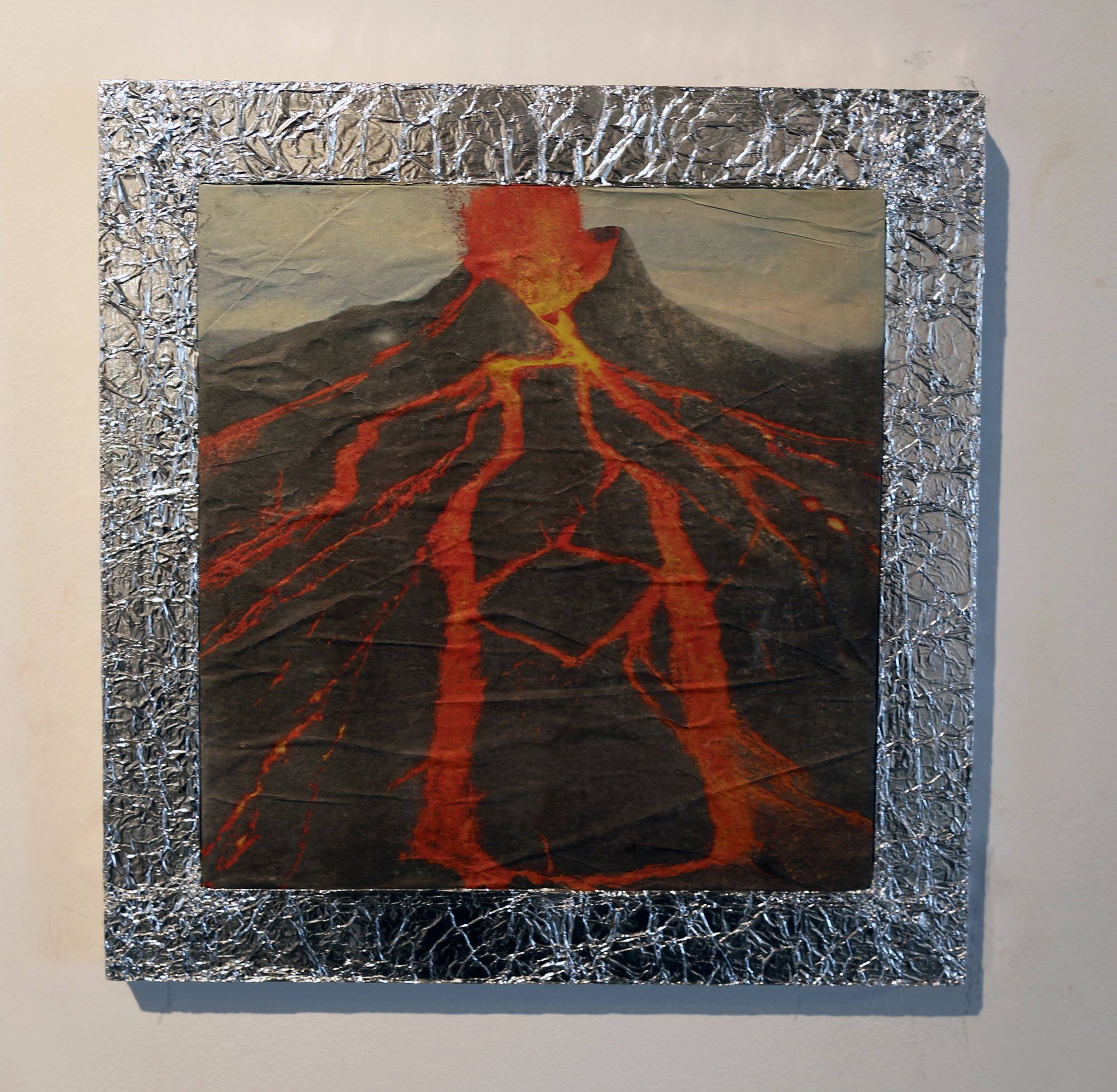
Libby Hoffenberg, Absolut vitality, 2026. Newspaper advertisement, aluminium foil, wood. Courtesy of the artist
AP: Historian and theorist Dipesh Chakrabarty uses the term “planetary” to suggest staying away from the human-centric conception of the world, epitomized by the gridded globe, and to think of the planet as a complex system that extends far beyond the human. I find it highly compelling how you unsettle the globe and its mathematical legibility in works such as NOW/HERE, with lines of latitude and longitude painted across a convex mirror, and To make a home in movement, where the grid sits at the center of a constellation of moving whales.
These works, through the idea of the gridded globe, raise questions about claims of “truth” and “objectivity” in mathematical and scientific representation — forms that have become our default way of picturing reality, and in this case, the planet itself. What happens to our conception of the planet when we subvert such an absolute, mathematical representation?
LH: I often employ the compositional tropes of the diagram — such as axial balance, vector geometries, and symmetry — to reference operational images (made by machines for machines) that structure scientific perception. This organization of the image also connects to pre-modern cosmological and alchemical diagrams, astrological charts, and ritual or sacred geometries. I am curious about the persistence of these compositional strategies across epochs, and what they may carry forward from earlier historical periods.
Diagrammatic images act less like representations and more like operational instruments that orient consciousness, compressing the overwhelming complexity of the world into navigable form.
In my work, this diagrammatic language often collides with a painterly language. While painting in the West was also part of a centuries-long project to geometrize vision, to make the world appear mathematically objective, here painting introduces sensuousness, contingency, and atmosphere. The collision of painting and scientific vision destabilizes the legibility of scientific abstractions.
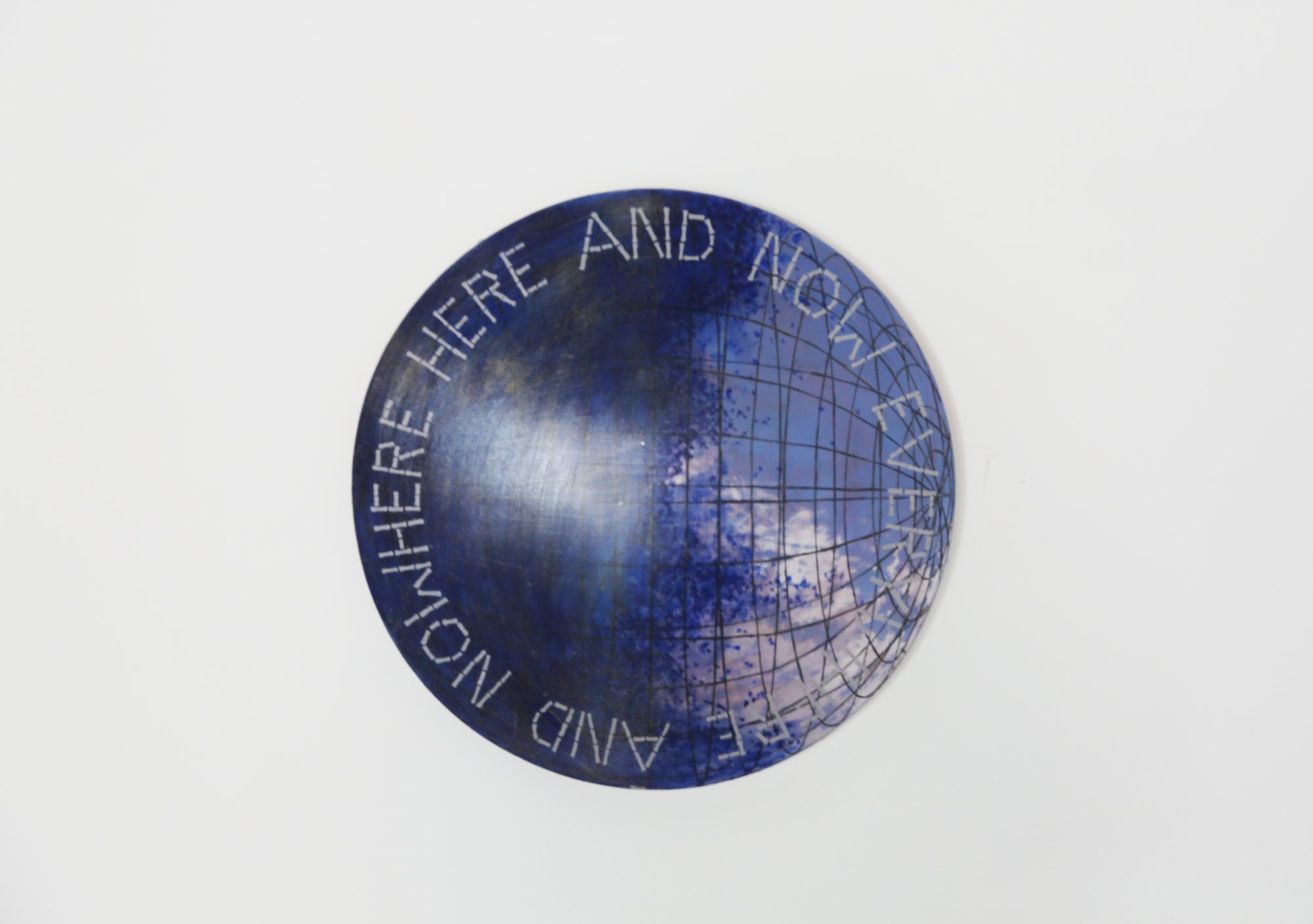
Libby Hoffenberg, NOW/HERE, 2026. Acrylic on convex mirror. Courtesy of the artist
I became obsessed with this symbol of the gridded globe because it combines a coordinate grid, implying calculability and control, with a circle implying wholeness and universality. This image, which recurs compulsively in corporate logos, is an icon of globalization. Yet the wireframe globe also appears frequently in other contexts — particularly the systems thinking, cybernetics, and network utopianism of the latter half of the 20th century and New Age movements. Multiple contested meanings of “the global” are encoded in these logos. I don’t think we have as clear a symbol of the planetary, although I wonder what that would look like.
AP: I also wanted to discuss the recurrence of New Age visual languages in your practice, as in the mandala-like Vertical cosmology, or the sunburst and flower emblems in Welcome to Paradise. New Age culture has stripped these symbols of context and recirculated them as motifs. Agnostic to tradition, the internet accelerates their pace of travel. What draws you to these New Age vocabularies, and what do you think they reveal about how we seek meaning today?
LH: I incorporate quite a bit of New Age material from the 1970s to the end of the millennium, although arguably the New Age really started at the end of the 19th century with Theosophy, a syncretic religious movement that emerged in response to the growing dominance of secular science. From the 1970s to the early 2000s, New Age culture transformed from a genuine, if naive, desire to build new ways of living to a market and consumer identity, and subsequently to an internet-accelerated version whose visual language is untethered from philosophical commitment.
It seems to me that we are now in a New New Age characterized by a widespread deployment of religious and spiritual language to make sense of emerging technologies. This tendency feels especially extreme in the case of AI.
Whether it is the Vatican’s encyclical, the fascination with occultism in both artistic and technological milieus, or the tendency to view AI as apocalyptic, we are consistently framing uncertainty in theological terms. This instinct toward the spiritual was repressed in stories we inherited about scientific modernity, and now haunts us in the many genres of spiritual slop online.
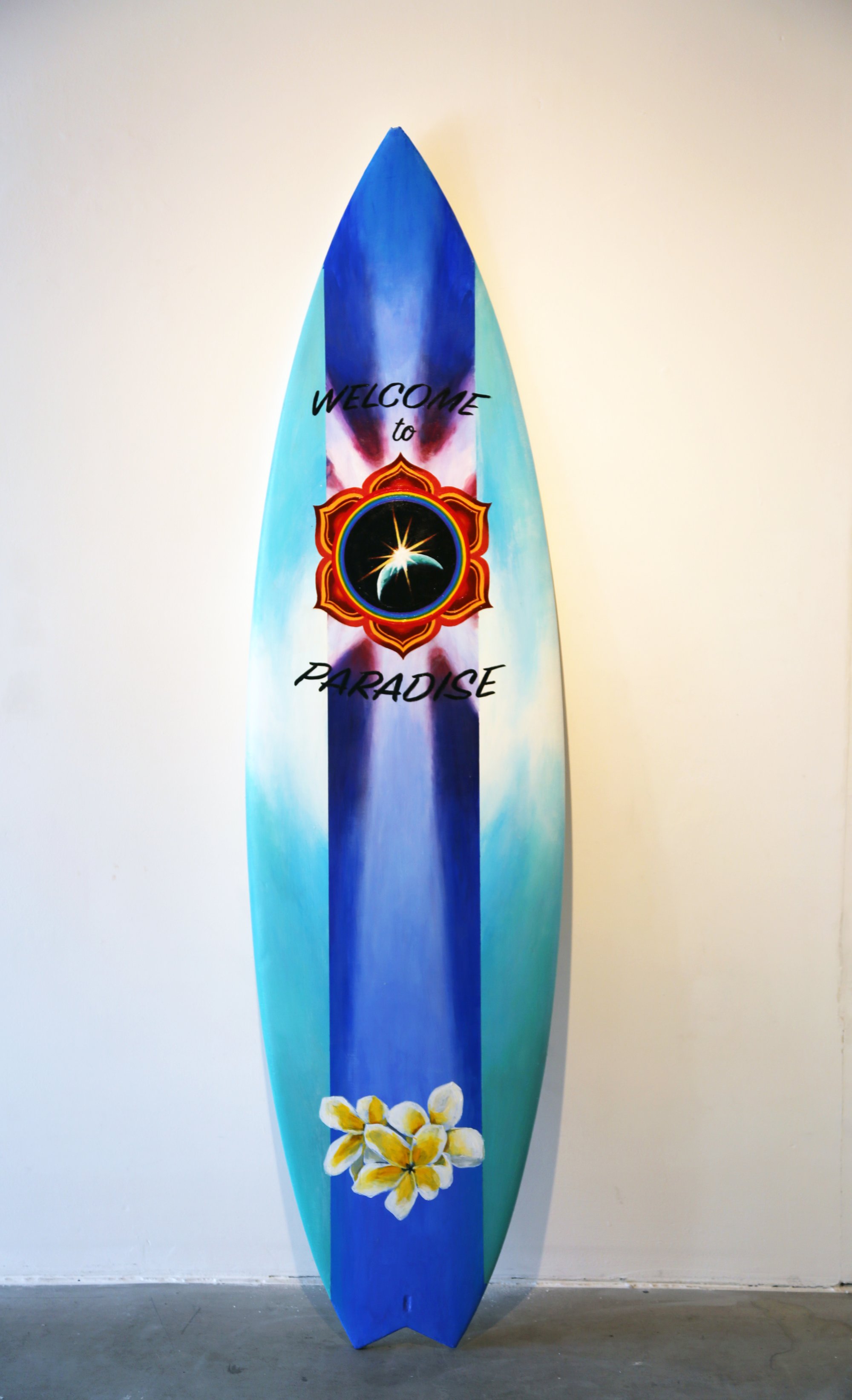
Libby Hoffenberg, Welcome to paradise, 2026. Acrylic on surfboard. Courtesy of the artist
I want to figure out whether these free-floating signifiers of spirituality still hold any of their original utopian aspirations — either explicitly political, in the sense of referring to a shared world, or anthropotechnic, in the sense of practices of self-cultivation — or whether they retain any actual relationship to the sacred. My instinct is that a lot of the conspiratorial certainty that characterizes meaning-making on the internet, contradicts the kind of mystical participation that might genuinely change collective consciousness.
But I’m inclined to take this religious instinct seriously, as an expression of a deeply-held need for coherence. New Age thinking, to me, is another genre of kitsch that expresses the persistence of longing, a spiritual kitsch that betrays desire for meaningful ways of inhabiting the world.
AP: On the question of their original utopian aspirations, and from our contemporary shared uprootedness, do you stay hopeful?
LH: The original utopian aspirations of New Age spirituality emerged from rootlessness. Those projects were creative responses to the unprecedented mobility of people and cultural forms that often employed science as a universal human language. According to Erich Fromm, the freedom that follows on from this mobility is terrifying, precipitating authoritarianism and compulsive consumption.
The necessary and challenging task is to continually imagine new possibilities of shared life. To me, the capacity to feel and respond to life and what exists — what Fromm would deem being, as opposed to having — is the only route to recover any kind of libidinal investment in the future.
Libby Hoffenberg makes paintings as machines for the disorganization and reassembly of thought. She investigates the logics of pseudo-rational systems, immersing herself in the mania of belief and cognition to articulate the ways knowledge is constructed, embodied, undone. Adopting visual codes of scientific diagrams, she collapses boundaries between art and knowledge images to query the structuring of sense through the visual organization of information. She recently obtained her M.A. in Painting from the Royal College of Art.
Ana Prendes is a curator and researcher based between London and Barcelona. Her practice explores the cultural and societal dimensions of fundamental science and advanced technologies, with a particular focus on quantum physics. She previously led Programmes at Platform Dalí / Gala-Salvador Dalí Foundation (2025-26), and was Assistant Curator at Arts at CERN (2020-25).
No comments yet. Be the first to share your thoughts.