Signals Intelligence in the Age of Hybrids - Right Click Save
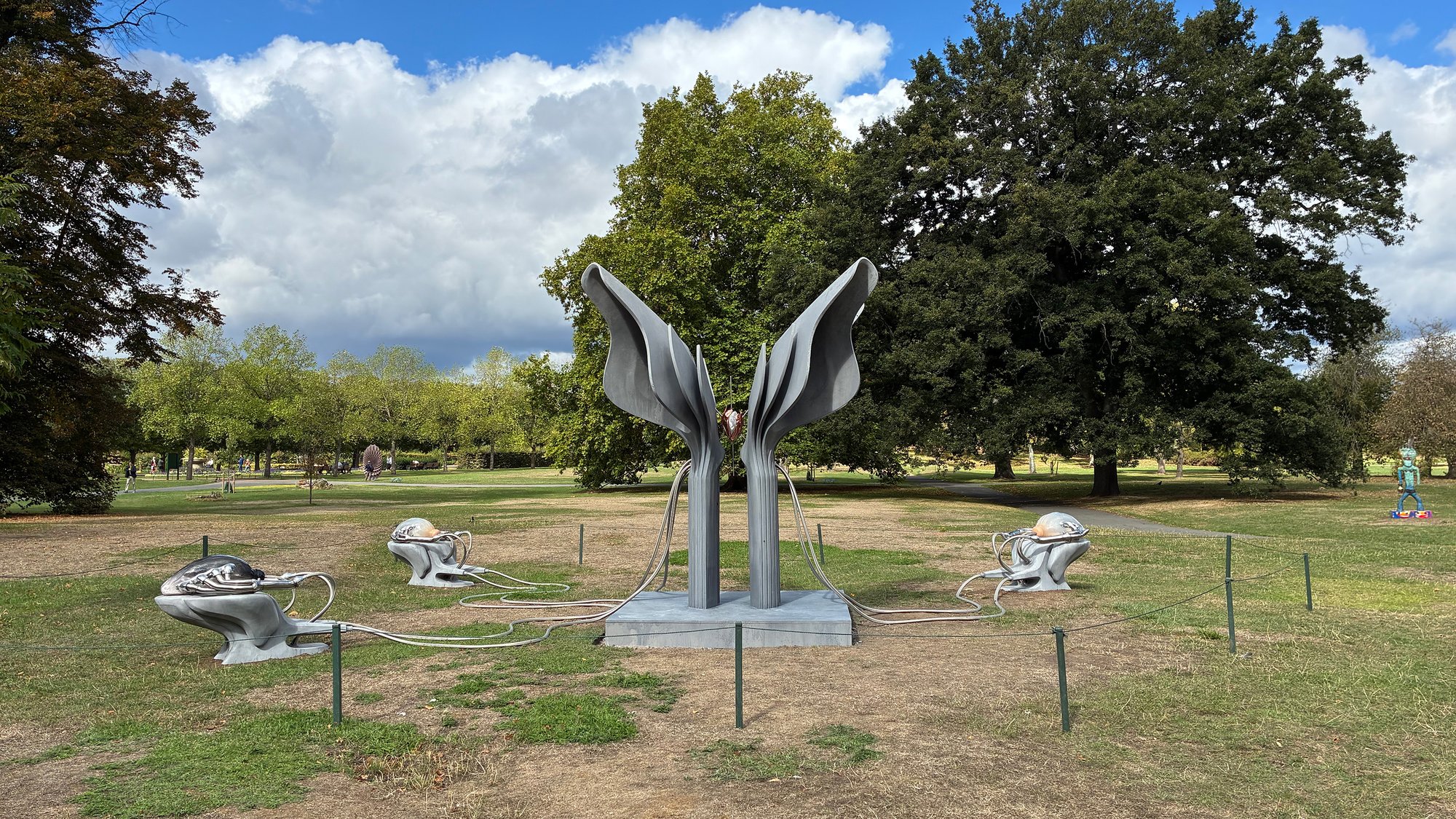
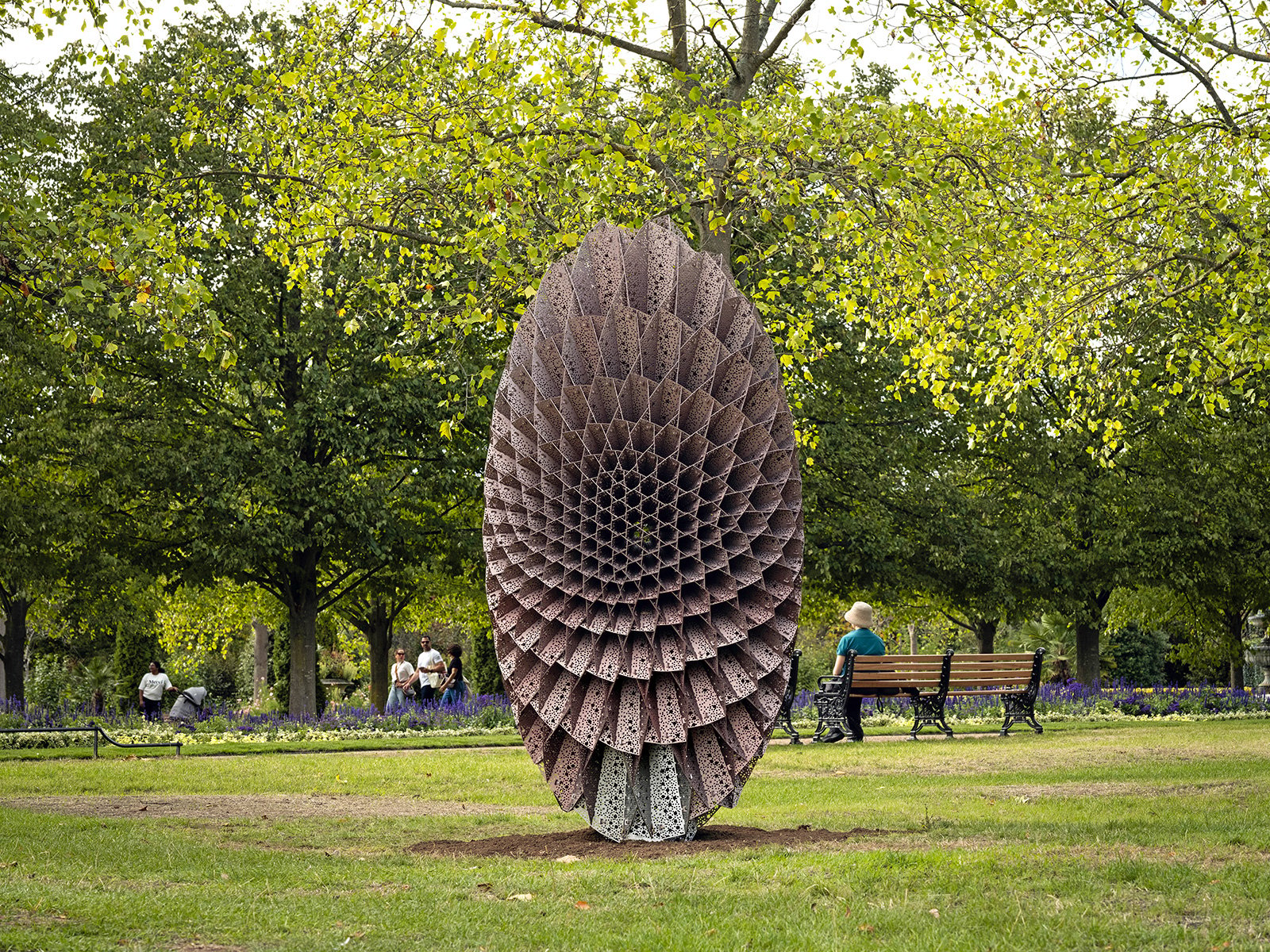
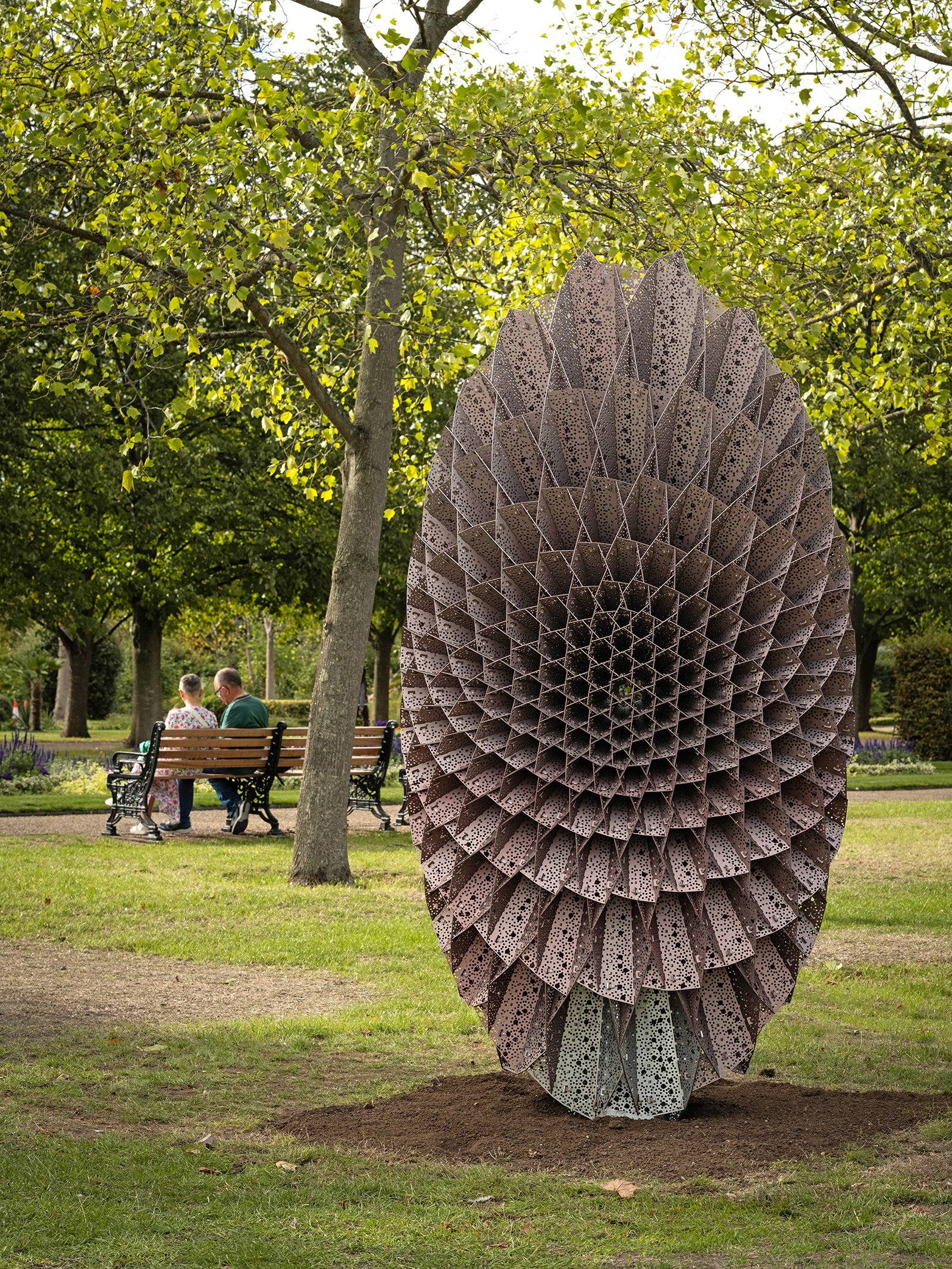
Installation view of Frieze Sculpture, London, 2026, with work: Metanoia (2025) by Ivana Basić. Presented by Albion Jeune. Photography by Right Click Save
Signals Intelligence in the Age of Hybrids
The curator of Frieze Sculpture and Right Click Save’s Founding Editor survey the power and problems of art’s new border ecology
Working with hybrid art forms challenges siloed thinking but can also obscure difference
Protecting difference helps make the language of new hybrid realities intelligible, while avoiding the erasure of cultural context
The “ecotone” between ecosystems can be a fertile zone where spaces on either side preserve their disciplinary roots
Frieze Sculpture, curated by Fatoş Üstek, is at The Regent’s Park, London, until November 1, 2026. The 14th edition of the annual exhibition presents work by 11 artists in the park’s English Gardens, images of which are used to illustrate this article.
Contemporary art exists in a hybrid condition. Artists move between physical and virtual spaces, and analog and digital processes while interlacing media and overlapping systems. Their practices increasingly involve constellations of collaborators, human and nonhuman, whose different literacies complicate the notion of individual authorship.
Hybridity is often invoked as though it described a settled state: the joining of two formerly separate things. But the word has a more complicated history. Its etymological associations with mixture, crossing, and lineage have long been entangled with botanical, biological, racial, and colonial classificatory regimes, designed to distinguish the pure from the impure, the native from the foreign, and the original from the derivative.
To use hybridity uncritically is therefore to risk reproducing its most troubling premise: that stable, autonomous categories existed before their encounter. They did not. Or, at least, they did not exist outside the institutional, technical, and political apparatuses that made them appear stable.
Art has often occupied this unstable terrain. Painting has borrowed from theater, photography from painting, sculpture from architecture, performance from ritual, cinema from literature, and digital media from all of the above. Yet the current condition is not simply one of accelerated transdisciplinarity. It concerns a more profound transformation in the organization of perception, knowledge, and imagination. Artists now work amid overlapping technical environments where images become data, data becomes form, code determines behavior, and exhibitions unfold as objects, platforms, simulations, and social encounters.
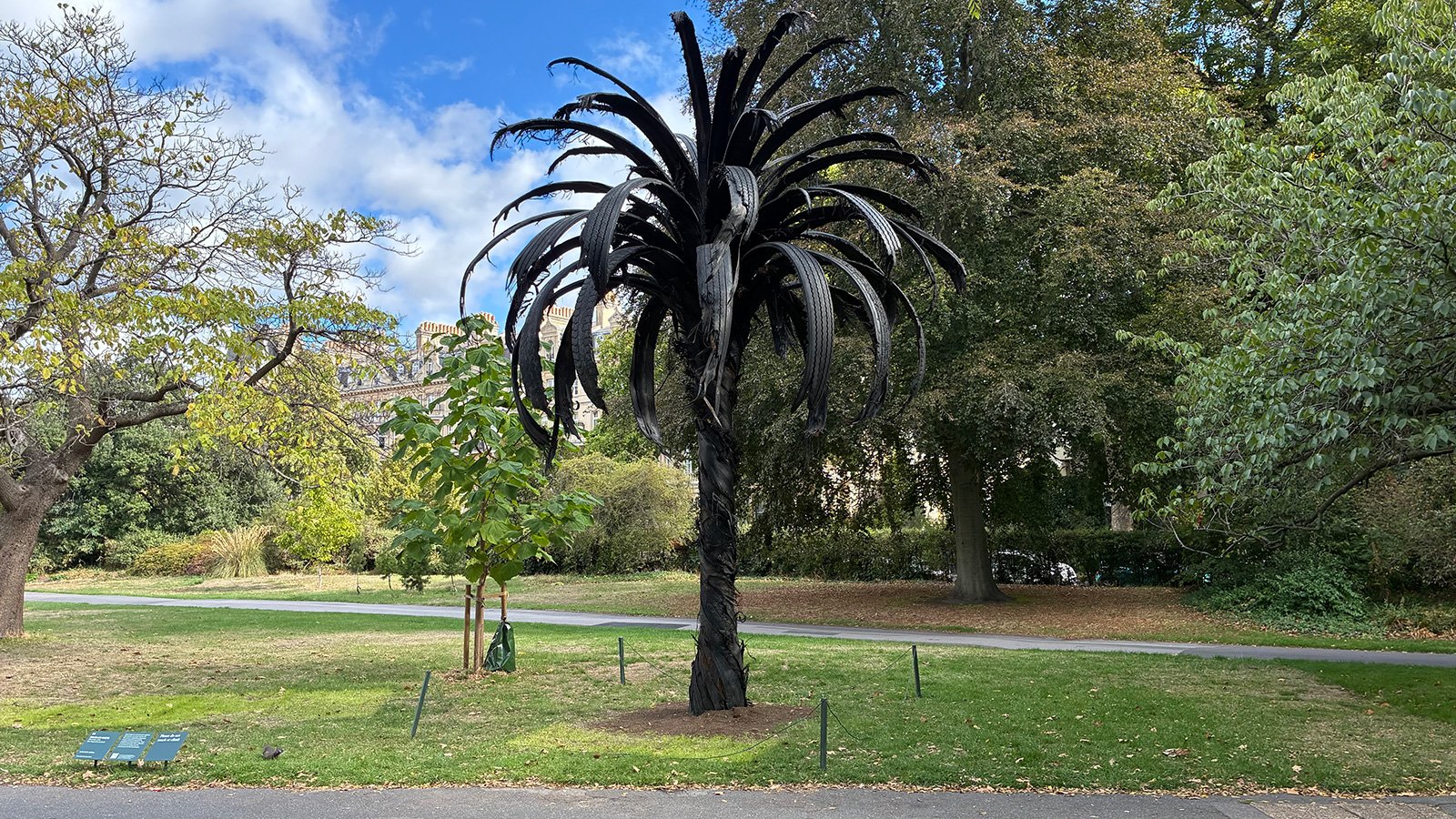
Installation view of Frieze Sculpture, London, 2026, with work: Black Palm (2026)by Douglas White. Presented by Leila Heller Gallery. Photography by Right Click Save
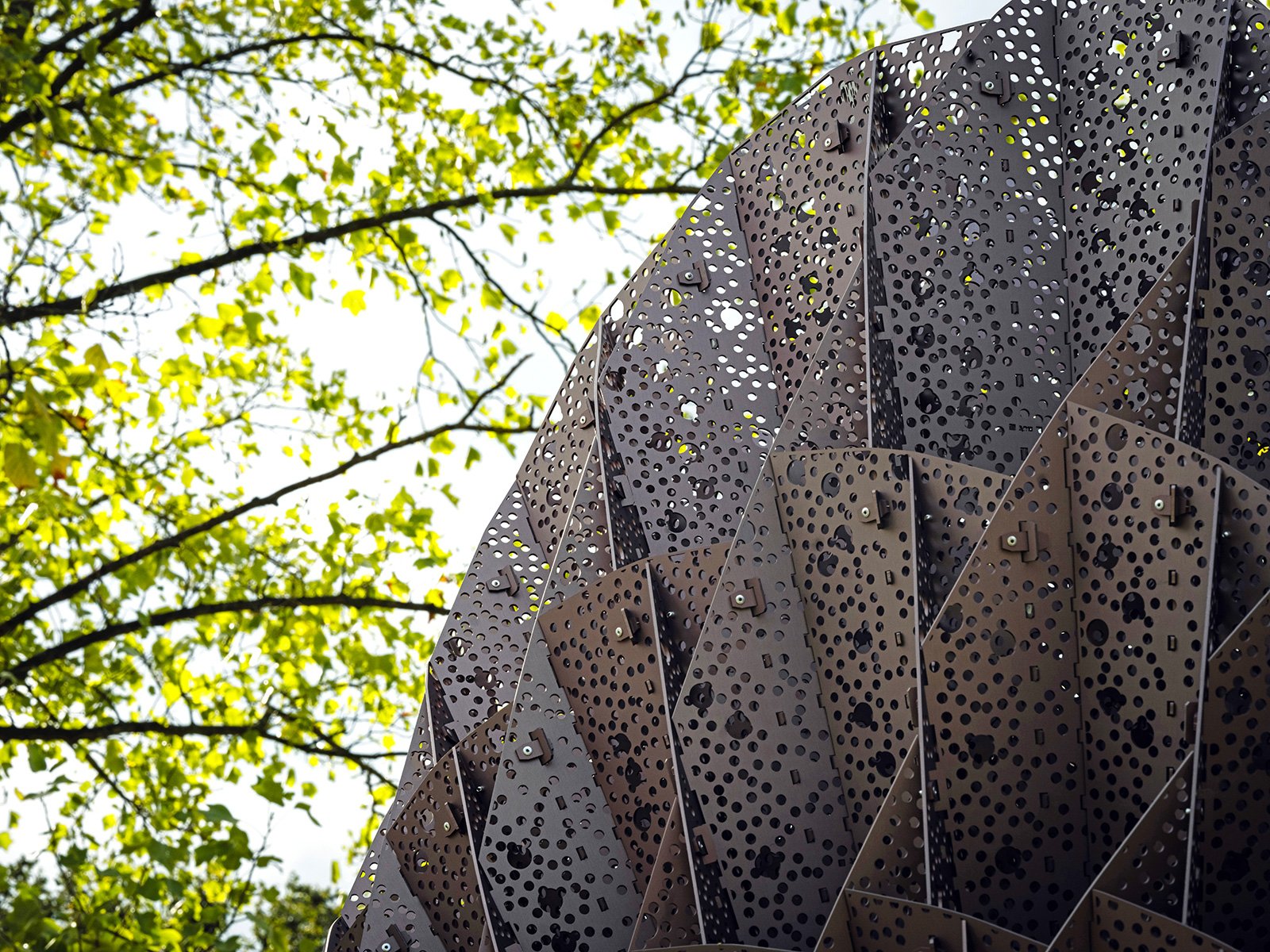
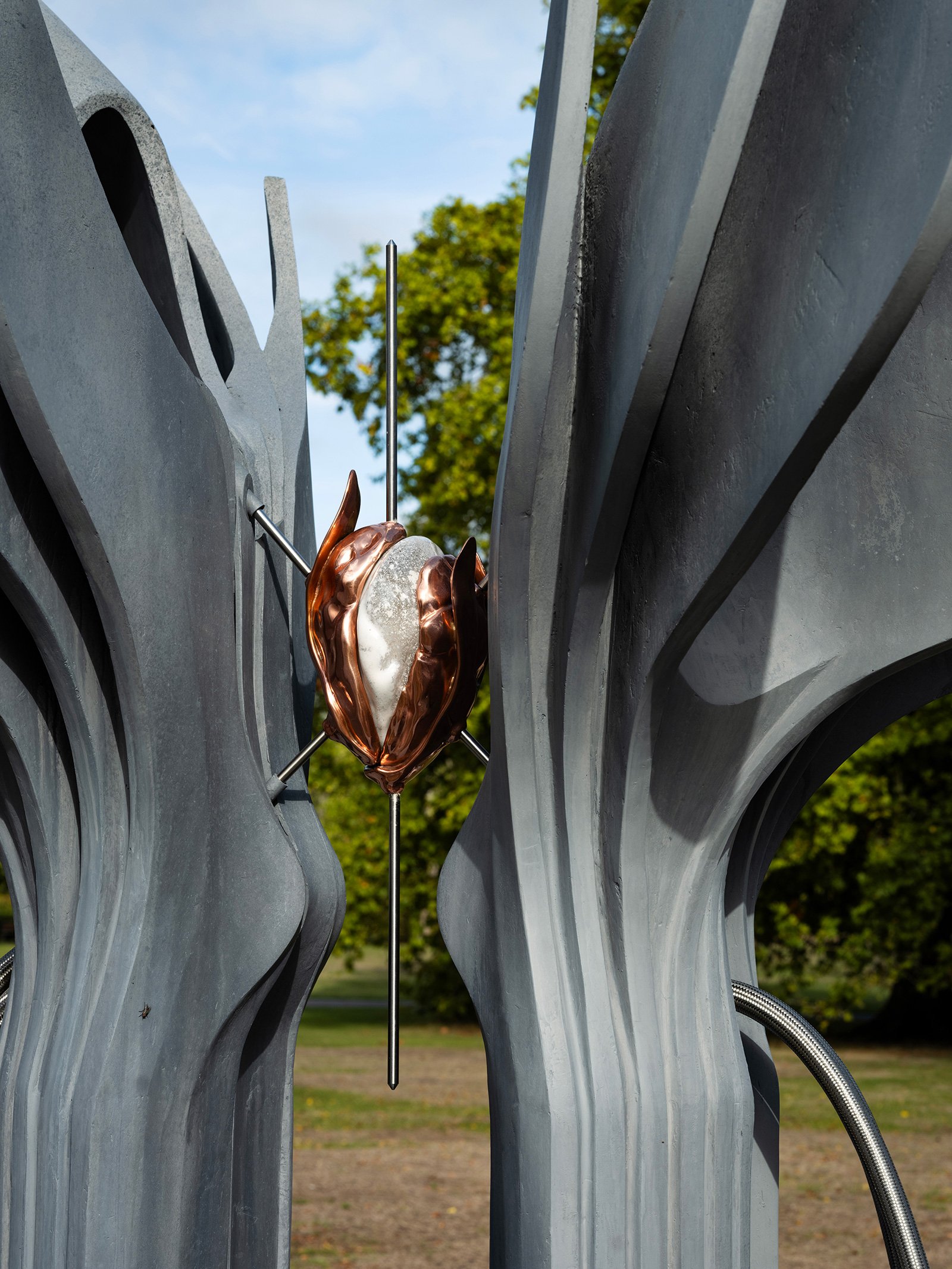
Installation view of Frieze Sculpture, London, 2026, with work: (Detail of) Eye of the Needle (Time Pebble (E30A13)) (2026) by Conrad Shawcross. Presented by Victoria Miro. Photography by Linda Nylind
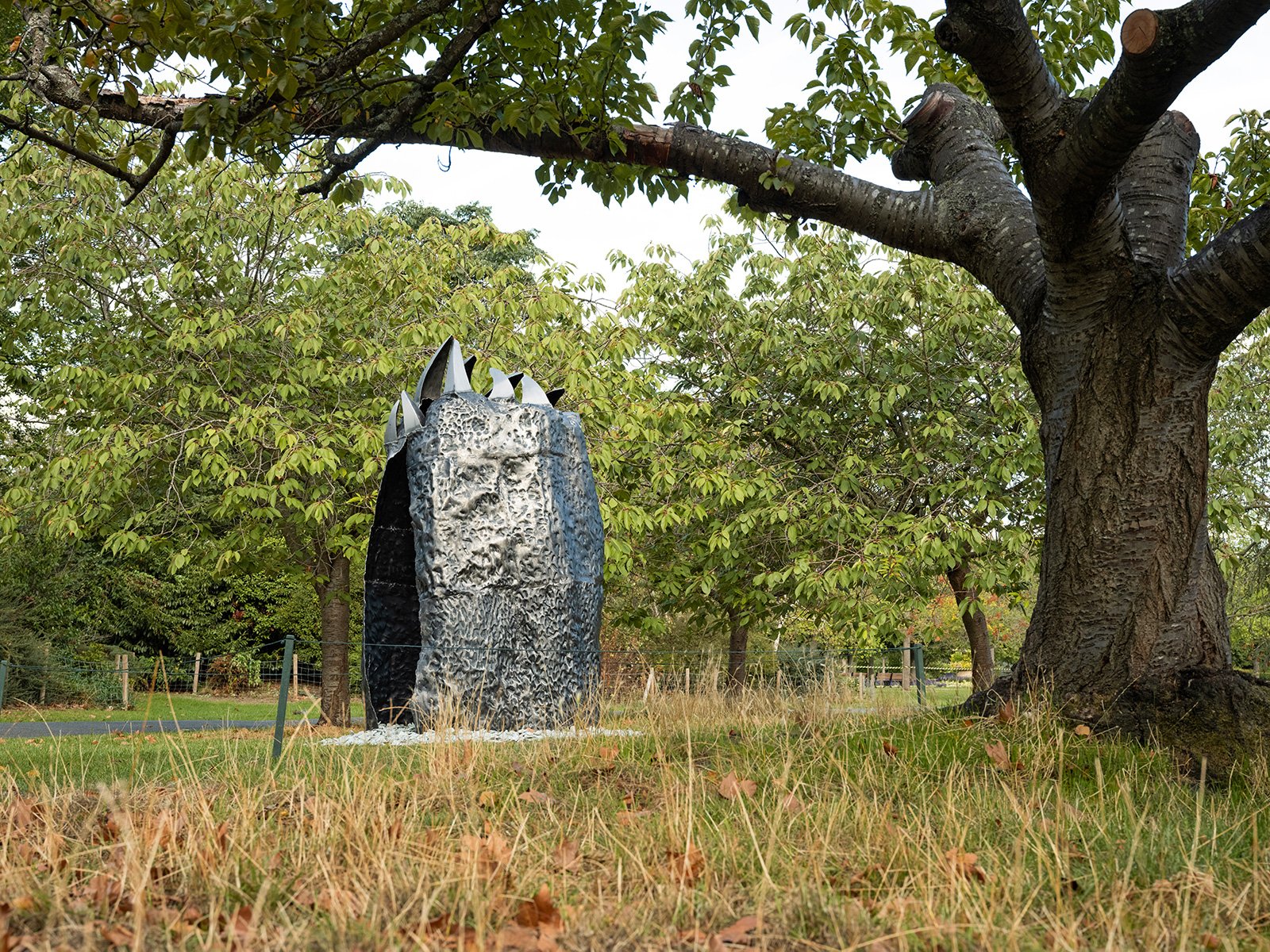
Installation view of Frieze Sculpture, London, 2026, with work: Agony in the Garden (2026) by Elena Nemkova. Presented by Dom Art Gallery. Photography by Linda Nylind
The question is no longer whether art is hybrid, it is which hybridities matter, for whom, under what conditions, and with what consequences.
Hybridity does not spread evenly across culture like a solvent. Nor does it melt disciplines into a single fluid field. It is more heterogeneous than that: a set of clustered intensities, temporary vortices, and points of friction and exchange. It resembles an ecotone, the transitional zone between distinct ecological communities that is often characterized by heightened abundance. In an ecotone, species adapt and new forms emerge, as well as new vulnerabilities. The same is true of art’s increasingly entangled ecology.
Between the imaginable, the physical, and the virtual
Contemporary culture takes shape across a triangulation of the imaginable, the physical, and the virtual. The imaginable is not simply fantasy or private interiority. Following the philosopher Cornelius Castoriadis, it is the social imaginary: the capacity through which societies institute meanings, produce values, and make collective worlds conceivable. It is what enables a community to recognize an image as evidence, or an artwork as a site of shared attention.
The physical (what is often called IRL) does not sit outside this imaginary but is continuously interpreted, staged, and reorganized through it. The virtual, or URL, is not a secondary realm either: it is an infrastructural, economic, and affective condition through which social relations are increasingly mediated. The online is real in its affect; the offline is already networked in its organization.
These domains do not fuse into a seamless phygital (physical and digital) totality. Instead, they produce distinct languages, habits, and modes of attention that make different demands upon bodies and imaginations. Their encounter may generate synthesis, but it can also generate dissonance, misrecognition, or refusal.
Installation view of Frieze Sculpture, London, 2026, with work: Eye of the Needle (Time Pebble (E30A13)) (2026) by Conrad Shawcross. Presented by Victoria Miro. Photography by Linda Nylind
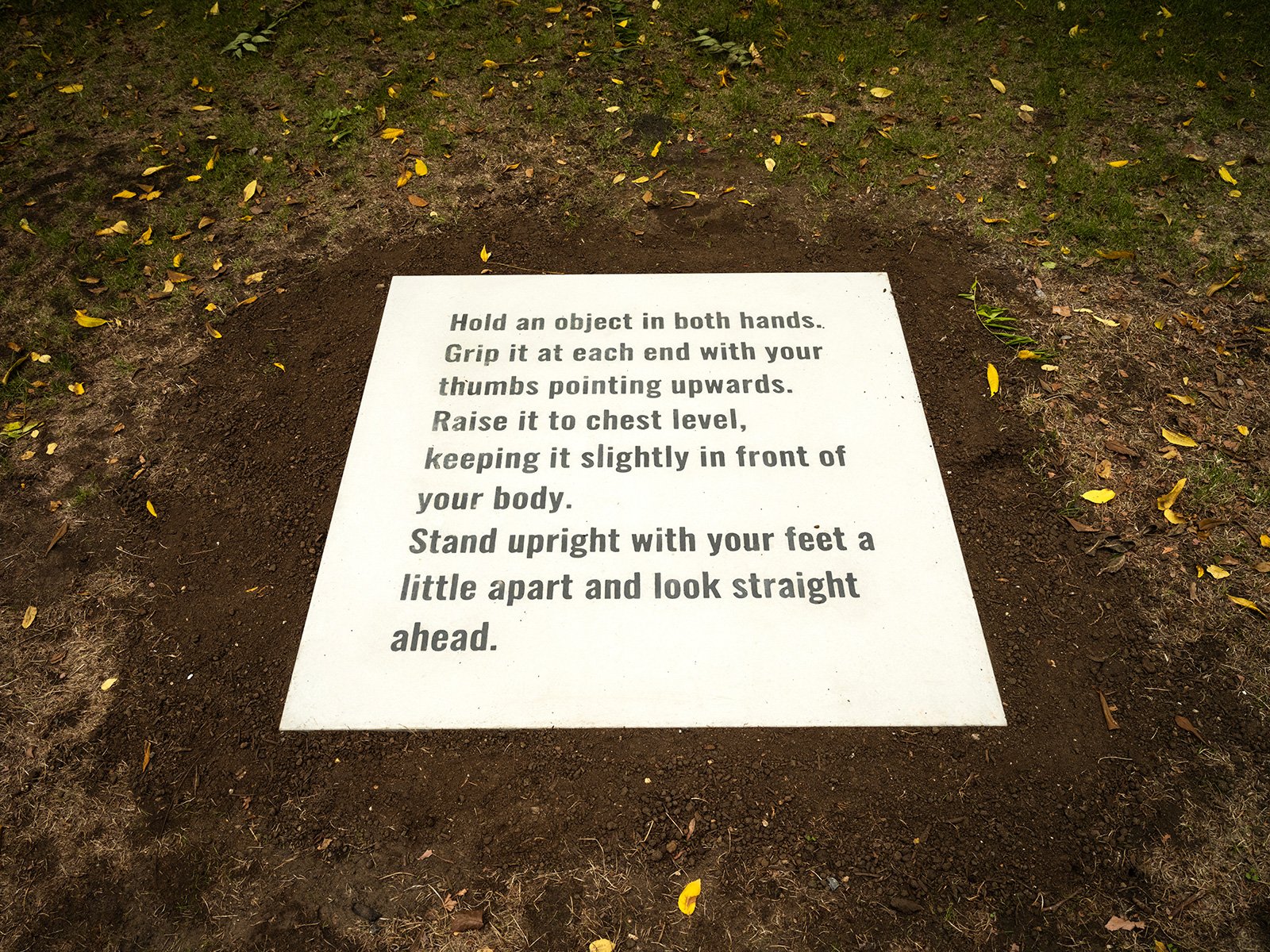
Installation view of Frieze Sculpture, London, 2026, with work: Possibilities for a Sculpture (2026) by Ozlem Gunyol and Mustafa Kunt. Presented by Dirimart. Photography by Linda Nylind
What happens when an ancestral cosmology meets satellite imaging, when a ritual gesture is translated into a game engine, when a sculpture is modelled through photogrammetry, rendered in a browser, and then fabricated at architectural scale? What is gained in the translation and what becomes illegible?
Artists are among the most critical translators. Their work does not merely move between media; it tests the assumptions that media encode. The invention or collision of mediums does not automatically yield hybridity. It creates the conditions in which a hybrid relation might emerge: a relation between different skills and systems.
In this sense, medium refers to the materials and techniques through which art is made, while also suggesting mediation as a process of carrying and shaping ideas. The artist receives, filters, redirects, and gives form to signals that do not come from one fixed self. These signals may come from code, matter, memory, collective struggle, nonhuman life, ritual knowledge, institutional systems, or machine-generated propositions. In this way, authorship becomes less a sovereign act than a process of negotiation among agencies that do not share a common language.
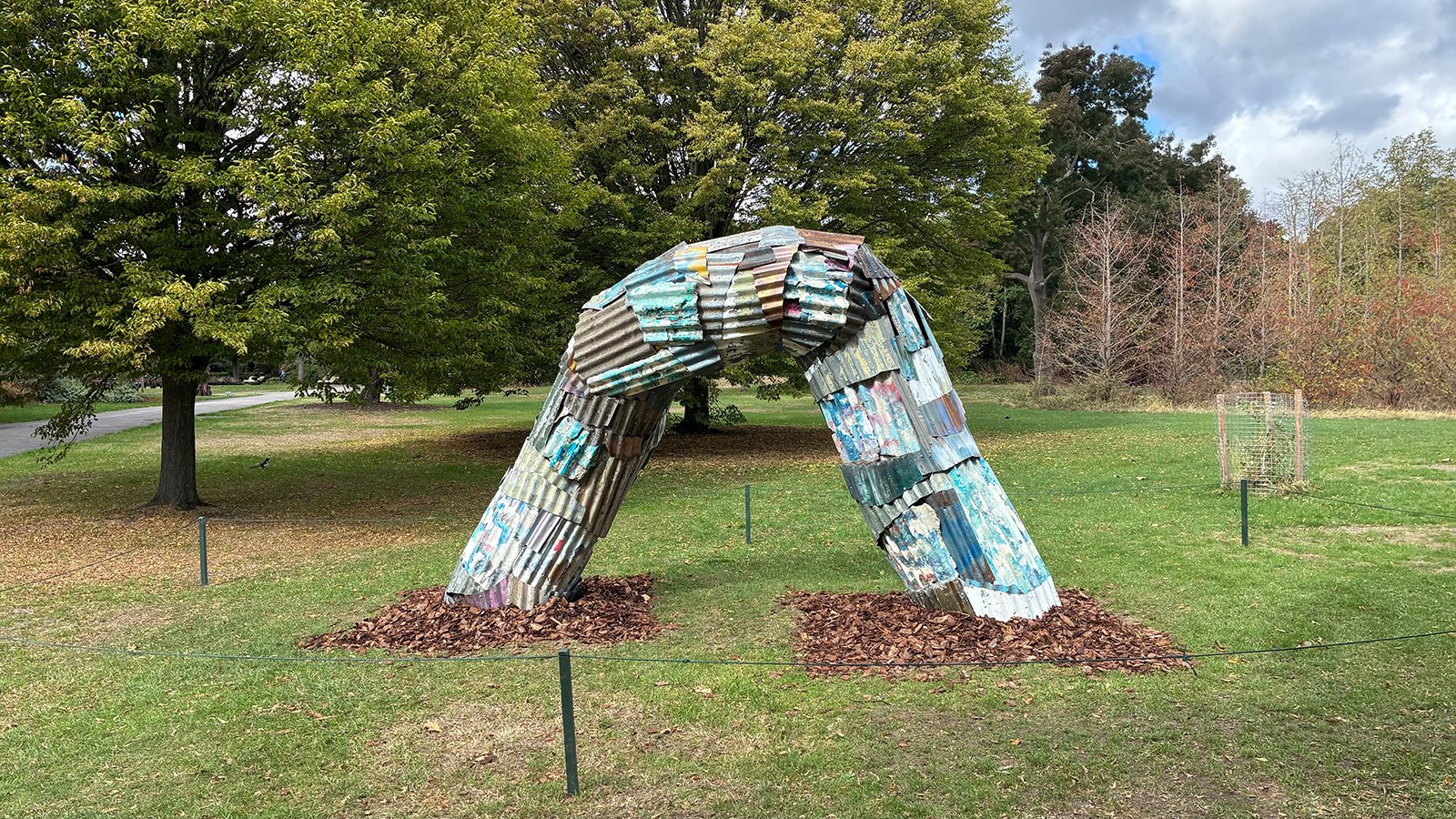
Installation view of Frieze Sculpture, London, 2026, with work: WYRM (2026) by Catriona Robertson. Presented by The Muse Gallery. Photography by Right Click Save
Against the fantasy of frictionless fusion
Machine learning has intensified this condition. Multimodal models process text, sound, image, and moving image within computational systems that can translate among them at extraordinary speed. Photographs, poems, paintings, and films can all be rendered commensurable as data, converted into statistical relations within a latent space whose scale exceeds human comprehension.
This capacity is often described as a triumph of hybridity. But it may be closer to a new form of abstraction. Latent space appears plural because it contains an immense archive of cultural material; it is reductive because its operation depends on translating that material into calculable relations. Difference becomes available to computation only once it is formalized.
The danger is not merely that machines imitate artistic styles. It is that the histories, labor, techniques, and struggles embedded in cultural forms are stripped of their situated context.
What happens to a tradition when it enters a dataset used to train a model? What happens to a painting when it is treated as a promptable aesthetic category? Can computing support genuinely plural ways of knowing, or does it produce a universal language in which all knowledge is ripe for extraction?
These questions are inseparable from the political economy of platforms. The internet’s cultural domain has expanded through forms of access that are remarkably broad, if radically unequal. To participate in the social imaginary of the network, one increasingly requires little more than connectivity, a device, and entry to a platform’s terms of service. This has created unprecedented possibilities for circulation, self-publication, mutual learning, and community formation. It has also transformed attention, language, and creative production into resources for acculturation and exploitation.
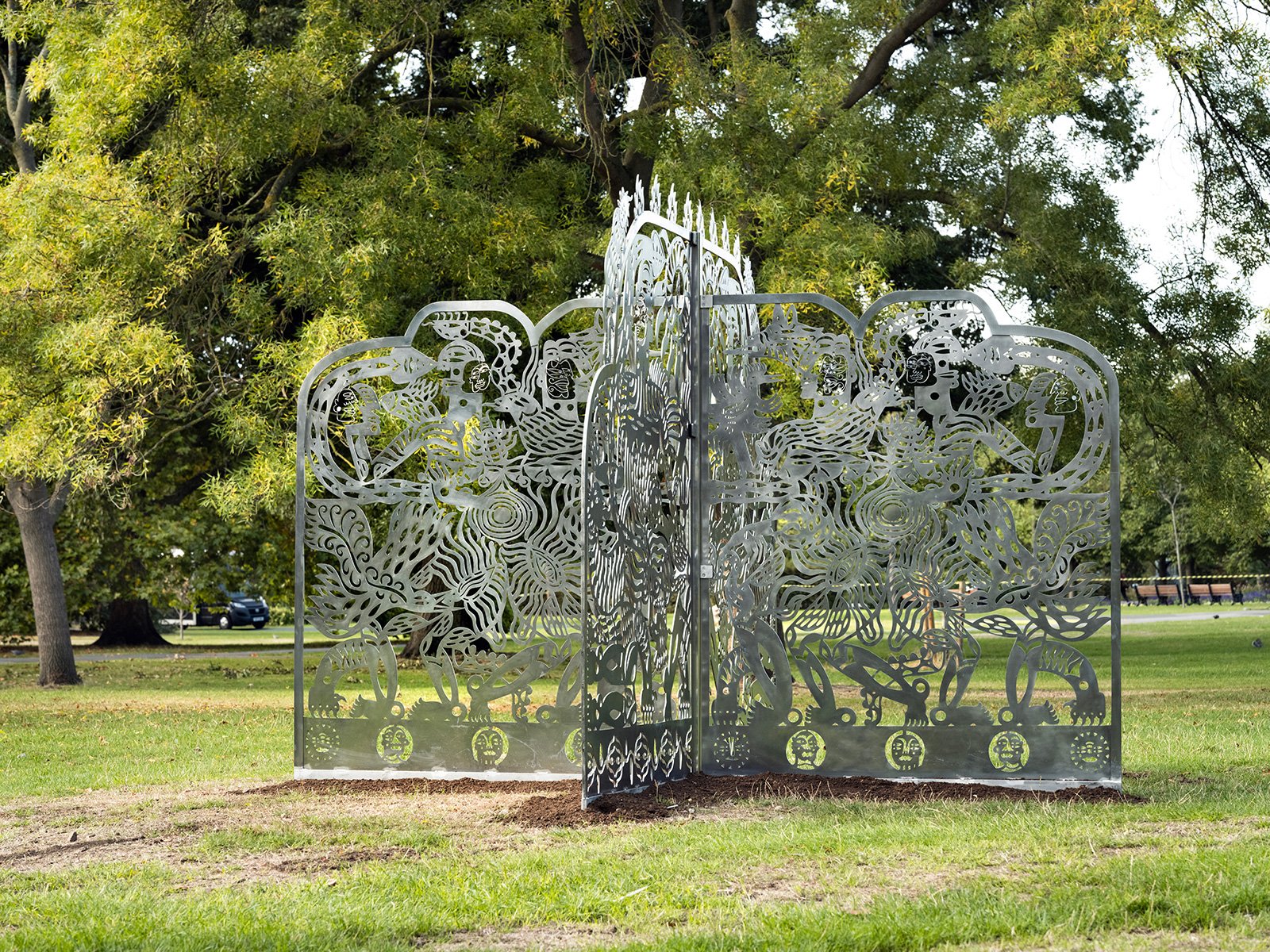
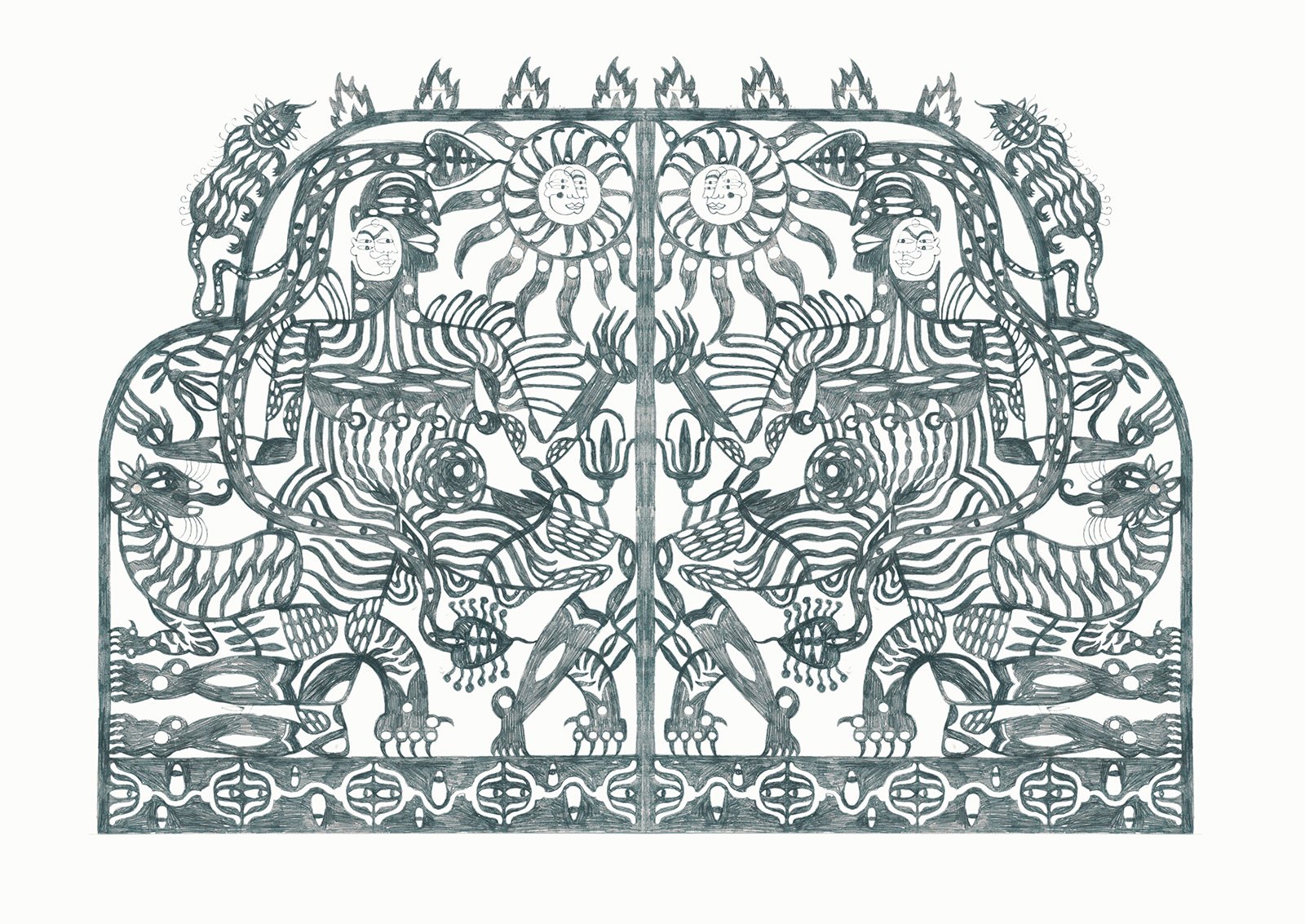
Installation view of Frieze Sculpture, London, 2026, with work: The Sun Bathes Its Friends and Neighbours (2026) by Tarini Sethi. Presented by Rajiv Menon Contemporary. Photography by Linda Nylind
Tarini Sethi, The Sun Bathes Its Friends and Neighbours, 2026. Presented by Rajiv Menon Contemporary. Photography by Linda Nylind. Courtesy of the artist
For cultural laborers, the challenge is double, and a new language is needed to account for new realities. But historical differences must also be preserved to ensure those realities are intelligible.
“Everyone” can contribute, but who owns the infrastructure through which they are to do so? Who is rendered visible, searchable, trainable, or monetizable? And who remains excluded by geography, language, cost, surveillance, disability, censorship, or the uneven distribution of bandwidth and technical literacy? Digital access is a prerequisite for participation, but it is not the same as equality.
Artists working with computational systems often make these contradictions palpable. Rather than treating code as a neutral tool, today’s hybrid practitioners remind us that protocols organize social relations. They determine what can circulate, who can act, when something is considered valuable, and what forms of care or exclusion a system permits.
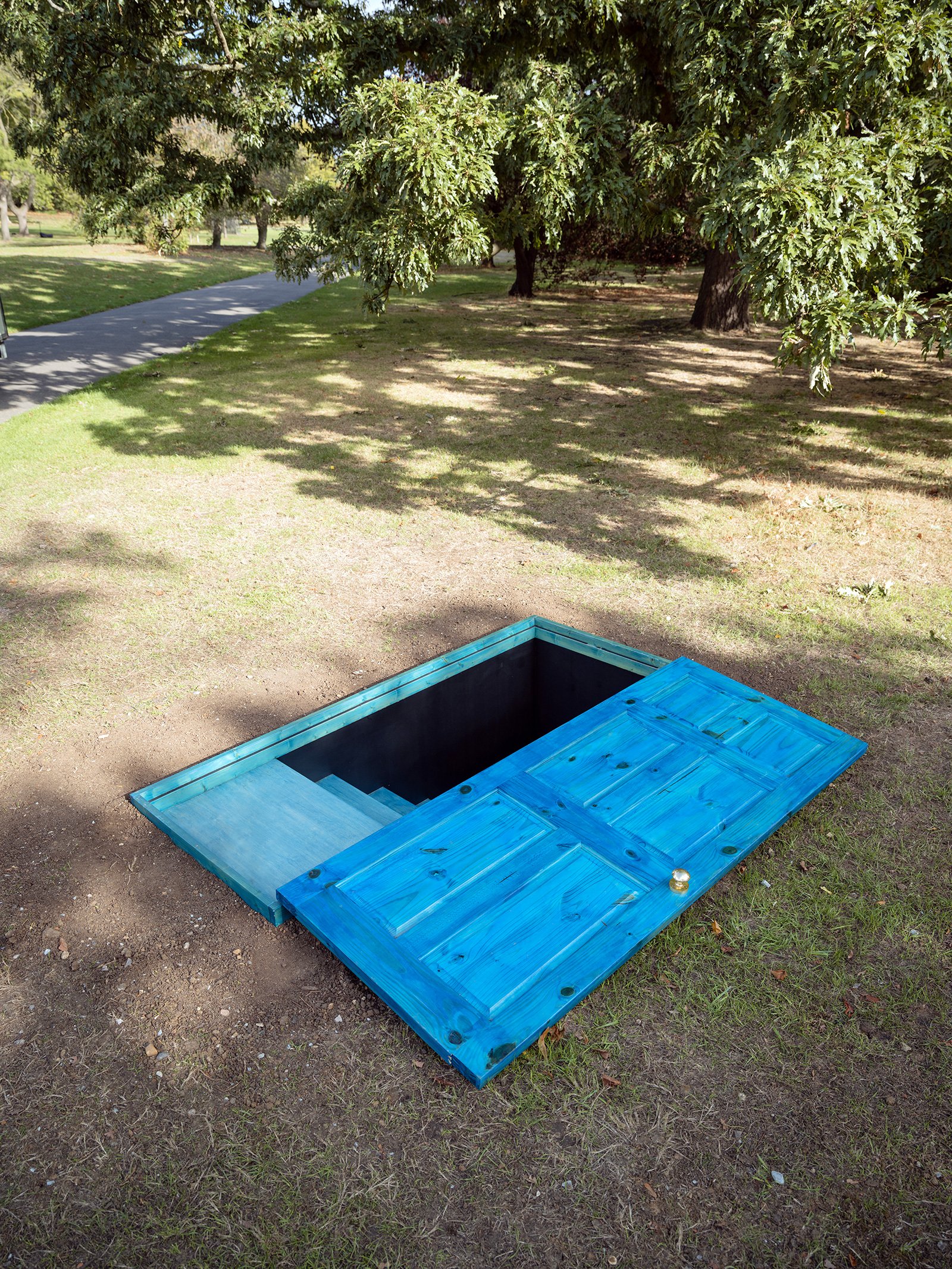
Installation view of Frieze Sculpture, London, 2026, with work: Dreams and Salt (2025–26) byAngel Otero. Presented by Hauser & Wirth. Photography by Linda Nylin
Installation view of Frieze Sculpture, London, 2026, with work: Eye of the Needle (Time Pebble (E30A13)) (2026) by Conrad Shawcross. Presented by Victoria Miro. Photography by Linda Nylind
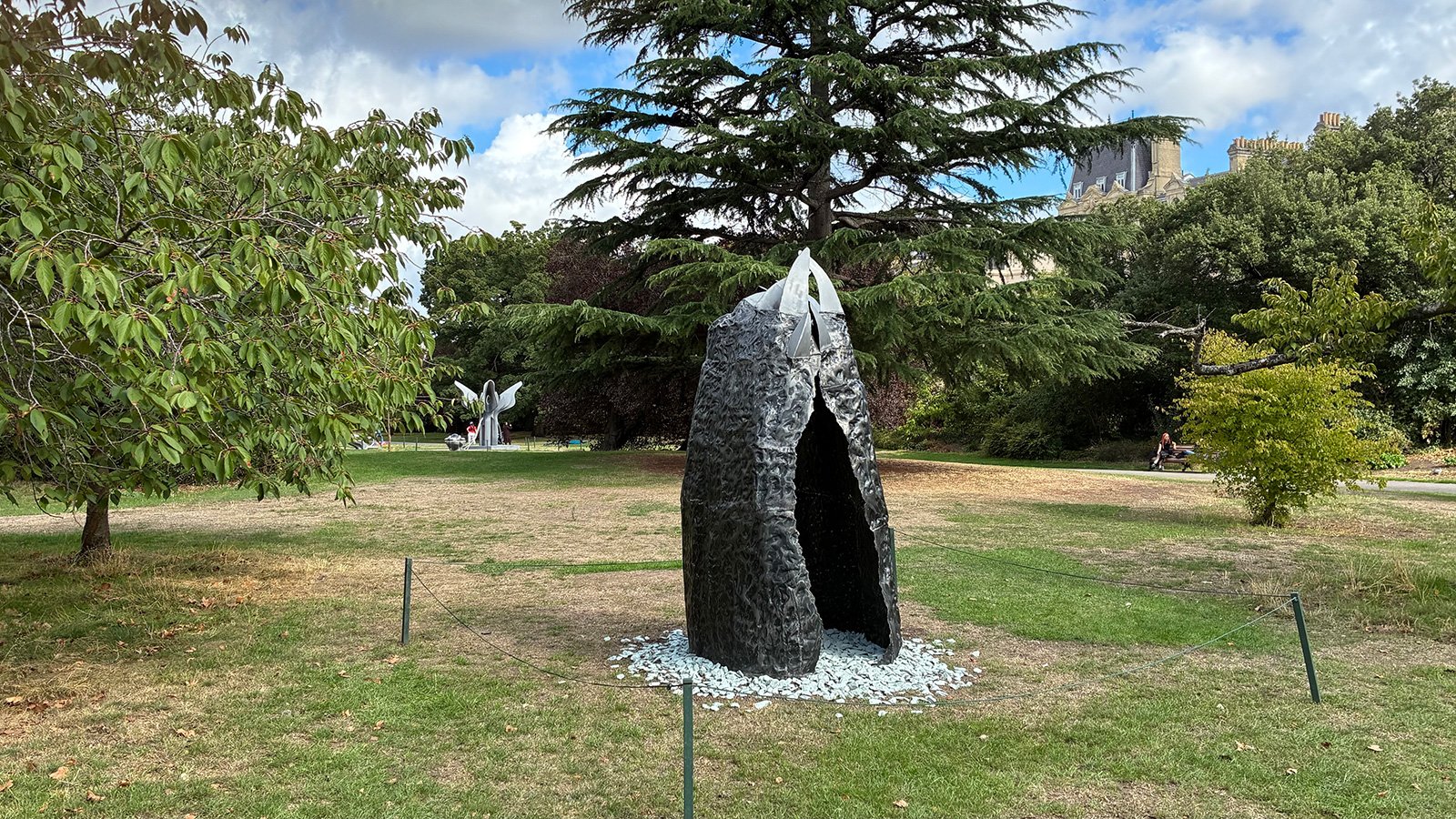
Installation view of Frieze Sculpture, London, 2026, with work: Metanoia (2025) by Ivana Basić. Presented by Albion Jeune. Photography by Linda Nylind
Ritual, agency, and technical imagination
The contemporary hybrid condition also reorders the relation between ancestral knowledge and scientific frameworks. These are often regarded as contrasting dimensions: one rooted in faith, tradition, and the preservation of heritage; the other emphasizing accuracy, objectivity, and the pursuit of progress and innovation. Yet artistic practices repeatedly show that neither domain is internally uniform, nor are they sealed off from one another.
A ritual turn is taking place alongside an agentic one. Artists are returning to ceremony, embodied knowledge, myth, healing, divination, and collective practice not necessarily as a retreat from technology, but as a means of asking what, and who, technology has failed to account for. At the same time, artists work with artificial intelligence, robotics, sensors, brain-computer interfaces, ecological modelling, and synthetic media to distribute agency beyond the individual human subject.
Yet agency is never simply transferred from artist to machine. Rather, responsibility is dispersed across designers, datasets, mineral supply chains, energy systems, interfaces, institutions, audiences, and the bodies affected by their outputs. To speak of machine agency without speaking of these relations risks turning technical complexity into a new mysticism.
This is where the more-than-human becomes useful, not as a fashionable post-humanism, but as a way of recognizing that all artworks, technologies, and ecosystems exist relationally.
Installation view of Frieze Sculpture, London, 2026, with works: Agony in the Garden (foreground, 2026) by Elena Nemkova, presented by Dom Art Gallery; and Metanoia (background, 2025) by Ivana Basić, presented by Albion Jeune. Photography by Right Click Save
Worlds beneath and beyond the surface
If hybridity describes an intensified condition of mediation, then immersion is one of its dominant aesthetic forms. Digital environments, game engines, real-time rendering, and spatial sound invite audiences not only to look at a world but to enter one. However, entry is not equivalent to understanding. Immersion may expand perception, but it can also package complex environments as consumable spectacles. This may be one of art’s most important contributions to a technological culture built around frictionless interfaces and fantasies of control. Art can make entanglement sensible, staging the limits of mastery without those limits inducing paralysis.
The ecotone as method
The ecotone is not a metaphor for easy coexistence. Border ecologies can be abundant, but they are also exposed: sites of adaptation, competition, stress, and accelerated change. To rethink art through the ecotone is therefore to reject hybridity as a cosmetic fusion of seemingly different contexts. It is to understand the space between media, disciplines, and ontologies as a place of resistance.
Such a position requires precision. We should not celebrate transdisciplinarity when it merely treats disciplines as aesthetic resources emptied of history. Nor should we defend disciplinary purity as if painting, sculpture, performance, science, design, or code had ever existed in isolation. The question is whether the encounter between fields preserves enough difference for each to challenge the other.
This is the paradox of hybridity. It challenges purity but can also mask difference.
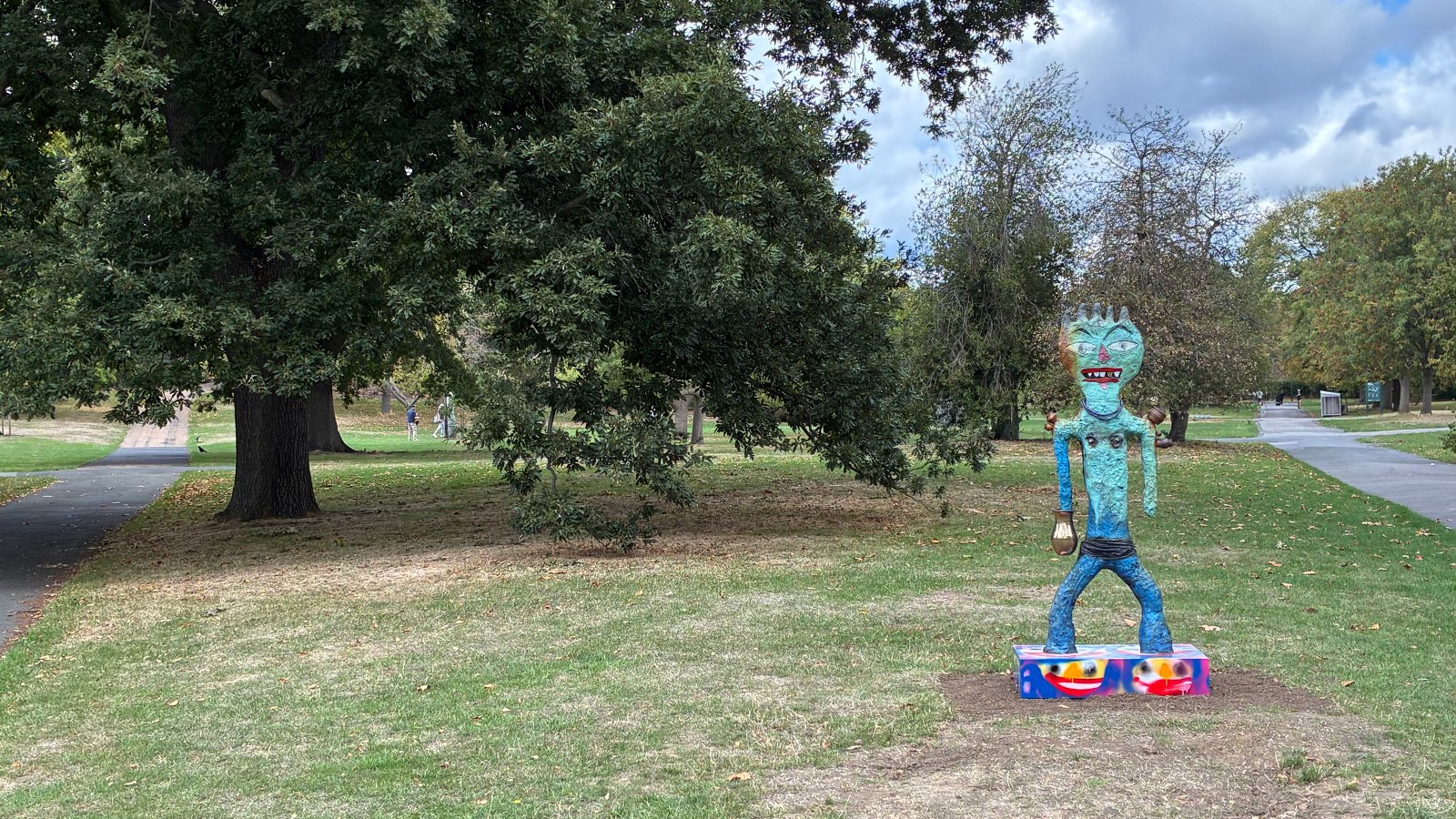
Installation view of Frieze Sculpture, London, 2026, with work: Warrior Figure (2026) by Ramesh Mario Nithiyendran. Presented by Jhaveri Contemporary and Sullivan+Strumpf. Photography by Right Click Save
Hybridity can confront the siloed thinking produced by disciplinary specialization while simultaneously erasing the diverse histories, backgrounds, and epistemologies of those it gathers together. The problem recalls decolonial critiques of universality: plurality only matters if different knowledges are capable of speaking from somewhere. Otherwise, it is hubris.
A sculpture modelled digitally is not necessarily “post-medium”; it may make new demands on sculptural thinking. A work of code is not automatically immaterial; it depends on energy, hardware, labor, supply chains, and technical standards, not to mention digital material. A virtual environment is not disembodied; it acts upon bodies, attention, memory, and social conduct. A ritual performance is not pre-technological; ritual itself is a technology for organizing time, relation, and collective imagination.
We need language capable of holding these complexities without neutralizing them.
What are we seeking through new technes: techniques, tools, technologies, and inherited forms of making? Are we pursuing efficiency, intimacy, control, repair, transcendence, survival, or collective recognition? When artists build underwater worlds, train models, print sculptures, choreograph sensors, or translate memory into code, what futures do they make available to perception? Do hybrid conditions offer a more nuanced account of existence, or do they merely multiply its interfaces?
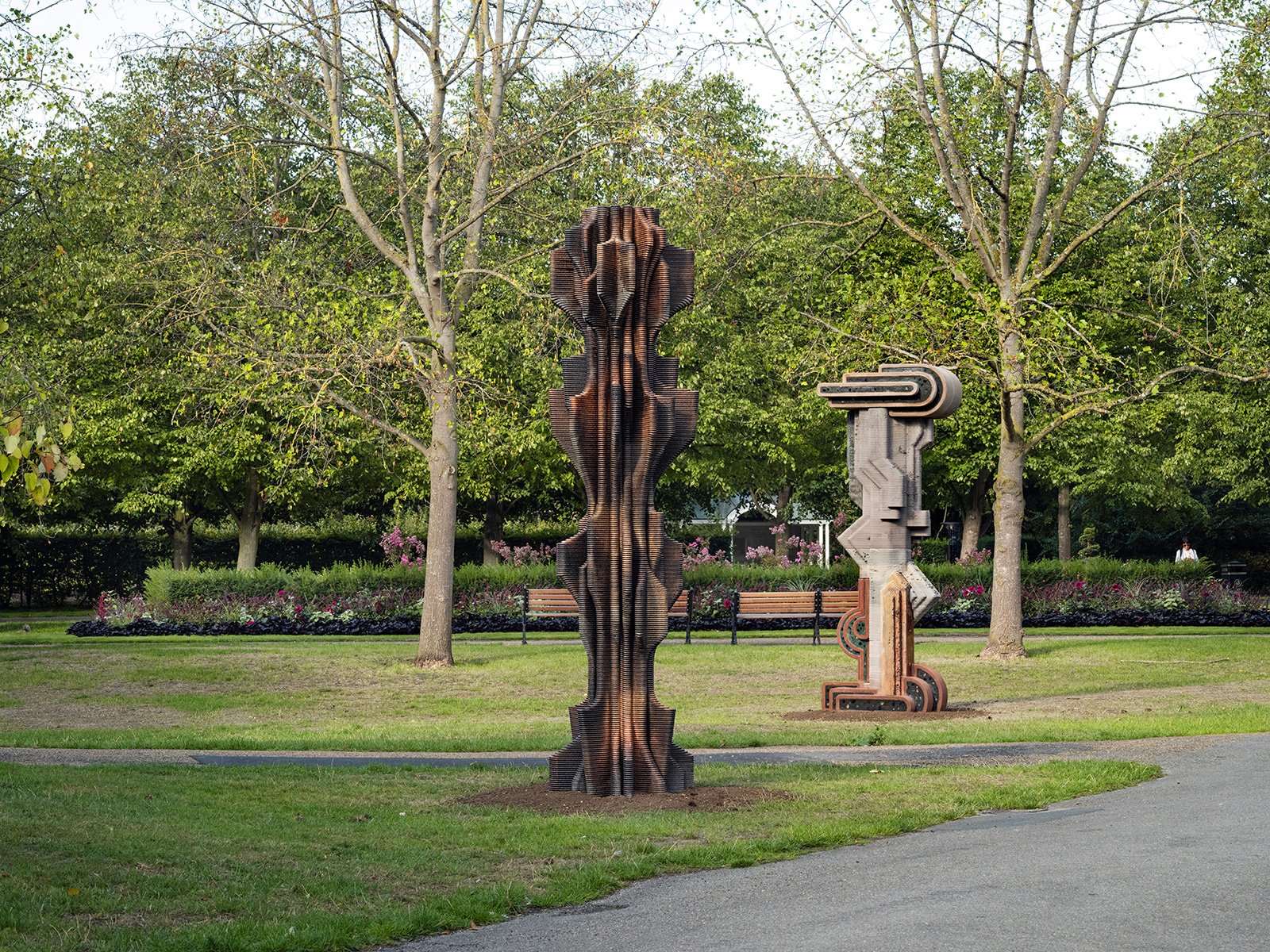
Installation view of Frieze Sculpture, London, 2026, with works: Brutalist (2024) and Mace II (2024) by Matyas Chochola. Presented by The Chemistry Gallery. Photography by Linda Nylind
There can be no universal answer. Hybridity does not mean the same thing from every point of access. For some, it may appear homogenous: an ambient culture in which all media circulate across the same screens and platforms. For others, it is a dense forest beset by unresolved distinctions between access and exclusion, translation and appropriation, connection and extraction, and participation and control. Works of art can make these distinctions tangible (even when digital).
The task is not to entrench separations between human and machine, physical and virtual, and natural and technological. Those distinctions are already inadequate to the worlds we inhabit simultaneously. Nor is it to celebrate their collapse.
The more urgent task is to ask how differences might remain active within relation: how they might survive contact, generate friction, produce care, and resist capture.
Art in the ecotone does not promise resolution. It offers a means of exploring unstable terrain: tracing its clusters, turbulences, and crossings; learning its languages without mistaking translation for equivalence; and crafting forms through which the imaginable, the physical, and the virtual can encounter one another without becoming one and the same.
Fatoş Üstek is a curator, writer, and cultural leader developing a new institution grounded in the ideas of her acclaimed book The Art Institution of Tomorrow (2024). Formerly director of two major UK art institutions, she is co-founder and Managing Director of FRANK Fair Artist Pay, and curator of Frieze Sculpture, London. She serves on international award juries (Turner Prize 2020, Scottish Pavilion 2022, and Netherlands Pavilion 2022 & 2024 in Venice) and advisory panels (Istanbul Modern Collection, Fourth Plinth, Jarman Award), and mentors artists (Chanel Next Art Prize) and curators.
Alex Estorick is the Founding Editor of Right Click Save.