Arts Technologies, the department of the Serpentine Gallery, London, that for more than a decade has been codifying the chronologies and experimental potential of art of the digital era, is presenting the exhibition “processing…” as the opening public event of a new project, Activating Serpentine’s Archive.
The “Activating” initiative, supported by the UK’s National Lottery Heritage Fund, is dedicated to preserving and sharing Serpentine’s archive and its institutional memory, built up over six decades. The archiving program will eventually cover the full history of Serpentine, which was founded in 1970 and has developed into a nimble, curatorially ambitious, kunsthalle holding temporary loan exhibitions of artists ranging from Bridget Riley to Marina Abramović and from Man Ray to Maria Lassnig.
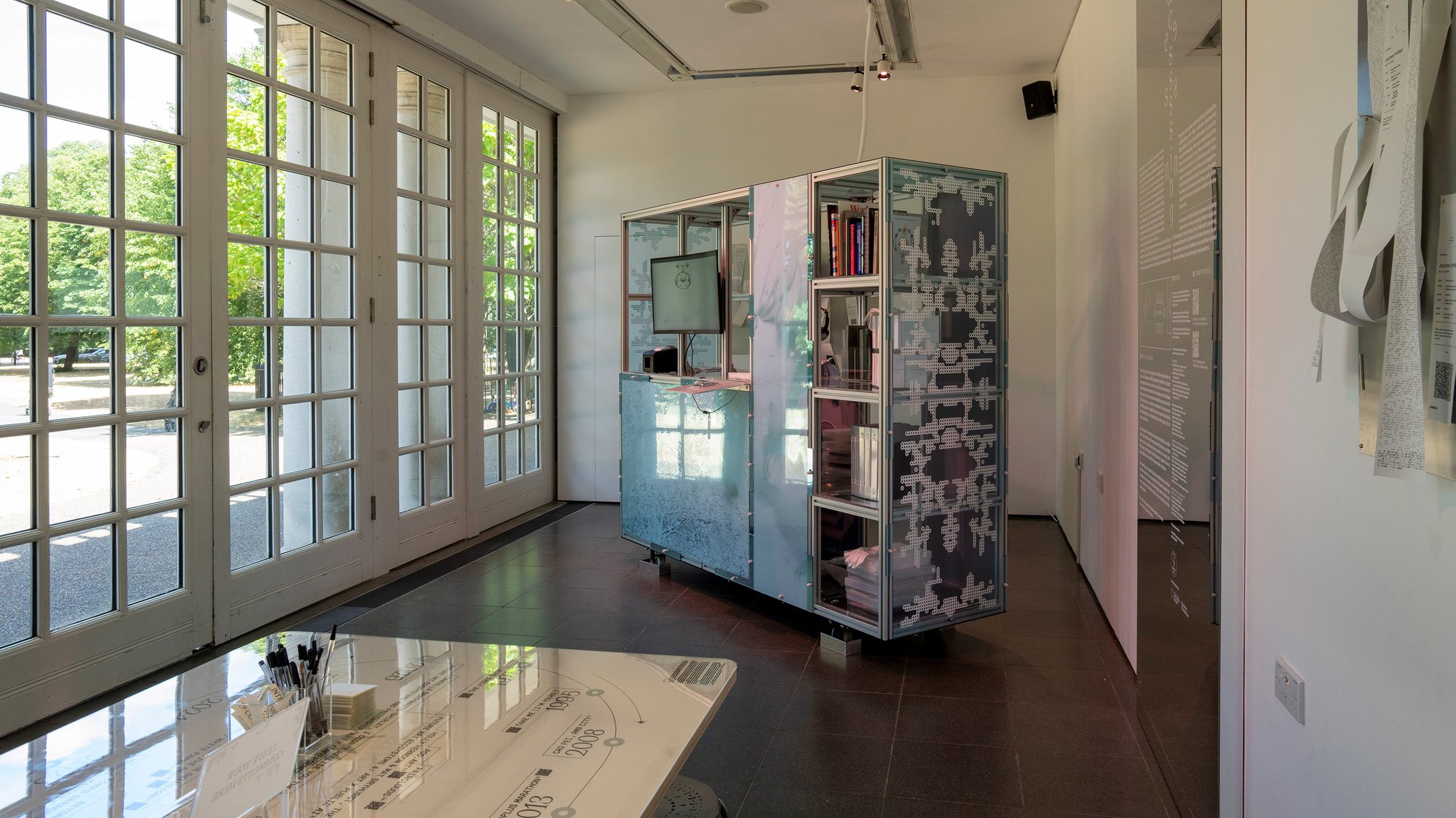
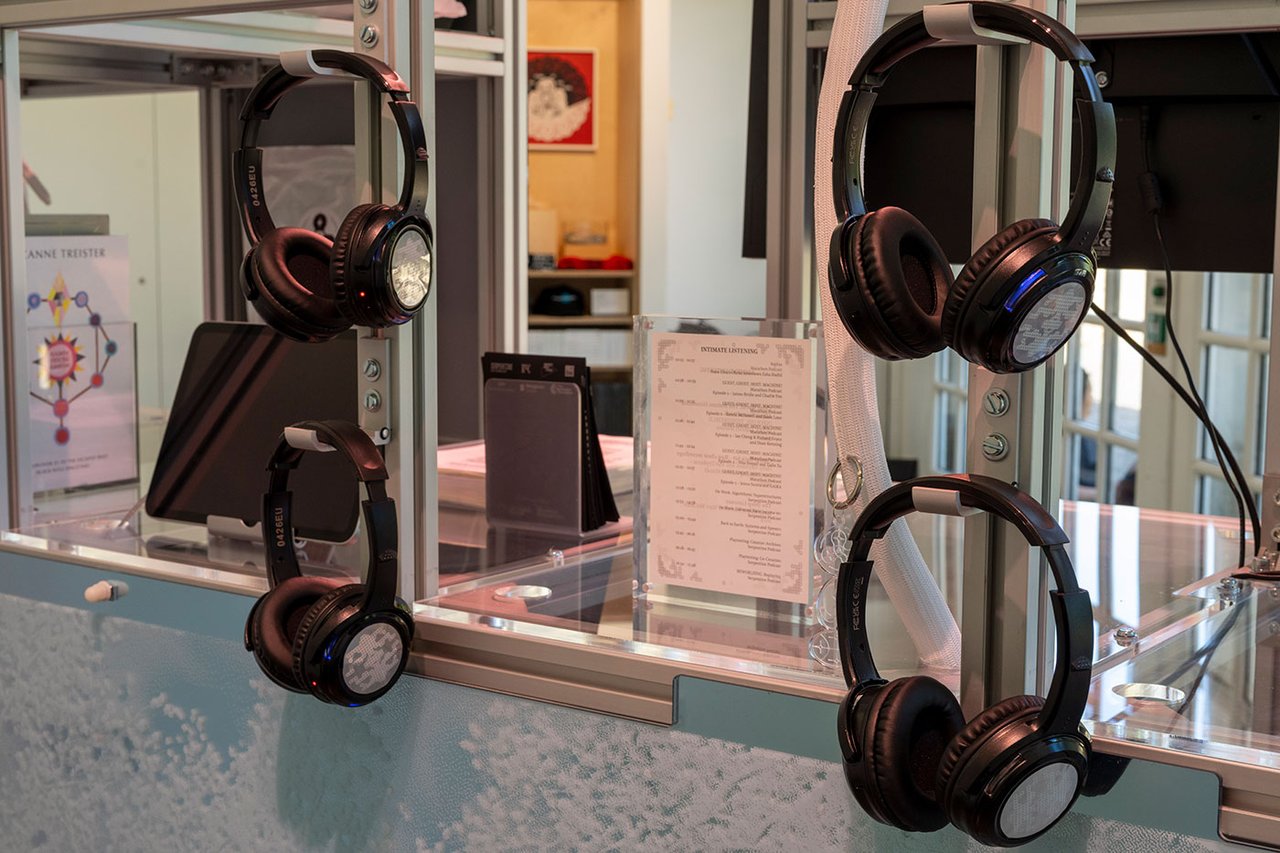
“Processing…”, a hybrid, interactive, physical and digital exhibition, is described by the gallery in a statement as “a mix of a library, listening room, and research space”. It is housed in the intimate but airy educational space in a gallery in the Serpentine South pavilion whose north-facing glazed frontage opens on to the shady, bucolic, landscape of Kensington Gardens, in Hyde Park. The show focuses on the work of Arts Technologies, which, since its foundation in 2014, has generated a series of collaborative projects at Serpentine to support innovation in the arts with a special focus on new cultural and organisational models for art and advanced technologies.
These initiatives have been captured in a series of Future Art Ecosystems (FAE) reports on Advanced Technologies (2020), TheMetaverse (2021), Decentralised Tech (2022), Public AI (2024), and Creative R&D (2025). Bettina Korek, CEO, Serpentine, and Hans Ulrich Obrist, artistic director of Serpentine, encapsulated the role of the Arts Technologies program at the launch of the third of the FAE strategic reports, Art x Decentralised Tech, when they described Serpentine’s mission as “building new alliances [...] new connections between artists and audiences”.
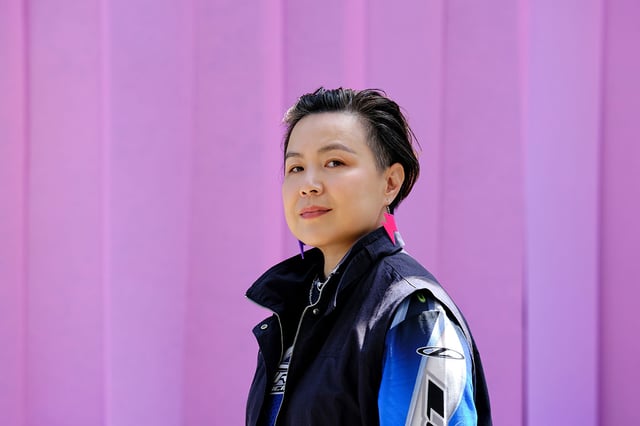
“It’s wonderful to see audiences engaging with and discovering our display, browsing through our archives and spending a long time in the space,” Kay Watson, Head of Serpentine Arts Technologies, tells Right Click Save. “‘Processing…’ looks at how we’ve been engaging with technology, reflecting on the achievements of Serpentine Arts Technologies’ research and looking back at our recent exhibition programme, including the work of Gabriel Massan and Collaborators (2023), Holly Herndon and Mat Dryhurst (2024), and Danielle Brathwaite-Shirley (2025) among other projects.”
“As technologies continue to transform culture and civic life, there is an increasing appetite to understand how artists can help us navigate these changes, challenge existing assumptions and imagine new possibilities.” (Kay Watson)
The launch of the initiative comes during a year that has featured the worldwide opening or reimagining of art institutions dedicated to an expanding art world. They include Serpentine; Somerset House Studios, London, which is celebrating its 10th anniversary; the enlarged and renovated Los Angeles County Museum of Art, and New Museum, New York; and the recently opened NODE, Palo Alto, Schwarzman Centre for the Humanities, Oxford University, and Refik Anadol Studio’s Dataland museum of AI Arts, in Los Angeles. The coming months will see the unveiling of Canyon in downtown Manhattan, and of Powerhouse Paramatta in Sydney, Australia.
This international cohort is, in varied ways, bringing artists together with curatorial and educational entities in a discourse that promises to offer an enlightening art-world prism on existential issues such as the future of the human in the age of AI; the reality of climate change; and living with the demands of the attention economy.
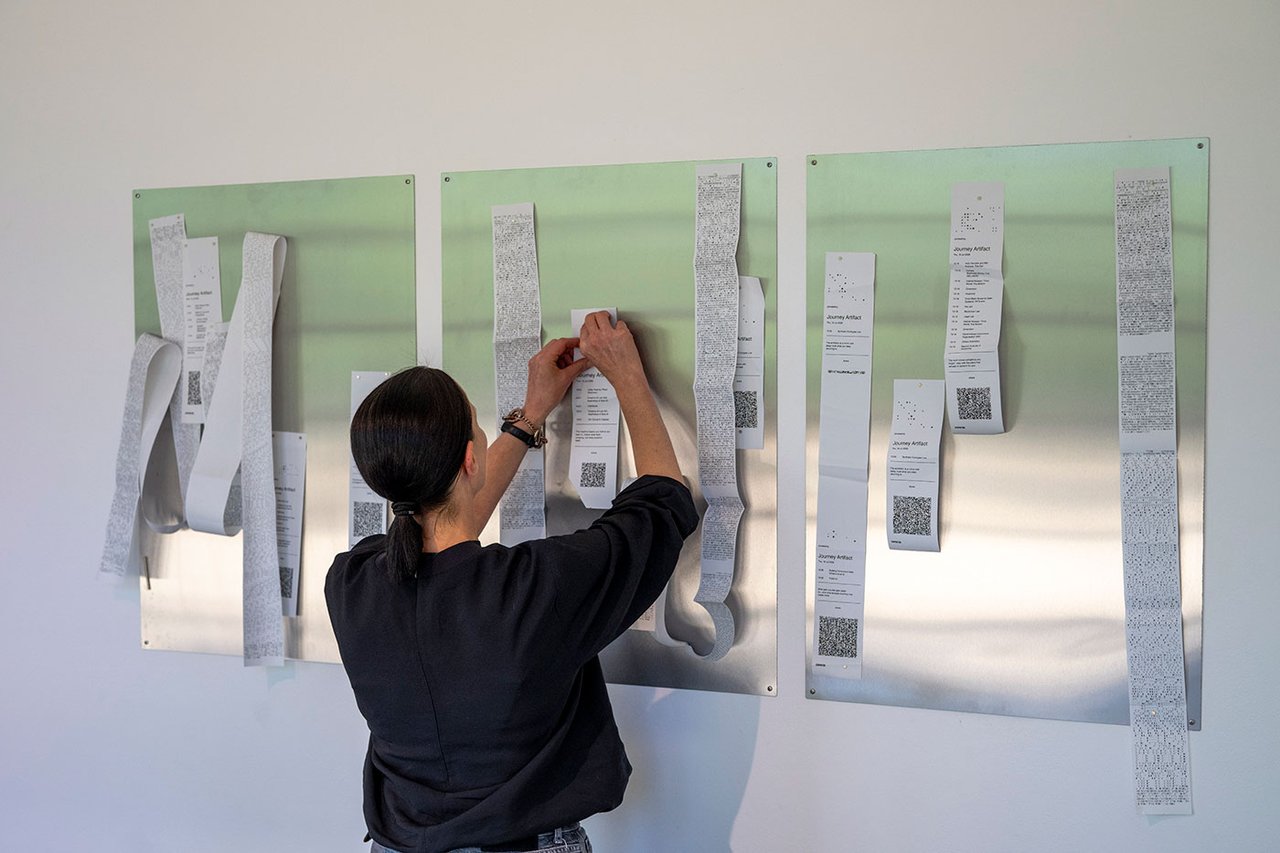
At “processing …”, visitors can engage with a computer terminal to explore the upcoming Future Art Ecosystems website, and print out a paper “receipt” of their digital activity in a system devised by the writer Henry Bruce-Jones. The exhibition organisers describe these outputs as “part data-poem, part divination”.
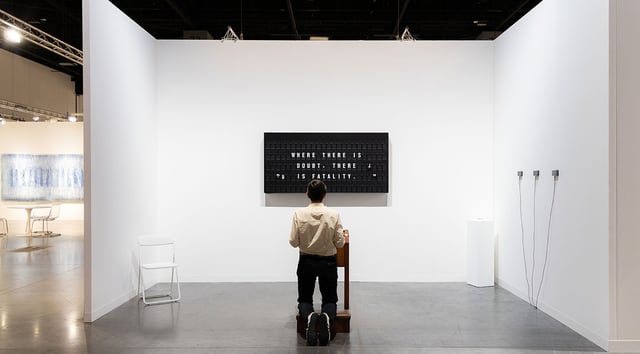
Bruce-Jones is also involved in developing the language of the website to be accessible to non-specialist readers. Visitors can keep the receipts or pin them to a collective noticeboard as part of the exhibition’s archive of audience-generated matter. (This manner of interactivity is reminiscent of the first iterations of Art Basel’s Zero 10 initiative dedicated to art of the digital era, which featured on-stand consoles and physical outputs on the Zero 10 exhibitor stands at Art Basel Miami Beach 2025, and Art Basel Hong Kong 2026.)
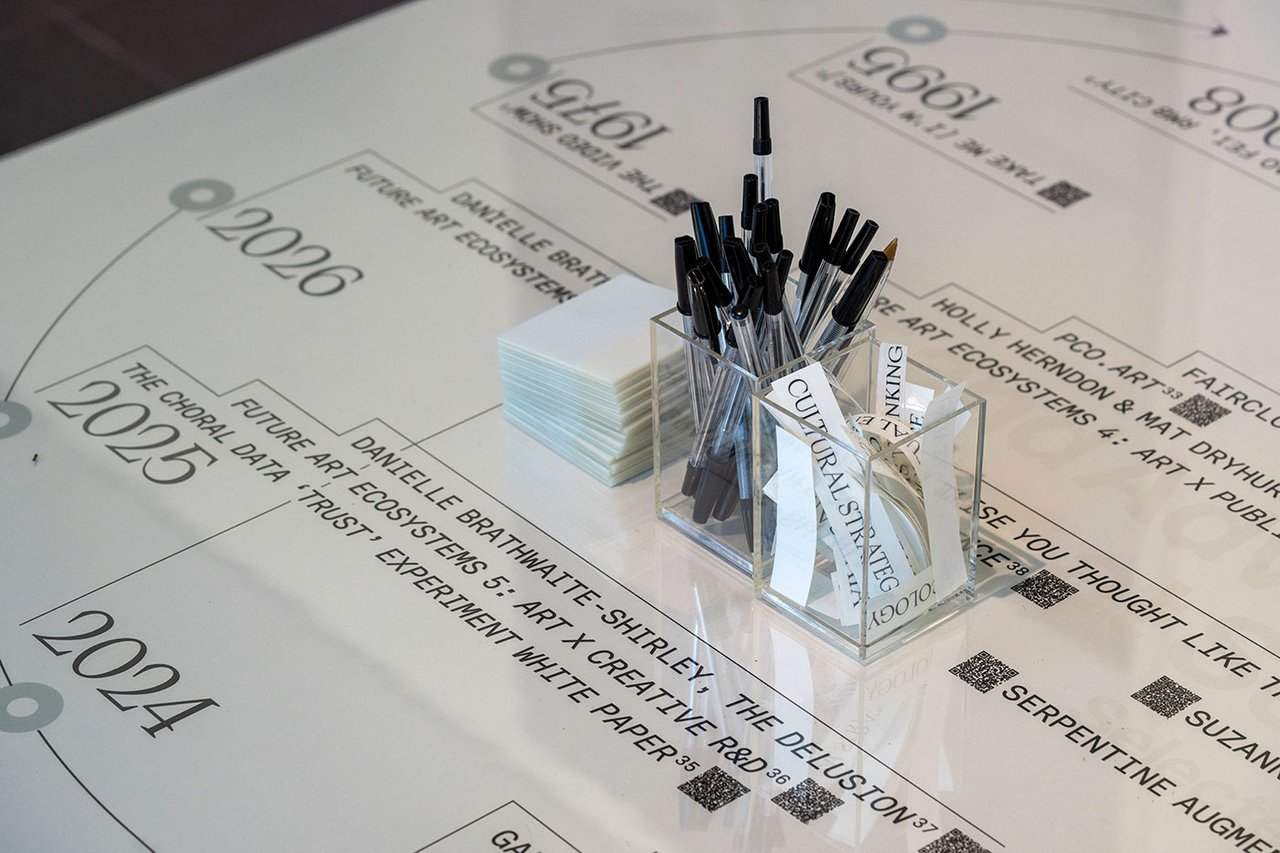
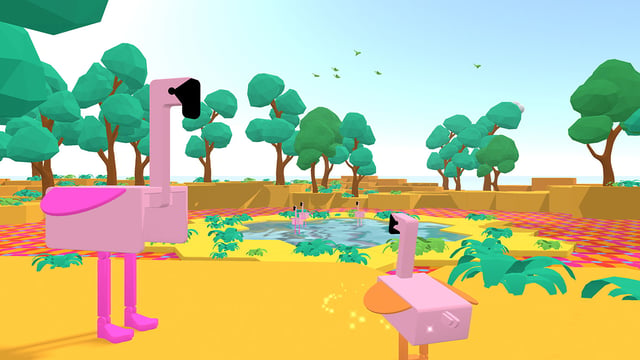
Visitors are invited to use a communal study table, whose top depicts a timeline of Serpentine’s history, while listening to an audio playlist that includes the unedited communal choir recordings from Herndon and Dryhurst’s “The Call”, 2024-25. At the table, some projects are accessible on mobile using QR codes, as is a new digital game, I Didn’t Realise you Thought Like that (2026), from Danielle Brathwaite-Shirley, whose 2025 Serpentine commission, “The Delusion”, will be presented, in its latest evolution, at the Creative Intelligence festival at Southbank Centre, London (September 11-13, 2026).
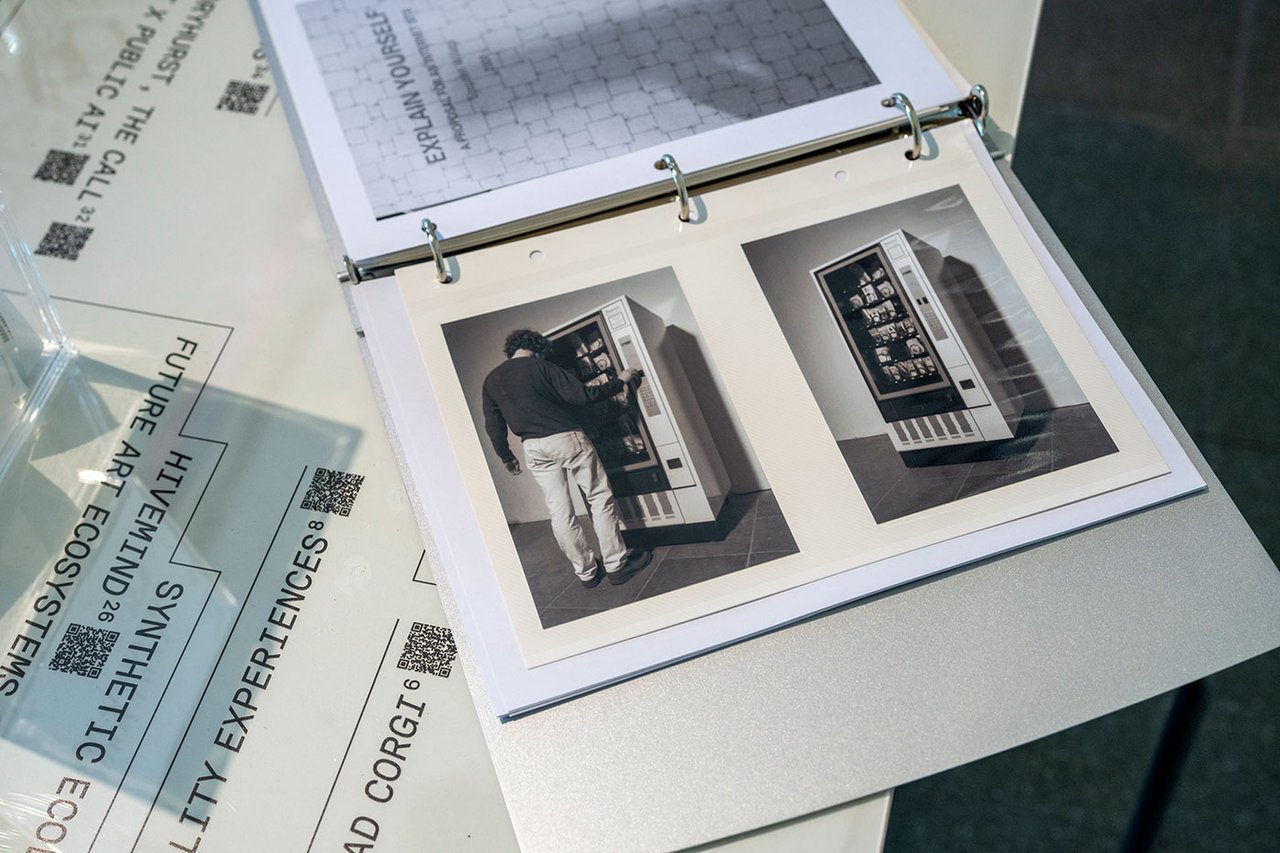
Users may gather materials to study from a mobile archive unit, made from clear and blue-light-tinted Perspex with mirrored fascias created to reflect views of the surrounding park. The design of the unit shares a family aesthetic with the glyphs, colours and fonts of the delightfully tangible ultra-small-format, hand-stitched, FAE reports which populate its shelves along with other gallery publications and physical binders, or “readers”, containing photographs, programs, and reports on historic Serpentine exhibitions.
The folders reference installations including “The Video Show” (1975), a festival of early independent video. Tara Tierney, Digital Archivist, Serpentine, tells Right Click Save that the show featured the work both of video artists and of community artists, with “submissions from schools, submissions from squatter groups, and submissions from women’s groups”.
Another featured exhibition is “Take Me [I’m Yours]” (1995), curated by Obrist 11 years before he joined the gallery, which featured an early internet-based installation, Absolut Access. The exhibition also covers the multi-disciplinary Serpentine marathons from the 2010s — including “89Plus” (2013), “Guest, Ghost, Host: Machine!” (2017) and Work (2018) — which examined questions that have become even more pressing since, including automation, AI and living in a networked society. Another show referenced in “processing…” is the artist Cao Fei’s presentation of RMB City, the virtual metropolis she created in the worldbuilding game Second Life, in a public space at Serpentine, in 2008.
The hybrid digital, physical, and aural, archive presented in “processing…” was devised as “a selection that people can sit with, in a tactile way”, Tamar Clarke Brown, curator, Arts Technologies, tells Right Click Save.
“For over a decade, Serpentine has worked at the frontier of art and advanced technologies, not only exhibiting this work but pioneering how institutions, artists and society engage with it,” Obrist and Korek said in a statement. “‘Processing…’ reflects on the achievements of this innovative research. As these technologies reshape culture and civic life, understanding where we have been has never been more important to imagining where we go next.”
The Arts Technologies team is using the exhibition as a time of experiment, a testing ground, for the upcoming FAE website but also for how to develop access to the archive, working out methods for managing data, metadata, and physical and digital feedback from the exhibition’s visitors. Clarke Brown says the name “processing…”, is a reflection of the exhibition’s role as a testbed for wider public engagement. The show is also a testing ground, given the mobile or portable nature of the installation units, for touring the exhibition to other parts of the UK.
Korek and Obrist are looking forward to the next stages for the Arts Technologies program, saying in a press announcement that “processing…” is “both a reflection and a beginning”, because Serpentine “will soon announce a new initiative to support the artists defining this field's future”.